As a Product Manager, your ability to make sharp, defensible decisions is what separates you from the rest of the pack. A competitive analysis framework template is the single most powerful tool for cutting through market noise and building a proactive, forward-looking strategy that informs your roadmap, pricing, and go-to-market execution.
This isn't about getting bogged down in endless feature checklists. It's about building a repeatable system that moves you from reactive tactics to strategic market leadership. Let's build your playbook.
Your Playbook for Market Intelligence
Without a structured way to understand your competitors, you're flying blind—relying on gut feelings and random bits of intel. As a PM leader who has hired and mentored dozens of PMs at companies like Google and Meta, I can tell you that a robust competitive analysis framework is what separates top-tier product talent from the rest. It's your system for making defensible, data-backed decisions.
I like to think of it as a playbook for a sports team. You wouldn't just know the other team's star player; you'd know their entire offensive scheme, defensive weaknesses, and how they perform under pressure. That's what a robust framework does for your product.
Why a Framework Is Non-Negotiable for Your PM Career
This methodical approach is more than just a good habit; it’s a proven driver of success. Using competitive analysis templates is directly linked with faster decision-making and better market agility.
A 2023 survey from Product School found that 67% of product managers in North America and Europe regularly use these frameworks to dig into features, pricing, and customer engagement. Even more telling, 54% pointed to a direct 10-15% improvement in their product launch success rates, all thanks to the insights they gathered. A solid framework helps you:
- Justify Roadmap Decisions: Walk into any stakeholder meeting with data-backed arguments for why you're prioritizing feature A over feature B. This is how you get buy-in from leadership.
- Identify Market Gaps: Systematically uncover underserved customer needs that your competitors are completely ignoring. This is where you find your next big opportunity.
- Anticipate Competitor Moves: By tracking their hiring (e.g., a sudden increase in AI/ML engineers), product updates, and marketing shifts, you get much better at predicting their next big play.
- Sharpen Your Positioning: Clearly articulate your unique value proposition because you know exactly where you fit in the broader landscape. This is critical for both marketing and sales enablement.
Real-World Example: Neutralizing a Threat with Structured Analysis
I remember leading a B2B SaaS product where a small, emerging competitor started gaining serious traction. At a quick glance, it looked like they were just undercutting us on price, and our initial reaction was to dismiss them. This is a common, and dangerous, mistake.
But our competitive analysis framework forced us to take a much deeper look.
We quickly discovered their real advantage wasn't price—it was a single, brilliantly simple feature that solved a huge pain point for a very specific niche of our user base. That insight, which came directly from our structured analysis, triggered an immediate pivot in our Q3 roadmap.
We fast-tracked a similar, but more polished, feature and launched it with highly targeted marketing. That move successfully defended our core user base and neutralized the threat before it could escalate. It's a perfect example of how a framework turns a potential disaster into a strategic win.
If you're looking to really dig in and build out your own system for market intelligence, this guide on a comprehensive competitive analysis framework offers another great perspective.
Building Your Custom Analysis Framework
A generic, downloadable template is a fine place to start, but the real magic happens when you customize it. I’ve seen too many teams treat a competitive analysis framework like a static checklist, and it almost never ends well. The frameworks that actually drive decisions are living documents, tailored specifically to your product, your market, and your strategic objectives.
Think of it like this: a generic marathon training plan gives you the basics. But an elite runner’s plan is dialed in to their specific physiology and goals. Your framework needs that same level of personalization.
Step 1: Define Your Core Objectives First
Before you even glance at a competitor's website, get ruthlessly clear on why you're doing this analysis. This single step dictates everything that follows and saves you from boiling the ocean of data out there.
So, what’s the goal? Are you…
- Preparing for a new product launch? Your focus should be on market gaps, validating your value prop, and understanding pricing benchmarks.
- Defending your current market position? You’ll need to track direct competitors' feature releases, monitor their marketing messages, and understand customer churn drivers.
- Exploring market expansion? The mission is to understand key players, dominant business models, and potential barriers to entry before you commit resources.
Getting this right up front is critical. It turns your analysis from a reactive data-gathering chore into a proactive, strategic weapon tied directly to business outcomes.
Step 2: Identify and Tier Your Competitors
Once your objective is locked in, it’s time to map the landscape. Don't just list your top two rivals and call it a day. A robust analysis requires a more sophisticated view. I always push my teams to sort competitors into three distinct tiers.
This structured approach is an evolution of ideas that gained traction after Michael Porter introduced his groundbreaking 'Five Forces' model in 1979. Porter gave us a systematic way to look at industry rivalry. By the early 2000s, over 70% of Fortune 500 companies were using his model or a variant to shape their strategy. If you're curious, you can explore how these foundational ideas evolved into modern templates for PMs to see the historical throughline.
Here's how to apply that tiered thinking today.
Competitor Tiers and Analysis Focus
Breaking down your competitors helps you allocate your time and resources effectively. Not every competitor deserves the same level of scrutiny. This table is a template you can use immediately to prioritize what truly matters for each tier.
| Competitor Tier | Definition & Example | Primary Analysis Focus | Key Metrics to Track |
|---|---|---|---|
| Direct Competitors | Companies offering a similar solution to the same target audience. Example For Miro: Mural, Lucidspark. | Feature parity, pricing models, go-to-market messaging, and customer reviews. | Market share, user growth rate, G2/Capterra ratings, pricing tiers. |
| Indirect Competitors | Companies solving the same core customer problem with a different solution. Example For Miro: Figma, Notion. | User workflows, integration ecosystems, and community engagement. | Overlapping user base, adoption trends in adjacent markets, partnership announcements. |
| Aspirational Players | Market leaders (even outside your direct space) who excel at something you want to improve. Example For Miro: Atlassian. | Business model innovation, platform strategy, developer ecosystem, and brand positioning. | Revenue per employee, annual reports (for public companies), conference keynotes. |
By using this tiered approach, you move from a flat, one-dimensional view to a rich, 3D understanding of the forces shaping your market. This is how you spot threats and opportunities that others miss.
Case Study: Miro's Multi-Tiered View
Let's make this tangible. Imagine you’re a PM at Miro. A simplistic analysis would only look at Mural. That’s a huge, rookie mistake that will get you blindsided.
A savvy Miro PM builds a framework that tracks all three tiers.
They’d obsess over Mural (direct competitor) for every feature update and enterprise pricing tweak. But they'd also watch Figma and Notion (indirect competitors) like a hawk. Why? Because teams using Figma for design might start using FigJam for brainstorming, chipping away at Miro's core use case. Teams using Notion for documentation might adopt its new collaborative features, reducing their need for a separate whiteboard tool.
Finally, they might track Atlassian (aspirational player) to reverse-engineer how to build a powerful suite of interconnected products and a massive developer marketplace. This multi-tiered view provides the complete picture, helping the Miro team anticipate threats coming not just from direct rivals, but from the evolving ways their customers get work done.
This is exactly how you build a competitive analysis framework template that creates lasting strategic value.
Gathering High-Value Competitive Intelligence
Your framework is only as good as the data you feed it. I've seen too many product teams waste entire sprints chasing irrelevant metrics, ending up with mountains of useless data. The goal is to build a tactical workflow that answers your most critical strategic questions.
It boils down to a simple, repeatable process: first, define what you need to learn (your objectives), then pinpoint the right competitors, and finally, customize how you gather your data.
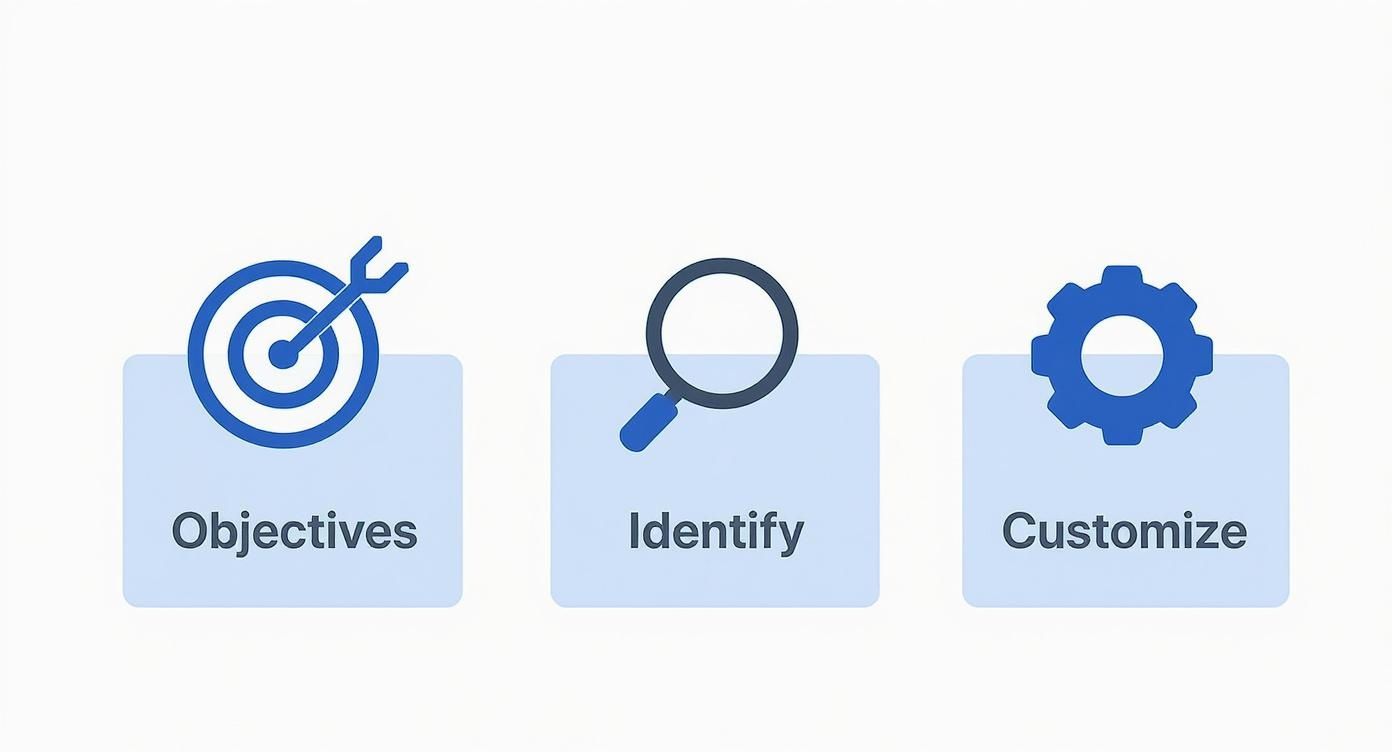
This workflow stops "analysis paralysis" before it starts, ensuring every piece of data you collect is tied to a strategic goal.
Mastering Public Data Tools
The first layer of intel comes from what's publicly available, but you need the right tools to separate signal from noise.
- Semrush: This is my go-to for deconstructing a competitor's content and SEO strategy. You can see the exact keywords they rank for and their top-performing content. For a PM, this reveals the problems they're positioning themselves to solve and how customers are finding them.
- Similarweb: Use this to get a pulse on web traffic and user engagement. It helps answer key questions: Are they growing faster than us? Where is their traffic coming from? Think of it as a high-level check on their market traction.
As a hiring manager, I always look for PMs who can move beyond simple feature comparisons. I want to see that you can analyze a competitor's entire go-to-market motion. Demonstrating that you've used tools like Semrush or Similarweb to understand how a competitor acquires customers is a massive differentiator in an interview.
Using AI for Synthesis and Speed
The modern PM's superpower is using AI as a research assistant. Instead of spending hours sifting through unstructured data like reviews or transcripts, you can get a solid summary in minutes. This isn't about automating your strategic thinking; it's about accelerating your path to insights.
I regularly use tools like Perplexity or ChatGPT to handle the initial heavy lifting. The trick is to give them specific, well-structured prompts.
Actionable AI Prompt for G2 Reviews:Act as a Senior Product Manager at [Your Company]. Analyze all G2 reviews for [Competitor Product Name] from the last 6 months. Create a summary table that identifies the top 3 most-loved features, the top 3 most common complaints, and the primary user persona that seems to be writing the reviews. Include 2-3 direct quotes that best capture overall user sentiment.
Actionable AI Prompt for an Earnings Call:I'm a Product Manager at [Your Company]. Summarize the key strategic takeaways from [Competitor's Name] Q2 2024 earnings call transcript. Focus specifically on their product roadmap announcements, R&D investment priorities, and any commentary on market trends or competitive threats. Highlight any new initiatives that could directly impact my product.
These prompts turn hours of tedious work into a five-minute task, freeing you up to focus on the strategic implications for your own roadmap.
Tapping Into Your Internal Experts
The most valuable, and often overlooked, source of competitive intel is already inside your company. Your sales and customer success teams are on the front lines, hearing direct, unfiltered feedback every day.
A key step is to conduct competitor analysis by creating simple, internal feedback loops.
- Sales Demos: Your sales team knows which competitors come up in conversations. Set up a dedicated Slack channel (e.g.,
#intel-competitive) where they can drop quick notes. Ask them to share "the one feature that almost lost us the deal." - Churn Interviews: Your customer success team is talking to customers leaving for a competitor. This is pure gold. Create a standardized template in your CRM for them to capture why a customer churned and which specific competitor they chose. Review these notes weekly.
Building these simple systems ensures a constant stream of high-value, qualitative data flows directly into your competitive analysis framework template. A deeper dive into how to conduct market research can help refine your approach even further. It's this blend of external data and internal intel that gives you a complete, actionable picture.
Finding Actionable Insights in the Data
You’ve done the hard work. You've gathered the intel and filled out your framework. Now you’re staring at a spreadsheet brimming with data.
This is where most PMs hit a wall. A spreadsheet full of data is useless on its own. The real value comes from interpretation—from turning raw facts into a strategic narrative that forces a decision.
Your job now is to answer the big "so what?" for your team and stakeholders. This means connecting the dots between a competitor’s pricing change, a recurring theme in their customer reviews, and your own product’s place in the market. This synthesis is what separates a junior PM from a true strategic leader.
Applying Classic Analysis Lenses
To get from data points to insights, you need a lens to view them through. Two of the most effective, time-tested frameworks are SWOT and a simplified take on the 3Cs model. They force you to organize your findings and pull out the most critical takeaways.
SWOT Analysis (Strengths, Weaknesses, Opportunities, Threats)
This isn't just a business school exercise; it’s a powerful tool for structuring your thoughts.
- Strengths: What does your competitor do exceptionally well? (e.g., "Their developer community is incredibly active and engaged.")
- Weaknesses: Where are their biggest gaps or most common complaints? (e.g., "Their onboarding process is notoriously complex for non-technical users.")
- Opportunities: What market trends or competitor weaknesses can you exploit? (e.g., "There's a growing demand for AI-powered features, which they haven't launched.")
- Threats: What external factors or competitor strengths could hurt your product? (e.g., "Their new partnership with a major enterprise platform could lock us out of key accounts.")
The 3Cs Model (Company, Customers, Competitors)
This model ensures your analysis is balanced and not just hyper-focused on one area.
- Company: How do our capabilities stack up against the competition? Where do we have a sustainable advantage?
- Customers: What unmet needs or frustrations are bubbling up from the competitor's customer base?
- Competitors: What strategic moves are they making, and what do those moves signal about where they're headed?
Applying these lenses systematically stops you from just making a long list of features. It helps you build a coherent story about what’s happening in the market.
From Weakness to Value Proposition
Let’s walk through a real-world scenario. Imagine you're a PM at Brex, the FinTech company focused on corporate cards. Your main competitors aren't just other startups; they're the legacy corporate cards from major banks.
Your data gathering turns up consistent weaknesses in what the traditional banks offer:
- Poor Software Integration: Finance teams are wasting days manually reconciling expenses.
- Slow Expense Reporting: Employees hate the clunky, manual process.
- Lack of Real-Time Visibility: CFOs have no immediate insight into company spending.
Using the SWOT framework, these are glaring Weaknesses for legacy players. For Brex, they represent massive Opportunities.
The insight isn’t just "Old corporate cards are bad." The actionable insight is: "The core pain point for modern finance teams is the manual, slow, and opaque nature of traditional expense management. We can win by building a product that is automated, real-time, and deeply integrated into their existing financial software stack."
See the difference? This synthesized narrative directly informs Brex's value proposition and roadmap. It’s not about having a shinier credit card; it’s about solving a fundamental workflow problem. This level of analysis transforms you from a feature manager to a business strategist. For a deeper dive, our guide on data-driven decision-making details how to turn raw data into strategic actions.
Ultimately, your goal is to have clear, data-backed recommendations. The best competitive analysis frameworks always include critical quantitative metrics like market share and revenue growth rates. It's no surprise that companies achieving growth rates 5% higher than their competitors systematically invest in this level of detailed analysis, including tracking relative revenue share quarterly.
Presenting Your Findings to Drive Action
An analysis left in a spreadsheet is a career opportunity wasted. As a product manager, your ability to turn competitive insights into actual business decisions is what separates you from a junior analyst and puts you on the path to strategic leadership.
Even the world's best competitive analysis framework template is useless if you can't get people to act on what's inside.
This isn’t about building a 50-slide deck that no one reads. It’s about sharp, targeted communication. What your engineering lead needs to hear is completely different from what your CEO needs to know. The game is about delivering the right insights, in the right format, to the right people to get your priorities on the roadmap.

Tailoring Your Message for Maximum Impact
I’ve watched brilliant analyses fall flat because the PM took a one-size-fits-all approach. To avoid that fate, you must become a translator, turning raw data into a story that clicks with each stakeholder’s unique goals.
Think of it like this:
- For the C-Suite (CEO, CFO): They care about market share, revenue, and strategic threats. Your pitch must be a brutally concise summary—ideally one page—that focuses on the biggest takeaways and your clear recommendations.
- For Engineering Leads: They live in the technical trenches. They need to know about a competitor's API architecture, performance benchmarks, or the tech stack enabling a killer feature. The conversation is about technical differentiation and feasibility.
- For Marketing & Sales Teams: They need ammunition. Give them competitor value props to counter, weaknesses to exploit on sales calls, and customer pain points you solve better. It's about arming them to win deals today.
To ensure your message lands, use this communication matrix as your plan.
Stakeholder Communication Matrix
| Stakeholder | Primary Interest | Key Metrics to Share | Recommended Format |
|---|---|---|---|
| C-Suite/Executives | Strategic threats, market share, revenue impact, and long-term positioning. | Market share trends, revenue-at-risk, potential TAM expansion, cost of inaction. | 1-page executive summary with clear, bold recommendations. |
| Engineering Leads | Technical capabilities, feasibility, build vs. buy decisions, and required effort. | Competitor tech stack, API performance, feature parity gaps, and integration points. | Technical deep-dive session, internal wiki doc with detailed specs. |
| Marketing Teams | Messaging, positioning, and campaign angles. | Competitor value props, customer reviews (verbatim), G2/Capterra ratings, ad copy. | Short presentation with key "battlecards" and messaging points. |
| Sales Teams | Objection handling, competitive differentiation, and reasons to win deals. | Pricing models, key feature gaps (theirs vs. ours), customer testimonials. | Live training session, one-sheet "cheat sheets," Slack channel updates. |
This matrix isn't just a checklist; it's a strategic tool. By thinking through these elements before you open PowerPoint, you ensure every conversation is impactful.
The One-Page Executive Summary
When you're talking to leadership, brevity is your best friend. Your ability to distill a complex analysis into a single page demonstrates your own strategic clarity.
A powerful one-pager must include:
- The "So What?" Up Front: Lead with your single most important finding. Example: "Our top competitor is stealing mid-market customers with a self-serve model, a segment we're completely ignoring."
- Key Supporting Insights (Max 3): Use bullets with the most compelling data points that prove your main conclusion.
- Strategic Implications & Risks: What’s the cost of doing nothing? What’s the prize if we act? Example: "Risk of losing 15% market share over the next 18 months."
- Clear Recommendations: Tell them exactly what you think should happen next. Example: "Initiate a Q3 discovery sprint to validate a self-serve MVP for the mid-market."
Getting this right is a career accelerant. For a deeper dive, our guide on how to present to executives offers a full blueprint for building narratives that get a 'yes' from senior leadership.
Anticipating and Handling Pushback
Presenting your analysis isn't a lecture; it’s a debate. You have to walk into that room ready for pushback. This is where you level up from analyst to a true business partner.
The moment you recommend something that challenges the status quo, you will get skepticism. This isn’t a sign you failed; it’s a sign that the stakes are high. How you handle it—with data and confidence—is what builds your credibility.
Before any big presentation, I run a "pre-mortem" on my own deck:
- Who is most likely to disagree and why? Is it the engineering lead who sees the technical debt this creates? Or the sales VP whose team is comfortable selling what they already have?
- What are the three toughest questions I could be asked? I script out my answers to these ahead of time, backing each one up with data.
- What data might they have that I don’t? This helps me anticipate counterarguments and shows I respect their expertise.
When you proactively tackle objections and ground every argument in data, you build the trust needed to turn your insights into action.
Frequently Asked Questions
As a PM, you're always looking for an edge. Building and maintaining a competitive analysis framework is a massive lever, but questions are natural. Here are the most common ones I hear from my mentees, with actionable answers.
How Often Should I Update My Competitive Analysis?
Think of your analysis as a living document, not a static report. For most tech products in fast-moving markets, a major refresh every quarter is about right. This is when you'll dig into the data and update your strategic narrative.
But the real magic happens with continuous updates:
- Weekly: Carve out 20 minutes to drop in quick notes on a competitor's press release, a key hire on LinkedIn, or intel from your sales team's Slack channel.
- Trigger-Based: When a major event happens—a competitor's funding round, a major product launch, or a pricing shift—update your framework immediately.
The right cadence depends on your market's velocity. A B2B SaaS product in a crowded space needs more attention than a stable enterprise hardware tool.
What Are the Biggest Mistakes PMs Make?
Over the years, I've seen a few recurring traps that render competitive analysis useless. The biggest is creating a beautiful, feature-by-feature matrix… and then stopping. This tells you what competitors have, but gives you zero strategic insight into why it matters or what to do about it.
Other classic blunders include:
- Analysis Paralysis: Drowning in data without getting to the "so what?" You must synthesize information into clear, actionable next steps for your roadmap.
- Ignoring Indirect Competitors: Focusing only on obvious rivals makes you vulnerable. You get blindsided by companies solving the same problem differently. Think early Figma vs. Miro.
- Treating it as a Solo Mission: The best insights rarely come from the PM alone. If you're not creating tight feedback loops with your sales and customer success teams, you're missing out on the most valuable, on-the-ground intel available.
How Do I Analyze Private Companies with Limited Data?
This is where you become a detective. Public data is scarce, but you can piece together an accurate picture if you know where to look.
- LinkedIn: Don't just look at their headcount. Track their employee growth rate and, more importantly, the types of roles they're hiring for. A sudden surge in enterprise sales hires tells you exactly where they're headed next. A quick check of a PM's job description might even reveal their next major feature.
- Review Sites: Dig through G2, Capterra, and TrustRadius. You'll find brutally honest customer feedback on their real-world strengths and weaknesses.
- Your Internal Teams: Your sales team is your secret weapon. They are on the front lines, hearing direct intel from prospects who are actively evaluating your competition. Set up a channel or a recurring meeting to mine this gold.
Can AI Automate My Competitive Analysis?
AI can dramatically accelerate your research, but it absolutely cannot replace your strategic thinking. Use AI tools as a powerful research assistant that can synthesize huge amounts of unstructured data in a fraction of the time it would take you.
A perfect example: you can feed an AI tool thousands of App Store reviews and ask it to identify the top three customer complaints in minutes. But the critical "so what?"—the strategic recommendation for your roadmap based on those complaints—that has to come from you, the Product Manager.
Treat AI as a force multiplier for the data-gathering part of the job. It frees you up to spend more time on high-value work: analysis, strategy, and decision-making.
Ready to build the skills that get you noticed by hiring managers at top tech companies? The Aakash Gupta newsletter and podcast provide the frameworks and career insights you need to level up. Learn more and subscribe at https://www.aakashg.com.
