For any Product Manager with serious career ambitions, let me be blunt: cross-functional collaboration skills aren't just a nice-to-have. They are the single biggest accelerator for getting promoted and shipping products that matter. I've hired and managed dozens of PMs at companies like Google and Affirm, and the difference between a good PM and a great one always comes down to their ability to orchestrate Engineering, Design, and Go-to-Market teams.
Here’s a tactical framework you can apply immediately to assess and improve your three most critical partnerships:
| Partnership | Health Check Question | Actionable Improvement Tactic |
|---|---|---|
| Engineering | "Is my Eng Lead a true strategic partner, or just an order-taker?" | Implement a Decision Memo. Before any major feature discussion, share a 1-page doc outlining the problem, user impact, and business goal. This frames the conversation around "how can we solve this?" instead of "can you build this?" |
| Design | "Are our design reviews focused on user problems or just UI polish?" | Start every design review with a 1-minute recap of the user story and the specific pain point. Constantly anchor the conversation in the why to ensure feedback is strategic, not just aesthetic. |
| Go-to-Market | "Does the sales team understand the value proposition or just the feature list?" | Create a "Sales Battlecard" for every major launch. A single slide that includes the target customer, the pain point, the solution's key benefit (in the customer's words), and answers to the top 3 anticipated objections. |
Mastering this orchestration is the most direct path to climbing the ladder. Let's dig into why and how.
Why Your PM Career Growth Is Directly Tied to Collaboration
As a Product Manager, you sit at the center of a complex web. You don't write the production code. You don't create the pixel-perfect mockups. You don't close the deals. Your value is in being an orchestrator, guiding the immense talent of others toward a single, shared goal. This is the art and science of cross-functional collaboration.
Without these skills, even the most brilliant product strategy is dead on arrival. It will get stuck in endless engineering debates, lost in a spiral of design revisions, or launch to a market that has no idea why it should care. Your ability to build bridges between these teams is a direct proxy for your ability to deliver results.
From Junior PM to Director: Expanding Your Circle of Influence
Think about your career progression not as climbing a ladder, but as expanding your circle of influence.
- Junior PM (APM/PM): Your circle is your immediate scrum team. Success means shipping features smoothly with 1-2 engineers and a designer. Your salary might be in the $110k-$150k range.
- Senior PM: Your circle expands to multiple teams and key GTM stakeholders. Success means launching a major product initiative that requires coordination across engineering, marketing, and sales. Your salary is now likely $160k-$220k.
- Principal PM / Director: Your circle encompasses an entire product line or business unit. Success is defined by your ability to get VPs from different functions to align on and fund your multi-year strategy. Your compensation can easily exceed $300k+.
Every promotion is a reward for successfully managing a larger, more complex circle of influence. The market data is clear: job postings for Senior PM roles at companies like Meta and Microsoft explicitly list "proven ability to influence cross-functional teams" as a top requirement. A recent Gartner report found that organizations with high levels of cross-functional collaboration achieve revenue and profit goals 20% more frequently. The writing is on the wall: master this, or get left behind.
The Three Core Partnerships You Must Master
Let's make this practical. Your success as a PM boils down to how well you manage three key partnerships. Your effectiveness—and your career trajectory—is dictated by your ability to navigate these relationships.
- The Engineering Partnership: This is where vision becomes reality. Your role is to bring absolute clarity on the "why" and the "what," which empowers engineering to truly own the "how." You know you're succeeding here when shipping velocity is high, technical debates are healthy and productive, and there's a strong sense of mutual respect.
- The Design Partnership: This collaboration is all about the user. You bring the customer problems, market needs, and business context. Design brings deep user empathy and creates intuitive, elegant solutions. The shared goal is to build products that aren't just functional but are genuinely delightful and solve a real pain point.
- The Go-to-Market (GTM) Partnership: This is your alliance with Sales, Marketing, and Support. They ensure the product you've built actually finds an audience and makes an impact on the business. You are their source of truth on product value, and they are your direct line to raw, unfiltered market feedback.
As you climb the ladder from an Associate PM to a Principal PM, the expectation fundamentally shifts. You go from facilitating collaboration within a single feature team to defining the entire collaborative strategy for a product line. This requires moving beyond simple project management and into true influence, which means understanding the nuances between leadership vs management to guide teams you don't directly manage.
Think about a product like Spotify Wrapped. It’s a masterclass in cross-functional execution. Data engineering teams wrangle petabytes of user data. Product and design teams weave that data into a compelling, shareable story. Then, marketing and GTM teams create a viral tidal wave that makes it a global cultural moment every single year.
The PM at the heart of Wrapped didn't do any of that single-handedly. They orchestrated a complex, beautiful dance between dozens of people across the company. That is the incredible power—and career potential—of elite cross-functional collaboration.
How to Lead and Influence Without Authority
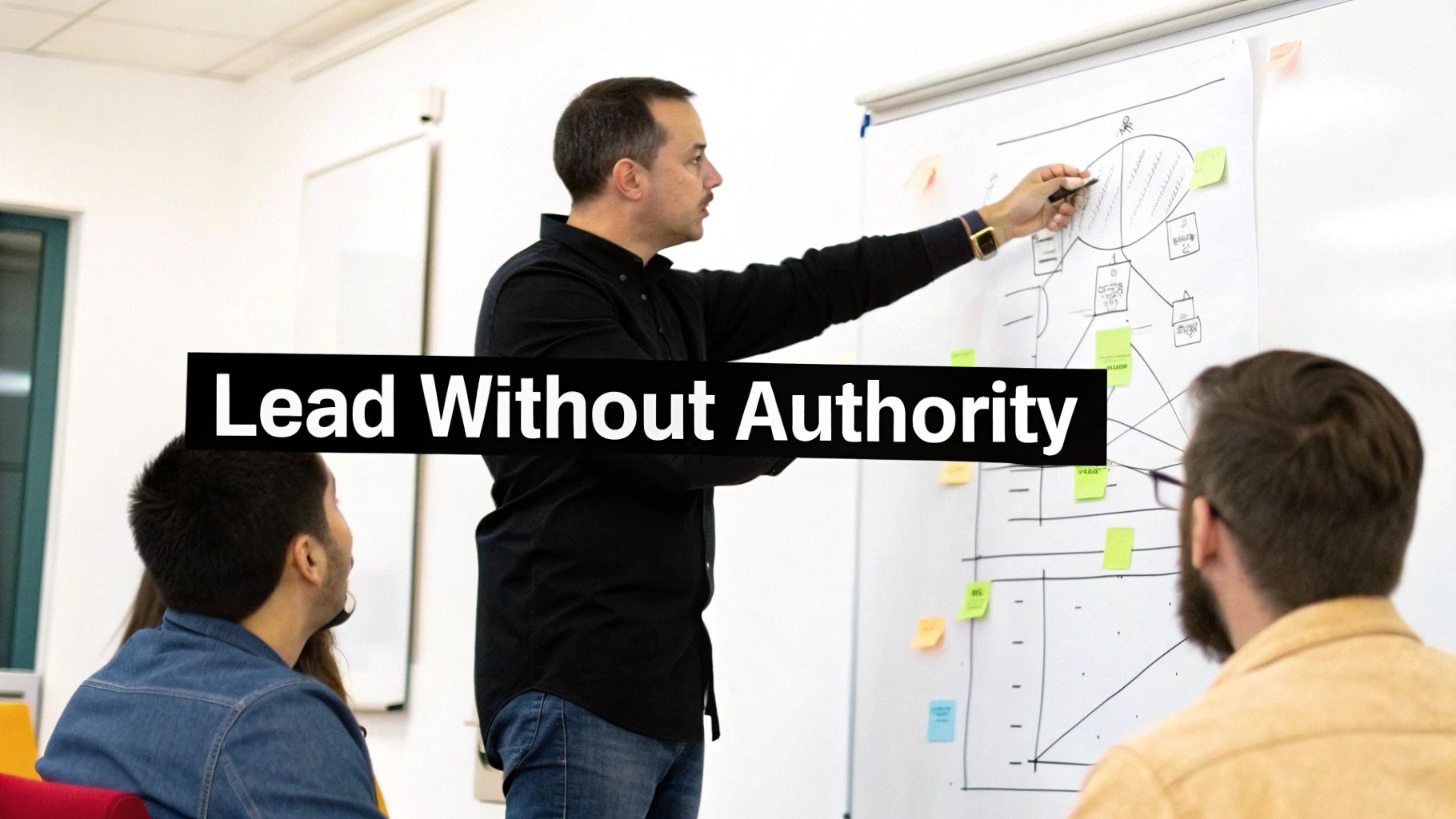
The best Product Managers I've hired are leaders, not managers. This might sound like a subtle distinction, but it's everything. You don't have direct reports in engineering, design, or marketing. Yet your success hinges entirely on getting them to rally around a shared vision. This is the art of leading without authority—a core set of cross functional collaboration skills that truly separates the good PMs from the great ones.
Your influence isn't handed to you by an org chart; it's something you have to earn, day in and day out, through credibility, clear communication, and a deep understanding of your team's motivations. It means you have to become a master translator, a persuasive storyteller, and a savvy negotiator.
Translate Complexity into Clarity
Think of yourself as the bridge between the technical and non-technical worlds. It’s one of your most critical functions. You need to be able to sit down with a sales leader and explain complex engineering constraints in a way that connects directly to their business goals. A minute later, you need to turn around and articulate the latest market demands to your engineering team so they understand the why behind their work.
When this translation breaks down, silos go up. Sales gets frustrated that engineering is "too slow," while engineering feels like sales is making impossible demands. You’re the one who prevents this by becoming fluent in both languages. This isn't just theory; when I was a PM at Google, the success of a new Ads feature hinged on my ability to explain the impact of machine learning model latency to the sales team in terms of dollars and cents for their clients.
Craft Compelling Narratives
Data is your foundation, but it won’t win hearts and minds on its own. To really influence stakeholders—especially designers and senior leadership—you have to wrap your data in a compelling story. A real, human story about a struggling user is infinitely more powerful than a spreadsheet showing a 15% drop-off in a conversion funnel.
Your story should always tie back to the company's mission and the specific customer pain point you’re solving. This simple shift in framing transforms a dry feature request into an inspiring chapter in a much larger story, making it far easier for everyone to get excited and get on board. A well-crafted narrative is also your secret weapon for presenting your roadmap; for more on that, check out our guide on how to present to executives.
Your job is to make the vision so clear and the user’s pain so palpable that your cross-functional partners feel intrinsically motivated to build the solution. When they are as passionate about solving the customer’s problem as you are, you’ve successfully influenced without authority.
Negotiate Scope Without Sacrificing Value
Let's be real: negotiating scope with engineering is a constant part of the job. The key is to treat these conversations as a partnership, not a battle. Never just dictate solutions. Instead, bring problems and constraints to the table and work through them together.
One of the best tools I've found for this is the Decision Memo. It's a simple one-pager that forces you to clearly outline the problem, the proposed solution, the technical trade-offs, and the expected impact on the user. Sharing this with your engineering lead before a planning session changes the entire dynamic. The conversation shifts from "Can we build this?" to "What's the best way to solve this user's problem given our constraints?" This collaborative approach protects the user's needs while respecting engineering realities.
Leading without authority often means skillfully navigating complex workplace relationships.
Actionable AI Prompts for Influential Communication
Use GPT-4 or Claude 3 to sharpen your communication and scale your influence. Here are a couple of prompts you can adapt and use today:
- For Sales Teams: "Act as a Senior PM at a B2B SaaS company launching a new AI-powered analytics feature. Draft a one-page brief for the sales team explaining the business value and key talking points. We deprioritized a requested reporting feature to get this out faster. Include a clear, positive framing of this trade-off, focusing on the competitive advantage of the AI feature."
- For Leadership: "Act as a Product Director at a fintech company. I need to secure an additional $250k in funding for a new initiative to reduce customer churn, which is currently at 20% for new users. Write a concise, two-paragraph narrative for an executive summary. Frame it around the story of a specific user persona and quantify the potential business impact in terms of saved Annual Recurring Revenue (ARR)."
Build Your Collaboration Operating System: A Step-by-Step Guide
Great cross-functional collaboration skills aren't about personality; they're engineered through deliberate systems. The best PMs build a reliable "operating system" for their teams—a set of predictable processes, rituals, and tools that make seamless collaboration the default. This is how you scale your impact and reclaim your time from procedural chaos.
In today's remote/hybrid world, this is non-negotiable. Data from Microsoft shows that while collaboration within immediate teams has increased, interactions with distant networks have shrunk. An intentional operating system is the only way to bridge these digital divides. Here’s how to build one.
Step 1: Implement a Weekly Strategic Sync (The "Product Trio")
This is not another status update. It’s a mandatory, 30-minute weekly working session with you (the PM), your Design Lead, and your Engineering Lead.
- Agenda: No status updates allowed. The agenda is strictly forward-looking:
- Review key insights from last week's user research/data (5 min).
- Debate and align on the top priority for the upcoming week (10 min).
- Identify and unblock the single biggest risk to the next sprint (15 min).
- Goal: To ensure the three core functions are strategically aligned at all times. This meeting prevents the classic PM pitfall of getting ahead of engineering and design, creating rework and frustration.
Step 2: Establish a Single Source of Truth for Project Risks (The RAID Log)
For any major initiative, create a simple RAID log in a shared space like Confluence or Notion. It stands for Risks, Assumptions, Issues, and Dependencies.
- How it works: This is a living document that you and your cross-functional leads update. Any team member can add a potential blocker. You, the PM, are responsible for ensuring every item has an owner and a next step.
- Why it's critical: It forces proactive problem-solving and gives stakeholders a self-serve way to check project health, dramatically reducing the number of "how's it going?" pings you receive.
Step 3: Formalize Big Decisions with a Lightweight RFC Process
When facing a significant decision (e.g., a major architectural change, a pricing model test), use a Request for Comments (RFC) document. This isn’t about bureaucracy; it’s about forcing clear, asynchronous thinking.
- The Template: Your RFC should be a 1-2 page document with four sections:
- Problem: What user or business problem are we solving?
- Proposal: What is our recommended solution?
- Alternatives Considered: What other options did we reject and why?
- Open Questions: What are the known unknowns?
- The Process: Share the doc in a dedicated Slack channel, tag all relevant stakeholders, and give a clear deadline for feedback (e.g., "Please add comments by EOD Friday"). This kills endless meeting debates and creates a written record of why a decision was made.
For a deeper look into structuring these team interactions, check out our guide on effective cross-functional team management.
Step 4: Curate Your Modern Collaboration Tech Stack
Your operating system runs on a modern tool stack designed to maximize focus and minimize noise. Selecting the right platforms is especially critical in distributed environments. You can explore some essential remote team communication tools that often form the backbone of a solid operating system.
A well-designed collaboration stack automates the flow of information, freeing up valuable meeting time for strategic discussion and problem-solving rather than simple status updates.
Here’s the essential toolkit for a modern PM and how to use it as a cohesive system.
| Tool Category | Recommended Tool | Primary PM Use Case | Pro-Tip for Cross-Functional Teams |
|---|---|---|---|
| Collaborative Discovery | Miro / FigJam | Running brainstorming sessions, user story mapping, and creating low-fidelity journey maps with design and engineering. | Create a "Team Canvas" board with key contacts, project goals, and links to all relevant docs. Pin it in your team's Slack channel. |
| Project Tracking | Jira / Linear | Managing the product backlog, planning sprints, and tracking progress against roadmap milestones. | Set up Jira automations to post key updates (e.g., "Epic marked as Done") directly to a dedicated #product-updates Slack channel. |
| Asynchronous Communication | Slack / Loom | Providing quick project updates, sharing feedback on designs, and asking clarifying questions without scheduling a meeting. | Use Loom to record short video walkthroughs of new features or bug reports. It's faster than writing and provides much richer context. |
| Documentation & Knowledge | Confluence / Notion | Creating and maintaining the single source of truth: PRDs, decision logs, meeting notes, and research findings. | Use templates for everything—PRDs, meeting agendas, RFCs. This enforces consistency and makes information easier for everyone to find. |
Turning Team Conflict into Productive Outcomes
In any high-stakes product team, conflict is not just inevitable—it’s a sign that people are invested. When your engineers, designers, and marketers all have strong, passionate opinions, things are bound to get tense. And that's okay.
As a PM, your job isn't to play referee and stamp out every disagreement. It's to become a conductor, channeling that friction into better product decisions. This is one of the most advanced cross functional collaboration skills you can possibly build.
The best PMs I know don't see conflict as a roadblock. They see it as a raw source of energy. The tension between a sales leader demanding "we have to ship this now!" and an engineer arguing "we need to refactor the entire legacy system first" is precisely where innovation sparks. You are the facilitator who stands in that gap, turning a clash of opinions into a smarter, more durable outcome for everyone.
The Interest-Based Negotiation Framework
Most arguments go nowhere because people get stuck defending their positions. An engineer might flatly state, "We can't build this feature in a two-week sprint." Meanwhile, a marketer insists, "We absolutely must have this for the upcoming launch." If you let them argue from these fixed points, you've already lost.
The trick is to move the conversation from positions (the what) to interests (the why). This simple but powerful shift is the heart of Interest-Based Negotiation.
Instead of treating a disagreement as a zero-sum battle to be won, you reframe it as a shared problem to be solved. Your goal is to uncover the 'why' behind each person's stance and find a creative solution that satisfies the most critical underlying interests of all parties.
Let's break down that example. The engineer's interest isn't to be difficult; it's likely to maintain system stability and avoid shipping buggy code. The marketer's interest isn't to be demanding; it's to hit a crucial revenue target tied to the launch.
All of a sudden, you're not debating a single feature anymore. You're collaboratively solving the real problem: "How can we achieve our revenue goal for this launch without compromising the stability of our platform?" This reframing opens up a whole new world of creative options that were completely invisible before.
Your Playbook for Tense Meetings
When a discussion gets heated, having a few battle-tested phrases in your back pocket can completely change the room's dynamic. These aren't just feel-good platitudes; they are tactical tools for de-escalating tension and steering the conversation back to a productive path.
- To uncover interests: "Help me understand the core concern from your perspective. What's the main outcome you're trying to achieve here?"
- To bring in data: "This is a tough trade-off. What data or user feedback could give us more confidence in either direction?"
- To find the shared goal: "Let's step back for a second. We all want to solve this customer problem. Knowing our current constraints, let's brainstorm a few ways we might do that."
- To build trust: "I hear your concern about the technical debt. That's a very valid point. How can we balance that priority with this market opportunity?"
Using this kind of language signals that you’re a neutral facilitator focused on the best outcome, not just another person pushing an agenda.
The Conflict Resolution Decision Tree
Knowing when to mediate a compromise versus when to escalate for a final decision is a critical judgment call for any PM. Escalate too often, and your team will see you as ineffective. Fail to escalate when needed, and you let critical issues fester and derail the project.
This simple decision tree can help you decide when to keep facilitating and when it's time to pull the plug and ask for a final call from leadership.
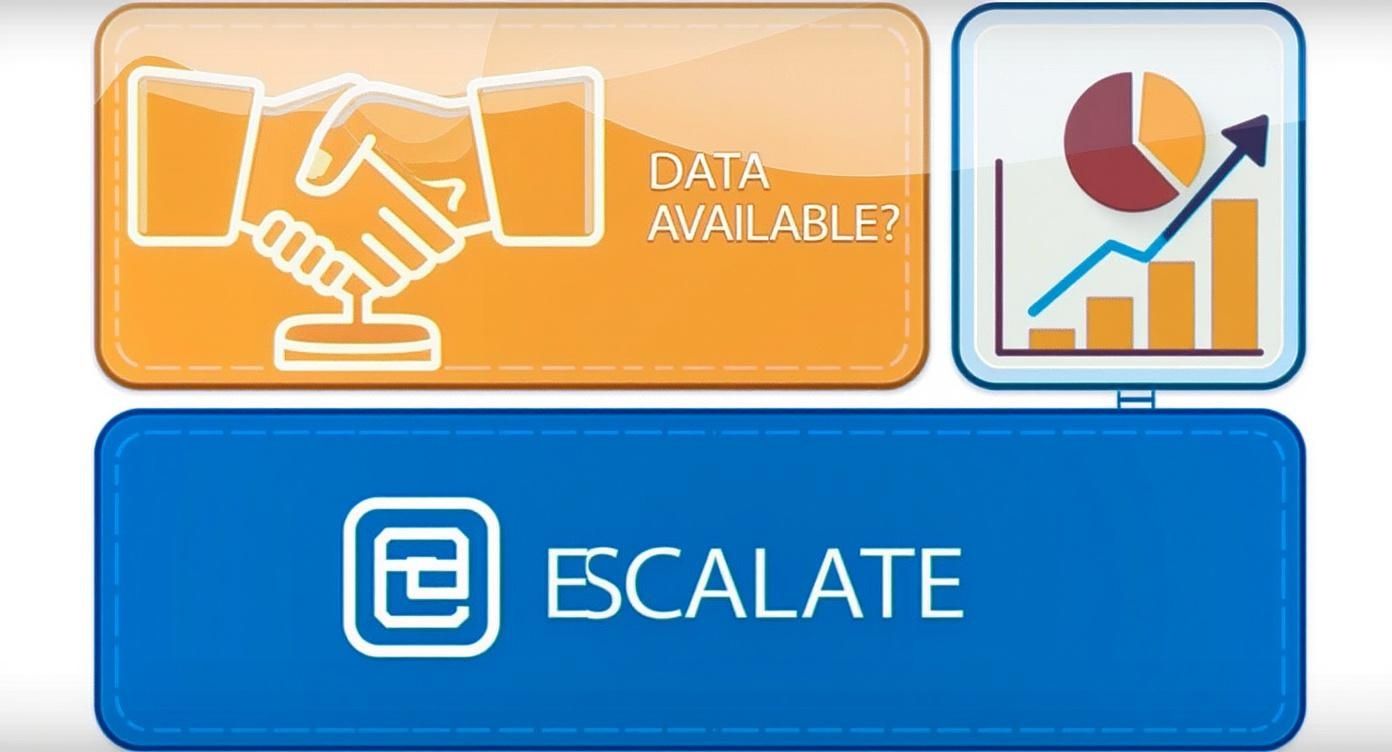
As the guide shows, your first moves should always be finding common ground and grounding the debate in data. Escalation should be your last resort, reserved for truly deadlocked decisions where the consequences of inaction are high.
Learning from Tech Giants Like Google and Netflix
To see what world-class cross-functional collaboration looks like, you don't have to look further than the companies building the products we use every day. Google and Netflix offer two different—yet equally effective—blueprints for making collaboration work at scale. By breaking down how they operate, you can pull out battle-tested principles that apply to any team.
Google's OKR System for Radical Alignment
When your company is the size of Google, chaos is the natural state. How do you get tens of thousands of PMs, engineers, and marketers all rowing in the same direction? Their secret weapon is Objectives and Key Results (OKRs), a goal-setting framework that forces alignment both vertically (up and down the ladder) and horizontally (across teams).
An Objective is the big, ambitious goal—think "Launch a delightful mobile user experience." The Key Results are the specific, measurable outcomes that prove you did it, like "Improve App Store rating from 4.2 to 4.6" or "Reduce crash rate by 50%."
For a PM at Google, this system is the bedrock of collaboration. Here’s how it works on the ground:
- Vertical Alignment: Your team's OKRs must directly support your director's OKRs, which support their VP's, and so on. This creates a crystal-clear line of sight from your daily tasks to the company's biggest priorities.
- Horizontal Alignment: This is the magic. All OKRs are public. Your engineering lead can see exactly what you're on the hook for, and you can see what they're measured on. This transparency forces the tough conversations about dependencies to happen at the start of the quarter, not during a last-minute fire drill.
The system transforms abstract strategy into concrete, shared work for everyone.
The real power of the OKR framework isn't just goal setting; it's a communication tool disguised as a performance framework. It forces difficult conversations about priorities and trade-offs, making cross-functional alignment a structural part of how work gets done.
Netflix's Culture of Freedom and Responsibility
Netflix plays a different game, one built on a foundation of incredibly high trust and personal accountability. Their famous "Freedom and Responsibility" culture isn't about having no rules. It's about hiring top-tier talent and then giving them the context and autonomy to do their best work. For a PM at Netflix, collaboration isn't about navigating a rigid process for "buy-in." It's about building a rock-solid case and earning the trust of your small, highly empowered team.
This model rests on two pillars:
- High Context, Not Control: Leadership's job isn't to give top-down commands. It's to provide deep, rich context on the business strategy, market challenges, and customer insights. The PM's job is to soak up that context and translate it for their team, empowering them to make smart decisions on their own.
- Highly Aligned, Loosely Coupled: Teams are given clear strategic missions but are rarely told how to accomplish them. This lets a small "pod"—usually a PM, a few engineers, and a designer—move at lightning speed without getting bogged down by layers of approval. This structure demands exceptional cross functional collaboration skills because direct communication and mutual trust are the only things holding it all together.
Whether you lean towards the structured alignment of Google or the autonomous empowerment of Netflix, the takeaway is clear. Elite collaboration is never an accident. It’s always the result of a deliberate, thoughtfully designed system.
Your Cross Functional Collaboration Questions Answered
Even with the best game plan, the day-to-day reality of cross-functional work gets messy. Here are my answers to the most common questions I hear from PMs I mentor, with direct advice you can use in your next meeting.
How Do I Build Influence with Engineering Without a Technical Background?
This is a classic PM insecurity. Influence with engineering comes from credibility and respect, not your ability to write code. Your power comes from being the undisputed expert on the "why." You need to master the customer's problem, the market context, and the business value so completely that you become the team's North Star for strategic clarity.
Engineers are expert problem-solvers. Your job is to give them a compelling problem to solve. Pull them into the discovery process early. Show them customer quotes, data visualizations, and short video clips of users struggling. This transforms you from a taskmaster into a strategic partner who connects their work to real human impact.
Finally, show genuine curiosity. You don’t need to be an engineer, but you should learn the language. Get comfortable with core concepts like tech debt, APIs, and sprint velocity. Ask smart questions like, "What are the biggest technical risks here?" or "Help me understand the trade-offs between these two approaches." This shows you value their expertise and are committed to making smart decisions together.
What Is the Best Way to Handle a Stakeholder Who Constantly Changes Their Mind?
When a stakeholder keeps flip-flopping, the key is to shift from being reactive to being proactive. This behavior often stems from a lack of confidence in the plan or feeling disconnected. Your first line of defense is rigorous, visible documentation. Every key decision, along with the data and rationale, needs to be logged in a shared space like Confluence or Notion.
When a change request comes, calmly pull up the original decision doc and ask, "This is a great point. What new information or change in circumstances has prompted this shift?" This forces a structured, data-driven discussion instead of an emotional one, and it subtly reinforces that decisions are based on evidence, not whims.
If it's a pattern, implement a lightweight change control process. This isn't bureaucracy. It's a simple team norm: any significant scope change after a sprint has started requires a brief, written justification outlining the impact. This friction filters out low-conviction ideas while ensuring critical changes get proper attention.
In a remote or hybrid world, proactive communication is your secret weapon for stakeholder management. Stakeholders often get antsy and change their minds when they feel out of the loop. A concise, regular weekly update can build a massive amount of confidence and head off those dreaded last-minute surprises that throw your team off course.
How Can I Improve Collaboration on a Fully Remote Team?
Working remotely means you must be hyper-intentional about creating clarity and connection. Over-invest in asynchronous communication. Your Product Requirement Documents (PRDs), project briefs, and decision logs need to be exceptionally clear, detailed, and ridiculously easy to find. They are the new hallway conversation.
Lean heavily on tools that add rich context without another meeting. A five-minute video walkthrough on Loom explaining a new Figma prototype can be far more effective than a long email chain. It provides tone and visual context that text cannot match.
When you do have live meetings, make them count. They should be for active problem-solving, not passive status updates. Use collaborative whiteboards like Miro or FigJam to get everyone involved. Finally, deliberately manufacture social connections. Create non-work Slack channels and schedule regular, informal virtual coffees with your key partners in engineering and design. This social capital is the essential lubricant for making remote collaboration work.
Ready to accelerate your product career? Aakash Gupta's newsletter provides the actionable insights and frameworks you need to become a top-tier Product Manager. Get proven PM career advice here.
