As a Product Manager, you're swimming in a sea of data: support tickets from Zendesk, fluctuating NPS scores from SurveyMonkey, scathing App Store reviews, and direct customer messages in Slack. The critical differentiator between a good PM and a great one—the kind hired at Google, Meta, or a high-growth startup—is the ability to translate this overwhelming noise into a clear, actionable signal that directly informs roadmap priorities and strategic decisions. This isn't about passively collecting feedback; it's about systematically dissecting it to uncover the fundamental 'why' driving user behavior. The right customer feedback analysis tools are the foundation for this capability, moving you from reactive fire-fighting to proactive, data-informed product strategy.
This guide provides a tactical playbook for selecting the precise tools used by high-performing product teams. We'll move beyond generic feature lists and marketing jargon to deliver a detailed, side-by-side comparison you can use to justify your next budget request. For each platform, you'll find a clear assessment based on the criteria that actually matter in a PM role:
- Company Stage: Are you a resource-constrained startup needing immediate value or a complex enterprise requiring robust governance? A PM at a Seed stage company makes a different choice than one at a Fortune 500.
- Existing Tech Stack: How does it integrate with your core systems like Salesforce, Jira, or Zendesk? A tool that doesn't talk to your existing stack creates more work, not less.
- Primary Goal: Are you trying to reduce customer churn, validate a new feature concept before committing engineering resources, or improve user sentiment? The job-to-be-done dictates the tool.
This guide is designed to be bookmarked and referenced repeatedly. It will equip you to stop drowning in data and start using customer voice as your most powerful asset for building products that win and advancing your career.
1. Qualtrics
Qualtrics is an enterprise-grade experience management (XM) platform, positioning itself as a comprehensive solution for large organizations needing to capture and analyze customer feedback at scale. It goes far beyond simple surveys, offering a powerful suite of tools for omnichannel listening—from web and email to in-app, IVR, and social media signals. This makes it one of the most robust customer feedback analysis tools for companies that require a single source of truth for all experience data, especially in regulated industries like finance and healthcare.
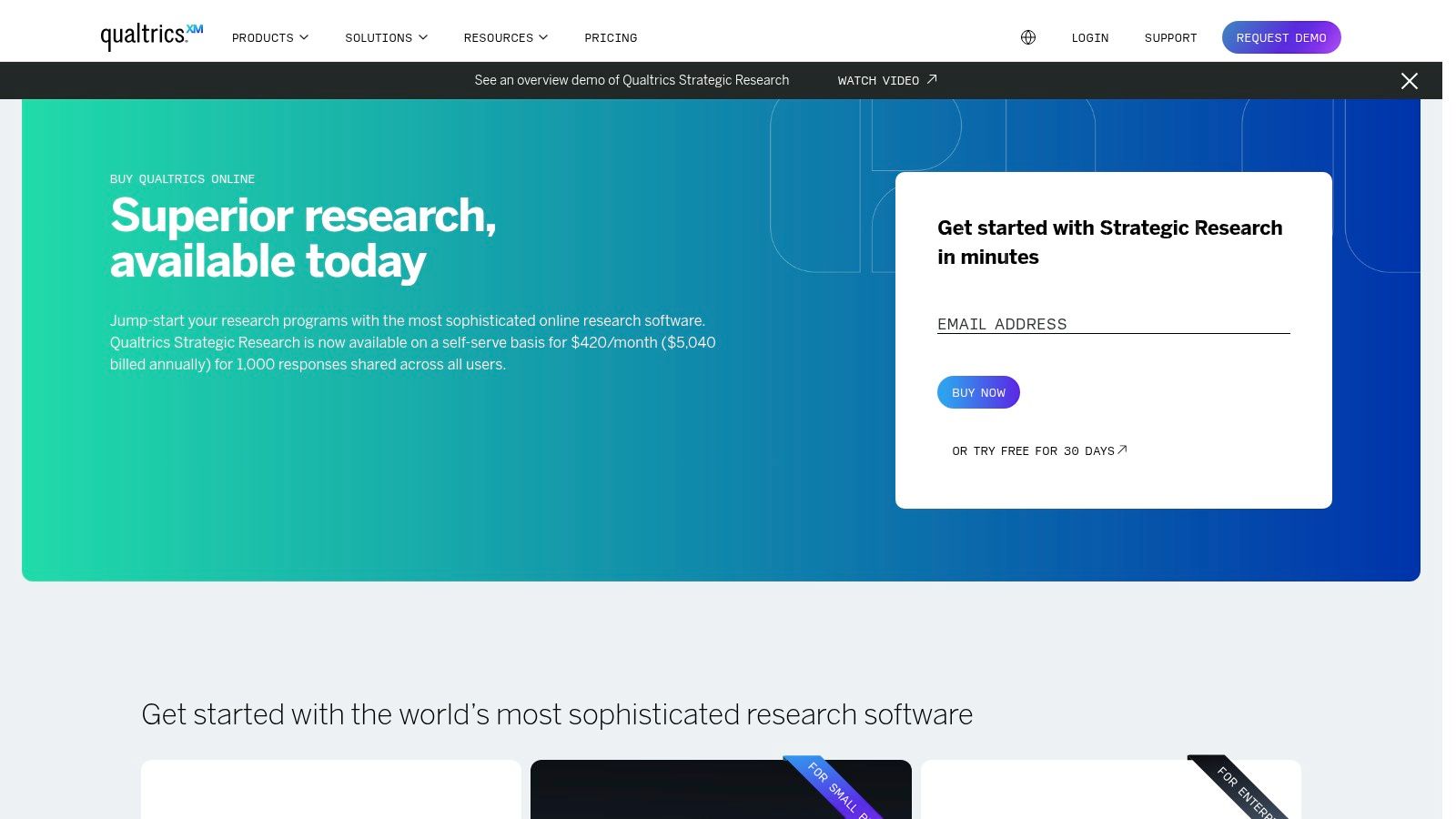
The platform’s real power lies in its AI-driven analytics, which automate the discovery of key themes, topics, and sentiment from unstructured text and voice data. For a PM, this means you can quickly move from thousands of open-text comments to a prioritized list of issues without manual analysis. The system also provides predictive recommendations and automated, closed-loop workflows, enabling you to trigger actions in other systems (like creating a Jira ticket or sending a Slack alert) based on specific feedback, such as a low NPS score from a high-value customer. You can use insights from Qualtrics to inform your approach to building user personas and applying sophisticated customer segmentation techniques.
Key Information & Assessment
| Category | Details |
|---|---|
| Best For | Enterprise-level product organizations, Fortune 500 companies, and regulated industries (e.g., finance, healthcare) that need a highly secure, scalable, and all-in-one experience management program. |
| Pricing & Access | Premium, enterprise-focused pricing. While some basic survey tools are available for free, the core analytics and XM capabilities require a custom quote. Access to advanced features often involves a six-figure annual contract. |
| Pros | Deep Analytics & Automation: Its AI-driven text analysis and automated workflow capabilities are best-in-class for large-scale feedback programs. Enterprise-Ready: Offers robust security, governance, and compliance options, including a FedRAMP High certified version. |
| Cons | Steep Learning Curve: Mastering the full suite of advanced capabilities requires significant training and dedicated resources. High Cost: The platform's enterprise pricing model makes it inaccessible for most startups and small businesses. |
Website: https://www.qualtrics.com/buy-online/
2. Medallia
Medallia is an enterprise-grade Voice of Customer (VoC) platform designed for large, complex organizations aiming to unify customer signals from every touchpoint. It excels at combining structured feedback from surveys with unstructured data from conversations, video, and digital interactions. This positions it as a powerful customer feedback analysis tool for companies that need to operationalize insights at scale across different business units, from the contact center to the product team.
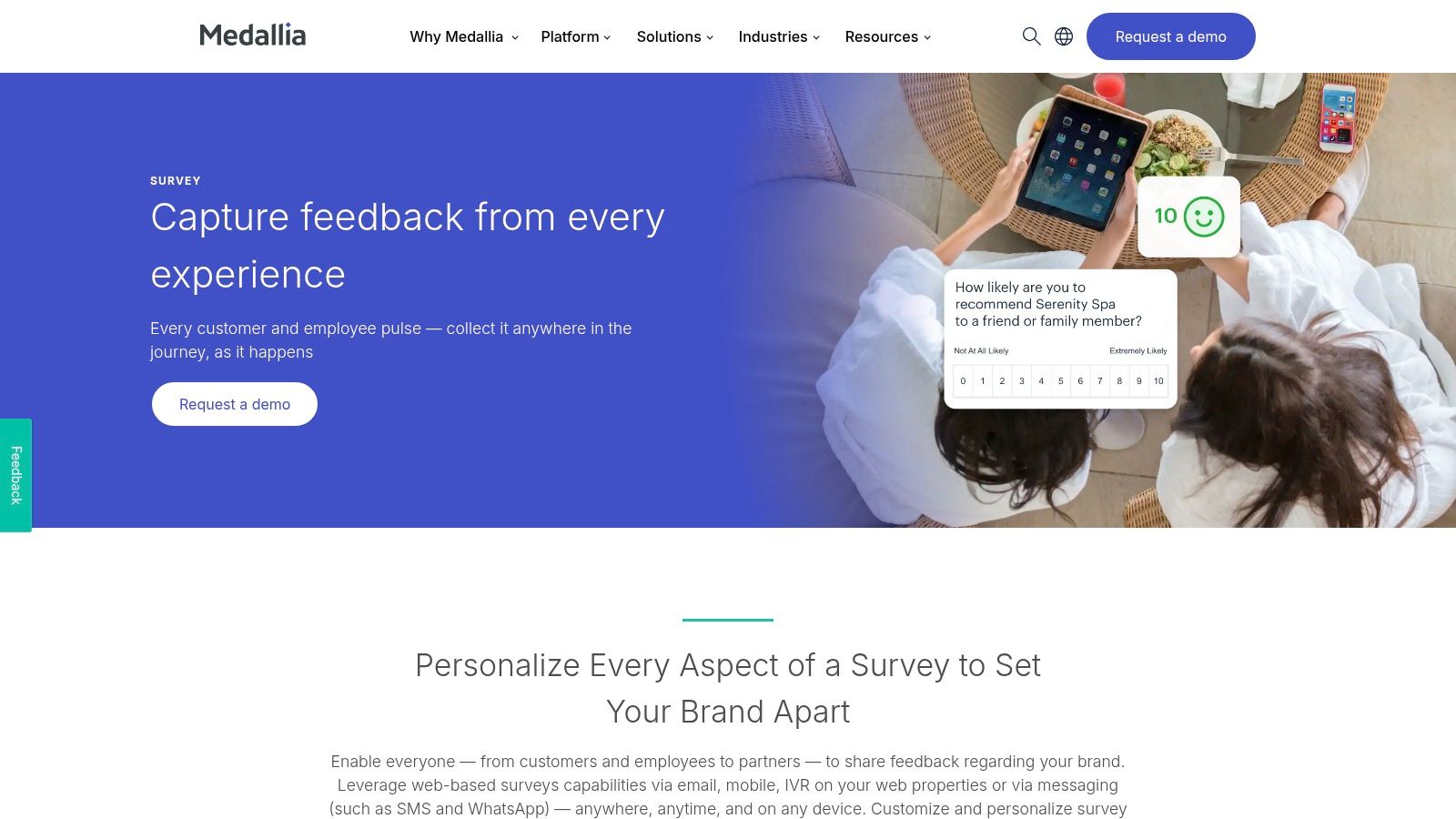
The platform’s core strength lies in its sophisticated AI that analyzes emotion and sentiment across text, speech, and even video feedback. For a product leader, this means you can identify not just what customers are saying but how they feel, uncovering critical risks or opportunities that text analysis alone might miss. Medallia’s Automated Action Intelligence goes a step further by detecting emerging issues and routing actionable insights directly to the relevant teams. An admin can use its self-service suite to quickly deploy new feedback programs, enabling agility even within a large corporate structure. This makes it a strategic asset for embedding a customer-centric feedback loop directly into product development and operational workflows.
Key Information & Assessment
| Category | Details |
|---|---|
| Best For | Global enterprises in sectors like hospitality, retail, and financial services that require a scalable, omnichannel VoC program to drive operational improvements and connect frontline actions with C-suite strategy. |
| Pricing & Access | Custom enterprise pricing. Access to the full platform requires a direct sales engagement and a tailored quote based on usage, data volume, and the specific modules required. It is a significant financial investment intended for large-scale deployments. |
| Pros | Market-Leading Analytics: Its AI capabilities for analyzing text, speech, and video are highly advanced, providing deep, multi-layered insights. Scalability & Ecosystem: Proven to handle massive data volumes for global companies and is supported by a strong partner and integration network. |
| Cons | Enterprise-Only Cost: The pricing structure and total cost of ownership are prohibitive for small to mid-sized businesses. Complex Implementation: Rolling out the platform effectively often requires dedicated internal resources and may necessitate professional services support, increasing the initial setup time. |
Website: https://www.medallia.com/platform/feedback-management/
3. SurveyMonkey (Momentive)
SurveyMonkey is one of the most recognizable names in self-serve surveys, offering an accessible yet powerful platform for teams to quickly gather and analyze feedback. While known for its user-friendly survey builder, its strength as one of the better customer feedback analysis tools comes from built-in analytics that help product teams make sense of qualitative data. The platform is ideal for SMBs and mid-market companies that need a fast, effective way to run CX programs, conduct market research, or validate product ideas without a six-figure budget.
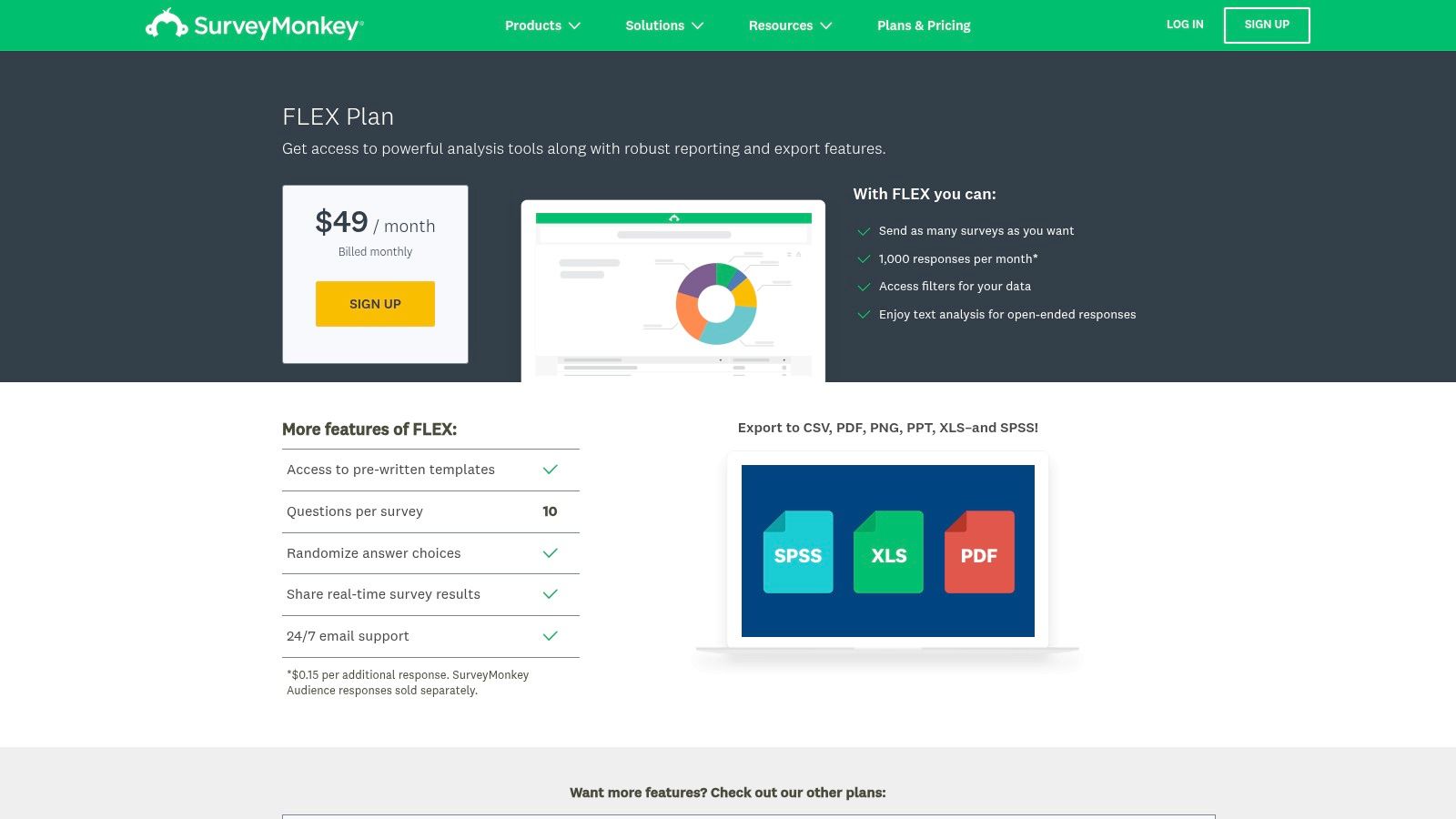
The platform’s Genius AI automatically analyzes open-ended text responses, providing sentiment analysis and word clouds to instantly highlight key themes without manual effort. A PM can use its crosstab reports and statistical significance testing to dig deeper, segmenting responses by user demographics or behavior. This makes it easier to connect specific feedback to user segments, informing everything from feature prioritization to persona development. For those just starting with qualitative research, these tools can be a great complement to a structured approach for how to conduct user interviews by providing quantitative validation for qualitative insights. The extensive library of integrations with tools like Slack, HubSpot, and Microsoft Teams ensures that feedback can be easily shared and acted upon across the organization.
Key Information & Assessment
| Category | Details |
|---|---|
| Best For | SMBs and mid-market product, marketing, and research teams needing a fast, self-serve tool for deploying surveys and performing text analysis without a steep learning curve or enterprise-level investment. |
| Pricing & Access | Offers a range of plans from a basic free tier to Team and Enterprise plans. Team Advantage plans start around $25/user/month. Core analysis features like text analysis and crosstabs are available in paid plans, which offer a good balance of features for the cost. |
| Pros | Quick Setup & Usability: Extremely intuitive interface with a vast template library allows for rapid deployment of surveys. Mainstream Price Point: Provides strong analysis capabilities, including AI-driven text analysis, at a cost accessible to most businesses. |
| Cons | Cost Scales with Use: Advanced research features and higher response limits can significantly increase the price. Limited CX Automation: While it integrates well, complex, automated closed-loop feedback workflows may require additional tools. |
Website: https://www.surveymonkey.com/pricing/analyze/
4. Zendesk (Marketplace & native CSAT/NPS)
Zendesk is a customer service platform that excels at integrating feedback collection directly into support workflows. While not a standalone analytics suite, its strength lies in its native CSAT/NPS collection tools and an extensive App Marketplace. For product teams in organizations where the support function already runs on Zendesk, it provides an unparalleled opportunity to capture and act on feedback at the point of interaction. This makes it one of the most practical customer feedback analysis tools for companies looking to leverage their existing support infrastructure to inform the roadmap.
As a PM, you can tap into the steady stream of customer sentiment flowing through support tickets. Native features allow for the automatic triggering of CSAT surveys after a ticket is resolved, providing immediate, context-rich feedback. For more advanced analysis, the Zendesk Marketplace is key. It offers dozens of one-click install apps for NPS, custom surveys, and text analytics that pipe data directly into the Zendesk environment. This creates powerful, closed-loop automations where, for example, a negative NPS response can automatically create a new high-priority ticket for follow-up, ensuring no critical feedback is missed. This direct integration streamlines the process of linking support insights to product development priorities.
Key Information & Assessment
| Category | Details |
|---|---|
| Best For | Organizations already using Zendesk for customer support who want to unify their feedback workflows and quickly deploy integrated survey and analysis tools without a complex implementation. |
| Pricing & Access | Core CSAT/NPS features are included in Zendesk Suite plans. Deeper analytics and specialized survey tools require installing apps from the Marketplace, which may have their own subscription fees ranging from free to enterprise-level pricing. |
| Pros | Fast Time-to-Value: One-click app installs within an existing Zendesk stack make it incredibly fast to get started. Seamless Integration: Feedback is directly tied to customer support interactions, providing rich context for product teams. |
| Cons | Ecosystem-Dependent: The platform's full value is primarily realized if your organization is already committed to the Zendesk ecosystem. Additional Costs: Advanced Voice of the Customer (VoC) analytics often rely on paid third-party Marketplace apps. |
Website: https://www.zendesk.com/marketplace/
5. Sprinklr
Sprinklr positions itself as a unified customer experience management (CXM) platform, designed for large enterprises needing to consolidate both solicited and unsolicited feedback. Its key differentiator is its ability to blend traditional survey data with real-time signals from over 30 digital channels, including social media, review sites, and messaging apps. This makes it one of the most comprehensive customer feedback analysis tools for brands that want a complete view of the public and private customer voice in a single platform.
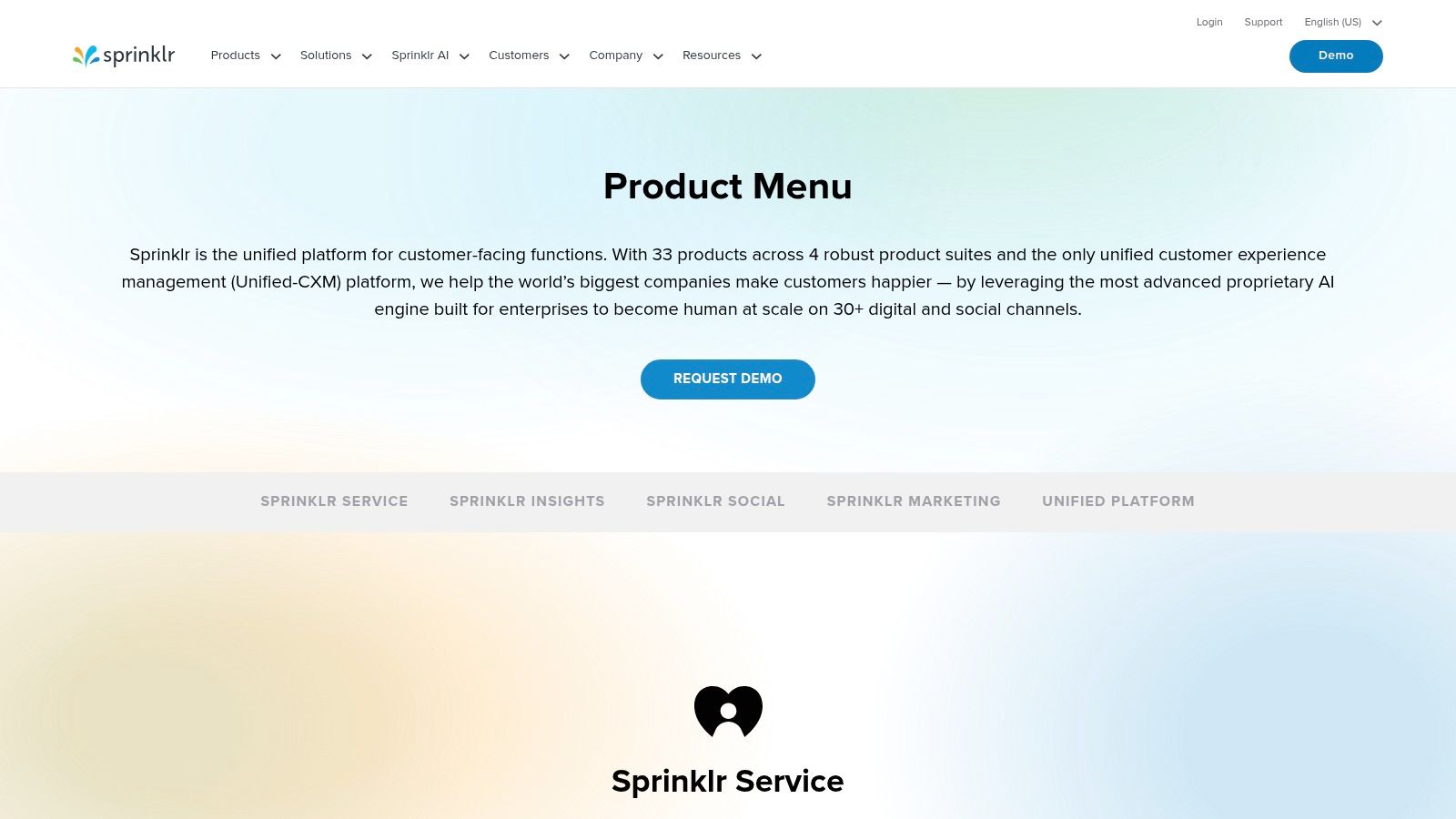
For a PM at a large consumer brand like Nike or McDonald's, Sprinklr's power lies in its AI-driven consumer intelligence. Instead of just analyzing survey responses, you can track how a new feature is being discussed on Twitter, see reviews on app stores, and monitor sentiment on Reddit, all within the same dashboard. Its AI engine automatically classifies this unstructured data, identifying themes, predicting CSAT, and routing critical feedback to the right teams. This unified Voice of the Customer (VoC) approach means you can correlate a drop in NPS scores with a spike in negative social media mentions, providing a much richer context for product decisions than surveys alone could ever offer.
Key Information & Assessment
| Category | Details |
|---|---|
| Best For | Global enterprises and large consumer brands that need to manage customer experience across numerous public and private digital channels, combining social listening with traditional VoC programs. |
| Pricing & Access | Enterprise-focused, custom pricing model. Access requires engaging with their sales team for a demo and a tailored quote based on the specific modules and scale required. It is not suitable for small businesses or startups. |
| Pros | Unified Channel Coverage: Excels at blending solicited (surveys) and unsolicited (social, reviews) feedback in one place. Powerful Social Listening: Its origins in social media management give it best-in-class capabilities for monitoring public conversations at scale. |
| Cons | High Complexity & Cost: The platform's breadth makes it complex to implement and manage, requiring significant investment and dedicated resources. Enterprise Focus: The sales process and pricing structure are built for large corporations, creating a high barrier to entry. |
Website: https://www.sprinklr.com/products/
6. Hotjar
Hotjar is a product experience insights suite that uniquely bridges the gap between what users say and what they do. It combines on-site feedback widgets and surveys with powerful behavioral analytics tools like session replays and heatmaps. This makes it one of the most practical customer feedback analysis tools for product teams that need to add rich, visual context to qualitative feedback, connecting a user’s comment directly to their on-screen journey.
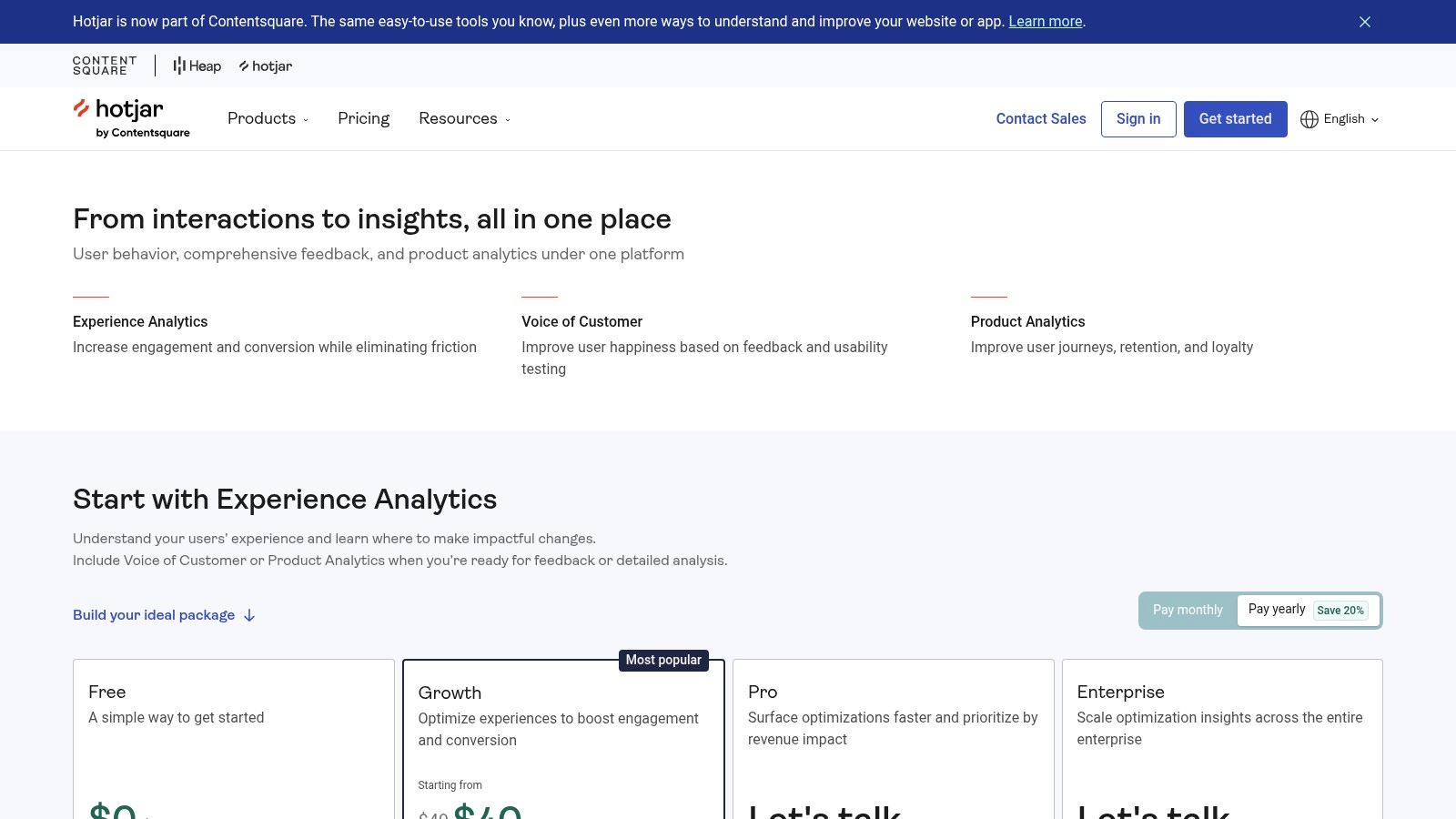
For a product manager, Hotjar’s strength is its ability to quickly diagnose usability issues and validate user sentiment. Instead of just reading a vague complaint from a feedback widget ("the checkout button doesn't work"), you can watch the session replay of that exact user to see them rage-clicking on the wrong element. The platform’s AI-assisted survey creation and AI summaries help teams launch effective feedback campaigns quickly and distill key insights from responses. By integrating behavioral data (heatmaps, funnels) with direct feedback, you can get to the "why" behind user actions, making it an invaluable asset when you need to understand the complete user story before committing development resources. This approach provides a powerful, real-world complement to more formal research methods, helping you learn more about how to conduct usability testing in a live environment.
Key Information & Assessment
| Category | Details |
|---|---|
| Best For | SMBs, mid-market product teams, and UX/UI designers who need an all-in-one tool to connect qualitative user feedback directly with quantitative behavioral analytics without the enterprise-level cost. |
| Pricing & Access | Freemium model available with a limited "Basic" plan. Paid plans (Plus, Business, Scale) start at around $32/month and scale based on the number of sessions, survey responses, and feedback submissions required. |
| Pros | Combines Behavioral & Feedback Data: The ability to link session recordings to specific feedback responses is a powerful way to understand user context. Fast to Deploy: It's incredibly easy to set up on any website or single-page application with a simple code snippet. |
| Cons | Not a Full VoC Replacement: Lacks the deep, omnichannel listening and text analytics capabilities of enterprise platforms. Response Caps: The "Ask" (surveys and feedback) and "Observe" (recordings and heatmaps) products have strict usage limits on lower-tier plans that can be hit quickly. |
Website: https://www.hotjar.com/pricing/
7. Birdeye
Birdeye is an all-in-one experience marketing platform that excels at aggregating and analyzing customer feedback from public-facing sources like online reviews and social media, alongside private channels like surveys. While it serves a broader marketing and reputation management function, its capabilities make it a powerful customer feedback analysis tool, especially for businesses with multiple physical locations. The platform consolidates reviews from hundreds of sites, providing a unified inbox for response and engagement.
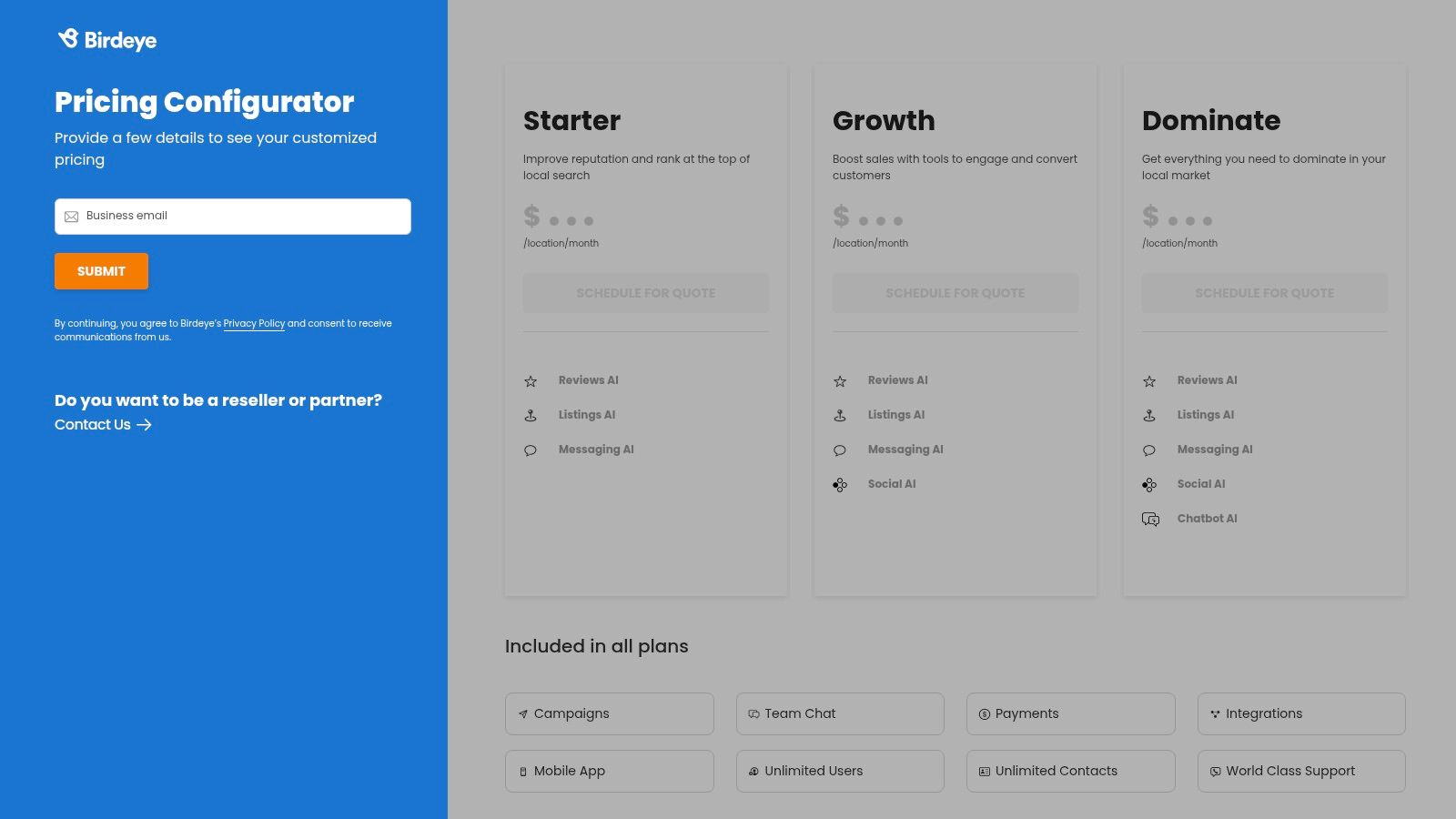
For product managers in retail, hospitality, or service industries, Birdeye's strength is its ability to benchmark performance across different locations. Its AI-powered engine, Athena, automatically processes unstructured text from reviews and surveys to extract key themes, sentiment scores, and actionable insights. This means you can quickly identify if a recurring issue with "slow service" is isolated to a single branch or is a systemic problem impacting the entire customer experience. The platform also offers robust NPS and CSAT survey tools, allowing teams to track these core metrics over time and correlate them with public sentiment.
Key Information & Assessment
| Category | Details |
|---|---|
| Best For | Multi-location businesses (e.g., retail chains, healthcare clinics, restaurants) that need to analyze customer feedback at a local level and connect online reputation to operational performance. |
| Pricing & Access | Quote-based pricing, typically billed per location. The model is designed for businesses and often requires a long-term contract commitment. It is not suited for individual users or very small startups. |
| Pros | Reputation & Feedback Integration: Seamlessly combines review management with survey-based feedback analysis, offering a holistic view of public and private customer sentiment. Location-Based Analytics: Excellent for benchmarking and comparing performance across many physical locations. |
| Cons | Focus on Reputation: The tool's primary emphasis is on marketing and reputation, which may lack the depth of dedicated product research tools for complex feature analysis. Contractual Commitment: Pricing and contract terms can be a significant barrier for smaller organizations. |
Website: https://birdeye.com/pricing/
8. ReviewTrackers
ReviewTrackers specializes in aggregating and analyzing online reviews, positioning itself as a crucial tool for B2C product managers who need to understand public perception and sentiment. The platform monitors over 100 review sites, pulling in feedback from sources like Google, Yelp, and industry-specific portals. This consolidation provides a centralized view of how customers are discussing your product in the wild, making it one of the most focused customer feedback analysis tools for managing brand reputation and user experience.
Its core strength is its proprietary natural language processing (NLP), which automatically identifies keywords, sentiment, and emerging themes from unstructured review text. For a product manager, this means you can quickly spot recurring issues, like a bug mentioned across multiple platforms, or identify feature requests that are gaining traction. The platform offers AI-assisted review responses to help teams engage with feedback efficiently, along with competitor tracking to benchmark your performance against others. Alerts and dashboards ensure that you are immediately notified of significant trends or critical feedback, enabling rapid response and informed product decisions.
Key Information & Assessment
| Category | Details |
|---|---|
| Best For | B2C companies, multi-location businesses (e.g., retail, hospitality), and product teams that rely heavily on public online reviews to gauge customer sentiment and identify product improvement opportunities. |
| Pricing & Access | Pricing is typically quoted per location and requires contacting sales for a custom quote. Tiers are well-defined, offering different levels of functionality, including a "Data Only" option for teams that want to pipe review data into their own BI tools via API. |
| Pros | Excellent Review Aggregation: Its ability to monitor and centralize feedback from a vast number of online sources is a major strength. Actionable NLP Insights: The automated sentiment and theme detection provides clear, actionable insights without manual analysis. |
| Cons | Niche Focus: It is heavily concentrated on online reviews and may not be the best fit for teams needing to analyze feedback from surveys, support tickets, or in-app channels. Per-Location Pricing Model: The pricing structure can be less suitable for purely digital or non-location-based products. |
Website: https://www.reviewtrackers.com/plans/
9. Yotpo (Reviews)
Yotpo is an e-commerce-focused customer experience platform best known for its powerful reviews and user-generated content (UGC) solutions. While its primary goal is to build social proof and lift conversion rates, it also serves as one of the more focused customer feedback analysis tools for direct-to-consumer brands. Its strength lies in turning qualitative product reviews into structured data that product managers can use to identify trends, defects, or feature requests directly from paying customers.
The platform's AI-driven analytics automatically analyze review text to detect sentiment and surface key topics, which are then displayed as "Smart Filters" on product pages. For a PM at a Shopify or BigCommerce store, this means you can instantly see what customers are saying about "fit," "fabric," or "battery life" without manual tagging. Yotpo also uses AI to prompt customers with specific questions in review requests, helping you gather richer, more targeted feedback on the product attributes you care about most. This turns a standard marketing tool into a valuable source for continuous product discovery and improvement, linking post-purchase feedback directly to the product development cycle.
Key Information & Assessment
| Category | Details |
|---|---|
| Best For | E-commerce product managers, direct-to-consumer (DTC) brands, and merchants on platforms like Shopify, BigCommerce, or Adobe Commerce who need to leverage product reviews for both marketing and product insights. |
| Pricing & Access | Offers a range of plans, including a free-forever tier with basic review collection. Paid plans scale up with more advanced features like AI insights, rich snippets, and syndication. Custom enterprise pricing is available for high-volume merchants. |
| Pros | Direct Conversion & Insight Link: Uniquely combines the ability to increase sales through social proof with surfacing actionable product feedback. Seamless E-commerce Integration: Quick and easy to install on major e-commerce platforms, getting you up and running in minutes. |
| Cons | E-commerce Centric: Its analysis is heavily focused on product and site reviews, making it less suitable for comprehensive, cross-channel Voice of the Customer (VoC) programs. Language Limitations: Some of the most advanced AI analytics and sentiment features are primarily optimized for English. |
Website: https://www.yotpo.com/get-started-reviews/
10. AWS Marketplace (feedback analytics category)
AWS Marketplace isn't a single tool but rather a curated digital catalog that simplifies the procurement of third-party software for companies heavily invested in the Amazon Web Services ecosystem. For product teams operating within an AWS-centric environment, it offers a streamlined way to discover, purchase, and deploy a variety of customer feedback analysis tools. Instead of navigating complex individual vendor contracts and security reviews, teams can leverage their existing AWS relationship to access and manage subscriptions, consolidating billing and simplifying vendor onboarding.
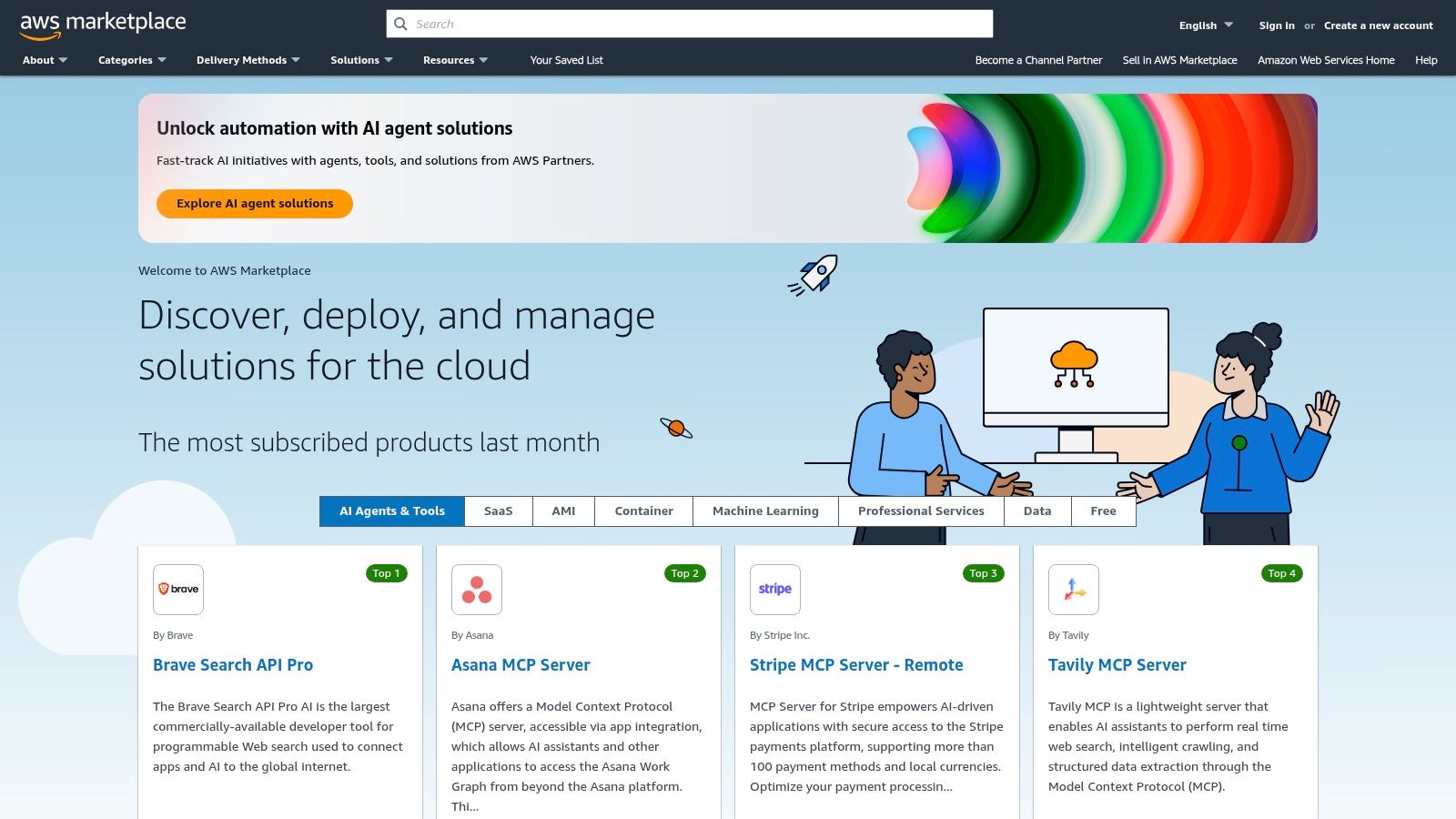
The platform lists a range of Voice of the Customer (VoC) and feedback analytics products, from specialized point solutions to comprehensive platforms. The key advantage for a PM is operational efficiency; you can get a tool approved and deployed much faster because it’s integrated into an established, trusted channel. You can browse detailed listings, compare features, and often initiate private offers directly with vendors. This makes AWS Marketplace a strategic resource for organizations looking to reduce administrative overhead and accelerate the adoption of new feedback tools.
Key Information & Assessment
| Category | Details |
|---|---|
| Best For | Product teams and organizations deeply integrated with AWS that need to streamline software procurement, consolidate billing, and simplify vendor security reviews for feedback analysis tools. |
| Pricing & Access | Varies widely by vendor listing. Pricing can be public, but many enterprise-grade tools require contacting the seller to create a private offer. Access is managed through an organization's primary AWS account. |
| Pros | Simplified Procurement: Radically shortens the buying cycle and security review process for companies already using AWS. Centralized Billing: Consolidates software subscriptions into a single AWS bill, simplifying budget management. |
| Cons | Vendor-Dependent: Not all feedback analysis tools are listed, limiting the selection to vendors participating in the marketplace. Inconsistent Offers: Pricing, trials, and offer structures vary significantly from one listing to another, requiring individual assessment for each potential tool. |
Website: https://aws.amazon.com/marketplace/
11. Salesforce AppExchange
Rather than a single tool, Salesforce AppExchange is a comprehensive marketplace where organizations can discover, trial, and install a vast array of business applications that integrate directly into the Salesforce ecosystem. For product managers whose GTM, sales, and service teams live in Salesforce, this is a crucial hub for finding customer feedback analysis tools that natively connect to their single source of customer truth. The AppExchange allows you to extend the Salesforce platform with specialized VoC apps for surveys, reputation management, and customer messaging.
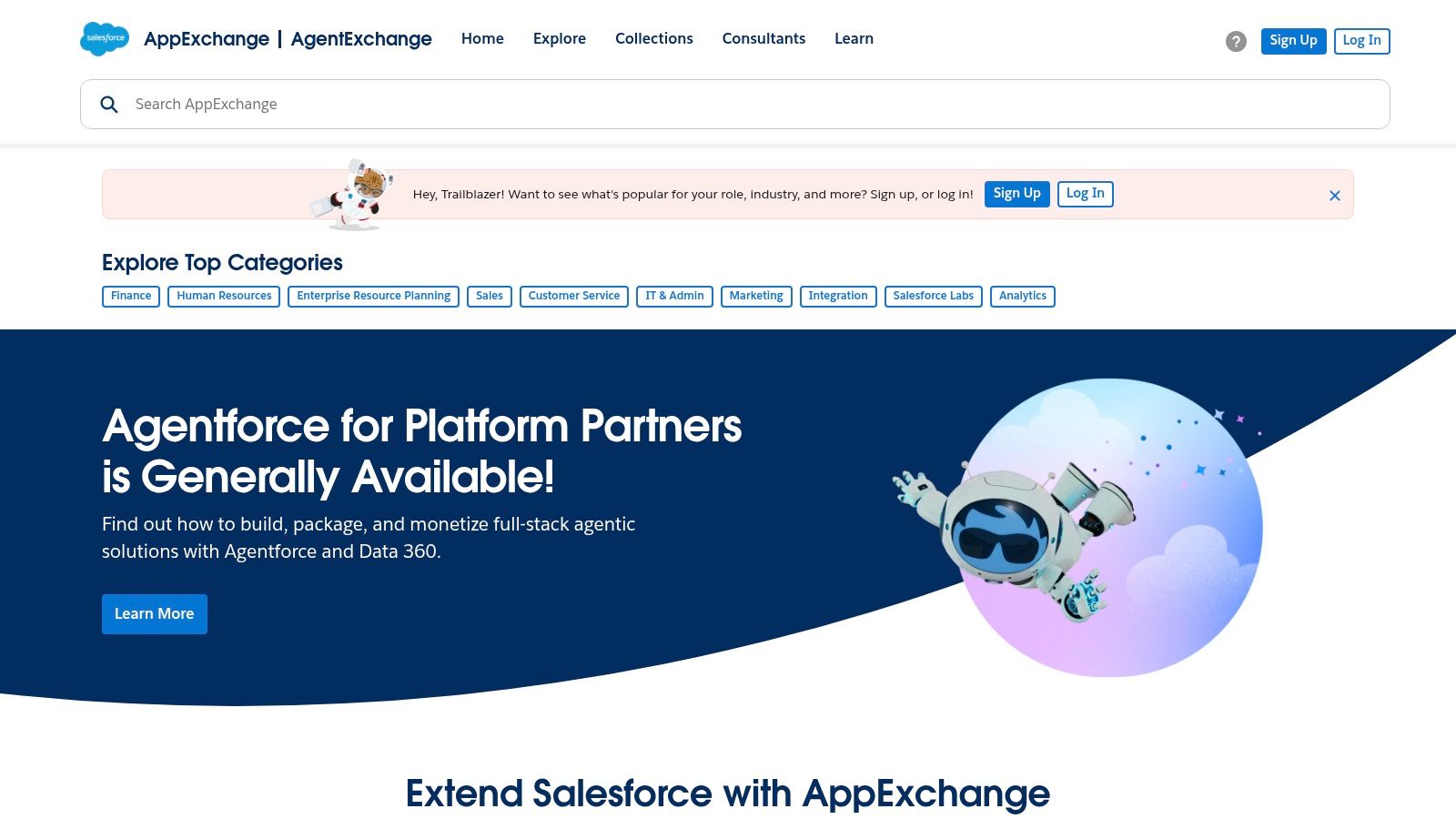
The primary advantage is the seamless data integration. Apps from vendors like SurveyMonkey or Medallia can map survey responses and feedback data directly to CRM objects like Accounts and Contacts. This enables powerful, automated workflows; for example, a negative survey response from a key account can automatically trigger a case for the support team or an alert for an account manager within Salesforce. Each app listing provides user reviews, pricing notes, and trial options, simplifying the procurement and governance process for adding new capabilities to your tech stack.
Key Information & Assessment
| Category | Details |
|---|---|
| Best For | Product, GTM, and service teams that operate primarily within the Salesforce ecosystem and need to enrich CRM data with direct customer feedback from integrated, third-party applications. |
| Pricing & Access | Varies widely by application. Each app on the AppExchange has its own pricing model, often per user or based on usage tiers. Many offer free trials, but costs can accumulate when deploying multiple specialized apps. |
| Pros | Native CRM Integration: Enables powerful, automated workflows and a unified view of the customer by syncing feedback data directly into Salesforce objects. Simplified Governance: Centralized discovery, trials, and installation simplify vendor management. |
| Cons | Inconsistent Functionality: The quality and depth of integration differ significantly from one app to another. Compounding Costs: Subscriptions for multiple apps can become expensive, especially with per-user pricing models. |
Website: https://appexchange.salesforce.com/
12. Microsoft Dynamics 365 Customer Voice
For organizations deeply embedded in the Microsoft ecosystem, Dynamics 365 Customer Voice presents a natively integrated solution for feedback management. It allows teams to create and distribute surveys (including standard NPS, CSAT, and CES templates) directly from within Dynamics 365, with all response data automatically flowing into the Microsoft Dataverse. This seamless integration makes it a powerful choice for businesses that want to link customer feedback directly to their CRM records and business processes without complex, third-party connectors.
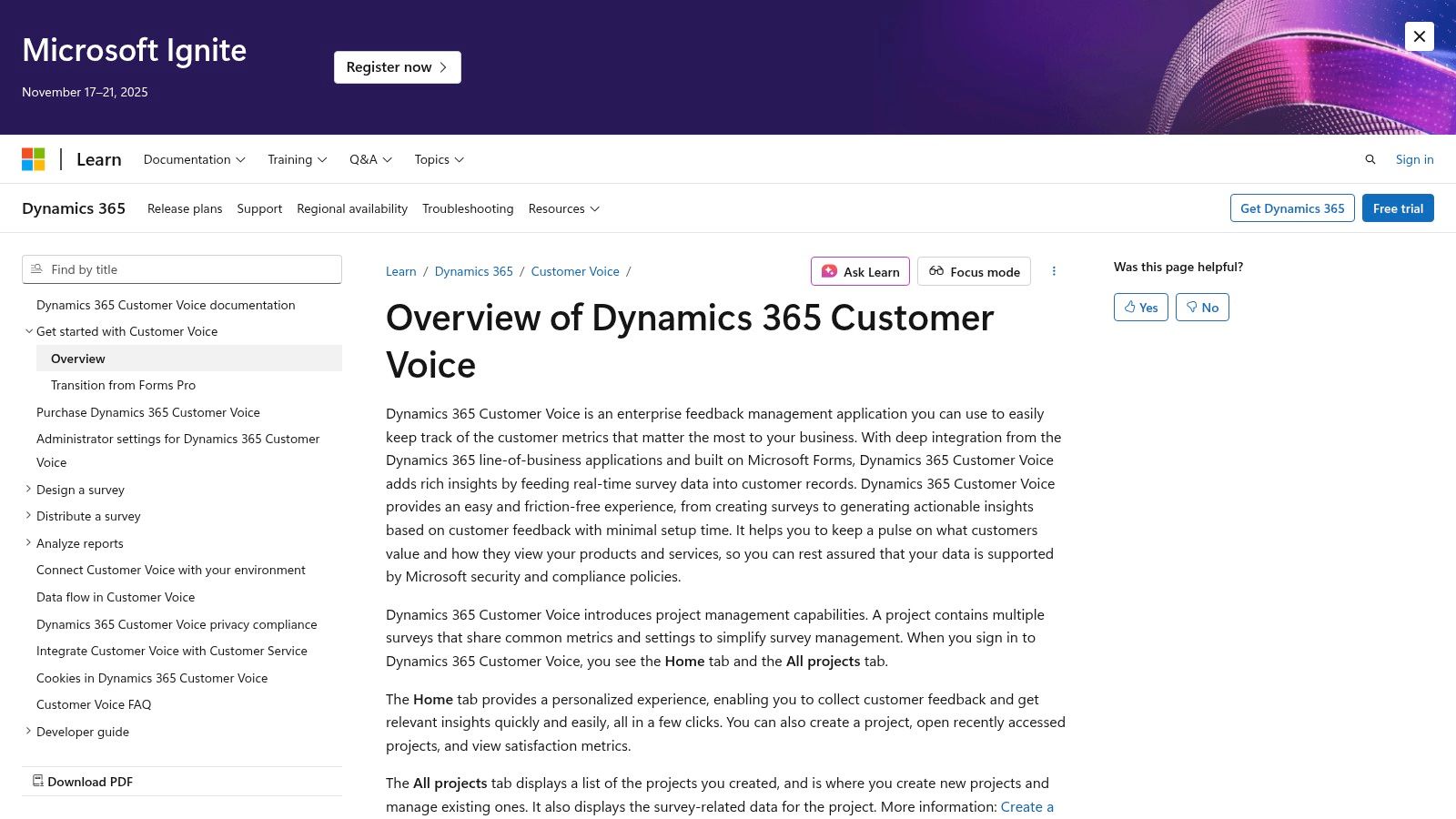
The platform's strength lies in its connection to the broader Power Platform, enabling sophisticated, automated workflows. For example, a PM can configure a Power Automate flow to trigger a task in Azure DevOps or a notification in Microsoft Teams whenever a customer submits negative feedback about a specific feature. Reporting is handled through Power BI, offering extensive customization for creating dashboards that merge feedback data with sales, service, and operational metrics. With recent additions like Copilot for survey design, it's becoming one of the most cohesive customer feedback analysis tools for any company standardized on Microsoft's cloud infrastructure.
Key Information & Assessment
| Category | Details |
|---|---|
| Best For | Enterprise and mid-market companies already using Dynamics 365, the Power Platform, and Microsoft 365, who want a fully integrated feedback tool to connect customer sentiment directly to CRM and business intelligence systems. |
| Pricing & Access | Included with certain Dynamics 365 enterprise licenses (e.g., Customer Service Enterprise), which come with a set number of survey responses per month. Additional response capacity can be purchased as an add-on. Access requires an existing Dynamics 365 subscription. |
| Pros | Deep Microsoft Integration: Unmatched connectivity with Dynamics 365, Power BI, and Power Automate for creating closed-loop feedback systems. Secure & Governed: Leverages the security and compliance framework of the Microsoft cloud and Dataverse. |
| Cons | Limited Value Standalone: Its primary benefit is its integration; it offers little advantage for organizations not already invested in the Dynamics 365 ecosystem. Complex Licensing: Understanding which SKU includes it and when add-ons are needed can be confusing. |
Website: https://learn.microsoft.com/en-us/dynamics/365/customer-voice/about
Top 12 Customer Feedback Tools — Side-by-Side Comparison
| Product | Core features ✨ | Key strengths 🏆 | Best for 👥 | Quality ★ | Pricing 💰 |
|---|---|---|---|---|---|
| Qualtrics | AI text analytics, omnichannel surveys, automated workflows, enterprise security | Very deep analytics & automation for large programs | 👥 Large enterprises, CX/VoC teams | ★★★★★ | 💰 Premium / quote |
| Medallia | Omnichannel feedback, speech/video sentiment, Action Intelligence, admin suite | Market-leading analytics & scale, strong US ecosystem | 👥 Complex enterprises, contact centers | ★★★★★ | 💰 Enterprise / custom |
| SurveyMonkey (Momentive) | Self-serve surveys, AI sentiment, 500+ templates, multi-survey analysis | Fast to deploy; strong integrations & templates | 👥 SMBs, mid-market product & research teams | ★★★★☆ | 💰 Mainstream tiers; add‑ons |
| Zendesk (Marketplace & native CSAT/NPS) | Native CSAT/NPS, APIs, app marketplace, real‑time automations | Fast value inside Zendesk; many third‑party apps | 👥 Support & ops teams on Zendesk | ★★★★ | 💰 Base + marketplace apps |
| Sprinklr | Unified CXM: surveys + social listening + contact center data | Strong blend of solicited + unsolicited feedback at scale | 👥 Large brands & social-centric teams | ★★★★☆ | 💰 Enterprise / sales‑led |
| Hotjar | On-site feedback widgets, surveys, session replays, heatmaps | Combines behavioral data with feedback; quick setup | 👥 Product, UX & web teams | ★★★★ | 💰 Affordable entry tiers |
| Birdeye | Reviews, surveys, NPS, location benchmarking, AI summaries | Strong local SEO + multi-location reporting | 👥 Multi-location businesses (US) | ★★★★ | 💰 Per-location / quote |
| ReviewTrackers | Review aggregation, proprietary NLP, dashboards & alerts | Clear tiers incl. "data only"; multi-source focus | 👥 Reputation managers, multi-site brands | ★★★★ | 💰 Per-location / quote |
| Yotpo (Reviews) | Ecommerce reviews, AI highlights, moderation, syndication | Drives conversion lift on product pages; easy installs | 👥 Ecommerce merchants (Shopify, etc.) | ★★★★ | 💰 Free → enterprise |
| AWS Marketplace (feedback analytics) | Curated VoC listings, procurement & billing via AWS | Simplifies buying/security for AWS-centric orgs | 👥 AWS-centric procurement & IT teams | ★★★★ | 💰 Varies by listing; centralized billing |
| Salesforce AppExchange | Curated VoC/survey apps, native CRM mapping & automations | Native Salesforce workflows & simplified governance | 👥 GTM/service teams on Salesforce | ★★★★ | 💰 App-dependent; can stack |
| Microsoft Dynamics 365 Customer Voice | Surveys in Dynamics, Copilot/Power Platform, Power BI reporting | Deep Dynamics + Power Platform integration | 👥 Microsoft/Dynamics organizations | ★★★★ | 💰 Best value if Dynamics licensed |
Your Action Plan: Implementing a Feedback System That Actually Works
We've just navigated a comprehensive landscape of the industry's top customer feedback analysis tools. But the most critical takeaway isn't about picking the tool with the most features. It's about recognizing that the tool itself is only 10% of the solution.
The other 90% is the system you build around it. The real differentiator between a junior PM who simply reports on CSAT scores and a senior product leader who shapes company strategy is the ability to create an operational engine for customer insights. The tools are just the cogs; you are the architect of the machine.
Your 48-Hour Implementation Framework
To move from analysis to action, you need a concrete plan. Great product managers don't wait for permission; they build systems that demonstrate value. Here is a step-by-step framework you can implement within the next two days to immediately elevate your team’s customer-centricity.
Step 1: Map Your Feedback Ecosystem (Day 1, 2-3 hours)
Before you can centralize data, you need to know where it lives. Grab a whiteboard or open a Miro board and map every single place your company receives customer feedback.
- Solicited Feedback:
- NPS/CSAT/CES surveys (e.g., sent via SurveyMonkey, Qualtrics).
- In-app feedback widgets (e.g., Hotjar).
- User interviews and beta testing notes (often in Confluence or Google Docs).
- Unsolicited Feedback:
- Support tickets (e.g., Zendesk, Salesforce Service Cloud).
- Public reviews (e.g., G2, Capterra, Google Play Store).
- Social media mentions (e.g., Twitter, LinkedIn, Reddit).
- Sales call notes and CRM entries (often lost in Salesforce or HubSpot).
Categorize these sources by volume, frequency, and data type (quantitative vs. qualitative). This map is your strategic blueprint.
Step 2: Select Your 'Single Source of Truth' (Day 1, 1 hour)
Now, review the tools we've discussed and make a decisive choice for your central hub. Your decision should be guided by your company's stage, scale, and existing tech stack.
- For Startups & Scale-ups: If you need speed and qualitative insights, Hotjar is a fantastic, high-ROI starting point. If you need structured survey data, SurveyMonkey offers an easy on-ramp.
- For Mid-Market & Enterprise: Your existing systems are your biggest clue. If your company lives in Salesforce, start by exploring the AppExchange for integrated feedback tools. If you use Zendesk for support, investigate its native capabilities and marketplace apps first to avoid creating data silos.
- For Large Enterprises with Complex Needs: This is where platforms like Qualtrics, Medallia, and Sprinklr shine. Your role here is less about initial implementation and more about championing the use of these powerful (and expensive) platforms within your product domain.
Step 3: Automate the Flow of Information (Day 2, 2-4 hours)
A system that relies on manual data entry is a system that will fail. Your goal is to automate the consolidation of feedback into your chosen hub.
- Set up Integrations: Use Zapier or native integrations to pipe data from its source to your central tool. For example:
Trigger: New 1-star review on G2 -> Action: Post summary in #voice-of-the-customer Slack channel. - Create a Real-Time Alert System: Configure a dedicated Slack or Microsoft Teams channel (e.g.,
#voice-of-the-customer) and feed it with real-time alerts. New G2 reviews, detractor NPS comments, and critical support issues should appear here instantly. This makes customer pain visible to the entire team, not just the PM.
Step 4: Build the Reporting Ritual (Day 2, 1 hour)
Data is useless without a forum for discussion and action. The final, most crucial step is to embed feedback analysis into your team's operating rhythm.
- Schedule a recurring 'Voice of the Customer' review. This should be a bi-weekly, 30-minute meeting with your engineering lead, designer, and key stakeholders.
- Create a simple, standardized dashboard in your chosen tool. It should answer three questions every time:
- What are the top 3-5 emerging qualitative themes this period? (Show the actual customer quotes).
- How are our core feedback metrics trending? (Show a simple line graph of CSAT or NPS over time).
- What actions did we take based on last period's feedback, and what was the result?
By operationalizing this process, you transform customer feedback from a collection of anecdotes into a strategic asset. You move from a reactive "firefighter" to a proactive, data-informed product leader, the kind that gets hired and promoted at top-tier companies. This systematic approach is a non-negotiable skill for any PM aiming for a leadership role.
If you want to master more frameworks like this, from building your first product strategy to navigating executive reviews, I share my most actionable insights for Product Managers on my newsletter. It's written by a PM leader, for PM leaders. You can subscribe and access my full library of resources at Aakash Gupta.
