As a Product Manager, your ability to influence the roadmap, secure budget, and ship winning products hinges on one thing: a brutally precise understanding of your customer. Vague personas and broad market definitions are career-killers. The difference between a Senior PM at a startup and a Principal PM at Google often comes down to their ability to move from generic user data to actionable customer segmentation that drives strategic bets.
This is a tactical playbook, not a theoretical lecture. We’re breaking down 10 battle-tested customer segmentation techniques you can deploy within the next 48 hours. You’ll get the frameworks, the implementation steps, and real-world examples from companies that have mastered this, turning segmentation into a competitive moat.
Moving beyond the "average user" fallacy is the first step to building products that dominate a market. This is how teams at Netflix, Amazon, and Salesforce tailor experiences, justify multi-million dollar feature investments, and capture market share.
Inside this guide, you’ll find actionable frameworks for every stage of your product lifecycle, from foundational demographic analysis to advanced AI-powered propensity modeling.
- Core Frameworks: What each model is and the strategic reasoning behind it.
- Implementation Steps: A clear, step-by-step process to get started.
- Strategic Trade-offs: The pros and cons for your specific product context.
- Company Examples: How top-tier PMs at leading companies apply these techniques.
Stop guessing. Start building for high-value customer segments that will define your product's success and your career trajectory.
1. Demographic Segmentation
Demographic segmentation is the foundational layer of customer analysis, dividing your market based on observable, statistical traits. It’s the starting point for most segmentation efforts because the data is often accessible and provides a clear, objective picture of who your users are. It’s the blocking-and-tackling of user understanding.
For PMs breaking into the field, mastering this is non-negotiable. For seasoned PMs, it's about ensuring your baseline assumptions are still correct. The data is readily available in tools like Google Analytics or through simple user sign-up forms.
Key Demographic Variables
- Age: Critical for products with generational differences in tech adoption or life-stage needs (e.g., a fintech app's features for a 22-year-old vs. a 65-year-old).
- Gender: While becoming less rigid, it can still be a primary differentiator for products in CPG, apparel, or wellness.
- Income: Directly impacts willingness-to-pay, pricing tier strategy, and the viability of a freemium vs. premium model. A PM for a SaaS tool might find their free tier over-indexed on users from companies with <$5M ARR.
- Occupation: A user's profession dictates their "job to be done." A software engineer's needs for a project management tool are vastly different from a marketing manager's.
- Location (Geographic): From a city to a country level, this impacts language, legal compliance (GDPR), and cultural relevance.
Real-World Example: Netflix
Netflix masterfully uses demographic segmentation, particularly age, to build distinct product experiences. The "Kids" profile isn’t just a content filter; it’s a completely different UI, discovery algorithm, and set of parental controls. A PM at Netflix isn't building one product; they're building multiple, tailored experiences under one brand, justified by clear demographic splits. Their content acquisition strategy is also heavily informed by the demographic makeup of key growth markets.
Actionable Framework for PMs
- Data Collection: Mandate the collection of essential demographic data at sign-up (e.g., role, company size for B2B) or through analytics tools like Google Analytics. For deeper data, use enrichment services like Clearbit.
- Identify Key Segments: Analyze your user base in a tool like Amplitude or Mixpanel. Do you have a significant cluster of "25-34 year-old urban professionals"? Or "SMBs in the healthcare industry"?
- Build Proto-Personas: Create data-backed personas for your top 1-3 segments. Go beyond the basics. This step turns abstract data into a concrete narrative for your engineering and design teams. To go deeper, learn more about defining a target audience and building effective personas.
- Map to Roadmap: Prioritize features based on segment needs. A product for a younger, lower-income demographic might prioritize a free, ad-supported tier. A tool for senior executives in finance might demand enterprise-grade security features above all else.
2. Psychographic Segmentation
Psychographic segmentation moves beyond "who" your customers are to "why" they act. This advanced technique divides your market based on psychological drivers like lifestyle, values, interests, and personality traits. It’s how you build a brand that people love, not just a product they use.

As a PM, this is your key to unlocking emotional resonance and brand loyalty. Demographics tell you what they are; psychographics tell you what they care about. This is how you justify brand-led feature development or a premium pricing strategy based on perceived value, not just utility.
Key Psychographic Variables
- Lifestyle: How a person allocates time and money (e.g., "wellness enthusiast," "digital nomad," "suburban parent").
- Values & Beliefs: Their core principles (e.g., "environmental consciousness," "family-centric," "career-driven").
- Interests & Hobbies: Their passions (e.g., gaming, AI experimentation, travel, cooking).
- Personality Traits: Inherent characteristics like "early adopter," "risk-averse," "analytical," or "creative."
- Attitudes: Their disposition towards your product category or brand.
Real-World Example: Patagonia
Patagonia is the gold standard of psychographic segmentation. Demographically, their customers are diverse. Psychographically, they are a monolith: they value sustainability, love the outdoors, and prefer high-quality, durable goods over fast fashion. A Patagonia PM's roadmap isn't just about making better jackets; it's about features like the "Worn Wear" trade-in program that directly appeal to the "environmentally-conscious adventurer" segment, creating an unshakeable brand loyalty that competitors can't touch.
Actionable Framework for PMs
- Gather Qualitative Data: Run user interviews and focus groups. Don't ask "what do you want?" Ask "tell me about the last time you…" Listen for motivations, frustrations, and values. Use social media listening tools to track conversations in relevant communities.
- Survey for Scale: Use surveys with Likert scale questions (e.g., "On a scale of 1-5, how important is sustainability in your purchase decisions?") to quantify the psychographic traits you uncovered qualitatively.
- Create Psychographic Personas: Upgrade your demographic personas. It’s no longer just "Sarah, 30, urban professional." It’s "Eco-Conscious Sarah, who values experiences over possessions and is willing to pay a premium for sustainable brands."
- Align Product & Messaging: Use these insights to guide your brand voice and feature development. If you're targeting a "status-seeking" segment, features that offer social proof (badges, leaderboards) should be prioritized. To effectively uncover these insights, learn how to conduct market research that gets to the "why."
3. Behavioral Segmentation
Behavioral segmentation groups users based on their direct interactions with your product. It’s not what they say, it’s what they do. This is the most truth-telling of all customer segmentation techniques because it’s based on observed actions, not self-reported attributes.
For PMs, this is where you live. Analytics platforms like Amplitude and Mixpanel are built for this. Analyzing behavior provides direct evidence of what users value, where they struggle, and what triggers conversion or churn. This is how you make data-driven decisions instead of relying on gut feelings.

Key Behavioral Variables
- Usage Rate: Differentiating "Power Users" who use your product daily from "Casual Users" who log in once a month.
- Feature Adoption: Segmenting users who have adopted your new key feature versus those who haven't.
- Purchase Behavior: Identifying one-time buyers, repeat customers, and high-value purchasers.
- Customer Journey Stage: Are they a "New User" in onboarding, an "Activated User," or a "Dormant User" at risk of churning?
- Benefits Sought: Grouping users by the primary value they derive (e.g., some use your tool for reporting, others for collaboration).
Real-World Example: Amazon
Amazon’s entire business is an engine for behavioral segmentation. Its recommendation system ("Customers who bought this item also bought…") is a direct application of this. More strategically, PMs at Amazon segment customers by their engagement with the Prime ecosystem. A user who only uses Prime for shipping is treated differently from one who uses Prime Video, Prime Music, and Whole Foods delivery. Each behavioral segment receives a tailored set of offers and communications designed to deepen their engagement and lock them into the ecosystem.
Actionable Framework for PMs
- Instrument Your Product: Work with engineering to implement robust event tracking using a tool like Segment, Mixpanel, or Amplitude. Track key actions: logins, feature clicks, purchases, invites sent, reports generated.
- Define Behavioral Segments: Start with a simple framework like Power/Core/Casual users. Or use RFM (Recency, Frequency, Monetary) analysis to identify your most valuable customers. Create cohorts like "Users who adopted Feature X in the first week" vs. "Users who ignored it."
- Analyze Segment Patterns: Dive into the data. Why do Power Users have 3x the retention rate? What specific action or "aha moment" separates them from Casual Users? This is where your roadmap insights are born.
- Personalize the Experience: Build for your best users. Prioritize feature requests from Power Users. For At-Risk Users, trigger an in-app guide or a re-engagement email campaign based on their lack of activity.
4. Geographic Segmentation
Geographic segmentation divides a market by location, from continent down to zip code. It recognizes that a user's needs, cultural norms, and purchasing habits are significantly shaped by where they live. This isn't just for physical products; for digital products, it's critical for market expansion, localization, and targeted marketing.
For PMs, especially those working on global products, this is fundamental. It guides decisions on language support, data residency (e.g., GDPR in Europe), pricing by purchasing power parity, and go-to-market strategies for new regions.
Key Geographic Variables
- Country/Region: Impacts legal regulations, cultural nuances, and economic conditions.
- Climate: Influences demand for seasonal products or features.
- Population Density: Differentiates urban vs. rural users, who have different lifestyles and access to services.
- Language: A primary driver for UI/UX, customer support, and marketing.
- Local Culture: Tastes, holidays, and values can dictate product preferences and messaging.
Real-World Example: McDonald's
McDonald's is a global master of geographic segmentation. A PM working on their mobile app in India knows the top-promoted item should be the McAloo Tikki burger. A PM in the Philippines must ensure the app supports McSpaghetti ordering. The core app functionality is global, but the content and promotions are hyper-localized. This strategy allows McDonald's to feel like a local brand everywhere, driving relevance and market penetration.
Actionable Framework for PMs
- Collect Location Data: Use IP address detection, user-provided data at sign-up, or language settings from the user's browser/OS.
- Identify Meaningful Segments: Analyze your user data by country or region. You might discover that user retention in Germany is half that of the US, prompting an investigation into localization issues.
- Analyze Regional Performance: Overlay your key product metrics (activation, engagement, monetization) on a world map. This will reveal your high-performing markets to double-down on and underperforming ones to investigate.
- Localize the Roadmap: Use these insights to inform your strategy. This could mean prioritizing a new language, adapting content for a local holiday, or creating a region-specific pricing tier. For digital products, this means geo-targeting marketing campaigns and personalizing the user experience based on detected location.
5. Firmographic Segmentation
Firmographic segmentation is the B2B product manager's equivalent of demographics. It divides business customers into groups based on company-level attributes. The core principle is that companies with similar profiles share common pain points, purchasing processes, and technology needs.
For PMs in B2B SaaS, this is your primary lens for understanding your market. It’s how you define your Ideal Customer Profile (ICP), structure your pricing tiers, and align your product roadmap with your go-to-market strategy. A feature that’s a "must-have" for a 10,000-person enterprise is often irrelevant to a 10-person startup.
Key Firmographic Variables
- Industry: A hospital's software needs (HIPAA compliance) are fundamentally different from a retail company's (supply chain integration).
- Company Size: Measured by employee count or Annual Recurring Revenue (ARR). This dictates budget, technical resources, and scalability requirements.
- Location: Influences business hours for support, regulatory environment, and language.
- Organizational Structure: A centralized company may require top-down implementation, while a decentralized one needs a product-led growth (PLG) motion.
- Growth Stage: A high-growth scale-up values innovation and speed, while a mature incumbent values stability and ROI.
Real-World Example: Salesforce
Salesforce is a behemoth built on firmographic segmentation. A PM at Salesforce isn’t just working on "a CRM." They're working on a specific solution for a specific segment. They offer distinct product editions (Essentials for SMBs, Enterprise for large corporations) and industry-specific "Clouds" (Financial Services Cloud, Health Cloud). These "Clouds" come with pre-built features and compliance tools tailored to the unique operational needs of those verticals, allowing Salesforce to command a premium price and dominate each market.
Actionable Framework for PMs
- Gather Data: Use data enrichment tools like Clearbit or ZoomInfo to append firmographic data to your user sign-ups. Mandate fields like "company size" and "industry" in your B2B onboarding flow.
- Define Key Segments: Analyze your customer base. Who are your highest LTV customers? You might find it’s "mid-market tech companies (250-1000 employees) in North America." This is your ICP.
- Map Segments to Tiers: Align your firmographic segments with your pricing tiers. Startups get the basic plan, mid-market gets the pro plan, and enterprise gets the premium plan with advanced security and support features.
- Tailor the Roadmap: Use your ICP to ruthlessly prioritize. If your target is enterprise customers, then features like SSO, audit logs, and advanced user permissions are high priority. If your target is SMBs, focus on ease-of-use, quick time-to-value, and self-service support.
6. Technographic Segmentation
Technographic segmentation groups customers by the technology they use. In today's tech-driven world, this is a critical layer of analysis for both B2B and B2C products. A user's tech stack reveals their digital fluency, operational workflows, and integration opportunities.
For PMs, this is how you build a product that fits seamlessly into your customer's existing ecosystem. Knowing your B2B user runs on Salesforce and Marketo, or that your B2C user is an early adopter of AI tools, allows you to build stickier, more valuable products.
Key Technographic Variables
- Software Stack (B2B): What CRM, marketing automation, or cloud provider do they use? This signals integration opportunities and competitive threats.
- Device & OS Usage: Are users primarily on iOS or Android? Desktop or mobile? This has massive implications for UI/UX design.
- Social Media Platforms: Where do they spend their time? LinkedIn for B2B professionals, TikTok for Gen Z. This informs marketing channels and feature design.
- Technology Adoption Rate: Are they "early adopters" who crave cutting-edge features or "late majority" who value stability?
- Productivity Tools: Do they live in Slack, Asana, or Microsoft Teams?
Real-World Example: HubSpot
HubSpot's product strategy is deeply rooted in technographic segmentation. Their App Marketplace, with thousands of integrations, is a direct result of this focus. When a potential customer is identified, HubSpot's sales and product teams know whether they use Salesforce, Mailchimp, or Shopify. This allows them to tailor the sales pitch and onboarding experience to highlight specific, high-value integrations. A HubSpot PM's roadmap is full of integration work because they know that becoming part of the existing tech stack is the fastest path to becoming indispensable.
Actionable Framework for PMs
- Gather Data: Use tools like BuiltWith or Datanyze to analyze the tech stacks of your website visitors. Use analytics to capture device/OS data. For B2B, ask about key tools during onboarding.
- Identify Key Tech Segments: Analyze the data for clusters. You might discover a large segment of "mobile-first, iOS users" or a B2B segment of "enterprises using the Microsoft Azure ecosystem."
- Build Integration-Focused Personas: Augment your user personas. "Marketing Mary" isn't just a marketing manager; she's a "Canva & Asana Power User." How does this affect her workflow and what she needs from your product?
- Prioritize Integrations: Use this data to build your integration roadmap. If 40% of your user base uses Slack, a robust Slack integration isn't a "nice-to-have," it's a strategic priority. Market your product by highlighting compatibility with the tools your target segments already love.
7. Value-Based Segmentation
Value-based segmentation groups customers based on the economic value they bring to your business. This is one of the most commercially impactful customer segmentation techniques because it directly informs where you should invest your limited product development and support resources. It operates on the Pareto principle: a small fraction of your customers likely generate the majority of your revenue.
For PMs, this is how you justify focusing on "unsexy" enterprise features or building a VIP support tier. It ensures your roadmap is aligned with profitability, not just user requests.
Key Value-Based Variables
- Customer Lifetime Value (CLV): A forecast of the total revenue a customer will generate over their entire relationship with your company.
- Average Revenue Per User (ARPU): The average revenue generated per user, typically calculated on a monthly or yearly basis.
- Purchase Frequency: How often a customer buys.
- Profit Margin: The profitability of the specific products or plans a segment purchases.
- Annual Contract Value (ACV): The cornerstone metric for B2B SaaS, representing the yearly revenue from a single customer.
Real-World Example: Airline Loyalty Programs
Airlines like Delta with its SkyMiles program are masters of value-based segmentation. They create explicit tiers (Silver, Gold, Platinum, Diamond Medallion) based on spending and miles flown. A PM working on the Delta mobile app knows to prioritize features that serve high-value Platinum and Diamond members, such as seamless upgrade management and personalized lounge access information. This tiered experience ensures the most profitable travelers are retained, protecting a critical revenue stream.
Actionable Framework for PMs
- Gather Financial Data: Partner with your data/finance team to access transactional data from your billing system (e.g., Stripe) or CRM.
- Calculate Customer Value: Build a model to calculate CLV or use a simpler RFM (Recency, Frequency, Monetary) analysis. For SaaS, simply segment by ACV or subscription tier. To further explore how understanding customer value drives pricing and offers, consider the principles of understanding revenue management strategies in various industries.
- Create Value Tiers: Group customers into segments like "High-Value Champions," "Mid-Value Potentials," and "Low-Value Occasionals."
- Allocate Resources Accordingly: Use these tiers to make tough prioritization calls. Prioritize feature requests from your "Champions." For "Potentials," build features that encourage upgrades. For "Low-Value" customers, focus on automated, self-service solutions to manage support costs.
8. Needs-Based Segmentation
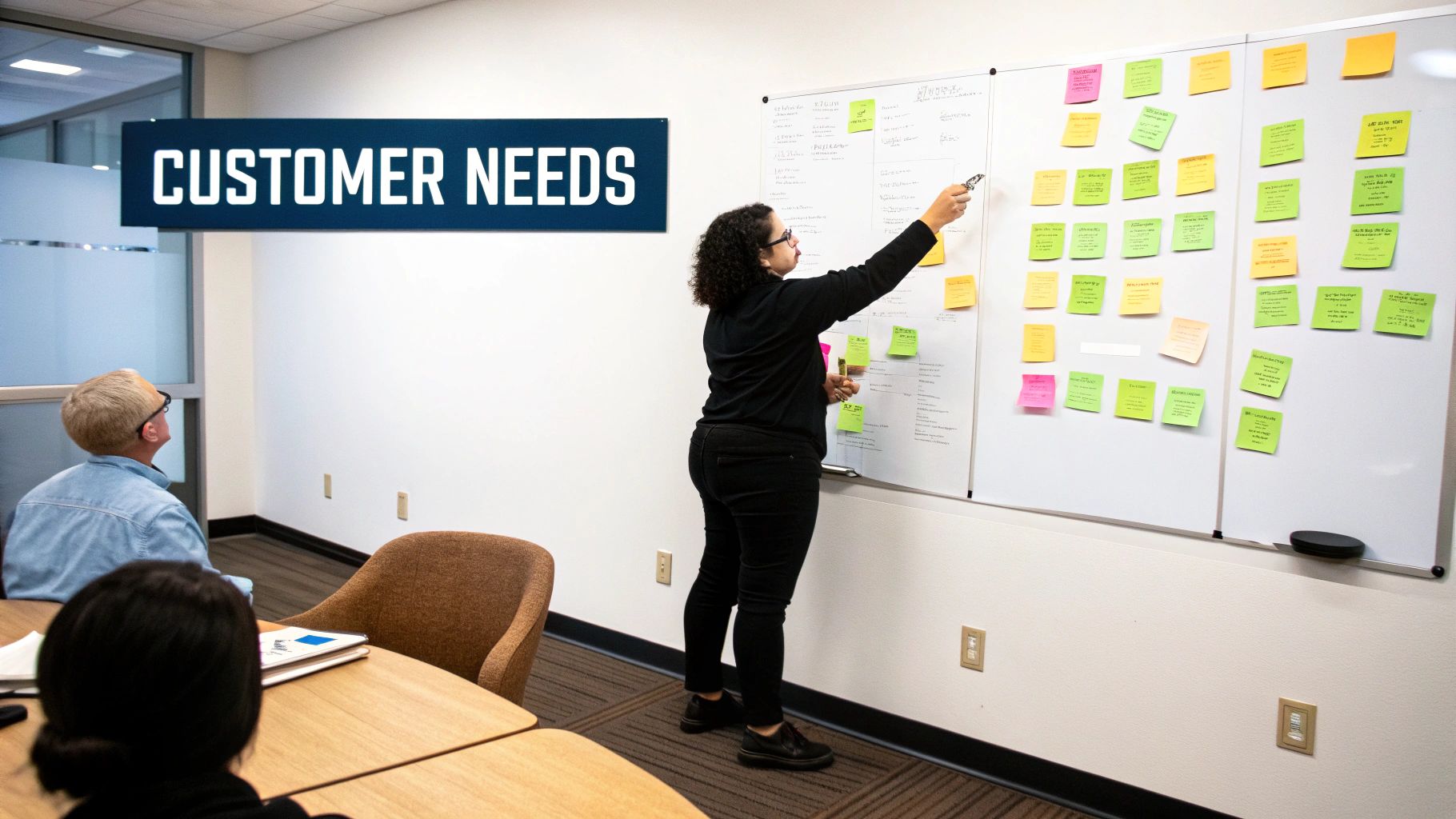
Needs-based segmentation groups users based on the specific problem they are trying to solve or the outcome they desire. It’s rooted in the Jobs-to-be-Done (JTBD) framework, which posits that customers "hire" products to do a specific "job" for them. This is one of the most powerful customer segmentation techniques for driving product innovation.
For PMs, this approach connects a user's core motivation directly to your product's value proposition. It helps you move beyond building incremental features and instead focus on delivering a complete solution to a painful problem.
Key Needs-Based Variables
- Pain Points: The specific frustrations and challenges customers face.
- Desired Outcomes: The ideal end state the customer wants to achieve.
- Jobs-to-be-Done (JTBD): The fundamental progress a customer is trying to make.
- Functional Needs: The practical tasks the product must perform (e.g., "I need to generate a Q4 report").
- Emotional Needs: How the customer wants to feel (e.g., "I need to feel confident presenting to my boss").
Real-World Example: Zoom
Zoom’s meteoric rise was fueled by a deep understanding of needs-based segments. A PM at Zoom knew they weren't just selling "video conferencing." For corporate users, the core need was reliability and security. For educators, the need was engagement and classroom management (e.g., breakout rooms). For individuals, the need was simplicity and accessibility. By building and marketing features tailored to these distinct needs, Zoom was able to capture multiple markets simultaneously.
Actionable Framework for PMs
- Conduct "Jobs-to-be-Done" Interviews: This is a specific interview technique. Don't ask about your product. Ask customers, "Tell me about the last time you struggled with [problem domain]." Dig into the context, the triggers, and the desired outcome.
- Identify Core Needs: Analyze your interview transcripts. Cluster the recurring struggles and desired outcomes into distinct "need" segments (e.g., the "Efficiency Seekers," the "Collaboration Champions," the "Compliance Controllers").
- Map Needs to Features: For each segment, create a clear hierarchy of which features solve their specific needs. This becomes a powerful prioritization matrix.
- Quantify and Validate: Use surveys to quantify the size of each needs-based segment. This ensures you're not building for a niche need, but for a sizable market opportunity. This data is how you get buy-in from leadership for your roadmap.
9. RFM Analysis (Recency, Frequency, Monetary)
RFM Analysis is a simple yet powerful behavioral segmentation technique that ranks customers on three dimensions: Recency (how recently they purchased), Frequency (how often they purchase), and Monetary value (how much they spend). It’s a quantitative method for identifying your best customers and those at risk of churning.
For e-commerce, subscription, and marketplace PMs, RFM is a go-to framework. It’s easy to calculate from transaction data and provides immediately actionable segments for driving retention and increasing customer lifetime value.
Key RFM Variables
- Recency (R): Time since last purchase. Recent purchasers are the most likely to buy again.
- Frequency (F): Total number of purchases. High frequency indicates loyalty.
- Monetary (M): Total amount spent. High value indicates a top customer.
Real-World Example: E-commerce Retailer
An online retailer like ASOS uses RFM to drive hyper-personalized campaigns.
- High R, F, M (Champions): This segment gets VIP treatment: early access to new collections, exclusive discounts, and loyalty rewards. A PM might build a "VIP Tier" feature in the app just for them.
- Low R, High F & M (At-Risk Champions): This is a high-value customer who hasn't purchased in a while. This segment is a prime target for a personalized "We Miss You" push notification with a compelling offer. A PM might prioritize building automated re-engagement flows to target this specific segment.
Actionable Framework for PMs
- Extract Transaction Data: Work with your data team to get a simple export: customer ID, transaction date, and purchase amount.
- Calculate R, F, & M Scores: For each customer, calculate their Recency, Frequency, and Monetary values. Rank them on a scale (e.g., 1 to 5) for each variable. For example, the top 20% most recent purchasers get a Recency score of 5.
- Create RFM Segments: Combine the scores to create segments like "Champions (555)," "Loyal Customers (X5X)," "At-Risk (155)," and "Lost (111)." To better understand how these user groups evolve, it's helpful to learn more about cohort analysis and track their behavior over time.
- Build Segment-Specific Features: Don't just send emails. Build features for these segments. "Champions" could get a referral program. "At-Risk" users could be prompted with an in-app survey to understand their disengagement. "New Customers" could get a tailored onboarding flow.
10. Lookalike and Propensity Modeling
Lookalike and propensity modeling are advanced, AI-driven customer segmentation techniques that predict future behavior. Instead of grouping customers based on past actions, these methods use machine learning to forecast what customers are likely to do next.
- Lookalike Modeling: Identifies potential new customers who share the characteristics of your existing best customers.
- Propensity Modeling: Predicts the likelihood of an existing user taking a specific action (e.g., churning, upgrading, adopting a feature).
For senior and principal PMs, especially at data-mature companies like Meta, Google, or Netflix, proficiency with these models is expected. This is how you move from reactive to proactive product management, making bets based on predictive insights.
Key Modeling Applications
- Lookalike Modeling: Used by growth PMs to find new, high-value acquisition channels by targeting audiences that "look like" their best customers on platforms like Facebook or Google.
- Propensity to Churn: Identifies at-risk users before they leave, allowing PMs to build proactive retention features or trigger interventions.
- Propensity to Buy/Upgrade: Pinpoints users most likely to convert, enabling targeted in-app promotions or sales outreach.
- Propensity to Adopt: Guides PMs on which user segments to target for a new feature beta or launch, maximizing early adoption rates.
Real-World Example: Spotify
Spotify uses propensity modeling to drive its premium subscription growth. A PM at Spotify has access to models that analyze a free user's listening habits, playlist creation frequency, and ad interaction. The model assigns each user a "propensity to subscribe" score. Users with a high score receive targeted offers (e.g., "3 months for $0.99"), maximizing conversion rates and marketing ROI. This is a far more efficient approach than blasting the same offer to all free users.
Actionable Framework for PMs
- Define the Objective: Partner with a data scientist. Clearly state the outcome you want to predict: churn, conversion, or feature adoption. This defines your model's target variable.
- Feature Engineering: Work with data science to gather and clean high-quality historical data. This is the most critical step. It includes user behaviors, demographics, and transaction history.
- Build & Train the Model: A data scientist will select the right algorithm (e.g., logistic regression, XGBoost) and train the model on your data.
- Score & Segment: The model assigns a propensity score (e.g., 0-100%) to each user. You can now create segments like "High Churn Risk (score > 80%)" or "Likely to Upgrade (score > 75%)."
- Activate in Product: Use these predictive segments to drive product decisions. Trigger a special offer for the "Likely to Upgrade" segment. Put the "High Churn Risk" segment into a proactive retention flow with a survey and a targeted intervention. Continuously monitor and retrain the model.
From Insight to Impact: Activating Your Segmentation Strategy
You now have an arsenal of ten powerful customer segmentation techniques. The path from a junior PM to a product leader at a company like Google or Meta is paved with the ability to move beyond knowing your customers to deeply understanding them in distinct, addressable groups. Mastering these methods is a core competency that directly correlates with your ability to influence roadmaps and ship products that win.
However, the greatest pitfall is treating segmentation as a purely academic exercise. The goal isn't a complex diagram; it's actionable insight that drives measurable business outcomes. The value is unlocked in the activation of these segments.
Bridging the Gap from Data to Decisions
Avoid "analysis paralysis." Start with the two or three techniques that provide the most immediate leverage for your product.
- For a B2B SaaS PM: Start with Firmographic and Needs-Based Segmentation. This combination lets you target the right companies and then tailor your value proposition to the specific problems each segment needs to solve. A recent job posting for a Senior PM at Atlassian required "experience with enterprise customer segmentation to inform roadmap prioritization."
- For an E-commerce PM: Begin with RFM Analysis and Behavioral Segmentation. This duo is a powerhouse for identifying your most valuable customers, driving retention, and personalizing upselling campaigns.
- For a Consumer Mobile App PM: A blend of Psychographic and Behavioral Segmentation can be a game-changer. Understanding user lifestyles and in-app actions helps you craft engagement loops that resonate on a deeper level.
Operationalize your segments. They must become living entities within your product analytics platform (Amplitude, Mixpanel), CRM (Salesforce), and marketing tools. When your segments are just a click away, they move from a static report to a dynamic lever for decision-making.
Key Takeaway: A segmentation strategy that lives only in a PowerPoint deck is a failed strategy. The true test of its value is its daily use by product, marketing, and sales teams to make smarter, faster, and more customer-centric decisions.
The Continuous Cycle of Refinement
Finally, customer segmentation is not a one-and-done project. It is a continuous process. Markets shift, competitors emerge, and customer needs evolve. The segments that defined your user base six months ago may already be obsolete.
Set a quarterly or bi-annual cadence to revisit and validate your segmentation model. This iterative approach ensures your product strategy remains aligned with the reality of your customer base. The ultimate goal is to deliver uniquely relevant interactions. Discover more about how to personalize guest experiences with data, a principle that applies far beyond hospitality. By continuously refining your view of the customer, you build a sustainable competitive advantage.
For PMs looking to deepen their strategic thinking and operational excellence, I highly recommend the resources from Aakash Gupta. His newsletter and content provide the kind of actionable, real-world advice that separates top-tier product leaders from the rest. Explore his work at Aakash Gupta for frameworks that will help you turn customer insights into career-defining products.
