Check out the conversation on Apple, Spotify and YouTube.
A comprehensive guide to engineering delight in AI products from Spotify’s Wrapped creator and Google’s Delight Team PM. Learn how Nesrine Changuel built emotional connections into products used by millions, discover the 4-step Delight Model, the 50-40-10 rule for roadmaps, and understand why ChatGPT has 800M users while your AI feature struggles with adoption.
Here is the transcript:
Introduction (00:00:00)
Aakash: The AI products that win – ChatGPT, Cursor, Claude Code – they delight. They’re not just better at their functional job. They’re doing something most AI product builders miss: engineering delight. When we build products, we are supposed to meet both dimensions: the functional needs of our users, but also the emotional needs of our users. And if we only focus on the functional part, there’s a risk, and I see it as a trap.
Nesrine Changuel is the product leader behind Spotify Wrapped and Google Meets AI transcription. In today’s episode, we’re going to dig deep into how to engineer delight into AI products and beyond. Today, she’s going to break down her exact toolkit to engineer delight into your AI products.
Really quickly, I think a crazy stat is that more than 50% of you listening are not subscribed. If you can subscribe on YouTube, follow on Apple or Spotify podcasts, my commitment to you is that we’ll continue to make this content better and better. And now on to today’s episode.
Nesrine, it’s so nice to be filming with you. How are you?
Nesrine: Hi, Aakash. I’m excited to be with you as well.
Aakash: So we met up for breakfast. We planned out an amazing session for people today. I think they’re going to get a ton of value here. Let’s start here. What’s the one thing that separates billion-dollar AI products from the graveyard of forgotten tools?
The Foundation: Function + Emotion (00:03:30)
Nesrine: Let me be clear. When I talk about product, I talk about successful products. And I talk a lot about how can we create standout products. And those standout products have something in common. They blend, while building the product, two dimensions. They blend the functional dimension and the emotional dimension into the same core experience.
So I do believe that for products to stand out and to differentiate themselves and to create what I call excellence, it’s really important to create them in a way that we address both functional needs and also emotional needs. So that’s the essence when I talk about delight. It’s about creating those two dimensions while crafting the solution, not separately.
Aakash: So why do some products feel like they’re delivering on both of these areas of delight and others fail?
Nesrine: Because some of them are authentic and others might feel like something on top, a bit like fake. Let’s be transparent. So I usually distinguish between different types of delight. There is what I call the surface delight and there is the other type which is the deep delight.
And here’s the thing. When we talk about surface delight, these are just those shiny moments, those confetti effects, those animations that make the product a little bit brighter. And of course, we know that they are nice to have, but it’s not necessarily what is making this strong emotional connection that I’m talking about.
However, on the other side, the deep delight is when we create functional solutions while addressing emotional needs while building them. So you see the difference? It’s not about sprinkling confetti on top of utility. It’s about creating the product while addressing the emotional need at the same time. So that’s the big difference between the two types of delight.
When Delight Goes Wrong (00:09:00)
Aakash: I think that’s a really important distinction. Why do some AI products just shoot themselves in the foot?
Nesrine: So when we talk about delight, let’s be very clear. It’s about emotion. And by the way, one element that we can address and clarify here is that delight by itself is an emotion. And there have been some studies conceptualizing delight as a combination of two primary emotions. These emotions are joy and surprise.
So just think about yourself. If you are in the moment where you are experiencing joy and surprise at the same time, then you are delighted. The problem is when we talk about emotion, what makes you happy is not necessarily what makes others happy. And even yourself, you might be happy with a situation that might not make the same effect on you in other situations.
So inclusiveness is really, really important in that aspect and making sure that you create that joy instead of disappointment. You see, that’s the problem. And I’ve seen this in action, unfortunately, in many products. We can talk about a few products that tried to be delightful but in some situations turn out to be, unfortunately, more disappointing than delightful. And I brought two examples to share with you today.
Aakash: Let’s take a look.
Nesrine: Yes. So the first one is actually that went viral, I think, on social media. People spoke about it. It’s this Apple message AI summary. So of course the idea was like when you receive a long message on your phone, then you get like a short two sentences summary. And that’s supposed to reduce friction for you and make it easier for you.
However, there are situations where summary doesn’t make sense at all. And I’m taking this screenshot because this post went viral on LinkedIn and X and a lot of social media. And it’s a real situation that someone got a long message from his girlfriend saying that she’s leaving and she’s quitting and she wants to take her belongings. And it’s actually a very long message with a lot of explanation.
But if you see the message, how it went and came as a summary – “no longer in a relationship, wants belongings from the apartment” – it was so cold. And funny enough, it was his birthday. I mean, that’s exactly the opposite of delight. That’s when you try to bring joy but it turns out to be disappointment.
So there are moments where delight doesn’t work if the emotions are not addressed exactly as they should be. That’s the first example.
Aakash: That’s crazy. Like this is like AI gone rogue, right? So yeah, and it’s very hard to predict as a product manager that you might have created your eval test suite of 200, but you didn’t create the one about breakup messages and just being super sensitive there. And all of a sudden, this is out there in the wild. And so this is the type of problem people trying to engineer delight have to really work around.
Nesrine: Yes. So that’s actually something I did a lot as a PM – looking at corner cases because we don’t want to have bad press. We don’t want to hurt users. I mean, it’s better not to bring delight than to bring delight the wrong way.
So for example, when I worked on Google Meet and we introduced filters, we made sure that it worked on all skin tones. And there had been one skin tone that it didn’t work well. We did not ship the feature because we don’t want to hurt even like 0.01% of the population. That won’t be aligned with the value of the product and that will not be delightful because it’s not aligned with our values. So that’s an interesting case.
The other case I wanted to bring is actually a real story from one of my best friends who actually shared this story with me. And we are all users of WhatsApp in one way or another. And she actually – it happens that she lost her brother quite recently. And she was scrolling some messages on WhatsApp and found out there is a picture of her brother holding her baby, like her six-month baby at the time.
So she clicked on the picture and she couldn’t get the picture. And instead she got this very similar message to this saying, “This picture is no longer available. Ask John to resend it.” You know, this kind of – the fact that “ask John to resend it” in that grief moment was the worst message, she said, that she could even receive. She said she was willing to not use WhatsApp anymore.
So sometime it’s about choosing the wording so you make sure that it’s appropriate for all cases and all situations.
Aakash: That’s absolutely wild. Yeah. I think that this is only getting tougher with AI features.
The AI Trap (00:16:15)
Nesrine: Yes. So here’s the thing. AI is making a lot of progress when it comes to functionality. And remember I said something in the beginning – that when we build products we are supposed to meet both dimensions: the functional needs of our users but also the emotional needs of our users.
And if we only focus on the functional part because AI is allowing us to progress so fast in developing functional features, then there’s a risk, and I see it as a trap, that we ignore a little bit the emotional need and we become just functional products. And that’s the worst case that we don’t want to fall into.
So it doesn’t mean that we should not work with AI the way it is today. But in the opposite, we need to train AI to be better at addressing emotional needs. And we see quite nice products like succeeding in doing it. The most important thing, and that’s why I want to talk about this inclusiveness, is to ask yourself the following question: is it inclusive enough? Is there any corner case that has not been addressed? Test. And if not, how can I train my agent, how can I train my machines to make sure that I am experiencing most of the cases to avoid whatever bad harm might happen out of that?
Aakash: I think you had shared with me an interesting example from Deliveroo around this.
Nesrine: Yes, because that’s an interesting case as well since we’re talking about the bad corner cases. And that’s something that just happened last year. So I’m based in Paris. And on Mother’s Day, Deliveroo tried to do a delightful campaign.
So what they did – and these are real screenshots by the way – they sent a notification on all users’ mobiles. And the notification, as you can see, looked exactly like a missed call. So this is written in French. It says “appel manqué,” which means literally “missed call from your mom.”
And so again, when you click on this, you’re supposed to get like, “Hey, it’s Mother’s Day. Think about your mother. Send her flowers.” Blah blah. I mean, we can help you doing that. That’s what the campaign is all about.
But again, this is something that had the worst press ever because a lot of people felt hurt. And not everyone can feel the joy out of this supposed-to-be delightful moment. Some of them felt weird, some others felt grief, some others felt sorrow. And so again, this is a pure example when delight can go wrong if it’s not addressing all cases and all corner examples.
What Makes ChatGPT Successful (00:21:45)
Aakash: I think the delight challenge around corner cases is perhaps hardest for something like ChatGPT, right? It needs to succeed in every single corner case. What is ChatGPT’s success really about? Is it about delight? What makes ChatGPT so successful?
Nesrine: So if we talk about ChatGPT, ChatGPT is definitely one of the products now that is used by most people around. Again, we might not maybe all agree on how it’s used. Some are using it more like a search engine and others using it more as a companion, and I like this concept of I’m using ChatGPT as a companion or like a co-writer or coworker.
So I’ve been talking a lot with many of my friends and ex-colleagues about how are they using ChatGPT. And I’m realizing that a lot of my friends are paying subscriptions to ChatGPT not for the functional part but for the fact that they are feeling less lonely with the product. Like especially – I personally very recently moved from being a full-time employee in a very well-established organization to working by myself and having ChatGPT on my side to honor that need of creating that companion feeling and feeling less lonely aspect.
So that’s one part because, I mean, again, the set of emotions is not necessarily the same for all products. I mean, when we talk about Spotify, the set of emotions that I’m looking for while using Spotify is definitely not the same set of emotions that I might be looking for while using ChatGPT.
So it’s really important, whatever product you are building, to identify what set of emotions you want to feel and build toward achieving those emotions.
The Humanization Technique (00:28:00)
Aakash: That was great. So in the case of ChatGPT, how do we make sure that we achieve that sense of belonging, that sense of company into the product?
Nesrine: So here’s the thing. We as human beings have some core values and we have some core needs. And these needs, of course, we are doing our best to honor those needs. And one of the needs that is very evident, and it’s gotten even more proven during COVID time, is the fact that we want to be closer human to human. So we want to be, of course, in company. We want to be closer to other peers.
And this is a concept that also can be very much integrated into tech products. Here’s the thing. I can talk about a technique that I’m calling humanization. What it means is, how can we build products that feel like it’s a human? It’s not necessarily a machine.
What I mean by that is asking yourself the question: if my product was a human being, how would the reaction be? How would the service be? And then compare your product to that level of service or that level of product.
And I’m bringing here an example because it’s a real conversation I had with the head of product back then from Dyson. And I asked Andy, like Andy the head of product from Dyson, like hey, how come that I love my vacuum cleaner? Like it’s a vacuum cleaner. And I feel proud of having it. I show it to my guests and friends. And how come?
And he shared an interesting story with me. He actually said, “We do not compare our vacuum cleaner to competitors. We do compare our robot to how it would have been done better if it was done by a human being.” You see the point?
Actually, he told me that if you hire someone to clean your house, you probably ask that person to start with a certain room or you probably clean in a certain way. And they got inspired by this kind of recommendation system to add it into their robots.
And the reality, Aakash, is that that’s exactly what we did at Google Meet as well. Because when I worked for Google Meet, we almost never compared Google Meet to Zoom or to Teams or whatever, but we compared Google Meet to how it would be better if we were all in the same room having the same meeting, but in a human style.
And if you do so, you raise the bar because that’s exactly what our brain is so willing to have. And that’s exactly what we want to have as well. So for example, we developed features like hand raise or we developed features like emoji reactions. These features were born out of conversations like, if my product was a human, how could the experience be better?
Aakash: That’s fascinating.
Emotional Connection & Competition (00:34:30)
Aakash: So when ChatGPT is thinking about engineering delight, and it’s thinking about it, you know, we’ve already said don’t think about it too much from a competitive lens, think about it more from a humanistic lens. But you’re living in a competitive marketplace versus a Claude or something like that. Are these integrations, are these good factors that a PM should be considering, good tactics to potentially build more delight into their product and differentiate from the competition like Claude?
Nesrine: From my perspective, and I’ve seen this working both for the products I’ve been building but also in so many other products, competition is very easy if we compete on the functional side only. I mean, if you have a product that is brilliantly engineered and users are using it tomorrow, if they find another product that gives them the same set of functionality, users will feel very easily – I mean, they – there’s no attachment. They can easily move to the new product, especially if you offer them like a lower price.
However, here is the secret ingredient that products or successful products use to create loyalty. It’s about creating that emotional connection. If you invest in creating that emotional connection, it will take time by the way. It’s not a feature. It’s not two features. It’s a relationship that you need to build. And you need to build from the start by the way, because you want to gain the trust. You want to gain the confidence. And you want to gain the proudness as well because you want to make sure that users are proud enough to tell the word.
So if you invest in this emotional connection, then it’s much, much harder for your user to move to a competitor. And that’s why I really emphasized on the fact that delight is a lens of differentiation. It’s a lens for growth. It is a driver for standing out and having a longer relationship with the users.
And by the way, I want to highlight something maybe interesting for our audience here. There have been recently quite interesting research. And this research has been conducted by giants like Capgemini, Deloitte, Harvard Business Review, McKinsey. Actually, they all studied the same thing. They studied the impact of emotional connection on product adoption.
And so out of these reports – and I spent weeks trying to like compile and get the best out of these reports – I realized that there is a consensus. And the consensus is saying that emotionally connected users are twice more likely to stay longer, twice more likely to recommend your product, and twice more likely to buy more products and services from you.
So you are doubling revenue, retention, and referral just with the ingredient of emotional connection. And by the way, do you know what they are comparing these numbers to? They are comparing them to highly satisfied users. So the two buckets are highly satisfied users and emotionally connected users. So you see the potential by investing into this area.
The Three Types of Delight (00:40:00)
Aakash: So as I was reading your book, thank you so much for writing this. I think one of the coolest resources you put in here was that there were three types of delight. Can you walk us through those and how those might relate to AI products?
Nesrine: Yes. So here’s the thing again. We always get back to this concept of every product is created for two reasons: for functional reasons and for emotional reasons.
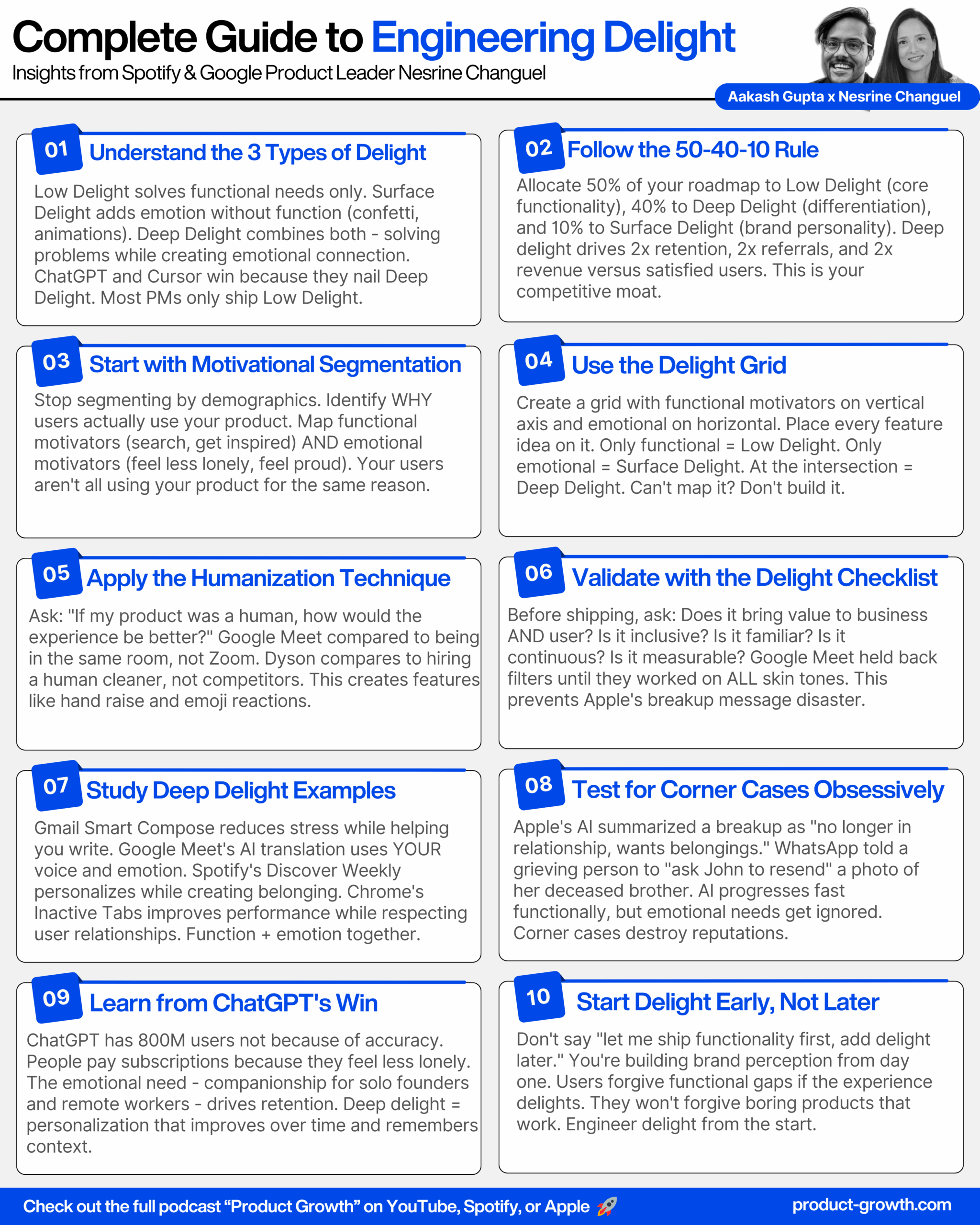
If the feature you are building is only solving for a functional reason, there’s no emotion into it, then it belongs to this category that I call the low delight. If your feature is only solving for an emotional need and there is definitely no functional need into it, then it is a surface delight.
Think about this confetti thing or these Easter eggs that we see nowadays in some products or even the emojis in Slack or the emojis in ChatGPT as well in order to add this tone and the fun effect in the output.
And then the third category is what I call the deep delight. And that’s when functionality meets emotion. And that’s when we create products that are blending the two dimensions together.
So let’s maybe go through some examples so we understand a little bit more these categories. I think the low delight category is very easy to understand. That’s what most people are doing nowadays. We are building features that work, and that’s what we want.
Now, the surface delight is actually something – for example, just happened to me a few weeks ago. It was my birthday. And on my birthday, my Apple Watch just popped up some balloons and some interesting confetti saying happy birthday on the screen. Is there any functional need for that? Maybe not.
Same for Wrapped, by the way. And I’m going to surprise you now because a feature like Spotify Wrapped, which you get like this retrospective toward the end of the year, there is no functional reason for having Wrapped. It’s all about making you feel cool so that you can share it with your friends. And these kind of features might sometimes have a lot of positive impact on the business and the product because a feature like Wrapped had a huge impact on the app downloads. Just Wrapped by itself had a huge impact on the app download.
The 4-Step Delight Model (00:46:30)
Aakash: So if you’re trying to decompose it into a model, which you have done in your book, what would that model be? What is the Delight Model and how can you engineer delight?
Nesrine: So after, like, with my own experience and also by interviewing a lot of leaders from different industries – by the way, I checked hardware industry, B2B industries, tech industry like GitHub or Snowflake. I mean, these are companies that I don’t necessarily have big knowledge about how they develop their product, but I spent a lot of months interviewing them.
Actually, I have a research background. I did a PhD in my early days. So I put my researcher hat again and I did my research to try to consolidate both my knowledge together with what I consider successful outside of my knowledge. And I ended up creating what I call the Delight Model.
So the Delight Model – I’m more calling it as a model because I see it more like a mental model. First of all, delight is a mental model. You need to be convinced that you need to delight your customers.
And here’s the truth, Aakash. The reality is that now that I’m coaching companies and founders, I think and I see that most companies and most founders agree that we need to delight our customers. They will tell you we should delight our customers. All of them, all industries confused. The only thing is that they don’t necessarily know how to.
So we agree on the goal. We just don’t know necessarily how to. So that for me was an eye-opener and a revealer that I needed to put this into something actionable. I needed to put it into something step by step that people can benefit from.
So the Delight Model is a four-step – think about it as a model or a process that works the following. The first step is about identifying users’ motivators. The second step is about turning those motivators into real product opportunities. Once you identify those opportunities, you create solutions and you categorize solutions into these different types of delights. And then the last step, which for me is fundamental and very necessary, is about validating delight.
Why? Because we don’t want to get into that bad press and all the risks that we started the session with today. So these are four steps that operate into the opportunity space and the solution space. And if we follow them step by step, then we can guarantee, at least, that we can achieve this goal of delight.
Motivational Segmentation (00:54:00)
Aakash: So I assume there’s a lot of depth here that we could go into. Let’s start with identifying a user’s motivators. What are the next-level layers and techniques to do this?
Nesrine: Well, yes. So it might be surprising, and a lot of times when I talk about this to leaders and founders, I surprise them the first time, but then they agree. The reality is that users use your product, but they are not all using it for the same reason.
So you think that you’re serving them the product for a reason, but they are using it for different reasons. And here’s the thing. When you’re building a new feature or a new product, of course, you have to start with segmenting your users. You need to start by doing your personas and creating your personas to understand who they are.
But what I see nowadays is that there are different types of segmentation. There is the demographic segmentation. It’s about who they are. And there’s a second type of segmentation, which is more about the behavioral segmentation. And that’s a little bit better than the demographic segmentation.
But the very best one is the motivational segmentation. It’s the why. It’s why your users are using your product. And you need to invest, and that’s the very first step. If we skip that step, the rest will not match. We need to start by listing what motivates my users on the functional side and what motivates my users on the emotional side.
Here’s an example. When I built Spotify together with my team, we know that from a functional side, some people go to Spotify knowing exactly what album they want to listen to. So they want to search for a specific album. But there are also other users who have no idea what they want to listen to. They go to Spotify to get inspired. So another need could be “inspire me” or “I want to get inspired,” whatever thing that you know about me, maybe my tastes, my preferences.
So these belong to the functional motivators. On the other side, a lot of people go to Spotify just because they want to change their mood or because they want to feel less lonely or they want to feel more productive. So these are also areas – let’s call them emotional motivators – that need to be identified.
Why? Because when you build the feature later on in the process, you want to blend them together to create that emotional connection. So for me, that’s the most important part. It’s about identifying the motivators but also from the functional side, but not only. Please, not only. Because most of the people I spoke with are really good at identifying functional motivators. Think about the emotional motivators of your users.
And if you manage to get them right, it’s a continuous process, by the way. It’s not like a one time and then I’m done with my motivators. Every time you have an opportunity to speak with your users, try to ask these questions like, walk me through the journey of using the product and describe how you feel. Even if you don’t ask that question, take notes. As the example of Google Chrome – this frustration feeling, this shame feeling, this relationship feeling – address that and write them down.
The Delight Grid (01:00:00)
Aakash: So you put together this delight grid that helps us walk through these. Can you walk us through that?
Nesrine: Yes. So the Delight Grid is another tool that I’m also describing very well in the book. And it’s why, by the way, I created this Delight Grid. It’s about helping teams who still wonder: is my feature delightful? Am I into the surface delight? Am I into the deep delight?
I created what I call this Delight Grid. And the best way to think about the Delight Grid is to use the motivators that we just spoke about. So remember, I spoke about functional motivators and emotional motivators.
All you have to do is go to your grid and write your motivators in the grid. So you see here on the vertical side you have the functional motivators. On the horizontal side you have all the emotional motivators. Why do we do that? Because once this is done, you’re gonna go and place your ideas from the backlog.
And if a feature is only solving for functional motivators, then it belongs to the low delight category. If the feature is solving only for emotional motivators, then it belongs to the surface delight. And we spoke of that. And then the rest is about deep delight.
And what I love about the Delight Grid, it’s not only a categorization tool. It’s a tool that will force you that every feature you are building in the product is connected to a motivator. I mean, if you can’t map it in the grid, it’s probably not something that needs to be there at all.
And I did this workshop with a lot of organizations where we tried to categorize their features in the Delight Grid. And we end up having three, four features that we are not at all able to map them. It’s like, okay, if the user is not at all asking for it and there is no motivator for it, do you think it’s really necessary to build it? And it’s usually great food for thought to think whether it’s really needed or not.
The 50-40-10 Rule (01:05:30)
Aakash: Since we’re talking about the Delight Grid, I usually – I want to be very clear. I’m not here to say that it’s not because it’s called low delight that we should not invest in low delight. And here is my clarification.
I get asked a lot of times about, hey, how do we prioritize between this low delight versus deep delight and surface delight? So I came with this rule that I’m calling the 50-40-10.
Nesrine: The 50-40-10 is a recommendation. Think about it as a recommendation where I recommend your backlog or your roadmap to look like the following: 50% would be more for low delight, 40% for deep delight, and only 10% for surface delight.
You might be surprised me telling you 50% of your roadmap should be low delight, but it’s actually so necessary. I mean, your product exists for a reason, and this reason needs to be there and needs to function the right way.
Now, if you can allocate 50% of the rest of your backlog toward the surface delight and deep delight, then you’re going to win. That’s what will make you different, and that’s the pure delight.
The Delight Checklist (01:09:00)
Aakash: So one more thing that you had put in the book that was a very interesting tool that I thought I personally will take away and use is the Delight Checklist. Can you walk us through?
Nesrine: Yes. So the Delight Checklist is a tool that comes more toward the fourth step of the process. So when we are done with generating ideas, categorizing ideas, understanding how much of them is low delight, surface delight, deep delight, then comes the time when you’re about to start building them. Check: is it really delightful? Is it bringing me the value that I want to bring to the customer, to the user, and to the business?
So the Delight Checklist – think about it as a guideline that you take every feature and ask the following questions. So it’s not only a list of categories, it’s a list of questions as well.
So the first two, which for me are really important, is: is this delightful feature bringing any value to the business? And does it bring any value to the user? Because for me, delight is not an excuse to add confetti. It’s about, again, aligning with business goals and KPIs and metrics. And also the same – I mean, we spoke about this example of confetti.
And I would love to share an example since we’re talking about confetti here. I want to share an example from Airbnb because I’m an Airbnb user, both as a guest but also as a host. And as a host, I have a goal. And my goal is to make sure that I maintain my Superhost tag.
Yeah, I mean, I work hard. I work hard to get that. I mean, for me it’s an achievement. And of course, I depend on users’ reviews. I depend on my quality of service, a lot of things. But Airbnb actually reassesses my ability to remain Superhost every three months.
And you know what? Every three months when I’m still a Superhost or I’m re-evaluated to stay Superhost, the app turns into confetti. Again, this is surface delight. Yes. But for me, it’s an interesting example because I feel like Airbnb is valuing the effort and recognizing the effort I’ve been putting into that goal. So I feel like the app is celebrating it with me.
So confetti or not confetti, is it aligned with your business goal? Is it aligned with your user’s goal? Those are the two. And the rest is like other guidance.
For example, have you been investigating enough to get insight from your users? Have you collected motivators from your users and from your data? You can also check whether the feature looks familiar or not.
I really like this example because if you come up with something completely new – I mean, of course, we are told that we love innovation, but we actually hate when it’s completely new.
I mean, I see you’re surprised. So I will share a story with you. A story you might even know about, which is the story behind Discover Weekly. So Discover Weekly turns out to be one of the most successful features of Spotify.
And do you know that Discover Weekly’s success on Spotify really came out of a bug? Because the real story behind Discover Weekly is that it was supposed to bring you only new tracks that you never listened to before. That’s why it’s called Discover. It’s all about making you discover new tracks.
And so when we shipped Discover Weekly the first time, we checked metrics and we’ve seen that they are all successful. Things are going so well. But two weeks later, the engineers realized that there’s a bug in the feature. And the bug is actually injecting some liked songs from time to time into Discover Weekly.
And we started to question, what the hell? This is not supposed to be that way. And so they fixed it. And do you know what happened when they fixed it? Absolutely. Things went down.
And so that was an interesting moment to think like, hey, people love Discover Weekly because from time to time they found something familiar into it. But if it was completely new for them or unfamiliar, then it won’t get that success.
So inspired by that story, I put familiarity as an interesting point to check when you’re building features. Think about – even Google Glasses didn’t work the first time because we’ve never seen them before. However, nowadays, when you see someone with the Apple glasses or things, they start to become more familiar and so more successful.
So again, I don’t think we have time to go through them all, but it’s about making sure that it’s feasible. It’s inclusive. Again, this is really, really important. We started the session talking about it, and it’s never enough to talk about inclusiveness when we talk about emotion.
It should not be distractive. It’s not about distraction. It should almost not feel there. I mean, the most delightful features are those that you almost do not notice.
So if it should not interfere between the user and the product, it’s about the experience, not the feeling. Again, continuity. We spoke about the habituation effect. Do you have a plan to make this continuous? Do you have a plan to make this delight continuous, or is it like a one-off and then you move away?
And of course, it’s about measurability because people think that delight is not measurable. However, there are ways of assessing user satisfaction. There are ways to measure users’ happiness. And you need to align your delight metrics with your business metrics in order to make sure that you’re serving for the right thing.
Deep Delight Examples (01:13:30)
Aakash: I think two other examples that people should really pay attention to. So one is Claude Code. So I think that they’re getting their deep delight and they’re winning right in this developer market against a GitHub Copilot or a ChatGPT Codex where they’re infusing similar things like autocomplete, like a Gmail Smart Compose, but they’re adding on – they have these crazy verbs every time it’s working. It’s like meandering or bamboozling or pontificating or whatever different interesting verbs that they’re putting in there. And similarly, Cursor’s.
So we’re seeing through these spaces in AI products like Cursor, where you just hit tab and it feels like magic as a coder, that delight, and specifically deep delight, is the way to win for AI products. I think it’s probably one of the most important lessons out there.
But a lot of our examples so far have really been in the B2C realm, people could say. Could you give us some examples in B2B?
Nesrine: Yes. So I love, by the way, the example you brought from the AI world. And I just want to complement one more thing because over the weekend I’ve been trying to prototype with Lovable. And again, this is one of those products that everyone starts to know nowadays. I mean, if you don’t know Lovable, it’s like you feel like so much behind.
And I loved the time I spent on Lovable. The reason is not only the output I get or the product I managed to prototype. It’s the sense of achievement out of hours of work. This is a very rare sentiment or feeling I usually get. I was so much impressed not only by the outcome but also by that sense of achievement, which is, again, one of our emotional needs. You want to feel like accomplishing and valued. And that’s an interesting part I just want to complement what you said.
Now, when it comes to B2B or B2C, I just want to highlight one thing here. When we talk about honoring emotional needs, I rarely distinguish between B2C and B2B. I mostly talk about B2H, which is business to human. Because if the user is used by a human being toward the end, then they need their emotion or they deserve their emotion to be honored. So that’s the concept, that’s the mindset I usually do.
Now, I also agree with you. Most of the products I worked on are more toward B2C, like Spotify, Skype, Google Meet. Even if for Google Meet we also addressed the enterprise side and we brought a lot of delight, by the way, in the enterprise side. But the reality is that when I started writing my book, Product Delight book, I interviewed a lot of people from the B2B space in order to get their opinion toward what it makes to build delightful products.
So I interviewed people from Intuit, Atlassian, Miro, Slack. The point was like, hey, I’m considering you as a delightful product. How do you do it? And what I realized – that all those products do integrate the principle of delight. They just integrate them in different ways.
So for example, let me give you an example. When I spoke with some product leaders from Dropbox, I realized that they had a product value called Cupcake. When I spoke to people from Snowflake, which is a pure tech company, I realized that they had a value called Superhero. They want to make their users feel like superheroes. So that’s the point.
And I quickly realized that they have more or less the same goal in order to achieve this excellence and this human connection. They just call it differently. And that’s the beauty part. So whether B2B or B2C, we need to take, or at least think about it, the same way.
The big difference, though – and that’s what I want to highlight – is, again, it’s not the same set of emotions. So if you’re working toward building a B2B product, the set of emotions that you want your user to feel is definitely something worth investigating and trying to understand.
I was talking the other day with a heavy user of Miro, and she told me something quite interesting. She said, actually, what I love about using Miro is that I feel like I’m a better facilitator. I feel like I’m a better leader. And she didn’t say, like, I can use boards or I can move cards or whatever. She said, like, I feel like I can do my job better. I can feel as a better leader.
And that’s an interesting set of emotions in the B2B space to investigate. I’m not saying it is the set of emotions. It’s one of them that you might consider others as well.
Leaving Google & Building a Business (01:16:00)
Aakash: I loved all the stories you shared about Google. How in the world did you leave? What are you up to now? Why did you leave this job that people consider having golden handcuffs?
Nesrine: Okay, I usually sometimes tell people, in order to leave Google, you either have to be crazy or you have a great mission. I don’t think I’m crazy. At least I don’t hope I’m crazy. But I really left Google with a very clear mission in mind.
Having built products for over 15 years in, let’s say, globally used and loved products from Skype time, by the way, to Spotify, Google Meet, I started acquiring this concept of how to build successful products. And when I joined Google, I actually realized there’s even a discipline called delight, and we know how to delight our customers. And most people don’t know how to.
So when I left, I was like, this is really a mission I want to bring to the world. This is what I want to teach others about. This is what I want to demystify because, unfortunately, it’s very much seen as a buzzword.
So when I left, I left with a lot of insights in my head. And my first step was to put that into a written format. So I spent most of the first months trying to, of course, interview – put my hat of researcher back in order to consolidate the biggest knowledge – and then put that on paper. And I wrote Product Delight.
So I was really excited to bring Product Delight to the world through a few weeks ago because now it’s available on Amazon. And what I do nowadays is actually I help organizations through coaching but also training because I organize what I call Delight Days.
So Delight Days is this delight workshop where we work together, not only on understanding the concepts but also getting our hands dirty into building delightful features for their own products.
Aakash: So for the PMs daydreaming about a mission like yours that strong, I’m curious, what’s the real talk here? And feel free to not share if you aren’t comfortable. But you know, how is life like post-Google? That’s a really secure place. How big is the business as a solopreneur now?
Nesrine: I think from the beginning, in the very beginning, it came with a lot of uncertainty. I’m going to lie to you if I say I left Google with a lot of confidence. Let me be transparent with you. When I left Google, it was the most terrifying decision I made in my life.
Most of the experiences or the jumps, the career changes I made so far are toward going to the best – going from a product to another, trying to acquire more knowledge and more experience or better level, at least moving from a PM to senior PM or a leader. And when I moved away from Google with such an established role and company, it was a lot of uncertainties. Like, hey, now I’m getting into this pure unknown world.
But I’m very surprised nowadays that this is opening for me a lot of opportunities that I didn’t get back then. Let me give you – I’m going to be very transparent with you today. I love being on stage. One of the things I do a lot nowadays is public speaking. I speak a lot about different topics.
Actually, I started in this during my research time. When I was a researcher, I traveled the world and I did a lot of conferences. And I kept this for me even during my PM roles. And before leaving Google, the thing that terrified me was like, what if nobody would invite me on stage anymore because I won’t have this “Senior PM from Google” or “PM from Spotify”? I was terrified by that idea.
But let me tell you the truth. The reality is that I’m getting maybe easily 20 more invitations and talk opportunities than before because I’m not a PM anymore. I’m a creator of a model. I’m moving away from being a coach. I’m not just a coach. I mean, I don’t see myself as coaching company based on others’ frameworks. I’m really putting my heart and soul from my own experience to share my model and the framework I created.
So I see that the career is taking another dimension, and I’m really enjoying it a lot. And at the same time, I’m doing things that I love, like teaching MBA students. And I mean, I have the freedom to do the things that I really love at the scale that I love.
Key Takeaways (01:18:30)
Aakash: Amazing. What a role model for people who want to follow that. Do check her out – ProductDelightBook.com. She has an amazing LinkedIn presence as well. Nesrine, thank you so much for being on the podcast.
Nesrine: Thank you, Aakash. Bye, everyone.
Aakash: So if you want to learn more about how to shift to this way of working, check out our full conversation on Apple or Spotify podcasts. And if you want the actual documents that we showed, the tools and frameworks and public links, be sure to check out my newsletter post with all of the details.
Finally, thank you so much for watching. It would really mean a lot if you could make sure you are subscribed on YouTube, following on Apple or Spotify podcasts, and leave us a review on those platforms. That really helps grow the podcast and support our work so that we can do bigger and better productions. I’ll see you in the next one.