As a Product Manager, your career trajectory is defined by the quality of your decisions. Decision-making frameworks are the structured playbooks that senior PMs at Google, Meta, and high-growth startups use to replace gut feelings with a repeatable, defensible process. They are the tools you deploy to cut through ambiguity, align stakeholders, and justify your roadmap with data, not just opinions.
This guide provides the tactical frameworks you can implement within the next 48 hours to make better, faster decisions and demonstrate the strategic thinking that gets you promoted.
Why Frameworks Are Your Most Valuable PM Asset
In product management, you are paid for your judgment. The big calls—prioritizing a new feature that could drive $10M in ARR or killing a legacy product draining engineering resources—land on your desk. Without a structured approach, these decisions become a battle of opinions where the loudest voice, often the HiPPO (Highest-Paid Person's Opinion), wins.
Top-tier PMs don't "wing it." They leverage a toolkit of decision-making frameworks to bring objectivity and clarity to high-stakes situations. Here's why this is non-negotiable for your career growth:
- Defend Your Roadmap: Frameworks provide a logical, data-informed narrative for your priorities. This is how you confidently explain your "why" to executives, engineers, and stakeholders, positioning yourself as a strategic leader.
- Create Team Alignment: When you use a shared system like DACI or RICE, everyone understands how a decision was made. They may not love every outcome, but they will respect the process, which builds your credibility and influence.
- Reduce Decision Fatigue: Frameworks systematize complex choices. This frees up your mental bandwidth to focus on the big picture—strategy, vision, and market dynamics—instead of getting bogged down in daily trade-offs.
- Mitigate Personal Bias: We all have biases. A 2018 McKinsey analysis found that a staggering 70% of product failures stem from biased prioritization. Frameworks force you and your team to evaluate options against objective criteria, pushing back against the cognitive shortcuts that lead to bad calls.
The Evolution From Gut Feel To Guided Logic
Structured decision-making isn't new; it has deep roots in economics and behavioral science. But in today's market, its importance is amplified. With the integration of AI, modern frameworks can leverage predictive analytics to spot risks with up to 85% accuracy. The shift from pure instinct to a structured system is what separates a feature manager from a true product leader.
Mastering these frameworks is a core competency interviewers look for in senior PM roles, which, according to Payscale data from 2024, can command salaries well over $180,000. To get a head start, check out this comprehensive product management template which bakes many of these principles right into a practical workflow.

Quick Guide to Selecting Your PM Decision Framework
Don't get overwhelmed by the options. The right framework depends on the specific problem you're solving. Here’s a tactical cheat sheet to get you started.
| PM Challenge | Best Framework to Use | Primary Benefit |
|---|---|---|
| Prioritizing features with limited engineering resources | RICE or ICE | Objective, data-informed scoring |
| Getting alignment on a complex, cross-functional project | DACI or RASCI | Crystal-clear roles and ownership |
| Making quick, tactical decisions under high pressure | OODA Loop | Speed and adaptability |
| Choosing between high-risk, high-reward strategic bets | Expected Value | Quantifies potential upside/downside |
| Mapping out complex "if-then" product scenarios | Decision Tree | Visualizes outcomes of sequential choices |
| Organizing daily tasks for maximum strategic impact | Eisenhower Matrix | Focuses on impact over mere urgency |
This table is your starting point. The real skill—the one that differentiates senior PMs—is understanding the "why" behind each one and adapting them to your team's unique culture and challenges.
Driving Objectivity with Quantitative Frameworks
We’ve all seen a roadmap get derailed by the HiPPO. To move past subjective debates, you need a system that forces everyone to look at the numbers. Quantitative decision-making frameworks are designed to replace "I think we should…" with "the data suggests…"
If you're a PM at a growth-stage company like HubSpot or Atlassian, these tools are your best friend. Your backlog is overflowing with good ideas, but you only have enough engineering capacity for a few. Frameworks like RICE and ICE provide a structured, defensible way to prioritize work based on its actual business value.
Adopting this mindset is a critical step in becoming a truly data-driven product manager. For a deeper dive, check out our guide on data-driven decision-making in product management.
The RICE Framework Explained
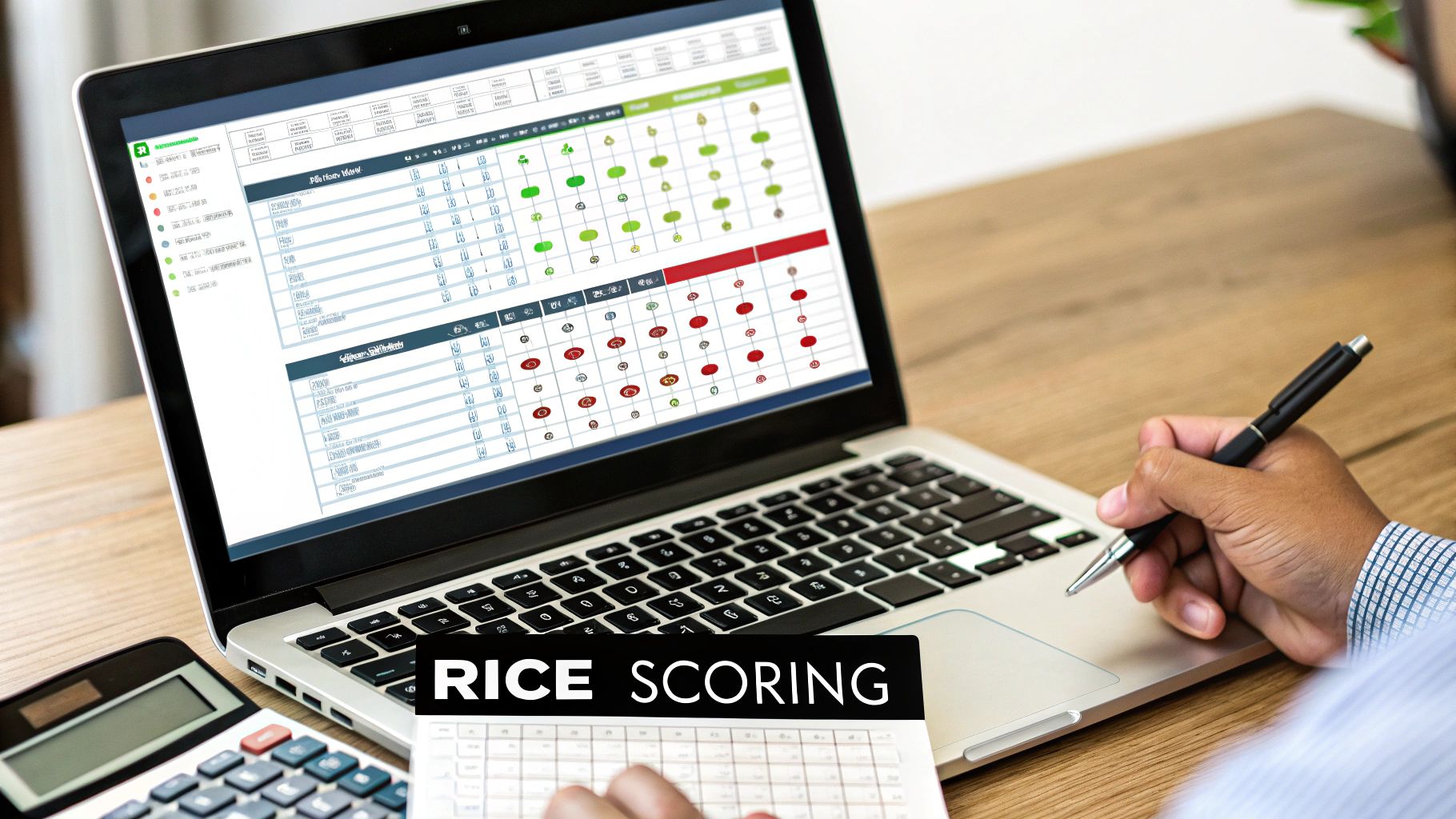
The RICE scoring model is one of the most popular frameworks for product prioritization because it forces you to evaluate each project across four distinct, easy-to-understand criteria.
The formula is simple: (Reach x Impact x Confidence) / Effort = RICE Score.
A higher score moves an idea up the priority list. Let's break down each component for immediate application.
- Reach: How many users will this feature touch over a specific time period (e.g., per month)? Be specific. Use metrics like "number of users completing checkout per month" or "new trial signups per quarter."
- Impact: How much will this move the needle for an individual user? To maintain objectivity, use a tiered scale: 3 for massive impact (e.g., core value prop), 2 for high, 1 for medium, 0.5 for low, and 0.25 for minimal.
- Confidence: How sure are you about your Reach and Impact estimates? This is your defense against optimism bias. Use a percentage: 100% for high confidence (backed by quantitative data), 80% for medium (qualitative evidence), and 50% for low (a pure assumption or hunch).
- Effort: What is the total engineering, design, and product cost? Estimate this in "person-months." For example, two engineers and one designer working for one month is 3 person-months.
Putting RICE Into Action: A Step-by-Step Guide
Imagine you're a PM at an AI SaaS company, evaluating two features: "AI-Powered Report Generation" versus an "Improved User Onboarding Flow."
Here’s the RICE breakdown:
| Feature | Reach (users/month) | Impact (0.25-3) | Confidence (50-100%) | Effort (person-months) | RICE Score |
|---|---|---|---|---|---|
| AI Report Generation | 1,000 | 3 | 80% | 5 | 480 |
| Onboarding Flow | 4,000 | 1 | 100% | 2 | 2,000 |
The AI feature feels more innovative and promises a massive impact. However, the data tells a different story. The Onboarding Flow improvement has a RICE score over 4x higher. It reaches more users with less than half the effort and much higher certainty, making it the clear winner for driving immediate business value by improving activation and retention.
Pro Tip: The 'Confidence' variable is your built-in reality check. Ambitious PMs often inflate the 'Impact' score for their pet projects. If you can't back up a high Impact score with quantitative data (user research, A/B test results) or qualitative evidence (customer interviews), your Confidence score must be low. This discipline is a hallmark of senior product leadership.
Using AI to Accelerate RICE Scoring
You can use AI tools like ChatGPT-4o or Claude 3 to get a head start on RICE scoring, especially for brainstorming initial estimates and pressure-testing your assumptions.
Try this specific, actionable prompt:
Act as a Senior Product Manager at a B2B SaaS company that provides [your product category]. Our current monthly active users are [number]. We are considering building a feature that [describe the feature and user problem].
Help me create a defensible RICE score for our next roadmap review.
- Reach: Brainstorm 3 methods to estimate how many unique users would interact with this feature per month. Provide a specific, calculated estimate.
- Impact: Based on the user problem, score the impact on our tiered scale (0.25-3). Justify your score by connecting it to a core business metric like activation, retention, or revenue.
- Confidence: List 3 key assumptions we are making. Suggest a confidence score (50%, 80%, or 100%) and explain your reasoning.
- Effort: Provide a rough estimate in person-months for a standard pod (2 engineers, 1 designer) to build and ship an MVP.
This prompt provides a structured starting point, forcing you to document your assumptions and making your prioritization process faster and more rigorous.
Navigating Strategy with Qualitative Frameworks
While quantitative frameworks bring mathematical rigor, not every critical decision can be captured in a spreadsheet. Strategic vision, long-term bets, and understanding unspoken customer needs require a different lens. This is where qualitative decision-making frameworks are essential for senior PMs and product leaders.
These frameworks don't provide a calculated score; they guide your thinking. They are the compass for navigating ambiguity, managing your focus, and uncovering what truly delights users. For leaders at design-led companies like Airbnb or Spotify, whose success hinges on user experience and brand loyalty, mastering these tools is as critical as quantitative analysis.
The Eisenhower Matrix: Taming Your Time for Strategic Impact
As a PM, your to-do list is a constant barrage of requests from sales, marketing, engineering, and leadership. The Eisenhower Matrix is a simple but powerful framework for cutting through the noise and focusing on what truly matters for your career and product.
It categorizes tasks not just by urgency, but by strategic importance, using a 2×2 grid:
- Urgent & Important (Do First): These are crises and time-sensitive deadlines. A production outage, a showstopper bug before a major launch. Handle these immediately.
- Not Urgent & Important (Schedule): This is where great product leaders spend their time. This is deep, strategic work: drafting a 6-month product strategy doc, conducting foundational user research, or mentoring a junior PM. These activities drive long-term value, so you must ruthlessly protect calendar time for them.
- Urgent & Not Important (Delegate): These are interruptions that feel pressing but don't advance your core goals. Scheduling meetings, fielding low-priority stakeholder requests. Delegate these without hesitation.
- Not Urgent & Not Important (Eliminate): This is the noise. Mindless scrolling, attending meetings with no clear agenda, or getting pulled into irrelevant email chains. Your job is to eliminate these from your day.
The Eisenhower Matrix is about managing your energy and focus, not just your time. Your goal as a PM isn't to be busy; it's to be effective. This framework forces that critical distinction.
The Kano Model: Decoding Customer Delight
What makes a user love a product? The Kano Model is a framework for understanding customer satisfaction that goes beyond a simple feature request list. It helps you classify features into categories, preventing you from over-investing in table stakes while uncovering opportunities for true differentiation.
This model is a cornerstone for building a comprehensive product strategy framework, as it directly links feature development to customer perception and market positioning.
The Kano Model plots features on two dimensions: how well a feature is executed (Implementation) and how a customer feels about it (Satisfaction). This yields three core feature types:
- Basic Features (Must-haves): These are features customers expect. For a banking app, this is seeing your account balance. Their absence causes extreme dissatisfaction, but their presence doesn't create satisfaction. You must build them, but they won't win you any fans.
- Performance Features (Satisfiers): With these, more is better. Faster load times, more storage, higher resolution. Investing here delivers a linear, predictable increase in customer satisfaction. This is where you often compete directly with rivals.
- Excitement Features (Delighters): These are the unexpected surprises that create loyal advocates. Think of the first time Google Maps automatically rerouted you around traffic. Users don't ask for these, but their presence creates a powerful competitive moat and brand love.
By sorting your backlog using this model, you can make smarter strategic bets: ensure you cover the basics, compete effectively on performance, and then strategically invest in the delighters that turn users into evangelists.
Creating Team Clarity and Stakeholder Alignment
Ambiguity is the silent killer of product velocity. Projects stall and morale tanks when no one is sure who owns a decision. While quantitative frameworks help decide what to build, alignment frameworks define how you build it effectively as a team.
For aspiring product leaders, mastering these frameworks is a direct path to demonstrating leadership. You shift from being a feature owner to the person who makes the entire cross-functional team more effective. This is where frameworks like DACI and RASCI are indispensable.
The DACI Framework for Clear Ownership
DACI is a simple model designed to eliminate confusion on complex projects, especially when many stakeholders are involved.
It assigns four specific roles:
- Driver (D): The person responsible for corralling stakeholders, gathering information, and driving the process to a conclusion. This is almost always the Product Manager.
- Approver (A): The one person who makes the final decision. There can only be one Approver. This single point of accountability prevents endless debate and gridlock.
- Contributors (C): Subject matter experts whose input is vital. This includes engineers, designers, data analysts, legal, and other key partners.
- Informed (I): People who need to know the outcome after a decision is made but are not directly involved in the process. This might include company leadership or adjacent teams.
Defining these roles before a project kicks off solves the "too many cooks in the kitchen" problem preemptively.
Case Study: B2B Pricing Model Launch
Imagine you're a PM at a B2B SaaS company tasked with launching a new usage-based pricing model. This project touches every part of the business, making it a perfect candidate for DACI.
Here’s your setup:
| Role | Individual/Team | Responsibility |
|---|---|---|
| Driver | You (Product Manager) | Lead meetings, gather data from finance and sales, and present the final proposal. |
| Approver | VP of Product | Makes the final "go/no-go" decision on the proposed pricing structure. |
| Contributors | Head of Engineering, Lead Designer, Head of Sales, Finance Analyst | Provide effort estimates, UI/UX feedback, market insights, and revenue projections. |
| Informed | CEO, Marketing Team, Customer Support Team | Kept updated on the final decision to prepare for launch and customer communication. |
This simple chart saves weeks of circular conversations. The Head of Sales knows their input is critical (Contributor) but understands the VP of Product is the ultimate Approver.
As the PM, your job is to guide this process, and a core part of that is knowing how to influence without authority to get the best input from your Contributors.
DACI vs. RASCI: A Quick Comparison
You might also encounter RASCI, a close cousin of DACI that adds more nuance, which can be useful in large, matrixed organizations like Microsoft or Amazon.
- Responsible (R): The person who does the work. (Similar to DACI's Driver)
- Accountable (A): The one person ultimately answerable for the outcome. (Similar to DACI's Approver)
- Support (S): People who actively assist the Responsible person.
- Consulted (C): Experts who provide input. (Similar to DACI's Contributors)
- Informed (I): Kept in the loop post-decision. (Same as DACI's Informed)
The key difference is splitting Responsible (the doer) from Accountable (the owner). For most product teams, DACI’s simplicity is its strength. But if your projects involve complex operational handoffs, RASCI can add that extra layer of precision.
To ensure you're including the right people, check out a practical guide to stakeholder analysis to map everyone out methodically.
Choosing the Right Framework for Any Situation
Having a toolbox of decision-making frameworks is useless if you don't know which tool to grab. Using a complex, data-heavy model like RICE for a simple decision leads to analysis paralysis. Conversely, relying on a lightweight alignment tool for a high-stakes prioritization call is a costly mistake.
The skill of a decisive product leader is matching the framework to the context. It's about diagnosing the situation and picking the system that brings clarity, not complexity. Your goal is always to make a better decision, faster.
A Decision Tree For Product Managers
Before reaching for a framework, run through a quick diagnostic by asking a few key questions. This mental flowchart can guide you to the right tool in minutes.
The decision tree below gives you a simple visual flow, focusing on your primary goal, data availability, and team size.
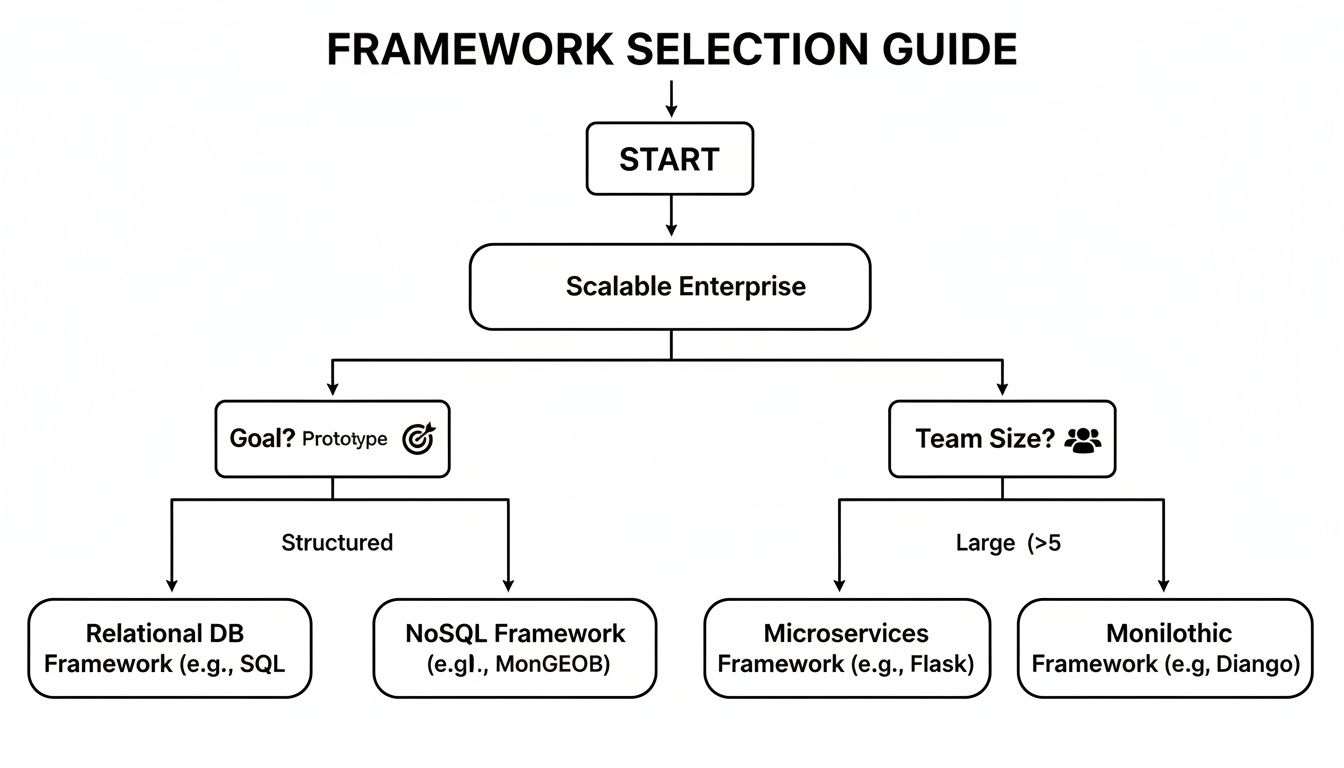
This visual guide helps you quickly map your challenge—whether it’s prioritization, stakeholder alignment, or rapid execution—to the most effective framework.
Here are the diagnostic questions to ask yourself:
What Is My Primary Goal?
-
Prioritization: Is your main challenge stacking a long list of features against limited resources? You need a quantitative framework. Reach for RICE or ICE to force an objective, data-informed comparison.
-
Alignment: Is the biggest risk confusion, delays, or conflicting stakeholders? Your top priority is clarity of ownership. Use DACI or RASCI to create a clear map of who does what.
-
Focus & Strategy: Is the challenge managing your own time or making broad strategic bets? You need a qualitative guide. The Eisenhower Matrix is perfect for personal focus, while the Kano Model helps with strategic feature categorization.
What Is The Quality Of My Data?
-
Data-Rich: If you have solid quantitative data on user behavior, engagement metrics, and market size, frameworks like RICE shine. The numbers will give your scores credibility.
-
Data-Poor: If you're working with early-stage ideas or qualitative feedback, forcing a quantitative model is a mistake. The GIGO (Garbage In, Garbage Out) principle applies. Lean on qualitative frameworks like the Kano Model or a simple pros-and-cons list.
How Complex Is The Stakeholder Environment?
-
Simple (1-3 key stakeholders): You can likely keep things lightweight. A simple conversation or a quick RICE score may be all you need.
-
Complex (4+ stakeholders across multiple teams): This signals a high risk of ambiguity. Proactively use a DACI matrix to define roles from the start and avoid headaches later.
Key Takeaway: The best PMs don't rigidly stick to one framework. They have a toolkit and are skilled at diagnosing the situation—the goal, the data, the people—to select the perfect tool for the job.
Framework Decision Matrix
Here’s a quick-reference table to help you pick your framework based on the decision you're facing.
| Decision Characteristic | RICE/ICE | Kano Model | DACI/RASCI | Eisenhower Matrix |
|---|---|---|---|---|
| Data Availability | High (Relies on metrics) | Low (Uses customer perception) | N/A (Focus is on roles) | N/A (Focus is on urgency) |
| Stakeholder Complexity | Low to Medium | Low | High (Its primary purpose) | Low (Personal/team focus) |
| Decision Type | Prioritization (What to build?) | Strategic (What delights users?) | Alignment (Who does what?) | Time Management (What to do now?) |
| Effort to Implement | Medium | Medium | Medium | Low |
| Best For… | Data-driven roadmaps | Feature strategy & innovation | Cross-functional projects | Personal or team productivity |
This matrix isn't a rigid rulebook, but it’s a fantastic starting point. Use it to narrow down your options quickly and build the muscle for making the right call under pressure.
Of course, understanding effective strategies for prioritizing product features is fundamental to applying these frameworks successfully. Selecting the right model is the first step; a strong prioritization strategy ensures the information you're feeding into it is sound.
Integrating AI Into Your Decision-Making Process
The next frontier for top-tier Product Managers isn't about letting AI make decisions for you. It’s about using it as a strategic partner to sharpen your own judgment.
The best PMs at companies like OpenAI and Google are already treating AI as a super-intelligent analyst that can synthesize vast amounts of data, flag potential biases, and accelerate the application of your favorite decision-making frameworks. This is about augmenting your abilities, not automating your role. For AI PMs, this is a core competency.
This shift requires moving beyond basic prompts to supercharge specific frameworks. The goal is to get better inputs, faster, so you can focus on the high-level strategic thinking that gets you promoted.
Actionable AI Prompts for PM Frameworks
To operate at a high level, you need specific, repeatable prompts. Here are battle-tested examples for tools like ChatGPT-4o and Claude 3 Opus that turn abstract frameworks into concrete action.
1. Brainstorming RICE Scores
Staring at a blank RICE spreadsheet is a waste of your time. Use this prompt to get a structured first pass.
Prompt: "Act as a Senior Product Manager for a [describe your product type, e.g., 'B2B SaaS marketing analytics platform']. We are considering a new feature: [describe the feature and the user problem it solves]. Our MAU is [your number]. Help me draft an initial RICE score. For each component (Reach, Impact, Confidence, Effort), provide a numeric estimate and a detailed justification. Crucially, include three potential risks or blind spots we should consider for our Confidence score."
2. Analyzing Feedback for the Kano Model
Sifting through hundreds of user feedback snippets is tedious. This prompt automates the initial categorization.
Prompt: "I am applying the Kano Model to prioritize features for [our product]. Below are 20 pieces of raw user feedback from interview transcripts. Analyze the sentiment and language in each to categorize the underlying feature request as a 'Basic Expectation,' 'Performance Feature,' or 'Excitement Feature.' Present the output as a table with three columns: Feedback Snippet, Feature Category, and Justification for your classification."
Accelerating Stakeholder Alignment with AI
One of the most tedious parts of kicking off a project is drafting alignment documents. AI can generate a first draft of your DACI matrix in seconds, giving your team a solid document to react to and refine.
3. Drafting an Initial DACI Matrix
This prompt helps you get the alignment process started and surface potential ownership conflicts early.
Prompt: "We are launching a new project: [describe the project, e.g., 'a pricing page redesign']. Key teams involved are Product, Engineering, Marketing, Sales, and Legal. Draft a DACI matrix for this project. Assign the most logical team/role to Driver, Approver, Contributors, and Informed. For each assignment, provide a one-sentence rationale explaining why they fit that role based on typical cross-functional responsibilities."
By weaving these prompts into your workflow, you save time, add a layer of rigor, and actively challenge your own assumptions. For any PM looking to stay competitive, mastering these techniques is non-negotiable. If you want to go deeper, our AI tools for Product Managers guide offers a closer look at the modern PM tech stack.
Modern PM platforms like Jira and Productboard are also embedding AI directly into their tools to suggest relevant frameworks, flag biases in your prioritization, and predict project bottlenecks. Proficiency with these tools is key to operating at maximum efficiency.
Frequently Asked Questions About Decision Frameworks
As a product leader who has hired and mentored many PMs, I get asked the same questions repeatedly about applying these frameworks in the real world. Here are the answers to the most common queries.
How Do I Get My Team to Adopt a New Framework?
Do not announce a formal, top-down rollout. This is the fastest way to meet resistance.
Instead, frame it as a small, targeted experiment to solve a specific, shared pain point.
-
Problem: "Our roadmap meetings feel like a battle of opinions."
-
Solution: "For our next planning session, let's try quickly scoring our top three ideas using RICE to see if it brings more clarity."
-
Problem: "We were delayed on the last project because we didn't know who the final approver was."
-
Solution: "For this new project, let's create a quick DACI chart to clarify roles upfront."
Run a trial on a single project. Afterward, highlight a clear, positive outcome (e.g., "We made this decision 30% faster using this method"). Let the success story, not a mandate, drive adoption.
What Is the Biggest Mistake PMs Make with Frameworks?
The most common mistake is treating a framework's output as an infallible truth. It's not. A framework is a tool to structure your thinking and surface assumptions, not an oracle.
A classic error is being seduced by a high RICE score while ignoring a low 'Confidence' number. This is how teams end up building exciting but unvalidated features. The other major pitfall is GIGO (Garbage In, Garbage Out). If your inputs are pure guesswork, the output will be worse than useless—it will be dangerously misleading.
Your Action: Always supplement framework outputs with qualitative insights from customer conversations, market analysis, and your own strategic judgment. The framework organizes the debate; it doesn't replace it.
Can I Combine Different Decision Making Frameworks?
Absolutely. In fact, learning to chain frameworks together is a sign of a sophisticated Product Manager.
Here is a common and highly effective workflow:
- Strategy (Kano Model): Use the Kano Model during discovery to generate a list of potential 'Performance' and 'Excitement' features that align with user needs.
- Prioritization (RICE): Apply the RICE framework to that vetted shortlist to determine the optimal implementation order based on impact and effort.
- Execution (DACI): Once a major feature is prioritized with RICE, immediately create a DACI chart to define roles and responsibilities, ensuring a smooth execution phase.
This multi-layered approach ensures you're making a smart strategic bet and setting the project up for operational success from day one.
At Aakash Gupta, we focus on providing the actionable strategies and mental models you need to excel as a product leader. For more in-depth guidance on career growth and PM best practices, explore the insights at https://www.aakashg.com.
