The fundamental difference between a product owner and a product manager boils down to focus and altitude. Product Managers are strategic leaders obsessed with the 'why'—they own the product vision, market fit, and business outcomes. Product Owners are tactical masters of the 'how'—they translate that vision into an executable backlog and guide the development team sprint by sprint.
As a product leader who has hired and mentored dozens for both roles at companies like Google and various startups, I’ve developed a simple framework to clarify the distinction. It’s not just theory; it’s how top-tier organizations structure their teams for maximum impact.
The PM vs. PO Decision Framework:
- Who do you spend 80% of your day talking to?
- PM: Customers, sales, marketing, and executives. (External-facing)
- PO: Engineers, designers, and the Scrum Master. (Internal-facing)
- What artifact do you own?
- PM: The strategic roadmap and the business case (P&L, market sizing).
- PO: The product backlog and the user stories.
- How is your success measured?
- PM: Business KPIs: Revenue, market share, user adoption, customer satisfaction (NPS).
- PO: Team/Delivery KPIs: Sprint velocity, cycle time, features shipped, bug rate.
This framework immediately cuts through the noise. A PM at Meta working on a new Instagram feature is judged on whether that feature grows daily active users. The PO for that same feature is judged on their team's ability to ship high-quality code on a predictable schedule. Both are critical, but they are playing different games on different fields.
Product Owner vs Product Manager at a Glance
For anyone in the product world, the line between a Product Manager (PM) and a Product Owner (PO) can get fuzzy. It gets even blurrier in startups where one person often wears both hats. Having hired for both roles, I see it as a clean split: the PM is market-facing, while the PO is team-facing. The PM owns the business outcome; the PO owns the team's output.
Think about a company like Meta. A PM for Instagram Reels might spend their day digging into competitive data from TikTok, figuring out how to tweak the algorithm, and building a business case for a new monetization feature. Their key conversations are with executives, marketing leads, and data scientists. Success is measured in things like user engagement, revenue growth, or stealing market share.

Meanwhile, the PO working on that exact same Reels feature is embedded with the engineers. They are in Jira all day, every day. Their job is to break the PM’s vision down into meticulously detailed user stories, prioritize the backlog for the next sprint, and answer a developer’s question in the moment it's asked. Their main stakeholders are the engineers, designers, and the Scrum Master. For the PO, success means a high-quality feature delivered on schedule that perfectly meets all acceptance criteria.
To make this crystal clear, here’s a quick breakdown of how these roles diverge in their day-to-day realities.
Product Manager vs Product Owner At a Glance
| Dimension | Product Manager (Strategic) | Product Owner (Tactical) |
|---|---|---|
| Primary Focus | Defining the why—product vision, market fit, and business strategy. | Defining the how—translating vision into a prioritized backlog and guiding development. |
| Key Metrics | Business outcomes like revenue, market share, and customer satisfaction (NPS). | Delivery outcomes like sprint velocity, cycle time, and features shipped. |
| Main Stakeholders | Executives, marketing, sales, legal, and key customers (outward-facing). | Engineering team, UX/UI designers, and Scrum Master (inward-facing). |
| Primary Artifacts | Product roadmap, business case, market requirements document (MRD). | Product backlog, user stories, sprint goals, and acceptance criteria. |
Ultimately, while the PM sets the destination, the PO is the one expertly navigating the ship through development waters, ensuring the crew has everything they need to get there efficiently and effectively. Both are absolutely critical, just focused on different altitudes of the product journey.
Deconstructing Daily Responsibilities and Deliverables

This is where the rubber meets the road. High-level definitions are fine, but the real difference between a Product Owner and a Product Manager shows up in their day-to-day work and the stuff they actually produce. A PM's calendar is packed with market-facing meetings and research, while a PO's is all about team-facing execution.
This split isn’t random; it comes from how the roles evolved. The Product Owner role was born out of Scrum, laser-focused on squeezing every drop of value from a development team's work. The Product Manager role, on the other hand, existed long before Agile, growing from a broader business need to own a product’s entire journey, from a glimmer in someone's eye to its eventual sunset.
The Product Manager's Strategic Toolkit
Product Managers live at the 30,000-foot view, constantly scanning the horizon. Their work product consists of strategic documents that nail down the "why" and the "what."
- Market Research & Competitive Analysis: They spend a huge chunk of their time in SWOT analyses, dissecting what competitors are doing, and hunting for gaps in the market. For instance, a PM at Netflix thinking about a new content discovery feature would be digging into TikTok’s algorithm and figuring out what’s frustrating users about the current Netflix experience.
- Product Vision & Strategy: This is where the PM turns those market insights into a compelling story about the product's future. They have to clearly articulate where the product needs to be in 1-3 years to not just compete, but win.
- Strategic Roadmaps: Using tools like Productboard or Aha!, the PM builds and shares a high-level, outcome-focused roadmap. This isn't a list of features; it's a communication tool that gets executives, sales, and marketing all rowing in the same direction.
As a PM leader, I expect my Product Managers to own the business case. They must be able to confidently tell me why we are building something, who it's for, and how it will impact our bottom line.
The Product Owner's Tactical Arsenal
The Product Owner is the one who grabs the PM’s strategic roadmap and makes it real. They operate inside the sprint, obsessing over the immediate "how" and "when" of getting things built. Their entire world revolves around empowering the development team.
So, a PO at Netflix would take that vision for a "new content discovery feature" and chop it into bite-sized pieces for the dev team. This means translating the high-level strategy into actual work items inside a tool like Jira.
The core deliverables for a Product Owner are all about tactical execution:
- Prioritized Product Backlog: This is the PO’s bible. They own the grooming, ordering, and relentless maintenance of this list, making sure the most valuable work is always right at the top.
- User Stories & Acceptance Criteria: The PO is responsible for writing crystal-clear user stories. Each story needs airtight acceptance criteria that leave no doubt about what "done" means from a user's point of view. For a masterclass on this, check out these powerful examples of user stories with acceptance criteria.
- Leading Agile Ceremonies: The PO is a critical voice in sprint planning, daily stand-ups, and sprint reviews. In these meetings, they are the proxy for the customer, providing on-the-spot clarifications and making tactical calls to keep the team unblocked and moving fast.
Mapping Stakeholder and Team Interactions
A product professional's ability to manage stakeholders and influence outcomes is make-or-break for their success. This is where the lines between a product manager and a product owner get drawn in the sand; their communication networks are fundamentally different.
Think of it this way: the Product Manager’s stakeholder map is wide and external, while the Product Owner’s is deep and internal.

Of course, great communication is non-negotiable for both. You're constantly juggling different personalities, priorities, and pressures. For anyone looking to level up here, there are some solid guides on improving communication skills that ditch the usual corporate fluff.
The Product Manager’s Outward-Facing Network
The Product Manager is the central nervous system connecting the product to the wider business and the market itself. Their main gig is to pull in signals from the outside world, stitch them into a coherent strategy, and get everyone in the organization nodding along.
Their key stakeholders are usually:
- Executive Leadership (C-Suite, VPs): They're in these meetings to secure budget, make sure the product roadmap aligns with company goals, and report back on how the product is actually moving the needle on business KPIs.
- Sales and Marketing Teams: They’re constantly gathering feedback from the front lines, arming these teams with the product knowledge they need to sell, and syncing up on go-to-market plans.
- Legal and Compliance: This is about making sure the product doesn't land the company in hot water. It has to meet all the necessary regulatory standards.
- Key Customers and Users: PMs live and breathe customer interviews and research. It's how they validate that the problems they're solving are real and that the proposed solutions will actually work.
Picture a PM at a company like HubSpot. Their morning might be spent with the VP of Sales, digging into why they're losing deals to a competitor. In the afternoon, they could be presenting a business case for a new AI feature to the executive team. Their entire day revolves around navigating external pressures and aligning the whole company on a strategic path forward.
The PM convinces the business to invest, while the PO guides the team to build.
The Product Owner’s Inward-Facing Circle
Switch gears, and you'll find the Product Owner living in a different world—one that's almost entirely centered on the development team and the nitty-gritty of the product backlog. They act as a firewall, protecting the team from outside noise so they can focus. The PO is the single, unwavering source of truth for requirements and priorities.
Their world is measured by how effectively the team can ship value.
The core of their interactions is with:
- The Engineering Team: They're in the trenches with developers, answering questions on the fly, clarifying the finer points of a user story, and giving instant feedback to keep things moving.
- UX/UI Designers: This is a tight collaboration to make sure designs are not just beautiful but also technically feasible and perfectly aligned with user needs before a single line of code gets written.
- The Scrum Master: They're partners in crime, working together to ensure a smooth agile product development process and knocking down any roadblocks that get in the team's way.
A Product Owner at HubSpot would take that same AI feature championed by the PM and spend their day meticulously breaking it down into bite-sized user stories. You'd find them deep in sprint planning meetings, huddling with engineers to hash out technical details, and formally accepting or rejecting completed work based on clear, pre-agreed criteria. Their focus is tactical, deep, and relentlessly trained on the team's output.
Evaluating Skills and Career Progression Paths
Figuring out the difference between a Product Manager and a Product Owner is one thing, but knowing which role actually fits your skills and where you want to go in your career? That's the real challenge. As a hiring manager, I'm always looking for specific skill sets that tell me if someone is geared for the strategic, big-picture PM track or the tactical, in-the-weeds PO track. Mastering the right abilities is what defines your entire career arc.
For Product Managers, it all comes down to a core set of strategic, outward-facing skills. These are the talents that let you not just define a product vision, but get the entire company excited to build it.
- Strategic Thinking and Business Acumen: Can you connect the dots between a market trend and its impact on the P&L? A great PM can build a business case for a new feature at a company like Google and forecast precisely how it will move the needle on ad revenue.
- Market Analysis and Research: This is so much more than skimming industry reports. It's about getting out of the building and into deep customer interviews, deconstructing competitor roadmaps, and finding those unmet needs that become your product's secret weapon.
- Storytelling and Influence: A PM has to sell the dream. You need to be able to walk into a C-suite meeting and confidently present a multi-year roadmap, persuading executives to invest millions based on the power of your strategic narrative.
The Product Owner's Tactical Mastery
On the flip side, a Product Owner’s world is all about translating that grand vision into flawless execution. Their skills are laser-focused on the internal team, maximizing the development squad’s velocity and impact.
A great Product Owner is the ultimate guardian of the backlog. They ensure every single sprint delivers the maximum possible value to the customer, protecting the engineering team from distraction and ambiguity.
When I'm interviewing for a top-tier PO, these are the non-negotiable competencies I'm looking for:
- Tactical Prioritization: This is the art of the tough call. You have to be fluent in frameworks like RICE or MoSCoW and be able to defend why one user story is more critical to tackle this sprint than another.
- Flawless User Story Writing: Can you write a user story in Jira that's so crystal clear, with such airtight acceptance criteria, that an engineer has zero questions about what to build? That’s the gold standard.
- Expert Backlog Management: This isn't just maintaining a to-do list. It's a constant process of grooming, refining, and re-shuffling the backlog to reflect shifting business priorities and the team's real-world capacity.
Charting Your Career Trajectory
These very different skill sets naturally lead to very different career paths. A Product Owner often grows by becoming a deeper expert within the Agile framework. They might move into a Senior PO role or eventually manage a team of POs. It's also a fantastic and common launchpad for people who want to eventually pivot into product management.
A Product Manager’s career, however, is a journey of ever-increasing strategic scope. The typical ladder goes from PM to Group PM (owning a whole product area), then to Director of Product (overseeing multiple product lines), and eventually to a seat at the executive table as Chief Product Officer (CPO), owning the company's entire product vision. If you're eyeing that path, our guide on how to become a PM breaks down the steps to get there.
This decision tree can help you visualize where you might fit.
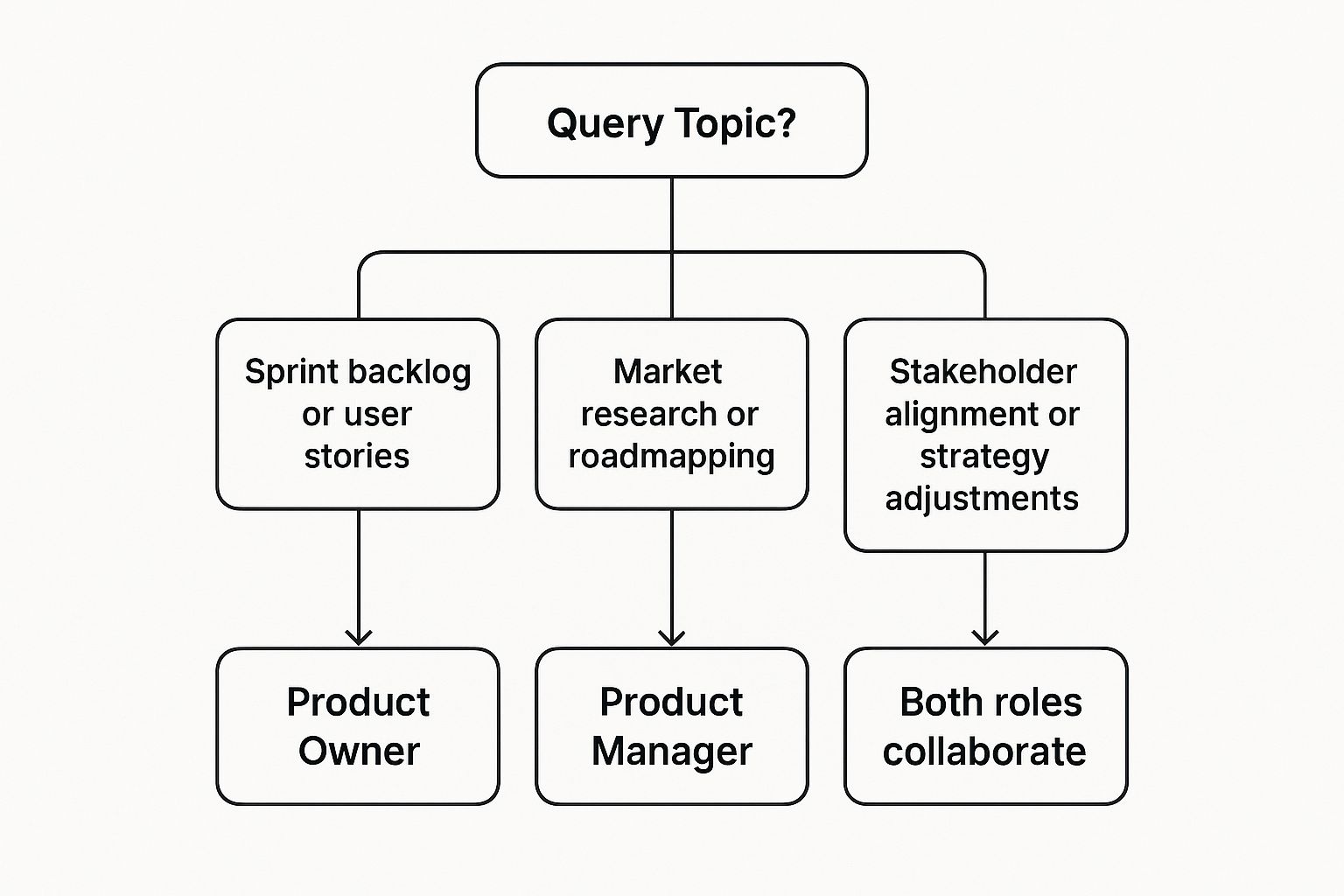
As the graphic shows, it's pretty straightforward. If your day-to-day is all about sprint-level execution and the dev team, the PO path is a natural fit. But if you're obsessed with market-level strategy and the "why," you're probably on the road to becoming a PM.
Analyzing Salary Data and Market Demand
Let's talk about the real-world impact of choosing between a Product Owner and Product Manager role: your wallet and your career path. The difference isn't just academic; hard data shows a clear pay gap that comes down to one thing—the strategic scope of the PM versus the tactical focus of the PO.
Product Managers consistently command higher salaries because their role is directly tied to business outcomes like revenue and market share. Looking at salary data from sites like Levels.fyi and Glassdoor for 2024, the trend is clear: the market places a premium on strategic ownership.
That gap gets even wider as you climb the ladder, especially in major tech hubs where a PM's strategic impact is worth its weight in gold.
A Data-Driven Salary Comparison
To really see how this plays out, we need to look at how experience changes the equation in the competitive US market. The trend is obvious: the more senior you get, the more companies are willing to pay for market-facing, strategic skills. That premium widens the compensation gap significantly.
This table gives a clear, data-driven look at the average salaries for Product Managers versus Product Owners at different experience levels across major US tech markets.
Average Salary Comparison PM vs PO (USA, 2024 Data)
| Role | Junior Level (1-3 Yrs) | Mid-Level (4-7 Yrs) | Senior Level (8+ Yrs) |
|---|---|---|---|
| Product Manager | $95,000 – $120,000 | $125,000 – $160,000 | $165,000+ |
| Product Owner | $85,000 – $110,000 | $115,000 – $140,000 | $145,000+ |
As you can see, both paths are lucrative, no question. But the data highlights a critical career consideration: the ceiling for Product Managers is just plain higher, a direct reflection of their ownership over business outcomes.
Analyzing Job Market Signals
Don't just take my word for it—look at the job postings from the big players.
A Product Manager posting from a company like Google will be packed with phrases like "market analysis," "P&L ownership," and "go-to-market strategy." They're not just hiring a project lead; they're hiring a mini-CEO for a product line. For example, a recent posting for a PM on the Google Cloud team listed "Develop product strategy and vision" and "Work with sales and marketing to launch new products" as primary responsibilities.
Flip over to a Product Owner role at a company like Atlassian (the makers of Jira), and the language shifts. You’ll see a heavy focus on "backlog prioritization," "user story authoring," and "Scrum proficiency." They need a master tactician to keep the development engine running smoothly. A recent PO job at a large bank focused on "Managing the team backlog" and "Ensuring user stories meet the 'Definition of Ready'."
For anyone trying to figure out their next move, digging into the current remote Product Manager job market is a great way to see which skills are really in demand right now.
As a hiring manager, the salary offer is a direct reflection of expected impact. I budget more for a PM because I'm paying for strategic vision that can create new revenue streams, not just efficiently execute an existing one.
The Reality of the Hybrid Product Manager/Owner Role
In the wild, especially at startups or smaller tech shops, that clean line between a Product Manager and a Product Owner gets real blurry, real fast. It’s incredibly common for one person to wear both hats, jumping from strategic visionary to tactical executor in the same afternoon.
On paper, this hybrid role seems efficient. When the person setting the long-term roadmap is the same one clarifying user stories for the engineers, communication is just… easier. Decisions can happen in a flash because you're not waiting for a separate PO to translate the grand strategic vision into a sprint-ready plan.
But let's be honest: the burnout risk is massive. The mental whiplash from a high-level strategy session with the CEO straight into a nitpicky backlog grooming session with the dev team is exhausting. If you're not careful, the urgent, tactical fires of the PO role will always burn brighter than the important, strategic work of the PM. It's a classic trap.
How to Survive (and Thrive) as a Hybrid PM/PO
If you find yourself straddling this line, you need a system. Your survival depends on deliberately managing your time and your stakeholders' expectations so you don't just become a feature factory, churning out tickets.
Here’s a practical game plan:
-
Block Your Time. Ruthlessly. Your calendar is your only defense against the chaos. Dedicate specific, non-negotiable blocks of your week to each "hat." Maybe Monday mornings are for market research and roadmap planning (PM mode), and afternoons are for backlog refinement (PO mode). You have to guard that strategic time like a hawk.
-
Build a Single Source of Truth. You can't have your strategy living in one place and your execution in another. They have to be linked. Tools like Notion or Coda are perfect for this. You can have a high-level roadmap page that literally links out to the granular user stories in the product backlog. This forces alignment and makes it part of your natural workflow.
-
Declare Your "Hat" Out Loud. This sounds simple, but it's a game-changer. Be totally explicit with your team about which role you’re playing at any given moment. Kick off a meeting by saying, "Okay, putting on my PM hat, let's talk about our Q3 business goals." Or in another, "With my PO hat on, let's nail down the acceptance criteria for this story." It instantly manages expectations and brings a ton of clarity to the conversation.
Common Questions, Answered
Look, the Product Owner vs. Product Manager debate brings up a lot of practical questions, especially for people trying to figure out their next career move or just make sense of their day-to-day. Let's tackle some of the ones I hear most often from aspiring and practicing PMs I mentor.
Can a Product Owner become a Product Manager?
Yes, absolutely. In fact, it's one of the most common and logical career paths out there. Being a PO is like being in the trenches—you master tactical execution, you live and breathe the backlog, and you learn how to collaborate with the engineering team to actually ship things. That's a rock-solid foundation.
To make the leap, you need an actionable plan to build strategic muscle:
- Find a Mentor: Identify a Senior PM or Group PM in your organization. Ask for 30 minutes a month to discuss their strategic work.
- Volunteer for Strategic Tasks: Ask your PM if you can take a first pass at a competitive analysis for an upcoming feature, or help draft the business case for a Q3 initiative.
- Learn the Business: Start reading your company's quarterly earnings reports and analyst calls. Understand the core business drivers beyond your product area.
- Practice Storytelling: Take the next feature your team is building and create a 5-minute presentation on the "why" for a non-technical audience. Pitch it to your PM for feedback.
Do I need a CSPO certification to be a Product Owner?
Straight answer: No, a Certified Scrum Product Owner (CSPO) cert isn't a mandatory ticket to play. From a hiring manager's perspective, it's a weak signal. It shows you can pass a test, not that you can ship great product. For aspiring POs, I'd recommend investing that time and money (~$1000 for a CSPO course) elsewhere.
A much better investment is a course on a core tactical skill, like Reforge's "Product Management Foundations" ($1,995/year for membership) which provides deep, applicable frameworks, or even just building a side project to demonstrate real-world execution ability. Demonstrable experience is far more valuable than any certification. A portfolio that shows you’ve successfully shipped features and can manage a backlog with your eyes closed will always, always trump a line on your resume.
How do the roles differ in non-software companies?
This is where the line between the two roles often gets even sharper and less blurry. In a hardware or consumer packaged goods company, the Product Manager is the undisputed business owner of the product. They’re dealing with everything from manufacturing timelines and supply chain logistics to retail channel strategy and marketing campaigns.
The Product Owner role, if it even exists by that name, gets adapted. It might be called a "Project Manager" or an "Engineering Lead." Their job is to take the PM’s business requirements and translate them into a detailed development plan for the engineering or manufacturing teams. The fundamental split—strategic vs. tactical—is still there, just with different titles and frameworks.
