You're probably doing what most aspiring PM candidates do. You've got a Notion doc full of product sense prompts, a bookmarked Reddit thread, a few YouTube videos playing at 1.5x speed, and no real confidence that any of it is building interview skill.
That approach fails because it confuses collecting advice with preparing for interviews.
Good entry level interview preparation is structured. It should make you sharper each week, not busier each day. The candidates who stand out don't know more random frameworks. They show cleaner thinking, stronger self-awareness, better examples, and better judgment about the company they're joining.
That matters even more in PM. A junior PM hire isn't getting selected because they already ran a billion-dollar roadmap. They're getting selected because the team believes they can learn fast, communicate clearly, and make good decisions under ambiguity. That's what your prep needs to prove.
Your PM Interview Prep Starts Here Not on Reddit
The biggest mistake in entry level interview preparation is starting with question banks.
Question banks feel productive because they're concrete. They also create fake progress. You answer ten prompts badly, learn no pattern, and end the day thinking you “studied.” You didn't. You sampled chaos.
Most mainstream entry-level guides still center on internships or prior jobs, but many candidates have neither. Independent career guidance emphasizes reframing school, volunteer, or personal-project work as evidence of transferable traits. The core problem isn't “no experience.” It's the lack of a structured method to translate that experience into role-relevant evidence, as noted in Indeed's guide to entry-level interview questions.
That's the mindset shift you need first. You are not underqualified because your resume doesn't look like a Stanford intern pipeline. You're underprepared if you can't explain your experience in a way that sounds useful to a hiring manager.
Your prep should turn vague history into hiring evidence.
If you need a broad baseline before going deep on PM, this guide on how to prepare for interviews is a useful starting point because it reinforces the basics candidates often skip, like role research, practice discipline, and answer clarity. Then go narrower and PM-specific.
I'd treat the next month like a mini training sprint. Week 1 is narrative and inputs. Week 2 is frameworks. Week 3 is mocks. Week 4 is company-specific polish and reverse interviewing. That's a far better system than grazing on random advice.
If you're still figuring out how PM hiring works, start with this breakdown on breaking into product management. It'll help you calibrate what teams care about when they hire junior talent.
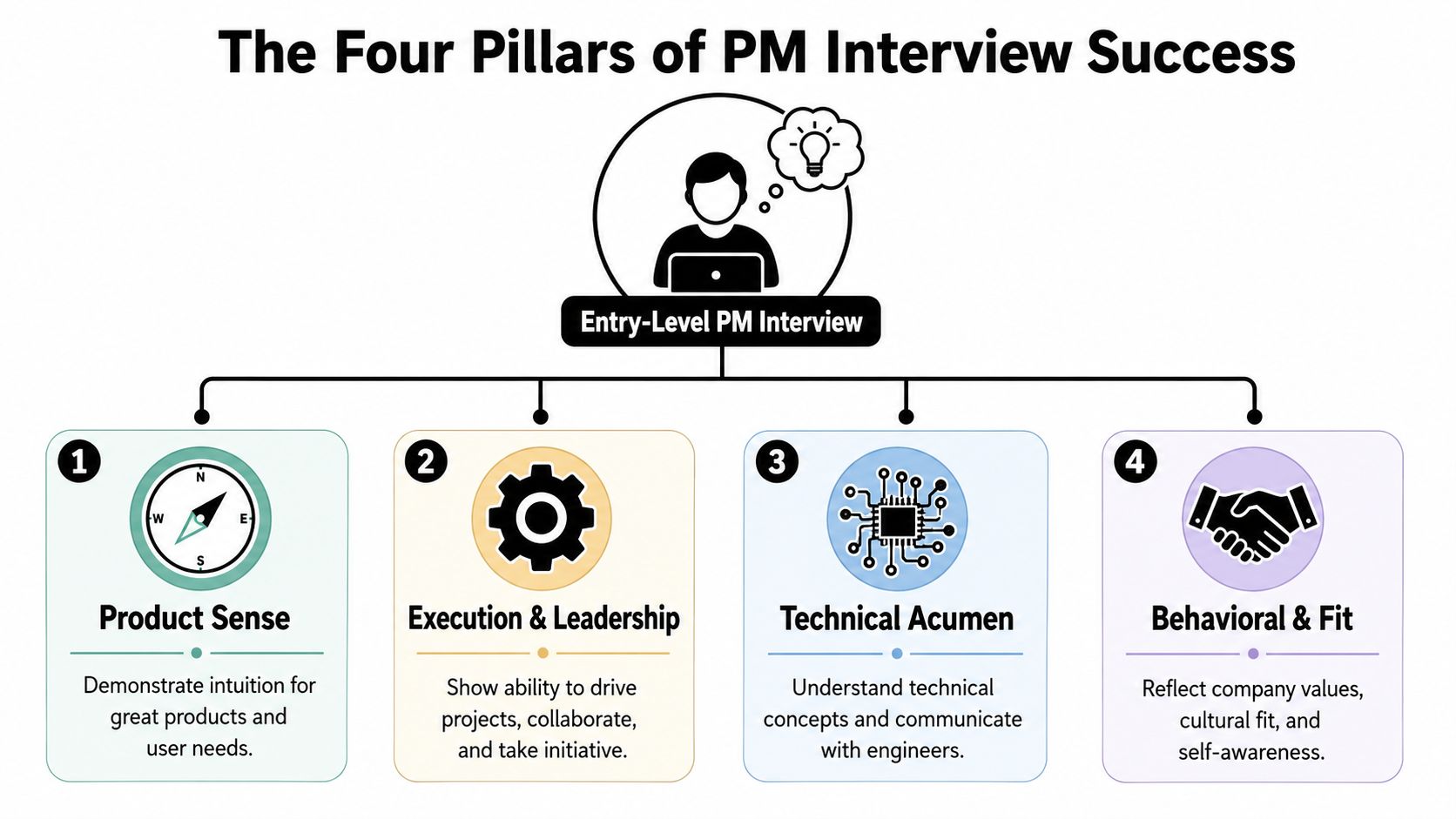
The Four Pillars of the PM Interview
Most PM interviews look messy from the outside and very predictable from the inside. Interviewers are usually testing some version of four things. If you don't know which pillar a question belongs to, your prep stays shallow.
Product sense
This is the part candidates obsess over, often for the wrong reason. They think product sense means sounding creative. It doesn't. It means finding a user problem, narrowing scope, making tradeoffs, and proposing something coherent.
For an entry-level PM, I'm not looking for genius. I'm looking for structure. Can you identify who the user is? Can you separate pain points from solutions? Can you avoid building five features at once?
A candidate who says, “I'd first choose one user segment and define the core problem before jumping into features,” already sounds more hireable than someone who blurts out a feature list.
Execution and analytics
A lot of junior candidates collapse. They can brainstorm. They can't operationalize.
I want to know if you can define success, choose a sensible metric, prioritize what matters, and explain what you'd do if the numbers moved in the wrong direction. In AI PM interviews, this expands into judgment around quality, risk, and feedback loops. You don't need deep statistics. You do need disciplined thinking.
Here's the simplest framing. Product sense asks, “What should we build?” Execution asks, “How would we know it's working, and what would we do next?”
Technical acumen
No, you don't need to code to be a strong entry-level PM candidate. But you do need enough technical fluency to work with engineers without becoming a translation problem.
That means you should be able to discuss APIs, system constraints, latency tradeoffs, instrumentation, logging, experimentation, and model limitations if you're interviewing for AI PM roles. Not at an architect level. At a collaboration level.
Hiring heuristic: If an engineer explains a constraint, your response should get sharper, not more confused.
Behavioral and fit
Behavioral interviews often decide the outcome because they reveal how you work when things are messy. Do you take ownership? Can you handle feedback? Do you influence without authority? Are you coachable, honest, and calm under pressure?
Entry-level candidates often undersell themselves here because they think behavioral stories only count if they happened at a famous company. Wrong. I've hired people based on strong examples from student orgs, side projects, support jobs, and volunteer work because the behaviors were real and relevant.
Here's a clean breakdown of what each pillar is testing.
| Pillar | What They're Testing | Example Question |
|---|---|---|
| Product Sense | User empathy, problem framing, prioritization | How would you improve onboarding for a note-taking app? |
| Execution and Analytics | Metrics judgment, tradeoffs, decision-making | What metric would you use to evaluate a new feature launch? |
| Technical Acumen | Ability to work credibly with engineering | How would you explain the tradeoff between speed and reliability? |
| Behavioral and Fit | Ownership, teamwork, self-awareness, resilience | Tell me about a time you handled conflict on a team. |
One practical move. Build your prep plan around pillars, not around companies. Google, Meta, and startups will package the interview differently, but they're still testing these core muscles. This article on product manager interview tips is a solid companion if you want to map common PM questions back to the underlying skill being tested.
Week 1 Build Your PM Toolkit
A candidate walks into a PM interview with polished frameworks, then falls apart on the first behavioral question because their resume is vague, their stories are thin, and they have no clear point of view on products. That failure starts in Week 1.
Use this week to build the raw material for every interview round and for your first months on the job. Strong candidates do not just prepare to get an offer. They prepare to show judgment, pressure-test the company, and start contributing fast after they join.
Rewrite your story so it signals PM potential
Your resume and LinkedIn should not read like a task list. They should prove that you spot problems, make decisions, and drive outcomes with other people.
Treat every experience as evidence. A class project can show user research and prioritization. A campus club can show stakeholder management and tradeoffs. A retail shift can show customer insight, pattern recognition, and calm execution when something breaks.
Use this filter on every bullet:
- What problem existed
- What you owned
- Who you worked with
- What changed because of your work
If a bullet misses one of those, rewrite it.
Weak bullet: “Worked on a student app project with a team.”
Better bullet: “Identified onboarding drop-off in a student app, worked with three teammates to prioritize fixes, and shipped a prototype based on user feedback.”
That version tells me how you think. That is what gets interviews.
If your materials still sound generic, start with a product manager resume template built for PM hiring signals. A template will not get you hired. It will stop you from wasting space on weak phrasing and bad structure.
Build a content diet that sharpens judgment
A lot of entry-level candidates confuse content consumption with preparation. Watching “day in the life” videos is not preparation. It is passive browsing dressed up as career work.
Read and listen to material that trains decision-making. Study product teardown threads. Read launch writeups. Follow operators who explain why a team made a call, what tradeoff they accepted, and what they would do differently now.
A practical stack:
Books that improve product thinking
Read Inspired for product craft and Cracking the PM Interview for question patterns and answer structure.Operator-led content
Pick newsletters, podcasts, and essays from PMs who have hired teams, shipped products, and made hard calls. Skip motivational fluff.Hands-on AI product exposure
If you want an AI PM role, use products like ChatGPT, Claude, Perplexity, Notion AI, and GitHub Copilot with intent. Examine onboarding, output quality, failure cases, and feedback loops.Weekly product teardowns
Choose one product a week and write one page on the user problem, friction points, success metric, and first change you would make.
This habit does more than help you answer interview questions. It trains the judgment you will need in your first 90 days, when nobody cares how many frameworks you memorized.
Create assets you can use under pressure
By the end of Week 1, you should have tools you can use in interviews, not a vague sense that you are “learning PM.”
Build these:
- A resume with clear PM-style bullets
- A LinkedIn headline that states your target role and strengths
- A story bank from school, work, projects, and volunteer roles
- A teardown doc with your own product observations
- A short list of companies you want to interview back
- A question bank for hiring managers, PM peers, and cross-functional interviewers
That last part matters. Top candidates do not wait until they get an offer to judge the company. They start in Week 1 by deciding what they need to learn. How are PMs evaluated? Who sets roadmap direction? What does onboarding look like? Where do junior PMs usually struggle?
If Week 1 is done right, you stop saying, “I do not have PM experience.” You start saying, “I have two strong examples of prioritization, one example of conflict resolution, one example of customer insight, and three questions that will tell me whether this team can develop me.”
That is how serious candidates prepare.
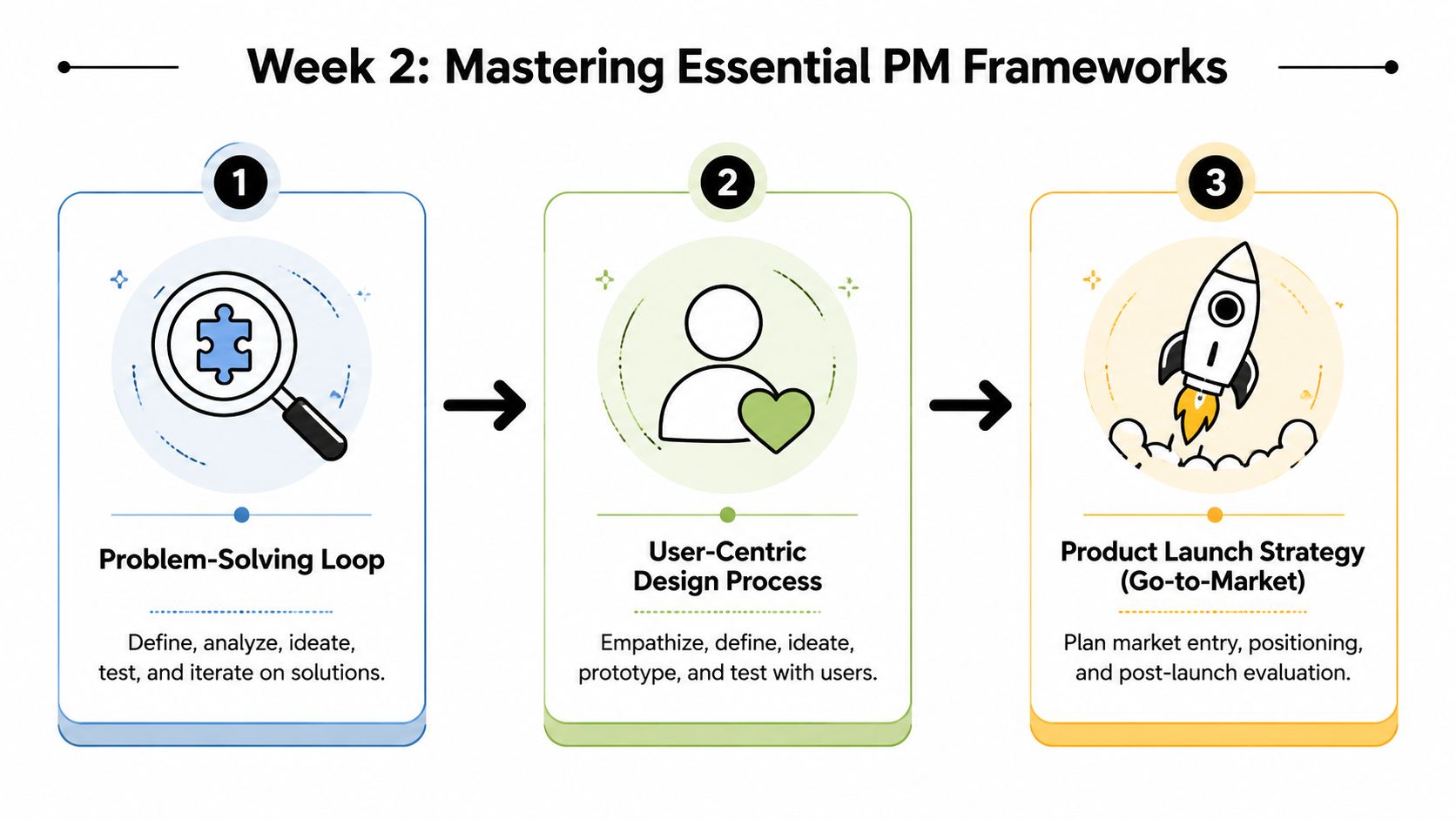
Week 2 Master the Core Frameworks
Frameworks matter, but only if you use them as thinking tools. If you memorize acronyms and recite them like a robot, you'll sound trained and weak at the same time.
You only need a few frameworks to get most of the value in entry level interview preparation. Keep them simple enough to use under pressure.
Use a product sense scaffold, not a script
For product design questions, I like a simplified CIRCLES-style flow:
- Clarify the goal
- Choose a user segment
- Identify pain points
- Prioritize one problem
- Propose a solution
- Define success
- Call out tradeoffs
That's enough structure to prevent rambling.
If I ask, “Design a product for first-time managers,” don't jump to features. Start with the user. Are you targeting new startup managers, enterprise managers, or student leaders becoming club leads? Their problems aren't the same. Once you narrow the user, your answer gets stronger fast.
A strong candidate sounds like this: “I'll focus on newly promoted managers in fast-growing teams because they often lack training but immediately need to run one-on-ones, give feedback, and prioritize work.”
That one sentence shows segmentation and judgment.
For more PM interview structures and when to use them, this guide to product management frameworks is useful.
A quick explainer can also help you calibrate what “framework” should feel like in practice:
Learn one execution lens you can reuse
For execution questions, use a simple funnel lens. Acquisition, activation, retention, and monetization is one practical way to break down growth and success questions.
If the interviewer asks, “How would you measure a new collaboration feature?” don't list every metric you've ever heard. Tie your metric choice to the user behavior the feature is supposed to change.
For example:
- Acquisition lens if the feature helps attract new users
- Activation lens if it helps users reach first value faster
- Retention lens if it makes the product stickier
- Monetization lens if it supports conversion or expansion
The key is explaining why one layer matters most. Prioritization beats metric dumping.
Behavioral answers need harder proof
Most candidates stay too abstract. They say they're collaborative, resilient, and user-focused. Nobody cares unless they can prove it.
A high-signal method for entry-level interview prep is to build 3 to 5 role-matched STAR stories. MIT's career guidance recommends weighting STAR as Situation 20%, Task 10%, Action 60%, Result 10% in behavioral interviews, which forces you to focus on what you personally did in the story, not just the setup or outcome, in MIT's STAR method guidance.
That 60% Action rule is gold.
It fixes the most common junior-candidate mistake. They spend too long describing the context because they're afraid the experience won't sound impressive. The interviewer doesn't need a movie trailer. They need evidence of judgment, initiative, and ownership.
Practical rule: If your “action” section doesn't include decisions, tradeoffs, and communication, your story is still too weak.
Build stories around recurring PM signals:
- Handling ambiguity
- Resolving conflict
- Influencing without authority
- Learning quickly
- Recovering from failure
- Driving something from idea to outcome
Write them out. Then say them aloud until they sound natural instead of memorized.
Week 3 The Mock Interview Grind
If you only do one thing seriously, do mock interviews.
Candidates love prep that feels safe. Reading frameworks is safe. Taking notes is safe. Watching another PM interview breakdown is safe. None of that tells you whether you can think clearly with a clock running and another person judging your answer.
Mocks do.
A practical benchmark for technical or structured interview prep is to complete at least 5 to 10 mock interviews before the actual interview, as described in this technical interview preparation framework. That guidance places mocks at the final calibration stage because they expose failure modes like weak explanation flow, poor time management, and failure to adapt a known pattern to a new question under pressure.
That's exactly why they matter for PM too. The interview isn't a take-home assignment. It's live performance.
What mock interviews reveal fast
Mock interviews surface things you can't see on your own.
They expose whether you:
- Ramble instead of structure when you're nervous
- Hide behind frameworks instead of making decisions
- Miss the actual question because you're forcing a memorized answer
- Freeze on follow-ups when your first answer gets challenged
- Talk in vague team language instead of stating your own contribution
You need that feedback before the actual loop, not after a rejection email.
A mediocre mock that gives honest feedback is worth more than another hour of solo note-taking.
How to run a useful mock
Most mock interviews are poorly run because both people are improvising. Fix that.
Use a simple structure:
Opening prompt
One person asks a real PM question and gives brief context.Live answer
The candidate answers without interruption for the first stretch, then handles follow-ups.Feedback review
The interviewer gives direct notes on structure, prioritization, communication, and depth.Role switch
The second person repeats the process.
You can practice with peers, PM communities, alumni, mentors, or operators willing to trade time. If you're applying broadly, rotate by interview type. Don't do five behavioral mocks in a row and pretend you've covered the field.
Use a scoring rubric
Without a rubric, mock feedback turns into “pretty good” and “maybe tighten that up.” That's useless.
Score each mock on these dimensions:
| Area | What good looks like |
|---|---|
| Structure | Answer has a clear beginning, middle, and end |
| User thinking | Candidate identifies a real user and problem |
| Prioritization | Candidate chooses, narrows, and explains tradeoffs |
| Communication | Candidate sounds concise, calm, and understandable |
| Adaptability | Candidate handles follow-up questions without breaking |
Track patterns. If three different mock partners say you over-explain context and under-explain decisions, that's now your main problem. Don't keep polishing everything equally.
For extra prompt practice, you can pull from curated sets like these first-round interview questions. Use them as reps, not as scripts.
Don't waste your last week on learning mode
By Week 3, stop consuming lots of new material. You're no longer in study mode. You're in calibration mode.
That means:
- Record yourself and listen for filler, speed, and clarity
- Practice timed answers so you don't burn half the interview on setup
- Ask for interruptions because real interviewers will interrupt you
- Repeat your weakest question type until it stops feeling fragile
The jump from “I know PM interviews” to “I perform well in PM interviews” happens here. Not in your reading list.
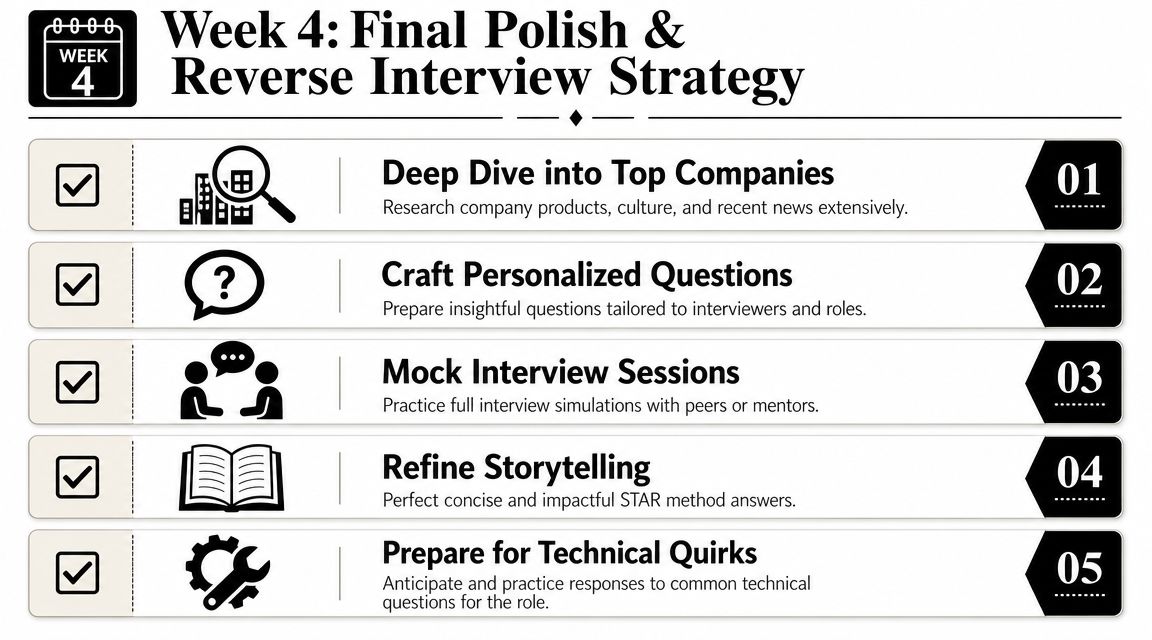
Week 4 The Final Polish and Reverse Interview
The final week is where strong candidates separate themselves from over-rehearsed candidates.
At this stage, you shouldn't be trying to become a different person. You should be tightening your delivery, deepening your company understanding, and preparing to evaluate the company with the same seriousness they're using to evaluate you.
Research like you're already on the team
Most candidates stop at the company blog, the mission page, and maybe a product demo. That's lazy.
Go deeper. Read leadership interviews. Look at product reviews. Use the product and write down friction points. Study how the company talks about priorities. If it's a public company, listen to how leaders describe product direction and strategic focus. If it's an AI company, pay attention to where the experience breaks, where trust matters, and what user behavior the product is trying to shape.
You don't need to sound like an industry analyst. You do need to sound like someone who cares enough to understand the business context.
Ask questions that produce signal
Existing content often tells candidates to ask questions, but rarely explains how to evaluate whether an entry-level role is a good first job. Practical guidance suggests using the interview to gather information about manager quality and learning velocity, making the interview a low-cost due-diligence moment for avoiding bad first jobs, as discussed in this career discussion on entry-level interview questions.
That's the right frame. Your reverse interview isn't theater. It's risk management.
Ask questions that help you evaluate:
Manager quality
“How does the manager support new PMs when they make their first prioritization mistakes?”Learning velocity
“What tends to separate the entry-level PMs who ramp well from the ones who struggle?”Team expectations
“In the first few months, what kind of ownership is realistic for someone new to the role?”Product environment
“Where does this team face the most ambiguity today. User needs, technical constraints, or cross-functional alignment?”AI-specific judgment
“If this role touches AI features, how does the team balance speed of iteration with output quality and user trust?”
The best reverse-interview questions do two jobs at once. They show you understand the role, and they help you avoid stepping into a bad setup.
Bring notes. Ask at least three thoughtful questions. Tailor them to the interviewer. The hiring manager should get different questions than an engineer or peer PM.
Control nerves without becoming robotic
Most last-week anxiety comes from uncertainty, not incapability. You're worried because you haven't decided what “ready” means.
Define it. Ready means your core stories are tight, your frameworks are usable, your mocks are complete, and your company questions are written down.
If you tend to spiral before interviews, practical mental reset tools can help. This guide on how to stop overthinking and worrying is worth skimming because overthinking often shows up as hesitation, over-explaining, and second-guessing in live interviews.
Your job in the final week isn't to eliminate nerves. It's to make sure nerves don't hijack your performance.
Beyond the Offer Your First 90 Days
Getting the offer is not the end of the process. It's the start of your reputation.
The best entry level interview preparation includes a plan for what happens after you join, because strong candidates don't just optimize for offer conversion. They optimize for early career trajectory.
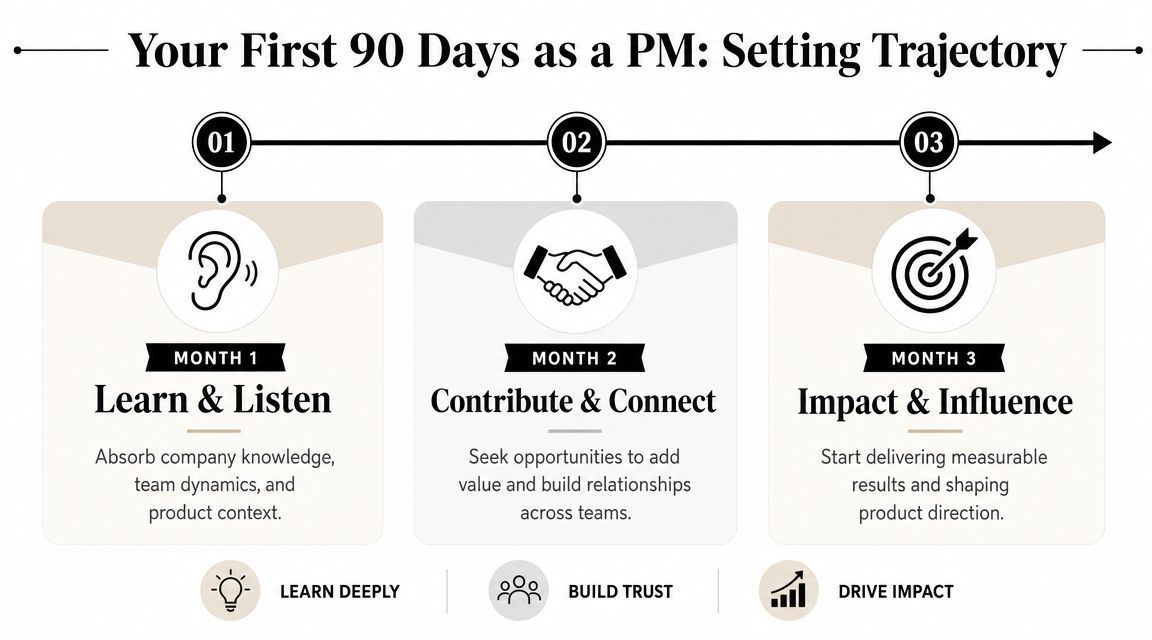
Days 1 through 30 learn and listen
Don't show up trying to prove you're the smartest person in the room. Show up trying to understand how the room works.
Meet engineers, designers, data partners, support, sales, and whoever talks to customers. Learn the product history. Read old docs. Sit in on roadmap and bug discussions. Use the product heavily. If it's an AI product, test failure modes and edge cases, not just happy paths.
Your first month should build context and trust.
Days 31 through 60 contribute and simplify
Find one small problem the team has tolerated for too long.
Maybe it's a broken feedback loop, a confusing internal dashboard, a fuzzy launch checklist, or a support pain point nobody owns clearly. Solve something contained and useful. Early wins matter because they show follow-through without forcing premature strategy.
Junior PMs can earn credibility fast, not by making grand product pronouncements, but by making messy work clearer.
Days 61 through 90 own a small bet
Now you can start acting more like a PM and less like a guest.
Form a hypothesis based on what you've learned. Propose a small experiment, process change, or scoped product improvement. Tie it to a user problem. Explain tradeoffs. Get input. Then drive it cleanly.
Early-career PMs build trust in this order. They absorb context, improve something small, then earn the right to push bigger ideas.
That sequence works because it respects how teams gain confidence in new hires.
If you want more practical PM career advice, interview prep resources, and operator-level frameworks from someone who's hired and coached PM talent, explore Aakash Gupta. It's a strong next step if you're serious about turning interview prep into a real PM career.
