Your first-round Product Manager interview is not a simple screening call. It's a high-stakes audition of your structured thinking, communication clarity, and business acumen. As a PM leader who has hired dozens of product managers at companies like Google, Meta, and unicorn startups, I have seen that this initial conversation is where most candidates are eliminated. It’s not about having the 'right' answers, but demonstrating the right frameworks. Far too many aspiring PMs fail by giving generic responses or rambling without a clear structure, which immediately signals they lack the disciplined thought process required for the job.
This guide changes that. We will dissect the 10 most critical first round interview questions you will almost certainly face. For each question, you will get more than just general tips; you will receive a detailed breakdown of the hiring manager's true intent, specific answer frameworks you can use immediately, and real-world examples, including those relevant to modern AI PM roles.
Think of this as a playbook, not a simple list. You'll learn what specific red flags signal a "no-hire" decision and receive actionable exercises to practice and refine your delivery. The goal is to move beyond simply answering questions and start demonstrating the strategic product thinking that hiring managers are desperate to see. By internalizing these structures, you'll be prepared to prove you have the foundational skills needed to not just pass the first round, but to advance confidently toward an offer. Let's get started.
1. Tell me about yourself
This foundational question opens most first-round interviews. For product managers, it's a critical opportunity to present a compelling narrative that connects your background directly to the PM role's core competencies. Your answer sets the tone for the entire conversation, demonstrating your communication skills, strategic thinking, and self-awareness from the very beginning.

The hiring manager uses this question to gauge your ability to synthesize complex information (your career) into a clear, concise, and relevant story. They are listening for signals that you understand what makes a great product manager and can articulate how your specific experiences have prepared you for this exact position.
Crafting Your 2-Minute PM Narrative
Your goal is to deliver a response that is no longer than two to three minutes. Structure it as a brief but powerful story with a clear beginning, middle, and end.
- Present: Start with your current role and a key achievement. "Currently, I'm a Product Manager at [Company Name], where I recently led the launch of a new AI-powered analytics feature that increased user engagement by 15%."
- Past: Connect 1-2 past experiences that show your journey toward this role. Highlight specific skills you developed. "Before this, I was a software engineer, which gave me a strong technical foundation. I found myself drawn to the 'why' behind the features we were building, which led me to take on a product strategy rotation."
- Future: End by connecting your story to the role you're interviewing for. "My experience in both the technical and strategic sides of product development has prepared me to tackle complex challenges. I'm particularly excited about this role at [Their Company Name] because of your focus on [mention a specific product or mission], and I believe my background in [mention a relevant skill] can directly contribute to that."
Hiring Manager Insight: We're not looking for your life story. We're assessing your ability to communicate effectively and connect your experience to our specific needs. A great answer is a well-rehearsed, confident pitch that shows you’ve done your homework. For a deeper dive into preparing your story and other crucial steps, consider a dedicated product manager interview prep course. This is one of the most common first round interview questions, so mastering it is essential.
2. Why are you interested in this role/company?
This question directly probes your motivation and whether you are a discerning candidate or simply applying everywhere. For product managers, it’s a test of your research skills, strategic thinking, and genuine enthusiasm for the company’s mission and product. A strong answer shows you've moved beyond the job description and understand the company's place in the market.
The interviewer is looking for authentic alignment. They want to know if you are truly excited by their specific challenges and vision. This question helps them distinguish between candidates seeking a job and those who want this job, which is a key indicator of future commitment and performance.
Structuring Your Response Around Research
Your answer should be a concise, evidence-backed statement that connects your skills to the company's specific context. Avoid generic praise and focus on concrete points.
- The Product/Market Hook: Start by mentioning a specific aspect of their product, strategy, or market position that caught your eye. "I've been following your expansion into Southeast Asia. What intrigues me is your approach to localization; your app features are thoughtfully adapted to regional preferences rather than just translated."
- The Skill Connection: Link your observation to your own experience and skills. "In my previous role, I worked on international product expansion for the European market and learned firsthand how critical deep cultural integration is for user adoption."
- The Future Contribution: Conclude by showing how you can add value to their mission. "Given my background in B2B SaaS and experience reducing customer acquisition cost, I see specific opportunities in your go-to-market strategy that I could impact. I'm excited by the chance to contribute to that mission."
Hiring Manager Insight: We hear "you're an innovative, fast-growing company" all day. It means nothing. The answers that stand out show you've analyzed our product, read our recent press, and formed a real opinion. It proves you have the analytical curiosity we look for in a PM. A well-prepared response here is just as important as how you answer “Tell me about yourself”.
3. Walk me through a product you use and how you would improve it
This is a signature PM question and a core component of many first round interview questions. It directly tests your product sense, analytical rigor, and communication skills. Your ability to deconstruct a product, identify meaningful user problems, and propose thoughtful solutions reveals how you would perform on the job.
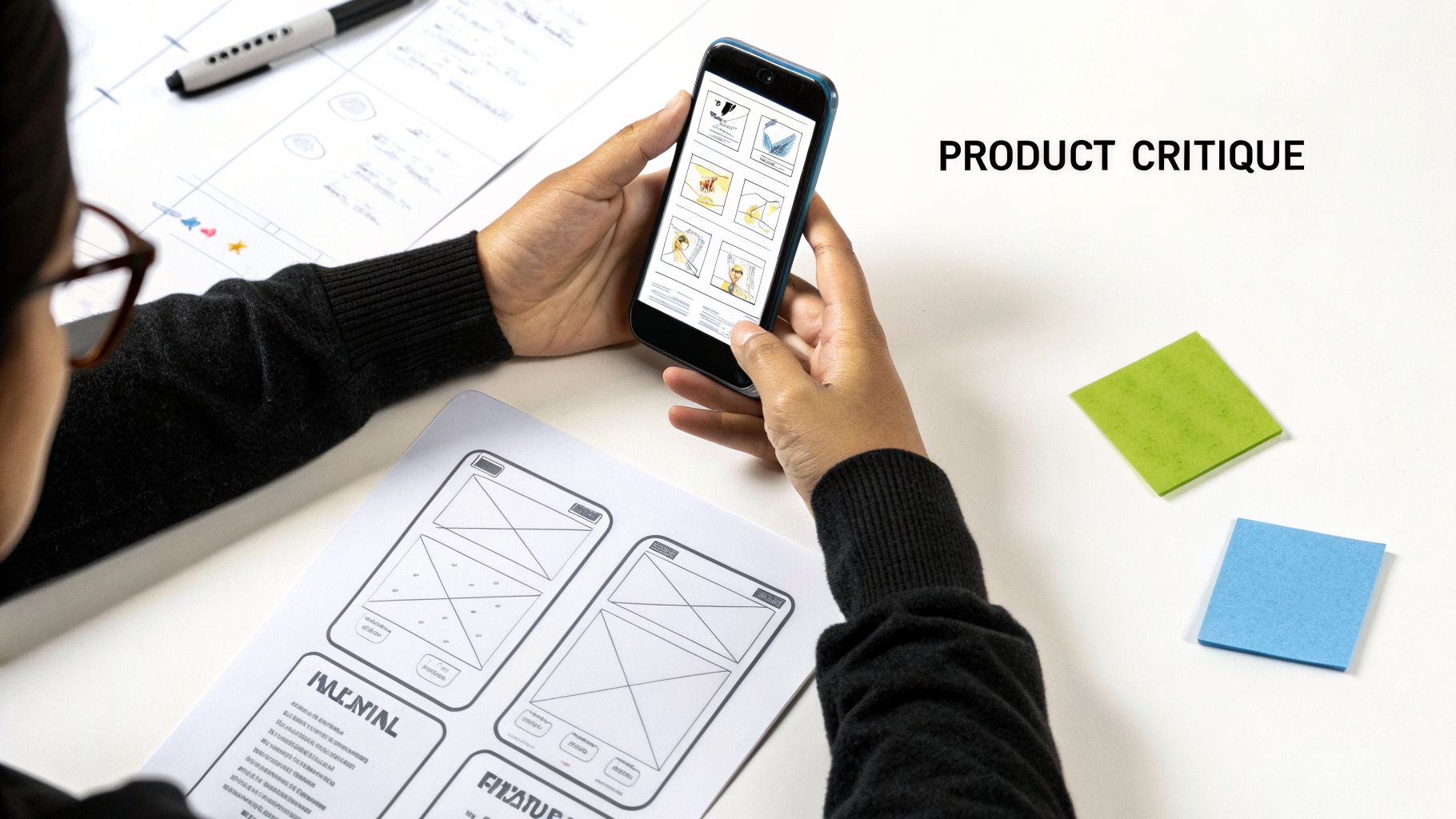
The interviewer isn't just looking for creative ideas; they're evaluating your thinking process. They want to see if you can articulate a structured analysis that considers user empathy, business goals, and technical constraints. A strong answer demonstrates that you can think like a product owner, not just a casual user.
Structuring Your Product Critique
Your response should follow a clear, logical framework that is easy for the interviewer to follow. Aim for a 3-4 minute structured explanation.
- Context and Problem: Start by naming the product and its core function. Then, identify a specific user problem. "I frequently use Slack for team communication. A key problem I've noticed in large workspaces is the high cost of context-switching; finding specific conversations or decisions across multiple channels is time-consuming."
- Validation and Solutions: Explain how you'd confirm this problem is real and widespread. "First, I'd validate this by analyzing usage data for search functions and talking to enterprise users. If confirmed, I'd explore solutions like an AI-powered search that understands context, a 'threads I'm involved in' dashboard, or smarter notifications."
- Prioritization and Impact: Conclude by explaining how you'd choose a solution and measure its success. "I'd prioritize based on user impact versus engineering effort. The dashboard seems like a strong candidate for an MVP. The business impact would be increased daily active users and reduced churn for enterprise clients who struggle with information overload."
Hiring Manager Insight: We want to see structured thinking. A weak answer is just a list of features ("Instagram should add this"). A great answer identifies a real user pain point, proposes a validation method, and connects the solution back to business metrics. This demonstrates a design thinking process that starts with empathy and ends with impact.
4. Describe a time you had to make a decision with incomplete information
Product management is the art of making high-stakes decisions with imperfect data. This behavioral question tests your ability to act decisively under ambiguity, one of the most common and critical parts of the job. Your answer reveals your analytical rigor, risk tolerance, and how you create structure in chaotic situations.

Interviewers use this to understand your decision-making framework. They want to see that you don't just guess or "go with your gut." Instead, they are looking for a methodical process for de-risking a decision, even when quantitative data is sparse. This is a crucial element in many first round interview questions.
Structuring Your Decision-Making Story
Frame your answer using a clear narrative that showcases your process. The process itself is often more important than the outcome.
- Situation: Briefly describe the context and the high-stakes decision you faced. "We needed to decide whether to pivot our core onboarding flow two weeks before our annual user conference. The new flow was designed to improve activation, but we only had usage data from 5% of our beta users."
- The Gap: Clearly state what information was missing and what you did have. "We were missing statistically significant data on activation rates. What we had were qualitative insights from support tickets, feedback from our sales team, and the limited beta metrics."
- Your Framework & Action: Detail the steps you took to make a confident choice. "I created a decision-making framework. I identified the primary question ('Will this new flow improve activation by at least 10%?'), gathered proxy data by calling our top 10 customers for their direct feedback, and analyzed the early user behavior. These sources, while incomplete, all pointed in the same direction."
- Outcome & Learning: Conclude with the result and what you learned. "Based on the aligned feedback, I made the call to proceed. The launch was successful, boosting activation by 12% and giving us a strong narrative for the conference. The key lesson was that a structured process, using a mix of qualitative and quantitative inputs, can build the confidence needed to make a sound decision without perfect information."
Hiring Manager Insight: We know you'll never have all the data. We're testing if you have a repeatable framework for ambiguity. Show us you can define the core question, identify the acceptable level of risk, gather the best available information (qualitative and quantitative), and make a reasoned call. A good answer demonstrates methodical thinking, not just a lucky guess.
5. How do you measure success for a product/feature?
This question directly tests your strategic thinking and data literacy. Hiring managers ask this to see if you can connect product work to tangible business value, distinguishing between simply shipping features (output) and achieving meaningful results for users and the company (outcomes). A strong response is a hallmark of a data-driven PM who can justify their product's existence and impact.
Interviewers use this common first round interview question to evaluate your ability to think in layers. They are listening for your understanding of how high-level company goals, like revenue or retention, cascade down into specific product metrics that your team can directly influence.
Building Your Metrics Framework
Your answer should demonstrate a structured approach, starting from the top-down. The key is to connect every metric back to a strategic objective.
- Start with the Goal: First, identify the primary business objective. Is the feature intended to increase user retention, drive new revenue, improve engagement, or reduce operational costs? "Success for a new B2B collaboration feature depends entirely on the goal. If we're aiming to reduce churn, success is different than if we're trying to drive expansion revenue."
- Identify Leading vs. Lagging Indicators: Show you understand how to get early signals. Leading indicators are predictive (e.g., feature adoption rate, weekly usage frequency), while lagging indicators confirm long-term impact (e.g., a 2% decrease in monthly churn, higher customer lifetime value).
- Layer in Qualitative Data: Quantitative metrics don't tell the whole story. Mention how you would capture the user's perspective. "Alongside the numbers, I'd track qualitative feedback through user surveys, App Store reviews, and direct customer interviews to understand the 'why' behind the data. A high adoption rate is meaningless if users report the feature is confusing."
Hiring Manager Insight: We're looking for metric fluency, not just a list of KPIs. The best candidates explain the relationship between different metrics. They can articulate that success for a retention feature might mean tracking feature adoption (leading), its effect on weekly active users (mid-funnel), and its final impact on the monthly churn rate (lagging). For a deep dive into building these frameworks, you can explore various expert approaches to the measurements of success.
6. Tell me about a time you disagreed with leadership/stakeholders and how you handled it
Product managers constantly stand at the intersection of competing priorities. This behavioral question is designed to test your influence, emotional intelligence, and ability to drive decisions without direct authority. Your answer reveals how you navigate conflict, champion user needs with data, and maintain crucial relationships with engineering, sales, or executive teams.
This is a core skill check. The interviewer wants to see if you can defend a position constructively and find a path forward, even when powerful stakeholders disagree. It’s a frequent part of the job, and your ability to handle it well is a predictor of your success.
Structuring Your Disagreement Story
The best answers follow a clear narrative arc that demonstrates strategic thinking and collaboration. Use a framework to keep your response concise and impactful, focusing on the process of alignment, not just "winning" the argument.
- Situation: Briefly set the scene. Who was involved and what was the context? "Our VP of Sales wanted to add a 'request demo' button to a high-traffic landing page to boost MQLs."
- Disagreement & Rationale: Clearly state the point of disagreement and your data-backed reasoning. "I disagreed, not because the goal was wrong, but because our funnel data showed a significant drop-off at the sign-up step, indicating a core friction problem. Adding another CTA would likely worsen the user experience and not solve the root issue."
- Action & Collaboration: Describe the steps you took to bridge the gap. Focus on collaborative language. "Instead of simply rejecting the idea, I proposed we partner on a quick analysis. I pulled the conversion data, and we walked through the user journey together. I asked, 'What problem are we trying to solve for the business, and what problem is the user facing right now?'"
- Resolution & Outcome: Explain the resolution and the positive result. "We agreed the primary issue was friction, not a lack of CTAs. We prioritized a project to streamline the sign-up flow, which ultimately increased conversions by 18%. The VP became a key ally, as we solved the bigger problem together."
Hiring Manager Insight: We are not looking for drama or a story where you made a stakeholder look foolish. We're testing your ability to persuade with data, respect other perspectives, and align teams around a shared goal. Show us you prioritize the right outcome for the business over being right. This is one of the most common first round interview questions for a reason; your ability to influence is paramount.
7. How do you stay updated on industry trends and competitive landscape?
This question directly probes your curiosity, market awareness, and dedication to continuous learning. Great product managers are perpetually students of their market, and the interviewer wants to see if you possess this intrinsic drive. Your answer reveals the systems you have in place to consume, synthesize, and apply external information.
The hiring manager is evaluating your proactivity. They want to know if you are passively scrolling headlines or actively building a deep, nuanced understanding of your industry, customers, and competitors. This is one of the first round interview questions that separates candidates who simply want a job from those who are truly passionate about the product craft.
Building Your Information System
A strong answer demonstrates a structured, multi-channel approach to learning. It's not just about what you read; it's about how you process that information and turn it into actionable insight.
- Establish Your Sources: Name specific, credible sources. "I have a daily routine where I scan several key newsletters, including Stratechery for high-level strategy and Lenny's Newsletter for tactical PM advice. For AI-specific trends, I follow The Neuron and a few key researchers on X (formerly Twitter)."
- Describe Your Process: Explain how you engage with the content. "Beyond just reading, I maintain a personal 'competitor watch' document. Once a month, I'll dedicate a few hours to hands-on testing of a competitor's new feature, documenting the user journey and noting friction points. I'll also review their app store reviews and Reddit threads to understand real user sentiment."
- Connect to Action: Show how this learning impacts your work. "This process directly informs our strategy. For example, after noticing a pattern of competitors introducing AI-powered summarization tools, I ran a small experiment with our user research team to validate the need for a similar feature. The positive signal led us to prioritize it for our next quarter's roadmap."
Hiring Manager Insight: We're looking for evidence of a system, not just a list of blogs. A vague answer like "I read tech news" is a major red flag. The best candidates describe a deliberate practice of learning and show how it makes them a more effective product manager. They connect the dots from market trend to product action.
8. Walk me through your approach to prioritization
This question gets to the heart of the product manager's role. Your ability to decide what to build, what to delay, and what to ignore is one of the most significant factors in a product's success. Hiring managers ask this to see if you have a systematic, defensible method for making high-stakes trade-offs or if you simply react to the loudest voice in the room.
They are looking for evidence of strategic thinking, data-informed decision-making, and stakeholder management skills. A strong answer demonstrates that you understand opportunity cost and can balance competing demands from customers, business leaders, and engineering teams with a clear, transparent process.
Articulating Your Prioritization Framework
Your response should prove you have a reliable system. Avoid vague answers like "we do the most important things first." Instead, name a specific framework and walk the interviewer through how you apply it.
- Establish Your Method: Start by naming the framework you prefer and why. "My approach is grounded in connecting product initiatives directly to our quarterly OKRs. I use a modified RICE framework to score potential features against those objectives. This ensures we're not just busy, but busy working on what actually moves our key results."
- Detail Your Inputs: Explain where you gather information to make decisions. "I gather inputs from multiple sources: user feedback from support tickets and interviews, quantitative usage data from our analytics platform, strategic goals from leadership, and technical constraints from engineering."
- Walk Through an Example: Give a concrete example of the framework in action. "Last quarter, our objective was to improve user retention by 5%. Sales was pushing for a custom integration for a large client, which was a high-effort, low-reach request. Meanwhile, user data showed a major drop-off point in our onboarding flow. Using the RICE model, fixing the onboarding flow had much higher Reach and Impact scores. I presented this data to leadership and the sales team, explaining the trade-off. We prioritized the onboarding fix, which ultimately lifted our 30-day retention by 7%."
Hiring Manager Insight: We need to know you can say 'no' intelligently. The best candidates don't just have a framework; they show how they use it to communicate decisions and manage stakeholder expectations. Proving you can make a tough call backed by data and then bring everyone along with your reasoning is a huge green flag. For a detailed comparison of different methods, you can explore various product prioritization frameworks. This is one of the core first round interview questions that separates junior and senior candidates.
9. Describe your experience with cross-functional collaboration
Product management is a team sport, and this question directly tests your ability to be a great teammate and leader. PMs sit at the intersection of business, technology, and design, so your success is almost entirely dependent on your ability to work with engineering, marketing, sales, and support. Your answer reveals your communication style, influence, and leadership potential.
Hiring managers ask this to see if you can align diverse perspectives, build consensus without direct authority, and guide a product from idea to launch by orchestrating the efforts of many. They are looking for a collaborator, not a dictator.
Structuring Your Collaboration Story
Your answer should be a specific, concrete example that demonstrates your process for working with others. Don't just say you're collaborative; show it with a story that highlights your approach.
- Set the Scene: Start with the project and the cross-functional challenge. "In my last role, we needed to redesign our core onboarding flow to reduce user drop-off. This required tight coordination between myself, two designers, five engineers, and the customer success team who had the best data on user pain points."
- Describe Your Process: Explain the specific actions you took to foster collaboration. "I kicked off the project with a workshop including all stakeholders. We didn't talk about solutions; we focused on aligning on the user problem and defining what success would look like with clear metrics. This ensured everyone was solving the same problem from day one."
- Show, Don't Tell: Provide an example of how you handled a specific interaction or conflict. "Mid-sprint, engineering found a technical constraint that made our initial design difficult. Instead of pushing my original plan, I brought design and engineering into a room to brainstorm alternatives. The solution we landed on was simpler to build and, as design pointed out, actually less confusing for the user. That outcome was only possible because we respected each other's expertise."
Hiring Manager Insight: We are actively listening for red flags. Saying "I told the engineers what to build" or "I had to get marketing to do their job" suggests a command-and-control mindset that fails in modern product teams. The best answers show you see other functions as partners whose expertise is critical to building a great product. Strong cross-functional collaboration skills are a non-negotiable for any PM.
10. What's your biggest weakness or area you want to improve?
This classic question is a test of self-awareness, humility, and your commitment to continuous growth. For product managers, where learning and adapting are central to the job, this is a chance to show you can honestly assess your own performance. The interviewer wants to see that you recognize professional gaps and, more importantly, are actively working to address them.
Hiring managers use this question to filter out candidates who give canned, disingenuous answers like "I'm a perfectionist" or "I work too hard." They are looking for a genuine, thoughtful response that proves you are coachable and dedicated to professional development, which is a key trait for success in product roles.
Structuring an Authentic Answer
To answer effectively, you need a story that demonstrates introspection and action. Avoid choosing a weakness that is a critical flaw for a PM (e.g., "I'm not good at communicating with stakeholders"). Instead, pick a real but manageable area for growth.
- Acknowledge a Real Weakness: Start by stating the weakness clearly and concisely. "An area I'm actively working on is my tendency to get too deep into technical implementation details with the engineering team, sometimes at the expense of higher-level strategic discussions."
- Provide a Specific Example: Give a brief, concrete situation where this weakness manifested. "In a past project, I spent a lot of time debating a specific database choice with the tech lead, when my focus should have remained on the user problem and business impact we were trying to achieve."
- Show Your Action Plan: This is the most important part. Describe the specific steps you are taking to improve. "To address this, I've started time-boxing my technical syncs and created a 'parking lot' for deep-dive topics to discuss offline. I also work with my engineering manager to ensure I'm engaging at the right level of detail, trusting them to manage the implementation."
Hiring Manager Insight: We want to see a growth mindset. A strong answer identifies a real, relevant weakness, shows you've taken ownership of it, and details the concrete actions you've taken to improve. This tells us you’re self-aware and proactive, qualities we value highly in a product manager. This is one of the first round interview questions that truly separates junior from senior mindsets.
Top 10 First-Round Interview Questions Comparison
| Question | 🔄 Implementation complexity | ⚡ Resource requirements | 📊 Expected outcomes | 💡 Ideal use cases | ⭐ Key advantages |
|---|---|---|---|---|---|
| Tell me about yourself | Low — open-ended, needs structure | Low — individual prep and rehearsal | Clear signal of fit, communication skill | First-round / icebreaker to set tone | Control narrative; highlight relevant experience |
| Why are you interested in this role/company? | Medium — requires tailoring and specificity | Medium — company research and examples | Demonstrates motivation and cultural fit | Screeners and behavioral rounds evaluating alignment | Shows genuine interest and role-specific fit |
| Walk me through a product you use and how you would improve it | Medium–High — needs frameworked analysis | Medium — product study, metrics, examples | Reveals product sense, prioritization, trade-offs | Product-sense or design-critique interviews | Demonstrates structured thinking and creativity |
| Describe a time you had to make a decision with incomplete information | Medium — craft a concise STAR story | Medium — gather data points and decision criteria | Shows judgment under uncertainty and process | Behavioral rounds testing decision-making | Highlights frameworked decision-making and risk management |
| How do you measure success for a product/feature? | Medium — requires metric literacy | Medium — knowledge of analytics & examples | Signals outcomes-orientation and metric thinking | Data-driven PM roles, analytics-focused interviews | Connects product choices to measurable business impact |
| Tell me about a time you disagreed with leadership/stakeholders and how you handled it | Medium — needs diplomatic framing | Medium — prepare evidence and collaborative steps | Reveals influence, conflict resolution, EQ | Senior PM roles or cross-functional hiring | Shows influence without authority and constructive collaboration |
| How do you stay updated on industry trends and competitive landscape? | Low — describe habitual practices | Medium — ongoing time investment (newsletters, podcasts, events) | Signals curiosity and market awareness | Roles needing competitive insight or product strategy | Demonstrates continuous learning and proactive research |
| Walk me through your approach to prioritization | High — explain framework + example | Medium — frameworks, stakeholder inputs, data | Shows trade-off discipline and roadmap clarity | Roles owning roadmap and trade-offs | Demonstrates systematic prioritization and transparency |
| Describe your experience with cross-functional collaboration | Medium — provide concrete examples | Medium — examples, outcomes, stakeholder mapping | Reveals alignment, communication, and delivery ability | Any PM role, especially matrixed teams | Shows ability to build consensus and deliver cross-team |
| What's your biggest weakness or area you want to improve? | Low — needs honest reflection | Low — self-awareness and improvement actions | Signals humility and growth mindset | Behavioral rounds assessing maturity | Demonstrates self-awareness and commitment to development |
Your Next 24 Hours: Turning Theory into Action
You have now worked through a comprehensive bank of the most common and critical first round interview questions for product management. We’ve dissected the intent behind each question, from "Tell me about yourself" to "Walk me through your approach to prioritization," and provided structured frameworks, real-world examples, and clear red flags to avoid. But knowledge without application is useless. The gap between a candidate who receives a polite "we'll keep your resume on file" email and one who secures a second interview is closed by deliberate, focused practice.
The goal was never to give you scripts to memorize. Memorization is fragile; it shatters under pressure. Instead, the goal was to give you mental models and frameworks. These are the tools that allow you to think on your feet, structure a compelling narrative, and demonstrate the organized, user-centric thinking that defines a great Product Manager. A hiring manager at Google or OpenAI doesn't want to hear a rehearsed story; they want to see your cognitive machinery at work. They want to know you can take a chaotic, ambiguous problem, apply a logical framework, and drive toward a coherent recommendation.
From Passive Reading to Active Rehearsal
Your immediate next step is to make this knowledge your own. The next 24 hours are critical for cementing these concepts. Here is your actionable plan to turn theory into interview-ready skill:
Select Your "Big Three": Choose three questions from this article that you find most challenging. Don't pick the easy ones. Target your areas of weakness. Perhaps it's the product design question ("Improve a product you use") or the behavioral one ("Describe a disagreement with leadership").
Set Up Your "Interview Gym": Find a quiet space and open a voice recording app or video recorder on your phone or laptop. The goal is to simulate the pressure of a real interview. Recording adds a layer of self-awareness that simple mental rehearsal lacks.
Perform and Timebox: Answer each of your three chosen questions, one by one. Force yourself to adhere to a strict time limit, aiming for a 2-3 minute response for each. This discipline is crucial. First-round interviews are often short, and rambling is a common reason for rejection.
Conduct a Post-Mortem: This is the most important step. Listen back to your recordings. Be an objective critic, just as a hiring manager would be. Ask yourself these questions:
- Structure: Did I state a framework upfront? (e.g., "I'd approach this using the CIRCLES method," or "I'd structure my answer by outlining the situation, my task, the action I took, and the result.")
- Data & Metrics: Did I use specific metrics to define success or size an opportunity, even if hypothetical? (e.g., "Success for this feature could be measured by a 5% increase in daily active users or a 10% reduction in churn.")
- Clarity & Conciseness: Was my answer clear, direct, and free of jargon? Did I get to the point quickly, or did I wander?
- Impact: Did I connect my actions to business or user outcomes? Did I explain the "so what?"
This active-recall and self-critique loop is the single most effective method for improving your performance on first round interview questions. Doing this exercise just once will reveal more about your communication style and gaps in your thinking than hours of passive reading. Repeating it will build the muscle memory required to perform flawlessly when it counts. Remember, the first round isn't about having the perfect answer; it's about demonstrating a perfect process for getting to an answer. That is the mark of a product leader.
Looking for deeper, more personalized coaching to land your dream PM role at a top tech company? The insights in this article are just the beginning. The frameworks and techniques are a core part of the system I teach at Aakash Gupta, where I help PMs master the interview process and accelerate their careers. To access exclusive content, 1-on-1 coaching, and a community of ambitious product leaders, visit Aakash Gupta.
