A strong hypothesis isn't a guess. It's a strategic tool for taking the risk out of big decisions. For an aspiring or practicing Product Manager, it’s the single most important skill separating those who ship impactful products from those who just waste engineering cycles. At companies like Google, Meta, and OpenAI, your ability to frame a verifiable hypothesis is the price of admission.
Let's get tactical. Your goal is to move from a vague idea like "Let's improve user engagement" to a specific, high-stakes bet that leadership can't ignore. This guide provides the exact frameworks and templates you need to do just that.
The Plug-and-Play Hypothesis Template for PMs
I give this template to every PM I mentor. It forces you to convert a fuzzy idea into a concrete, strategic bet. If you can't fill in each blank with confidence, you've just identified a gap in your research—and saved your team from building the wrong thing.
We believe that [implementing X specific change] for [Y specific user segment] will result in a [Z measurable metric] [increase/decrease] of [N% (your MDE)], because [qualitative/quantitative reason].
Let's apply this to a real-world AI PM scenario:
- Vague Idea: "Let's use AI to improve search." (This gets you nowhere).
- Strong Hypothesis: "We believe that introducing AI-powered query suggestions for new users (first 7 days) will result in a 10% decrease in 'zero-results' page views, because our data shows they currently struggle with query formulation and churn at a high rate."
See the difference? The second statement is a plan. It's a specific, falsifiable prediction that forces a definitive answer from your experiment. This is the level of rigor required to get a new AI feature funded and prioritized.
The 5 Core Qualities of a Career-Defining Hypothesis
I’ve reviewed thousands of product proposals. The ones that get funded and turn into successful products all share these five traits. These aren't academic concepts; they are practical filters you must run every idea through before you write a single PRD.

Internalize this checklist. It’s the difference between being an "idea person" and a product leader who delivers results.
| Quality | What It Means for a PM | Why It Matters for Your Career Advancement |
|---|---|---|
| Testable | You can design a clear experiment (A/B test, user study, smoke test) to check if it's true. | Shows you're results-oriented. You build to learn, not just to ship. This is a core competency for PMs at any level. |
| Falsifiable | You can clearly define what failure looks like. If metric X doesn't move, the hypothesis is proven wrong. | Demonstrates intellectual honesty and saves company resources. Killing bad ideas early is a sign of a senior leader. |
| Specific | It’s laser-focused on a single change for a well-defined user segment. No ambiguity. | Proves you've done your homework. Makes you a more credible leader who understands the user and the problem space deeply. |
| Measurable | The expected outcome is tied to a concrete metric you can actually track (e.g., 7-day retention, not "happiness"). | This is how you prove your impact and quantify your contribution. Leaders who move metrics get more responsibility and higher comp. |
| Relevant | The outcome, if achieved, directly impacts a key business or product objective (e.g., revenue, retention, user activation). | Connects your work to the company's bottom line. It's the fastest way to get noticed by the C-suite. |
Mastering these five qualities is how you turn weak suggestions into strong, strategic bets that get funded and built. A junior PM might suggest, "Users would like a more personalized homepage." A senior PM at Netflix, whose team is responsible for a $20M P&L, would frame it as a testable hypothesis: "We believe that for new subscribers, replacing the static 'Top 10' row with an AI-powered 'Recommended For You' carousel will increase the 7-day retention rate by at least 5%." That is a high-impact, strategic bet.
Building Testable and Falsifiable Hypotheses
Let's talk about two words that can make or break your product career: testability and falsifiability. In my years hiring and managing PMs at top tech firms, I’ve seen more projects flounder because of a failure to grasp these concepts than any other reason.
If you can’t design an experiment to prove your idea right or wrong, it’s not a hypothesis. It's just an opinion, and opinions are not a strategy. A statement like, "Improving our UI will make users happier," is a classic dead end.
A real hypothesis is a precise bet. A PM at a B2B SaaS company might propose: "Changing our primary call-to-action button from blue to high-contrast green will increase free trial sign-ups by 5% over the next 30 days." Now that's an experiment waiting to happen.
Why Falsifiability Is Your Best Defense
Falsifiability is the secret weapon of top-tier PMs. It's your best defense against confirmation bias and the "zombie projects" that shamble along for quarters, draining resources because nobody ever defined what failure would look like.
By forcing yourself to articulate what would prove your hypothesis wrong, you ensure objectivity. You pre-commit to accepting an outcome that contradicts your beliefs, a hallmark of a mature product leader.
This means you must actively define your null hypothesis—the scenario where your brilliant idea has no effect at all.
- Hypothesis: If we add social login options (Google/Meta), we will increase new user registration completion by 10%.
- Null Hypothesis: Adding social login options will have no statistically significant impact on the new user registration completion rate.
Running an experiment isn’t about proving you’re right. It's about discovering the truth, and falsifiability is the framework that keeps you honest.
The Testable vs. Untestable Hypothesis Litmus Test
Before you commit a single engineering hour, use this comparison to gut-check your ideas. This is the transition from junior-level thinking to senior-level strategy.
| Weak, Untestable Idea | Strong, Testable & Falsifiable Hypothesis |
|---|---|
| "Users will engage more with AI features." | "If we introduce an AI-powered summary feature for articles, we will see a 15% increase in the average session duration for our 'Power User' segment." |
| "A simpler checkout will be better." | "By implementing a single-page checkout, we will decrease cart abandonment rates by 8% for mobile users in Q3." |
| "Our onboarding needs to be more intuitive." | "By adding a 3-step guided product tour, we will increase user activation (defined as completing 3 key actions) by 20% within 7 days of sign-up." |
The examples on the right are specific, measurable, and—most importantly—can be proven false. They give your engineering team a clear target and your leadership a clear reason to invest. For more on structuring tests, our guide to A/B testing best practices is essential reading, as is this practical guide to testing ad campaigns.
Crafting Specific and Measurable Product Bets
Vague ideas are the silent killers of product momentum. As a PM, your job is to take abstract concepts and hammer them into precise, measurable bets that your team can build and leadership will fund.
The difference between a vague wish and a strategic bet is specificity and measurability. It forces strategic clarity and makes success impossible to argue with. This is exactly the level of rigor used at Amazon to quantify every single product decision. One recent analysis found that product teams with quantified goals—like a '5% activation rate increase'—succeeded 72% more often than teams with vague goals.
The Power of a Well-Defined Metric (and MDE)
Specificity is your greatest weapon. It’s not enough to say you’ll “increase retention.” You must define the exact metric and the target uplift.
Here’s a clear example of how a team can transform a weak idea into a strong, data-driven bet.
A critical part of this is setting your Minimum Detectable Effect (MDE). This is the smallest change in your chosen metric that you would actually consider meaningful for the business.
Setting an MDE of a 3-7% change for key metrics with 95% confidence is a standard practice at data-driven companies. This prevents you from chasing tiny, statistically significant changes that have no real-world impact. If an experiment costs $50k in engineering time, a 0.1% lift isn't a win, it's a waste.
To go deeper on this, you should check out our guide on choosing the right measurements of success.
Ensuring Your Hypothesis Drives Business Impact
A statistically perfect A/B test result can still be completely worthless. I've seen junior PMs celebrate a 0.5% lift in clicks on an obscure button while the company’s churn rate is skyrocketing.
Your job as a product leader is to draw a straight line from every experiment to a goal leadership actually cares about: revenue, retention, or market share. This means connecting your hypothesis directly to your team’s OKRs or the company’s North Star Metric. If it doesn’t connect, you shouldn't be working on it. Period.
The 'So What?' Test
Before you write a single Jira ticket, apply the ‘So What?’ Test. After drafting your perfectly structured hypothesis, ask, “If this is true, so what?”
Will the outcome:
- Increase monthly recurring revenue (MRR)?
- Improve user retention and reduce churn?
- Expand our market share in a critical demographic?
- Drive down customer acquisition costs (CAC)?
If the answer is a vague shrug, your hypothesis is weak, no matter how well-phrased. This is the crucial difference between statistical significance and practical significance.
As a PM, you are a steward of the company’s resources. Your primary job isn't just to ship features; it's to generate a return on investment. The 'So What?' Test is the filter that keeps you focused on creating tangible business value.
Prioritizing Hypotheses with RICE
In any given week, a decent team can generate dozens of hypotheses. The skill that separates a senior PM from the pack is ruthless prioritization. You can't test everything. You must use a framework to pick the bets with the highest potential return.
The RICE (Reach, Impact, Confidence, Effort) scoring framework is the industry standard for this.
- Reach: How many users will this experiment touch in a set period (e.g., a month)?
- Impact: If this works, how big of an effect will it have on your main KPI? (Score 1-3).
- Confidence: How sure are you this will work, based on existing data or research? (As a percentage).
- Effort: How many person-months will this take to build and test?
RICE Score = (Reach x Impact x Confidence) / Effort
Using RICE transforms prioritization from a battle of opinions into a data-informed conversation. It's how you ensure your roadmap is stacked with high-potential work, a key expectation for PMs aiming for promotion. For instance, PMs who can clearly connect their work to OKRs get 40% more callbacks for senior roles, according to a recent LinkedIn poll. This excellent hypothesis testing guide from Statsig provides more data on this.
When you can stand before leadership and say, “My team ran three experiments last quarter that directly contributed to a 2% increase in our primary North Star Metric,” you’re no longer just managing a backlog. You're a business leader. That’s how you get promoted and secure a salary in the top quartile (often $220k+ for senior PMs in major tech hubs).
Real-World Hypothesis Examples & Templates
Alright, theory is great, but how does this actually work day-to-day? A well-formed hypothesis is the single most important tool for a product manager to drive clarity and focus. Let's get tactical with examples for different PM roles.
The flow is simple but powerful: start with an educated guess based on data, design a test, measure what happens, and iterate.
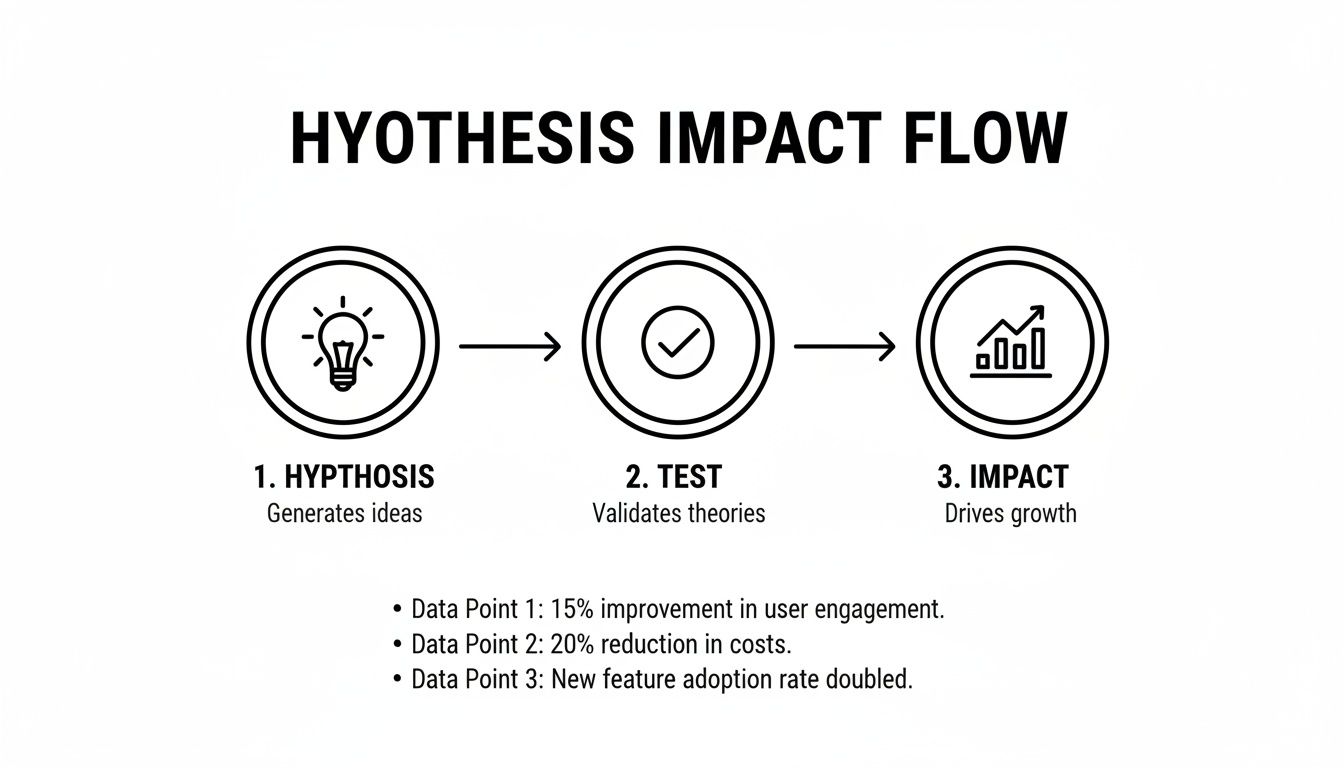
This diagram shows that a hypothesis isn't the final word. It's the starting gun for a cycle of learning and iteration that leads to real product growth.
Hypothesis Examples for Different PM Roles
Notice how each example is specific, measurable, and hooks directly into a business outcome.
1. The Growth PM: Onboarding Flow Optimization
- Hypothesis: We believe that for new users on mobile, replacing the 5-step onboarding carousel with a single, interactive "key action" prompt will increase the user activation rate (defined as completing 3 core tasks) by 15% within their first 24 hours.
- Why we believe this: Session recordings show a 70% drop-off rate at step 3 of the current carousel. Users are signaling they want to get to the value faster.
2. The AI PM: New Recommendation Engine
- Hypothesis: We believe that for logged-in users with over 10 past purchases, introducing a new collaborative filtering model in the "You Might Like" section will increase the click-through rate (CTR) by 20% and the average order value (AOV) by 5%.
- Why we believe this: Our current model is based on basic item similarity and has a low engagement rate. We're missing opportunities for cross-selling based on nuanced user taste. A better AI model is a direct path to increased revenue.
3. The Platform PM: API Performance Improvement
- Hypothesis: We believe that for our enterprise customers, implementing a dedicated caching layer for the
/user/profilesendpoint will decrease the P95 latency from 800ms to under 300ms. - Why we believe this: This endpoint is the source of 40% of customer-reported performance complaints and is a blocker for a major partner integration that represents $500k in ARR.
In every case, the hypothesis gives the entire team their marching orders. This is how you prototype and test ideas without wasting everyone's time.
The PM's Hypothesis Scorecard
Before you pitch an idea, run it through this rubric. Be brutally honest. If you can't score a 4 or 5 on most of these, go back to the drawing board.
| Attribute | 1 (Junior-Level) | 3 (Mid-Level) | 5 (Senior-Level) |
|---|---|---|---|
| Specificity | Vague change for a vague audience (e.g., "improve the app for users"). | Defined change, but broad audience (e.g., "for all mobile users"). | A specific change for a well-defined, strategic user segment (e.g., "for new users on iOS who churned"). |
| Measurability | Outcome is a vanity metric (e.g., "users will like it more"). | A real metric is named, but no target (e.g., "will increase retention"). | A specific KPI with a clear MDE is targeted (e.g., "increase 7-day retention by 5%"). |
| Falsifiability | No clear failure state; any outcome can be spun as a "learning." | The failure state is implied but not explicitly defined. | It's obvious what "failing" looks like (e.g., "the change has no statistically significant impact on the target metric"). |
| Relevance | The outcome has no connection to a key business objective (OKR). | The connection to business goals is a stretch. | The outcome directly contributes to a C-level OKR (e.g., "increase MRR by reducing churn"). |
Consistently running your ideas through this kind of rigor is what separates the pros from the amateurs. You'll build the muscle memory for spotting—and creating—hypotheses that actually move the needle for the business and your career.
Common Hypothesis Pitfalls and How to Avoid Them
I've seen even the most seasoned PMs stumble into the same few traps. Knowing these ahead of time is like having a mentor tap you on the shoulder before you make a mistake that could sink a project—or worse, your credibility.
The Confirmation Bias Trap
This is the most dangerous pitfall. Confirmation bias is our tendency to look for proof that we're right, instead of searching for the truth. A PM falls in love with their "genius" idea and then unconsciously designs tests guaranteed to succeed.
- How it looks: A PM sends out a survey with leading questions like, "Wouldn't an intelligent AI meal planner make your life so much easier?" and presents the "yes" responses as validation.
- How to beat it: Your goal is to prove yourself wrong. Actively focus on the null hypothesis. Your entire mission should be to find evidence that could disprove your idea. This intellectual honesty is a hallmark of a senior PM.
Focusing on Vanity Metrics
Another classic blunder is tying a hypothesis to a vanity metric—numbers that look impressive but have zero connection to business health (e.g., total app downloads).
- How it looks: A team hypothesizes a new feature will boost "likes per post." The metric shoots up, but behind the scenes, user session time and 30-day retention are tanking.
- How to beat it: Constantly ask, "So what?" If this metric goes up, does it lead to more revenue or better retention? Anchor your hypotheses to actionable metrics that reflect customer value. This gets to the core difference between a testable bet and just an example of an assumption—one is a focused experiment, the other is just an unchallenged belief.
The Overly Complex Hypothesis
Resist the urge to test a million things at once. A hypothesis like, "If we redesign the header, change the CTA color, and add a new icon, then conversion will increase," is untestable. If it works, you don't know which change made the difference.
- How to beat it: Isolate your variables. A strong hypothesis tests one specific, focused change. If you have three ideas, that's three separate hypotheses. Prioritize them with RICE, then test them one by one to get clean, unambiguous data.
Hypothesis FAQs for Product Managers
Even with the best frameworks, the same questions come up. Let's tackle the most common ones I hear from PMs.
How Do I Form a Hypothesis with Very Little Data?
This is the classic "new product" or "new feature" problem. Your first move isn't a big A/B test; it's to gather qualitative insights.
- Talk to users: Conduct 5-10 customer interviews. Use a prompt like: "Tell me about the last time you tried to [achieve X outcome]. What was the hardest part?"
- Analyze competitors: Sign up for their products. Where do they fail? What are their customers complaining about in reviews?
- Leverage AI for research: Use a tool like ChatGPT or Perplexity with a prompt like: "I am a PM for a [product type]. Analyze recent market reports and customer reviews for [competitor A] and [competitor B]. Summarize the top 3 unsolved user problems in the [market space]."
These observations fuel your first "qualitative hypothesis," which you can then test with a small, cheap experiment like a smoke test or a survey to get your first piece of quantitative data.
What Is the Difference Between a Hypothesis and an Assumption?
They’re related, but mixing them up is a recipe for disaster.
An assumption is a belief you hold to be true, without proof. A hypothesis is the formal, testable statement you create to see if that belief is actually true.
- Assumption: "I bet our users want a dark mode."
- Hypothesis: "We believe that for our power users (active daily), launching a dark mode will increase average session duration by 15% because it reduces eye strain during long sessions."
The best PMs are masters at sniffing out their riskiest assumptions and turning them into sharp, testable hypotheses.
How Many Hypotheses Should My Team Test Per Quarter?
The goal is quality and impact, not quantity. A growth team at a startup might burn through 5-10 small hypotheses a week optimizing an onboarding flow. A platform team at Google might spend a whole quarter on a single, massive hypothesis about infrastructure performance.
Focus on creating a steady rhythm of learning. Are you consistently testing your most critical assumptions? Are you learning something valuable from every experiment, win or lose? That's the mark of a high-functioning product team.
Ready to build the skills that get you noticed by top tech companies? Aakash Gupta provides the frameworks and real-world insights you need to advance your product career. Explore the newsletter and podcast for actionable advice from a seasoned product leader.
