Struggling to find your place as a Product Manager in a sprawling SAFe organization? The Product Owner in SAFe role is your most direct path to impact. This isn't a step down; it's a pivot from high-level strategy to ground-level execution where value is actually created.
This guide is your tactical playbook. We'll skip the abstract theory and dive straight into the frameworks, tools, and career moves that define a top-tier SAFe Product Owner. Let's start with your new mission.
From PM to SAFe PO: A 3-Step Action Plan for Your First 90 Days
Transitioning from a generalist PM to a SAFe PO is a fundamental shift in focus. Forget spending most of your time on market analysis or five-year roadmaps. Your new reality is the Agile team, and your primary measure of success is the consistent delivery of high-quality, working software.
Here’s your immediate action plan:
Step 1: Master the Team Backlog (Days 1-30). This is your new kingdom. Your first month is about owning this artifact completely.
- Action: Partner with the outgoing PO or your Product Manager to review the next three sprints' worth of stories.
- Action: Schedule 1-on-1s with every engineer and the QA on your team. Ask them: "What makes a user story 'ready' for you? What's the biggest bottleneck you face in a sprint?"
- Action: Use an AI tool like Gemini to redraft existing stories for clarity. Prompt: "Rewrite this user story: [paste story]. Add Gherkin-style acceptance criteria for a successful user login."
Step 2: Become the 'Voice of Value' (Days 31-60). Your job is to be the ultimate authority on what the team builds next.
- Action: For every feature, create a one-page summary that includes the "Why" (business goal), the "Who" (user persona), and the "How we'll measure it" (key metric).
- Action: Before every sprint planning, force-rank the backlog based on the WSJF (Weighted Shortest Job First) framework. Be prepared to defend your top 3 choices.
Step 3: Own the Execution, Not Just the Idea (Days 61-90). You are the bridge between the PM's vision and the team's code.
- Action: Set a personal goal to accept or reject every completed story within 24 hours of it being moved to "Ready for Review." This builds team momentum.
- Action: At the end of every sprint, send a concise email to stakeholders (including your PM) showcasing the value delivered, not just the stories completed. Include screenshots or short GIFs.
If you’re coming from a more traditional PM background, thinking about how to pivot careers can help frame this as a powerful specialization. In massive enterprises like Salesforce and UnitedHealth Group, the PO is the lynchpin. They ensure the hugely expensive Agile Release Train (ART) actually delivers on its promises.
For a broader look at the role outside of the SAFe framework, we've broken down how to define the product owner in more detail.
Product Owner vs. Product Manager in SAFe: Key Distinctions
One of the biggest mistakes I see people make when they move into a large-scale SAFe organization is blurring the lines between the Product Owner and the Product Manager. It’s an easy mistake to make, but in the world of SAFe, it’s a career-limiting one.
While they are tight-knit partners, their day-to-day realities, their authority, and their entire focus are fundamentally different. Getting this right is your first step to navigating a SAFe-driven career.
Here’s the best way I’ve found to explain it: the Product Manager is the architect of the skyscraper. They’re focused externally, studying the city's needs (market research), designing the building's purpose (the vision), and ensuring the final structure is valuable and meets the client's goals. They own the strategic "what" and "why."
The Product Owner, on the other hand, is the construction foreman for a specific set of floors. You are on-site, deep in the details with the development team. You're the one translating the architect's grand vision into the concrete, steel, and wiring that the crew can build right now. You own the tactical "how" and "when."
Focus and Horizon
The most critical difference comes down to their line of sight.
A Product Manager thinks strategically, looking outward and far ahead. They're obsessed with the market, competitors, and the customer problems they need to solve over the next 1-3 Program Increments (PIs). Their job is to make sure the entire Agile Release Train (ART) is pointed in the right direction, building something the market will actually want.
A Product Owner is tactical, looking inward and at the immediate future. Your world revolves around the current and next Iteration (or sprint). You are laser-focused on the Team Backlog, making sure it’s packed with well-defined, perfectly-prioritized stories to deliver the most possible value in the next two weeks.
A Product Manager asks, "What problem should we solve next quarter to win market share?" A Product Owner asks, "What is the most valuable story we can deliver in the next sprint to advance that goal?"
Authority and Ownership
This difference in focus directly shapes what each role owns and has final say over. To make it crystal clear, this table breaks down how their responsibilities are divided in a SAFe setup.
Product Owner vs. Product Manager in SAFe
| Dimension | Product Owner (PO) | Product Manager (PM) |
|---|---|---|
| Primary Artifact | Team Backlog | Program Backlog & Vision |
| Key Responsibility | Story acceptance and prioritization | Feature prioritization (WSJF) |
| Main Collaboration | Agile Team, Scrum Master | Business Owners, Customers, Architects |
| Core Output | Well-defined User Stories | Vision, Roadmap, Features |
As you can see, the PM sets the direction with Features in the Program Backlog, while the PO breaks those Features down into Stories for the Team Backlog.
Grasping this division of labor is absolutely essential. If you're looking to explore the differences between these roles more broadly, outside of just the SAFe framework, our detailed guide on the Product Owner vs Product Manager provides even more clarity. This knowledge is what will help you speak the right language in interviews and position your skills correctly for any large-scale Agile company.
To truly master the Product Owner role in SAFe, you have to do more than just read the manual. Theory is one thing, but your real impact comes from how you show up in the critical events that set the pace for the entire Agile Release Train (ART).
These aren't just meetings on a calendar; they are high-stakes moments where strategy gets turned into actual work. Your job isn't to be a scribe or a passive observer. You're there to prepare, to lead, and to see things through.
This chart paints a clear picture of the fundamental split between the Product Manager and the Product Owner. It's a distinction that becomes incredibly important when you're in the thick of these SAFe events.
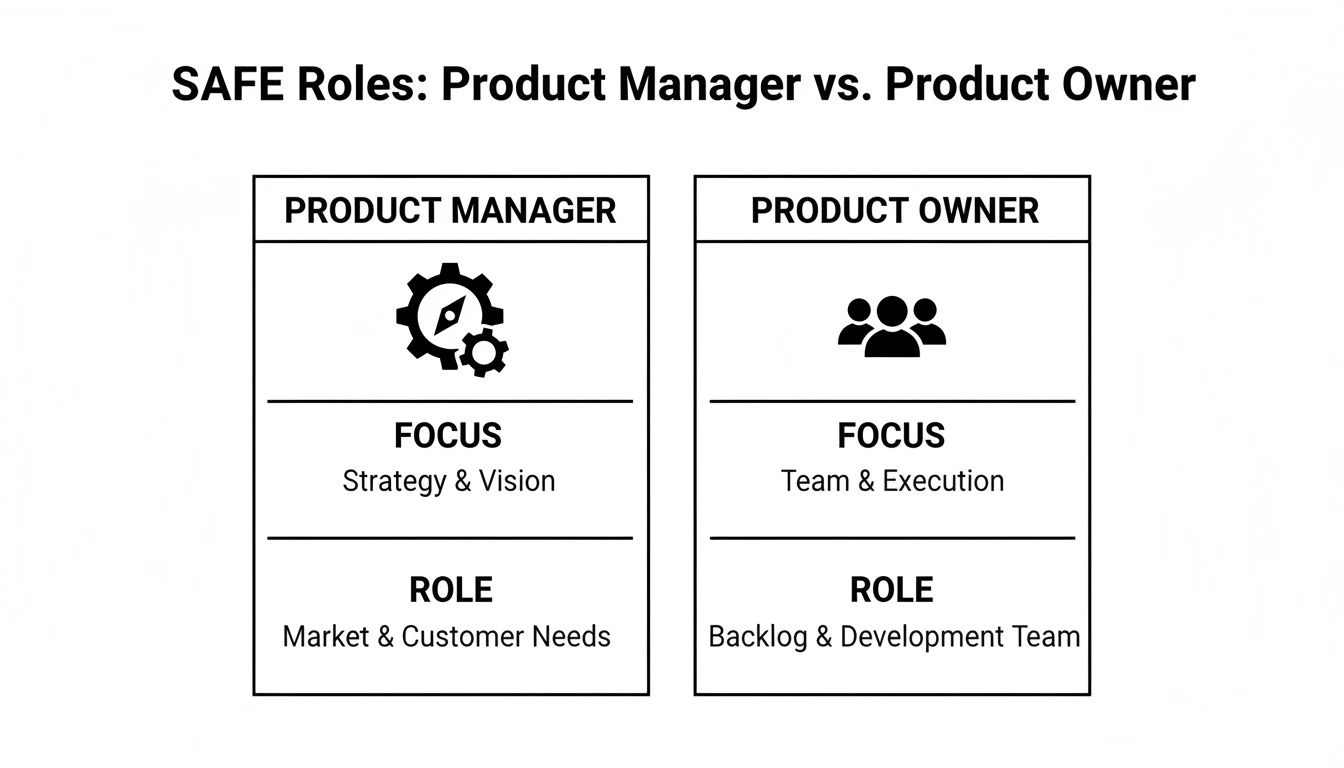
Think of it this way: the PM is looking out at the market, figuring out the big picture. You, the PO, are laser-focused on the team, owning the nitty-gritty of how to get that vision built.
Mastering PI Planning
Let's be clear: Program Increment (PI) Planning is the most important event in the SAFe universe. As a PO, you walk into this intense two-day session as the undisputed authority on your team's backlog and the stand-in for the customer.
The real work for you starts long before Day 1. Your pre-planning is everything.
- Become a Feature Expert: You need to get deep into the "what" and "why" behind the Features with your Product Manager. When your team asks questions, you need to be able to explain the business context and customer value without needing the PM by your side.
- Prep Your Opening Stories: You should have the top-priority user stories drafted for the most critical features. They don't have to be perfect, but they must be solid enough for your team to grab onto and start estimating.
- Shape the PI Objectives: During the planning sessions, you'll guide the team as they turn their work into clear, measurable PI Objectives. These are the promises your team makes to the business, and it's on you to make sure they're both ambitious and achievable.
The ART Sync: Your Tactical Command Center
If PI Planning is the big strategic push, the Agile Release Train (ART) Sync is your regular tactical checkpoint. This meeting, often held weekly, is your main arena for knocking down dependencies and raising the flag on bigger problems.
Think of it as the ART's air traffic control. Here's your playbook:
- Be Your Team's Voice: You speak for your team on all things related to backlog progress and feature delivery. Report the wins, and don't shy away from the roadblocks.
- Horse-Trade on Dependencies: This is where you connect with other POs to sort out dependencies. Is another team's work blocking your most important story? You hash it out here, not over a long email chain.
- Know When to Escalate: Some problems are too big for the sync to handle—a major technical hurdle or a surprise shift in business needs. Your job is to recognize those moments and escalate them to the Product Manager for a strategic call.
Running Powerful Backlog Refinement Sessions
Backlog Refinement (or grooming, if you're old school) is where you deliver consistent value, week in and week out. These aren't just meetings; they are hands-on working sessions to make sure the pipeline of work is always primed and ready. A clean, well-prepared backlog is the signature of a great Product Owner.
While many of the core mechanics are similar to what you'd find in any agile team, the SAFe twist is that you're constantly breaking down the larger, PM-owned Features into team-sized chunks. For a refresher on the basics, our guide on sprint planning best practices is a great place to start.
A great PO ensures the team never starts an Iteration staring at a blank slate. Your mission should be to always have at least two sprints' worth of stories fully refined and ready to go in the backlog.
Your Essential SAFe Product Owner Toolkit
Knowing the theory gets you in the door, but having the right tools is what makes you a great SAFe Product Owner. Your real job is to bring clarity to the chaos of a Program Increment. It's about turning high-level ideas into tangible work the team can actually build.
These are the battle-tested frameworks I’ve seen work time and time again. Your success hinges on the smallest unit of work: the User Story. A bad story causes confusion, rework, and wasted sprints. But a great one? That’s how you get the team building the right thing, right from the start.
The Anatomy of a Perfect User Story
Think of a user story not just as a backlog item, but as a mini-contract. It’s a promise of value. And while the classic "As a…, I want…, so that…" format is a decent start, it's just the tip of the iceberg. The real magic is in creating a shared understanding between you and your team.
For a story to be truly "ready," it needs to pass the INVEST test:
- Independent: Can we build and ship this without being tangled up in another story?
- Negotiable: Is this a starting point for a conversation, not a rigid command?
- Valuable: Does it actually matter to a user or the business?
- Estimable: Can the team give us a ballpark size for the effort?
- Small: Can we get this done in a single iteration? Seriously, keep it small.
- Testable: Do we know exactly what "done" looks like?
That last one—Testable—is where most stories fall apart. Acceptance criteria are your best friend here. They are the non-negotiable, pass/fail conditions that leave no room for guessing. You can find more real-world examples in our deep-dive on how to write excellent user stories.
Pro Tip: For any story with a bit of complexity, use the Gherkin format (Given/When/Then). It's a lifesaver. It forces you to think through the scenario in plain English, making it crystal clear for developers, QAs, and business folks alike. No technical jargon needed.
Prioritizing with Weighted Shortest Job First (WSJF)
In SAFe, we don't prioritize based on who shouts the loudest. We use data. The gold standard for this is Weighted Shortest Job First (WSJF), a model for sequencing work to get the biggest economic bang for our buck.
The formula is simple: WSJF = Cost of Delay / Job Size.
Calculating the Cost of Delay (CoD) is where the real thinking happens. You break it down into three parts, scoring each on a relative scale (like 1-10):
- User-Business Value: How badly do our users and the business need this? Is this a game-changer or a nice-to-have?
- Time Criticality: Is the value about to rot on the vine? Is there a hard deadline or a market window we’re about to miss?
- Risk Reduction / Opportunity Enablement: Does this feature fix a critical vulnerability or unlock a massive new opportunity for us down the line?
You add those three numbers up to get your Cost of Delay score. Then, divide it by the Job Size (your team’s effort estimate, usually in story points).
The job with the highest WSJF score wins. It goes to the top of the backlog. This simple math forces an objective, value-first conversation and stops gut-feel decisions in their tracks.
SAFe Product Owner Salary Potential in 2026
Let's get to the critical question: what does a Product Owner in SAFe earn in 2026? Specializing in a high-demand framework like SAFe is a smart career move, and the compensation reflects that. Companies like Google, Meta, and large financial institutions that rely on scaled agile frameworks are in a constant battle for talent that can translate strategy into execution.
This salary data is your negotiation tool. For aspiring PMs, it's the ROI on your skill investment. For practicing POs, it's your leverage for a promotion or a more lucrative role.
Real-World Job Postings & Salary Data
To give you a concrete example, here's a sanitized version of a recent Senior SAFe Product Owner posting from a Fortune 100 company:
Senior Product Owner, Digital Experience (Remote)
Salary Range: $135,000 – $165,000 base + 15% target bonus
Responsibilities: Own and prioritize the team backlog for 2 Agile teams working on our customer self-service portal. Decompose epics from the Product Manager into actionable user stories. Lead story refinement and act as the voice of the customer within the ART.
Qualifications: 5+ years as a Product Owner. SAFe POPM certification required. Demonstrated experience with WSJF and PI Planning.
This is typical for a senior role. For those earlier in their career, the numbers still tell a compelling story. Recent industry data shows the average base salary for a Product Owner in the US hovers around $102,059 a year, but this is a national average that includes all industries and company sizes.
When you factor in total compensation (base + bonus + equity), the range is significant: starting around $72,000 for entry-level roles and climbing past $148,000 for experienced leads in major tech hubs. You can explore the data yourself on Product Owner salary benchmarks to see the full breakdown.
How Location and Demand Drive Higher Earnings
It’s no secret that where you live and work makes a huge difference in your paycheck. The major tech and business hubs are hungry for skilled SAFe practitioners, and they've created a salary bubble for people with the right experience.
For instance, a SAFe Product Owner role at a major bank in New York City or a tech firm in Seattle will almost certainly command a higher salary than a similar role in a smaller market. This premium can often be 15-25% higher than the national average.
This is simple economics: supply and demand. Big companies are concentrated in these cities, and most of them have gone all-in on SAFe. They need qualified people to keep their Agile Release Trains on the tracks, and they're willing to pay top dollar for talent that can deliver value from day one. Your SAFe expertise becomes a golden ticket in these high-cost, high-opportunity cities.
Your Career Path as a SAFe Product Owner
Let’s be clear: the SAFe Product Owner role isn’t just another title on your LinkedIn profile. It's a strategic launchpad. I’ve seen it time and time again—this role is where you build the deep, practical expertise that opens doors to senior leadership roles you might not even be thinking about yet.
Think of it as your master key. You're positioned right at the intersection of business strategy and team-level execution. Mastering this spot proves you can do the one thing every company craves: turn ideas into real, shipping products.
Where Does This Role Actually Lead?
Your journey from SAFe Product Owner isn't a straight line up a corporate ladder. It's more like a branching tree with several high-value paths. Once you’ve proven you can translate strategy into tangible results for an Agile team, you become a hot commodity.
Here are the most common (and lucrative) moves I see successful POs make:
- Senior Product Owner: This is the most natural next step. It's not just a title bump. It means you’re trusted with more complexity—maybe leading a bigger or more mission-critical Agile team, mentoring the next crop of POs, or owning a strategically vital slice of the product.
- Product Manager: After getting your hands dirty with the "how" at the team level, you can graduate to the "what and why." Your ground-level experience as a PO gives you a massive advantage as a Product Manager. You'll have an almost intuitive feel for what it really takes to build the vision you’re selling.
- Release Train Engineer (RTE): Do you find yourself geeking out on process, coaching, and helping the whole system run better? The RTE role might be your calling. You go from optimizing one team to become the servant leader who makes the entire Agile Release Train (the "team of teams") hum.
- Agile Coach: The best POs often develop a real passion for the principles that make it all work. Becoming an Agile Coach is a way to scale your impact exponentially, teaching and guiding multiple teams—and even leaders—across the entire organization.
Let's Talk Money: Salary and Growth
The financial rewards for getting good in this role are real and well-documented. Experience isn't just a nice-to-have; it's a huge driver of your earning potential.
Data shows that while a PO in their first few years (1-4) might average around $90,861 in total compensation, that number takes a significant leap once you get more experience. Seasoned professionals with 7+ years under their belt see that average jump to $132,408. The top 10% of earners in the field often break $150,000 annually. You can dig into more of the specifics by checking out the latest product owner salary data on ProductHQ.org.
This isn't an accident. This steep salary curve shows that companies are willing to pay a serious premium for people who have proven they can navigate a complex enterprise environment and deliver real value.
For a broader look at how this fits into the larger picture, we've put together a comprehensive guide on the product management career path.
Answering Your Top Questions About the SAFe Product Owner Role
Moving into a massive framework like SAFe can feel like you're learning a new language. As a product leader who hires for these roles, I get a lot of sharp, pointed questions from candidates trying to figure out if this path is right for them.
Let's cut through the noise. Here are my straight-up answers to the questions I hear the most.
Do I Really Need a SAFe Certification to Be a Product Owner?
Look, is it mandatory? Not always. But a SAFe Product Owner/Product Manager (POPM) certification is a huge green flag for hiring managers at companies like AT&T or Cisco. It tells me you've already invested in learning the specific language and rituals of their operating model. In a competitive market, it's a powerful differentiator.
Actionable Advice: The SAFe POPM certification from Scaled Agile is the industry standard. The course typically costs between $1,000 – $1,500 and is usually a two-day virtual or in-person workshop. Many employers will sponsor this. If yours won't, consider it a direct investment in your earning potential. It de-risks you as a candidate and signals you can contribute from day one without extensive hand-holding on the framework itself.
How Should I Actually Use AI as a SAFe PO in 2026?
AI is your new superpower, not your replacement. A smart product owner in SAFe uses AI to eliminate tedious work, freeing up mental space for high-value strategic tasks. As we move into an AI-first world, proficiency with these tools is becoming a core competency.
Here is a tactical workflow you can use today:
- Drafting User Stories: Stop staring at a blank Jira ticket. Use a large language model like Gemini as your co-pilot.
- Prompt: "Act as a senior SAFe Product Owner. You are working on an e-commerce platform. Your Product Manager has given you a feature: 'Enable guest checkout'. Write 5 distinct user stories for this feature, following the 'As a, I want, so that' format. For each story, also provide 3-5 Gherkin-style acceptance criteria (Given/When/Then). Optimize for clarity and testability."
- Synthesizing Feedback: You have 100 pieces of user feedback from a recent launch. Don't read them one by one.
- Action: Export the feedback to a CSV. Use the data analysis function in ChatGPT-4 or Gemini.
- Prompt: "Analyze this customer feedback data. Identify the top 5 recurring themes or complaints. For each theme, provide 3 direct quotes that exemplify the issue. Present the output as a table."
- Generating Test Data: Your developers need realistic data to test a new form.
- Prompt: "Generate a 10-row CSV of synthetic user data for testing a new account sign-up form. Include columns for: first_name, last_name, email_address, password (complex string), and phone_number (US format)."
The goal is to automate the 80% of your job that is repetitive (drafting, summarizing, formatting) so you can dedicate your human intelligence to the 20% that requires negotiation, strategic alignment, and stakeholder management.
What's the Single Biggest Challenge for a New SAFe PO?
It's the mental whiplash of going from strategic to tactical. Almost every time.
If you’re coming from a traditional PM role, you're used to living in the clouds, owning the grand vision, and thinking 18 months ahead. As a SAFe PO, your entire universe suddenly shrinks to the Team Backlog and what can be done in the next two sprints.
Your new obsession has to be execution. You have to learn to put your full trust in your Product Manager to own that long-term strategy. Your job is to take their features and become a master at breaking them down into perfectly formed, valuable, and—most importantly—small user stories that your team can crush.
Making that mental shift, from visionary to enabler of execution, is the toughest and most important hurdle you'll face in your first six months. Nail that, and you'll succeed.
At Aakash Gupta, we're dedicated to helping you master every stage of your product career. For more deep dives into product strategy, career growth, and market trends, explore the insights at https://www.aakashg.com.
