As a Product Manager, your entire job boils down to making high-quality decisions under pressure. A decision-making framework is your system for doing that—a structured, repeatable process that takes emotion and bias out of the equation. Instead of going with your gut, you're using a logical, data-informed process to bring clarity and consistency to your choices, turning chaos into a clear, defensible roadmap. This is a core skill that separates junior PMs from senior product leaders.
As an example, when I was leading a team at Google, we had to decide whether to invest in a major platform refactor or ship a new user-facing feature. The sales team wanted the feature; engineering was desperate for the refactor. Without a framework, that decision becomes a political battle. We used a modified RICE framework, layering on strategic alignment scores, to depoliticize the conversation and make a data-driven choice that everyone could stand behind.
Why Every PM Needs a Framework for Decision Making
A Product Manager's daily life is a constant battle against chaos. You're juggling conflicting demands from stakeholders, staring down a mountain of data, and trying to make sense of an endless backlog. Without a structured approach, you end up making decisions based on who’s yelling the loudest, not what users actually need.
A decision-making framework is your toolkit for creating order and actually driving impact. Think of it like a pilot's pre-flight checklist. It doesn't replace their expertise, but it makes damn sure they don't miss a critical step when the pressure is on.
From Chaos to Clarity
Top PMs at places like Google and Meta rely on these systems to cut through the noise, justify their choices with data, and get their teams aligned around a clear vision. This isn't just about avoiding costly mistakes; it's about accelerating your career. Making good, clear-headed decisions is a core part of strong leadership, and it directly influences how leaders apply various leadership principles to sharpen strategy and manage their teams effectively. For an aspiring PM, mastering a framework like RICE can be a key differentiator in interviews, showing you can think systematically. For a Senior PM, using a framework like DACI is table stakes for managing complex, cross-functional initiatives.
And this skill is only getting more critical. The entire Management Decision Analysis sector is projected to balloon from USD 6.38 billion in 2023 to USD 14.91 billion by 2030. That’s a huge signal that the industry is moving away from winging it and toward structured, defensible thinking. You can dig into the growth of decision analysis markets if you're curious about the numbers.
A decision-making framework transforms you from a feature manager—just reacting to requests—into a product leader who strategically guides the product toward a defined goal. It’s the difference between being busy and being effective.
Adopting a framework gives you a few serious advantages right off the bat:
- Defensible Logic: It provides a clear, documented reason for why a decision was made. This is absolutely crucial when you need to get stakeholders on board.
- Reduced Bias: It forces you to evaluate options systematically, which helps minimize the influence of your own personal preferences or gut reactions.
- Team Alignment: When everyone uses a shared framework, you create a common language for talking about priorities and strategy. The debates become much more productive.
Choosing the Right PM Decision Making Framework
Picking a decision-making framework is like choosing the right tool for a job. You wouldn't use a sledgehammer to hang a picture frame, right? In the same way, the framework you grab has to fit the problem you're trying to solve. For product managers, whether you're at a fast-moving startup or a giant like Google, this choice directly impacts how quickly and effectively your product evolves.
The most useful frameworks generally fall into two buckets: quantitative and strategic. Each one has a very different job to do in a PM's day-to-day life.
Quantitative vs. Strategic Frameworks
Quantitative frameworks are all about backlog prioritization. They use numbers and scoring to cut through the noise of a long list of potential features, giving you an objective way to decide what to build next. Think of them as your data-backed tiebreakers when everyone has a strong opinion.
- RICE (Reach, Impact, Confidence, Effort): This is a fantastic tool for established products that have a steady stream of user data. It forces you to think through how many people a feature will touch (Reach) and how much it will actually move the needle (Impact). At companies like Intercom, RICE is the standard for roadmap planning.
- ICE (Impact, Confidence, Ease): This is the leaner, faster cousin of RICE. It’s perfect for early-stage products or new features where you can't really quantify "Reach" yet. It's built for quick, gut-checked prioritization to keep things moving. A startup PM can run an ICE score in 15 minutes.
Strategic frameworks, on the other hand, are designed to tackle the messier problems of team alignment and stakeholder management. Their goal isn't to score features but to clarify who gets to make the final call and make sure everyone is on board for big, important projects.
- DACI (Driver, Approver, Contributor, Informed): This is the ultimate weapon against decision-making bottlenecks in complex organizations. It clearly assigns roles, making one person the Driver (responsible for getting a decision made) and only one person or group the final Approver.
- RAPID (Recommend, Agree, Perform, Input, Decide): Similar to DACI, this framework is often used to nail down decision rights on large, cross-functional initiatives where any ambiguity can cause massive delays and frustration. It's heavily used in management consulting and large tech firms.
This flowchart pretty much sums up the classic PM dilemma: when you’re staring at chaos, a framework is your path back to clarity.
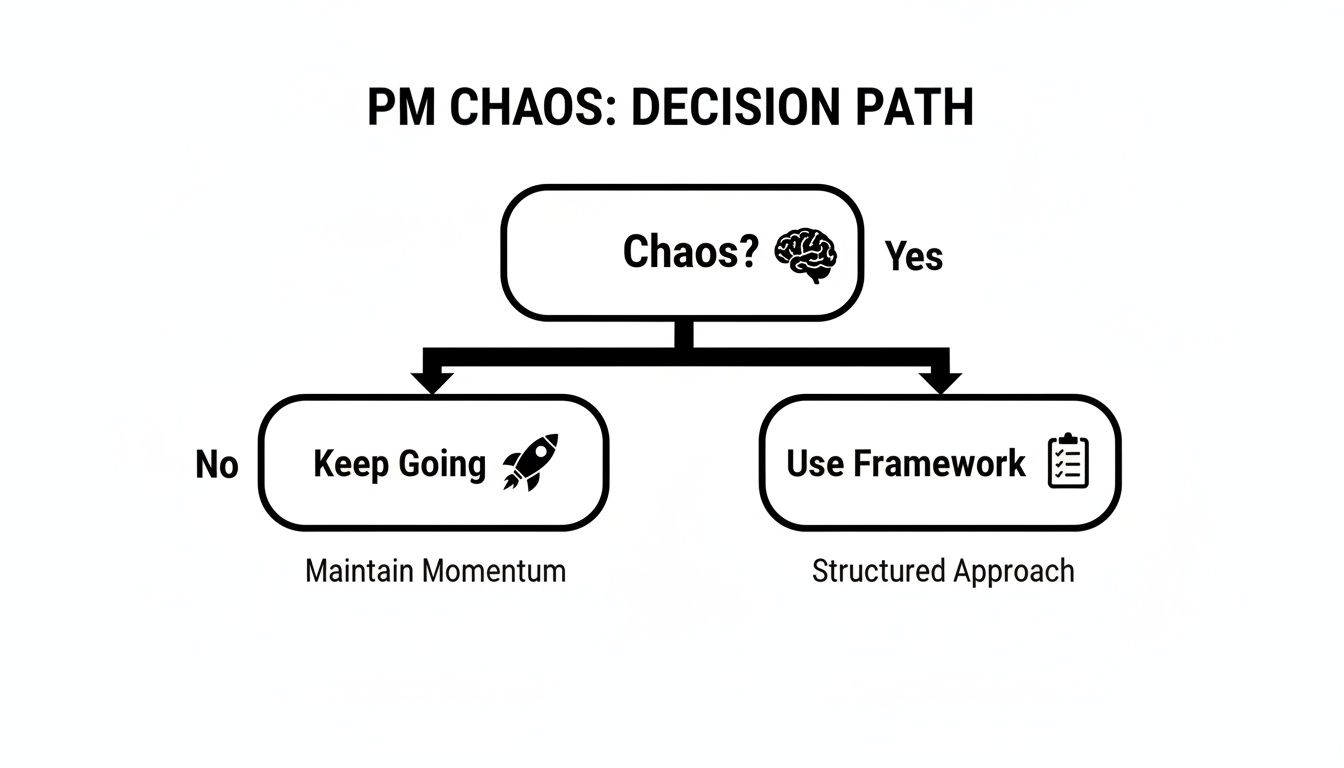
As you can see, just "keeping going" without any structure really only works when the waters are calm. The moment things get messy, a framework is what brings order back to the chaos.
How to Select Your Framework
To pick the right tool, you first have to diagnose the problem accurately. Is your team drowning in a bloated backlog with endless debates over what to build next? Or are your biggest projects constantly stalling because nobody is sure who actually owns the final decision?
The goal isn't to find one perfect framework for everything. The goal is to build a small, versatile toolkit and know exactly when to pull out each tool. A senior PM's value often lies in diagnosing the problem correctly before prescribing a solution.
No matter which framework you lean toward, a solid grasp of data-driven decision-making principles will serve you well. It's the foundation for making more objective, defensible choices.
If you're just starting out, it's far more valuable to master one or two of these frameworks than to have a superficial knowledge of a dozen. For a deeper dive into sorting out your roadmap, our detailed guide on product prioritization frameworks is a great next step.
To make the choice a little easier, I've put together a quick-reference table that breaks down some of the most common frameworks we use in product management.
PM Decision Framework Comparison
This table should help you quickly match your current challenge to the right framework. Think of it as a cheat sheet for choosing your tool.
| Framework | Best For | Key Benefit | When to Avoid |
|---|---|---|---|
| RICE | Prioritizing features in mature products | Data-informed objectivity | Early-stage products with no user data |
| ICE | Quick prioritization in startups | Speed and simplicity | Complex features needing deep analysis |
| DACI | Clarifying roles for major decisions | Eliminates confusion and bottlenecks | Small, autonomous teams with clear roles |
| RAPID | High-stakes, cross-functional projects | Ensures accountability and buy-in | Simple, single-threaded decisions |
Ultimately, the best framework is the one your team will actually use. Start small, pick one that solves a real pain point, and build from there.
Mastering RICE: A Step-by-Step Implementation Guide
Product backlogs are notorious battlegrounds. Everyone has a strong opinion on what to build next, and those debates can easily get bogged down in subjectivity. The RICE scoring model is one of the best tools for cutting through that noise and bringing some much-needed objectivity to the chaos.
It's a simple framework that forces a structured, data-informed conversation about your priorities.

The formula itself looks easy enough: (Reach x Impact x Confidence) / Effort = RICE Score.
But the real magic isn't in the math. It's in the rigor of defining each of those variables. Let's walk through how to actually put it into practice.
Step 1: Quantify Your Reach
First up is Reach. This isn't a vague guess; it's about how many real users a project will touch in a specific timeframe, like a month or a quarter. You need a hard number here.
- Actionable Tip: Get into your analytics. Pull up Amplitude or Mixpanel and find the actual data. How many "users complete onboarding per month"? Or how many customers fall into your target segment, like "trial users on the Pro plan"? Be specific.
Step 2: Define the Impact
Next is Impact, which measures how much a project will move the needle on your most important goals—think activation, revenue, or retention. Gut feelings don't count. To keep this consistent, everyone on the team should use the same standardized scale.
Here’s a common one that works well:
- 3 = Massive impact
- 2 = High impact
- 1 = Medium impact
- 0.5 = Low impact
- 0.25 = Minimal impact
To land on a score, ask yourselves: "If this feature is wildly successful, how much does it actually help us hit our North Star metric or a key OKR?" Tying Impact directly back to company goals is how you keep the team rowing in the same direction.
Step 3: Assign a Confidence Score
Confidence is your built-in reality check. It’s a percentage that forces you to be honest about how much you really know about your Reach and Impact numbers. This is your defense against getting carried away by your own optimism.
- 100% = High confidence (You have solid quantitative data, user research, and maybe even a successful A/B test to back it up).
- 80% = Medium confidence (You're working off qualitative feedback and some promising data, but it's not a sure thing).
- 50% = Low confidence (This is more of a hunch—an idea with little to no evidence yet).
If your score dips below 50%, that’s a red flag. It’s a clear signal that you need to do more homework and gather data before you even think about dedicating engineering time. This kind of honest self-assessment is a core part of any healthy product strategy framework.
Step 4: Estimate the Effort
Finally, you need to estimate the Effort. This isn't just about coding; it's the total work required from your product, design, and engineering teams. This is a conversation you absolutely must have with your engineering lead.
A great way to do this without getting lost in the weeds is to use "person-months"—the amount of work one person can get done in a single month.
- 0.5 = Just a few days of work.
- 1 = One person-month.
- 2 = Two person-months.
- 3+ = A large, complex project.
This keeps the estimates high-level and avoids the trap of trying to map out every single hour during early-stage prioritization.
By working through these four steps, the RICE model gives you a defensible, data-driven score for every idea on the table. That clarity empowers you to build a roadmap that truly aligns with what your users need and what your business needs to achieve.
Using DACI to Drive Alignment and Speed
While frameworks like RICE are fantastic for sorting through a jam-packed backlog, some of the toughest challenges for mid-career and senior PMs aren’t about what to build. They’re about how to get a complex decision made without it getting stuck in committee for three months.
Progress grinds to a halt the moment someone asks, "So… who actually makes the call here?" This is exactly where a strategic framework like DACI comes in.
The DACI framework is the ultimate tool for cutting through this kind of confusion in large organizations. It’s not for prioritizing features; it’s for clarifying roles and blowing up the bottlenecks that kill momentum on high-stakes projects. It's how you bring sanity to cross-functional chaos.

Defining the DACI Roles
The real power of DACI lies in its simplicity. For any given decision, it assigns every key stakeholder to one of four distinct roles.
- D = Driver: The single person responsible for shepherding the decision from start to finish. This is usually the Product Manager. They rally the troops, gather information, and make sure a decision happens on time, but they are not the final decision-maker.
- A = Approver: The one person (or, in rare cases, a tiny group) who actually makes the final call. This is the most critical role to define—having only one "A" is the secret to preventing stalemates.
- C = Contributor: These are your subject matter experts whose knowledge is essential. Think engineering leads, legal counsel, or marketing specialists. They have a voice and provide crucial input, but they don't get a vote.
- I = Informed: People who need to know the outcome of the decision but aren't actively involved in making it. This might be the broader engineering team, customer support, or sales.
This structure forces you to be brutally clear about who does what. The minute you start assigning roles, you’ll immediately see if you have too many Approvers—a classic recipe for gridlock. Getting this right is a non-negotiable skill for anyone looking to master cross-functional team management.
DACI in Action at Slack
Let's make this real. Imagine you're a Senior PM at Slack, and your big project is launching a major integration with a new AI platform. The decision isn't if you should do it, but which partner to choose and what the go-to-market strategy should look like. The project is completely stuck.
Here’s how you’d use DACI to get things moving again:
The Decision: Select the primary AI partner and finalize the Q3 launch plan.
Your DACI chart would look something like this:
| Role | Stakeholder | Responsibility |
|---|---|---|
| Driver | You (Senior PM) | Organize partner evaluations, consolidate research from teams, and schedule the final decision meeting. |
| Approver | VP of Product | Makes the final call on the partner and budget based on the team's recommendation. |
| Contributors | Head of Engineering, Director of Marketing, Legal Counsel | Provide technical feasibility assessments, go-to-market input, and contract reviews. |
| Informed | Sales Team, Customer Success, Broader Product Org | Receive updates on the final decision and launch timeline via email and Slack channels. |
Suddenly, everyone knows their job. The engineering lead understands they’re there to provide input on technical effort, not to approve the business case. The marketing director contributes campaign ideas but doesn't have veto power.
Most importantly, everyone knows the VP of Product is the single point of approval. That clarity alone eliminates the back-channeling and confusion, speeding up the entire process.
Integrating AI into Your Decision Making Process
Traditional decision-making frameworks give you structure, but let's be honest, they can feel a bit static. Modern AI tools are changing that, adding a powerful layer of speed and depth that turns a good process into a great one.
For Product Managers, this isn't about letting an algorithm take your job. It's about augmenting your strategic thinking to make faster, smarter, and more data-driven choices. Think of AI as a tireless analyst, instantly synthesizing mountains of information that would take you days to sift through. This frees you up to focus on the high-level strategy and the "so what?" behind the data—which is where true product leadership really shines. An AI PM doesn’t just build AI features; they use AI to build all features better.

Actionable AI Prompts to Supercharge Your Frameworks
Let's move from theory to practice. Here are a few specific prompts you can plug into tools like ChatGPT-4 or Claude 3 Opus today to get more out of your go-to frameworks.
For RICE Scoring:
- Synthesize Impact: "Act as a senior product manager. Analyze these 50 user support tickets from Zendesk and 10 app store reviews [paste text]. Identify the top 3 most requested features or common pain points. Explain which, if solved, would have the highest positive impact on our stated goal of 'increasing user retention' and why."
- Identify Risks for Effort: "My engineering team has estimated the effort for building a new 'AI-powered team collaboration summary' feature. Based on common risks for developing LLM-based products, list 5 potential hidden complexities that could inflate the effort score. Consider dependencies on OpenAI's API, data privacy reviews, prompt engineering, and scalability issues."
For DACI Alignment:
- Draft a DACI Charter: "Draft a DACI charter for a project to redesign our mobile app's onboarding flow to include a new AI assistant. The goal is to get cross-functional alignment before kickoff. Assign placeholder roles for a PM (Driver), VP of Product (Approver), and include Engineering Lead, UX Lead, Data Scientist (AI), and Marketing Manager as Contributors. Specifically outline what input is needed from the Data Scientist."
AI doesn't make the decision for you; it sharpens the inputs. It provides a data-backed starting point, helping you define variables like 'Impact' or 'Confidence' with more objectivity and less guesswork.
The Rise of Decision Intelligence
This blend of AI and classic decision-making is giving rise to a new field: Decision Intelligence. It’s not just a buzzword; it’s a discipline that combines data science, social science, and management principles into a practical framework for making better choices. New platforms are emerging that automate complex data analysis, helping PMs shift from reactive decisions to predictive strategies.
And this isn't some niche trend. The decision intelligence market is exploding, valued at USD 13.3 billion in 2024 and projected to hit an incredible USD 50.1 billion by 2030. These aren't just numbers; they signal a massive industry shift. Companies are embedding intelligence directly into their core decision-making processes. You can dig into the growth drivers of the decision intelligence market to see just how big this is becoming.
Mastering these tools is how you build a future-proof skill set. For those looking to go even deeper, check out our guide on how AI is fundamentally changing the PM role. Leaning into this shift is no longer optional—it's essential for staying ahead in your career.
Avoiding Common Decision Making Traps
Look, even the most perfect framework can go completely off the rails. It’s a tool, not a substitute for thinking. I’ve seen enough product managers fall into this trap to know that the real challenge isn’t picking RICE or DACI; it’s spotting the mental shortcuts and biases that cause us to misapply them in the first place.
These pitfalls are so common because they’re baked into our psychology. As product leaders, our job is to see them coming and steer the team back on course. The real skill isn't just using a framework, but using it well when the pressure is on.
Beyond the Numbers Game
One of the most dangerous traps is treating a quantitative score as gospel. You run a RICE analysis, a feature gets a high number, and the immediate impulse is to jam it at the top of the backlog. Case closed. This is a classic rookie mistake.
A score is a conversation starter, not a conclusion. It’s totally stripped of the qualitative context—the why—behind the numbers. Maybe that high-scoring feature is a technical one-off that doesn’t fit your quarterly theme at all. Or maybe it delights a small group of power users but completely alienates a much larger segment of new ones.
A framework gives you a data-informed opinion, not a data-dictated mandate. Your job as a PM is to layer strategic context and user empathy on top of the numbers.
Overcoming Analysis Paralysis
Frameworks are supposed to bring clarity, but sometimes they do the exact opposite. They create analysis paralysis. This is what happens when the team gets so obsessed with perfecting the inputs—endlessly debating the exact Reach number or the precise Effort score—that they never actually make a decision.
Frankly, this is often a sign that the team is using the framework to avoid accountability. It's a huge issue, especially in complex IT environments. In fact, 81% of surveyed leaders point to slow implementation and process complexity as their biggest challenges. They get stuck because they’re terrified of making the wrong call. You can read more about the challenges in the IT decision-making process to see just how common this is.
To break the cycle, you have to timebox the discussion:
- Set a Deadline: "We will spend two hours debating these scores, and then we will make a call."
- Define "Good Enough": Agree on a confidence threshold. A decision made with 80% confidence today is almost always better than one made with 95% confidence in three weeks.
Another huge one is confirmation bias. This is where we subconsciously favor data that supports what we already believe. We’ll inflate the "Impact" score for a pet feature we love while conveniently downplaying the "Effort" required.
To fight this, you have to actively seek out dissent. Go to your engineering lead and ask, "What are all the reasons this is a terrible idea?" The point isn’t to create conflict; it’s to pressure-test your assumptions. Uncovering those hidden beliefs is everything. You can find more detail in our guide on how to challenge product assumptions.
Frequently Asked Questions
Let's dig into some of the most common questions that pop up when product managers start putting these frameworks into practice. I've kept the answers tight and full of advice you can use right away.
How Do I Introduce a New Decision-Making Framework to My Team?
Start small and prove it works. Instead of a big, formal announcement that's likely to get eye-rolls, find a single, painful problem—like your notoriously chaotic backlog—and propose a simple framework like ICE as a "one-sprint experiment."
You have to sell it. Frame it as a tool to cut down on endless debates and bring some much-needed clarity to the chaos. Get your tech lead and design lead on board first; their buy-in is critical. Once the team feels the relief of a logical, prioritized list, they'll be much more open to using it more broadly. Always focus on "what's in it for them"—less guesswork, more building.
What Is the Biggest Mistake PMs Make with the RICE Framework?
The classic mistake is treating the RICE score like it’s gospel. It's so easy to fall into the trap of just blindly following the numbers and switching off your own product brain.
A feature might score off the charts but be completely disconnected from your quarterly goals. The score is just a starting point for a conversation; it's not a machine that spits out the right answer. Always, always layer your own qualitative insights and strategic judgment on top of the quantitative score.
Which Framework Is Best for a Startup Versus a Large Enterprise?
For a startup, it's all about speed. You need something that won't bog you down. Lightweight frameworks like ICE or a simple Impact vs. Effort matrix are perfect for making quick prioritization calls without a ton of administrative overhead. They help you stay nimble and learn as you go.
In a big company, your main battle is alignment. With so many stakeholders and departments, getting everyone on the same page is a massive challenge. This is where frameworks like DACI or RAPID really shine. They force clarity on who does what, preventing those last-minute swoops from executives that can derail everything. The trick is to match the framework's complexity to your organization's complexity.
Ready to level up your product management skills? At Aakash Gupta, we provide the insights, strategies, and real-world advice you need to excel in your career. Explore my newsletter and podcast for more expert guidance.
