Being a Google Product Manager is one of the most sought-after roles in tech. You're handed the keys to products that touch billions of lives, setting the vision and strategy for what gets built. As an experienced PM leader who has hired and mentored PMs at top-tier companies, I can tell you it’s a role that places you at the center of innovation, working with world-class engineering, design, and marketing teams to bring ambitious ideas to life.
And yes, the pay is incredible. Experienced PMs at Google can easily clear $350,000 in total compensation, with senior roles pushing well beyond that.
But before you start polishing your resume, let's get real about what the job actually is day-to-day. The title is flashy, but the role comes with immense strategic weight and the challenge of navigating one of the world's most complex organizations. This guide provides an actionable framework for aspiring and practicing PMs to understand the role, build the right skills, and navigate the hiring process.
What a Google Product Manager Role Actually Involves

At its heart, a Google PM’s job is to define the what and the why. You become the ultimate advocate for the user, translating their needs into a compelling product vision that engineers can turn into reality. This isn’t a simple task; it demands a rare mix of business savvy, technical fluency, and a deep, almost obsessive empathy for your users.
Let's break down what this career path really looks like, from the responsibilities you'll have at different levels to the compensation you can expect.
Google Product Manager Role At A Glance
This table gives you a snapshot of the PM career ladder at Google. It shows how your responsibilities grow and what kind of compensation you can anticipate as you climb. These numbers are based on current market data for 2026.
| Level | Core Responsibilities | Estimated Total Compensation (2026) |
|---|---|---|
| L3 (Associate PM) | Focus on a specific feature or component of a larger product. Heavy on execution, learning the ropes, and data analysis. | $160,000 – $190,000 |
| L4 (PM) | Own a feature set or small product. Develop roadmaps, work cross-functionally, and start defining strategy. | $200,000 – $250,000 |
| L5 (Senior PM) | Manage a significant product area or a complex product. Lead strategy, mentor junior PMs, and influence other teams. | $270,000 – $350,000 |
| L6 (Group PM) | Lead a team of PMs for a larger product group. Set broad strategic direction and are accountable for major business outcomes. | $400,000 – $600,000+ |
As you can see, the path is well-defined, with both impact and compensation scaling significantly as you advance. It's a journey from owning features to owning entire product lines and organizations.
The Strategic Weight and Career Trajectory
A Google PM doesn’t just manage a backlog; they shape entire markets. You'll be the one owning the product roadmap, pitching your vision to senior leadership, and making tough, data-backed decisions that can swing millions in revenue or move the needle on daily active users.
Your job is to connect the dots. You have to translate a massive company objective, like "organize the world's information," into a tangible product initiative, like a new algorithm for Google Maps routing powered by a next-generation AI model.
This is a direct path to serious influence. Just look at Sundar Pichai. He began his Google career leading product management for the Google Toolbar, a seemingly small product that was actually a critical asset for driving search traffic. His success there shows how product leadership can be a launchpad to the highest echelons of the company.
The best PMs that I’ve worked with have had amazing multi-talented skills that cut across all major disciplines and some grew up to run companies. As a hiring manager, if a candidate demonstrates they have that potential, they are hired.
But it’s not all sunshine and innovation. The reality can often involve grinding through a massive bureaucracy. One former Group Product Manager who spent four years at Google described 90% of their time there as miserable. They pointed to a frustrating lack of clear processes and a culture that defaults to "no," which can suffocate new ideas. Progress can feel painfully slow in a world of quarterly cycles, a stark contrast to the agility of the startup world.
You can hear more in this unfiltered testimonial on the Google PM experience. It’s a must-watch if you’re seriously considering this path.
The Modern AI-First Mandate
Here’s the deal in 2026: being a Google PM is now synonymous with being an AI PM. Google is an AI-first company. That means product development across Search, Cloud, and DeepMind is fundamentally built on machine learning. If you're not deeply engaged with AI, you are behind.
This shift has new expectations for product managers. You now need to:
- Speak the Language of AI: You have to be comfortable discussing concepts like large language models (LLMs), retrieval-augmented generation (RAG), training data, and model evaluation metrics with your engineering team. You don't need to be an ML engineer, but you need to be technically literate.
- Redefine Product Success: How do you measure the success of an AI feature? It's not just about clicks and engagement anymore. It's about user trust, model accuracy, responsible AI principles, and latency.
- Embrace Deep Ambiguity: AI throws a lot of new ethical and product curveballs. As a PM, you’ll be on the front lines, forced to make critical calls on issues like model bias and hallucination with incomplete information.
Grasping the leadership and organizational skills needed is your first step. Thinking about how to be a successful project manager is a great starting point, as many of those skills are directly transferable. For a deeper look at the core duties, check out this guide on the roles and responsibilities of a Product Manager. Ultimately, deciding if this career is for you means weighing the incredible scale and impact against some very real organizational hurdles.
Building the Skills Google Actually Looks For

When people ask me what it takes to be a PM at Google, they expect a simple checklist. The truth is, there's no generic skill list you can just tick off. Google has spent over 20 years building products that operate at a planetary scale, and they’ve gotten very good at spotting the specific traits that predict success in that environment.
You need to prove you have the intellectual horsepower to not just survive, but thrive in one of the most demanding product cultures in the world. As a hiring manager, I boil it down to three core areas: your technical chops, your product intuition, and your ability to drive strategic outcomes.
Let's break down what those actually mean inside Google's walls.
Mastering Technical Fluency Without Coding
Let's get one of the biggest myths out of the way first. No, you don't need a computer science degree to get hired as a Google PM. But you absolutely, positively must have technical fluency.
This isn't about writing code. It's about earning the respect of some of the sharpest engineers on the planet by holding your own in deeply technical conversations.
You have to be able to:
- Talk System Design: You should feel comfortable grabbing a whiteboard and sketching out the high-level architecture for something like Google Photos. That means discussing APIs, making sense of data storage choices (like SQL vs. NoSQL), and explaining how microservices talk to each other.
- Weigh Technical Trade-offs: An engineering lead tells you, "We can ship this fast, but it’ll add a ton of tech debt." You need to instantly grasp the long-term cost of that decision and decide if the short-term gain is worth it.
- Understand AI/ML Basics: You need to know how models are trained, why data quality is everything, and the difference between a classification model and a generative one. You should understand the cost and latency implications of different model sizes.
The best way to think about technical fluency is that you are the translator between the business/user need and the engineering reality. A strong Tech Lead is your ideal complement, but you must be able to speak their language to earn their respect and partnership.
Developing World-Class Product Sense
Product sense is that almost magical ability to deeply understand users and design solutions that feel both obvious and brilliant. At Google, this isn't a soft skill; it's a core competency that gets tested again and again. It's about breaking down fuzzy problems and showing genuine user empathy.
The best way to build this muscle is to constantly ask why. When you use any product—from Google Maps to a niche B2B tool—don't just be a user. Be an analyst.
- Why is that button right there? What user journey is it optimizing for?
- What's the real user problem this feature is trying to solve?
- If I built this, how would I even know if it was successful? What’s the North Star metric?
Take YouTube Shorts, for instance. A decent candidate might say it's a TikTok competitor. A great candidate would go deeper, thinking about the strategic drivers: it boosts daily active users, opens up a new ad revenue stream, and lowers the barrier for new creator acquisition.
They’d then pitch a new feature, like AI-powered editing suggestions that automatically string together a user's best clips, and clearly articulate how it benefits both the user (makes creating faster and more fun) and the business (increases video output and engagement).
The AI-First Mandate for Every Google PM
As of 2026, pretty much every PM at Google is an AI PM. The company's "AI First" strategy isn't just a slogan; it's a fundamental shift in how products are built. Expertise in artificial intelligence and machine learning is no longer a "nice-to-have."
You have to be ready to lead products where a model, not just traditional code, is the core logic. This demands a specific kind of learning.
Go beyond the buzzwords and build a real-world understanding of the AI product development lifecycle. A fantastic starting point is Andrew Ng's 'AI For Everyone' on Coursera (cost: ~$49/month). It gives you a solid, non-technical foundation for AI strategy and lingo.
You also need to read what Google's own leaders are reading. Put "Attention Is All You Need" on your list. It’s the foundational paper that introduced the Transformer architecture—the engine behind models like Gemini. You don't need to be a mathematician to get it, but understanding the core concept is non-negotiable for a modern Google Product Manager. If you want to dive deeper into the essential skills for the role, check out our guide on the product manager skills required.
Engineering a Resume That Gets Noticed
Your resume is the first product you ship to Google. It’s your MVP. And the truth is, a recruiter will probably give it less than 10 seconds before deciding if it’s worth a deeper look.
To land a Google Product Manager role, your resume can't just be a laundry list of what you did. It has to be a highlight reel of your impact.
Forget about listing responsibilities. A Google recruiter doesn't care that you "managed a product backlog." What they want to know is that you drove a 15% lift in user retention by shipping a specific set of features. Or maybe you cut down customer support tickets by 30% with a new onboarding flow you launched. Every single bullet point has to scream result.
The STAR Method For Quantifiable Impact
The best way I've found to reframe your experience is the STAR method: Situation, Task, Action, and Result. It’s a simple framework that forces you out of vague descriptions and makes you present your accomplishments as mini case studies. This is what separates a resume that gets tossed from one that lands you an interview.
Let's look at a real-world transformation.
Before (Vague and Action-Focused):
- Responsible for the mobile app redesign project.
- Conducted user research and gathered feedback.
- Worked with engineering and design to launch a new version.
This is what most resumes look like. As a hiring manager, this tells me nothing about your actual performance or your product sense.
After (Specific and Result-Focused):
- Led the redesign of a B2B mobile app with 50,000 monthly active users (Situation), tasked with improving a dismal 2.1-star app store rating (Task).
- Pinpointed key user pain points through 25+ user interviews and by A/B testing three different navigation prototypes (Action).
- Launched the revamped app, driving the App Store rating to 4.5 stars in three months and boosting session length by 40% (Result).
See the difference? The "after" version tells a compelling story. It shows product leadership and proves you can deliver tangible business impact. This is exactly what Google PM recruiters are looking for.
Optimizing Your LinkedIn Profile
Your LinkedIn profile isn't just a digital copy of your resume—it's your personal brand headquarters. Recruiters from Google, Meta, and OpenAI are actively searching for candidates like you. Optimize it to get found.
Here’s a tactical checklist to make your profile stand out:
- Headline: Don't just put "Product Manager." Go for something like: "Senior Product Manager | AI & Machine Learning Platforms | Ex-Meta." This immediately signals your seniority and your niche. Keywords like "AI Product Management" or "Generative AI" are gold.
- About Section: This is your elevator pitch. Write it in the first person. Tell a story about your product philosophy, highlight a key achievement (use numbers!), and show your passion for solving tough problems in the AI space.
- Experience Bullets: Use the exact same STAR method from your resume. Quantify everything. Numbers, percentages, and dollar amounts show the scale of your work and the impact you made.
- Recommendations: Don't be shy. Proactively ask for recommendations from former managers, tech leads, and designers. Nudge them to talk about a specific project where you showed strong product sense or leadership. A great recommendation is powerful social proof.
While a solid resume and profile are your foundation, you can get a leg up by learning some tactics for finding hiring manager emails. A direct, thoughtful outreach can sometimes help you skip the line.
"A great PM resume reads like a highlight reel of business impact, not a job description. Each bullet point should answer the question, 'So what?' If you can't tie an action to a clear, measurable outcome, it doesn't belong on your resume for a top-tier company like Google."
Finally, make sure your resume and LinkedIn are aligned, but not identical. Your resume should be a sharp, one-page document tailored to the specific Google Product Manager role you want. Your LinkedIn can be more expansive, giving a fuller picture of your career journey. To get past the automated screeners, you'll also want to sprinkle in the right product manager resume keywords.
A Practical Guide to the Google PM Interview
The Google PM interview is famously tough, but it's not magic. It’s a system you can absolutely learn. As someone who's been on the hiring side, I can tell you we're not looking for a single "right" answer. We're pressure-testing how you think.
Your goal is to show us you have a structured, repeatable way of tackling hard, ambiguous problems.
The modern PM role has deep roots. It actually goes back to a 1930s memo from a Procter & Gamble executive who pitched the idea of a "brand man"—someone with total ownership over a product's entire journey. That core idea, from customer needs to market outcomes, is exactly what a Google Product Manager does today. It's fascinating to see how product management has evolved since the 1930s to get to this point.
Deconstructing the Interview Loop
The process usually starts with a recruiter screen, followed by a loop of 4-6 interviews. Each one is about 45 minutes long. These sessions are designed to test four core skills, and you'll often have a dedicated interview for each.
You can pretty much guarantee you'll face interviews covering:
- Product Design: Can you deeply understand user needs and design a creative, thoughtful solution?
- Analytical: How sharp are you at defining metrics, making sense of data, and using it to drive decisions?
- Strategy: Are you able to size up market landscapes, spot business opportunities, and handle competitive threats?
- Technical: How well do you grasp system design and architectural concepts, especially as they relate to AI/ML systems?
This is all about engineering your experience into a story that hits these points. You need to frame your work in terms of achievements, use structured storytelling, and pepper in the right keywords.
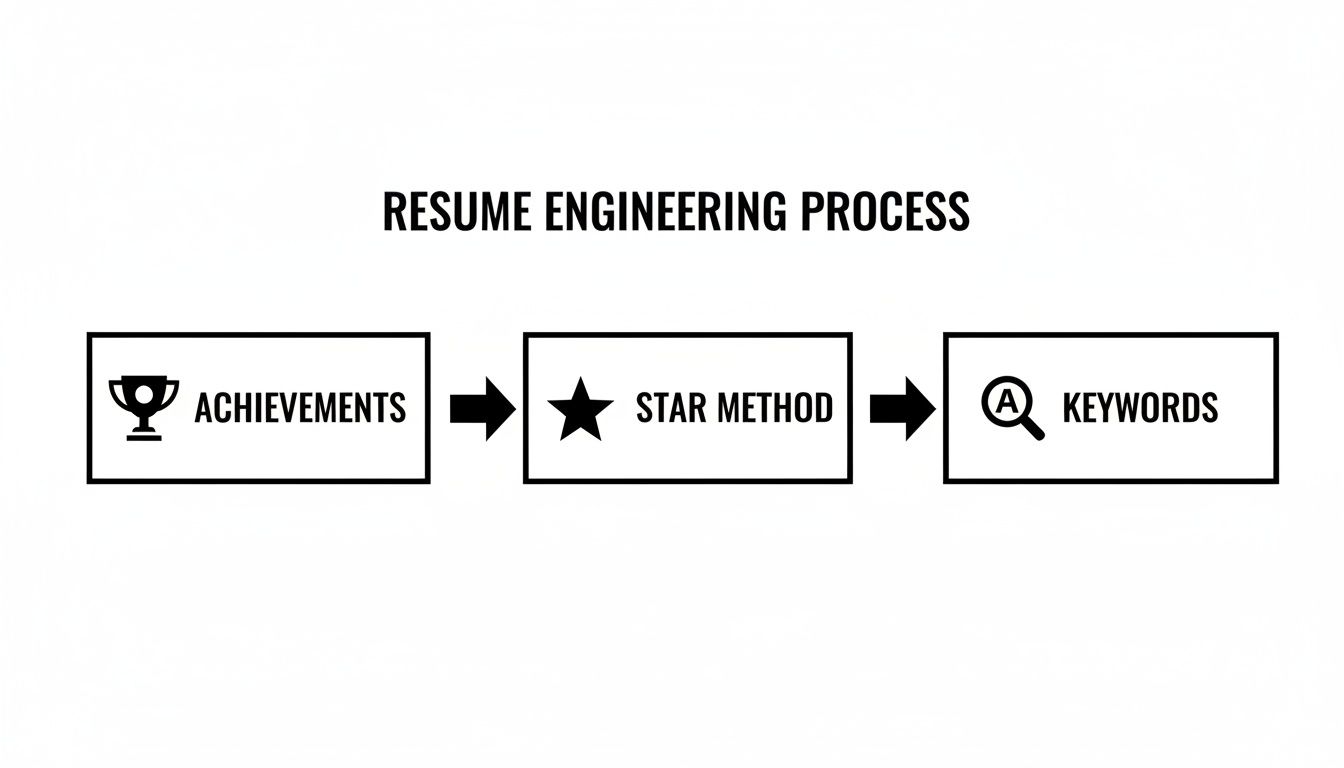
Think of this as your guide to turning past projects into clear stories of quantifiable impact. You’ll need this skill for every single question that comes your way.
Frameworks for Product Design Questions
Product design questions are the heart and soul of the Google PM interview. You'll get a prompt like, "Design a YouTube feature for aspiring creators" or "How would you improve Google Maps for EV owners?"
Whatever you do, don't just jump into a list of features.
Use a framework to give your answer structure. One of the most popular and effective ones is the CIRCLES method:
- Comprehend the situation: Start by asking clarifying questions. "Who are we building for? Is this for mobile or web? What are the business goals—engagement, revenue, or user growth? What are the technical constraints?"
- Identify the customer: Get specific with user personas. "Aspiring creators" is way too broad. Are we talking about a teen filming on their phone for fun, or a semi-pro with a home studio trying to build a business? Let's focus on the latter.
- Report the customer's needs: Spell out the pain points and user stories for the persona you chose. "As a semi-pro creator, I struggle to find trending topics that fit my niche."
- Cut, through prioritization: Brainstorm a wide range of potential features, then prioritize them based on impact vs. effort.
- List solutions: Pick your top 2-3 ideas and flesh them out. "We could build an AI-powered 'Trend Hunter' that surfaces rising search queries relevant to the creator's channel."
- Evaluate tradeoffs: No solution is perfect. Discuss the pros and cons. "An AI feature requires significant data and engineering, and there's a risk of surfacing irrelevant trends. However, the potential for driving high-quality content creation is huge."
- Summarize: Wrap up with a clear recommendation and explain how you’d measure success. "I recommend we start with the 'Trend Hunter' feature. We'll measure success by the adoption rate among creators and the subsequent view lift on videos made using the suggestions."
As an interviewer, when I see a candidate use a framework like CIRCLES, it's a huge green flag. It tells me they have a reliable process for navigating ambiguity. It shows structure, user empathy, and a bias for action—all critical PM skills.
Answering Analytical and Strategy Questions
Analytical questions are all about your quantitative reasoning. A classic prompt is, "How would you measure the success of Google Lens?" A good answer here goes way beyond a simple metric like Daily Active Users.
First, tie success back to the product's mission. For Google Lens, the mission is to help people understand the world around them through their camera.
- Primary Metrics: Define a North Star metric that captures this mission. Something like, "Number of successful visual queries per week," where 'successful' means the user took a positive action on the result (e.g., navigated, called, saved).
- Secondary Metrics: Support your North Star with engagement metrics (e.g., session length), adoption metrics (new user growth), and quality metrics (result accuracy, user satisfaction scores). For an AI product like Lens, you’d also track model-specific metrics like precision and recall.
- Counter-Metrics: Think about what could go wrong. What if users are making more queries because the first result was bad? A counter-metric like "time to a successful answer" or "queries per session" can help you spot this.
Strategy questions test your business sense. You might get asked, "Should Google acquire an AI startup that specializes in video summarization?" For these, you can use a simple Pro/Con or SWOT analysis, but the key is to ground it in Google's overarching corporate strategy.
Think about how the acquisition would:
- Accelerate an existing roadmap (e.g., for YouTube's "Key Moments" or Google Cloud's video intelligence APIs).
- Bring in new technology or top talent (Acqui-hire).
- Neutralize a competitive threat (e.g., if a rival like Microsoft was also looking to acquire them).
- Align with Google's mission and its AI-first principles.
The ability to connect a specific decision to the company's bigger picture is what separates senior-level thinking from junior-level execution. For a deeper dive into these topics, check out our complete guide on product manager interview preparation.
How to Succeed in Your First 90 Days

You got the offer. You made it. After all those interviews, the real work is about to begin. Your first three months as a Google Product Manager are less about shipping the next billion-user feature and more about earning the right to do so.
Forget the mindset that got you the job. This isn't about proving your brilliance anymore. It’s about proving you can listen, learn, and build trust inside one of the most complex product organizations on the planet.
Your first mission isn't to change the world. It’s to understand the world you just entered. Your engineering lead, your designer, and your stakeholders are walking encyclopedias of product history, technical debt, and tribal knowledge. Your job is to become their most dedicated student.
Phase 1: The First 30 Days — Become a Sponge
Your first month is all about input. Shut up and listen. Seriously. Book 1-on-1s with everyone: your core team, your cross-functional partners, your director, even that grumpy-looking engineer in the corner who’s been on the team for a decade.
Your agenda for these meetings is a simple, actionable checklist:
- "What do you think is our single biggest untapped opportunity?"
- "If you could wave a magic wand and fix one thing about our product or process, what would it be?"
- "Tell me about a project that failed. What did we really learn from it?"
- "Who are the most important stakeholders I need to build a relationship with?"
While you're playing detective with people, do the same with documents. Dive into the product's guts. Find the original design docs, read old sprint notes, and ask your Tech Lead to whiteboard the architecture for you. Gaining a quick grasp of the system’s constraints will earn you more respect than any grand vision you could possibly cook up in your first few weeks.
Your first 30 days are not about making an impact; they're about earning the right to make an impact later. Show up with humility, ask intelligent questions, and focus on building genuine relationships. Trust is the currency of influence at Google.
Phase 2: The Next 30 Days — Find a Pebble
Okay, you’ve absorbed a ton of context. Now it’s time to start connecting the dots. Your goal for this month is to align with the existing strategy and—critically—find a small, achievable win.
I call this "finding a pebble." It's not a boulder. It's not even a rock. It's a small, low-risk project that solves a real, nagging pain point for your users or your team. Maybe it's a tiny but infuriating bug fix that has been backlogged for months. Or a small improvement to an internal tool that makes your engineers' lives easier.
Shipping this "pebble" accomplishes two massive things:
- It builds execution muscle: You'll learn, firsthand, how to actually get something launched at Google. Who do you need to talk to for a privacy review? How does code get pushed? This is your tutorial level.
- It proves you deliver: You immediately show your team you’re not just a slide-deck PM. You're someone who gets things done. You ship.
This is absolutely not the time to second-guess the big-picture roadmap. Instead, look for a gap within the existing plan that you can fill quickly. This builds momentum and credibility. If you need some frameworks for running small, fast projects, our guide on product management for startups has some great tips that are surprisingly effective even inside a behemoth like Google.
Phase 3: The Final 30 Days — Start Building Your Case
You've built trust. You've shipped something (even if it was small). Now, you can finally start to form an educated point of view on where your product should go next. This is where your long-term impact begins.
You’re now ready to transition from absorbing information to contributing your own strategic perspective. Grounded in everything you've learned from your team, the data, and your "pebble" project, start formulating your first real roadmap proposal.
Frame it as an evolution, not a revolution. Use the data and stakeholder quotes you’ve gathered to build a compelling case. "Based on my conversations with the ads team and the user feedback we saw in Q2, I believe we have an opportunity to increase engagement by 15% if we…" is infinitely more powerful than "I think we should…"
By the end of your 90 days, your goal is to have a clear, data-backed plan for your first major product cycle. It should be a plan your team feels they co-created with you, because, well, they did. You just listened, synthesized, and led them there.
Frequently Asked Questions About the Google PM Career
When you're trying to land a Google Product Manager role, a ton of questions pop up. I've been hiring and mentoring PMs for years, and I've heard them all. Let's cut through the noise and get you some straight answers to the most common ones I see.
Do I Need a Computer Science Degree?
Let's get this one out of the way: no, you don't need a CS degree. But—and this is a big but—you absolutely must have technical fluency.
Plenty of fantastic Google PMs I've worked with came from backgrounds in economics, philosophy, or even marketing. What they all have in common is that they put in the work to understand system design, APIs, and the basics of machine learning. It's about earning the respect of your engineering team and being able to hold your own in deep technical discussions.
If you don't have that CS diploma, the burden of proof is on you. You can build that credibility by:
- Grabbing a few certifications in cloud architecture (e.g., Google Cloud Certified) or system design.
- Building a small but real technical side project you can talk about, even if it's just a simple app using a public API.
- Nailing the technical trade-off questions in your interviews by drawing on past project experiences.
Remember, your job isn't to write code. It's to be a credible partner to the people who do. A Google Tech Lead once told me something that stuck: a great PM doesn't need to know how to build it, but they must understand the consequences of what is being built.
How Important Is AI Knowledge in 2026?
It's not just important; it's critically important. Google is an "AI First" company, and that's not just a marketing slogan. It's the core of their product strategy, woven into everything from Search and Ads to Waymo and Pixel.
You're expected to speak the language of modern product development, which is now completely steeped in AI.
You don't have to be a machine learning engineer. But you do need to think critically about the opportunities and the pitfalls of AI. Your job will be to ask the right questions to steer the ship:
- "What's the right data we need to train this model? Do we have a good source for it?"
- "How are we going to define and measure success for this new AI feature? What are the key guardrail metrics?"
- "What are the ethical lines we need to draw and the potential biases in our approach? How will we mitigate model hallucinations?"
A Google PM who can't navigate these conversations is starting from a serious deficit. A practical tip: use an AI assistant like ChatGPT or Gemini and give it this prompt: "Act as my AI mentor. I am a Product Manager. Ask me questions about the product development lifecycle for a new generative AI feature to test my knowledge."
"A huge part of a Google PM's job today is to translate fuzzy human problems into something a machine can learn from. If you can't grasp the basics of how that learning happens, you can't effectively guide the product."
What's the Typical Career Progression?
The career path for a Google PM is pretty well-defined, and it's all about growing your scope and impact. Most people start as an Associate Product Manager (APM) straight out of college, or as a Product Manager (L4) if they have a few years of experience under their belt.
From that point, the ladder generally looks like this:
- Senior PM (L5): You own a more complex part of the product and start to influence strategy beyond your immediate feature team.
- Group PM (L6): You begin managing other PMs and are on the hook for the strategy of a much larger product area.
- Director (L7) and Up: Your world expands to portfolio-level strategy, shaping the organization, and driving major business goals across several product lines.
Moving up is tied directly to your impact. If you lead a major, successful product launch or ship a feature that's strategically vital to Google, you can accelerate your career pretty quickly. Google rewards PMs who prove they can scale their influence from a single team to an entire product portfolio.
At Aakash Gupta, we provide the frameworks and career insights you need to excel at every stage of your product management journey. Explore my newsletter and podcast for more in-depth strategies. Find out more at https://www.aakashg.com.

One reply on “Your Guide to Becoming a Google Product Manager in 2026”
[…] about $944K (4 x $236K), if both packages stay flat. If Google is your target, my guide to becoming a Google product manager covers the […]