Forget the generic advice. If you want to land a top-tier product manager job on LinkedIn, you can’t just passively scroll the Jobs tab. You need a system. As a PM leader who has hired dozens of product managers at companies like Google and various startups, I see the same patterns. The candidates who cut through the noise—the ones who land roles at places like OpenAI, Meta, and Stripe—treat their job search like a product. They strategize, execute, and iterate.
This guide is your product requirements document (PRD) for that campaign. We'll start with the most critical, actionable frameworks you can implement today to optimize your profile and search, then move into advanced networking and content strategies.
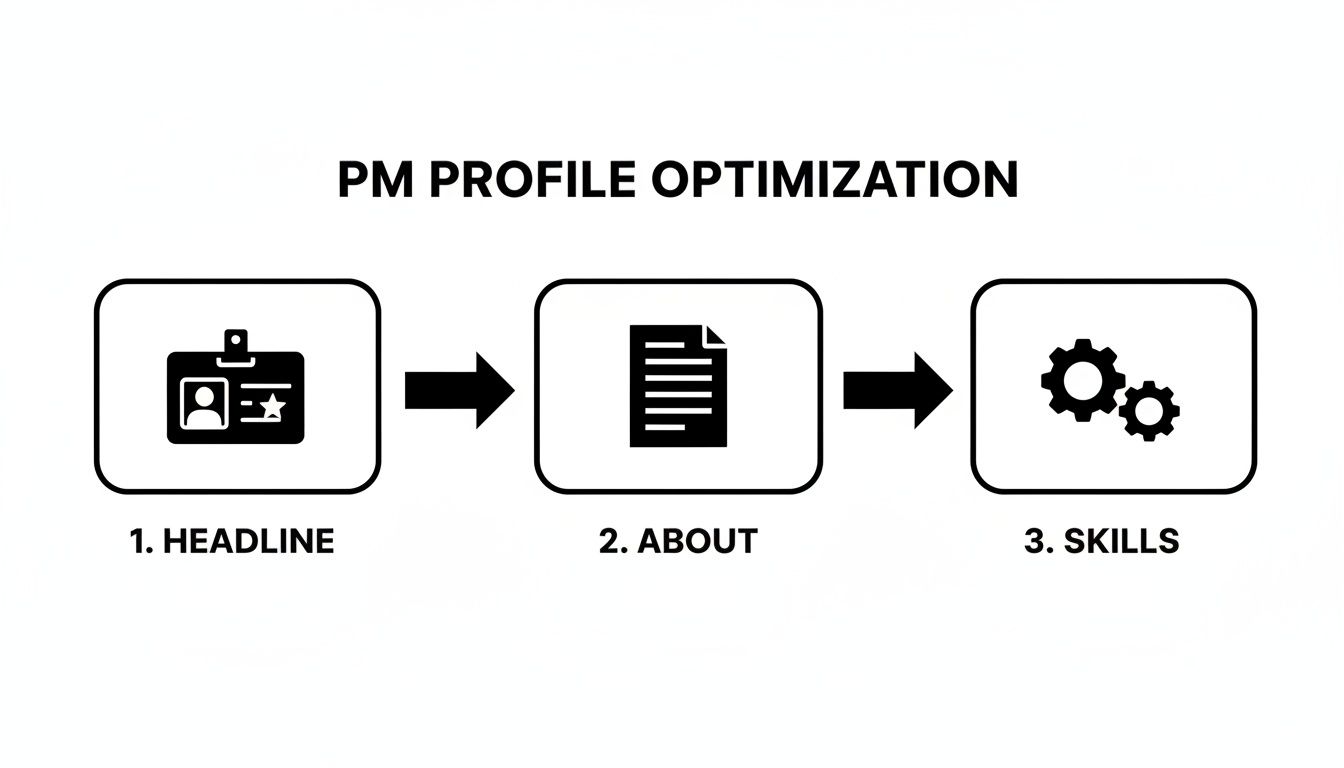
Pillar 1: The 24-Hour LinkedIn Profile Relaunch
Your LinkedIn profile is your personal landing page. A lazy or incomplete profile signals a lack of attention to detail—a fatal flaw for a PM. When I'm hiring for an AI Product Manager role, a candidate's profile is my first filter. A great profile tells a story about the value you deliver, crafted to convert both the LinkedIn search algorithm and the human hiring manager.
Let's relaunch your profile. Here's your checklist.
Step 1: Rewrite Your Headline as a Value Proposition
This is the most valuable real estate on your profile. A generic "Product Manager at Company X" is a wasted opportunity. The formula is: [Target Role & Level], [Specialization] | [Top Company/Big Win] | [Key Impact Metric].
This structure immediately signals your level, niche, and results. It's a magnet for recruiters.
Real-World Examples:
- Senior AI PM: Senior Product Manager, AI Platforms | Ex-Google | Shipped GenAI Products to 10M+ Users
- Fintech PM (Mid-Career): Product Manager, B2B Payments | Stripe Alum | Scaled ARR from $5M to $25M
- Aspiring PM: Aspiring Product Manager | Ex-Consultant Driving Digital Transformation | Certified Scrum Master
Step 2: Engineer Your "About" Section for Scannability & Keywords
No one reads a novel. Structure your "About" section for a 30-second scan, leading with your most powerful accomplishments.
- The Hook (1 Sentence): "Product leader with 8 years of experience building and scaling AI-driven B2B SaaS products from 0 to 1 and 1 to 10."
- Key Achievements (3-5 Bullets): Quantify everything. "● Led the launch of a new LLM-based feature, resulting in a 15% increase in user engagement and $2M in new ARR." Use the STAR method (Situation, Task, Action, Result) condensed into a single power statement.
- Core Competencies (Keyword List): Pull directly from your target job descriptions. Use a tool like ChatGPT with the prompt: "Analyze these 5 job descriptions for a Senior AI PM. Extract the top 15 most common skills and competencies." This will surface critical keywords like 'LLM Integration', 'Ethical AI Frameworks', 'GTM Strategy', 'P&L Ownership'. See our list of essential product manager resume keywords.
- Call to Action (CTA): "Always open to connecting with fellow product builders and innovators in the AI space."
Step 3: Curate Your Skills & Recommendations
The "Skills" section is a primary input for LinkedIn's recruiter search algorithm. If a recruiter filters for "A/B Testing" and it's not on your profile, you're invisible.
15 PM Skills to Feature on Your Profile in 2026:
- Product Strategy & Roadmapping
- Large Language Model (LLM) Integration (Non-negotiable for AI PMs)
- Data Analysis & SQL
- A/B Testing & Experimentation
- User Research & Persona Development
- Agile & Scrum Methodologies
- Go-to-Market (GTM) Strategy
- Stakeholder Management
- Pricing & Monetization
- Ethical AI Frameworks
- API Product Management
- Technical Acumen (System Design Basics)
- Financial Modeling & P&L Ownership
- Public Speaking & Storytelling
- Figma or other Prototyping Tools
Pro Tip: Get written recommendations. A specific, glowing recommendation from a former manager about your direct impact is social proof a recruiter can't ignore. It’s one thing for you to say you’re great; it’s another for your old Director of Product to say it. According to global talent trends on LinkedIn, profiles with at least five recommendations get significantly more views and messages.
Pillar 2: Master the LinkedIn Jobs Search Engine
Just scrolling the Jobs tab is like fishing with a single line in the ocean. To land the best product manager jobs on LinkedIn, especially in AI, you must hunt with precision. This means building a personalized pipeline of high-quality leads that come directly to you.
Build Precision Search Queries with Boolean Logic
Mastering Boolean logic turns a generic search into a surgical strike. Use these operators:
"Quoted Phrases": For exact titles like"Senior Product Manager".AND: Narrows your search (results must have both terms).OR: Broadens your search (results can have either term).NOT: Excludes terms you don't want.(): Groups terms together.
Example AI PM Search Query:("Senior Product Manager" OR "Product Lead") AND ("AI" OR "Machine Learning" OR "LLM") NOT ("Associate" OR "Intern" OR "Junior")
This single query is a game-changer. It finds senior-level AI roles while filtering out the noise. As a hiring manager, I know job titles are inconsistent; a "Product Lead" at a startup is often a "Senior Product Manager" at Google. The OR operator ensures you don't miss these opportunities. If you're new to the field, start by understanding the foundational duties in a modern product manager job description.
Automate Your Pipeline with Filters and Alerts
Once you have your Boolean query, layer on LinkedIn's filters to zero in on your ideal role.
- Salary: Search for jobs with an estimated salary of $180,000+ (adjust for your level/location).
- Company: Target a list of 10-20 dream companies (e.g., Anthropic, Databricks, Scale AI).
- Remote/Hybrid/On-site: Non-negotiable in 2026.
- "Posted by" filter: Select "Hiring Manager" to see posts directly from the decision-maker.
The final, crucial step: Click "Create alert" for your search. Set up 3-5 of these alerts for different role variations. This builds an automated pipeline of opportunities delivered directly to your inbox.
Pillar 3: A System for Networking That Gets You Referred
Let's be blunt: hitting "Easy Apply" without a referral is the digital equivalent of shouting into the void. Referred candidates always jump to the front of the line. Data shows referral hires are made faster, onboard quicker, and stay longer.
Your goal isn't just to find LinkedIn jobs for a product manager. It's to build connections that get your resume pulled from the digital slush pile. This is how you do it.
Step 1: Map Your Key Contacts
For every target company on your list (e.g., a Series C fintech startup or a specific team at Microsoft), map out these key people:
- The Hiring Manager: (e.g., Group PM, Director, VP of Product). Look for titles like "Director of Product, AI Platform."
- Peer Product Managers: PMs on the team you want to join. They'll give you the ground truth on culture and challenges.
- Talent Acquisition / Recruiters: Find the recruiters who specifically handle product roles at that company.
Step 2: The "Warm-Up" Playbook
Never send a cold connection request asking for a favor. You must warm up the connection first.
- Follow & Engage (1 Week): Follow your key contacts. Don't just "like" their posts. Leave a thoughtful comment that adds to the conversation. "Great post!" is noise. "Great point on model fine-tuning. I saw a similar challenge at my last company where we solved for X by doing Y. Did you consider that approach?" creates a flicker of name recognition.
- Send the Personalized Request: After a week of light engagement, now you send the request with a personalized note referencing your interaction or their work.
As someone who gets dozens of requests a day, a message that references a recent post proves you've done your homework and respect my time. A generic request is an instant "ignore." This is the core principle behind a successful strategy to invest in a referral channel.
Step 3: Write Outreach That Gets a Reply (Templates)
Your message must be short, clear, and about them.
Template 1: Reaching out to a Peer PM
"Hi [Name], I've been following your posts on generative AI products and really enjoyed your perspective on [specific point]. I'm a PM in the AI space myself and am deeply impressed by the work [Company]'s team is doing on [Product]. Would you be open to a 15-minute chat about your experience there? I'd love to learn more about the team culture."
Template 2: The Referral Ask (After a Chat)
"Thanks again for the chat last week, [Name]. I was energized by our conversation about [specific project you discussed]. As we talked about, I just applied for the Senior Product Manager, AI role. If you feel comfortable, a referral would be a huge help. I've attached my resume here for easy reference. Appreciate your consideration!"
This is how you turn a cold lead into a warm introduction.
Pillar 4: Create Content That Proves Your PM Expertise

Applying and networking is reactive. Creating content is proactive. It flips the script, so recruiters start finding you. As a hiring manager, a candidate who can publicly articulate their product thinking is a unicorn. They instantly jump to the top of my list. This is your chance to give hiring managers a free sample of how you think.
High-Impact Content Ideas You Can Post This Week
Avoid the generic, "I'm open to new opportunities" post. It signals neediness, not value. Show, don't tell.
- The Product Teardown: Pick a feature and break it down. Example: Dissect how Spotify's "Daylist" nails personalization but fumbles social sharing. Ground your analysis in product principles.
- My Take on an Industry Shift: A new AI model drops from Google or OpenAI? Write a short post about the product implications. This proves you connect market trends to product strategy.
- How I'd Solve X for Y Company: A mini-case study. Example: "How I'd Improve Airbnb's Search Filters for Digital Nomads." This showcases your problem-solving skills directly.
A Simple Content Calendar for Consistency
One thoughtful post a week is all it takes. Consistency beats virality.
| Week | Content Prompt | Goal of the Post |
|---|---|---|
| Week 1 | Product Teardown: Analyze the user onboarding of a popular app like Duolingo. | Demonstrate user empathy and your ability to critique product flows. |
| Week 2 | My Take on a Trend: Analyze the product implications of a new AI model from OpenAI or Google. | Show you are forward-thinking and connect tech to business value. |
| Week 3 | How I'd Solve X: Outline a feature to reduce cart abandonment for a major e-commerce site. | Showcase your problem-solving, prioritization, and business-oriented thinking. |
| Week 4 | Share a Resource: Create and share a useful artifact, like a simple Product Requirements Document (PRD) template with your own notes. | Prove you create actionable work and can provide value to the community. |
Format Your Posts for Maximum Engagement
- The Hook: Your first two lines must be compelling. Ask a provocative question or state a bold opinion.
- Short Paragraphs & Bullets: No paragraph longer than 1-3 sentences. Use lists to make key points scannable on mobile.
- End with a Question: Invite comments. "What do you think?" or "What did I miss?"
When you create value, you stop looking for a linkedin jobs product manager role. You start building a brand that pulls opportunities to you.
Your PM Job Search FAQ (From a Hiring Manager)
As a PM leader, I get asked these questions constantly. Here are the straight answers.
How Many LinkedIn Jobs Should I Actually Apply To?
Focus on quality, but don't lose momentum. Aim for 5-10 highly targeted applications per week. "Highly targeted" means:
- You've customized your resume to mirror the language in the job description.
- You've identified a key contact at the company.
- You have a warm touchpoint for at least 2 of every 5 applications. An application with a referral is worth 10 cold "Easy Apply" shots in the dark.
This pace keeps your pipeline full without spreading you so thin that your applications become generic.
What Are the Biggest Mistakes PMs Make on LinkedIn?
- The Generic, Passive Profile: Your headline says "Product Manager" and your "About" section is a resume copy-paste. This is a massive missed opportunity.
- Zero Engagement (The Ghost Candidate): You only log in to apply. You never post or comment. If you're silent, you're invisible.
- Cold, "Me-First" Outreach: Your messages are all about what you need. Give them a reason to care first.
How Can I Use AI for My LinkedIn Job Search in 2026?
Use AI as a co-pilot, not an autopilot. Tools like ChatGPT or Claude can accelerate your workflow.
- Smarter Resume Customization: Use this prompt: "Act as an expert product management hiring manager. Here is a JD for a Senior AI PM at [Company] and my master resume. Identify the top 5 keywords in the JD. Then, suggest 3 bullet points from my resume I should rephrase to better match this role, focusing on quantifiable impact."
- Content Idea Generation: "Analyze this news about [new product launch]. Generate 3 different LinkedIn post angles for a product manager, focusing on user impact, business strategy, and potential future iterations."
- Better Outreach Drafting: "Draft a short, 100-word LinkedIn connection request to a Group Product Manager at [Company]. My goal is to learn about their team culture. Mention that I've been following their work on [specific product]. Keep the tone professional but conversational."
Remember, AI gives you a solid B+ draft. It's your job to add the personal insight and human touch to turn it into an A+ that gets a response.
Throughout your product manager journey, from breaking into product management to becoming a product leader, having a source of proven, actionable advice is critical. At Aakash Gupta, we provide the frameworks, insights, and career strategies you need to excel. Explore more at https://www.aakashg.com.
