As a Product Manager, managing competing priorities feels like you're a battlefield commander. Sales needs that one feature to close a multi-million dollar deal. Engineering is pointing to a mountain of tech debt that’s about to cause a site-wide outage. And the CEO just dropped a new AI initiative on your roadmap that needs to happen now.
This isn't just a to-do list; it's the core challenge that defines your career and your compensation. Having hired and mentored PMs at every level—from Associate PMs making $90k to Principal PMs clearing $400k+ at places like Google and Meta—I can tell you this: the ability to cut through this noise with a defensible system is what separates the top 1% from everyone else. It's the skill that gets you promoted.
Forget being a reactive "feature factory." Your job is to become a proactive, strategic leader who is ruthless about focusing on outcomes over outputs. Every single task must tie back to a core business objective. This strategic focus is what turns a good PM into a leader who commands respect and drives real business impact.
Why Prioritization Is The Core Product Management Skill
Weak prioritization doesn't just slow you down—it actively burns cash. You end up in the dreaded 'feature factory,' where your engineering team is constantly shipping, but key metrics like user engagement, revenue, and retention are completely flat.
I’ve seen this movie before, and it doesn't have a happy ending. I watched a promising Series C startup completely miss its revenue targets because they got bogged down in minor enhancements instead of focusing on critical user acquisition features. I've also seen a team at a FAANG company watch their engagement numbers tank because they were too busy servicing internal requests to fix core user pain points.
The Consequences of Reactive Management
The hard truth is that most product strategies are dangerously reactive. Think about it: research shows that a whopping 52% of product strategies are dictated by senior executive requests or direct customer feedback. That leaves almost no room for proactive, strategic planning.
This becomes a massive growing pain as companies scale. The 2023 State of Product Management Annual Report found that over 50% of large product teams say their top challenge is "keeping roadmaps and processes consistent"—a classic symptom of a team being pulled in a dozen different directions. If you want to dig deeper, the full findings from ProductPlan's report are an eye-opener.
The problem gets even worse when roadmaps are focused on the wrong things entirely.
The same report revealed that a staggering 54% of roadmaps are still designed around outputs (like shipping features) rather than outcomes (like improving user retention by 10%). This is the feature factory trap in its purest form, and it's a surefire way to dilute focus and kill any chance of creating real value.
Your job isn't to build everything everyone asks for. It's to build the right thing at the right time. Mastering how to manage competing priorities is about fundamentally shifting your team's mindset from being busy to being impactful. Get this right, and you're not just managing a backlog; you're building the foundation for your next promotion.
Your Toolkit For Ruthless Prioritization
Talking about prioritization is easy. Actually doing it when you’re getting pulled in a dozen different directions? That's the real test of a Product Manager. To get a handle on all the competing priorities, you need a toolkit of battle-tested frameworks that bring cold, hard objectivity to what can often feel like a subjective shouting match.
These aren't just trendy acronyms to throw around in meetings; they are implementable systems for making defensible decisions that you can stand behind when challenged by executives or sales leaders. They are your armor.
The game has shifted from feature-driven to outcome-driven roadmaps. This isn't just a theory—it's a massive trend born from companies needing to prove real impact, not just sheer output. We're prioritizing the 'why' (like boosting user retention) over the 'what' (like adding another button).
Let's arm you with the frameworks to take back control.
Breaking Down The RICE Framework
The RICE scoring model is a workhorse for a reason. It forces you and your team into a structured conversation around four critical factors: Reach, Impact, Confidence, and Effort. It’s an absolute powerhouse for mature products, especially at data-rich companies like Meta or Google where you can pull real numbers.
Here’s how you actually put it to work:
- Reach: How many users will this feature actually touch over a specific time period, like one quarter? Don't just guess. Pull this straight from your analytics tools like Amplitude or Mixpanel. A great Reach statement sounds like, "This will affect the 25,000 users who complete our checkout flow each month."
- Impact: How much will this move the needle on a key business metric (e.g., conversion, retention)? Use a simple, tiered scale (e.g., 3 for massive impact, 2 for high, 1 for medium, 0.5 for low). Your past A/B tests are gold here. If a similar UI tweak previously lifted conversion by 5%, that’s your starting point for the discussion.
- Confidence: This is your gut-check, expressed as a percentage. How sure are you about your Reach and Impact scores? Be honest. 100% for high confidence (backed by hard quantitative data), 80% for medium (strong qualitative user research), and 50% or less for a brand new idea with no validation.
- Effort: How much engineering time will this consume? Get this estimate from your engineering lead in "person-months" or T-shirt sizes that you convert to a number. A classic rookie mistake is underestimating this; always push your lead to factor in testing, QA, and potential deployment hiccups.
The final score is calculated as (Reach x Impact x Confidence) / Effort. The higher the score, the higher the priority. For a deeper dive into this and other models, check out this comprehensive guide on product prioritization frameworks.
When To Use The Kano Model
Sometimes, it's less about the numbers and more about customer perception. That’s where the Kano Model shines. It’s brilliant for B2B SaaS companies trying to balance must-have functionality with delightful new features that make customers swoon.
The Kano Model helps you sort features into three main buckets:
- Basic Expectations: These are the table stakes. Customers just assume they'll be there. If they're missing, users are dissatisfied. Think of a "forgot password" link—it just needs to work.
- Performance Payoffs: With these, more is more. The more you invest, the more satisfied customers become. Think faster page load times at an e-commerce checkout.
- Delighters: These are the unexpected, innovative features that create a "wow" moment and can give you a huge competitive edge. The original iPod click wheel was a classic Delighter.
This decision tree gives you a simple flow for triaging incoming work and figuring out where it fits.
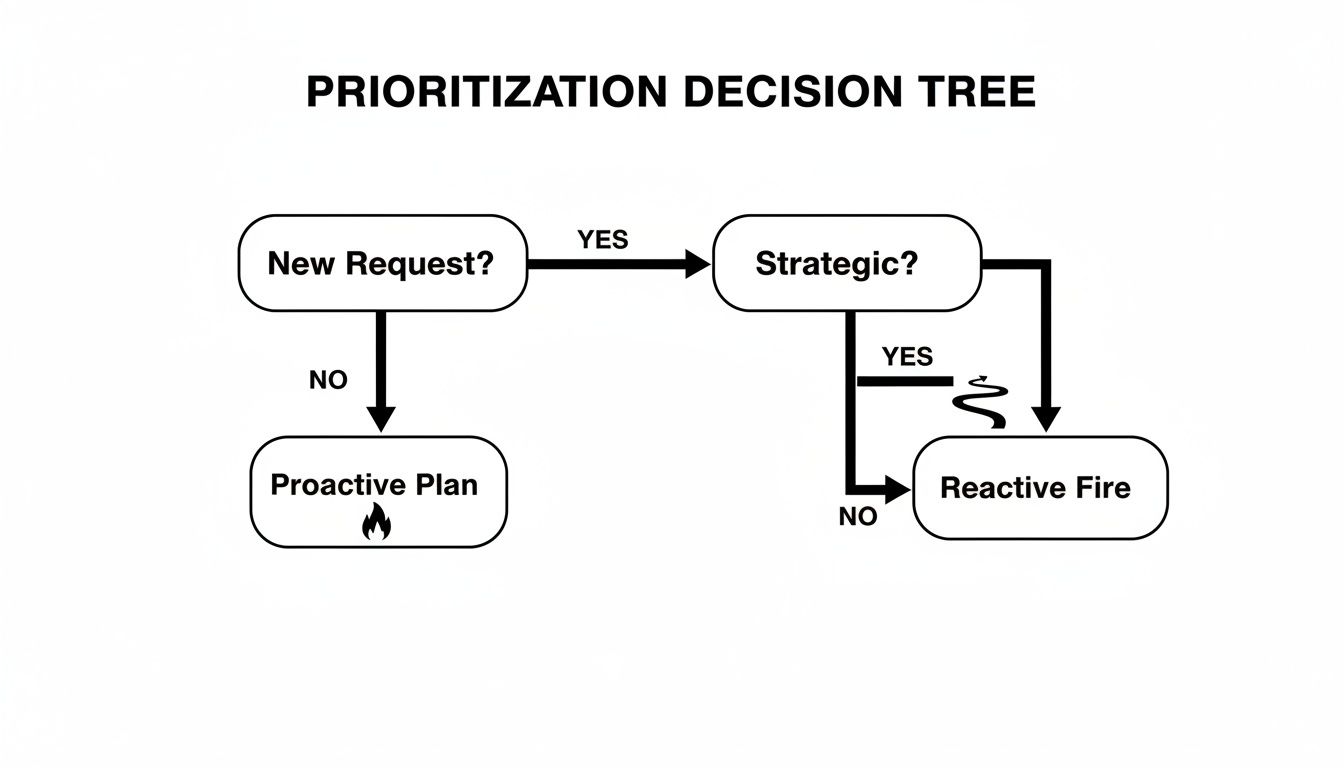
This kind of flowchart makes it instantly clear whether a new task aligns with your strategic goals or is just a reactive fire drill.
Let's make this real. Imagine you're a PM at a B2B analytics company like Mixpanel. The sales team is demanding a flashy new AI-powered dashboard visualization—a total Delighter. At the same time, your engineering lead flags that a critical database query is slowing down report generation for all enterprise customers.
Using the Kano Model, that slow query is a Performance Payoff. Fixing it will directly boost every single user's satisfaction. You prioritize the performance fix. Why? Because failing to meet basic performance expectations will cause far more pain and churn than the new dashboard will create delight. This is a defensible decision that protects the core business.
Prioritization Framework Selection Guide
Picking the right framework depends on your company stage, product maturity, and the data you have available. Use this cheat sheet to make the right call.
| Framework | Best For | Key Inputs | Common Pitfall |
|---|---|---|---|
| RICE | Mature products with access to quantitative user data (e.g., at Meta, Google). | User metrics, impact estimates, engineering effort (time). | Over-relying on precise numbers; can be biased by optimistic estimates. |
| ICE | Early-stage products or teams with limited data; quick gut-checks. | Subjective scores for Impact, Confidence, and Ease. | Highly subjective; can lead to "feelings-based" prioritization if not careful. |
| Kano | B2B products balancing core features with innovation; understanding user needs. | Customer feedback, surveys, user research insights. | Can be time-consuming to gather data; doesn't directly dictate build order. |
Ultimately, choosing the right framework is all about your context. Mastering these tools isn’t just about making lists; it’s about building a proactive, strategic, and yes, ruthless process for deciding what matters most.
Mastering Stakeholder Communication And Alignment
So you've got your perfectly scored RICE framework. That's great, but it's completely useless if you can't get your stakeholders on board. Let's be honest, the math is the easy part. The real work—the thing that separates a junior PM from a true product leader—is navigating the messy, complex world of human relationships and competing motivations.
Your job isn't to win arguments with data. It's to build consensus and guide the organization toward a shared goal. This is a game of influence, not authority. It’s about creating a system for communication that builds trust and makes your tough prioritization calls feel collaborative, even when you have to say "no."
Building Your Communication Artifacts
The first step is to get out of the business of having endless one-off, reactive conversations. You need to create artifacts—tangible, shared documents—that do the heavy lifting for you by proactively communicating your strategy and decisions. Think of them as your single source of truth.
- The One-Page Strategy Doc: This is your North Star. It should crisply lay out the product vision, who you're building for, key business goals for the quarter (OKRs), and how you'll measure success. When a random request comes in that doesn't fit, you don't have to get into a debate. Just point to the document and ask, "How does this move us closer to these objectives?"
- The Decision Log: This one is a lifesaver. Keep a simple, shared log in Notion or Confluence of every significant prioritization decision. For each entry, quickly note what was decided, why it was decided (linking back to your strategy doc), and who was involved. This level of transparency is your best defense against someone popping up weeks later asking, "Hey, why didn't we ever build my feature?"
These aren't just for record-keeping; they are active tools for alignment. Use them.
The Rise Of Product Ops
Let's face it: managing stakeholder expectations is a full-time job. This daily battle is exactly why Product Operations (Product Ops) has emerged as a key ally for PMs. Recent industry reports show that top goals for Product Ops are enabling teams (32%) and maximizing value through cross-functional harmony (18%).
This is critical when you consider that misaligned executive requests drive a staggering 52% of product strategies reactively. As Gabby Peralta at Tealium puts it, Product Ops helps drive efficient prioritization, which frees up PMs to focus on high-level strategy. You can dive deeper by checking out the full 2023 State of Product Ops Report from Runwise.
Even without a dedicated Product Ops team, you can adopt their mindset. Standardize your communication channels and create repeatable processes for how stakeholders can give input.
Scripts For Difficult Conversations
You are going to face aggressive stakeholders. It's not a matter of if, but when. The key is to be prepared. Having a few go-to scripts in your back pocket helps you stay calm and focused on facts, not emotions.
Scenario: A sales leader is breathing down your neck about a one-off feature needed to close a massive deal, but it completely derails your quarterly plan.
Sales Leader: "We need to build the custom integration for Acme Corp now, or we lose a $500k deal!"
You (The PM): "I completely get the urgency—a deal that size is a huge opportunity. Right now, our engineering team is 100% focused on delivering the performance improvements we all agreed were our top priority for the quarter. That work directly impacts our churn goals and benefits our entire customer base. How about this: let's look at the data together—the RICE score for this integration versus the performance work—and then we can take a joint recommendation to leadership about the trade-offs."
Let's break down why this works:
- Empathize and Validate: You immediately show you understand their pressure.
- Redirect to the Framework: You bring the conversation back to objective data and shared goals.
- Highlight the Trade-off: You make it painfully clear that saying 'yes' to this means saying 'no' to something else important.
- Create a Partnership: You frame it as "let's solve this problem together."
This approach is also a game-changer for unplanned work. If you want to get better at protecting your roadmap from these kinds of disruptions, you might want to check out our guide on how to handle scope creep.
Your Stakeholder Alignment Meeting Agenda
Stop just showing up to meetings. Run them with purpose. A tightly structured alignment meeting can preempt conflicts before they even start.
Feel free to steal this agenda for your next roadmap review:
- Recap of Business Goals (5 mins): Always start here. Anchor every conversation in the company's top-level objectives for the quarter.
- Progress on Key Initiatives (10 mins): Show what you’ve shipped and, more importantly, the impact it's having on your key metrics. Quick wins build trust.
- Roadmap Review (15 mins): Walk through the prioritized list of what’s next. For each item, clearly state the problem it solves and how it ladders up to the business goals.
- What We're Not Doing (10 mins): This is arguably the most critical part of the meeting. Explicitly call out popular requests that are "below the line" and explain why, using your prioritization framework as the objective reason.
- Open Q&A and Feedback (5 mins): Create a structured space for questions. This isn't a free-for-all; it's a focused session to ensure everyone feels heard.
By mastering these communication tactics, you’ll shift from being a request-taker to a strategic leader who can confidently manage even the most demanding priorities and rally the organization toward a unified goal.
Using AI to Supercharge Your Prioritization Workflow

The best product managers I know—especially those working on AI products or at AI-first companies like OpenAI and Anthropic—aren't just relying on frameworks anymore. They're weaving AI into their daily work to make faster, sharper, data-backed decisions. This isn't about letting a robot take your job; it's about augmenting your own judgment to finally get a handle on the insane volume of inputs that drive modern product development.
If you’re still manually sifting through thousands of user feedback tickets or listening to hours of sales calls, you’re already falling behind. The new standard is using AI as a force multiplier for synthesis and analysis, turning a mountain of raw data into actionable insights for your prioritization frameworks.
First, Automate Your Data Aggregation
Your first move is to stop chasing data across a dozen different platforms. User feedback is everywhere: Intercom chats, Gong call transcripts, Zendesk tickets, App Store reviews, and random Slack channels. You need to get all this unstructured data flowing into a single, analyzable place.
This is where automation tools become your best friend. A simple workflow can make a world of difference:
- Set up a Zapier or Make.com workflow: Create automations that trigger whenever new feedback gets logged in your key tools (like when a specific tag is added in Intercom or a ticket is closed in Zendesk).
- Centralize everything: Funnel all that text data into one destination. This could be a dedicated Slack channel, a Google Sheet, or an Airtable base.
This isn’t just for convenience. It's about creating a comprehensive, clean dataset that your AI models can actually work with. Without a centralized input, your analysis will be fragmented and pretty much useless.
Next, Synthesize Feedback With AI
Once your data is flowing into one spot, the real magic begins. You can now use Large Language Models (LLMs) like GPT-4 or Claude 3 to do the heavy lifting that used to take days or even weeks. Specialized platforms like Dovetail also have powerful AI features built for this exact purpose.
Instead of reading everything yourself, you can feed this aggregated data to an AI and ask it to pull out the core themes, user problems, and overall sentiment.
Pro Tip: Don't just ask the AI to "summarize" the feedback. That's lazy. Use a specific, structured prompt to get results you can actually use. You're not looking for a book report; you're hunting for inputs for your prioritization model.
Here’s a powerful GPT-4 prompt I’ve used with my own teams. Feel free to adapt it:
"You are an expert Product Manager at a B2B SaaS company specializing in AI-driven analytics. Analyze the following user feedback from [Source, e.g., Intercom chats, Gong call transcripts]. Your task is to identify the top 5 most frequently mentioned user problems. For each problem, provide: 1. A clear problem statement from the user's perspective. 2. A 'Severity Score' from 1-10 based on the user's expressed frustration and its potential impact on churn. 3. Three direct quotes that best exemplify this problem. 4. An estimated frequency (as a percentage) of how often this theme appears in the dataset. Present the output in a markdown table for clarity."
This kind of prompt moves you way beyond a simple summary. It gives you structured, quantifiable data that you can plug directly into your decision-making process. The world of AI in product is moving incredibly fast, and for those who want to go deeper, our guide on the intersection of product management and artificial intelligence is a great next step.
Finally, Apply AI Insights to Your Frameworks
The last piece of the puzzle is translating these AI-generated insights into your chosen prioritization framework. The output from that AI prompt gives you a massive head start on your RICE or ICE scores.
Let's break down how this works in practice:
- Reach: The AI's frequency analysis is a powerful proxy for Reach. If a theme is mentioned in 40% of your feedback tickets, you know it’s affecting a huge chunk of your user base.
- Impact: That "Severity Score" you asked for? It's a direct input for your Impact score. High user frustration signals a high-impact problem to solve.
- Confidence: The number of direct quotes and the consistency of the theme across different data sources (sales calls, support tickets, etc.) should skyrocket your Confidence score. If everyone is complaining about the same thing, you can be pretty sure it’s a real problem.
By using AI this way, you're not just managing priorities more efficiently; you're doing it with a level of data-driven rigor that used to require a dedicated research team. For more advanced applications, exploring topics like Smart Routing AI Models can show you how AI can dynamically manage and prioritize tasks, ensuring you're always working on the most important thing. This is how you level up from gut-feel prioritization to a system that’s scalable, defensible, and deeply rooted in the voice of your customer.
Building A System To Manage Your Own Time And Focus

It’s easy to get obsessed with managing your team's competing priorities. We build frameworks and run workshops for it. But the real silent killer of a PM’s effectiveness is failing to manage your own time.
Your focus is your single most valuable—and finite—asset. Without a deliberate system to protect it, your calendar will get hijacked by other people's emergencies. You’ll be left with zero room for the deep, strategic work that actually moves the needle.
That constant context switching—jumping from a user research call to a budget meeting, then to a technical bug bash—is mentally draining and wildly inefficient. Let's be real: high-performing PMs at places like Shopify and Airbnb don't have more hours in the day. They just have better systems. They’ve learned to move from a reactive calendar they don't own to a proactive schedule they command.
Designing Your Proactive Week
First thing's first: you have to treat your own time with the same ruthless prioritization you apply to your product backlog. This starts with time-boxing, a simple but powerful technique where you proactively block out chunks of your calendar for specific kinds of work. This isn't just about scheduling meetings. It's about carving out non-negotiable blocks for your most important thinking.
A model I've seen work incredibly well is creating theme-based days. It gives your week a rhythm and predictability.
- Mondays: All about team syncs, stakeholder check-ins, and weekly planning. Knock out the alignment work upfront so everyone is on the same page.
- Tuesdays: This is your "deep work" sanctuary. No meetings. Full stop. Use this time for drafting strategy docs, roadmap planning, and deep-diving into competitive analysis.
- Wednesdays: Customer day. All your user interviews, feedback synthesis sessions, and beta program calls happen today.
- Thursdays: Execution and engineering collaboration day. This is prime time for backlog grooming, sprint planning, and hashing out technical details with your eng lead.
- Fridays: For wrapping up administrative tasks, catching up on personal development, and planning for the week ahead.
This structure does more than just organize your tasks; it signals to your entire team when you're available for different types of collaboration.
Building Your Personal Command Center
Your brain is for having ideas, not holding them. You need a single, trusted system to offload tasks and manage your personal priorities. Tools like Notion or Asana are perfect for this. We're not just making a to-do list; we're building a personal command center that connects daily tasks to your larger goals.
A solid command center should have a few key components:
- A Master Task List: Every single commitment, big or small, personal or professional, gets dumped here. Get it out of your head.
- A Weekly Plan: At the start of each week, pull tasks from the master list into your plan for the next five days. This becomes your North Star.
- A "Waiting For" List: This is crucial. Keep a running list of items you've delegated or are blocked on. It’s your safety net to prevent things from falling through the cracks.
This kind of system is what moves you from frantically trying to remember what to do next to calmly executing a pre-defined plan. It’s the difference between being a firefighter and an architect.
Establishing An Escalation Framework
To make those "no meeting" blocks stick, your team needs to know when it's genuinely okay to interrupt you. An escalation framework gives them clear rules of engagement. It’s a simple set of guidelines that empowers your team to solve problems on their own while ensuring you’re still looped in on true emergencies.
For example, your framework might look something like this:
- Level 1 (Low Urgency): Send an email or add it to our next 1:1 agenda. A response can wait 24 hours.
- Level 2 (Medium Urgency): Tag me in a Slack message. I check Slack twice a day, at 11 AM and 4 PM.
- Level 3 (High Urgency): Send a direct message with the prefix "[URGENT]". This is for production issues or critical blockers that need attention today.
- Level 4 (Emergency): Call me. This is reserved for system-down, crisis-level events only.
Mastering these personal systems goes beyond just productivity; it's about sustainability and preventing burnout. Building a truly effective system for yourself means understanding the broader impact of time management on well-being. It's not just about managing work; it's about managing your energy.
Ultimately, owning your time is the foundation upon which all other product management skills are built.
Your Action Plan For Mastering Competing Priorities
You’ve got the frameworks, the stakeholder scripts, and the personal systems. Fantastic. But theory only gets you so far. Now it’s time to put it all into practice. Mastering the chaos of competing priorities isn’t a one-time project; it’s a muscle you build through consistent, deliberate effort.
This is your starting line.
Your 30-Day PM Kickstart
If you're an aspiring or new PM, the goal for the next month is simple: build a solid foundation. Don't try to boil the ocean. Just focus on executing these core skills, one week at a time. This is how you start building the habits that get you promoted.
-
Week 1: Pick one prioritization framework—RICE is a great place to start—and score your team's current backlog. The goal is to learn the process and have a data-informed conversation, not to achieve a perfect list on your first try.
-
Week 2: Schedule 1:1s with your top 3 stakeholders (e.g., Eng Lead, Sales Lead, Head of Design). Walk them through your newly prioritized list and practice articulating the why behind your decisions, linking back to company goals.
-
Week 3: Block out two 3-hour "deep work" sessions on your calendar. Treat them like an unbreakable appointment with your CEO. Use this time for strategic thinking, writing a PRD, or whatever requires uninterrupted focus.
-
Week 4: Dip your toes into AI automation. Set up a simple workflow using a tool like Zapier. A great first project is to pipe feedback from a source like a Slack channel into a Google Sheet, then use a GPT-4 prompt to automatically synthesize themes.
The 90-Day Strategic Overhaul
For mid-career and senior PMs, it's time to stop just managing and start building a scalable system that elevates you to a strategic leader. Your focus should be on refining and scaling your approach to prioritization and decision-making across the organization.
The real mark of a senior product leader isn't just making the right call, but building a system that consistently produces the right calls with buy-in from the entire organization. This is your opportunity to build that system.
Over the next quarter, your first priority is to implement a comprehensive decision log for all major roadmap changes. Documenting these choices is absolutely critical for transparency and future reference. We've got a whole guide on this, so check out our playbook for building a robust framework for making decisions to make sure your log is solid.
Next, create and share a formal escalation framework with your direct reports and key cross-functional partners. This isn't about creating bureaucracy; it’s about empowerment. A clear escalation path gives your team the autonomy to solve problems while protecting your time for the highest-leverage work. This is how you shift from being a reactive firefighter to a truly strategic leader.
We Need To Talk: Common Questions PMs Ask
As a PM, you're constantly in the hot seat, managing competing priorities and personalities. I get these questions all the time from product managers trying to navigate the chaos. Here's my direct, no-BS advice for the most common challenges.
How Do I Handle "Urgent" Requests From Executives?
An exec swoops in with an "urgent" request that threatens to blow up your entire roadmap. We've all been there. The worst thing you can do is give a knee-jerk "yes" or "no."
Stay calm. Your first move is to reframe the conversation around trade-offs, not timelines.
Acknowledge the request, then immediately tie it back to the bigger picture—the company goals you all agreed on. Try something like this:
"That's an interesting idea. Right now, the team is laser-focused on hitting our Q3 goal of reducing churn by 10%. Can you help me understand how this new request gets us to that goal faster than our current plan?"
This little conversational judo move does two things beautifully:
- It forces the executive to think strategically about the real impact of their idea, not just its urgency.
- It shifts the dynamic from you being an order-taker to a collaborative partner trying to find the best way to hit shared objectives.
What If Different Frameworks Give Me Conflicting Results?
This happens way more than you'd think. Your RICE score is screaming "Feature A," but the Kano Model suggests "Feature B" will be a massive customer delighter.
When your frameworks disagree, it's not a bug; it's a feature. It's a clear signal that the quantitative data alone isn't giving you the full story.
Don't treat these frameworks like some infallible magic calculator. The conflict is your cue to pause and have a deeper, more strategic conversation with your team and key stakeholders. Ask the tough questions:
- Are we optimizing for a short-term metric (RICE) at the expense of long-term customer love (Kano)?
- Does one of these features align better with our product vision, even if its score is a little lower?
A conflict like this isn't a problem to be solved. It’s a fantastic opportunity to layer on qualitative judgment and double down on what truly matters for your product.
How Do I Say No To A Really Passionate Stakeholder?
Learning to say "no" is a core PM muscle, but dropping the word itself can feel like slamming a door in someone's face. The trick is to reframe it as "not now." Your job is to make the stakeholder feel heard while fiercely protecting the roadmap.
First, just listen. Let them get their pitch out and validate their passion for the idea. Then, pull back the curtain. Walk them through your current priorities and the data-driven framework you used to get there. Show them exactly where their request stacks up against everything else and explain the trade-offs needed to bump it up the list.
You close out the conversation by defining what would need to be true for their idea to get prioritized in the future. This transforms a hard "no" into a collaborative, "Here’s what we’d need to see to make this happen."
At Aakash Gupta, we provide the frameworks and career insights to help you navigate these tough conversations and become a top-tier product leader. Explore our resources to sharpen your strategic skills.
