You’re probably at one of two points right now.
Either you’re a strong Senior PM who can run a roadmap, influence engineering, and ship meaningful product work, but your scope still ends at your own team. Or you’re a first-line PM manager who has learned that managing individual contributors is hard enough, and now you’re staring at a bigger question: what changes when you start managing managers?
That jump is where many product careers either scale or stall.
A manager of managers in product usually shows up as a Group PM, Director of Product, or Senior Manager leading multiple PM teams through other people. This is not a bigger version of the same job. It’s a different operating model. You stop winning by personally making the sharpest product call in the room. You start winning by building a system where good calls happen consistently across multiple teams, even when you’re not in the meeting.
The hardest part is that the work can look less tangible while the stakes get much higher. Your old strengths still matter, but they’re no longer sufficient. Product taste helps. Clear communication helps. Strong execution habits help. But the fundamental change is: your output becomes an organizational multiplier.
The Crossroads From Great PM to Product Leader
A lot of PMs hit this ceiling, often unnoticed.
They’re respected. Their teams trust them. They know the customer, the market, the roadmap, and the trade-offs. But after a while, their impact feels capped by calendar time and decision bandwidth. They can improve one product area a lot, yet they can’t shape how the organization makes decisions across several product areas.
That’s the moment the role changes.

The job gets bigger by getting less direct
The move from PM to product leader isn’t mainly about seniority. It’s about scale. A first-line manager can improve the quality of a few PMs. A manager of managers can improve hiring, coaching, planning, and decision quality across an entire slice of the product org.
That layer has become more important, not less. Harvard Business School research on changing manager roles found that the proportion of managers among all employees rose from 9.2% in 1983 to 13.2% in 2002 and continued to grow by another 23% from 2005 to 2020. In practice, companies keep needing leaders who can coordinate work through other leaders, not just through direct execution.
That tracks with what happens inside product organizations as they mature. One team can still run on heroic effort and direct founder input. Three teams need alignment. Six teams need operating rules. Ten teams need portfolio choices, manager calibration, and consistent quality standards.
Why this isn’t just another promotion
Most PM career ladders make this jump look linear. It isn’t. It’s a pivot from execution leadership to organizational leadership.
A strong IC PM asks, “What should we build, and how do I get this shipped well?”
A strong PM manager asks, “How do I help this team make better product decisions?”
A strong manager of managers asks, “How do I design the org so several teams keep making better decisions over time?”
That difference matters because many PMs over-index on authority and under-index on system design. They think the next role gives them more decision rights. It does, but that’s not the main asset. The main asset is the ability to shape structure, talent density, and operating rhythm.
A product leader’s real scale shows up when good product decisions keep happening without escalation.
If you’re making this jump, it helps to get crisp on the difference between directing work and shaping an environment. Leadership vs management in product is a useful framing because this role requires both. You still need management discipline, but your leadership quality becomes visible in how other managers operate when you’re not present.
The Shift From Managing Products to Building an Org
The fastest way to understand the role is to compare the jobs directly.
Manager vs manager of managers focus shift
| Area of Focus | First-Line Manager (Manages ICs) | Manager of Managers (Manages Managers) |
|---|---|---|
| Team scope | One PM team or one product area | Multiple PM teams across several product areas |
| Primary concern | Quality of execution | Quality of the organization |
| Time horizon | Current quarter and near-term roadmap | Annual planning and multi-year capability building |
| Talent work | Coach PMs directly | Coach managers, set standards, shape bench strength |
| Decision role | Product decisions for a team | Portfolio, resourcing, and org design decisions |
| Cross-functional work | Partner with engineering, design, data | Align several product-engineering-design leadership triads |
| Meetings | Reviews, roadmap discussions, 1:1s with PMs | Manager coaching, org reviews, strategy alignment, talent calibration |
| Failure mode | Micromanaging PMs | Becoming a bottleneck for managers |
| Success signal | Team ships strong outcomes | Multiple teams operate well without constant intervention |
The first-line manager still lives close to the work. They review PRDs, pressure-test prioritization, and help PMs manage trade-offs with design and engineering. They’re close enough to catch weak reasoning early.
The manager of managers can’t live there all day. If they do, they usually break the org.
Your unit of work changes
At director or group level, your unit of work is no longer the feature, launch, or even roadmap. It’s the system that produces those things. That includes team charters, decision rights, role clarity, escalation paths, planning quality, and whether your managers can independently run their areas.
A significant challenge for many new leaders emerges. They stay attached to being the smartest product thinker in every review. That gives them short-term relevance and long-term fragility. Every manager starts routing judgment upward because that’s where decisions get finalized.
A better model is to reserve your direct involvement for a narrower set of moments:
- Ambiguity spikes: New business lines, major platform bets, or high-conflict prioritization.
- Quality bar setting: Defining what “good product thinking” looks like across teams.
- Org design calls: Re-scoping teams, changing reporting lines, or clarifying ownership.
- Executive translation: Turning portfolio complexity into a clear business narrative.
From expert to architect
The identity shift is usually harder than the skill shift. Product leaders who were promoted because of excellent instincts often feel pressure to keep proving those instincts. That creates shadow management.
Instead, the role asks you to become an organization architect. You design how product work gets done. You tune the mechanisms. You pick where consistency matters and where local variation is healthy.
At companies with multiple product lines, this often shows up in common patterns:
What first-line managers tend to optimize
- Roadmap precision: Clear priorities, dependencies, and launch readiness.
- PM craft quality: Strong problem framing, customer insight, and stakeholder management.
- Team execution: Healthy operating tempo and fewer dropped balls.
What managers of managers tend to optimize
- Topology: Whether teams are organized around customer journeys, product lines, or platforms.
- Management quality: Whether managers know how to coach, hire, and evaluate PMs.
- Strategic coherence: Whether several teams add up to a portfolio that makes business sense.
If every roadmap is locally rational but the org is globally confused, the director owns the confusion.
In practice, leaders at companies like Google or Meta don’t amplify their impact by attending every product review. They amplify it by making sure each review runs with the same strategic standards, the same decision hygiene, and the same quality bar. That’s a big difference.
A useful mental model is this: the first-line manager improves a team. The manager of managers improves the mechanism that keeps improving teams. That’s why this role sits at the intersection of product, process, and people. If one of those three is weak, the others get distorted, and product, process, and people start working against each other instead of reinforcing one another.
Three Pillars of a Great Manager of Managers
Most advice on this role gets fuzzy fast. “Be strategic.” “Develop leaders.” “Think bigger.” None of that helps much on Monday morning.
The job becomes easier when you evaluate it through three pillars: organizational design, talent pipeline management, and portfolio strategy.
Organizational design
Most product problems that look like execution problems are really design problems. Two teams own overlapping surfaces. A platform team behaves like a feature team. An AI team is treated like a service desk instead of a strategic capability. PMs escalate because ownership isn’t clear.
A strong manager of managers starts by making the structure legible.
Use this checklist when looking at your org:
- Clear charters: Can each team explain what it owns, what it doesn’t, and which goals matter?
- Clean interfaces: Do adjacent teams know where handoffs begin and end?
- Aligned scope: Is each manager’s span realistic for the complexity of the domain?
- Decision rights: Is it obvious who decides roadmap, architecture input, launch timing, and success criteria?
For AI and ML product teams, this matters even more. Ambiguity compounds when model teams, platform teams, safety teams, and end-user product teams all touch the same initiative. A bad org chart can turn every AI roadmap into a dependency negotiation.
Practical rule: If the same conflict shows up in three meetings, fix the structure instead of coaching around it again.
Talent pipeline management
Your most important product is your management bench.
That’s not motivational language. It’s the operating reality of the role. The Harvard Business Review summary of CareerBuilder survey findings notes that only 34% of workers aspire to management, and among new managers, only 23% wanted to lead people. If your org needs good managers and the supply is thin, then developing managers becomes one of the most impactful things you can do.
That means you need a repeatable pipeline, not occasional mentorship.
A practical management bench system
Spot future managers early
Look for PMs who already create clarity for others, not just PMs with polished presentations. The signal is peer influence, not self-promotion.Test before promoting
Give candidates responsibility for onboarding a new PM, leading a cross-team initiative, or handling a difficult stakeholder situation. Temporary leadership reveals far more than self-assessment.Coach managers on behavior, not slogans
“Be more strategic” is useless. “In your next review, start with the customer and business trade-off before the solution detail” is coachable.Calibrate manager quality together
Use manager roundtables. Compare notes on performance standards, promotions, and coaching challenges. Independent manager silos create uneven bars.
Good coaching matters here. If you want a simple reference for what strong coaching behavior looks like in practice, this guide on characteristics of a good coach is worth scanning because it maps well to the daily realities of developing PM managers.
A lot of leaders think talent work means being supportive. It doesn’t. It means being precise. High empathy and low clarity creates drift.
Here’s a useful resource if you’re actively taking on this layer of leadership: managing managers tips.
A quick video can help anchor the mindset shift before you build your own system.
Portfolio strategy
The third pillar is where many excellent PM managers get exposed.
Running one roadmap well does not prepare you for balancing several bets with different horizons, confidence levels, and dependency loads. A manager of managers has to decide whether to fund a new initiative, consolidate teams, pause a weak area, or protect a long-term platform investment even when short-term pressure is rising.
A simple portfolio lens helps:
| Portfolio bucket | What to ask |
|---|---|
| Core business | Are we protecting the main revenue and customer value engine? |
| Growth bets | Which adjacent opportunities deserve sustained support? |
| Strategic enablers | Which platform, data, or AI capabilities unlock several teams? |
| Experimental work | What deserves learning investment before scale investment? |
The mistake is treating every team as equally strategic. They aren’t. Some teams should optimize predictability. Some should optimize learning speed. Some should reduce future complexity.
That’s the craft of a product manager of managers. You’re not just allocating headcount. You’re encoding strategy into structure, leadership attention, and investment discipline.
Mapping the Org Chart and Measuring Success
Many product leaders can describe the role abstractly but struggle to place it concretely. Where does a manager of managers sit? What do they own that a Head of Product owns differently? How do executives evaluate whether they’re doing the job well?
Start with the org chart.
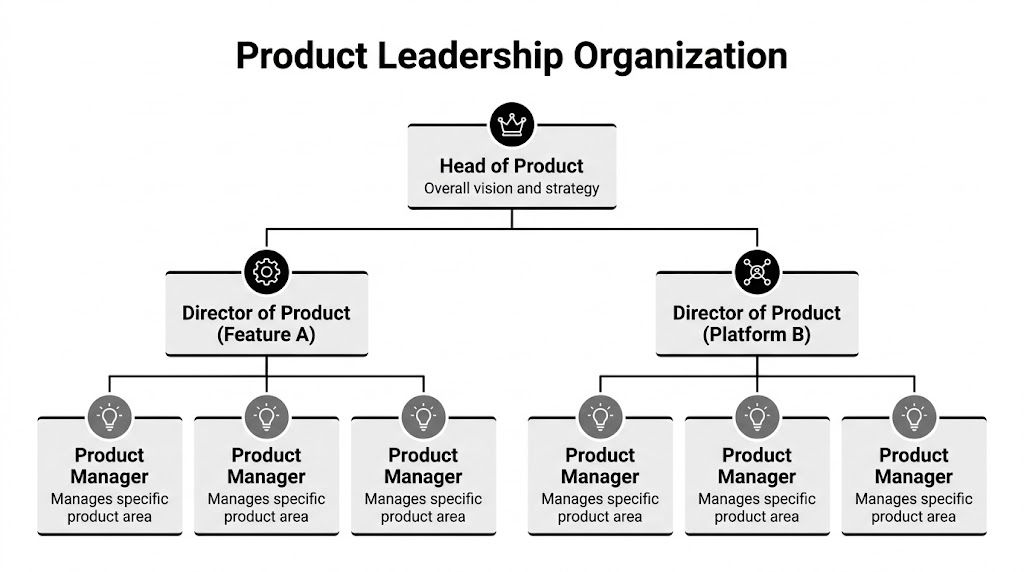
Common product org patterns
The same title can operate very differently depending on how the company groups product teams.
Product line structure
This is common in multi-product SaaS companies. One director might own collaboration, another analytics, another admin platform. Each manager of managers has a relatively self-contained business area.
This structure works well when products have distinct customers, roadmaps, and commercial logic. It breaks down when shared platform dependencies are strong but underpowered.
Customer journey structure
Consumer companies often organize around a journey. Acquisition, activation, engagement, monetization, support. A manager of managers here has to coordinate handoffs and avoid local optimization.
This model helps teams stay close to user behavior. It creates friction when one journey team over-optimizes its step at the expense of the end-to-end experience.
Platform and capability structure
AI and infrastructure-heavy companies often need platform PM leadership alongside surface-area PM leadership. One product director may own user-facing experiences while another owns ML platform, experimentation systems, or internal tooling.
This setup is often the healthiest model for AI product organizations because it acknowledges that enabling systems need dedicated product leadership. It also creates a tougher alignment problem. Platform teams can become detached from user value unless the manager of managers keeps the connection explicit.
What success looks like at this level
A PM manager is often judged by product outcomes for one team and by the growth of their direct reports. A manager of managers gets evaluated on a wider scorecard.
That scorecard usually has three categories.
Business outcomes
- Portfolio contribution: Did the set of teams move the company’s top priorities?
- Resource allocation quality: Did funding and staffing map to strategy?
- Cross-team coherence: Did the portfolio work together or compete with itself?
Operational excellence
- Planning quality: Were plans realistic, clearly prioritized, and adaptable?
- Decision velocity: Did the org make important calls without endless escalation?
- Dependency health: Were cross-team relationships managed early instead of reactively?
Team health and leadership depth
- Manager quality: Are managers developing, retaining, and raising the bar for PMs?
- Bench strength: Is there a credible internal path for future leadership?
- Org stability: Does the team operate with clarity, trust, and sustainable load?
Senior leaders rarely ask whether you personally had the best product idea. They ask whether your organization keeps producing strong outcomes.
A practical measurement lens
If you’re already in the role, use a quarterly review to address these questions:
- What improved because of better structure?
- Which managers got stronger, and what evidence shows it?
- Where are decisions still too centralized?
- Which team is under-scoped, over-scoped, or poorly placed?
- Which portfolio bet is consuming attention without enough strategic return?
This is why the role can feel slippery to people moving up from direct product ownership. The metrics stop being purely product metrics. They become mixed indicators of business value, execution quality, and leadership effectiveness.
A good reference point is to think in terms of measurements of success for product leaders. At this level, your results are visible in what the org can do repeatedly, not just in what one team shipped recently.
The Product vs Engineering Leadership Tango
At director level, one relationship can make the org hum or grind: the partnership between the product manager of managers and the engineering manager of managers.
A lot of companies still reduce this to “product owns what, engineering owns how.” That’s too simplistic to be useful. It produces role confusion, weak accountability, and passive-aggressive planning.
The better model is this:
- Product leadership owns why and who. Market problem, customer need, business logic, prioritization, and portfolio choice.
- Engineering leadership owns how and how well. Architecture, technical execution quality, reliability, team sustainability, and operational performance.
Those domains overlap, but they aren’t interchangeable.

Respect the engineering director’s real job
Product leaders who haven’t managed engineering peers at this level often underestimate the complexity on the other side of the table. ISC Paris on technical manager responsibilities describes effective technical managers as balancing 40% of time on technical oversight and 60% on leadership, while driving 15-25% improvements in system performance and stronger project success. That’s a useful reminder that your engineering counterpart is not just staffing delivery. They’re managing architecture quality, technical risk, and team capability simultaneously.
In AI and ML orgs, this is even sharper. Engineering leaders are often balancing model infrastructure, data quality, latency, reliability, and safety constraints that product teams don’t see day to day.
If product leaders ignore that complexity, they usually default to one of two bad habits:
- pushing for roadmap certainty where technical uncertainty is still high
- treating platform work as overhead instead of strategic capacity
Build shared rituals, not just goodwill
Strong partnerships don’t rely on chemistry alone. They rely on shared mechanisms.
Rituals that actually help
| Ritual | Purpose |
|---|---|
| Weekly product-engineering director sync | Surface trade-offs before they harden into conflict |
| Monthly portfolio review | Reconcile strategy, capacity, and technical constraints |
| Talent calibration | Align on manager quality, gaps, and succession |
| Pre-planning architecture review | Catch major technical implications before roadmap commitment |
| Post-launch review | Learn where process, scope, or coordination broke down |
The important part is that these meetings answer specific questions. If your weekly sync becomes status theater, it won’t build trust.
The healthiest director partnerships argue early, decide clearly, and present a unified call to the rest of the org.
Separate tension from misalignment
Good product and engineering leaders should have tension. Product pushes ambition, clarity, and market timing. Engineering pushes feasibility, resilience, and quality. That tension is productive.
Misalignment is different. Misalignment happens when the two leaders aren’t using the same planning assumptions, success criteria, or escalation rules. Then every team below them inherits the confusion.
For AI product teams, one pattern works well. Product leadership sets the problem framing, user value, risk posture, and portfolio priority. Engineering leadership defines the technical path, maturity constraints, and operating envelope. Both leaders jointly decide where to reduce scope, where to invest in enabling systems, and when not to launch yet.
That’s the tango. Not parallel lanes. Not blurred ownership. Coordinated leadership with distinct responsibilities.
Your Roadmap to a Director-Level Product Role
If you want to become a manager of managers, waiting for a title change is the slowest path. The faster path is to start doing slices of the role before anyone gives you formal authority.
That means building evidence in four areas: scale, people leadership, strategic judgment, and executive communication.
Build evidence before the promotion
If you’re an IC PM today, your first target isn’t “manage people.” It’s “create impact beyond my own roadmap.”
Start with work like this:
- Lead cross-team initiatives: Take on programs that require alignment across product, engineering, design, data, and GTM.
- Mentor PMs informally: Help junior PMs with framing, planning, and stakeholder management.
- Operate at system level: Don’t just diagnose a missed launch. Fix the process, ownership, or dependency pattern behind it.
- Write strategy memos: Practice synthesizing a messy space into a clear recommendation for leaders.
If you’re already a first-line manager, the next signal is different. You need to show that you can scale other leaders, not just run a good team yourself.
Look for opportunities to:
- Coach another manager: Especially on feedback, prioritization, or organizational tension.
- Standardize quality bars: Create reusable templates for roadmap reviews, PRDs, product strategy docs, or AI launch readiness.
- Influence org design: Recommend how teams should be grouped, split, or re-chartered.
- Own planning across several teams: Help shape annual or half-year planning, not just a team roadmap.
A lot of candidates say they’re ready for director because they’ve shipped large work. That’s necessary. It’s not decisive.
Prepare for the interview you’ll actually face
Director interviews test pattern recognition, judgment, and people leadership. They also test whether you can stay out of the weeds without becoming vague.
Use a prep checklist like this:
Questions you should be ready for
- Manager conflict: How would you handle a disagreement between two PM managers whose teams have overlapping goals?
- Org design: When would you reorganize teams, and what signals tell you it’s time?
- Talent calls: Tell me about a manager you coached successfully. Tell me about one you had to move out of role.
- Portfolio trade-offs: How have you decided to stop investing in one area to fund another?
- Executive communication: How do you present uncertainty without looking unprepared?
- AI product judgment: How do you decide when an AI capability is mature enough for broad customer use versus limited rollout?
A good answer usually includes the mechanism, not just the principle. Interviewers want to hear how you diagnose, how you decide, and how you communicate.
Don’t answer director-level questions like a strong PM. Answer them like someone responsible for an entire operating system.
For candidates who want extra practice on structured planning and stakeholder trade-offs, even outside product-specific prep, Project Management Professional certification practice exams can be useful as a drill for decomposing complex scenarios under time pressure.
Handle today’s leadership realities honestly
This level of leadership has a recruiting problem in plain sight. Some high-potential people don’t want it.
A Robert Walters survey on conscious unbossing among Gen Z found that 52% of Gen-Z professionals avoid middle management roles, with 69% citing high stress and low reward, while other respondents pointed to limited decision-making power and reduced personal growth. If you want to build a durable management bench, you can’t sell management as prestige. You have to make it a role with real ownership, clear support, and visible development.
That has practical implications for product orgs:
- Use player-coach transitions carefully: Let future leaders test management without severing all craft work immediately.
- Clarify authority: Don’t create manager roles that carry accountability without decision rights.
- Reduce admin drag: Use tools like Notion, Linear, Jira, and AI meeting assistants to cut repetitive coordination work.
- Show growth paths: Great managers need to see how people leadership advances their career, not stalls it.
Another leadership reality is that not everyone experiences this ladder the same way. Research summarized in a SAGE article on women middle managers points to persistent barriers including feeling unappreciated, facing promotion bias, and having to adapt to masculine norms. If you’re a woman pursuing this role, informal power networks and perception traps are often part of the actual job market, not side issues.
Practical responses help more than generic encouragement:
- Build sponsorship, not just mentorship: You need leaders who will advocate when stretch roles are discussed.
- Document your operating impact: Make org design wins, talent development, and portfolio decisions visible.
- Practice followership as a leadership skill: Senior roles require giving and receiving feedback across power lines.
- Interrogate vague feedback: “Needs more executive presence” is not actionable until someone names the behavior.
If you’re aiming for this path, study how director-level product roles are framed and evaluated in the market. Director of Product Management expectations is a good lens for seeing how scope, leadership, and business ownership converge at this stage.
The promotion tends to come after the market already believes you’re doing the job. Act accordingly.
If you want more practical guidance on becoming a stronger product leader, growing your PM career, and learning how top operators think about org design, hiring, and scale, follow Aakash Gupta. His writing, podcast, and resources are built for PMs who want to move from execution to leadership with much more clarity.
