A North Star Metric (NSM) isn't just another KPI for your dashboard. It's the one metric that best captures the core value your product delivers to customers. For a Product Manager, it's your most powerful tool for alignment.
Think of it as the compass for your product organization. At Google, Meta, and the fastest-growing startups, a well-defined NSM aligns every team—from a junior engineer in SF to a marketing lead in Singapore—on the single, unified goal that drives sustainable growth. Get this right, and you stop shipping features and start building value.
This guide provides the tactical framework used by top-tier PMs to define, implement, and lead with a North Star Metric. We'll move beyond theory and give you the step-by-step process you can implement with your team in the next 48 hours.
What Is a North Star Metric and Why Does It Matter for Your Career?
As a product manager, your world is a constant barrage of stakeholder requests, competing priorities, and an ocean of data. Without a laser focus, your team gets pulled in a dozen different directions. You end up shipping features that feel productive but don't actually move the needle for the business or your career.
This is exactly where a North Star Metric becomes your most powerful tool. It’s the difference between a PM who manages a backlog and a PM who leads a strategy.
It cuts through the noise by forcing you to answer one critical question: What single measure of customer value also predicts our long-term business success?
The concept isn't just a buzzword; it’s a core tenet of product-led growth. As a hiring manager, when I see a PM who can clearly articulate their product’s NSM and how their work drove it, I know I'm talking to a strategic thinker. They know why they're building what they're building.
The Core Purpose of an NSM for a PM
A good North Star Metric fundamentally changes how your organization operates. It creates a shared language for success that everyone, from an intern to the CEO, can understand and rally behind.
For a PM, this single metric serves three crucial functions:
- Radical Alignment: It gets every team—product, marketing, sales, engineering—rowing in the same direction. Instead of chasing departmental KPIs that might conflict, everyone is focused on moving the same number. When sales is pushing for features that don’t serve the NSM, you have a powerful, data-backed reason to push back.
- Ruthless Focus: It acts as an objective filter for your roadmap. When you're debating which initiative to tackle next, you can simply ask, "Which of these is most likely to impact our North Star?" This sharpens your prioritization and kills the "good idea" features that don’t deliver core value.
- Executive Clarity: It tells a simple, powerful story about the health of your product. It clearly communicates to leadership and stakeholders whether you're succeeding at delivering value to customers in a way that fuels the business.
Key Characteristics of a Powerful NSM
Not all metrics are created equal. Choosing the right one is the mark of a seasoned PM. A true North Star Metric has specific qualities that make it an effective guide.
Thinking about this is a core part of understanding what is product growth and how to achieve it.
A great NSM is a leading indicator of future success, not a lagging indicator of past performance. It measures customer behavior that directly correlates with retention and revenue, giving you a predictive view of your business's health.
To help you vet potential metrics, I've put together a quick reference table. Use this as a checklist to ensure your chosen metric is a reliable guide for your product's journey.
Characteristics of a High-Impact North Star Metric
This table breaks down the essential qualities of an effective North Star Metric, helping PMs quickly evaluate potential candidates.
| Characteristic | Why It Matters for a PM | Example |
|---|---|---|
| Measures Customer Value | It forces your team to focus on solving real user problems, not just hitting internal targets. | For a meditation app, "Weekly Mindful Minutes" is better than "Daily App Opens." |
| Represents Progress | The metric should naturally grow as your product delivers more value, giving you a clear signal of momentum. | For a collaboration tool, "Teams Sending 20+ Messages a Week" shows deep engagement. |
| Is Actionable | Your product and engineering teams must be able to directly influence the metric through the features they build. | "New Users Completing Onboarding" is actionable; "Monthly Active Users" is too broad. |
| Predicts Revenue | While not a direct revenue metric itself, it must be a leading indicator of long-term financial success. | For a SaaS tool, "Number of Paid Teams" is a better predictor than "Total Sign-ups." |
Ultimately, a strong NSM connects the work your team does every day directly to the value customers receive and the long-term health of the business. Get this right, and it becomes the foundation for a truly product-led strategy.
How Top Companies Use Their North Star Metric to Win
Theory only gets you so far. As a PM, your career lives and dies by how well you can turn concepts into real-world strategy. The fastest way to truly get the North Star Metric is to break down how the best in the business use it to dominate their markets.
These companies don't just pick a metric; they choose a compass that dictates their entire product direction.
Let's ditch the abstract definitions and look under the hood at the tactical decisions behind the NSMs of industry giants. This isn't just a list—it's a playbook of strategic thinking you can borrow from.
Airbnb: Nights Booked
Airbnb's choice of Nights Booked is a masterclass in capturing the core value of a two-sided marketplace. So many marketplace startups make the rookie mistake of chasing vanity metrics like "new host sign-ups." But those numbers say nothing about whether anyone is actually getting value.
A new host with zero bookings isn't a success story. A guest who signs up but never books a trip is just a name in a database.
Nights Booked is the magic moment. It represents the exact point where value is created for both sides. The guest has a place to stay, and the host just earned income.
This single metric forces every product team at Airbnb to think about the entire user journey:
- The search and discovery team is pushed to improve filters and matching to drive up booking conversion.
- The trust and safety team has to build features that make both guests and hosts feel secure enough to transact.
- The host tools team is focused on building better calendars and pricing guides to maximize occupancy, which directly fuels more Nights Booked.
Spotify: Time Spent Listening
For a subscription business like Spotify, the game is all about retention. They win when they become an indispensable daily habit. A metric like "Daily Active Users" (DAU) is dangerously shallow. A user opening the app for 30 seconds is not the same as someone who listens for two hours.
Spotify’s North Star Metric, Time Spent Listening, goes deeper. It measures the depth of engagement, a powerful leading indicator for long-term retention and customer lifetime value. If that number is trending up, the product is weaving itself into the fabric of their lives.
This NSM directly shapes their entire product strategy:
- Algorithmic Playlists: Features like Discover Weekly aren't just cool tech; they're engines designed to keep you engaged by serving up new tracks you'll love, boosting your listening time.
- Podcast Investment: Their massive push into podcasts was a brilliant strategic move to capture more "ear time" throughout the day.
- UI/UX Decisions: Every tweak that reduces the friction to playing content is made in service of this core metric.
Slack and the Focus on Teams
Slack's success was never about one person using it. It was about becoming deeply embedded in how an entire organization communicates. That's why their North Star has always centered on team-level adoption.
A metric like Number of Paid Teams, for instance, is incredibly powerful. It cuts through the noise of free individual users and hones in on the organizations who see enough value to pull out a credit card.
This metric aligns product development with the real needs of businesses, pushing teams to build features like integrations, security compliance, and admin controls that are make-or-break for enterprise customers.
Many of the greats, from Uber's focus on 'number of trips' to PayPal's early growth strategies, have won by picking a metric that perfectly mirrors their core value exchange.
When you study these examples, a pattern emerges. The metric is never a vanity number. It's always a direct measure of the core value your product promises to deliver.
A PM's Framework for Defining Your North Star Metric
Defining your North Star Metric isn't some academic exercise you do on a whiteboard and forget. This is one of the highest-leverage activities a product manager can lead.
Think of this as your playbook—a step-by-step framework you can kick off in the next 48 hours. The goal isn’t just to pick a metric; it's to build unshakable, cross-functional alignment around what success actually looks like. As the PM, your job is to guide this process, not dictate the outcome.
Phase 1: Uncover True Customer Value (Data Deep Dive)
Before you can measure value, you have to know what it is. Pinpoint the "aha!" moment where your product "clicks" for a user. To get there, you need to start with the data. Dive into your product analytics (Amplitude, Mixpanel, etc.) and hunt for behaviors that correlate with high retention. What are the specific actions your most loyal users take in their first week?
- For a project management tool (e.g., Asana): Is it creating their second project? Inviting three teammates?
- For an e-commerce app (e.g., Shein): Is it saving an item to a wishlist? Making a second purchase?
- For a social media platform (e.g., TikTok): Is it following 5 accounts? Sharing a video?
This isn't guesswork. It's about identifying the repeatable actions that transform a new user into a power user. This behavior is the raw material for your NSM.
Phase 2: Run a Collaborative Brainstorming Workshop
Once you have a data-backed hypothesis, get your key stakeholders in a room. A great NSM can't be cooked up in a product silo. You need the collective brainpower of engineering, marketing, sales, and design.
Your role here is to be the facilitator. Set up a 90-minute workshop with a crystal-clear agenda.
Workshop Agenda Template
- (15 min) The 'Why': Kick things off by presenting your data findings from Phase 1. Explain what a North Star Metric is, why it's critical, and share examples like Airbnb's "Nights Booked."
- (30 min) Brainstorming Candidate Metrics: Open the floor. Based on the "aha!" moment, how could we measure this value exchange? Go for quantity over quality. Get every idea onto a virtual whiteboard (Miro, FigJam).
- (30 min) Initial Filtering & Discussion: Group similar ideas. As a team, talk through the top 5-7 candidates. How do they stack up against the core traits of a strong NSM (measures value, predicts revenue, is actionable)?
- (15 min) Next Steps & Ownership: End with clear action items. Who is going to pull the data to validate each of the top candidates? Set a deadline.
A successful workshop doesn't end with a final decision. It ends with a short list of validated, data-supported candidates and clear ownership for the next round of analysis. You're aiming for alignment, not immediate consensus.
Phase 3: Map Metrics to Your Product Strategy
Now, take that shortlist of candidate metrics and map each one directly against your high-level company goals. The right North Star Metric has to be a direct reflection of your bigger business and product strategy framework.
If the company's big strategic push for the year is to expand into the enterprise market, a metric focused only on individual user sign-ups is off the mark.
Ask your team and stakeholders these critical questions for each candidate metric:
- Does this metric show direct progress toward our quarterly and annual business goals?
- If we manage to boost this metric by 20%, what tangible impact will that have on revenue and customer retention?
- Does this metric actually encourage the user behaviors that fit our long-term product vision?
This phase ensures your NSM is a core driver of the business itself. For a different lens on how AI and product development intersect with business metrics, you might find some interesting takes on Parakeet AI's blog.
Phase 4: Use a Decision Matrix to Select the Winner
You're at the home stretch. You've got a small list of strong, strategy-aligned candidate metrics. To make the final call objective and transparent, lean on a simple decision matrix.
Create a table with your final candidates in the rows. For the columns, list the must-have attributes of a great NSM. Then, score each metric from 1 (poor) to 5 (excellent) for each attribute.
| Candidate Metric | Measures Customer Value (1-5) | Predicts Revenue (1-5) | Is Actionable (1-5) | Easy to Understand (1-5) | Total Score |
|---|---|---|---|---|---|
| Weekly Active Teams | 5 | 5 | 4 | 5 | 19 |
| Daily Messages Sent | 4 | 3 | 5 | 4 | 16 |
| New Paid Seats Added | 3 | 5 | 3 | 5 | 16 |
The metric with the highest score wins. This simple process strips emotion and personal bias out of the decision, making it a logical conclusion based on criteria everyone has already agreed on.
Once it's chosen, your job is to communicate the new North Star Metric—and the 'why' behind it—to the entire company. From this point forward, it's the compass for everything you build.
Connecting Your North Star to Actionable Team Metrics
A high-level North Star Metric is a fantastic compass for the C-suite, but for the product squads in the trenches, it can feel frustratingly abstract. An engineer will ask, "How does building this button help us hit our goal?" You need a real answer.
A great NSM doesn't just live on an executive dashboard. It must cascade down into a clear hierarchy of metrics your team can actually change. Without this vital link, your North Star is just a vanity metric.
The whole point is to build a "metric tree." This framework visually connects your team's backlog to the company's biggest goal. It empowers you to justify roadmap priorities and gives your team a tangible sense of purpose.
From High-Level Vision to Team-Level KPIs
Let's make this real. Imagine you're a PM at Spotify and the company's North Star is Time Spent Listening. The CEO obsesses over that number, but your podcast discovery squad can't directly control it.
You have to break that big goal down into smaller, influenceable pieces. What are the key behaviors that actually drive more listening time? We call these your driver metrics.
For Spotify, a simple metric tree might look like this:
- North Star Metric: Time Spent Listening
- Driver Metric 1: Average Session Length (How long do users listen at a time?)
- Driver Metric 2: Session Frequency (How often do users come back to listen?)
- Driver Metric 3: Content Discovery Rate (How well do users find new stuff they love?)
Suddenly, your team has something concrete to tackle. They can't just "increase listening time," but they can absolutely ship features to "increase average session length." This hierarchy draws a straight line from the team's work to the big picture.
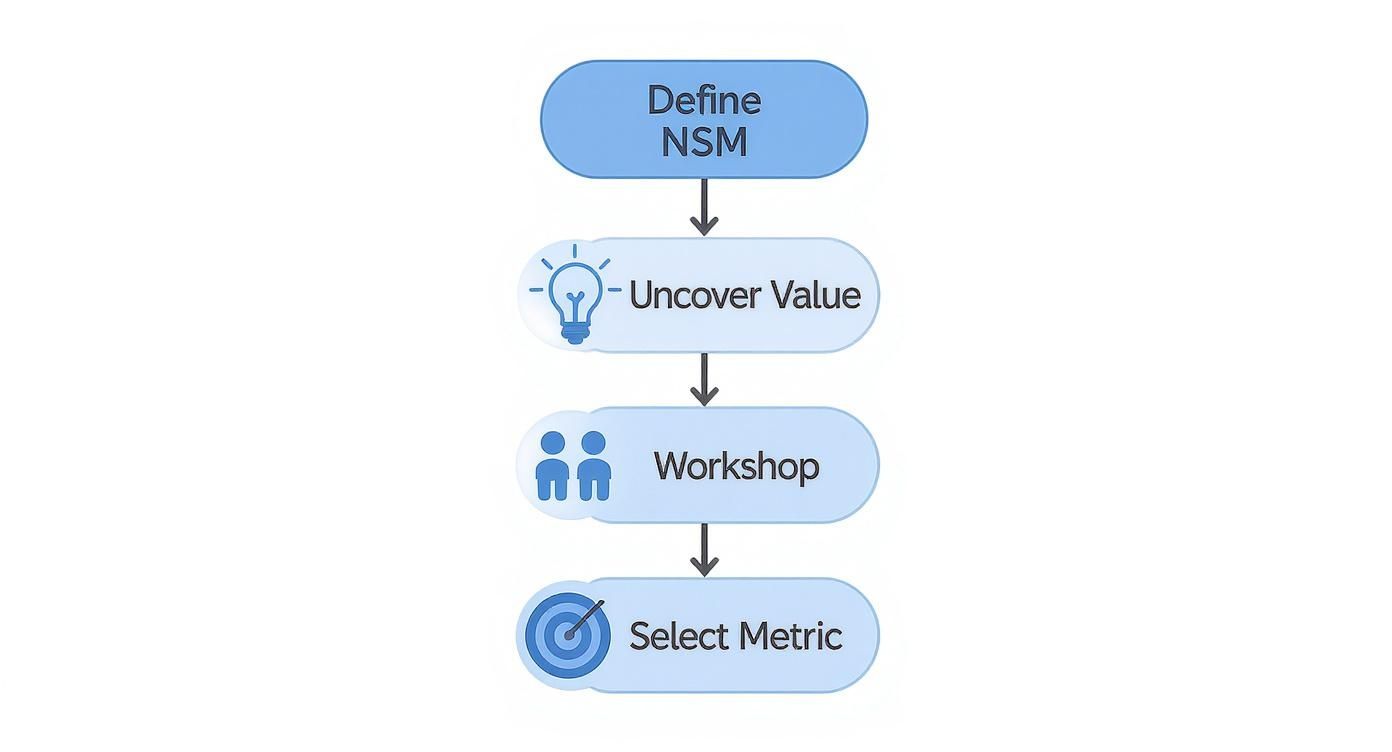
This diagram shows you how it works: you start with the big, high-level goal and break it down through a series of collaborative steps until you land on a concrete metric your team can own.
Building Your Product Squad's Metric Tree
Now, let's get even more granular. The podcast discovery team can take a driver metric like Content Discovery Rate and break it down even further into specific, squad-level KPIs they have total control over.
A metric tree isn't just a reporting tool; it's a decision-making framework. It helps teams identify the highest-leverage inputs they can control to achieve a desired output.
Here’s how that squad might build out its own branch of the tree:
- Start with the Driver Metric: The team is tasked with improving Content Discovery Rate.
- Identify Input Metrics: What specific user actions contribute to this?
- Input Metric A: Podcast Follow Rate (Users following new shows).
- Input Metric B: "Play" Clicks from Recommendation Surfaces.
- Input Metric C: Search-to-Play Conversion Rate.
- Connect to the Backlog: Now, the team can brainstorm features with crystal-clear hypotheses. "We believe a new 'Recommended for You' carousel on the homepage will increase 'Play' Clicks from Recommendation Surfaces by 15%, which will contribute to our overall discovery goal."
This structure connects a single feature idea all the way up the chain to the company's North Star. When you can trace that line, you have a powerful tool for prioritization.
Of course, tracking these connections effectively requires the right data infrastructure. For metrics where speed is critical, a solid grasp of real-time data analytics is essential for any modern product team.
Ultimately, this framework ensures that every line of code you ship and every design choice you make serves the one metric that matters most.
Common Mistakes to Avoid When Setting Your North Star

Defining a North Star Metric can feel like a career-defining moment. Get it right, and you align the entire company. Get it wrong, and you'll send your product org chasing ghosts.
I’ve hired and mentored dozens of PMs over the years, and I’ve seen these mistakes play out in real-time. They aren’t just theoretical risks; they lead directly to wasted engineering cycles, frustrated teams, and stalled growth.
Let’s walk through the most common pitfalls so you can spot them before they derail your strategy.
The Vanity Metric Trap
The most seductive mistake is falling for a vanity metric. This is a number that looks amazing on a slide deck but has zero connection to actual customer value or business health. Think "total app downloads" or "new user sign-ups."
These numbers feel great to report, but they're dangerously misleading. A million downloads means nothing if 95% of those users open the app once and never come back.
A vanity metric measures activity, not value. It tells you people are showing up, but it doesn't tell you if they're staying for the main event or just passing through.
The fix? Constantly ask yourself, "Does this number prove our users are successfully solving their problem with our product?" That simple question forces you to shift from shallow activity metrics to the deeper engagement metrics that truly matter.
Choosing a Lagging Indicator
Another classic blunder is picking a metric that’s a lagging indicator. This is a number that only tells you about past performance, like "monthly recurring revenue" (MRR) or "customer lifetime value" (CLV).
While these numbers are mission-critical for the business, they make for terrible North Stars. Why? Because you only see the results weeks or months after you've done the work. It’s like trying to navigate a ship by looking at its wake.
The danger here is the painfully slow feedback loop. Your team ships a feature, but you have to wait an entire quarter to see if it moved the needle on MRR. By then, it’s far too late to iterate.
Instead, find a leading indicator that predicts your lagging business metric. For example:
- Lagging Indicator: Monthly Churn Rate
- Leading Indicator (NSM): Percentage of users completing a key workflow weekly
Focusing on the leading indicator gives your team a metric they can influence in near real-time. This creates much faster learning cycles.
Picking a Metric That Can Be Gamed
The final pitfall is choosing an NSM that’s easy to game. Always remember: what gets measured gets managed. If your NSM can be juiced through "dark patterns" or short-term tricks that hurt the user experience, you can bet someone will eventually do it.
A classic example is "number of notifications sent." A team could easily pump up this number by spamming users, but that would quickly lead to uninstalls and serious brand damage.
To avoid this, stress-test your candidates. Ask your team, "What are all the ways we could increase this number while making the product worse for users?" If that list is long, you've got a problem.
The solution is to pair your NSM with a quality guardrail or a counter-metric. If your NSM is "items added to cart," you might pair it with "cart abandonment rate" to ensure you're not just encouraging clicks without driving actual purchases.
North Star Metric Pitfalls and How to Avoid Them
Spotting these issues is half the battle. As a PM, your job is to anticipate these traps and build a framework that guides your team toward genuine, sustainable growth. Here’s a quick reference table to keep in your back pocket.
| Common Mistake | Potential Negative Impact | PM's Action Plan to Fix |
|---|---|---|
| Focusing on a Vanity Metric | Wasted resources on features that don't drive real user value. Misleading picture of product health. | Shift focus from acquisition (e.g., sign-ups) to activation and engagement (e.g., weekly active users completing a core action). |
| Selecting a Lagging Indicator | Slow feedback loops for the product team. Inability to iterate quickly based on performance. | Identify a leading indicator that predicts the lagging business outcome. For example, track "daily active users sharing content" instead of just "monthly revenue." |
| Choosing a Gameable Metric | Teams optimize for the number, potentially harming the user experience with dark patterns or spammy tactics. | Implement a counter-metric or quality guardrail. If the NSM is "messages sent," also track "block/report rate" to ensure healthy interactions. |
| Making It Too Complex | The team doesn't understand it, can't remember it, or doesn't know how their work influences it. | Keep it simple and memorable. The NSM should be easy to explain to anyone in the company, from an intern to the CEO. It should pass the "hallway test." |
| Not Connecting to Revenue | The product team hits its NSM goals, but the company's revenue doesn't grow. Creates a disconnect with the business. | Ensure a clear, logical link between the NSM and a top-level business metric like revenue or profit. You should be able to explain how improving the NSM leads to business success. |
Ultimately, a strong North Star Metric isn't just a number—it's a shared understanding of what success looks like for your users. By sidestepping these common mistakes, you can provide the clarity and focus your team needs to build products that customers truly value.
Frequently Asked Questions About the North Star Metric
Even after you've run the workshop and aligned on a North Star Metric, the real work is just beginning. This is where the tough, real-world questions start popping up. As a PM, your job isn't just to define the metric; you have to champion it, defend it, and navigate all the organizational chaos that comes with it. This is where your leadership chops are truly tested.
I've seen PMs get stuck on the same questions time and time again. Here are some direct, actionable answers to get you through the tough spots.
How Often Should We Review or Change Our North Star Metric?
A North Star Metric should give you long-term direction, not something you fiddle with every quarter. Think of it as a strategic anchor, not a tactical KPI. As a general rule, you should review it annually or maybe semi-annually, but you should only change it if something big happens.
You really only want to change your NSM if there's a fundamental shift in your business or product strategy.
- You're entering a new market: A B2C product suddenly trying to sell to enterprise B2B customers will have a completely different idea of value. That demands a new NSM.
- Your business model changes: If you're moving from one-time purchases to a subscription model, the game is no longer about the transaction. It's about long-term engagement and retention.
- Your understanding of customer value evolves: Sometimes you realize through data that what you thought was the "aha!" moment was just a stop along the way to the real value driver.
A North Star Metric should be stable enough to guide strategy for at least 12-18 months. If you find yourself wanting to change it every quarter, that's a huge red flag. It probably means you've picked a tactical team metric, not a true North Star.
What Is the Real Difference Between an NSM and a Team OKR?
This is a critical distinction that trips up so many teams. An NSM and an OKR (Objective and Key Result) are connected, but they serve very different purposes. Confusing them is a surefire way to lose focus.
The North Star Metric is your company's unchanging compass. It's the single, high-level measure of customer value that predicts long-term success. It is singular and it is meant to last.
A team OKR, on the other hand, is a short-term, tactical goal. It’s what your team commits to achieving in a specific timeframe (usually a quarter) to help push the NSM forward.
Let's break it down with an example:
- NSM (The Compass): "Increase Weekly Active Teams by 20% over the next year."
- Team OKR (The Quarterly Mission):
- Objective: Streamline the new user onboarding experience to drive team activation.
- Key Result 1: Increase the percentage of new teams inviting 3+ members in their first week from 40% to 60%.
- Key Result 2: Reduce the time to send the first team message from 15 minutes to 5 minutes.
Your OKRs are the specific, measurable bets you're making this quarter to move the North Star in the right direction.
How Do I Manage Conflict Between Departments?
It's going to happen. The Head of Sales wants the NSM to be "New MRR," marketing is pushing for "Qualified Leads," and you, the PM, are arguing for an engagement metric like "Weekly Active Projects." This is where you have to step up from being a project manager to being a product leader.
Your job is to get everyone out of their departmental silos by facilitating a conversation grounded in data.
- Acknowledge and Validate: Start by showing you get it. "I completely understand why MRR is critical; it's the lifeblood of our business." This builds trust and shows you respect their perspective.
- Re-center on the Customer: Gently pull the conversation back to the whole point of an NSM—measuring customer value. Ask the group, "What is the one action a customer takes that tells us they're getting real value and are likely to stick around for the long haul?"
- Use Data to Connect the Dots: This is your secret weapon. Come prepared with analysis showing how your proposed NSM is a leading indicator of their desired lagging outcomes. For instance, show them a chart that proves your point: "Teams that create three active projects in their first month have a 75% higher retention rate, which directly fuels the MRR you care about."
- Frame it as 'And,' Not 'Or': Make it clear that the NSM doesn't replace their departmental KPIs. It aligns everyone on the customer behavior that ultimately powers all of their goals. It's the rising tide that lifts all boats.
What Is the Best Way to Introduce an NSM?
If your company has never used a North Star Metric, you can't just announce it in an all-hands meeting and expect everyone to get on board. A successful rollout is a change management exercise that requires a smart, phased approach.
Start small to build momentum. Pick a single, influential product squad to run a pilot program.
- Phase 1 – Pilot Program (1 Quarter): Work with this one team to define their driver metrics and align their backlog to the NSM. Track their progress, but more importantly, get their honest feedback. Does it bring clarity? Does it actually help with prioritization?
- Phase 2 – Showcase the Win (Month 4): At a company-wide demo or product review, have the pilot team present their work. Frame it as a success story. Show how their focus on the NSM led to a measurable impact on both customer engagement and a key business outcome.
- Phase 3 – Gradual Rollout (Quarters 3-4): Use that pilot team's success as an internal case study to roll the framework out to other product teams. By now, you've replaced abstract theory with a real, tangible example of success, making adoption feel a lot less risky.
This approach de-risks the whole process and builds buy-in organically. The NSM becomes a proven tool for success, not just another top-down mandate.
At Aakash Gupta, we provide the frameworks and insights you need to navigate these exact challenges and accelerate your product career. To get tactical advice from a seasoned product leader delivered to your inbox, subscribe to my newsletter.
