A battle-tested product launch checklist template is the single most important asset a Product Manager owns during a launch. It’s the framework that transforms ambiguity and chaos into a predictable, step-by-step roadmap. At Google and Meta, I saw firsthand that the difference between a launch that hits its Q1 numbers and one that fizzles out often comes down to the rigor of this document. It ensures every detail—from pre-launch messaging validation to post-launch KPI reporting—is tracked, owned, and executed.
Beyond the To-Do List: Why PMs Need a Strategic Launch Framework
I've seen it time and time again: launches live or die based on the quality of their plan. A simple to-do list is just that—a list of tasks. A strategic framework, on the other hand, is a risk mitigation tool and an orchestration engine.
For any serious Product Manager, a structured product launch checklist template isn't optional. It’s the critical difference between just 'shipping' a feature and launching a product that makes a measurable market impact and accelerates your career.
This framework forces the critical conversations that a simple task list glosses over. It's where you challenge assumptions, secure executive buy-in, and align the entire company around a single vision for how you're going to win.
A great launch checklist doesn't just ask, "Did we build the feature?" It forces the team to answer, "Does the market actually care?" and "Is the entire company ready to sell, support, and scale this thing?" This shift in mindset is what separates senior PMs from the rest.
Shifting from Tactical Tasks to Strategic Orchestration
Think about the difference. A tactical task list might have items like "Write blog post" or "Send announcement email." A strategic framework digs much deeper, including items that de-risk the entire launch:
- Market Positioning Validation: Have we pressure-tested our core messaging with at least 10 ideal customers to confirm it resonates and drives intent?
- Competitive Threat Assessment: What’s our pre-mortem plan if a key competitor (e.g., a well-funded startup or a legacy player like Microsoft) slashes their price the week before we go live?
- Internal Readiness Check: Has the sales team completed the new training and been certified on the product messaging and demo flow, scoring >90% on the certification exam?
I remember one launch where our detailed checklist caught a minor but critical oversight in sales enablement—our competitor battle cards were based on a three-month-old version of their product. Catching that one line item saved our sales team from walking into key objections completely unprepared. That small detail could have cost us millions in our first quarter.
This is where having robust project management software like Asana or Monday.com becomes critical. It’s essential for tracking these dependencies and maintaining visibility across the organization.
Mitigating the High Risk of Failure
The numbers don't lie, and they really underscore the need for this strategic depth. Market research from sources like CB Insights consistently shows that a staggering number of new products fail—often cited as high as 70%. The top reasons are almost always a lack of product-market fit or inadequate planning.
By building steps into your checklist for defining your target audience, creating sharp buyer personas, and mapping out a multi-channel marketing campaign, you directly tackle those risks head-on. In fact, companies that use detailed launch templates with clear roles see, on average, a 30% bump in first-quarter sales compared to those with less structured efforts. The goal is to stop checking boxes and start orchestrating a winning market entry.
The Three Phases of Every Successful Product Launch
Every launch I've ever managed, from small feature releases at startups to major platform launches at Google, follows a clear, three-act structure: Pre-Launch, Launch, and Post-Launch. Internalizing this flow is crucial because it shifts your thinking from just what to do, to why you're doing it at each critical stage.
This framework is the absolute backbone of a solid product launch checklist template. It turns a simple task list into a strategic roadmap, connecting your team's day-to-day work directly to the bigger business goals.
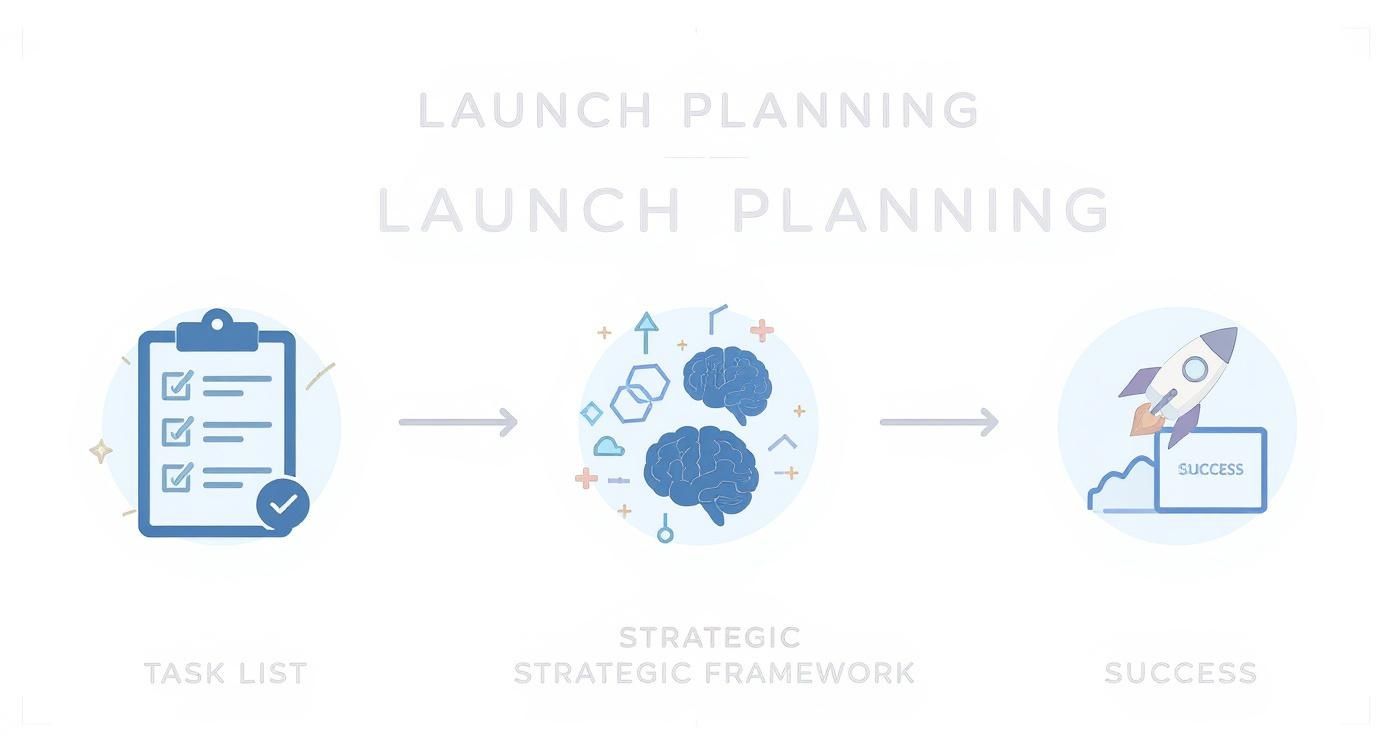
The real takeaway here? A checklist isn't just a to-do list. It's the operational arm of your entire strategy.
To make this crystal clear, here’s a breakdown of how these phases connect. Each one has a distinct purpose and its own measure of success.
Product Launch Phases At a Glance
| Launch Phase | Primary Goal | Example Activities | Key Metric |
|---|---|---|---|
| Pre-Launch | De-risk and build a foundation | Customer interviews, internal training, finalize GTM strategy | Strategic alignment (e.g., OKR sign-off from all VPs) |
| Launch | Maximize impact and execute flawlessly | Activate marketing campaigns, enable sales, support first users | Initial adoption or revenue targets (e.g., 500 new paid users in Week 1) |
| Post-Launch | Sustain momentum and learn | Gather user feedback, analyze cohort data, report on KPIs | User retention at Day 30 and overall business impact vs. forecast |
This table gives you the 30,000-foot view, but let's get into what really happens on the ground in each phase.
The Pre-Launch Phase: De-Risking the Entire Effort
This is where you win or lose. The pre-launch phase is all about front-loading the hard work to squash as much risk and uncertainty as you can before the big day. It’s about building an unshakeable foundation of alignment and validation.
Your main goal here is to lock in strategic alignment across every department and prove your assumptions with real market feedback. We're talking about business readiness, not just product readiness.
Key activities include:
- Market Validation: Getting out of the building. Run structured interviews with your Ideal Customer Profile (ICP) to confirm your messaging and positioning framework hits the mark with real people who have real budgets.
- Internal Alignment: Secure explicit sign-off from leadership on the launch goals (your OKRs). Ensure sales, marketing, and support teams are fully trained, equipped with battle cards and FAQs, and ready to execute.
- Go-to-Market (GTM) Strategy: Nail down your target audience, pricing & packaging, and finalize the channel strategy for your initial push. This document becomes the source of truth for the entire company.
When I was hiring PMs at Google and Meta, the ability to clearly articulate a pre-launch plan was a massive differentiator. It proves you think about risk mitigation and stakeholder management, not just shipping features.
The Launch Phase: Flawless Execution
Alright, showtime. The launch phase is a short, intense sprint where all that planning gets put to the test. The focus flips from strategy to pure, flawless execution. Your mission is to maximize impact and expertly handle the immediate response.
This is your moment of truth. Your team needs to operate like a well-oiled machine, with clear roles and lightning-fast communication. Think of it as a coordinated performance where every single person knows their part.
A typical product launch checklist might have 40 to 50 distinct tasks, but the launch window itself is surprisingly lean. For example, some frameworks dedicate a whopping 29 tasks to pre-launch and only about six for the actual launch period. This just goes to show how critical preparation is. Launch day becomes about activating those pre-planned campaigns, enabling sales, and making sure customer support is ready for that first wave of users. If you're curious, you can explore a detailed breakdown of essential product launch steps to see how these tasks are structured.
The Post-Launch Phase: Sustaining Momentum
The job isn’t done when the product goes live. In many ways, it's just getting started. The post-launch phase is all about keeping the momentum going, proving business impact, and closing the learning loop. This is where you shift from a one-off launch project to a sustainable business driver.
Your objective is to quickly collect user feedback, iterate based on real-world data, and report back on the success metrics you defined way back in the pre-launch phase. This is how you prove the value of your work and build credibility for your next big bet.
Building Your Pre-Launch Foundation
This is where launches are won or lost—long before anyone even thinks about clicking the "go live" button. The pre-launch phase is all about building an unshakeable foundation. If you get this right, launch day feels like a well-orchestrated event. Get it wrong, and it’s a chaotic scramble to the finish line.

This period isn't just for hammering out the final lines of code. It's for building the entire business case and operational readiness around the product. This is where your product launch checklist template really starts to earn its keep, steering you through the tough strategic decisions that prevent nasty launch-day surprises.
Defining Your Ideal Customer Profile and Messaging
First things first: before you can sell anything, you have to know exactly who you're selling to and what you need to say to them. This all starts with a crystal-clear Ideal Customer Profile (ICP). I'm not talking about a vague persona, but a specific, detailed definition of the company (e.g., "Series B SaaS companies with 50-200 employees") and user (e.g., "VPs of Engineering") who will get the most value from your product—and, in turn, provide the most value back to you.
Once that ICP is locked in, you can build out your messaging and positioning framework. Think about how Notion positioned itself not just as another note-taking app, but as an "all-in-one workspace." They knew their ICPs were teams at fast-growing tech companies drowning in a sea of disconnected tools (Google Docs, Trello, Asana), and they built their entire story around solving that specific pain.
Your own framework needs to answer three core questions:
- For (your target customer)
- Who has (the problem you solve)
- Our product is a (your market category) that provides (your key benefit).
A winning positioning statement is memorable, defensible, and hits the primary pain point of your ICP head-on. It becomes the North Star for every single piece of marketing copy, sales script, and press release that follows.
This clarity is completely non-negotiable. Without it, your marketing team is just guessing at what assets to create, and your sales team will struggle to articulate the product's real value.
Assembling the Go-To-Market Team and Strategy
Your Go-to-Market (GTM) team is the cross-functional crew of leaders from product, marketing, sales, and support who will collectively own the launch. This isn't just a list of names on a slide; it's a strategic council responsible for aligning the entire organization. Their very first job is to build the GTM strategy, which outlines the how of the launch.
A huge part of this is running a competitive analysis that goes way beyond a simple feature-by-feature matrix. You need to dig into your competitors’ strategies. Where are they winning? More importantly, where are the gaps in their value proposition that you can exploit? The whole point is to find your unique, strategic advantage. For a deeper dive, check out our guide on how to conduct market research that yields real insights.
Timing here is everything. From what I've seen, kicking off your checklist process 3 to 6 months before a major launch gives you the runway for deep market research and solid messaging development. For smaller updates, a 4 to 6 week timeline might work, but the principle is the same: treat the checklist as a strategic guide, not a last-minute chore.
Setting Clear and Measurable Launch Goals
Finally, you have to define what success looks like in concrete, measurable terms. Fuzzy goals like "increase user engagement" are useless for a PM trying to prove business impact. A senior PM sets sharp Objectives and Key Results (OKRs) that leave zero room for ambiguity.
Here's an example for a B2B SaaS product:
- Objective: Successfully launch Product Y to the small business market in Q3, establishing a strong market foothold.
- Key Result 1: Achieve 1,000 new trial sign-ups in the first 30 days.
- Key Result 2: Secure a 20% trial-to-paid conversion rate within 60 days.
- Key Result 3: Get product mentions in 5 key industry publications (e.g., TechCrunch, a top industry blog) by the end of the quarter.
These OKRs do more than just measure success. They secure early buy-in from leadership and align every single team on a common mission. When the whole company knows exactly what you’re trying to achieve, you transform potential launch-day chaos into a focused, collective effort to win.
Executing Launch Day and Driving Post-Launch Momentum
After months of grinding away and leaning on your product launch checklist template, the big day is finally here. This is where all that meticulous planning comes to life. Launch day isn't just about flipping a switch; it's a carefully orchestrated event designed to make the biggest splash possible.

This is the central nervous system for any modern launch: a dedicated Slack channel. Think of it as a real-time command center for escalating bugs, keeping an eye on performance metrics, and pushing out stakeholder updates. It’s what stops tiny hiccups from turning into full-blown crises.
The Launch Day War Room Mindset
Once you get the final "go," it's time to spin up your launch "war room." This doesn't have to be a physical room—a dedicated Slack channel like #launch-war-room and a shared metrics dashboard (e.g., a Datadog or Amplitude dashboard) often work even better. The entire point is to create a single hub for instant communication, monitoring, and quick decisions.
In the war room, everyone needs to know their part:
- Engineering Lead: Eyes glued to system health, server load, and error rates using monitoring tools like Datadog.
- Support Lead: Triaging incoming tickets in Zendesk or Intercom and spotting recurring user issues before anyone else.
- Marketing Lead: Monitoring social media sentiment on X and Reddit and the initial pulse of campaign performance in Google Analytics.
- Product Manager: You’re the commander-in-chief, connecting the dots, communicating status to executives, and making the tough calls on what gets escalated.
With this setup, you can react in minutes, not hours. When a bug report pops up on X (formerly Twitter), the marketing lead can flag it, the support lead can verify it with user tickets, and an engineer can be pushing a hotfix before it snowballs.
Sustaining Momentum in the First 30 Days
The launch isn't the finish line; it’s the starting gun. Seriously. The work you do in the first month is what separates a flash-in-the-pan from a product with actual staying power. Your focus needs to pivot immediately from execution to learning and iteration.
Your first job is to get your feedback loops running. Don't just sit back and wait for the complaints to roll in. Go out and get the feedback yourself.
- Net Promoter Score (NPS) surveys: Trigger these in-app right after a user completes a key action for the first time.
- Targeted customer interviews: Hunt down your first 20 paying customers and get them on a 15-minute call. Offer a gift card; their time is valuable.
- Support ticket analysis: Look for patterns. Are users getting stuck on one specific feature? Is the onboarding a mess? Use this to build your first post-launch bug-fix/improvement sprint.
The most valuable data you will ever get comes directly from the behavior and words of your earliest users. Your ability to quickly analyze this data and act on it will literally define your product's long-term trajectory.
The Post-Launch Retrospective and First Update
About two weeks post-launch, get everyone together for a retrospective. The goal here is learning, not blame. Frame the conversation around three simple questions: "What went well?", "What could have gone better?", and "What will we do differently next time?" This process builds trust and makes your launch playbook that much sharper for the next release. You can find more on refining your go-to-market plan in our guide to effective product launch strategies.
Finally, take all that initial user data and feedback and use it to prioritize your first feature update. Shipping a meaningful improvement within the first 30-60 days sends a powerful message to your early adopters: you're listening, and you're committed to making the product better. This is how you build the loyalty that turns initial buzz into sustainable growth.
How to Adapt the Launch Checklist for Your PM Career Level
A generic product launch checklist template is a great starting point, but its real power comes alive when you mold it to fit your specific role and where you are in your career. How you engage with a launch as an Associate PM versus, say, a Group PM is worlds apart. Your checklist needs to reflect that.

This isn't just a tool to get stuff done; it's a vehicle for demonstrating strategic value and accelerating your career progression. The way you use it sends a strong signal about your maturity and readiness for the next level.
Aspiring and Associate PMs
If you're just breaking into product or are in your first role (typical salary range: $90k-$130k), think of the checklist as your roadmap for learning the business. Your world revolves around execution and contribution. You won't be owning the Go-to-Market strategy, but you can absolutely own critical pieces within it.
Your checklist should zero in on:
- Supporting Senior PMs: Focus on tasks like documenting user feedback from beta tests, working with the support team to draft FAQs, or chasing down marketing assets to make sure they're complete.
- Learning Cross-Functional Dynamics: Use the checklist to figure out how marketing, sales, and engineering actually work together. Who is the directly responsible individual (DRI) for the press release? What's the sales team's deadline for training materials?
- Delivering Flawlessly: Your success is all about reliability. When you own a task—no matter how small—you see it through to completion without drama or surprises. This builds trust, which is the currency of a junior PM.
Mid-Career Product Managers
As a mid-career PM (think PM or Senior PM, with salaries often in the $140k-$220k range), you're shifting from executing tasks to strategic ownership. You're now the one accountable for the GTM strategy, not just a contributor. You're expected to navigate complex relationships across teams and make tough trade-off decisions.
Your checklist becomes more of a command center for:
- Stakeholder Management: Your list needs explicit checkpoints for getting buy-in from leadership and ensuring directors in sales, marketing, and CS are all aligned and have what they need.
- Owning the Narrative: You are responsible for the core messaging and positioning. The checklist should track how you're validating that story with actual customers through user testing and sales call recordings.
- Managing Risk: This is when you start adding sections for contingency planning. What happens if a key partner bails or a competitor like Slack or Microsoft Teams drops a spoiler feature right before your launch?
At this level, your ability to influence without direct authority is everything. The launch checklist is your main tool for orchestrating that influence, making sure every team feels a sense of shared ownership and is committed to the launch goals.
Senior and Principal PMs
Once you reach the senior leadership level (Principal, Group, or Director, with total compensation often exceeding $300k+), you're operating at a portfolio level. You're less in the weeds of a single launch and more focused on enabling your team and managing the broader business impact.
You're looking at the checklist from a much more strategic altitude:
- Portfolio Planning: You use launch templates to drive consistency and quality across multiple product lines. This stops teams from constantly reinventing the wheel and ensures a uniform level of excellence.
- Mentorship and Delegation: You're reviewing your team’s checklists to spot strategic gaps, coach junior PMs on risk assessment, and ensure resources are allocated to the highest-impact initiatives.
- Business Forecasting: Your involvement is about making sure the launch plan actually lines up with quarterly revenue targets and long-term business goals. You're asking "How does this launch help us win the market, not just this quarter?"
The table below breaks down how your focus with the launch checklist evolves as you climb the PM career ladder.
Launch Checklist Focus by PM Career Level
| PM Level | Primary Focus | Key Responsibilities | Success Indicator |
|---|---|---|---|
| Associate PM | Execution & Contribution | Supporting senior PMs, learning processes, owning specific tasks (e.g., FAQ drafts, asset tracking). | Flawless, on-time delivery of assigned tasks. |
| Mid-Career PM | Strategic Ownership | Driving GTM strategy, managing stakeholders, owning messaging, and planning for risks. | A smooth launch where all teams are aligned and business goals are met. |
| Senior/Principal PM | Enablement & Portfolio Impact | Ensuring consistency across launches, mentoring PMs, aligning launch plans with business targets. | The cumulative success of your team's launches and their contribution to portfolio-level goals. |
As you can see, the checklist transforms from a personal to-do list into a strategic alignment and coaching tool.
Mastering the checklist at each stage is a huge part of your development. For anyone looking to level up, learning how to get promoted often involves proving you can handle this evolving scope of strategic ownership.
Got Questions? Let's Talk Launch Strategy
Even with the world's best product launch checklist, questions are bound to pop up. A template gives you the skeleton, but knowing how to put flesh on the bones in the real world—that’s what separates a smooth launch from a frantic, stressful one.
I get asked these questions all the time by Product Managers I mentor. Here's the straight-up advice I give them.
How Early Do I Actually Need to Start This Checklist?
For a major new product launch, you need to be socializing the plan and building the checklist 3-6 months out. This isn't just about ticking boxes; it's about giving your team enough runway for proper market research, validating your messaging, and getting all your cross-functional dependencies locked in.
Launching a smaller feature? A 4-6 week timeline is usually more practical. The critical thing is to treat this checklist as a living, breathing strategic document from day one—not a last-minute to-do list you’re scrambling to fill out the week before you go live.
Who's Really in Charge of This Thing?
Look, a launch is a massive team effort, but the buck stops with the Product Manager. You are the ultimate owner and driver of that checklist.
Think of yourself as the central hub, the orchestra conductor making sure every single item gets assigned, tracked, and completed on time. You're the one who has to coordinate with marketing, sales, engineering, and support. This ownership means you’re also the one who has to have the tough conversations when things start to slip. Your job is to keep everyone aligned and accountable for their piece of the puzzle.
Your job isn't to do everything on the checklist. Your job is to ensure everything on the checklist gets done. That distinction is a core competency for senior PM roles.
What’s the Best Way to Handle Unexpected Delays?
First, don't panic. Delays happen to everyone, even at top companies like Google and OpenAI. How you handle them defines your maturity as a leader.
Your first move is to calmly assess the impact of the delay on the critical path to launch. Is this going to block other essential work? Once you understand the blast radius, communicate immediately and transparently with all your stakeholders.
Explain the issue, lay out its potential impact on the timeline, and come prepared with a proposed plan to mitigate the damage. A great checklist isn't just for planning a perfect launch; its real value shines when things go wrong, giving you the structure to manage setbacks and make smart trade-off decisions under pressure.
Ready to stop improvising and start orchestrating? The insights don't stop here. For career-defining advice on product strategy, growth, and leadership, subscribe to the Aakash Gupta newsletter and podcast. Join the community of PMs building the future at https://www.aakashg.com.
