Product management frameworks are the structured systems that top-tier Product Managers use to make objective, data-driven decisions about what to build and why. Think of them as a shared language that gets engineering, design, marketing, and leadership aligned, moving you from guesswork and gut feelings to strategic clarity.
The best frameworks help you tackle the biggest product questions: What do we prioritize? What do our users actually need? What's our strategy for winning? And how do we even know if we're successful?
This guide provides the battle-tested playbooks used at companies like Google, Meta, and Intercom to build products that millions of people love. You'll get actionable templates, real-world examples, and AI prompts you can use within 24 hours to make better decisions and advance your PM career.
Stop Guessing and Start Building Products That Win
If you're a Product Manager, you know the feeling. Your backlog is overflowing with stakeholder demands, conflicting feature requests, and ideas that sound good but lack any real substance. It's a daily reality for most of us.
The difference between a PM who's just treading water and a top-tier PM at a place like Google or Meta often comes down to one thing: having a system for making defensible decisions. This is where frameworks become your most valuable asset. They provide a structured approach from idea to launch that turns ambiguity into a clear, actionable plan.
As a PM leader who has hired and mentored teams at multiple tech companies, I can tell you that a candidate’s ability to articulate and apply the right framework to the right problem is a massive signal of their potential. It shows they think systematically, not just reactively. It's often the differentiator between a mid-level PM with a $150K salary and a senior PM commanding $220K+.
The Four Pillars of Product Frameworks
To make sense of the dozens of frameworks out there, it helps to group them into four main categories. Each one is designed to answer a core question you'll face. Think of this as your mental map for picking the right tool for the job—a skill that’s absolutely critical for advancing your career.
We'll dive deep into specific frameworks for each category later in this guide. For now, let's just get a handle on their distinct roles.
This diagram shows how different types of frameworks plug into specific stages of product development.
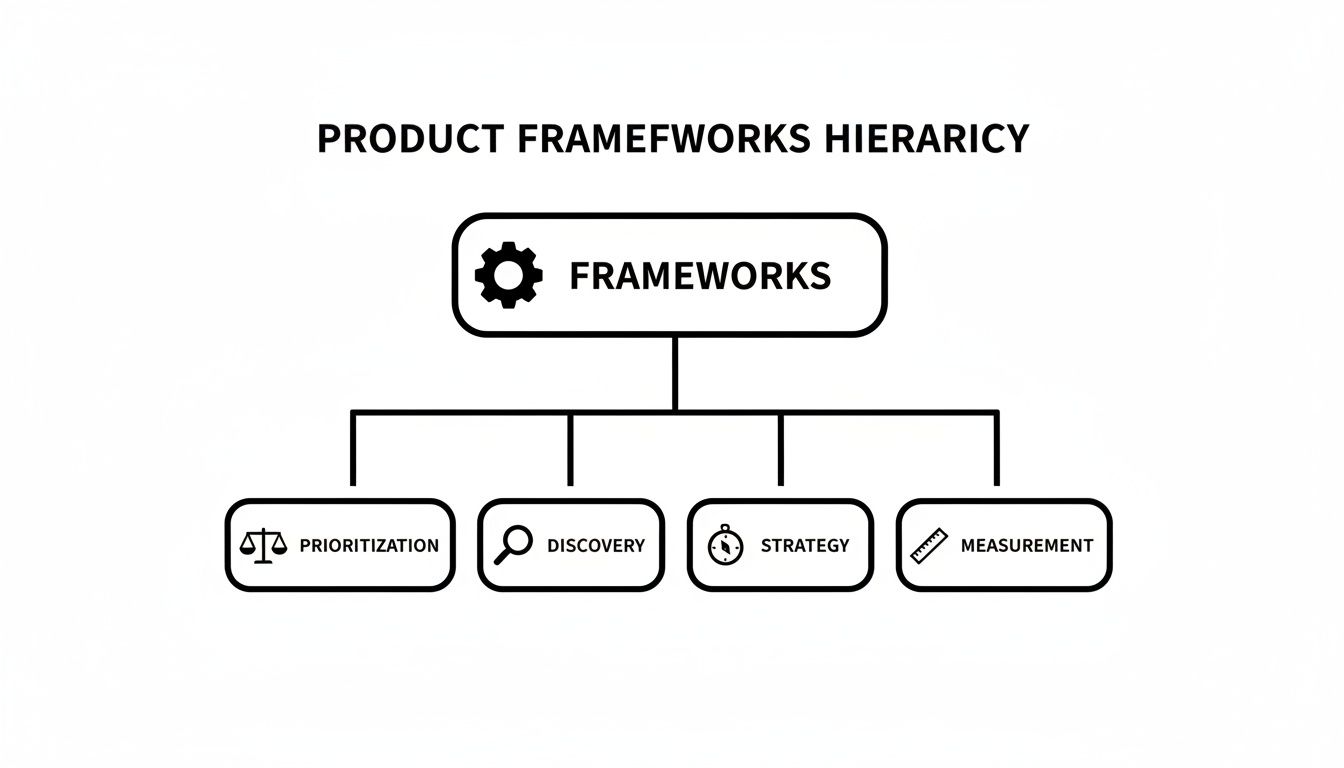
The key takeaway here is that frameworks aren't a one-size-fits-all concept. They're a toolkit with specialized instruments for every challenge a PM faces.
Core Framework Categories
To help you get your bearings, this table breaks down the four main categories of product management frameworks. It's a quick way to understand what each type does and when you should reach for it.
Product Management Framework Categories at a Glance
| Framework Category | Primary Goal | When to Use It | Example Frameworks |
|---|---|---|---|
| Prioritization | Decide what to build next | When you have more ideas than resources and need a logical way to rank them. | RICE, ICE, Kano Model |
| Discovery | Understand user problems | Before you build anything, to uncover deep customer needs and pain points. | Jobs to be Done, Opportunity Solution Tree |
| Strategy | Define the long-term vision | When setting the product's direction, aligning the team, and defining what success looks like. | North Star Metric, OKRs, V2MOM |
| Measurement | Evaluate product performance | After launch, to track user behavior and determine if the product is delivering value. | AARRR, HEART, Customer Satisfaction |
This table serves as a handy cheat sheet as we go deeper. Understanding these pillars helps you diagnose your current challenge and pull the right playbook off the shelf. While there are easily over 50 frameworks out there, almost all of them fit neatly into one of these areas.
Let's quickly summarize what each one is all about:
- Prioritization Frameworks: These answer the classic question, "What should we build next?" They give you a structured method, whether quantitative or qualitative, for ranking initiatives based on things like impact, effort, and strategic fit.
- Discovery Frameworks: These are all about answering, "What problems do our customers actually have?" They help you dig past surface-level requests to find the real pain points, ensuring you're building something people genuinely need.
- Strategy Frameworks: These help you answer the big one: "Where are we going and how will we win?" You'll use these to define a clear product vision, set measurable goals, and get the entire company marching in the same direction.
- Measurement Frameworks: Finally, these answer the critical question, "Is what we built actually working?" They provide a structure for tracking engagement, retention, and satisfaction to prove your product is delivering on its promise.
Mastering these categories is a cornerstone of effective product leadership. You can explore our guide on product management best practices to see how these systems fit into the bigger picture of your career.
Now, let's get into the specific tools and templates you need to put them into action.
Mastering Ruthless Prioritization
In product management, the ability to prioritize isn’t just a skill; it’s the single most critical and visible thing you do. When you’re staring down a backlog with hundreds of ideas from every corner of the business, ten engineering teams waiting for direction, and only enough budget for a fraction of it all, your career hinges on picking the right things to build.
This is where prioritization frameworks stop being theory and start becoming your best defense.
They give you a structured, defensible system for making these high-stakes calls. Instead of defaulting to the loudest person in the room or a vague "gut feeling," you’re using a shared language backed by data to get everyone aligned. That transparency builds an incredible amount of trust with engineering and leadership. They see why you're making these choices.
The market for tools that facilitate this is exploding. The global Product Management Software market hit an estimated USD 35.3 billion in 2022, with platforms like Jira and Monday.com becoming central to how teams operate. This growth is happening because companies are realizing just how expensive bad decisions are. When you consider that 70% of product failures are due to a poor market fit, you start to see why. Data Insights Market has a great report on this growth.
The RICE Scoring Model Explained
One of the most battle-tested frameworks for this is RICE. Developed by the product team at Intercom, RICE is brilliant because it forces you to break down your gut feelings into four distinct, quantifiable factors.
The formula is simple enough:
(Reach x Impact x Confidence) / Effort = RICE Score
Let's unpack what each of these really means:
- Reach: How many actual users will this touch in a given timeframe? Be specific. "500 paying customers per month" is a real number you can defend. It grounds the conversation in reality.
- Impact: How much will this actually matter to those users? This is the squishiest part, so most teams use a simple scale to keep it consistent: 3 for "massive impact," 2 for "high," 1 for "medium," 0.5 for "low," and 0.25 for "minimal."
- Confidence: This is your gut-check. How sure are you about your Reach and Impact numbers? A percentage scale works best here: 100% means you have hard data, 80% is for "pretty sure," and 50% is basically a well-informed guess. This keeps everyone honest.
- Effort: What’s the total cost in team time? This isn't just engineering; it's product, design, and QA, too. "Person-months" is the standard unit. A small tweak might be 0.5 person-months, while a big feature could easily be 3 or 4.

As you can see, RICE isn't just about chasing the shiniest object. It systematically balances the potential upside against the very real cost of building it, with a healthy dose of reality baked in via the confidence score.
A Practical RICE Scoring Example
Let's make this real. Imagine you're a PM for a SaaS analytics tool and three features are fighting for a spot in the next sprint.
| Feature | Reach (users/qtr) | Impact (0.25-3) | Confidence (50-100%) | Effort (person-months) | RICE Score |
|---|---|---|---|---|---|
| New Dashboard Widget | 10,000 | 1 (Medium) | 80% | 2 | 4,000 |
| Slack Integration | 2,000 | 3 (Massive) | 100% | 3 | 2,000 |
| UI Performance Tweak | 50,000 | 0.5 (Low) | 100% | 1 | 25,000 |
Looking at the scores, the UI Performance Tweak is the runaway winner. But wait—its per-user impact is tiny! How did that happen? Its enormous reach combined with a laughably low effort score sends its value through the roof.
The Slack integration, which everyone was so excited about, scored poorly. Its "massive" impact couldn't overcome its limited reach and high effort cost. This is RICE doing its job perfectly.
The real power of RICE isn't the final number. It’s the structured conversation it forces. When a stakeholder asks why their pet project isn't at the top, you can walk them through the scores and ask, "Which of these numbers do you disagree with and what data do you have to support that?"
Customizing and Adapting Frameworks
Remember, no framework is a perfect, one-size-fits-all solution. You have to make it your own. A common tweak to RICE is adding a fifth variable for Strategic Fit. If your company’s big goal this quarter is to land more enterprise customers, you could add a 1.5x multiplier for features that directly support that OKR.
This also brings up a popular, lighter-weight alternative: the ICE scoring model. It strips things down to just Impact, Confidence, and Ease (which is simply the inverse of Effort).
ICE is fast. It’s great for early-stage startups or internal tools where "Reach" is a fuzzy concept. But its simplicity is also its weakness. It can trick you into prioritizing high-impact features that only a tiny fraction of your users will ever find.
The key is to pick a framework, use it consistently, and then have the confidence to tweak it to fit your team's reality. If you want to go deeper, you can explore more product prioritization frameworks in our detailed guide.
Uncovering What Customers Truly Want
Prioritization frameworks like RICE are fantastic for deciding what to build from a list of options you already have. But they have a huge blind spot: they can't tell you if you have the right options to begin with.
There's nothing more soul-crushing (or career-limiting) than perfectly executing a feature that nobody actually uses. It’s the fastest way to burn through engineering resources and lose your team's trust. This is exactly why the best PMs are just as obsessed with discovery as they are with delivery.
Discovery frameworks help you dig into the messy, human "why" behind what people do. They push you past surface-level feature requests to get at the real, unmet needs driving their behavior. Two of the most powerful tools in this arena are the Jobs to be Done (JTBD) framework and the Kano Model.

The Jobs to be Done Framework
The core idea behind Jobs to be Done (JTBD) is simple, but it will fundamentally change how you see your product: customers don't buy products, they hire them to do a "job."
Think about it. No one wakes up with a burning desire to own a drill. What they really want is to hang a picture on their wall. The drill is just the tool they hire for the job of "creating a hole."
This mental shift is a game-changer. It forces you to stop obsessing over your product's features and start focusing on the customer's desired outcome. It’s the classic difference between building a faster horse and inventing the car.
The most practical way to apply JTBD is through the "job story," a much more insightful alternative to the traditional user story format.
- Traditional User Story: "As a user, I want to filter my dashboard, so I can see relevant data."
- Powerful Job Story: "When I am preparing for my weekly team meeting, I want to filter my dashboard, so I can present only the most relevant data and have a more productive conversation."
See the difference? The job story gives you the critical context (the "when") and the deeper motivation (the "so I can"). It anchors the entire feature in a real-world scenario, giving your team a crystal-clear picture of what success actually looks like for the user.
A job story isn't just a semantic change. It reframes the entire problem-solving process. You stop asking "What feature should we build?" and start asking "How can we best help someone get this job done?"
Running a JTBD Interview
To find these "jobs," you have to talk to your customers. But simply asking "what do you want?" is a recipe for disaster. Instead, you need to become an archaeologist, digging into their past behaviors to uncover the real story. For a deeper dive, you can learn more about how to conduct user interviews that reveal powerful insights.
Here are a few questions to get you started in your next customer interview:
- "Tell me about the last time you tried to [achieve an outcome, e.g., 'share a report with your boss']."
- "What were you hoping to accomplish by doing that?"
- "What else did you try before you used our product for this?"
- "Was there anything particularly frustrating or time-consuming about that process?"
These questions ground the conversation in actual events and motivations, which are infinitely more reliable than asking people to predict their future behavior.
The Kano Model for Feature Classification
Once you've zeroed in on a user's job, the Kano Model helps you figure out how different features impact their satisfaction. Developed by Professor Noriaki Kano, this model is brilliant for categorizing features and prioritizing what will actually move the needle.
Let's break it down using a modern smartphone as an example.
Basic Features (Must-haves): These are the absolute table stakes. If you don't have them, customers will be furious. But if you do have them, nobody cares—they're just expected. For a smartphone, this is the ability to make a phone call. Nobody buys an iPhone because it makes calls, but they sure as hell wouldn't buy it if it couldn't.
Performance Features (More is Better): With these features, customer satisfaction is directly tied to how well you execute. More is always better. Think of a smartphone's battery life or camera quality. A 10% boost in battery life results in a tangible increase in how happy users are.
Delighters (Exciters): These are the magic moments. The unexpected, innovative features that create true delight and give you a serious competitive edge. When Apple first introduced Face ID, it was a delighter. Nobody was asking for it, but it created an experience that felt like the future.
The true genius of the Kano Model is its insight into the feature lifecycle: today's Delighter becomes tomorrow's Performance feature, and eventually, just another Basic expectation. This is why you can never stop doing discovery.
Defining Your Product's North Star
Great PMs have a knack for connecting the daily grind of sprints and bug fixes to a bigger, inspiring vision. Without a clear destination, your team is just shipping features into the void. This is where strategic and measurement frameworks come in, elevating the conversation from short-term tactics to sustainable, long-term growth.
Think of these frameworks as the compass for your product. They help you define what winning actually looks like and then measure your progress toward that goal in a way that resonates with everyone, from the engineering pod all the way up to the C-suite.

Setting Your Strategic Compass with a North Star Metric
Your North Star Metric (NSM) is the one number that best captures the core value your product delivers to customers. It’s not revenue or daily active users; it’s a pure measure of customer success. When your NSM goes up, it’s a sign that your users are getting more value, which is the real engine for company growth.
Take Airbnb. Their NSM isn't simply "bookings"; it's "Nights Booked." That small but critical shift focuses the entire company on making sure guests have successful stays, not just processing transactions. For Slack, it's "Messages Sent within Organizations," a clear signal that teams are actively collaborating and finding the platform indispensable.
Your North Star Metric should answer the question: "If our company could only look at one number for the next five years to know if we're on the right track, what would it be?" It must be a leading indicator of future business results.
A powerful NSM acts as a unifying force. It cuts through the complexity and aligns every team—from marketing to product to customer support—on a single, shared objective. You can learn more about how to define and implement a North Star Metric in our detailed guide.
Cascading Vision into Action with OKRs
A great vision is useless if you don't have a plan to make it real. This is where the Objectives and Key Results (OKRs) framework comes into play. Pioneered at Intel and made famous by Google, OKRs are a dead-simple system for setting ambitious goals and tracking your progress.
- Objective: The qualitative, inspirational goal. It's where you want to go.
- Key Results: The quantitative, measurable outcomes that prove you've reached your objective. They are how you know you got there.
Let's see how this works. Imagine your company sets a high-level Objective: "Become the market leader in our category." That’s inspiring, but you can’t build a feature against that.
Using the OKR framework, this vision cascades down into something your team can act on:
- Company Objective: Become the market leader in our category.
- Product Team Objective: Increase user activation and make our product the "stickiest" solution.
- Key Result 1: Improve the new user activation rate from 25% to 40% by the end of Q3.
- Key Result 2: Increase the ratio of daily active users to monthly active users (DAU/MAU) by 15%.
- Key Result 3: Reduce first-week churn by 20%.
- Product Team Objective: Increase user activation and make our product the "stickiest" solution.
Suddenly, your team's work is directly and measurably connected to the company's biggest goals. Every feature you prioritize can be evaluated against its potential to move these specific numbers.
Choosing the Right Measurement Framework for Your Stage
Once you have a strategy, you need a way to measure the health of your product at a more granular level. The framework you choose really depends on your product's maturity. A startup trying to find product-market fit has very different measurement needs than a scaled product at Google.
The AARRR (Pirate Metrics) framework is perfect for startups and new products. It gives you a simple, linear model for tracking the entire customer lifecycle and quickly spotting where your funnel is leaking.
- Acquisition: How do users find you?
- Activation: Do users have a great first experience?
- Retention: Do users come back?
- Referral: Do users tell others?
- Revenue: How do you make money?
For more mature products at scale, the HEART framework, developed at Google, offers a much more nuanced view of the user experience. It moves beyond the funnel to measure the quality of the user's journey.
- Happiness: How do users feel about your product? (Measured via surveys, NPS)
- Engagement: How often and deeply do users interact? (e.g., sessions per user, features used)
- Adoption: How many new users are trying a feature?
- Retention: What percentage of users are returning?
- Task Success: Can users accomplish key tasks easily and efficiently? (e.g., time to complete a task)
Which model is right for you? It boils down to what questions you need to answer right now. AARRR is all about growth and conversion, while HEART is focused on experience and value.
Choosing Your Measurement Framework
| Framework | Best For | Core Metrics | Primary Question Answered |
|---|---|---|---|
| AARRR | Startups, new products, growth focus | Acquisition, Activation, Retention, Referral, Revenue | "How are we acquiring and converting users through our funnel?" |
| HEART | Established products, UX focus | Happiness, Engagement, Adoption, Retention, Task Success | "Are we delivering a high-quality, valuable user experience?" |
Ultimately, knowing which lens to apply is becoming more crucial than ever. By 2026, product-led growth (PLG) models are expected to be the standard way of doing business. Yet, only 31% of product leaders are confident they're building the right products. That gap is exactly why frameworks that connect teams and data are so essential. After all, the PLG model relies on the product itself to drive growth, which can slash customer acquisition costs by a massive 20-50%.
Your Playbook for Implementing Frameworks
Knowing about product management frameworks is one thing. Actually weaving them into your team’s DNA is a whole different ballgame. This is your tactical guide to making that happen—the real-world steps that connect theory to impact.
Let’s be honest: without a smart rollout, even the best framework becomes just another poster on the wall that your team quietly ignores.
The point isn't to become a "framework zealot," forcing a rigid process on people who need to be dynamic. It's about introducing a shared way of thinking that cuts through the ambiguity and helps everyone make better, more consistent decisions. This playbook will get you there, starting small.
Start Small with a Pilot Project
Before you roll out RICE scoring to the entire company, just pick one, low-risk project and test the waters. Think of this pilot as your own little lab. It’s a controlled space where you can introduce the framework, work out the kinks, and actually show its value without blowing up anyone’s critical workflow.
Here’s a simple, four-step way to run your pilot:
- Select the Right Project: Find a small initiative or a single feature backlog that feels a bit chaotic and could use some clear prioritization. Just make sure it’s not on a fire-drill deadline.
- Get Your Engineering Lead's Buy-In: Don't just Slack them a link to an article. Grab coffee and explain the problem you're trying to solve. Try something like, "I want to bring more transparency to why we're building X over Y." Frame it as an experiment to make both your lives easier.
- Run the Framework Session: Book an actual meeting to apply the framework. If you're using RICE, for example, walk through scoring each item together. Remember, the conversation and debate that happens here is often more valuable than the final score itself.
- Gather Immediate Feedback: Right after the session, ask your team: "Did this actually help clarify our priorities? What part was confusing? What would you change?" This isn’t just about being nice; it’s about building a sense of shared ownership.
Weave it into Existing Rituals
The secret to making any new process stick is to bake it into the routines your team already has. Don't add another meeting to the calendar—find an existing one you can make better.
For instance, that RICE scoring session could become a standard 30-minute kickoff before your sprint planning meeting. The output of the scoring session—your prioritized list—becomes the direct input for planning. The connection is seamless and logical. It feels less like a new chore and more like a helpful upgrade to an existing process.
The ultimate sign you’ve succeeded? When your engineering team starts using the framework's language on their own. When a developer asks, "What's the confidence score on this feature's impact?"—you know you've won.
Accelerate Frameworks with AI
The modern PM has a powerful co-pilot: Artificial Intelligence. Tools like ChatGPT can slash the time it takes to apply almost any framework by doing the initial heavy lifting for you. This is especially true for AI PMs, who are expected to leverage these tools to drive efficiency.
- Brainstorming JTBD: Feed user interview transcripts into an AI model and ask it to pull out potential "jobs." Prompt: "Based on this customer interview transcript, identify 5 potential 'Jobs to be Done' using the 'When… I want to… so I can…' format. Focus on underlying motivations, not surface-level feature requests."
- Drafting OKRs: Give the AI your company's top-level goals. Prompt: "Our company objective is to 'Increase enterprise market share.' Draft three potential Product Team Objectives and three measurable Key Results for each. Ensure the Key Results are specific, time-bound, and quantifiable."
- Challenging Assumptions: Use AI as your personal sparring partner. Prompt: "I've given this feature an Impact score of 3 in a RICE model. Play devil's advocate and give me three strong reasons why this score might be too high, citing potential user segments or market risks."
This approach gets you past that dreaded "blank page" paralysis and lets you focus on the real work: refining, validating, and leading your team. For more on this, check out our guide to product strategy frameworks that can also be supercharged with AI.
When to Adapt or Abandon
At the end of the day, frameworks are tools, not gospel. You have to know when to tweak them or even drop them entirely.
As teams deal with volatile markets, many are adopting portfolio management models like 70-20-10. This model allocates 70% of resources to core products, 20% to adjacent opportunities, and 10% to riskier, next-generation bets. Some PMs using this find it boosts their portfolio's resilience by 25%, creating a healthier balance between stability and innovation. You can find more insights on how PMs can prepare for 2026 on aipmm.com.
If a framework consistently creates more arguments than alignment, or if its outputs just don't feel tethered to reality, it's time for a rethink. The best PMs know the goal is shipping great products, and they aren't afraid to ditch a tool that's no longer helping them do that.
Answering Your Top Framework Questions
Even after you get the hang of the core product management frameworks, the real-world questions always start to bubble up. As a PM leader, I hear the same ones pop up again and again, whether from aspiring PMs just starting out or seasoned pros looking to sharpen their toolset.
Let's cut through the noise and get straight to the practical answers you can use today.
I Am a New PM and Feel Overwhelmed. Which Framework Should I Learn First?
If you're new to the game, the single most valuable framework to master first is a prioritization model like RICE. No question.
Prioritization is the heart of the job. It’s the most frequent, high-stakes activity you'll perform. Learning RICE forces you to think through the fundamental trade-offs of product management: business impact versus user value versus engineering effort. It trains you to defend your decisions with data, not just your gut feeling, which is how you build credibility with your team and stakeholders from day one.
Start there. Once you're comfortable having structured conversations about what to build next, branch out to a discovery framework like Jobs to be Done. That will strengthen the "why" behind the features you're prioritizing in the first place.
How Do I Choose the Right Framework for My Specific Situation?
The best framework is always dictated by the question you’re trying to answer. A classic mistake is picking a framework you like and then hunting for a problem to solve with it. That's backward. Always start with the problem.
- Struggling to decide which of 20 features to build next? That's a prioritization problem. You need a framework like RICE or ICE to bring order to the chaos.
- Unsure if your new feature ideas solve a real user problem? That's a discovery problem. You need a framework like Jobs to be Done or the Kano Model to get to the root of genuine customer needs.
- Need to align your team on a high-level goal for the quarter? That's a strategy problem. You need a framework like OKRs or a North Star Metric to set a clear, unifying direction.
Always match the tool to the job at hand. Let the context of your challenge pick the framework, not the other way around.
What Is the Biggest Mistake PMs Make When Using Frameworks?
The most common trap is treating frameworks like rigid, unbreakable laws instead of what they really are: flexible thinking tools. The numbers you plug into a RICE model are just educated guesses. They're designed to kickstart a conversation, not to spit out a mathematically perfect truth.
A senior PM knows when to override a framework's output because of new strategic context or some powerful qualitative feedback they just heard. The goal isn't to blindly follow a score; it's to have a more structured, transparent conversation that leads to the best possible decision.
Rigidity is the enemy of great product management. Frameworks are here to improve your judgment, not replace it.
How Can AI Help Me Apply These Product Management Frameworks?
AI, especially large language models like ChatGPT, can be a seriously powerful co-pilot here. Think of it as an accelerator for the grunt work.
Here’s how you can put it to use:
- Brainstorm potential "Jobs to be Done" by feeding it a bunch of user interview transcripts and asking for themes.
- Generate first drafts of OKRs after giving it a high-level company goal to work from.
- Act as a sounding board to challenge your assumptions. Try prompting it with, "Critique my 'Impact' score for this feature and give me three solid counterarguments."
- Summarize customer feedback and categorize it based on the Kano Model (e.g., "Sort these reviews into potential 'delighters' and 'must-haves'").
AI doesn’t do the critical thinking for you, but it can dramatically speed up the research, synthesis, and drafting phases. That frees you up to spend more time on the high-level strategic thinking that actually moves the needle.
At Aakash Gupta, we provide the frameworks, mental models, and career advice you need to excel in product management. To get expert insights delivered directly to your inbox, check out the newsletter at https://www.aakashg.com.
