Most advice about product management training programs is wrong because it starts with brand names. It tells you to pick a bootcamp, a certificate, or a course provider before you've defined the actual career problem you're trying to solve.
That's backwards.
Hiring managers don't care that you “took a PM course.” They care whether the training changed how you think, what artifacts you can produce, and how quickly you can operate inside a product team. If your program doesn't improve your judgment, your communication with engineering and design, and your ability to make evidence-based decisions, it's a résumé line, not a career investment.
I've seen candidates with expensive credentials who still couldn't write a sharp problem statement, structure an experiment, or explain a roadmap tradeoff. I've also seen candidates with lean, practical training outperform them because they learned the right skills and turned them into visible work.
That's the frame you should use. Don't ask, “Which program is best?” Ask, “Which program gives me the strongest hiring signal for the exact gap I need to close?”
The PM Training Spectrum from Bootcamps to University Programs
The market for product management training programs is broad, but the decision is simpler than people make it. Most options fall into three buckets: bootcamps, online courses, and university programs.
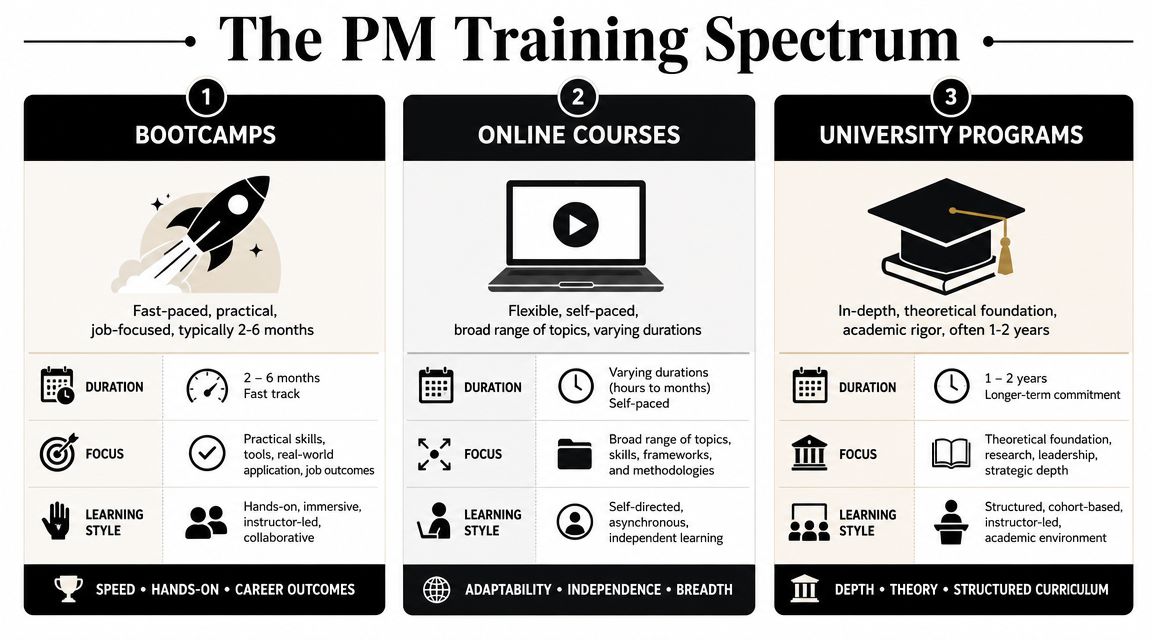
If you don't sort the options this way, you'll compare apples to screwdrivers.
What each path is really buying you
| Path | Best for | Typical strength | Main weakness | Hiring signal |
|---|---|---|---|---|
| Bootcamps | Career switchers and aspiring PMs | Structure, accountability, portfolio-style output | Can be shallow on strategy and data rigor | Useful if paired with strong projects |
| Online courses | Self-directed PMs with a narrow gap | Flexibility, targeted learning | Low accountability, easy to quit | Weak unless converted into real work |
| University programs | Mid-career and senior PMs | Depth, rigor, broader business framing | Slower, more expensive, can drift toward theory | Stronger signal for strategic roles |
Bootcamps are useful when you need speed and external pressure. If you're trying to break into product from design, consulting, engineering, or operations, this format can force momentum. But many bootcamps over-index on PM theater: prioritization matrices, mock roadmaps, and polished decks that never touch real instrumentation, experimentation, or technical ambiguity.
Online courses are the cheapest way to learn exactly one thing. That's their strength. If you already work in product and need to sharpen experimentation, analytics, or AI fluency, this format can work well. If you need a career reset and a new peer group, it usually won't.
University-affiliated programs are the strongest option when you want a more durable signal and a more rigorous operating model. They're especially relevant if you're moving into technical, platform, or leadership-heavy PM roles, or if you're weighing a broader route such as an MBA path into product management.
Don't confuse prestige with relevance. A recognizable logo helps, but curriculum quality matters more than brand recognition if the role you want is execution-heavy.
What hiring managers actually value
At companies with high hiring bars, the certificate itself rarely wins the interview. It can help you get a second look. That's different.
Hiring managers usually evaluate training through four questions:
- Did it produce evidence of judgment: Can you explain tradeoffs, not just frameworks?
- Did it produce artifacts: PRDs, prototypes, metrics plans, experiment designs, or roadmap narratives.
- Did it increase technical fluency: Can you work with engineering, analytics, design, and go-to-market teams without translation loss?
- Did it sharpen business thinking: Can you connect user problems to outcomes, not just feature ideas?
The wrong way to choose a program is by popularity. The right way is by matching format to your current gap.
Matching Your Career Stage to the Right Training
Career stage matters more than course reputation. The same program can be a smart move for one person and a waste for another.
If you're early, you need proof you can do the work. If you're mid-career, you need sharper specialization. If you're senior, you need to amplify your impact through strategy, systems thinking, and leadership.
Aspiring PMs
If you haven't worked as a PM yet, don't start with abstract strategy. Start with applied execution.
Your target is simple: become interviewable. That means you need enough structured training to show that you understand discovery, prioritization, product requirements, and cross-functional collaboration. A practical bootcamp or a tightly scoped cohort program is often better than a broad academic option here.
Prioritize programs that force you to produce:
- A case-based product artifact
- A mock or real PRD
- A basic experiment plan
- A prototype or wireframe
- A crisp narrative about customer pain and business value
If you're exploring entry routes, reviewing different associate product manager programs alongside training options is smart because many aspiring PMs don't need another course. They need the right hiring funnel.
Junior and mid-career PMs
This group wastes the most money on training.
You already know the basics. You don't need another course that teaches user stories, agile ceremonies, and generic prioritization. You need differentiation.
That usually means one of three paths:
- Technical depth if you work closely with engineering, infrastructure, data, APIs, or developer platforms.
- Growth and experimentation depth if your bottleneck is activation, retention, monetization, or pricing.
- AI product depth if your roadmap increasingly includes AI-assisted or AI-native experiences.
Hiring filter: Mid-level PMs get promoted when they stop sounding like facilitators and start sounding like decision-makers.
A university-backed certificate or advanced specialist program often makes more sense here than a beginner bootcamp because the value is in analytical rigor and broader market understanding, not just job-search packaging.
Senior PMs and product leaders
Senior people should stop buying beginner content with executive branding.
If you lead teams or own a large surface area, your training should improve how you handle portfolio bets, organizational design, platform strategy, experimentation systems, and executive influence. That's where more rigorous programs earn their keep.
You also need to be honest about whether your problem is skill or environment. If your company has poor decision rights, weak product leadership, or a confused operating model, another course won't fix that. It may still help you manage the mess better, but don't mistake personal development for organizational repair.
How to Evaluate a Program's Curriculum for Modern PM Skills
A modern PM curriculum should make you better at decisions, not just better at talking about decisions.
That means I'd reject any program that still centers itself on agile vocabulary, roadmap templates, and generic stakeholder management without going deeper into tools, experimentation, and quantitative judgment. The market has moved.
Tooling depth is no longer optional
One of the clearest signs of a serious curriculum is whether it teaches PM work across the actual workflow, not just the meeting layer. Northwestern Kellogg's AI-Enabled Product Management certificate explicitly pairs strategic PM instruction with hands-on certifications in project management, wireframing in Balsamiq, roadmapping in Miro, and analytics in Google Analytics, which is a strong example of practical skill-building across discovery, planning, and measurement (Northwestern Kellogg AI-Enabled Product Management certificate).
That matters because good PMs don't just “have ideas.” They translate user insight into prototypes, planning artifacts, and measurable signals. Programs that teach adjacent tools are usually more useful because they produce work engineering, design, and growth teams can execute.
If you want a gut-check on what's missing from your current toolkit, compare the syllabus against this breakdown of product manager skills required.
The non-negotiable curriculum checklist
Use this checklist before you enroll:
- Discovery that goes beyond interviews: The course should teach how to frame problems, identify assumptions, and validate demand.
- Prototyping fluency: PMs should leave able to create low-fidelity artifacts in tools like Balsamiq or equivalent wireframing software.
- Roadmapping with tradeoffs: Not roadmap cosmetics. Real sequencing logic, dependency handling, and prioritization under constraints.
- Analytics instrumentation: You should learn what to measure, how to define success, and how metrics influence prioritization.
- Experiment design: A good curriculum teaches how to test whether a feature changed behavior, not just how to launch it.
- Cross-functional output: The program should produce artifacts that design, engineering, and go-to-market teams can work from.
What outdated curricula still get wrong
A weak PM curriculum usually has three giveaways.
First, it treats product management as a communication job with slides and ceremonies. Second, it teaches frameworks detached from software delivery reality. Third, it ignores analytics and operational tooling.
Strong product management training programs build fluency across discovery, planning, and measurement. Weak ones leave you with vocabulary and confidence, but no operational edge.
If the syllabus can't answer how you'll go from research insight to prototype, from prototype to roadmap, and from roadmap to measurable outcome, skip it.
The AI Product Management Specialization
AI PM training is a mess because most of it is still packaged as generic AI literacy. That's not enough. Product managers don't need to become ML engineers, but they do need role-specific competence.
The fragmented way people are learning proves the point. In a recent General Assembly survey, 45% of respondents said they learned AI independently, 29% attended company-funded external programs, and 20% paid out of pocket, which shows formal employer-sponsored upskilling still isn't the dominant path (General Assembly AI and product management survey).
That creates a real career problem. Many PMs know they need AI skills, but they're learning them in random pieces.
What an AI PM curriculum must include
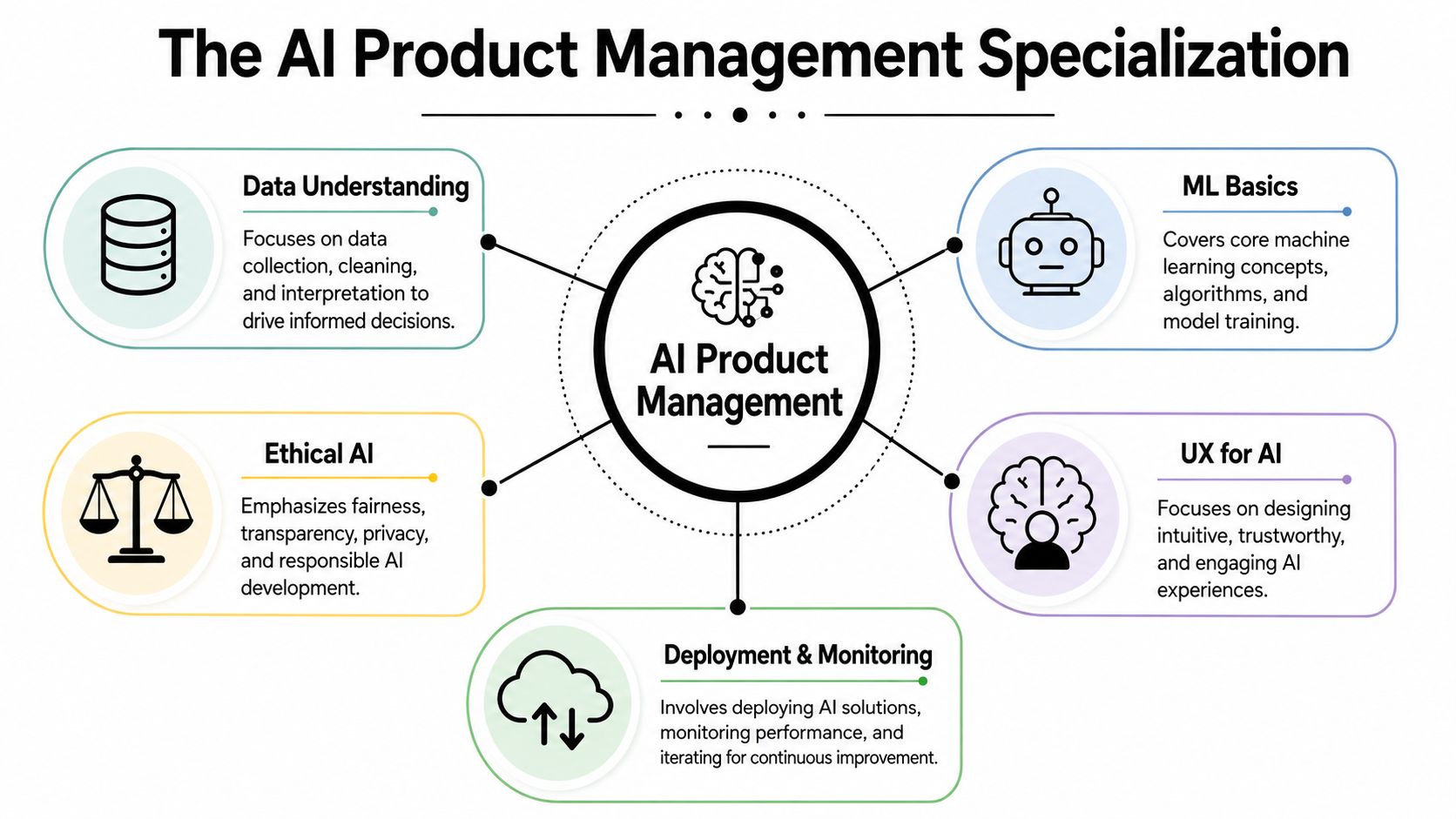
A serious AI specialization should cover five areas:
- Data understanding: What data the product uses, where it comes from, how quality affects the output, and what breaks when inputs are weak.
- ML and model basics: Enough fluency to discuss model behavior, limitations, tradeoffs, and when a simpler rules-based approach may be better.
- UX for AI systems: Confidence, control, explainability, fallback states, and interaction design for probabilistic outputs.
- Responsible AI: Bias, fairness, privacy, governance, and escalation paths when the model behaves badly.
- Deployment and monitoring: Evaluation, failure modes, drift, feedback loops, and post-launch iteration.
This short video is a useful complement to that framing.
The real skill is changing PM workflows
AI training should change how you work in discovery, prioritization, experimentation, and roadmap planning.
For discovery, you should learn how to identify problems that are improved by AI, rather than forcing AI into a feature list. For prioritization, you need a sharper lens on feasibility, model risk, and operational burden. For experimentation, you need to think beyond binary success metrics because AI experiences can create partial value, inconsistent quality, and novel trust issues.
If you want a practical list of options, use a curated page focused on AI PM courses and evaluate each one against those five capabilities.
AI PMs are valuable when they can separate “cool demo” from “durable product value.”
That's the difference between adding AI to a roadmap and managing an AI product.
Program Examples and Your Evaluation Scorecard
You don't need a “top 10” list. You need a shortlist by category, then a scorecard.
Representative program types worth studying
Here's how I'd think about examples, not as endorsements, but as reference points.
University-affiliated strategic programs are useful when you want quantitative rigor and broader business context. MIT's professional certificate program in product management includes design thinking, product family architecture, digital platforms, two-sided markets, and data-driven methods for measuring and influencing technological innovation. Cornell's technical PM certificate also emphasizes experimentation, analytics, translating consumer insights into specifications, prioritization, and pricing decisions. That shift toward quantitative decision-making and market-design skills is exactly what modern PM training should look like (MIT professional certificate program in product management).
Live cohort programs can be strong when your bottleneck is accountability and peer learning. The good ones force discussion, feedback, and artifact creation. The weak ones are just webinars with a Slack group.
Self-study bundles work when your gap is narrow and your discipline is high. If you know you need pricing, growth loops, marketplace mechanics, or experimentation, self-study can beat a broad curriculum.
One practical option in the live-course category is Aakash Gupta's structured PM training offer, which is positioned as a cohort-based program for aspiring PMs and career transitioners. It's one format among many, not a universal answer.
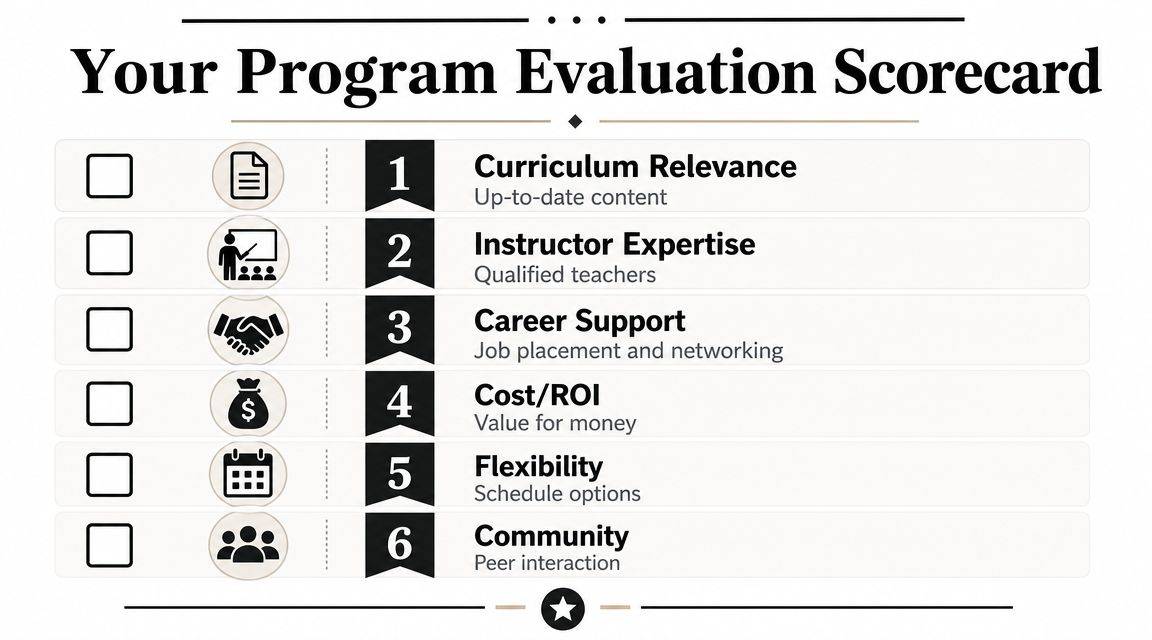
Your scorecard
Use a simple scoring model from 1 to 5 on each criterion:
- Curriculum relevance: Does it teach modern PM work, including experimentation, analytics, technical fluency, and AI where relevant?
- Instructor expertise: Have the instructors built and shipped products, or are they mostly teaching frameworks?
- Career support: Is there portfolio feedback, interview prep, alumni access, or hiring-oriented coaching?
- Cost versus likely return: Will this program solve a specific problem that affects your next role, promotion, or specialization?
- Flexibility: Can you complete it without sabotaging your job, health, or consistency?
- Community quality: Are the peers serious enough to create useful discussion, referrals, and long-term relationships?
I also like adding one more lens. Use this competitive analysis framework template to compare two or three programs side by side before you commit.
Decision rule: If a program scores high on branding but low on curriculum relevance and artifact creation, pass.
A fancy certificate with weak applied learning is still weak applied learning.
Beyond the Certificate How to Make Your Training Matter
Hiring managers do not reward coursework. They reward proof.
I have hired PMs from brand-name MBA programs, short bootcamps, and no formal program at all. The pattern is consistent. The people who get interviews and offers can point to sharper judgment, better artifacts, and stronger execution after training. The ones who lead with a certificate usually stall.
Convert training into evidence
Treat the end of a program like the start of your case-building process. Within a week, turn what you learned into assets a hiring manager or promotion committee can evaluate.
Rewrite your résumé around decisions
Skip “completed capstone” language. Show the problem, the options you considered, the tradeoff you made, and the outcome you were aiming for. Good PM résumés show decision quality, not attendance.Build interview stories that reveal judgment
Your best stories should cover ambiguity, prioritization, stakeholder conflict, metrics, and failure. If a program gave you a project, turn it into a crisp narrative with a clear tension point and a clear decision.Create one artifact you would be proud to share at work
A product requirements doc, experiment brief, metric tree, user problem synthesis, or AI feature evaluation memo works. Hiring teams trust artifacts because they show how you think when the slides are gone.Apply one lesson on the job immediately
Improve your roadmap review, clean up your success metrics, tighten a discovery process, or write a better spec. Skills decay fast when they stay trapped inside course portals.
Find the actual constraint
Training fails when you use it to solve the wrong problem.
Some PMs do need sharper product sense, analytics fluency, or technical range. Others are stuck in companies with weak strategy, confused ownership, and constant stakeholder churn. In that situation, another class will improve your toolkit but not your output.
That is why strong PMs often pair training with mentorship. A mentor helps you adapt generic frameworks to the politics, incentives, and constraints of your actual company. If you need help finding one, the Chicago Brandstarters mentor guide is a practical place to start.
Make your training visible inside the business
Quiet improvement gets ignored.
Present a teardown to your team. Share a short memo on how you would measure a new feature. Run a lunch-and-learn on experimentation, AI evaluation, or prioritization. Volunteer to improve a broken operating ritual. Promotion decisions often come down to visible business impact, not private self-improvement.
This matters even more for AI-focused training. Anyone can say they studied AI product management. Far fewer PMs can show they defined a useful AI use case, identified failure modes, set human-in-the-loop safeguards, and chose metrics that go beyond adoption vanity.
The program helped you learn. Your job is to make that learning legible.
Answering Your Top Questions About PM Training
Are product management training programs worth it
Yes, if they solve a defined problem. No, if you're using them as career procrastination.
A strong program helps when you need structure, skill acceleration, or a better signal for a role transition. It's weak value if you're avoiding the harder work of building a portfolio, shipping better work, or fixing your interview performance.
Do hiring managers care about certificates
They care a little about the certificate and a lot about what it enabled.
A recognizable program can help your résumé get a closer look. After that, the signal fades and your thinking takes over. In interviews, your examples, artifacts, and judgment carry far more weight than the credential.
Should you ask your employer to pay
Yes. Ask directly and tie the request to business value.
Use a short pitch:
- Name the capability gap: experimentation, analytics, AI product fluency, platform strategy, or stakeholder alignment.
- Tie it to your team's needs: better prioritization, cleaner product specs, stronger measurement, or improved roadmap decisions.
- Commit to sharing the learning: offer to document takeaways or teach the team.
That last part matters. Managers fund development more readily when the benefit extends beyond one person.
Should you choose AI-specific training or general PM training
Choose AI-specific training if AI is already affecting your product area or target role. Choose general PM training if your fundamentals are still weak.
Don't stack advanced AI content on top of shaky product basics. You'll end up sounding impressive while missing core PM judgment.
What's the biggest mistake people make
Buying a program for motivation instead of capability.
Motivation fades. Capability compounds. Pick the option that changes how you operate next week, not the one that makes you feel ambitious for a weekend.
If you want sharper, practical PM guidance from someone who's operated at VP level and built one of the most useful ecosystems for product managers, explore Aakash Gupta. His resources span newsletters, courses, podcasts, and coaching for aspiring PMs, working PMs, and product leaders trying to turn learning into real career advantage.
