Product sense interview questions ask you to design or improve a product while you show that you understand the user and the business. This page sorts the questions into five types and walks through the seven-step CIRCLES structure with Lewis Lin’s Uber example.
The sources are two of my own guides, one on product sense and one on execution interviews, and my episodes with Lewis Lin and Gayle McDowell. Where a number or a framework comes from one of them, the link sits on the claim.
What a product sense interview asks you to do
In my product sense guide I list four questions that show the range:
- How would you design a 10x better airplane boarding experience?
- What’s your favorite product? And how would you improve it?
- What would you build to differentiate Reels from TikTok?
- How would you improve ChatGPT?
In the guide I wrote that these questions test your ability to structure a response, brainstorm and be creative, all while considering what is best for users and for the business. I also wrote that I have done hundreds of product sense interviews as a candidate and as an interviewer.
The interview evaluates four things:
- Your creativity. Can you come up with features outside the box, or do you copy competitors and the latest trends?
- Your data acumen. Do you use data to drive feature development, and do you know how to measure a feature?
- Your user understanding. Do you put the user first and find the needs and problems that make a feature succeed?
- Your ability to prioritize features. When several options are good, do you have a process for deciding what comes first?
The guide makes the point that this interview is not a test of which color a button should be. A strong answer shows that you understand human behavior and business logic.
The five types of product sense interview questions
The guide splits the case version of this interview into five types. Each one tests a different muscle, so it helps to practice all five instead of the one you like best.
| Type | What it tests | Question template from the guide |
|---|---|---|
| Product improvement | Your ability to improve a product that already exists | How would you improve X product for Y segment? What would you do to improve your favorite product? |
| Product growth | Your ability to understand product data | How would you improve retention for X? How would you solve a problem in Y metric for A company? |
| Product launch | Your ability to launch new products | How would you build A feature for B segment? How would you launch X product for us? |
| Product design | Your ability to design elegant solutions | How would you design X everyday object for Y segment? How would you design A feature? |
| Product pricing | Your ability to price products in the market | How would you improve our pricing and packaging? How would you price X new product? |
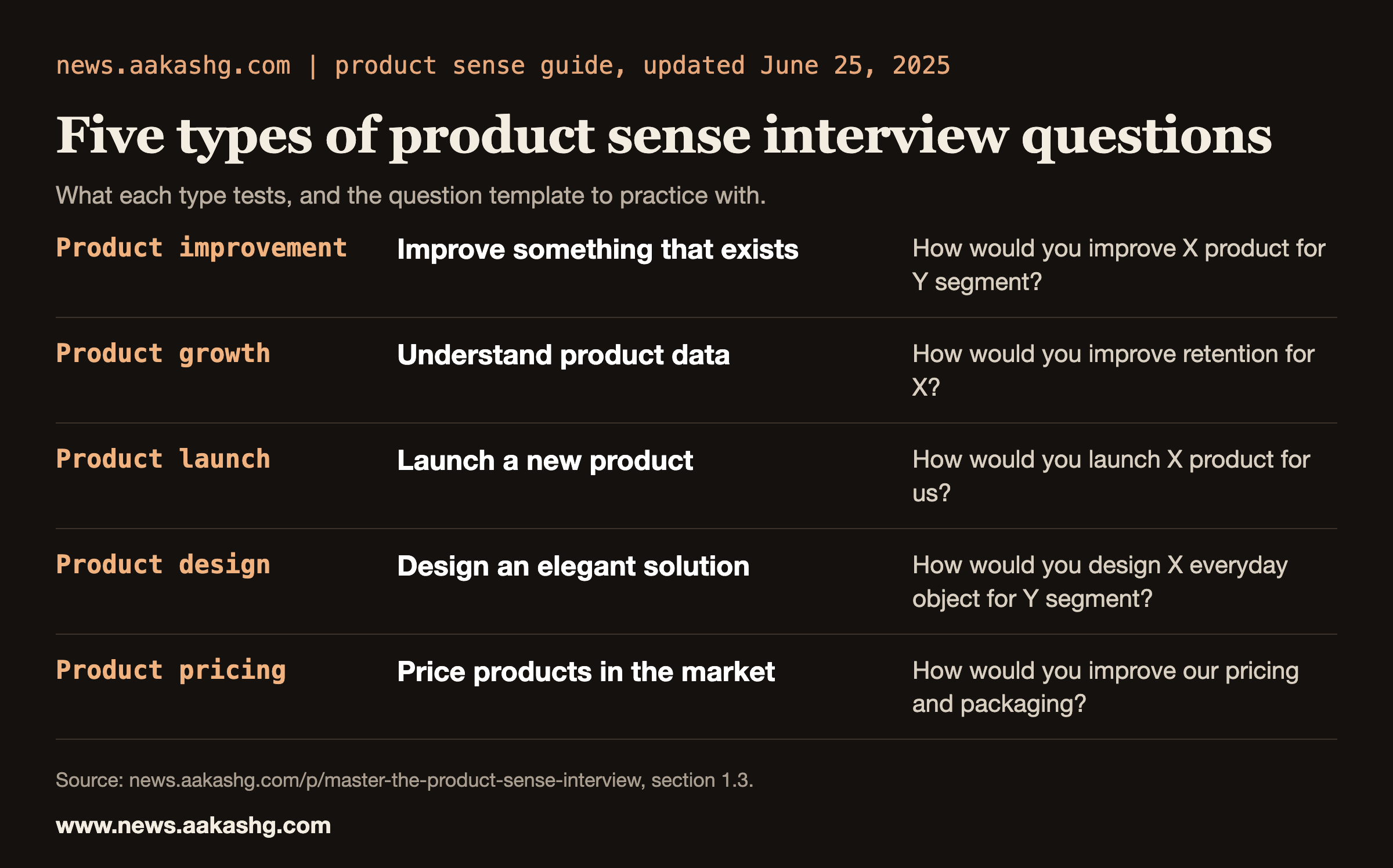
The guide also names two kinds of interviewer. The Case Masters run a cleanly structured process and want an impartial read of your performance in the case. The Laissez Faire interviewers do not love cases, so they drop a product sense question into a conversation, such as asking for your favorite product and how you would improve it. I wrote in the guide that one is not better than the other, and that you are likely to meet both on a job search.
That second kind is easy to miss. A casual “what’s your favorite product” in the middle of a conversation is still a product sense interview, with no whiteboard and no warning. The structure below works for a 45-minute case and for a three-minute answer.
Sample questions for each type
Here are example prompts you can practice with. The first two groups are adapted from my guide’s case prompts. The third group comes from the questions Lewis Lin uses to teach the framework in my episode with him.
Growth and improvement prompts
- A social media app wants to increase daily active users. What would you do?
- You lead an e-commerce platform with declining repeat purchases. What would you do?
- We have a health app with low engagement. How should we grow it?
- A music streaming service wants to increase conversion from free to paid subscriptions. What features or incentives would you introduce?
- How can we 10x our activation rate?
Launch prompts
- Your company is entering the highly competitive fitness wearable market. How would you do market analysis, define the unique selling proposition and plan the go-to-market strategy?
- You are in charge of launching a new sales SaaS tool for small and medium businesses. Outline your plan for user acquisition, positioning and initial customer support.
Improvement and design prompts from Lewis Lin
- How do you improve the Amazon shopping experience?
- How do you improve the Uber app?
- Design a pencil for the blind.
What has changed in case interviews since 2013
Lewis Lin first wrote Decode and Conquer in 2013, and in our March 28, 2025 episode he was rewriting it from scratch. We talked about two shifts since then.
The first is the bar. What worked on a question like “design a pencil for the blind” in 2014 does not seem to work in 2025, because candidates have been through several job-search cycles and many have the popular frameworks memorized. ChatGPT has also changed both sides: job seekers use it to practice, and recruiters and hiring managers use it to produce case questions in seconds.
The second is the take-home. Many jobs now include a presentation, a product work sample or a written assignment. My write-up of the episode calls interview assignments the new filter. Lewis has seen near-perfect submissions followed by in-person interviews that do not match the quality of the take-home, and the advice that came out of it was to use AI as a co-pilot.
Both shifts point the same way. A structured answer you can deliver live matters more than it used to, because the written part is easy to polish.
A seven-step structure for answering
Lewis describes his CIRCLES method as a seven-step framework in the episode. My write-up of the episode lists the steps as comprehend the situation, identify the customer, report customer needs, cut through prioritization, list solutions, evaluate tradeoffs and summarize your recommendation. Here is what each one asks of you.
- Comprehend the situation. Clarify the goal and the constraints before you say anything about solutions.
- Identify the customer. Choose one specific segment and meet its needs deeply.
- Report customer needs. Sketch a quick user flow so the pain shows up in a moment, not in a generic list.
- Cut through prioritization. Choose which pain point to solve, using a prioritization matrix such as Intercom’s RICE.
- List solutions. Generate several ideas.
- Evaluate tradeoffs. Talk through your top three, because there is no time to discuss everything that came up.
- Summarize your recommendation. Tie it to the product goal or the company mission, the key metrics you would track and the next steps.
Gayle McDowell frames what the interviewer is doing underneath this in her episode. They are not looking for a perfect solution. They are checking whether you can structure a problem clearly, whether you think about users first, whether you relate everything to business outcomes and whether you can prioritize under constraints. Her advice is to start by clarifying the problem, understanding the context and asking the right questions.
That lines up with step one. Here is each step in more detail.
Step 1: clarify the goal and the constraints
Lewis says the goal matters because you do not want to improve a product just because you are bored. Are you trying to improve engagement or increase revenue? The second thing to settle is which constraints apply.
He gives a classic Amazon example. The interviewer asks how you would improve the Amazon shopping experience. You start talking, and thirty minutes later the interviewer says they wanted your ideas for the smart speaker, not the web. Lewis calls that a bad gotcha, and then explains why the clarifying question still matters. In a real company an executive’s one-line request, his example is “destroy Twitter,” can mean several different things, and you need to confirm which one before you build anything.
So spend the first minute on two questions. What outcome are we after? What is off the table?
Step 2: identify the customer
A common mistake Lewis points out is to say that the company sells to multiple segments, so you will focus on all of them. His advice is the opposite. Pick a very specific segment and meet their needs very deeply.
In an interview this is also where you show that you understand the user. A named segment with a named situation makes the rest of your answer easier to follow.
Step 3: report customer needs, with pain points that are not generic
Lewis says candidates have real trouble here, which he ties to System One versus System Two thinking. Ask a typical candidate how to improve the Uber app, and the pain points come out as things like “it could load faster” or “the prices could be cheaper.” He calls those not very inspiring pain points, and they lead to solutions like lowering prices or speeding up the back end.
His fix is the G method, and G means literally get mad, like a bear. Think about a time the product annoyed you. His example: he called an Uber, the driver canceled and Uber did not take the initiative to set him up with a backup driver. A second example: Uber knows he has a family, so why did it not assign a driver with a car seat?
Both pain points are specific, and each one points at a solution.
There is one more rule here, which comes up in the episode. Keep the solution space inside the product. A candidate who walks into a product case and says the company should lower prices invites the reply that a pricing team already owns that decision. Your ideas should be things a product manager can ship.
Step 4: cut through prioritization
After you list the pain points, choose one. Lewis mentions a prioritization matrix such as Intercom’s RICE. The point is to show a reason for the choice. Say which pain point you picked, why it beats the others for your segment and what you are leaving for later.
Step 5: list solutions
The episode names solutions as the second place candidates struggle. Lewis says a blank page invites the ideas you saw recently, which usually means what competitors are already doing, and an interviewer has heard those before.
He suggests a few ways to get unstuck:
- Use a brainstorming framework such as SCAMPER, which gives you six prompts. He also points to the book Thinkertoys, which collects 101 brainstorming frameworks.
- Use emerging technology as a stimulus. Take the problem, such as buying clothes on Amazon, and ask how AR could fix it and how a drone could. Some answers will sound silly, which is fine, because the stimulus is there to get ideas moving.
- Pay attention to what the products you use have launched recently. The examples in the episode are Bolt adding a Figma integration and a mobile app deploy, and Spotify launching video podcasts. That builds your sense of what a big feature launch looks like.
- Ask what another company’s solution to the same problem would be. The episode gives the example of borrowing a swipe mechanic from a dating app for a B2B workflow, which may go nowhere, but the third or fourth idea might.
Step 6: evaluate tradeoffs
Pick your best ideas and talk about them. Lewis says to discuss your top three because there is not enough time to cover all of them. For each one, say who it helps, what it costs to build and how you would know it worked.
Step 7: summarize your recommendation
Close by restating your recommendation in terms of the product goal or the company’s mission, then the key metrics you would track and the next steps. This is also where data acumen shows up. If you never mention a metric, the interviewer has no evidence for it.
A worked pass through one question
Here is how the seven steps run on “How do you improve the Uber app?”, using the examples from the episode. The wording is an illustration of the structure, not a recording of an answer.
- Comprehend. Ask whether the goal is rider retention or revenue, and whether the question is about the rider app, the driver app or both.
- Segment. Pick parents who travel with young children.
- Pain points. A driver cancels and no backup is offered. The app does not know a car seat is needed, even though it knows the rider is a parent.
- Prioritize. Choose the missing car seat, because it blocks the trip entirely, where a late driver only delays it.
- Solutions. Let riders save a car seat preference in their profile and route the request to drivers who carry one. A weaker idea, such as lowering prices, falls outside the product.
- Evaluate. Compare the ideas on rider impact and build cost, and pick the preference setting.
- Summarize. Tie it to the goal you set in step one and name the metric, such as completed trips for riders with children, plus what you would test first.
Notice what the walkthrough does. Every step ties back to a person and a goal, so the interviewer can follow your thinking and push on any step. It is also the kind of answer Gayle McDowell describes above: structured, user-first and tied to business outcomes.
How product sense shows up at Meta
Meta is one place where this interview is codified. In my execution interview guide I wrote that by 2017 Facebook had made the product execution interview a core round alongside product sense, and that Meta now calls the execution round Analytical Thinking. For the full Meta loop, see my page on the Meta PM interview.
How to practice
In my write-up of Gayle McDowell’s episode, the practice advice is to record yourself answering questions, which catches timing issues and unclear explanations, and to do mock interviews with PMs, which simulate real-time pressure. The reason is that you have to think on your feet, and structured problem-solving beats memorized answers.
Lewis puts it in terms of sparring. Nobody wins a karate tournament by reading a karate book, so find sparring partners. He says the number of mock interviews varies. In his Slack practice group he has seen people do as many as 100 before landing an interview, others closer to 30 to 40, and some employed people doing two to three practice sessions a day.
He also warns about the illusion of knowledge. Reading the explanation and understanding it does not mean you can replicate it on your own. If you are nervous about practicing with friends, the episode suggests two ways to start alone: record yourself, or pause a YouTube mock interview and give your own answer first.
Practicing with AI
Lewis says ChatGPT gives a very confident answer to any question, and a candidate with little PM experience cannot tell whether it is a top 1% answer, a top 20% answer or something closer to the median. He also says the noise now comes from Reddit and YouTube, where it is easy to get swayed if you do not have enough knowledge of the topic.
His advice for AI-assisted interview assignments is to give the model a very specific framework, such as asking it to frame the response around the pain-point step of his method. He also suggests doing the first 20% of the work yourself, using AI to get from 20 to 80%, and then adding your own final touches. For a full practice setup, see my page on AI mock interviews.
Product sense for AI products
Product sense questions now cover AI products too, as “How would you improve ChatGPT?” from the list above shows. I cover how the interview changes for AI features in two paid guides: Master the AI Product Sense Interview and The AI Product Sense Interview Guide. The seven steps on this page are the base that both build on.
Where each question type changes the answer
The seven steps stay the same, but the type of question tells you which step to spend your time on. This is my reading of the guide’s “what it tests” line for each type, not a rule from a source.
- Improvement. The guide says these test whether you can improve something that already exists. Spend the most time on steps two and three, so the improvement targets one customer’s specific pain.
- Growth. These test whether you understand product data. Use step one to pin down the metric you are moving, which direction it is going and over what period, before you list any ideas.
- Launch. These test whether you can launch a new product. The guide’s fitness wearable prompt asks for market analysis, a unique selling proposition and a go-to-market strategy, so step one is where you confirm which of those the interviewer wants.
- Design. These test whether you can design an elegant solution. A prompt like the pencil for the blind lives or dies on step two, because the design only makes sense for a named user.
- Pricing. These test whether you can price a product in the market. The episode’s warning that “lower the prices” is a weak answer applies to improvement questions, where a pricing team owns that decision. On a pricing question the price is the subject, so the rule flips.
A practice routine built from these sources
- Pick one prompt from each of the five types in the table above.
- Answer each one out loud and record yourself, which is the first of the practice habits in Gayle McDowell’s episode. Listen for timing problems and unclear explanations.
- Score the recording against the four things the interview evaluates: creativity, data acumen, user understanding and prioritization. Then check Gayle’s four interviewer questions: did you structure the problem clearly, think about users first, tie everything to business outcomes and prioritize under constraints?
- Book mock interviews with other PMs, the second habit. Lewis says people in his Slack group did anywhere from 30 to 40 up to 100 of them before landing an interview.
- If you use AI as a practice partner, hand it a specific framework such as the seven steps above, and do your own first pass before you ask it for feedback.
Mistakes to avoid
- Starting to answer before you have clarified the goal and the constraints.
- Choosing every segment instead of one.
- Listing pain points like “slow” and “expensive” that any product has.
- Proposing solutions that belong to another team, such as lowering prices.
- Offering the ideas you saw a competitor ship last month.
- Ending without a metric or a next step.
Land a PM Job is the 12-week cohort I run for PMs who want to win offers. The next cohort starts November 23, 2026. It has 2-3 live sessions a week and six 1:1 coaching sessions, and the coaching team reviews your resume, LinkedIn, GitHub and portfolio on your real materials. I write about this at www.news.aakashg.com.
Product sense interview questions FAQ
What are product sense interview questions?
They are questions that ask you to design or improve a product while showing creativity, data judgment, user understanding and prioritization. In my product sense guide, examples include how to design a 10x better airplane boarding experience and how to improve ChatGPT.
What are the five types of product sense questions?
Product improvement, product growth, product launch, product design and product pricing, per my product sense guide. Improvement tests whether you can improve something that exists, and pricing tests whether you can price a product in the market.
How do you answer a product sense interview question?
Clarify the goal and the constraints, identify one specific customer, report specific pain points, prioritize one, list solutions, evaluate your top three and summarize with a recommendation, key metrics and next steps. This is the CIRCLES order Lewis Lin teaches in my episode with him.
How many mock interviews do you need?
It varies. Lewis Lin said that in his Slack practice group some people did as many as 100 before landing an interview, others did 30 to 40, and some employed people did two to three a day.
Is product sense the same as the execution interview?
No. Product sense asks you to design or improve products. The execution round is about metrics, and Meta now calls it Analytical Thinking, per my execution interview guide.
Can you use AI to prepare for a product sense interview?
Yes. Lewis Lin recommends giving the model a specific framework, doing the first 20% of an assignment yourself and using AI to reach about 80% before you add your own final touches.
