The Meta PM interview centers on product sense and analytical thinking, with a leadership and drive round added for individual contributors. This page covers how the Meta product manager loop is structured, how interviewers score it, the six types of metrics questions and how to prepare for each. The loop details come from my Meta PM guide and the question types come from my episode with Lewis Lin.
How the Meta PM interview is structured
In June 2024 I spoke with 4 former Meta PMs, 4 current Meta PMs and 4 former Meta product recruiters for my Meta PM interview guide. That guide says the process typically has two rounds, and that it forks by track.
| Track | Round 1 | Round 2 |
|---|---|---|
| Individual contributor PMs | Product Sense, Analytical Thinking | Product Sense, Analytical Thinking, Leadership & Drive |
| Manager track | Product Sense, Execution, Project Retrospective | People Management, Cross-functional Partnership and Influence, Operating at Meta |
Treat the table as a June 2024 picture. Loops change, so confirm the current rounds with your recruiter.
How Meta scores the rounds
Each interview is run by a separate interviewer and scored on a 1-5 scale for each attribute, along with an overall hire or no-hire recommendation. According to the guide, the interviewers do not discuss their evaluations with each other. They pass their ratings and detailed feedback to a recruiting panel that makes the final decision.
Several people I interviewed said it is more important to get a 3 out of 5 on each rubric scale than a 5 on some and a 0 on others. In other words, consistency across every round beats one standout round.
Leveling happens after a candidate passes the hiring committee, and the exact team match is also determined after that stage. The biggest reason you might get another interview or two is that an interviewer did not have high confidence in a rating.
From execution to Analytical Thinking
In my execution interview guide I wrote that by 2017 Facebook had codified the product execution interview into one of its three main interviews, next to product sense and leadership and drive. The same guide notes that Meta now calls this interview Analytical Thinking.
Lewis Lin described the same shift in our March 28, 2025 episode. The rounds many people know as execution questions were renamed in the last two years to product analytics or analytics execution. He gave Meta full credit for pioneering this metrics space and setting the standard for the questions asked in it.
The six types of metrics questions
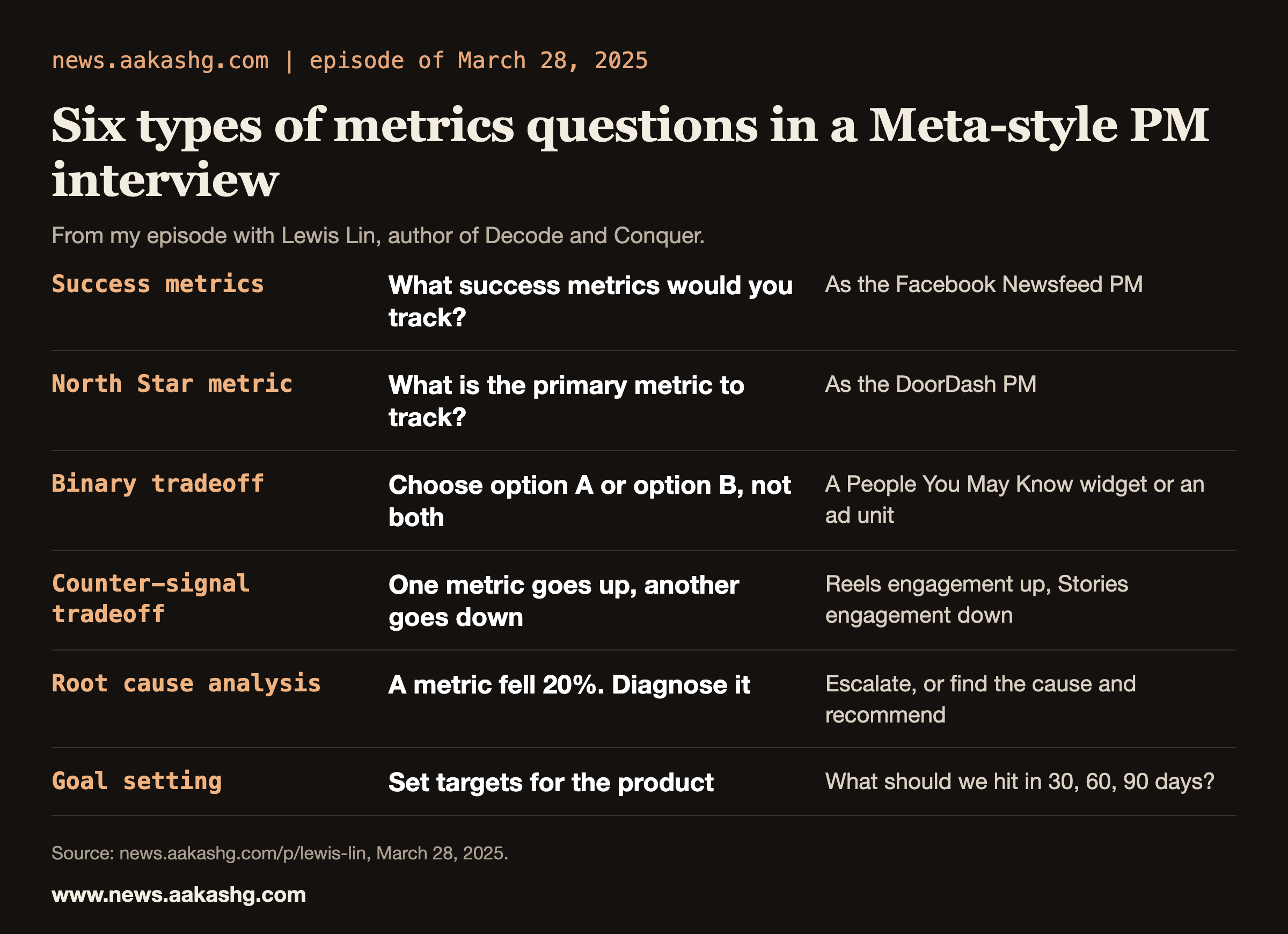
My write-up of the Lewis Lin episode lists six types of metrics questions. Lewis’s examples below come from the episode.
- Success metrics. “What success metrics would you track as the Facebook Newsfeed PM?”
- North Star metric. “What is the North Star metric, or the primary metric we should track, as the DoorDash PM?”
- Binary tradeoff. You choose option A or option B. His example from Meta: as the Facebook Newsfeed PM, you can add a People You May Know widget or insert an ad unit.
- Counter-signal tradeoff. One metric goes up and another goes down. His example: you are the Instagram PM for Reels, you put Reels at the top of the feed, Reels engagement rises and the Stories PM complains that Stories engagement fell. What do you do?
- Root cause analysis. A feature’s metric, or its North Star, went down 20%. How would you diagnose it?
- Goal setting. My write-up lists this sixth type with the question “What should we hit in 30, 60, 90 days?”
How to answer each one
Success metrics and the North Star
Lewis’s tip is to start with the company’s mission statement and align everything with it. For Meta, he reads the mission as connecting people and strengthening relationships. If the product delivers on that promise, people should spend a lot of time with the people they are connected to, so one North Star candidate he offers is total time spent on Instagram.
He then says not to get tied in knots when the North Star has flaws. Time spent can be gamed, and it ignores the breadth of your relationships. The fix is to name the other categories of metrics next to it:
- Counter metrics balance the North Star. His example is that time spent on Reels could be gamed, so a more truthful check is the share of people who watched a video and shared it with friends.
- Supporting metrics add context, such as the number of people who created a Reel and what share of them created more than five.
- Leading and lagging metrics separate early signals from late ones. Revenue is typically a lagging metric and can keep rising while a product is already losing its users, so Lewis says to look for a leading indicator such as how many people make it through onboarding.
Binary tradeoffs
Pick one. Lewis says interviewers do not want you to say you will do a bit of A and a bit of B and invent an option C. Real estate is finite, and the right answer is the option that is best for the company. State the criteria you used, then commit.
Counter-signal tradeoffs
When one metric rises while another falls, Lewis says the move is to zoom out to a different signal. In the Reels and Stories example, ask how the change affected total engagement on Instagram. If total engagement went up, then Reels rising and Stories falling may be a good outcome. He adds that sticking with the status quo is unacceptable at Meta, because the question exists to test your decision-making.
Root cause analysis
Lewis says the question has two parts. The first is whether you just escalate to your boss that the metric went down or whether you have enough initiative to get to the root cause. The second is whether you come up with a plan to identify the key issues or hypotheses and then recommend how to resolve them.
What the Meta rubric looks for in these rounds
My execution guide says Meta teaches its candidates to look at four buckets: metrics, PM skill, problem definition and Facebook-specific knowledge. It gives two example prompts, “Define success for a language learning app” and “Define success for Bumble”. It also notes that Meta has PMs focus on Daily Active People instead of Daily Active Users.
Product sense and leadership and drive
The product sense round is covered in my paid product sense guide. Product sense and analytical thinking appear in both rounds for individual contributors, so it is worth practicing both.
Leadership and drive is the behavioral part of the loop. My Meta RPM page lists the behavioral questions candidates report for it. On how to answer them, Lewis has a clear view in the episode. He does not love the STAR method, because candidates take it too literally and it sounds robotic. His alternative is a framework he calls DIGS. Two parts of it stand out. First, dramatize the situation, so the interviewer understands why it mattered. Second, say what alternatives you considered and why you chose the one you did, because otherwise the interviewer thinks “so what.”
Another tip from the episode is to choose a story that advances your candidacy by addressing what the interviewer may be hesitant about. And since recalling details from months ago is hard, Lewis says to keep artifacts from your jobs, such as your own performance reviews, so you can recall what you did.
How to prepare
- Spar before you read more. Lewis says nobody wins a karate tournament by reading a karate book, so find sparring partners for mock interviews. In my write-up of Gayle McDowell’s episode, the advice is to record yourself answering questions and to do mock interviews with PMs.
- Use the words Meta uses. Lewis’s networking tip is to ask a friend at Meta which North Star they use for Instagram, write it down and say the same words in your Meta interview.
- Practice with AI, with a specific framework. See my page on AI mock interviews for a full setup.
- Know the track you are interviewing for. The individual contributor and manager tracks have different rounds, so ask your recruiter which one applies.
Related reading on Meta
If you are earlier in your career, my page on the Meta RPM program covers the rotational program. For how Meta thinks about growth, I recorded an episode with Andre Nader, who spent 9+ years at Meta, and an episode on big tech career growth with a senior director at Meta and Salesforce. The full leveling, compensation and process breakdown is in my paid Meta PM guide.
Land a PM Job is the 12-week cohort I run for PMs who want to win offers. The next cohort starts November 23, 2026. It has 2-3 live sessions a week and six 1:1 coaching sessions, and the coaching team reviews your resume, LinkedIn, GitHub and portfolio on your real materials. I write about this at www.news.aakashg.com.
Meta PM interview FAQ
How many rounds is the Meta PM interview?
My Meta PM guide says the process typically has two rounds. For individual contributor PMs, round one has product sense and analytical thinking, and round two adds leadership and drive. This is a June 2024 picture, so confirm with your recruiter.
What is the Analytical Thinking interview at Meta?
It is Meta’s current name for the metrics round that used to be called the execution interview. In my episode with Lewis Lin, it covers success metrics, North Star metrics, tradeoffs, root cause analysis and goal setting.
What are the six types of metrics questions?
Success metrics, North Star metrics, binary tradeoffs, counter-signal tradeoffs, root cause analysis and goal setting, per my write-up of the Lewis Lin episode.
How is the Meta PM interview scored?
Each interviewer scores each attribute from 1 to 5 and gives a hire or no-hire recommendation, and a recruiting panel makes the final decision. Several insiders told me that a 3 out of 5 on every attribute beats a 5 on some and a 0 on others.
What should I do when one metric goes up and another goes down?
Zoom out to a signal that covers both, such as total engagement. In Lewis Lin’s Reels and Stories example, if total engagement went up, the trade may be a good one.
