Tech for product managers means knowing enough to build prototypes and internal tools with AI and to judge what engineers ship.
The four levels, from Lovable to a team of agents
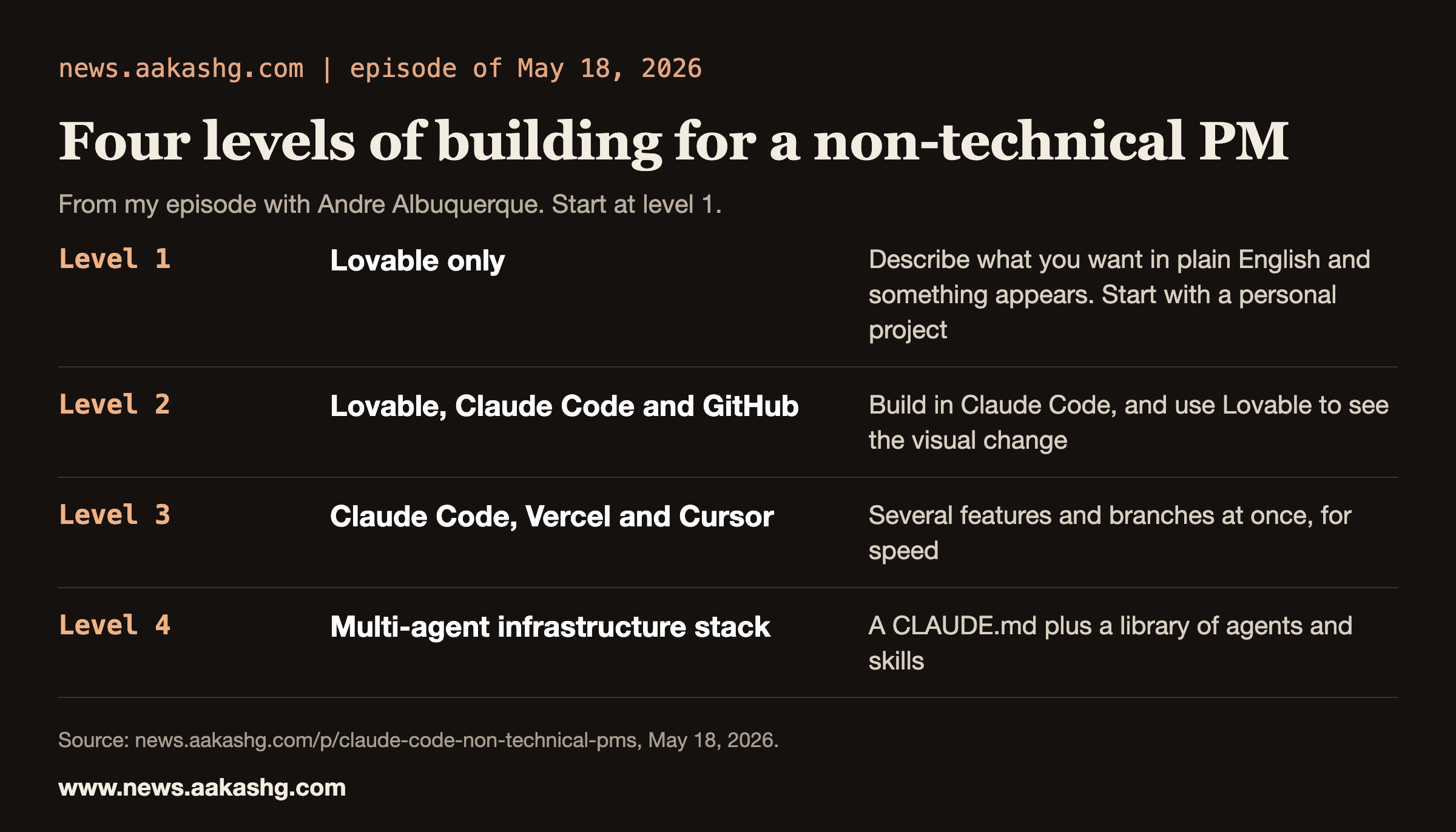
| Level | Tools | What changes at this level |
|---|---|---|
| 1 | Lovable only | Something appears on screen from a plain-English description, and you write no code |
| 2 | Lovable, Claude Code and GitHub | Claude Code and Lovable share one GitHub repo, so you build in Claude Code and see the visual change in Lovable |
| 3 | Claude Code, Vercel and Cursor | You work on several features and branches at once, and Vercel gives you a preview link for each change |
| 4 | A multi-agent stack | A CLAUDE.md for the rules, with a library of agents and skills where each agent has one specific job and you act as the director |
The levels come from my May 18, 2026 episode with Andre Albuquerque, who builds this way as a non-technical PM. My tip from that episode: do not try to jump straight to Level 4. Start with Level 1, the way Andre did.
Why the ladder starts with a personal project
Andre’s first Lovable project was a basic tool to manage his family’s vacation home availability. He recommends a personal project first because it keeps things fun, and because there is no business risk while you explore. Lovable is the right place to begin because it is less scary than Claude Code: you describe what you want in plain English and something appears on your screen.
Why build at all? Andre told me about a feature he scoped as a one-day ask. After he tried building something similar himself in Claude Code, he found it needed restructuring how the database handled user sessions, which made it a three-day architectural change.
One rule decides the order. The Lovable and Claude Code sync only works one way, so start the project in Lovable first, then extend it in Claude Code. A project that starts in Claude Code cannot be ported back into Lovable.
At Level 4, Andre calls his setup the Team Claude Config. It pairs a CLAUDE.md that holds the rules with a library of agents and skills. He advises against copying someone else’s version. Build a setup that mirrors your own team, he says. If you want the mechanics, my pages on how I set up Claude Code and on Claude Code skills show how mine is built.
Two kinds of builder PM
In my episode with Mahesh Yadav on becoming a builder PM, the guide splits the idea in two. Type one ships customer-facing product without engineering handoffs. Type two builds internal agents that automate their own PM work, such as PRD reviewers and competitive intel agents. The guide teaches mostly type two, and treats type one as the aspirational endpoint.
Mahesh’s roadmap starts somewhere else than Andre’s ladder: the first weeks are n8n only, before any Claude Code. In my write-up I put the reason this way: tools only get you so far, and learning Claude Code means nothing without an understanding of the first principles underneath it. For agents, the guide lays those out as four components: the model (the brain), tools (the hands), memory (the recall) and knowledge (your data).
What a Chief AI Officer says about PMs shipping code
In my episode with Tyler Folkman, the Chief AI Officer at JobNimbus, I asked about PMs pushing code. His answer was that with really bad systems you barely want your engineers coding, so you do not want PMs there, but with great systems there is no reason PMs cannot jump in and help. His one caution was to make sure it is agreed upon in the team, because it can create shadow work for engineers, and you want the code reviewed. The full conversation is on my site.
He also drew a concrete line. He was not sure he would put a PM on the back-end billing system, where upgrades could affect people’s money flow, but he finds it reasonable for a PM to push front-end changes where there is good decoupling from the back end, good APIs, good CI/CD and good quality testing.
The ladder in the table is meant to build a non-technical PM’s technical confidence without learning to code from scratch, and Tyler’s caution is the rule for when your building reaches a shared codebase. For a loop that runs your own work, see my page on the Claude Code loop.
Where to start this week
- Pick one small thing you would use yourself, such as a tracker for a hobby or a family task.
- Build it in Lovable, and ask Lovable to critique your prompt before it builds, as Andre suggests.
- Move to Claude Code only when you want something Lovable will not do.
If you are interviewing for AI PM roles, the technical bar is its own subject. I cover it in the AI PM technical interview guide.
Land a PM Job is the 12-week cohort I run for PMs who want to build with AI and win offers. The next one starts November 23, 2026. It has 2-3 live sessions a week and six 1:1 coaching sessions, and the coaching team reviews your resume, LinkedIn, GitHub and portfolio live on your real materials. I write about this at www.news.aakashg.com.
Tech for product managers FAQ
How technical does a product manager need to be?
Technical enough to build prototypes and internal tools with AI, and to judge what engineers ship. If you want to push code to a shared codebase, Tyler Folkman, the Chief AI Officer at JobNimbus, told me to agree it with the team first, because it can create shadow work for engineers.
Do product managers need to code?
Not to get started. In my episode with Andre Albuquerque, a non-technical PM begins at Level 1 with Lovable, where you describe what you want in plain English and no code is written by you.
What technical skills should a product manager learn first?
Start by building one small personal project in Lovable. Then learn Claude Code when Lovable stops being enough. For agents, learn the four components in the Mahesh Yadav episode: the model, tools, memory and knowledge.
What is a builder PM?
A builder PM either ships customer-facing product without engineering handoffs or builds internal agents that automate their own PM work. In my episode with Mahesh Yadav, the guide teaches mostly the second type.
Is Claude Code only for engineers?
No. In my write-up of the Andre Albuquerque episode, I point out that you can have a real conversation with Claude Code like any other LLM. The episode builds from Lovable up to Claude Code step by step.
