The Meta RPM program (Rotational Product Manager) is an 18-month, full-time rotation: a four-week bootcamp, then three product teams, in Menlo Park or New York City. Meta’s page now says it hires people with four-plus years of related experience, and that applications for the 2027 cohort are closed until Summer 2027. At the end, you’re evaluated and considered for a full-time role. Meta doesn’t guarantee one.
Levels.fyi shows $174K in average total pay for the RPM level, from 29 reports. The interview runs a recruiter screen, then product sense and analytical thinking, then a final loop that adds leadership and drive. Reported questions include redesigning Groups or Events and diagnosing a metric that falls week after week.
I opened Meta’s page in a browser and read Levels.fyi on October 11, 2026. Guides for this program mix 2020 numbers with 2026 ones, so every fact below carries its source and its date.
What the program is, per Meta’s own page
| Item | Meta’s page, read October 11, 2026 |
|---|---|
| Length | 18 months, a short-term employment (STE) rotational program |
| Start | A four-week training bootcamp |
| Rotations | Three product teams across Meta |
| Locations | Menlo Park and New York City |
| Start dates | March 2027 and September 2027 |
| Application window | Opens once a year, usually late summer or early fall |
| Status today | The page says applications for the 2027 cohort are closed and to check back in Summer 2027 |
| End of program | You’re evaluated and considered for a full-time role at Meta |
| Pay | Not listed |
Source: Meta Careers, Rotational Programs. Two details come from third parties. Leland’s guide, reposted by the University of Miami’s career center in January 2026, puts each rotation at six months and adds a two-week global research trip. Meta’s current page mentions neither. And apmlist reports that the 2026-27 posting went up on September 23, 2026, which sits oddly beside the page’s closed notice. I can’t reconcile the two from outside Meta. The Meta Careers job-details page that Google ranked second for “meta rpm program” on October 11 returned a not-found notice when I opened it. That leans toward closed, but I can’t confirm it.
Older guides list Seattle and London as RPM cities. Meta’s current page names two.
Who gets in: the page says four years, Levels.fyi reports say two
Meta’s page says two things. The program is built for people with non-traditional backgrounds, and the overview says it hires people with four-plus years of related experience. Both lines sit on the same page.
Earlier versions set a lower bar. apmlist reports that the 2026-27 posting lists four-plus years as a minimum, and that when it first wrote its guide in July 2026, the same Meta page said RPM hired people with less than one year of direct PM experience. I couldn’t open the older version, so I can’t date the change. IGotAnOffer’s guide, the top result for “rpm questions” and last updated in February 2026, still describes the program as open to recent graduates.
Levels.fyi adds a third data point. The 29 reports at Meta’s RPM level average 2.4 years of experience, and the median is 2.
What I take from it: the posted bar went up, and the people reporting pay were hired with less. Nobody outside Meta can say what “related” counts. Exponent’s guide adds that there is no technical background requirement.
Here’s the test I’d use before spending an application. In my piece on Unicorn Candidate-Market Fit, the advice is to find the 15 roles where you’re the obvious choice, get 8 interviews, get 3 offers. RPM is one of your 15 if you have four-plus years of related work, a background outside product and product work to show. If you’ve already worked as a PM for several years, a regular PM role is the closer fit, and my Meta PM guide covers that loop. If you’re a new grad, apmlist’s read is that RPM is no longer your door. My list of APM programs covers the ones that are. Leland’s guide says Meta limits you to three applications every six months, so each one counts.
What Meta RPMs are paid
Levels.fyi’s page for Meta’s RPM level (L3) shows $174K in average total pay, from 29 reports: $132K base, $30K stock and $11K bonus. The median total is $170K. Base is $132K of $174K, about three quarters of the package.
| Source | Date | Base | Stock | Bonus | Total |
|---|---|---|---|---|---|
| Levels.fyi, Meta RPM (L3), US | October 11, 2026 | $132K | $30K | $11K | $174K |
| My Meta PM guide, Levels.fyi IC3 | June 2024 | $130K | $25K | $12K | $166K |
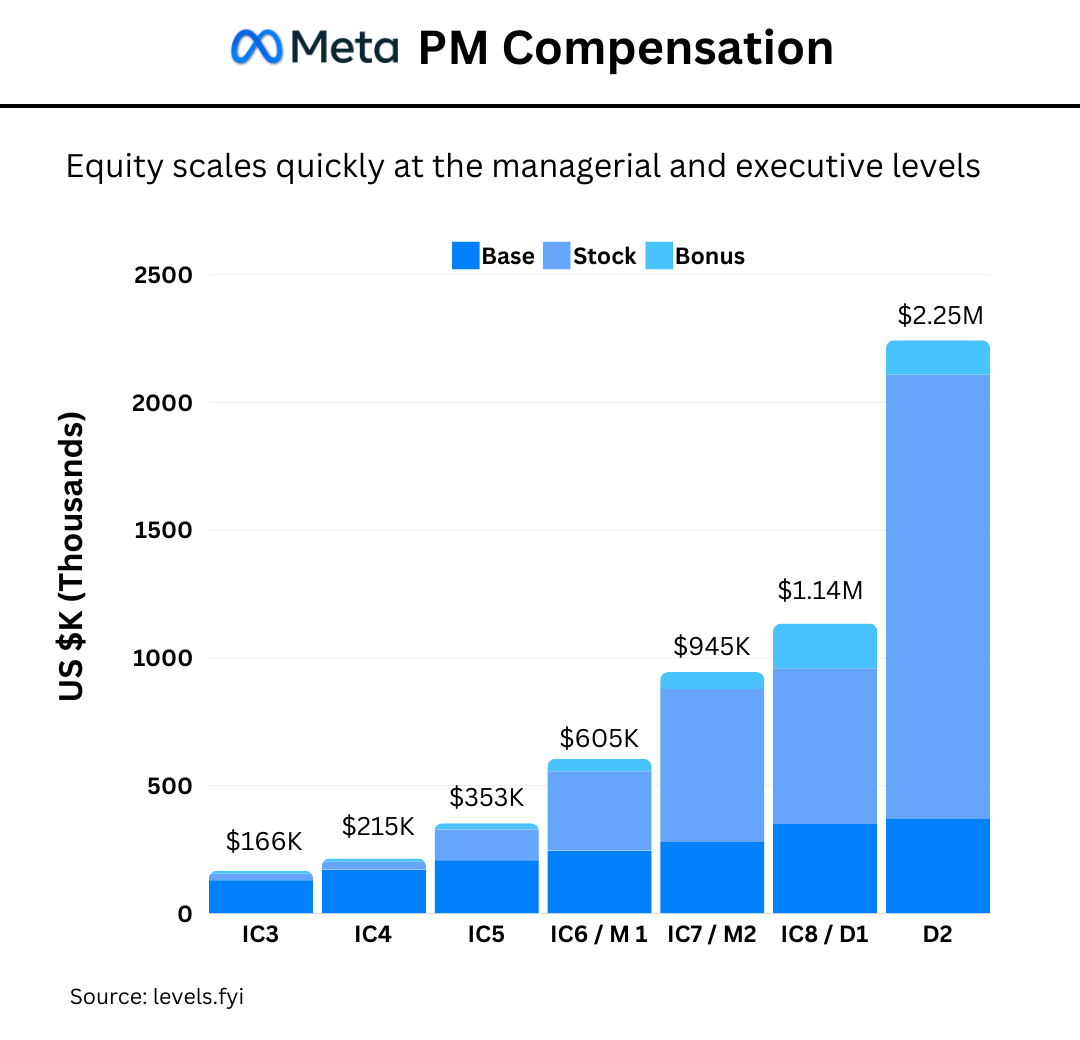
Meta’s page lists no pay. apmlist reports that the 2026-27 posting shows $114,000 to $172,000 a year and that the 2025 posting topped out at $133,000. I couldn’t open the posting, so treat both numbers as third-party. The Levels.fyi base sits inside the 2026-27 range.
Everything on Levels.fyi is self-reported and the RPM sample is 29 people, so read $174K as a band. The 2024 and 2026 figures come from different reports, so the $8K gap says nothing about a raise. Equity matters little at this level. In my 2024 numbers, stock overtakes base at IC6.
How the RPM interview runs, stage by stage
Meta doesn’t publish the RPM loop. Three third-party sources describe it, and they agree on the shape.
| Stage | What happens | Reported by |
|---|---|---|
| 1 | Resume and a short questionnaire | Meta, apmlist |
| 2 | Short-answer questions by email, due in about 24 hours, about an hour of work | Leland, apmlist |
| 3 | Recruiter screen of about 20 minutes, mostly behavioral | apmlist, Leland |
| 4 | Two 45-minute interviews: product sense, then analytical thinking | Exponent (length), apmlist (topics) |
| 5 | A final virtual loop with leadership and drive, plus product and analytical rounds | apmlist. Exponent calls the final interview optional. |
apmlist puts the whole process at two to three months, and IGotAnOffer says 6 to 12 weeks. Those are two trackers’ estimates. Meta now calls the second round Analytical Thinking. It used to be Execution, which is why older guides use the old name.
How Meta scores the rounds
This part comes from my Meta PM guide, built from 12 current and former Meta PMs in June 2024. A separate interviewer runs each round and scores each attribute from 1 to 5, plus a hire or no-hire call. The interviewers don’t discuss their ratings. They send them to a panel that decides.
Several insiders told me a 3 out of 5 on every attribute beats a 5 on some and a 0 on others. Interviewers also note how confident they are in each rating, and low confidence is the usual reason a candidate gets an extra round.
That guide covers the experienced IC loop. The RPM reports describe the same three interview types, so I’d prep against the same rubric. I haven’t seen an RPM-specific one.
RPM questions candidates report
Every question below is attributed to the page that lists it. I didn’t write any of them. Some sources are old, and I’ve marked which. IGotAnOffer’s lists come from Glassdoor reports for Meta PM roles, and its page says so. They aren’t RPM-only data.
Product sense
- Pick a product you think is great and explain why. Redesign Groups, Events or Birthdays. (Exponent guide, marked 2026)
- How would you improve Instagram for new users? (apmlist, October 2026)
- Build a renters product. (One Exponent candidate report from a rejected Mid Level / L4 candidate, filed as a general PM report)
- Differentiate Instagram Reels from TikTok. Help someone find roommates in a new city. Improve peer-to-peer payments. (Product Alliance, undated and written in the Facebook era)
- Facebook Events is struggling. How would you turn it around? Design a jobs product for Meta. (IGotAnOffer, February 2026, from Glassdoor Meta PM reports)
Analytical thinking
- A metric is dropping week after week. Diagnose it. (Exponent guide)
- Engagement on a feature dropped 5%. How do you diagnose it? (apmlist, October 2026)
- Newsfeed engagement drops 10%. What do you do? How would you evaluate a trade-off between boosting ad revenue and decreasing retention? (IGotAnOffer, February 2026, from Glassdoor Meta PM reports)
- Measure the success of Facebook Dating. Diagnose a 25% drop in daily usage. Judge an ad campaign that costs $10 per acquisition. Decide whether to ship an algorithm that raised matches but lowered messages. (Product Alliance, undated)
Leadership and drive
- Four to five behavioral questions on ownership, introspection, supporting people and grit. (Exponent guide)
- A time you persuaded a team, a project you started unprompted, a failure and what you changed after it. (apmlist, describing the leadership round)
- Why Meta? Why product management? Tell me about a time you managed a conflict in a team. Tell me about a time you made a decision with incomplete information. (IGotAnOffer, February 2026, from Glassdoor Meta PM reports)
- Describe a failure. Describe working without resources. Name something you built outside work. Say how you’d handle an underperforming designer. (Product Alliance, undated)
The emailed short-answer round uses the same three buckets. apmlist gives “what’s a product you love and why” and “describe a time you led without authority” as examples. Treat the Product Alliance list as an old question bank. Its page is a course sales page, and its one hard number, about 60 RPMs across four offices, is dated 2020.
How I’d prepare for each round
Product sense. Spend most of your time on the solution. A Meta PM who has done 200+ interviews told me that silence, pen and paper, and wireframe-level descriptions set candidates apart. Sort features into must-haves, nice-to-haves and future considerations, and say why each one made the cut. Pick a user problem with some meat first, because a thin problem leaves you nothing to build on. The full method is in my product sense interview guide.
Analytical thinking. You’ll often get two questions, so outline both on paper before you start. The best candidates in my guide map an executive dashboard across the whole ecosystem, set goals reachable in a quarter and add counter-metrics. Expect the interviewer to add a constraint. More in my execution interview guide.
Leadership and drive. There’s no set rubric. It rides on your real experience, so bring specific examples of steering a project and changing course after a failure. Meta’s page says the program is built for non-traditional backgrounds, so a product you shipped or a venture you ran can carry these stories. My 3 Laws of PM behavioral interviews covers how to build them.
What happens after the 18 months
Meta’s page says participants are evaluated and considered for a full-time role. I found no published conversion rate, and no dated source that gives one. apmlist quotes the 2026-27 posting as saying successful participants “may be eligible to apply for a full-time position,” and reads that as applying for a permanent role, not converting automatically. The page frames the end as an evaluation, so I’d treat each of the three rotations as part of it.
Marily Nika, then a GenAI PM at Google and formerly at Meta’s Reality Labs, told me in February 2025 that she sees a lot of technical AI people join RPM and get retained within teams. Meta doesn’t guarantee AI work, she said, but during matchmaking you can say you want AI-specific teams.
Andre Nader, who spent 9+ years at Meta, told me in August 2024 that at companies like Meta, people who enter through APM or rotational programs are a fraction of the people who join with industry experience. In September 2024 I relayed what students keep telling me: companies have reduced their rotational and associate PM programs. That one is an anecdote.
RPM or a regular PM role at Meta
| Path | Level | Typical experience (Levels.fyi) | Total pay (Levels.fyi) | Reports |
|---|---|---|---|---|
| Rotational Product Manager | L3 | 2 to 3 years | $174K | 29 |
| Product Manager | L4 | 5 to 6 years | $265K | 12 |
Both rows come from Levels.fyi’s Meta PM page as of October 11, 2026. The table shows who reports pay at each level. It doesn’t say RPMs convert into L4.
If you have four-plus years of work outside product, RPM is the structured way in, and Meta’s page says it’s open to non-traditional backgrounds. If you’ve spent several years as a PM, the direct route is the bigger door, and my Meta PM guide walks through it. If you’re earlier in your career than either, my list of APM programs covers the early-career programs, and my playbook for breaking into product management shows how to pick between them.
What I couldn’t verify
- What “related experience” counts as on Meta’s four-plus years line. Meta’s page doesn’t say.
- The conversion rate to full-time. Meta doesn’t publish one and I found no dated source.
- The acceptance rate. Meta doesn’t publish it. Leland’s guide estimates under 2% and shows no source for the figure.
- Current class size. The only figure is about 60 RPMs from 2020, per Product Alliance.
- Whether the posting is open. Meta’s page says closed for the 2027 cohort, apmlist reports a September 23, 2026 posting, and a Meta Careers job page that ranks for the query returned not-found.
- When the 29 Levels.fyi reports were submitted. The page I read doesn’t show dates, so I can’t say how many reflect the current program.
Meta RPM FAQ
What is the Meta RPM program?
An 18-month, full-time rotational program. It starts with a four-week bootcamp, then three product teams, in Menlo Park and New York City. Meta’s page says it hires people with four-plus years of related experience. At the end you’re evaluated and considered for a full-time role (Meta Careers, read October 11, 2026).
How much does a Meta RPM make?
Levels.fyi shows $174K in average total pay for the RPM level from 29 reports: $132K base, $30K stock and $11K bonus (October 11, 2026). Meta’s page lists no pay. See Levels.fyi.
What are the Meta RPM interview rounds?
Third-party sources describe a resume and questionnaire, short-answer questions, a recruiter screen, two 45-minute interviews on product sense and analytical thinking, and a final loop that adds leadership and drive. Meta doesn’t publish the loop (apmlist, Exponent).
Does the Meta RPM program guarantee a full-time job?
No. Meta’s page says participants are evaluated and considered for a full-time role. Meta doesn’t publish a conversion rate.
Do you need a technical background for Meta RPM?
Meta’s page says the program is built for people with non-traditional backgrounds, and Exponent’s guide says there’s no technical background requirement. The same Meta page also says the program hires people with four-plus years of related experience (Meta Careers, Exponent).
Can new grads apply to the Meta RPM program?
Meta’s page says the program hires individuals with four-plus years of related experience. apmlist’s read is that RPM is no longer a door for new grads, while IGotAnOffer’s February 2026 guide still describes it as open to recent graduates. The 29 RPM reports on Levels.fyi average 2.4 years of experience (Meta Careers, apmlist, IGotAnOffer, Levels.fyi).
Is Meta RPM open for applications?
Meta’s page says applications for the 2027 cohort are closed and to check back in Summer 2027 (read in a browser on October 11, 2026). apmlist reports that a 2026-27 posting went up on September 23, 2026. I can’t reconcile the two from outside Meta (Meta Careers, apmlist).
Sources and dates
- Meta Careers, Rotational Programs, read in a browser October 11, 2026
- Levels.fyi, Meta Rotational Product Manager (RPM) and Meta product manager salaries, parsed October 11, 2026
- apmlist, Meta RPM, checked by apmlist on October 8, 2026
- Leland’s Meta RPM guide, reposted by the University of Miami, January 29, 2026 (the text refers to 2025)
- Exponent, Meta RPM interview guide, marked 2026, and one candidate report (Mid Level / L4, rejected)
- Product Alliance, Meta RPM cheat sheet, undated, hiring figure from 2020
- IGotAnOffer, Meta RPM interview guide, last updated February 12, 2026, read October 11, 2026
- My Meta PM guide, June 2024
- Podcast: Marily Nika, February 14, 2025. Andre Nader, August 29, 2024. Christian Idiodi, September 28, 2024.
I’ll re-check this page when Meta opens the next cycle. New guides like this land first on my newsletter.
