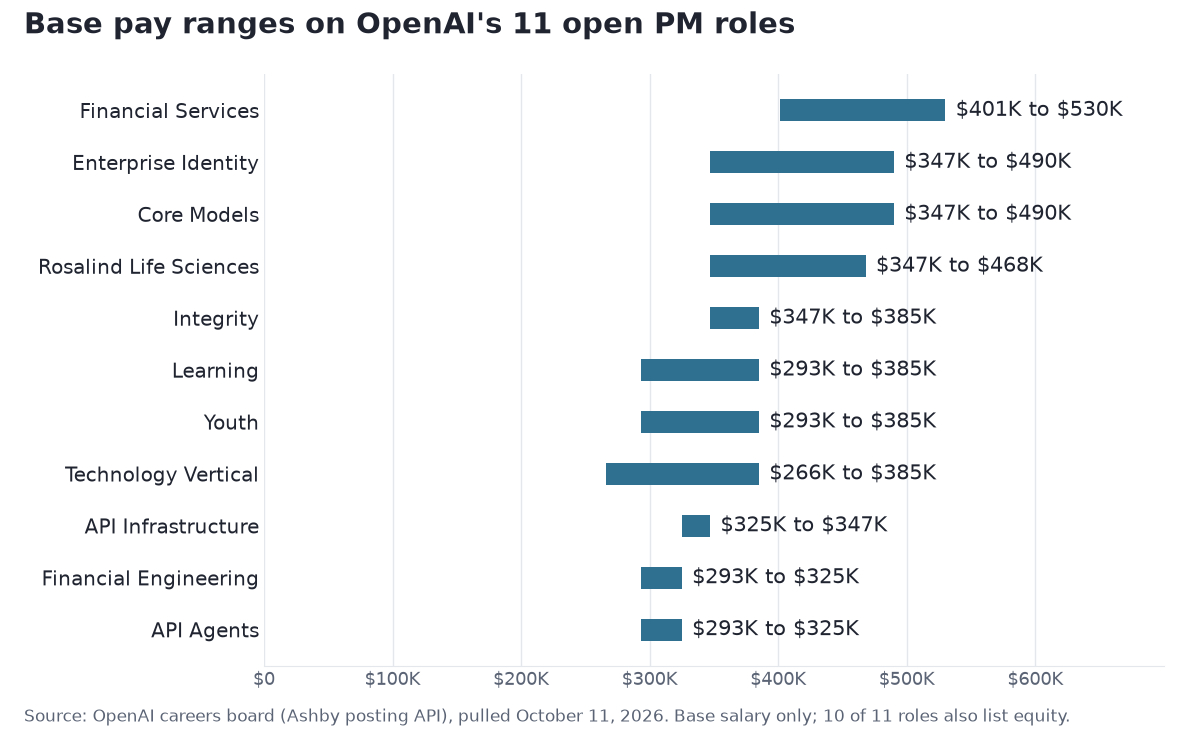
The OpenAI PM interview takes 4 to 10 weeks, depending on whose account you read. You get a recruiter call, a hiring manager conversation, a skills assessment, then a final loop. OpenAI’s own interview guide puts the final loop at 4 to 6 hours with 4 to 6 interviewers over 1 to 2 days, and says you hear back within a week. Candidates report product sense, execution, stakeholder and behavioral rounds inside it. The 11 PM roles on OpenAI’s job board on October 11, 2026 list base pay of $266K to $530K.
As of April 2026, I had coached 200+ PM candidates, and 30+ of them landed AI PM offers in the prior 12 months at OpenAI, Anthropic, Google, Meta and Amazon. For this page I re-read OpenAI’s guide, pulled its job board, checked Levels.fyi and compared what candidates have reported since. Every figure carries its source and date. Where sources disagree, I show both.
The OpenAI interview process on OpenAI’s own page
OpenAI publishes an example loop and says yours may differ. This is that loop and the waits it lists, from the page as archived on October 9, 2026.
| Stage | What the guide says | Wait it lists |
|---|---|---|
| Resume review | You apply and the recruiting team reviews your resume. | About 1 week |
| Introductory calls | A call with the hiring manager or recruiter about your work, motivations and goals. The guide suggests reading OpenAI’s recent blog posts, especially on the team you would join. | You hear within a week if you advanced |
| Skills-based assessment | Formats vary by team: pair coding, take-home projects, technical tests. You may get more than one, and the recruiting team provides prep. | You hear within a week of finishing |
| Final interviews | 4 to 6 hours with 4 to 6 people over 1 to 2 days. Virtual by default, or onsite in San Francisco. Your recruiter may then ask for references. | Decision within a week |
Add up the one-week waits and you get about four weeks before any scheduling gaps. That matches the low end of what candidates report.
Two lines in the guide matter more than the table.
The first is “We are not credential-driven.” OpenAI says it wants experts and people with “high potential,” which it defines as people who have “demonstrated the ability to ramp up quickly in a new domain and produce results.”
The second is about AI in the room. “Expectations for AI and other tools vary by interview: some formats intentionally allow them, while others are designed to assess your independent problem-solving without AI tools.” The guide says your prep materials explain which is which.
What candidates report for each round
OpenAI doesn’t publish PM round names. These come from candidate accounts, so the mix changes by team.
Timelines differ too. IGotAnOffer says 4 to 8 weeks (page updated May 5, 2026). Exponent’s guide says 6 to 10 weeks across five stages, with as many as 12 conversations. For my March 2025 OpenAI guide I talked to 10 recent PM candidates. The average loop had about eight rounds over 4 to 8 weeks. Five of the 10 counted the same interviews as three rounds, and five had no final case presentation.
Recruiter screen
About 30 minutes. Exponent’s guide treats it as a full behavioral interview, and candidates report being asked about their hardest launch and their biggest failure. It adds that recruiters have raised leveling and compensation as early as this call. Know your level target before you dial in.
Hiring manager screen
Exponent describes either two calls or one long conversation. Part one covers your background and the role. Part two is a strategy question for the team you would join, and candidates are asked to arrive with a plan for it. No formal presentation is expected. Interviewers then press on the risks and trade-offs in what you propose.
Product sense
Exponent’s guide lists two rounds of about an hour, one after the hiring manager screen and one in the final loop. The prompt can be a single sentence, with little help from the interviewer on scope. State your structure at the start instead of waiting for the interviewer to narrow the question. Exponent also warns that a prompt your recruiter calls unrelated to ChatGPT can still end up about OpenAI or AI.
Product execution
This is the metrics round. Exponent describes short prompts tied to real OpenAI problems. You build the framework from scratch, a hero metric with supporting and counter metrics, then defend your trade-offs. In my 2025 interviews, 7 of 10 candidates were asked how they would measure success if instrumentation failed. Both IGotAnOffer and Exponent still list that question in 2026.
Final loop
Four to six interviews across one to two days, matching OpenAI’s guide. Exponent’s guide lists a go-to-market collaboration round, an engineering round, a stakeholder round and a behavioral round, plus a second product sense and execution round. Ahead of the engineering round you may be sent a research paper on LLMs to read. In the stakeholder round you meet a leader from a function such as Legal, Design, Research, Finance or Trust & Safety, and the questions center on safety and responsible deployment. Some candidates also present a take-home case. The format varies by team.
OpenAI PM interview questions candidates report
These come from candidate reports, not from OpenAI, and I haven’t verified any of them with OpenAI. Each row links its source. Reports of the technical round are thin, so the two technical rows come from my own 2025 guide.
| Question | Round | Reported by |
|---|---|---|
| Walk me through the most difficult product launch you’ve led. What made it hard, and what did you do to reduce the difficulty? | Recruiter screen | Exponent |
| Why OpenAI? What don’t you like about OpenAI? | Recruiter or behavioral | IGotAnOffer |
| If you were already an OpenAI PM on this team, what would you do and why? | Hiring manager | Exponent |
| How would you improve ChatGPT for enterprise users? | Product sense | Exponent |
| You’ve invented a memory machine that produces video, image, smell, and sound. Go to market. | Product sense | Exponent |
| What goal would you set for an AI-only social network that OpenAI is building? | Product sense or execution | IGotAnOffer, Exponent |
| You have a model with 10x the capability at 10x the cost. What do you do with it? | Execution | Exponent |
| Imagine you’re leading the next ChatGPT rollout. How would you launch it? | Execution | Exponent |
| How would you measure success for OpenAI? What if instrumentation went down? | Execution | IGotAnOffer, Exponent, my 2025 interviews |
| How would you balance product velocity with safety constraints? | Stakeholder | Exponent |
| How would you design safeguards for an AI system that can take actions on behalf of a user? | Stakeholder | Exponent |
| How would you prevent the system from reinforcing harmful biases, and how would you detect them? | Stakeholder | Exponent |
| How do you navigate situations where sales pushes for something that conflicts with the roadmap? | Go-to-market collaboration | Exponent |
| How do you balance model quality versus inference cost? | Technical | My March 2025 guide |
| How would you test for and mitigate harmful outputs? | Technical | My March 2025 guide |
Most of these ask you to commit to a position under a constraint, such as inference cost or an instrumentation outage. Practice naming what you would give up. The full question bank and a mock interviewer prompt sit in my AI PM interview guide.
What the job postings say interviewers want
OpenAI’s job descriptions read like rubrics. The Core Models PM posting asks for someone who can “pair offline evaluation with online experimentation and user signals, and can distinguish a useful metric from a convenient one.” That is a metrics-round answer written as a job requirement.
The Integrity PM posting asks you to “define how we measure residual risk, decision quality, review quality, and mitigation effectiveness.” That is the safety half of the stakeholder round.
OpenAI’s job board listed 811 open roles on October 11, 2026. Eleven were PM roles: API Agents, API Infrastructure, Core Models, Enterprise Identity, Financial Engineering, Financial Services, Integrity, Learning, Technology Vertical, Youth and a Rosalind life sciences role. Each sits on a different team, and candidates report the loop varies by team.
Jake Brill, who led integrity product at OpenAI when he joined my podcast in August 2025, gave me the map of where PMs sit. Some PMs work on the research side, on things like model behavior and safety. Some work on the product side, on consumer ChatGPT, enterprise and the developer platform. His integrity team is a platform team that serves them. Pick the team you are targeting first, then read its posting as the rubric.
How people get the first call
For my March 2025 guide, 7 of the 10 candidates I talked to were approached by OpenAI recruiters directly. 6 had a connection at OpenAI who referred them or boosted their resume. 8 had worked on generative AI products at a name-brand company or university. Ten people is a small sample, so read these as a pattern.
Jake Brill named the same two levers on the podcast. When OpenAI posts a role publicly, a lot of people apply, he said, and two things help the team sort them. One is someone at the company who has worked with you and can speak to your skill. The other is a LinkedIn profile or resume that shows comfort with AI and experience that matches the posted role. He added that the best integrity hires have well-rounded backgrounds, because the problems are new and ambiguous, and that startup and hypergrowth experience counts too.
His own loop ran a couple of months in summer 2023, with three or four different hiring managers as the shape of the job changed. He prepared for roughly two months and called it a very demanding interview process. On planning, he said OpenAI writes its plans “in pencil, not in pen.”
Abhi Muchhal, a PM on international growth at OpenAI, took a different route. At his previous job, colleagues spoke Portuguese, English or Spanish and nobody spoke all three, so he built a Chrome extension on OpenAI’s APIs to translate between them. When the translations didn’t hold up, he wrote a rubric to score them. He later learned the word for that is evals. In the interview he could say he hadn’t done the work to OpenAI’s standard, but he understood it operationally. He credits his experience plus the builder attitude. The full conversation is here. For a view of the daily work, Ryan Lopopolo from OpenAI’s Frontier team walks through how PMs there ship code with Codex.
How I would prepare, in order
- Pick one team and read its posting as the rubric. My Unicorn Candidate-Market Fit method does this. You find the roles where you are the obvious choice, then write the case for each one.
- Build one thing on OpenAI’s API and write its eval. Abhi’s rubric is the model. A short write-up of what failed and how you scored it answers “tell me about your AI experience” better than a course certificate. My evals guide walks through a first one.
- Write the strategy for your target team before the hiring manager screen. Keep it to one page with what you would build, what you would cut, the biggest risk and the first metric. Candidates report being asked what they would do if they were already the PM on that team.
- Put safety inside every answer by saying who a feature could harm and which safeguards ship with it. My AI product sense guide shows how, and the safety and ethics guide goes deeper.
- Test your answer to “Why OpenAI?” by putting Anthropic or Google in its place. If the answer still works, rewrite it around something only OpenAI has, such as a specific model release or a line in the OpenAI Charter, which the guide recommends reading.
- Ask your recruiter which rounds allow AI tools. The guide says it varies by interview.
What OpenAI PMs earn
Two dated sources follow, and they measure different things, so don’t mix them.
| Source | What it shows | Scope |
|---|---|---|
| OpenAI job board, October 11, 2026 | Base salary $266K to $530K, plus equity on 10 of 11 roles | 11 open PM roles, all listing San Francisco (one also lists New York City) |
| Levels.fyi OpenAI PM page, October 2026 | Total compensation: 25th percentile $325K, median $750K, 75th percentile $860K, 90th percentile $925K, average $715K | US, 4 submissions |
Four submissions is a thin sample. The page’s “median package” is a single San Francisco L5 growth PM offer from August 2026, listed as $750K base with no stock or bonus. OpenAI’s own postings top out at $530K base, so that entry looks like a total figure entered as base. Levels.fyi doesn’t break OpenAI PM pay out by level, so treat the median as a marker.
You will see $860K quoted as OpenAI’s PM figure in several guides, including IGotAnOffer’s and Exponent’s, as well as my April 2026 one. On today’s Levels.fyi page, $860K is the 75th percentile and the median is $750K. Across every job family at OpenAI, Levels.fyi’s company page shows a median of $610K.
On equity, Levels.fyi lists OpenAI stock as RSUs vesting 25% a year over four years. IGotAnOffer reports the move from profit participation units came in 2026. For the labs and Big Tech side by side, see my AI product manager salary guide.
Sources and what I checked
- OpenAI interview guide, read from the copy archived October 9, 2026.
- OpenAI job board, public feed pulled October 11, 2026.
- Levels.fyi OpenAI PM page, October 2026.
- IGotAnOffer OpenAI PM guide, updated May 5, 2026.
- Exponent OpenAI PM guide, 2026.
- My March 2025 OpenAI guide and April 2026 AI PM interview guide.
- Podcast episodes with Jake Brill (August 2025) and Abhi Muchhal (June 2026).
OpenAI hasn’t published its PM loop beyond the guide above, so every round detail past that is candidate-reported and unverified by OpenAI. I’ll re-pull the job board and pay figures in about 90 days.
Questions about the OpenAI PM interview
How many rounds is the OpenAI PM interview?
OpenAI’s guide describes 4 to 6 final interviews over 1 to 2 days, after a recruiter call and a skills assessment. Exponent’s guide counts as many as 12 conversations in total, and the average loop among the candidates I interviewed in 2025 had about eight rounds. The count changes by team.
How long does the OpenAI PM interview take?
Candidate accounts range from 4 to 8 weeks (IGotAnOffer, May 2026) to 6 to 10 weeks (Exponent, 2026). OpenAI’s guide lists one-week waits at four steps, which adds up to about four weeks before scheduling gaps.
Can I use AI in an OpenAI interview?
It depends on the round. OpenAI’s guide says some formats intentionally allow AI tools and others are designed to assess your independent problem-solving without them. Your recruiter explains what is allowed in the prep materials, and the guide tells you to ask if you are unsure.
What is the salary for an OpenAI product manager?
On Levels.fyi in October 2026, the median OpenAI PM total compensation is $750K, based on four US submissions, with a 25th to 75th percentile range of $325K to $860K. OpenAI’s 11 open PM roles list base pay of $266K to $530K, plus equity on 10 of them.
Do you need AI experience to get an OpenAI PM interview?
OpenAI says it is not credential-driven and looks for people who ramp up fast. In my 2025 interviews, 8 of 10 candidates had worked on generative AI products, and the other two showed concrete AI work such as side projects. Abhi Muchhal credits a side build and the eval he wrote for it.
If you are preparing for OpenAI or another AI lab, the full question bank and the mock interviewer prompt are in my AI PM interview guide. For a new guide each week, subscribe to Product Growth.
Save this for later.
