For a Product Manager in SaaS, churn rate isn't just another KPI. It's the ultimate report card on your product's value and your company's long-term viability. When your CEO asks about churn, you can't just quote a number; you need to own the narrative, diagnose the root cause, and present a data-backed plan of attack. A high churn rate is a direct threat to recurring revenue, and as a PM, it's your job to lead the charge in fixing it.
Your Immediate PM Playbook for SaaS Churn Rate

As a PM leader who has hired and managed teams at companies like Google and Meta, I can tell you that mastering churn is a non-negotiable skill. Forget abstract theories. The two metrics that drive every strategic conversation about product health are Gross Churn and Net Churn. Understanding them is your first step to demonstrating executive-level thinking.
Imagine your customer base as a bucket of water. Every month, some water leaks out as customers cancel. That leakage is Gross Churn. It’s the raw, unfiltered loss of customers and their revenue. It's the purest signal of a product-value gap.
But what if you could also pour more water into that same bucket—not from new customers, but from the ones already there? This happens when existing users at companies like Slack or Miro upgrade their plans, add more seats, or buy add-ons. That extra revenue is your Expansion MRR.
Net Churn is what you get when you balance the leaks (Gross Churn) against these refills (Expansion MRR). It gives you the full, unvarnished story of your product's market momentum.
The Formulas You Need to Master Today
You don't need a fancy BI tool to start. As a PM, you need these two formulas at your fingertips. Grab your own data and plug them in right now.
- Gross MRR Churn Rate: This shows the total monthly recurring revenue (MRR) lost from cancellations and downgrades. It's your "leaky bucket" metric.
(Churned MRR / MRR at Start of Period) * 100 - Net MRR Churn Rate: This provides the complete picture by subtracting expansion revenue from churned revenue.
((Churned MRR - Expansion MRR) / MRR at Start of Period) * 100
The Holy Grail: Hitting negative net churn is the ultimate goal for any growth-stage SaaS company like Datadog or Snowflake. This is the magic moment when your expansion revenue from existing customers is greater than the revenue you're losing from churn. You're growing your business even if you don't sign a single new customer—a powerful story for any board meeting.
This table breaks down the two most critical churn metrics for Product Managers at a glance.
Gross vs Net Churn: The PM's Quick Reference
| Metric | What It Measures | Formula | PM Action Focus | Real-World Example |
|---|---|---|---|---|
| Gross MRR Churn | The raw revenue loss from cancellations and downgrades. | (Churned MRR / MRR at Start) * 100 |
Fixing the core retention problem. Why are customers leaving? | A bug in a key workflow causes 50 customers to cancel. |
| Net MRR Churn | The overall revenue change after accounting for expansion. | ((Churned MRR - Expansion MRR) / MRR at Start) * 100 |
Driving more value and upselling. How do we get happy customers to spend more? | 50 customers cancel, but 30 others upgrade to a new AI feature, offsetting the loss. |
Understanding these two numbers is the first step toward building a product strategy grounded in business reality, not just feature requests. A strong foundation in analytics is non-negotiable for this work; you can go deeper on how to build data-driven product teams in our detailed guide.
Knowing the difference between gross and net churn lets you pinpoint your real problem. Is your core product failing to retain users (high gross churn)? Or are you missing opportunities to deliver more value to your happy customers (low expansion MRR)? That distinction is everything—it tells you exactly where to focus your engineering resources.
How to Calculate and Analyze Churn: A Step-by-Step PM Workflow
Alright, you get the concepts. Now let's get tactical. As a Product Manager, you can't just throw a top-line churn number at your team and call it a day. You have to dissect it, understand the story behind it, and build a case that forces action. This means moving beyond simple formulas to real-world analysis.
We'll use a hypothetical AI project management tool, "SynthAI," to walk through exactly how a PM at a fast-growing startup would tackle this.
A Practical Walkthrough with SynthAI
Let's say SynthAI kicked off October with 1,000 customers and $100,000 in MRR. Over the course of the month:
- Cancellations: 50 customers canceled, taking $5,000 MRR with them.
- Upgrades: 20 happy customers upgraded to a higher plan with new AI features, adding $2,000 in Expansion MRR.
With these data points, we can start building our narrative.
1. Calculating Gross MRR Churn Rate
First, we isolate the total revenue lost. This metric shows the raw leakage from your product, completely ignoring any positive movement from upgrades. It’s the purest signal of customer pain.
- Formula:
(Churned MRR / MRR at Start of Period) * 100 - SynthAI's Calculation:
($5,000 / $100,000) * 100 = 5%
A 5% Gross MRR Churn is a flashing red light for a B2B SaaS company. It tells you that for every $100 you started the month with, you lost $5. A number like this immediately triggers a deep dive to figure out why users are leaving.
2. Calculating Net MRR Churn Rate
Next, we factor in the revenue gained from our existing customer base. This gives a more holistic view of your product's health.
- Formula:
((Churned MRR - Expansion MRR) / MRR at Start of Period) * 100 - SynthAI's Calculation:
(($5,000 - $2,000) / $100,000) * 100 = 3%
SynthAI's 3% Net MRR Churn is better, but it's still a problem. While the expansion revenue helps, it's not enough to mask the high gross churn. The story here isn't just "we need to upsell more"; it's "we need to fix the core experience that's pushing people away."
Unlocking Deeper Insights with Cohort Analysis
Calculating monthly churn is a vital health check, but it doesn't tell you when the problem started or which users are most affected. This is where cohort analysis becomes a PM's most powerful diagnostic tool.
Cohort analysis is the practice of grouping users based on a shared characteristic—most commonly their sign-up month—and tracking their behavior over time. It transforms a single, blurry churn number into a high-definition story of your product's evolution.
Instead of looking at your entire user base as one big group, you slice them into segments: a "January Cohort," a "February Cohort," etc.
By tracking the retention rate of each cohort month after month, you can pinpoint specific problems. Did the September cohort’s retention suddenly fall off a cliff in their second month? That's a huge clue that a feature you shipped or an onboarding change you made back then is causing long-term damage.
This level of detail is what allows you to move from guessing to knowing. It draws a straight line from your product decisions to your churn rate. For a more detailed breakdown, you can learn more about what cohort analysis is and how to implement it. This is the technique that separates reactive PMs from proactive, strategic leaders who can see problems coming before they impact the P&L.
Benchmarking Your SaaS Churn Rate for Credibility and Impact
Every product manager has been there. You’re in a meeting, and a leader asks, “So, is our churn rate good or bad?”
Answering without context is a classic junior PM mistake. Your ability to benchmark your SaaS churn rate against the correct industry standards is what separates a tactical PM from a strategic leader who can confidently frame performance and win budget for retention initiatives.
Simply put, a "good" churn rate depends entirely on who you sell to. A 5% monthly churn might be acceptable for a B2C app, but it would be a five-alarm fire for a B2B platform like Salesforce selling enterprise deals with annual contracts. Knowing these benchmarks is how you set realistic OKRs and keep executive expectations grounded in reality.
What the Market Data Says About Churn Rates
To set credible goals, let's look at the numbers from top SaaS businesses. The average annual churn rate for SaaS companies typically falls between 5% and 7%. That breaks down to a monthly churn of roughly 0.4% to 0.6%.
This is why top-tier companies are obsessed with getting churn under 3% annually—it’s the fuel for compound growth. Think about it: if you start the year with 100 customers and have 5% monthly churn, you'll be down to just 46 customers by the end of the year. That compounding loss is devastating.
When you dig deeper, the benchmarks get more specific:
- B2B (SMB Focus): Companies like HubSpot or Mailchimp typically see 3-5% annual churn.
- B2B (Enterprise Focus): The goal for a company like Workday is 1-2% annual churn, thanks to long contracts and high switching costs.
- B2C: Churn often spikes to around 5.06% annual churn, due to lower customer commitment and more payment failures.
- Mature SaaS ($10M+ ARR): Best-in-class companies often achieve under 1% annual churn after years of investing heavily in customer success.
The key is moving from raw data to actionable insights, which is where a structured analysis process comes in.
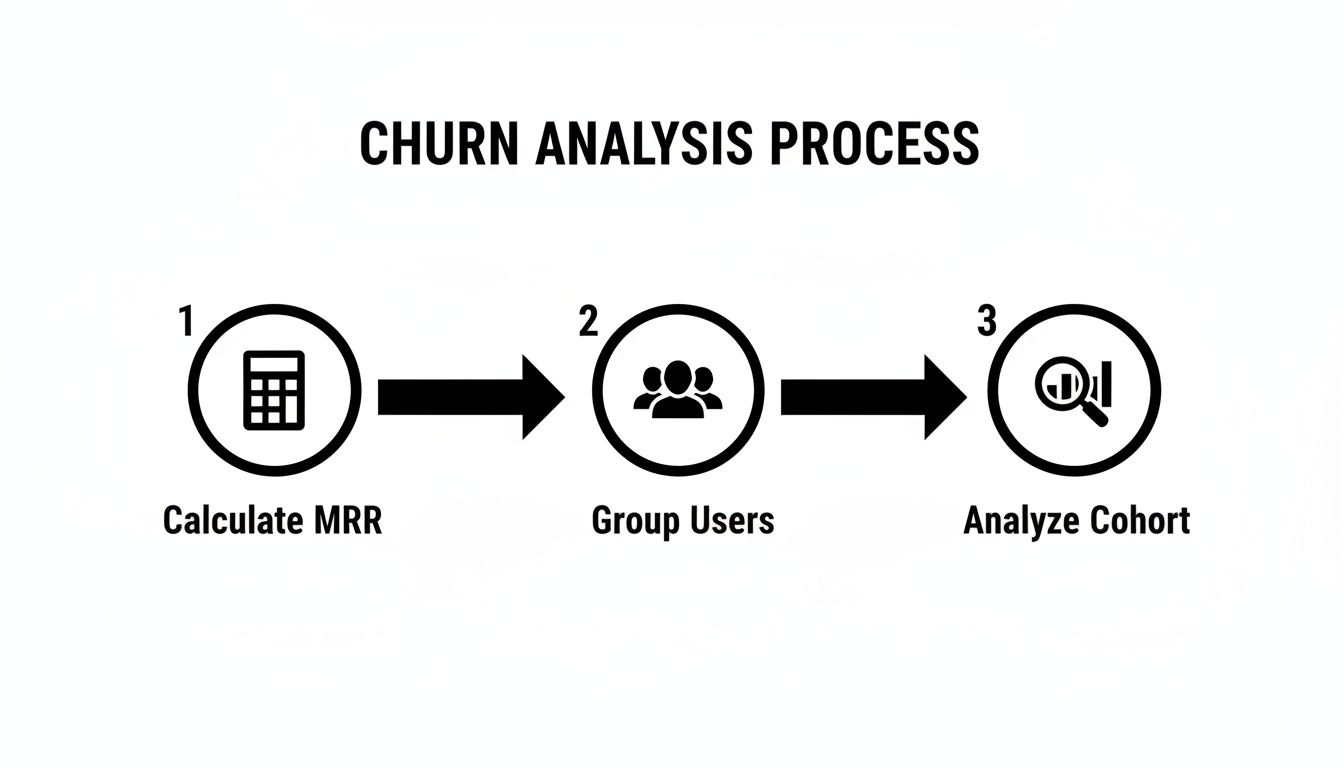
This kind of structured approach ensures you're not just tracking a number, but diagnosing the health of specific customer groups over time.
Setting Actionable Goals as a PM
As a PM, you use this data to set goals that make sense for your product. If you're running a product for SMBs, aiming for a 1% annual churn rate right away is just setting your team up to fail. A much smarter goal would be to drive churn down from 7% to 5% over the next two quarters.
Use these benchmarks as your anchor in every roadmap discussion. When you can say, "Our current net churn is 4%, which is high for our enterprise segment where the median is 2%. My goal is to get it to 2.5% by Q4 by improving onboarding," you instantly establish credibility.
This data-backed framing transforms your requests from "I think we should…" to "The business needs us to…" It’s the foundation for arguing for engineering resources and tying your product roadmap directly to financial outcomes like Customer Lifetime Value.
Diagnosing the Root Causes of Churn: A PM's Detective Framework
High churn is a symptom, not the disease.
As a product manager, your real job is to shift from being a metric-tracker to a lead detective. You have to dig into the "why" behind the numbers. Simply knowing your churn rate is useless if you don't have a framework to figure out what's actually broken.
Your toolkit as a PM is a mix of hard data and real human feedback, used together to uncover why customers are walking away.
The Five Common Culprits of High Churn
In my experience hiring and mentoring PMs, churn almost always traces back to one of these five core problems. Use this as your starting checklist.
- Poor Onboarding: The first 15 minutes in your product are make-or-break. If a new user doesn't hit that "aha!" moment and see how you solve their problem, they'll be gone within a month.
- Value-Perception Gap: The customer doesn't believe your product is worth the price. This isn't just about being "too expensive"—it's often a failure on our part to consistently communicate the value they're getting.
- Missing Critical Features: A competitor like Asana or Jira just shipped a must-have feature that makes your product look outdated.
- Bad User Experience (UX): The product is buggy, slow, or confusing. People's patience for friction is near zero.
- Competitive Pressure: A competitor is eating your lunch with a similar solution for less money or a more aggressive marketing campaign.
Your Diagnostic Toolkit: Quantitative and Qualitative Methods
A world-class PM triangulates data from multiple sources. You need the "what" from quantitative data and the "why" from qualitative insights.
First, start with quantitative analysis to spot patterns at scale.
- Analyze User Activity Data: Get into your product analytics tools like Mixpanel or Amplitude. Look for what churned users didn't do. Is there a "sticky" feature that retained users love but churned users never touched? For a tool like Figma, it might be using "Components." That's a huge clue.
- Segment Churned Users: Don't treat all churned customers as a monolith. Break them down by plan type, company size, or acquisition channel. You might find that users from a specific ad campaign have a 30% higher churn rate, pointing to a major mismatch in expectations set by your marketing.
Next, layer on the human story behind those numbers.
Qualitative feedback is where you find the raw, unfiltered truth about your product's shortcomings. It's often uncomfortable to hear, but it's the fastest path to identifying the root cause of your SaaS churn rate.
- Conduct Targeted Exit Surveys: When someone clicks "cancel," show them a simple, one-question survey: "What's the primary reason you're leaving?" Give them multiple-choice options based on your hypotheses (e.g., price, missing features) but always include an open-ended "Other" field. That's where the gold is.
- Run User Interviews: Reach out to people who churned recently. Offer them a $50 gift card for 30 minutes of their time—it's the best money you'll spend all quarter. Ask open-ended questions like, "Walk me through the day you decided to cancel. What was going on?"
Using AI to Accelerate Your Diagnosis
Manually reading hundreds of survey responses or support tickets from Zendesk or Intercom is a soul-crushing and slow process. This is where modern AI tools become a PM's superpower. As an AI PM, I use this exact workflow to synthesize qualitative feedback at scale.
Export thousands of lines of customer feedback into a CSV. Then, feed it to a large language model like GPT-4 to do the heavy lifting.
Here’s a prompt you can adapt and use today:
"Act as a Senior Product Manager. Analyze the following customer feedback from churned users in the 'Feedback' column. Identify the top 5 recurring themes or pain points. For each theme, provide a 1-sentence summary, 3 direct quotes that exemplify the issue, and assign it to one of these categories: [Onboarding, Pricing/Value, Missing Feature, UX/Bugs, Competition]. Present the output as a markdown table. Prioritize the themes by frequency."
This simple prompt turns hours of manual work into minutes of analysis. You get a prioritized list of problems, backed by real customer quotes, that you can take straight into your next roadmap meeting. It's how you turn raw feedback into the actionable, data-driven insights that become the foundation of your retention strategy.
Actionable Strategies for Reducing SaaS Churn

You've diagnosed the root causes of your churn. Now it's time to switch from investigator to strategist. This is where you build your tactical playbook for retention. A high SaaS churn rate isn't a life sentence; it's a solvable problem that demands focused product work.
Prioritize experiments that promise the biggest impact. Don't try to boil the ocean. Pick a few high-leverage areas that address the pain points you've uncovered.
Optimize the First-Time User Experience (FTUE)
The first 15 minutes a user spends with your product are make-or-break. If they don't hit that "aha!" moment, they're already mentally unsubscribing. Your one job is to shrink the time-to-value.
- Slack's "Magic Number": The growth team at Slack famously found that once a team sends 2,000 messages, their odds of sticking around go through the roof. Their entire onboarding flow is reverse-engineered to push teams toward that activation metric.
- Notion's Templated Onboarding: Instead of dropping users into a blank canvas, Notion offers a library of pre-built templates for project management, personal journals, and more. This instantly shows off the product's power and helps users see how it solves their specific problem.
Build Proactive In-App Engagement
Don't wait for users to get stuck. Use in-app messaging and targeted campaigns to nudge them toward valuable features. You need to turn your product from a passive tool into an active guide.
A classic PM mistake is assuming users will magically discover every feature. You have to actively merchandise your product's value. Proactive engagement campaigns using tools like Pendo or Appcues are your best tool for educating users and driving deeper adoption, a powerful leading indicator of retention.
For instance, trigger a guide for a new AI reporting feature, but only for users who've exported data three times in the last month. That's how you make an interruption feel relevant and helpful.
Implement a Direct Feedback Loop to the Roadmap
Your most valuable product ideas are hiding with the customers who are struggling or leaving. Building a structured system to capture, analyze, and act on this feedback is non-negotiable.
HubSpot is a master at this. They feed customer feedback from support tickets, NPS surveys, and community forums directly into their product roadmap using tools like Productboard or Canny. When they ship a highly requested feature, they often circle back to the very customers who asked for it. That creates huge moments of customer delight and builds fierce loyalty.
This process ensures your roadmap is a direct response to the real-world problems causing people to churn.
Leverage AI for Predictive Churn Modeling
The new frontier in retention is using AI to predict which customers are at risk of churning before they even consider canceling. By crunching data on usage patterns, support ticket sentiment, and engagement levels, AI models can flag at-risk accounts with surprising accuracy.
This arms your customer success team with a superpower. Instead of waiting for a cancellation email, they can reach out proactively with a helpful resource, offer a training session, or solve a nagging support issue. This shifts your team from a defensive, reactive posture to a proactive, value-adding one.
Among these strategies, don't overlook your payment infrastructure. Involuntary churn from failed payments is a huge, and often fixable, problem. Getting smart about credit card processing for recurring payments can be a surprisingly simple way to clean up transactions and boost retention.
Recent economic shifts have only made these strategies more urgent. As seen in market data from Paddle's 2023 index, churn spiked as companies ruthlessly cut software budgets amid economic uncertainty. A solid retention playbook is more critical than ever.
How to Present Churn Metrics to Executive Leadership
All your deep, insightful churn analysis is worthless if it never leaves your spreadsheet.
As a Product Manager, one of the most career-defining skills you can develop is translating complex data into a compelling narrative for leadership. Executives don't want a data dump; they want a story. They need to quickly grasp the challenge, understand your insights, and see the decisive actions you’re taking to protect the company's revenue.
Frame Your Narrative Around Business Impact
Senior leaders think in terms of growth, profitability, and ARR. Your job is to connect the dots between your SaaS churn rate and these top-level business goals.
Instead of saying, "Users are churning because the UI is confusing," you need to frame it with business context: "Our confusing UI in the analytics module is driving a 7% higher churn rate in our enterprise segment, putting $50,000 in ARR at risk this quarter."
This simple shift immediately answers the "so what?" question that’s on every executive's mind. It elevates you from a feature manager to a business leader who understands the financial implications of product decisions. Mastering this is key, and it all comes down to knowing how to present to executives by focusing on what they care about.
The Challenge-Insight-Action Framework
When I mentor PMs, I push them to structure their presentations using this simple but powerful framework. It builds a logical, undeniable case for your strategy.
- The Challenge: Start with the top-line metric. "Our Net MRR Churn increased from 2.5% to 3.1% last quarter, driven almost entirely by our SMB segment." This is the hook.
- The Insight: Reveal the "why" you discovered. "Our cohort analysis shows that users who don't adopt our new AI reporting feature within their first 14 days are 3x more likely to churn. Qualitative feedback confirms they find the setup process too difficult."
- The Action: Conclude with your clear, decisive plan. "To address this, we are launching an in-app onboarding wizard for this specific feature in Q3. We project this will reduce churn in this cohort by at least 20%, protecting $120,000 in ARR over the next six months."
This storytelling approach does more than report numbers. It demonstrates your command of the data, your strategic thinking, and your direct contribution to the company's bottom line. This is how you build credibility and secure the buy-in you need to execute your product vision.
A Few Lingering Questions on SaaS Churn
Let's tackle some common questions that pop up in real-world strategy meetings.
What’s the Difference Between Voluntary and Involuntary Churn?
Voluntary churn is when a customer actively decides to cancel. This is a symptom of a problem with the product, price, or a competitor. Most of your retention playbooks are built to fight this.
Involuntary churn is when a customer disappears due to a billing failure, like an expired credit card. As a PM, teaming up with engineering and finance to plug these leaks is critical. It's often the lowest-hanging fruit you can find.
How Often Should I Be Tracking and Reporting on Churn?
You need to be looking at churn rates at least monthly. This aligns with Monthly Recurring Revenue (MRR) reporting and gives you a consistent pulse on product health.
But for an earlier warning system, tracking weekly cohorts is a game-changer, especially after a big feature launch. Formal reporting to leadership is typically done monthly or quarterly, focusing on bigger picture trends and the impact of your retention efforts.
The Gold Standard: The ultimate goal for any healthy SaaS business is to hit negative churn. This happens when your expansion revenue from existing customers (upgrades, add-ons) is greater than the revenue you lose from cancellations. It means your business can grow even without landing a single new customer.
This is the holy grail because it’s definitive proof that your product is delivering compounding value. That’s a powerful story to tell any board or investor.
Ready to build a product that customers can't live without? At Aakash Gupta, we provide the frameworks, data, and career insights that top-tier Product Managers use to drive growth and retention. Elevate your PM career by subscribing to the newsletter trusted by leaders at Google, Meta, and beyond. Learn more at Aakash Gupta.
