Product strategy is the framework that separates top-tier Product Managers from the rest. While others talk in hypotheticals, leaders articulate and execute a clear plan. This guide is your playbook. We’re moving past vague definitions to dissect real-world strategic models from companies like OpenAI, Slack, and Tesla. This is the level of strategic thinking I expect when hiring PMs for my teams—it’s about demonstrating you can connect a product vision to measurable business outcomes.
Instead of just defining a Freemium model, we'll analyze a specific sample of product strategy from a market leader. You'll see the exact metrics they obsessed over (e.g., conversion rate from free to paid, LTV:CAC ratio), the trade-offs they made (e.g., sacrificing short-term revenue for market share), and how their strategy directly informed their roadmap.
For each of the 10 strategies, you'll get:
- A Real-World Example: How a top company like Google or Netflix used this strategy to win.
- Actionable Framework: A step-by-step process you can apply to your product within the next 48 hours.
- Career Advancement Focus: How mastering this strategy differentiates you in PM interviews and performance reviews, with salary data context.
- Modern AI Context: How AI is reshaping these classic frameworks and what that means for you as a modern PM.
Forget abstract theory. This is a toolkit for ambitious PMs, from those breaking into the field to senior leaders. Let's build your strategic muscle.
1. Jobs to Be Done Framework
The Jobs to Be Done (JTBD) framework is the foundation of customer-centricity. Instead of focusing on user personas or features, it centers on the "job" a customer is trying to accomplish. The strategic question shifts from "What do users look like?" to "What progress is the customer trying to make?"

This perspective uncovers the real "why" behind a purchase. Intercom, the customer messaging platform, is a prime example. They didn't build a better helpdesk ticketing system. They focused on the "job" of "having personal, real-time conversations with website visitors to convert them into customers." This insight led them to build a product that felt more like iMessage than Zendesk, creating a new category.
Strategic Application and Key Benefits
Using JTBD as a sample of product strategy forces you to see competition differently. Your competition isn't just similar products; it's anything the customer currently "hires" to do the job. For an AI-powered meeting summarizer like Fireflies.ai, the competition isn't just other transcription tools—it's also hiring a junior employee to take notes, manually writing summaries, or simply deciding a meeting isn't important enough to summarize.
- Identifies True Competition: Reveals non-obvious alternatives, opening a wider strategic playing field.
- Guides Innovation: Focuses R&D on outcomes, not features. Instead of adding more buttons, you focus on making the "job" faster, easier, or cheaper.
- Improves Market Targeting: Creates messaging that resonates with the customer’s struggle and desired outcome.
Actionable Framework for Product Managers
- Conduct "Switch" Interviews: Talk to customers who recently switched to or away from your product. Your goal is to map the "timeline of the struggle" that led to their decision.
- Ask "Why" Repeatedly: Use the "5 Whys" technique to dig past surface-level answers ("I needed a new CRM") to find the core emotional and functional drivers ("I was terrified of letting a key lead slip through the cracks").
- Define the Job Story: Frame the need using the format: "When [SITUATION], I want to [MOTIVATION], so I can [EXPECTED OUTCOME]." This becomes the North Star for your roadmap.
- AI Integration: Use a tool like Dovetail or Gong.io to analyze interview transcripts, automatically tagging themes related to customer struggles, motivations, and desired outcomes to accelerate JTBD synthesis.
Career Impact: A PM who can articulate a product's JTBD in an interview demonstrates a level of strategic depth that commands a higher salary (often seen in Senior PM roles, $180k+). It shows you think about the market, not just the backlog.
2. Freemium Model
The Freemium Model is a product-led growth strategy offering a core product for free to drive massive top-of-funnel acquisition, then converting a fraction of those users to a paid premium version. This strategy lives and dies by the product's ability to demonstrate value and create a compelling, natural reason to upgrade.

Slack is the quintessential example. Their free version is fully functional for small teams, allowing them to get hooked on the core "channel-based messaging" loop. The upgrade trigger isn't an arbitrary feature gate; it's a natural consequence of success: when a team grows and needs to access its full message history or add more integrations, upgrading becomes a business necessity.
Strategic Application and Key Benefits
Using freemium as a sample of product strategy means the product is the marketing. The key is to define a value metric that scales with usage and directly ties to the upgrade trigger. For Dropbox, it's storage space. For Slack, message history. For Miro, the number of editable boards.
- Creates a Low-Friction Sales Pipeline: The product itself qualifies leads. Users who hit a usage limit have already demonstrated they find the product valuable.
- Builds a Strong User Base & Network Effects: Rapidly penetrates a market and creates a competitive moat.
- Provides Rich Product Data: A massive free user base is a goldmine for understanding user behavior, training AI models, and refining the premium offering.
Actionable Framework for Product Managers
- Define the "Value Axis": Identify the one metric that best represents growing value for your users (e.g., contacts, projects, API calls). This will be your primary upgrade lever.
- Ensure the "Aha!" Moment is Free: New users must experience the core value proposition without hitting a paywall. For Slack, it's having that first conversation in a channel that isn't email.
- Align Upgrade Triggers with Value: Don't cripple the free version. Place limits on features that become more critical as a user's dependency grows (e.g., collaboration, advanced security, reporting).
- AI Integration: Use product analytics tools like Amplitude or Mixpanel to create behavioral cohorts. Identify patterns in free users who are most likely to convert, then use this data to trigger targeted in-app upgrade prompts or educational content powered by a customer data platform (CDP).
Career Impact: PMs who have successfully managed a freemium product are highly sought after in PLG companies. Being able to discuss optimizing the free-to-paid conversion funnel is a key skill for growth PM roles, which often command salaries of $165k-$220k+.
3. Platform Strategy
A Platform Strategy shifts your focus from building a single product to creating an ecosystem where different user groups can connect and create value for each other. Instead of just selling features, you're facilitating interactions—like developers and users (Apple's App Store), hosts and guests (Airbnb), or AI model creators and businesses (OpenAI).
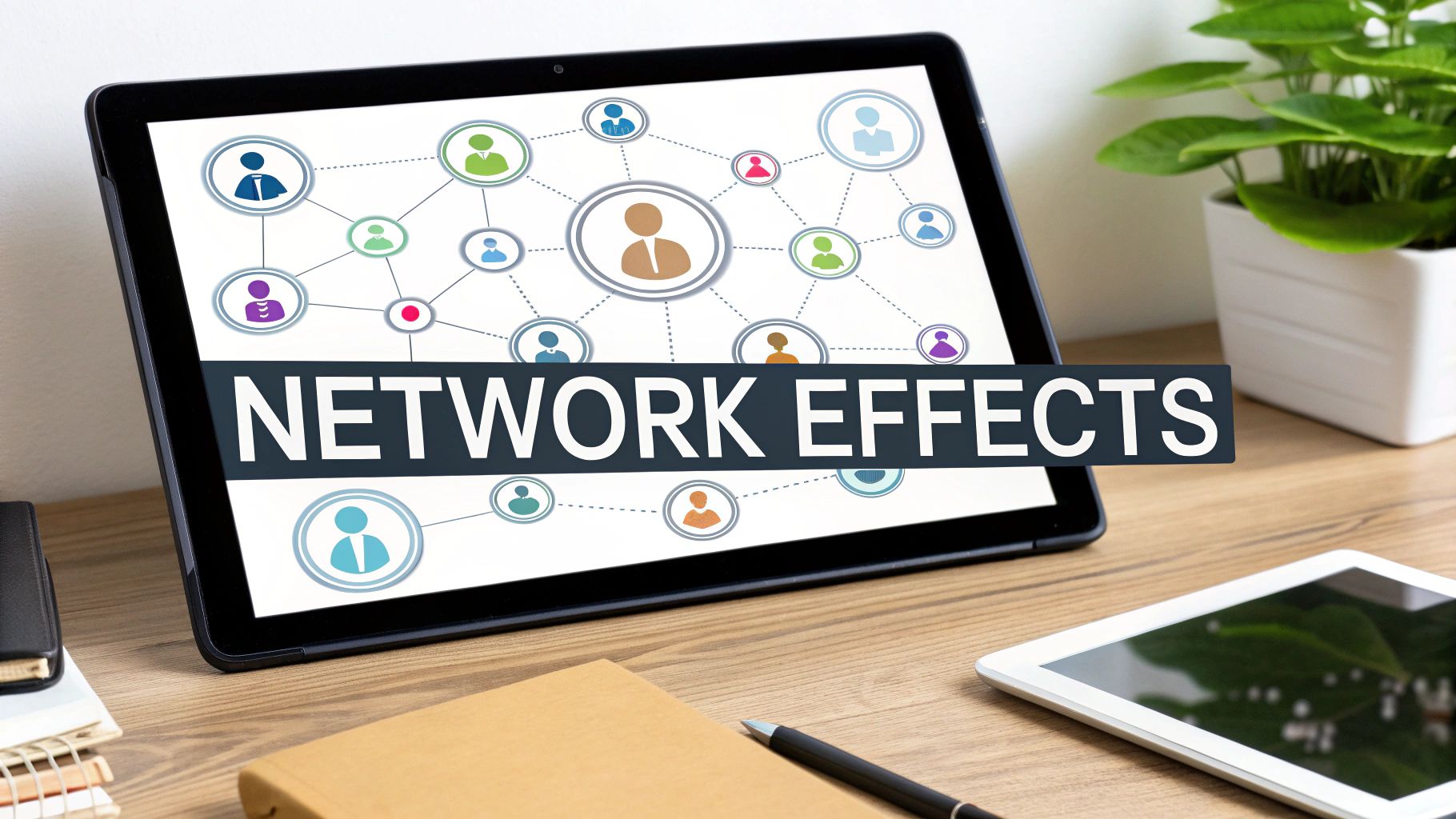
The power lies in network effects: the platform becomes more valuable as more people use it. OpenAI's API is a modern example. It provides the core GPT models, but its true value is unlocked by the thousands of developers building applications on top of it. This creates a powerful, self-reinforcing loop where more apps attract more users, which in turn justifies more investment in the core models.
Strategic Application and Key Benefits
A Platform Strategy as a sample of product strategy means you're in the business of building infrastructure and community. Your success is measured by the success of your participants. The initial, critical challenge is solving the "chicken and egg" problem: how to attract one side of the market without the other.
- Creates a Defensible Moat: Strong network effects build high switching costs. Leaving Facebook is hard because your friends are there.
- Enables Scalable Growth: Value is created by users, allowing the business to grow exponentially without a linear increase in internal resources.
- Fosters Innovation: An open platform with good APIs allows third parties to build solutions you never imagined, enriching the ecosystem.
Actionable Framework for Product Managers
- Solve the "Cold Start" Problem: You must initially "seed" one side of the market. Subsidize or manually onboard the "producer" side first (e.g., Airbnb recruited hosts from Craigslist; OpenAI gave early access to select developers).
- Build Foundational Tools: Your roadmap priority isn't features, it's enablers. Create robust APIs, easy-to-use SDKs, and clear documentation that make it simple for participants to interact and build.
- Establish Trust and Safety: Implement review systems, verification processes, and clear governance rules to make all users feel secure. This is non-negotiable for a healthy platform.
- AI Integration: Use AI-powered moderation tools to automatically flag fraudulent listings, inappropriate content, or policy violations. Use machine learning to improve matchmaking between sides of the platform (e.g., suggesting the right developer tool for a specific use case).
Career Impact: Experience as a Platform PM is a direct path to senior leadership (Director/VP level, $250k+). It demonstrates an ability to think in terms of systems, ecosystems, and long-term value creation, skills essential for C-suite roles.
4. Minimum Viable Product (MVP)
The Minimum Viable Product (MVP) is not a cheap version of your final product; it's a strategy for rapid, validated learning. The core idea is to launch a product with the absolute minimum features required to test a critical business hypothesis and gather real-world feedback. The strategic question is not "Can we build this?" but "Should we build this?"
This approach minimizes the risk of building something nobody wants. Dropbox famously used an MVP. Before writing a line of complex code for file syncing, they released a simple video demonstrating the concept. The overwhelming signup rate from that video validated their core hypothesis—that people desperately wanted a seamless file-syncing solution.
Strategic Application and Key Benefits
Using an MVP as a sample of product strategy forces ruthless prioritization. The goal is not a stripped-down product, but a focused product that does one thing exceptionally well to test one key assumption.
- Accelerates Learning: Provides the fastest way to get a product into users' hands and start collecting quantitative (usage data) and qualitative (feedback) insights.
- Reduces Development Waste: Prevents teams from investing months building features based on unproven assumptions.
- Validates Market Demand: Offers concrete evidence that you are solving a real problem for which customers will exchange value (time, money, data).
Actionable Framework for Product Managers
- Isolate the Core Hypothesis: Clearly state the single most important assumption you need to test in the format: "We believe that [TARGET AUDIENCE] will [PERFORM A KEY ACTION] because [REASON], which we can validate if we see [SUCCESS METRIC]."
- Define "Minimum" and "Viable": "Minimum" is the smallest feature set to test the hypothesis. "Viable" means it must be high-quality, bug-free, and solve a core problem effectively. A broken product is not a viable MVP. For guidance, read how to build an MVP that validates your idea fast.
- Measure and Iterate: Define clear success metrics before launch (e.g., 10% of users invite a teammate within 7 days). Be prepared to pivot or persevere based on the data. Before coding, it's often best to create a prototype of the product.
- AI Integration: Use AI tools to build the MVP itself. For example, use a no-code platform with GPT integration to create a functional prototype of an AI-powered app in days, not months, allowing for even faster hypothesis testing.
Career Impact: Demonstrating your ability to define and ship a successful MVP is a core competency for any PM, especially at startups and in new product divisions. It shows you are resourceful, data-driven, and focused on business impact, key traits for entry-level to mid-career PMs ($120k-$170k).
5. Blue Ocean Strategy
The Blue Ocean Strategy is about creating new market space rather than competing in an existing one. Instead of fighting rivals in a bloody "red ocean," this strategy focuses on making the competition irrelevant by creating an uncontested "blue ocean." It challenges you to redefine industry boundaries and create a leap in value for customers.
A classic example is the Nintendo Wii. While Sony and Microsoft were fighting a "red ocean" war over graphics and processing power for hardcore gamers, Nintendo created a "blue ocean." They targeted families and casual players with intuitive motion controls, creating an entirely new type of gaming experience. They didn't try to beat the competition; they made them irrelevant to their target market.
Strategic Application and Key Benefits
Adopting a Blue Ocean Strategy as a sample of product strategy requires you to pursue differentiation and low cost simultaneously, a concept called "value innovation." You do this by asking four key questions about industry standards:
-
Eliminate: Which factors that the industry takes for granted should be eliminated?
-
Reduce: Which factors should be reduced well below the industry standard?
-
Raise: Which factors should be raised well above the industry standard?
-
Create: Which factors should be created that the industry has never offered?
-
Creates Uncontested Markets: You set the rules in a space you defined.
-
Makes Competition Irrelevant: Your value proposition is so different that direct comparisons become meaningless.
-
Unlocks New Demand: Taps into non-customers who were previously ignored by the industry.
Actionable Framework for Product Managers
- Analyze the "As-Is" Value Curve: Map out the primary factors your industry competes on and how current players score on them (e.g., price, performance, features).
- Focus on Non-Customers: Deeply investigate why potential buyers are not using existing solutions. What are their biggest blockers and pain points?
- Apply the Four Actions Framework: Systematically challenge industry norms using the Eliminate-Reduce-Raise-Create model to sketch a new value curve.
- AI Integration: Use AI-powered market intelligence tools (like Crayon or Klue) to analyze competitor messaging, customer reviews, and industry trends at scale. This can help you spot "red ocean" patterns and identify gaps where a "blue ocean" opportunity might exist.
Career Impact: PMs who can successfully lead a Blue Ocean initiative are seen as true innovators and are on a fast track to senior leadership. This is a high-risk, high-reward strategy that, if successful, can define a career and position you for Head of Product or CPO roles ($275k+).
6. Subscription Model
The subscription model shifts the revenue focus from one-time sales to recurring payments for ongoing access to a product or service. This fundamentally changes the company-customer relationship, prioritizing long-term retention over short-term acquisition. The customer journey becomes a continuous cycle of delivering value to justify the next renewal.
Netflix is a prime example. They don't just sell you a movie; they sell ongoing access to a constantly updated library of entertainment. This creates a predictable revenue stream (Monthly Recurring Revenue or MRR) and forces the company to be obsessed with engagement. Their product strategy isn't just about launching new shows; it's about using data to recommend the right content to keep you subscribed.
Strategic Application and Key Benefits
Using a subscription model as a sample of product strategy makes retention your North Star metric. The strategic goal isn't just to make a sale; it's to earn the customer's business every single month. Churn becomes your primary enemy.
- Creates Predictable Revenue: Monthly or annual recurring revenue (MRR/ARR) is highly valued by investors and allows for stable financial planning.
- Fosters Customer Relationships: Creates a direct line to your customer, encouraging continuous engagement and feedback.
- Enables Continuous Improvement: Provides a stable financial base to fund ongoing development and deliver incremental value regularly, without needing big "version 2.0" launches.
Actionable Framework for Product Managers
- Obsess Over Churn and LTV: Your key metrics are Churn Rate, Customer Lifetime Value (LTV), and LTV:CAC (Customer Acquisition Cost) ratio. A healthy SaaS business aims for an LTV:CAC ratio of 3:1 or higher.
- Nail the Onboarding Experience: The first 7 days are critical. Your roadmap must prioritize features that help new users achieve their first "aha!" moment as quickly as possible to reduce early churn.
- Build a Retention-Focused Roadmap: Prioritize features that increase "stickiness" (e.g., integrations, collaboration), solve recurring problems, and provide clear, ongoing value to justify the next payment.
- AI Integration: Implement a predictive churn model using machine learning. Analyze user behavior patterns (e.g., decreased login frequency, fewer key actions) to identify at-risk accounts, then trigger automated re-engagement campaigns or alerts for the customer success team.
Career Impact: Experience in a subscription/SaaS business is almost a prerequisite for most modern PM roles. Being able to intelligently discuss MRR, churn, and LTV is table stakes for mid-career and senior PM interviews ($150k-$250k).
7. Product Differentiation Strategy
A Product Differentiation Strategy focuses on making your product uniquely attractive to a target market by emphasizing superior quality, unique features, or an exceptional customer experience. Instead of competing on price, you compete on value. The goal is to be the best option for a specific customer segment, creating a compelling reason to choose your product over all others.
Apple is the master of differentiation. They don't sell computers; they sell beautifully designed tools for creative professionals that "just work." Their differentiation is built on premium hardware design, a seamless software ecosystem, and a powerful brand identity. They don't compete on price because their customers aren't buying on price; they're buying into the Apple experience.
Strategic Application and Key Benefits
Using differentiation as a sample of product strategy means you must deeply understand what your target customers truly value beyond basic functionality. Your competitive advantage comes from being unique in a way that is difficult for rivals to copy.
- Reduces Price Sensitivity: When customers perceive unique value, they are willing to pay a premium.
- Builds Brand Loyalty: A strong differentiator creates an emotional connection, turning customers into advocates.
- Creates a Defensible Market Position: Unique attributes like proprietary technology, a trusted brand, or a superior user experience are hard to replicate.
Actionable Framework for Product Managers
- Identify Your "Spike": You can't be the best at everything. Identify the one or two dimensions where you will be radically better than the competition (e.g., ease of use, performance, customer support, design).
- Map the Competitive Landscape: Create a 2×2 matrix plotting key value dimensions in your market. Identify where there is a crowded space (the "red ocean") and where there is an open opportunity.
- Communicate the Difference Relentlessly: Your marketing, sales, and in-product messaging must consistently and clearly articulate what makes your product superior and why it matters to the customer.
- AI Integration: Use AI to create a hyper-personalized user experience, a powerful differentiator. For example, an e-commerce site can use a recommendation engine to create a unique homepage for every user, or a productivity tool can use AI to suggest personalized workflows.
Career Impact: PMs who can successfully carve out a differentiated market position demonstrate strong strategic and commercial acumen. This is a key skill for Principal PM and Group PM roles ($200k+), where you are expected to own a business line and defend its market position.
8. Growth Hacking Strategy
A Growth Hacking Strategy prioritizes rapid, scalable user acquisition through creative, low-cost tactics embedded directly into the product. It's a mindset that blends product, marketing, and engineering, focused on a continuous cycle of data-driven experimentation to achieve explosive growth.
Hotmail's classic growth hack—adding "P.S. I love you. Get your free email at Hotmail" to every user's email signature—is the perfect example. It turned every email sent into a viral marketing message, driving exponential growth at zero marginal cost. This wasn't a marketing campaign; it was a product feature designed for growth.
Strategic Application and Key Benefits
Using growth hacking as a sample of product strategy means every feature is evaluated through the lens of "How will this help us grow?" The goal is to build a self-perpetuating growth engine, often described by the AARRR (Acquisition, Activation, Retention, Referral, Revenue) pirate metrics funnel. Dropbox's two-sided referral program ("give 500MB, get 500MB") is a masterclass, driving a 3900% growth in 15 months by directly incentivizing viral sharing.
- Cost-Effective Scalability: Unlocks exponential growth without a proportional increase in marketing spend.
- Data-Informed Decisions: Relies on A/B testing and analytics to validate hypotheses, reducing reliance on gut feelings.
- Product-Led Growth: Makes the product itself the primary driver of acquisition and retention.
Actionable Framework for Product Managers
- Identify Your North Star Metric (NSM): Focus the entire team on a single metric that best captures the core value your product delivers (e.g., for Airbnb, it's "nights booked"). All experiments should aim to move this number.
- Build an Experimentation Pipeline: Use a simple framework (e.g., ICE: Impact, Confidence, Ease) to score and prioritize a backlog of growth ideas. Run multiple small, high-tempo tests weekly.
- Analyze the AARRR Funnel: Map every step of the user journey and identify the biggest drop-off points. Isolate the one conversion point that, if improved, would have the biggest impact on your NSM, and focus your experiments there.
- AI Integration: Use AI-powered tools like Mutiny or VWO to dynamically personalize website and onboarding experiences for different user segments, dramatically increasing activation and conversion rates with minimal engineering effort.
Career Impact: Growth PM is one of the most in-demand and well-compensated roles in tech ($165k-$220k+). Success in this area requires a rare blend of data analysis, creativity, and technical understanding, making it a highly visible and impactful career path. Explore top SaaS marketing strategies for growth to get started.
9. Vertical Integration Strategy
A vertical integration strategy is when a company takes control over multiple stages of its production and supply chain. Instead of outsourcing, the company owns everything from component design and manufacturing to distribution and sales. This provides ultimate control over quality, cost, and the customer experience.
Tesla is the modern archetype of vertical integration. They design their own chips, write their own software, manufacture their own batteries and vehicles, and operate their own sales centers and charging network. This gives them an unparalleled ability to innovate and create a seamless experience that competitors relying on a fragmented network of suppliers cannot match.
Strategic Application and Key Benefits
Using vertical integration as a sample of product strategy is a capital-intensive move that trades flexibility for control. Apple does this by designing its own A-series and M-series chips, giving them a performance advantage that competitors using off-the-shelf components from Qualcomm or Intel struggle to match.
- Greater Quality Control: Ensures every component and customer touchpoint meets the company's standards.
- Reduced Supply Chain Risk: Decreases dependency on external suppliers who can cause delays or leak secrets.
- Enhanced Innovation: Enables tight integration between hardware, software, and services, unlocking unique features (e.g., Apple's Face ID).
Actionable Framework for Product Managers
- Analyze the Value Chain: Map out every step from raw materials to the end customer. Identify which parts of this chain are most critical to your unique value proposition or pose the biggest risk.
- Evaluate Build vs. Buy: For a critical component, determine if it's more strategic to build the capability internally over time or acquire a company that already possesses it.
- Focus on Strategic Control Points: Don't integrate for the sake of it. Focus on integrating the stages that provide a distinct competitive advantage and directly enhance the end-product value.
- AI Integration: Use AI and robotics to optimize manufacturing and supply chain logistics within your integrated system. Predictive maintenance on factory equipment and AI-optimized inventory management can turn vertical integration from a cost center into a significant efficiency advantage.
Career Impact: PMs working in vertically integrated companies (common in hardware, automotive, and deep tech) develop a "general manager" skillset. Understanding supply chains, manufacturing, and operations in addition to product makes you a candidate for COO or GM roles later in your career.
10. Agile Product Development
Agile is not just a development process; it's a strategic framework for execution that prioritizes flexibility, customer collaboration, and iterative progress. Instead of a rigid, long-term plan ("waterfall"), Agile breaks work into small increments ("sprints") to build, measure, and learn in rapid cycles. This allows the product strategy to adapt to real-world feedback.
Spotify’s famous "squads, tribes, chapters, and guilds" model is an organizational structure built entirely around Agile principles. It's designed for autonomous teams to ship features and run experiments independently and quickly. This allows them to constantly test new ideas and improve the user experience without monolithic, high-risk releases. The strategy is not to get it right the first time, but to create a system that finds the right answer faster than anyone else.
Strategic Application and Key Benefits
Adopting agile as a sample of product strategy means treating the product roadmap as a living document of testable hypotheses, not a fixed schedule. The strategy is about maximizing the value delivered in the next sprint based on the latest data and customer insights.
- Accelerates Time-to-Market: Delivers functional product increments quickly, enabling earlier user feedback and revenue generation.
- Reduces Development Risk: Short, iterative cycles catch incorrect assumptions early, minimizing wasted engineering effort.
- Enhances Product-Market Fit: Bakes continuous customer feedback directly into the development process, ensuring you build what users actually need.
Actionable Framework for Product Managers
- Maintain a Prioritized Backlog: Your product backlog is a strategic tool. Continuously groom it to ensure the team is always working on the highest-value items that align with your current strategic goals (OKRs).
- Establish a Clear "Definition of Done": Work with engineering to create a shared understanding of what it means for a task to be complete. This ensures quality and predictability.
- Lead Effective Retrospectives: Guide the team in regular retrospectives to identify what's working, what's not, and what to improve in the next cycle. This is the engine of continuous improvement.
- AI Integration: Use AI-powered project management tools like Linear or Jira with AI features to automate sprint planning, predict delivery timelines, and flag potential roadblocks by analyzing past performance data. This frees up PMs to focus on strategy rather than process.
Career Impact: Mastery of Agile is a baseline requirement for virtually all PM roles today. However, truly leading an agile team—by setting a clear vision, ruthlessly prioritizing, and fostering a culture of continuous learning—is what distinguishes senior PMs and is a core leadership competency.
Top 10 Product Strategy Comparison
| Approach | Implementation Complexity 🔄 | Resource Requirements ⚡ | Expected Outcomes 📊 | Ideal Use Cases 💡 | Key Advantages ⭐ |
|---|---|---|---|---|---|
| Jobs to Be Done Framework | Moderate–High — deep qualitative research & synthesis | Moderate — skilled researchers, time investment | Deeper customer insights; better product-market fit | New-product discovery, repositioning, reducing PMF risk | Predicts behavior; uncovers unmet needs |
| Freemium Model | Low–Moderate — tier design, billing & conversion flows | High — infrastructure & support for large free base | Rapid user growth with low CAC; low free→paid conversion rate | Consumer apps, content platforms, product-led growth | Scales user base; demonstrates value pre-purchase |
| Platform Strategy | High — multi-sided design, governance, network mechanics | High — developer tools, marketplace liquidity investment | Exponential value via network effects; multiple revenue streams | Marketplaces, developer ecosystems, multi-stakeholder products | Strong defensibility; high switching costs |
| Minimum Viable Product (MVP) | Low — focus on core features, rapid build-measure-learn | Low — minimal dev resources & fast iterations | Quick hypothesis validation; reduced development risk | Early-stage startups; testing core assumptions | Fast learning; cost-efficient validation |
| Blue Ocean Strategy | High — strategic innovation and market creation | High — investment in novel value propositions | Uncontested markets initially; higher margins but uncertain demand | Radical differentiation, entering untapped markets | Less direct competition; strong differentiation |
| Subscription Model | Moderate — recurring billing, retention systems | Moderate–High — product continuity, retention efforts | Predictable recurring revenue; higher CLV, churn sensitivity | SaaS, media streaming, services requiring ongoing access | Predictable MRR; deeper customer relationships |
| Product Differentiation Strategy | Moderate–High — sustained R&D and brand work | Moderate–High — innovation, marketing, quality control | Premium pricing, brand loyalty; narrower target segments | Markets where quality/brand drives purchase decisions | Enables premium pricing; reduces price wars |
| Growth Hacking Strategy | Moderate — rapid experiments and analytics loops | Low–Moderate — analytics, engineering time, creative spend | Fast user acquisition; variable sustainability & scale | Early growth phases, low-budget rapid traction seeks | Low-cost acquisition; rapid scaling potential |
| Vertical Integration Strategy | High — managing multiple value-chain layers | High — capital, operations, and specialized teams | Lower supply costs, margin improvement, less disruption | Businesses needing supply control or quality assurance | Better cost control; improved quality & margins |
| Agile Product Development | Moderate — iterative processes, disciplined ceremonies | Moderate — cross-functional teams, tooling for CI/CD | Faster time-to-market; continuous improvement & feedback | Ongoing product delivery, teams needing responsiveness | Faster delivery; improved adaptability and team alignment |
Putting Strategy Into Action: Your Next Steps
We've covered 10 distinct strategic frameworks, from the deep user empathy of Jobs to Be Done to the market-creating power of Blue Ocean. You've seen how a sample of product strategy like Freemium propelled Slack to a multi-billion dollar exit, and how Vertical Integration gives Tesla a competitive edge. Each model is a powerful tool for your PM toolkit.
The most critical takeaway is that strategy is not a document you write once a year; it is the active, daily practice of making disciplined choices. It’s choosing to win with a superior user experience over a lower price. It's choosing to build a platform instead of just a feature. As a Product Manager, your job is to frame these choices, arm your team with the data to make them intelligently, and articulate the "why" behind your roadmap.
From Theory to Tangible Results
A well-chosen strategy transforms a vague business goal into an actionable plan. It aligns engineering, design, and marketing around a coherent vision, answering the "why" behind every feature you prioritize.
Think about your product's most pressing challenge right now:
- Struggling with user acquisition? A Growth Hacking or Freemium strategy provides a playbook.
- Facing intense competition? Product Differentiation or Blue Ocean are your paths to breaking away.
- Unsure what to build next? An MVP approach guided by JTBD will bring clarity and reduce risk.
Mastering these frameworks is what separates a mid-level PM from a senior leader. It’s the difference between managing a backlog and shaping a market. Your ability to articulate, defend, and execute a clear product strategy is the single most valuable skill for career advancement.
Your Action Plan for the Next 48 Hours
Knowledge without action is useless. To turn these insights into impact, follow this high-leverage plan.
- Select One Framework: Identify the single most relevant strategy from this article that addresses your product's primary challenge today. Is it growth, competition, or validation? Pick one.
- Draft a One-Page Strategy Canvas: Spend 25 minutes creating a simple one-page document. At the top, name the framework (e.g., "Freemium Strategy"). Below, create bullet points for: Core Hypothesis, Target Audience, Key Metrics to Track (e.g., Free-to-Paid Conversion %), and Key Roadmap Bets. This makes the strategy tangible.
- Schedule a 30-Minute "Strategy Spark" Session: Book a meeting with your engineering lead and a marketing counterpart. Present your one-pager not as a final decision, but as a conversation starter. Your goal is to spark a more structured, strategic dialogue about your product's direction.
This simple process moves you from being a passive feature manager to an active strategic leader. By introducing a proven sample of product strategy into your team's workflow, you elevate the conversation from "what are we building?" to "why are we building it, and how will it win?" This is the work that gets you promoted.
For an even deeper dive into advanced product strategy, growth, and the latest trends in AI-powered product management, I highly recommend following the work of Aakash Gupta. His newsletter and essays provide the tactical, behind-the-scenes insights from an industry leader who has shaped products at companies like Google and Epic Games. You can find his invaluable content at Aakash Gupta.
