Most advice about the vp of product role starts in the wrong place. It tells you to think bigger, act like a mini-CEO, and own the vision. That sounds impressive. It also produces a lot of weak product leadership.
The role is not about personal ownership theater. It is about disciplined judgment across a portfolio, a team, and an executive table that often wants different things at the same time. In a startup, that means deciding where scarce engineering time goes. In a scale-up, it means building a machine that can keep shipping without turning PMs into ticket clerks. In a larger company, it means translating strategy into investment choices people can execute.
That distinction matters most for PMs trying to move up. Strong Senior PMs usually win through depth. Strong VPs win through allocation, people judgment, and alignment. Those are different muscles.
The VP of Product Is Not the CEO of the Product
“CEO of the product” is one of the most damaging phrases in product management.
A CEO has formal authority over the company. A vp of product does not. A VP works through influence, evidence, trade-offs, and operating mechanisms. If you internalize the CEO metaphor too strictly, you start behaving as if conviction alone should move engineering, design, sales, marketing, and the leadership team. It will not.
The better model is chief product portfolio manager.
That means your core job is not to “own everything.” It is to decide which problems deserve investment, which bets need more proof, which teams need stronger leaders, and which requests should die early. Engineering time is capital. Design attention is capital. Leadership bandwidth is capital. The VP allocates all three.
Google, Meta, and OpenAI offer useful reality checks here. These companies do not run on charismatic product speeches alone. They run on decision systems, resource choices, and repeated alignment across technical and commercial constraints. Even when a leader has strong product instincts, the work still comes down to sequencing, trade-offs, and organizational clarity.
What the CEO metaphor gets wrong
The metaphor usually pushes people into three bad habits:
- Authority inflation: You assume your title should settle debates.
- Feature attachment: You over-identify with a roadmap instead of managing a portfolio.
- Hero behavior: You jump into product details to prove expertise instead of empowering the team.
A VP who behaves like a super-PM may look busy. That same VP usually creates dependency, slows decisions, and trains the org to escalate everything upward.
What to replace it with
Use a simpler framing:
- You are accountable for product outcomes
- You are responsible for the product management system
- You are rarely the person who should have the strongest opinion on every feature
That last point is hard for ambitious PMs. It is also the unlock.
A useful companion lens is the distinction between leadership vs management. A VP needs both. Leadership without operating discipline turns into vague inspiration. Management without leadership turns into roadmap administration.
The vp of product role gets stronger when you stop asking, “What should I personally own?” and start asking, “What system will let this org make better product decisions without me in every room?”
What a VP of Product Does
A practical way to understand the role is to think like an investment manager. The vp of product manages assets, managers, and stakeholders. If any one of those breaks, the org starts to drift.

Manage the product portfolio
This is the strategy part, but not in the abstract. The VP decides how much of the company’s product investment goes to core growth, retention, platform health, new bets, and urgent market needs.
That means asking hard questions that Directors and PMs often cannot answer alone:
- Which roadmap items support company goals?
- Which bets are under-evidenced?
- Where are teams shipping motion instead of value?
- What should we stop funding?
At Google, Meta, and OpenAI, product leaders do not just generate ideas. They choose what deserves concentrated talent and compute. The same principle applies in a much smaller B2B SaaS company. Your roadmap is a capital allocation document whether you treat it that way or not.
A VP also has to balance technical feasibility, business viability, and customer desirability. Product School describes the role in exactly those terms, and notes that VPs who use OKRs to tie 60% of team goals to a North Star Metric and reject 70% of low-ROI sales requests see 25% higher customer LTV in SVPG execution benchmarks (Product School on VP product leadership).
Manage the product team
A weak VP spends too much time evaluating ideas. A strong VP spends serious time evaluating and upgrading the people system.
That includes:
- Hiring PMs for the next stage, not the last one
- Coaching managers, not just individual contributors
- Defining decision rights across PM, design, and engineering
- Building operating rhythms that make quality repeatable
In practice, the team question is often harder than the strategy question. Most product plans are fixable. A mis-scoped org with unclear accountability is much harder to rescue. Many scale-ups struggle with this. They promote their best PM into a broad leadership role, then keep rewarding that person for solving individual product problems instead of building a stronger bench.
Manage the executive and board interface
The VP also manages “limited partners,” meaning the executive team, CEO, and sometimes the board. These people fund the product organization, shape expectations, and judge whether product is helping the business move.
That work includes:
| Executive interface job | What good looks like |
|---|---|
| Translate strategy | Explain roadmap choices in business terms |
| Create alignment | Surface trade-offs before they become political fights |
| Set expectations | Be explicit about what will not happen this half |
| Defend focus | Push back on reactive requests without becoming ideological |
If you cannot do this, product becomes a service function. Sales starts pulling roadmap exceptions. Engineering fills the vacuum with architecture priorities. The CEO starts going direct to PMs.
A VP is not measured by how well they describe the roadmap. They are measured by whether the company can make coherent product decisions under pressure.
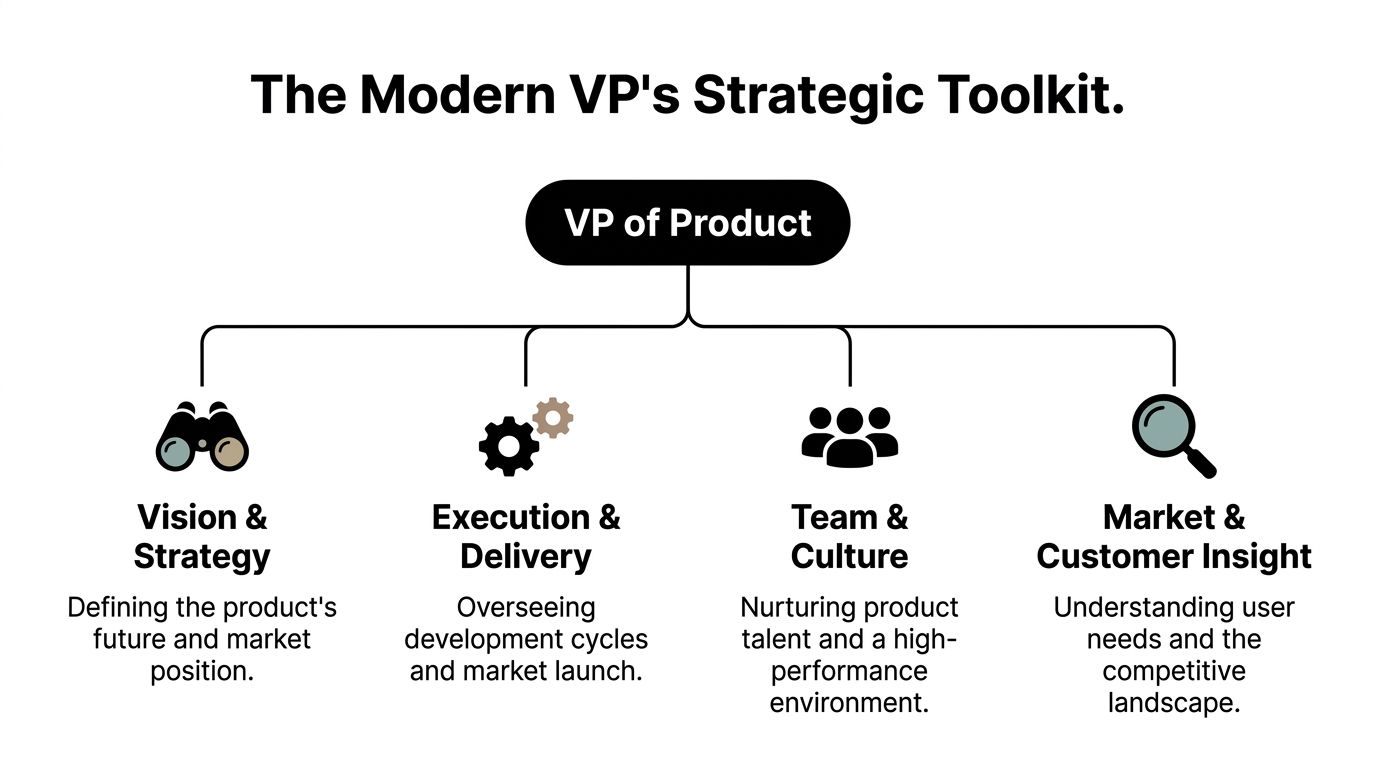
The Modern VP's Strategic Toolkit
A modern vp of product needs a toolkit that converts ideas into greater operational impact. Vision is part of it, but only part. The rest is structure, communication, and decision quality under ambiguity.
Start with written strategy
Strong product orgs write before they build. Amazon popularized PR/FAQ. Other teams use memos, narrative docs, or one-page strategy briefs. The format matters less than the discipline.
A good strategic artifact answers:
- What customer problem matters enough to solve now
- Why this is the right time
- What changed in the market or product
- What success would look like
- What we are not doing
At Meta-scale companies, this writing discipline prevents meetings from becoming opinion contests. At smaller companies, it prevents roadmap drift.
If your current strategy is a deck full of ambition and no hard choices, fix that first. A practical way to do it is to use a product strategy template that forces scope, sequencing, and evidence. This product strategy framework is a useful example of the kind of structured artifact teams can adapt.
Build an org that can scale judgment
The best org design is not the fanciest model. It is the one that makes accountability obvious.
Spotify’s squad and tribe language became popular because it gave companies a vocabulary for autonomy and coordination. The mistake was copying the labels without copying the thinking. Titles do not create clarity. Interfaces do.
For most scale-ups, org design gets better when you answer four questions cleanly:
- What is each team’s mission
- What metrics define success
- Who makes the call when design, engineering, and product disagree
- Where do dependencies get resolved
Google and OpenAI both show a broader lesson here. Highly technical environments do not reduce the need for product leadership. They increase the need for sharper interfaces between research, engineering, product, and go-to-market.
Use AI where it improves signal
AI is changing the operating model for product leaders, especially in research-heavy work. The win is not “AI writes my strategy.” The win is faster synthesis, broader pattern detection, and better preparation.
Practical uses:
- Competitive analysis: Use ChatGPT, Claude, or Perplexity to summarize product positioning, release notes, pricing pages, and messaging changes across competitors.
- Customer insight synthesis: Feed call transcripts from Gong, Chorus, Zoom, or support systems into AI workflows to cluster repeated pain points.
- Drafting decision docs: Use AI to produce first-pass memos, then sharpen with product judgment.
- Signal review: Summarize NPS comments, churn reasons, onboarding friction, and sales objections before staff meetings.
The human job is still the hard part. You decide what matters, what is noise, and what deserves investment.
Turn executive communication into an an operating advantage
A surprising amount of VP performance comes down to writing and presenting clearly. If you cannot explain a trade-off in a way the CEO, CFO, and CTO all understand, your roadmap will be unstable.
That is why I recommend deliberate practice in executive communication, not just better slides. This guide on executive communication skills training is useful because it focuses on message structure and executive-level clarity rather than generic presentation advice.
A short operating rule works well: every major product recommendation should fit into a one-page narrative with a decision request, business context, expected outcome, risk, and alternatives considered.
A quick visual explanation can also help when you need to align a broader team.
Build one management system, not ten ceremonies
A VP does not need more meetings. The org needs a small set of management loops that work:
| Operating loop | What it should answer |
|---|---|
| Weekly product review | Are the highest-priority bets moving, blocked, or drifting? |
| Monthly portfolio review | Are we funding the right bets? |
| Quarterly strategy review | What changed in customers, market, or company goals? |
| Talent review | Who is ready for more scope, and where are the management gaps? |
If you want one body of work to benchmark against, Aakash Gupta’s product leadership material is relevant here because it focuses on systems for product growth, management strategy, and leadership job search, rather than generic PM motivation.
Modern VPs win by making good decisions easier for the organization. They do not scale through personal brilliance alone.
The Career Path From PM to VP of Product
Most PMs underestimate how discontinuous this path is. The move from Senior PM to Director feels like a bigger version of the same job. The move from Director or Head of Product to vp of product is different in kind.
PW Skills notes an estimated 68% of Senior PM to VP promotions fail within 18 months in non-unicorn companies, often because people do not shift from tactical execution to strategic influence. The same source says 40% of successful VPs in major markets come from adjacent backgrounds such as sales or engineering, which is a useful reminder that cross-functional leadership matters as much as classic PM craft (PW Skills on VP of Product responsibilities).
The scope shift at each level
The easiest way to map the journey is by what you own.
| Level | Primary scope | Skill that matters most |
|—|—|
| Senior PM | A product area or major surface | Product judgment |
| Group PM or Lead | Multiple PMs or a broader domain | Coaching and coordination |
| Director or Head of Product | A business line or major org slice | Org design and prioritization |
| VP of Product | The product portfolio and product leadership system | Executive alignment and capital allocation |
A Senior PM succeeds by being right often. A VP succeeds by helping the company be right more often.
That means your growth plan has to include more than product craft. It has to include hiring, budgeting logic, board-level communication, and the ability to manage strong peers in engineering, design, sales, and finance.
A 12-month plan to get ready
The most reliable path I have seen is intentional preparation over a year, not hoping a promotion will somehow teach you the job.
Months 1 to 3
Pick up one level of scope beyond your title.
- Own a cross-functional initiative: Choose something with engineering, design, GTM, and support dependencies.
- Write strategy artifacts: Volunteer for an annual plan, investment memo, or roadmap narrative.
- Learn the business model: If you cannot explain pricing, packaging, churn drivers, and expansion motion, fix that first.
Months 4 to 6
Shift from project leadership to people influence.
- Mentor PMs actively: Not ad hoc. Give structured feedback on prioritization, stakeholder handling, and discovery quality.
- Run a review forum: Portfolio review, product review, or launch review. Learn to keep leaders aligned under tension.
- Partner with finance and sales: VPs must understand commercial trade-offs, not just user needs.
Months 7 to 9
Practice executive-level communication.
- Present trade-offs, not status: Bring recommendation memos with options, risks, and asks.
- Defend focus: Push back on requests that do not support strategy.
- Handle ambiguity in public: Senior leaders watch how you behave when data is incomplete.
Months 10 to 12
Operate as the probable successor.
- Build a talent point of view: Who on the team is under-scoped, over-scoped, or miscast?
- Draft an org recommendation: Show how you would structure PM coverage for the next stage.
- Create a VP-ready portfolio narrative: Explain where investment should increase, stay flat, or stop.
A more detailed career ladder can help you benchmark where your current scope really sits. This product management career path is useful for seeing how titles and responsibilities tend to evolve across stages and company sizes.
Skills that usually lag behind
The gaps that block promotion are predictable.
- Business fluency: Many PMs can discuss users and features, but not margin, pricing, or revenue implications.
- Talent judgment: Leadership teams promote people who can build teams, not just influence them.
- Executive presence: Not charisma. Clarity, composure, brevity, and conviction under scrutiny.
- Political maturity: Product leaders need to disagree cleanly and preserve trust.
If you want a VP role, stop optimizing only for stronger product artifacts. Start optimizing for broader trust.
Landing the VP of Product Role
By the time you apply for a vp of product role, your resume matters less than your narrative. Companies hire VPs when they believe the candidate can solve a stage-specific problem.
One company needs portfolio discipline. Another needs a product org rebuilt after fast hiring. Another needs a leader who can partner tightly with an AI-heavy engineering group. If you show up with generic “I drive strategy and execution” language, you blend into the pile.
Read the job description like an operating diagnosis
A VP job spec tells you less about the title and more about the company’s pain.
If the posting emphasizes “cross-functional alignment,” they probably have executive friction. If it stresses “scaling product processes,” the team may be inconsistent or too dependent on founder decisions. If it repeatedly mentions AI, platform, or technical depth, they may need someone who can translate between research-heavy engineering teams and commercial priorities.
When I review VP candidates, I look for whether they can reverse-engineer the business problem from the hiring language. That is a better signal than a polished executive summary.
Questions to ask yourself when tailoring the application:
- What stage is this company in
- What would break in the next year if they do nothing
- Why are they hiring a VP instead of another Director
- Which of my examples prove I can solve that specific problem
Prepare for executive-level interview prompts
VP interviews are usually testing how you think under compression.
Common prompts include:
- How would you structure the product organization here?
- Which parts of the current roadmap would you revisit first?
- How do you decide when to sunset a product?
- What should product own versus engineering or design?
- How would you manage conflict between enterprise sales needs and platform strategy?
Strong answers share a pattern.
Lead with a framework
Do not jump straight into anecdotes. Give the interviewer your decision logic first.
For example, on org structure:
- Start with company goals.
- Map the product portfolio.
- Define ownership boundaries.
- Check manager quality.
- Only then decide structure.
Use one real example
Pick a situation where you reallocated investment, changed team structure, or reset a roadmap. Keep it tight. Focus on judgment and trade-offs.
End with what you would test first
Executives hire for orientation, not certainty. A good VP candidate knows what they would want to learn in the first few weeks before making structural changes.
If your communication at this level still feels too detailed or too tactical, sharpen it. This guide on how to present to executives is a useful benchmark for the level of compression and decision framing these interviews require.
Know the compensation range before you negotiate
Compensation is one place where too many product leaders still improvise.
According to 2024 data aggregated by Paraform and cited in Indeed, average VP of Product salaries in major US markets range from $183,000 to $255,000 annually, with reported figures including Zippia at $183,231, Product School at $199,563, Built In at $217,391, Comparably at $254,994, Glassdoor at $195,110, and Indeed at $191,476. The same source notes that startup roles can include substantial equity, including $11M-$14M equity for some Series B remote roles and $15M for a Series A Bay Area role (Indeed guide to what a VP of Product does).
VP of Product Salary Benchmarks (USA, 2026)
| Source | Average Base Salary (USD) |
|---|---|
| Zippia | $183,231 |
| Indeed | $191,476 |
| Glassdoor | $195,110 |
| Product School | $199,563 |
| Built In | $217,391 |
| Comparably | $254,994 |
A few negotiation rules hold up well:
- Negotiate the whole package: Base, equity, title, scope, and reporting line all matter.
- Clarify what success means: A vague mandate weakens your position later.
- Ask about stage-specific expectations: Growth, turnaround, platform build, and AI transformation are different jobs hiding under one title.
Your First 90 Days as a New VP of Product
The first quarter decides whether people see you as a stabilizing executive or an expensive interruption.
Most new vp of product hires fail in one of two ways. They either change too much before they understand the system, or they spend too long “listening” and create no momentum. You need both diagnosis and movement.
If you want a companion template for sequencing your entry plan, this resource on Create a Winning 30-60-90 Day Plan for Success is a practical reference. Adapt it to product leadership rather than using it as a generic onboarding checklist.
Days 1 to 30
Start with observation, but make it structured.
Meet the CEO, CTO, design lead, sales leader, customer success leader, finance partner, and your PM team. Ask each of them the same core questions so you can compare narratives rather than collecting random impressions.
Use a short set:
- What do you believe product is doing well?
- Where is product slowing the company down?
- Which roadmap item worries you most?
- What decision gets stuck too often?
- Which PM or manager has more capacity than we are using?
Also review the product operating system itself. Look at current roadmaps, KPI definitions, planning docs, launch notes, support themes, sales objections, and team rituals.
If you are joining a startup or scale-up, this product management for startups guide is relevant because early-stage product organizations often blur product, founder, and GTM decisions. A new VP needs to untangle those quickly.
What to avoid in the first month
- Do not reorg on instinct
- Do not declare a new strategy from interview impressions
- Do not bypass existing managers to “get the truth”
- Do not promise roadmap changes before you understand engineering constraints
Days 31 to 60
By now, you should have a point of view.
It does not need to be a grand strategy deck. It does need to answer a few things clearly:
| Question | What your answer should include |
|---|---|
| Where are we over-investing | Teams or bets with weak evidence |
| Where are we under-investing | Products, capabilities, or customer problems with strong impact |
| What is unclear | Ownership, metrics, or decision rights |
| What can improve fast | One or two process fixes that reduce drag |
This is the right time to identify an early win. Pick something meaningful but tractable. Good examples include cleaning up product review cadence, resetting roadmap ownership, tightening launch criteria, or clarifying one strategic investment decision that has been lingering.
Share your initial diagnosis with the executive team in writing. Keep it brief. State the observed problems, the likely causes, and what you want to test next.
In the second month, credibility comes from clarity. Not confidence theater.
Days 61 to 90
The third month is for visible execution.
You should have one early improvement in motion and one bigger decision framed for the next planning cycle. This proves you can both operate and think long-term.
A strong pattern in this phase looks like:
- Ship a process improvement: for example, a cleaner product review or portfolio review cadence
- Make one staffing call: close a leadership gap, redefine scope, or support a manager more directly
- Reset one planning mechanism: simplify quarterly planning, define ownership boundaries, or introduce better written decision docs
- Stay close to customers: sit in on calls, review support pain points, and keep your own product intuition grounded
The VP role can become abstract fast. The best leaders resist that drift. They do not micromanage feature details, but they stay connected enough to know whether the product experience matches the executive story.
Common VP Failure Modes and How to Avoid Them
Most new vp of product failures are not mysterious. They are visible early if you know what to watch.
Acting like a super IC
You might be failing if every major decision still routes through you, PMs wait for your edits before moving, and you keep jumping into feature-level debates to prove your value.
The fix is uncomfortable but simple. Cultivate influence intentionally. Coach PMs on decision quality, clarify ownership, and let managers manage. Your job is to improve the system, not win every product argument.
Becoming a stakeholder service desk
You might be failing if roadmap additions appear through side conversations with sales, the CEO, or a single major customer.
A VP has to absorb pressure without turning the roadmap into a political document. That means requiring a common intake path, writing down trade-offs, and saying no with economic logic rather than ideology.
Letting PMs become product janitors
This is one of the costliest failure modes because it looks like productivity from the outside.
Rich Mironov argues that without VP-level enforcement of roughly a 10:1 engineer-to-PM ratio, PMs get pulled into less impactful work and output can be diluted by 30% to 50%. He also notes that VPs who audit workloads and protect 20% of PM time for discovery see 25% faster roadmap delivery (Rich Mironov on the VP PM ratio problem).
Warning signs
- PMs spend most of their week in status, bugs, and coordination
- Discovery gets postponed repeatedly
- No one can explain why certain admin work still sits with PMs
- The team confuses motion with product leadership
What to do
- Audit workload quarterly: Look at where PM time goes.
- Protect discovery time: If it is not blocked, it will be consumed.
- Hire support roles where needed: Technical writing, program management, or analytics can remove drag.
- Reset expectations with executives: Product managers are not there to absorb every operational gap.
Losing customer contact
You might be failing if your understanding of the customer comes only through dashboards, sales summaries, or your direct reports.
The farther you move up, the easier it is to become strategic but abstract. Good VPs stay close enough to real customers to spot when internal narratives drift away from actual usage, friction, or willingness to pay.
If the executive team thinks product is slow, the PM team feels overloaded, and customers still do not feel heard, the problem is rarely effort. It is usually structure.
The vp of product role rewards leaders who can hold two truths at once. You need strategic altitude and operational sharpness. You need to defend focus while staying flexible. You need to build a team that can outperform your individual judgment.
That is the work. Not product-CEO mythology.
Aakash Gupta publishes practical resources for product managers and product leaders, drawing on experience that includes serving as a VP of Product at a unicorn startup. If you want more frameworks, career guidance, and product leadership content, explore Aakash Gupta.
