A release goes out on Tuesday. Engineering closes the sprint. The PM marks the feature as shipped. On Wednesday, sales asks a basic question: “How do I explain this to a buyer in one sentence?” Nobody agrees on the answer.
That’s the moment product marketing and product management stop being org-chart labels and become a business problem.
I’ve seen strong teams build something users asked for, only to watch launch performance stall because the PM optimized for readiness inside the product while the PMM got pulled in too late to shape the market story. The feature worked. The launch didn't. Support tickets rose. Sales improvised. Leadership called it an execution gap when it was really a handoff failure.
This matters more now because product roles have become magnets for ambitious operators. In 2022, only 8% of Harvard Business School graduates pursued product management roles, a signal of how selective and strategically important the field has become, according to airfocus. The prestige is real. So is the pressure.
The Billion-Dollar Handshake
A common failure pattern looks like this.
The PM spends weeks with design and engineering tightening workflow logic, edge cases, and release sequencing. The PMM hears about the launch date in a status meeting, then scrambles to draft messaging, update enablement, and figure out which customer segment should care first. The product is technically ready, but the company is not.

That gap erodes value. Nobody misses their Jira tickets. Everyone still feels late.
What usually breaks
Three things tend to fail first:
- Audience clarity slips. The PM defines the problem in workflow terms. The PMM needs the buyer problem, urgency, and differentiation.
- Launch scope gets muddled. Engineering ships the minimum viable feature. Marketing tries to sell the maximum possible promise.
- Feedback loops arrive too late. PM learns from usage after launch. PMM learns from confused prospects during launch.
When teams get this wrong, product marketing and product management work as adjacent functions instead of one decision system. The PM says, “We built what users requested.” The PMM says, “The market still doesn’t get it.” Both can be right.
Practical rule: If sales can't explain the new capability without grabbing the PM, the launch wasn't ready.
The companies that handle this well treat the PM and PMM relationship as a standing operating model, not a launch-day coordination task. PM brings product truth. PMM brings market truth. Neither one is optional.
A useful way to frame it is simple. The PM owns whether the thing should exist and how it should work. The PMM owns why the market should care and how the story earns attention. If either side works in isolation, the product leaks value between ship and adoption.
If your team needs a tighter structure for launch planning, Aakash Gupta’s go-to-market strategy framework is a solid reference point because it forces decisions before launch chaos starts.
The career angle often overlooked
This partnership is also a career accelerator.
PMs who understand GTM dynamics become easier to trust with larger bets. PMMs who influence roadmap quality become harder to exclude from strategic planning. In both cases, the arbitrage comes from operating across the seam where many teams still encounter challenges.
Who Owns What Core Responsibilities Defined
Role confusion frequently starts because companies describe PM and PMM at a high level, then force them into the same meetings with different success criteria. Clear teams define ownership by lifecycle stage and artifact.
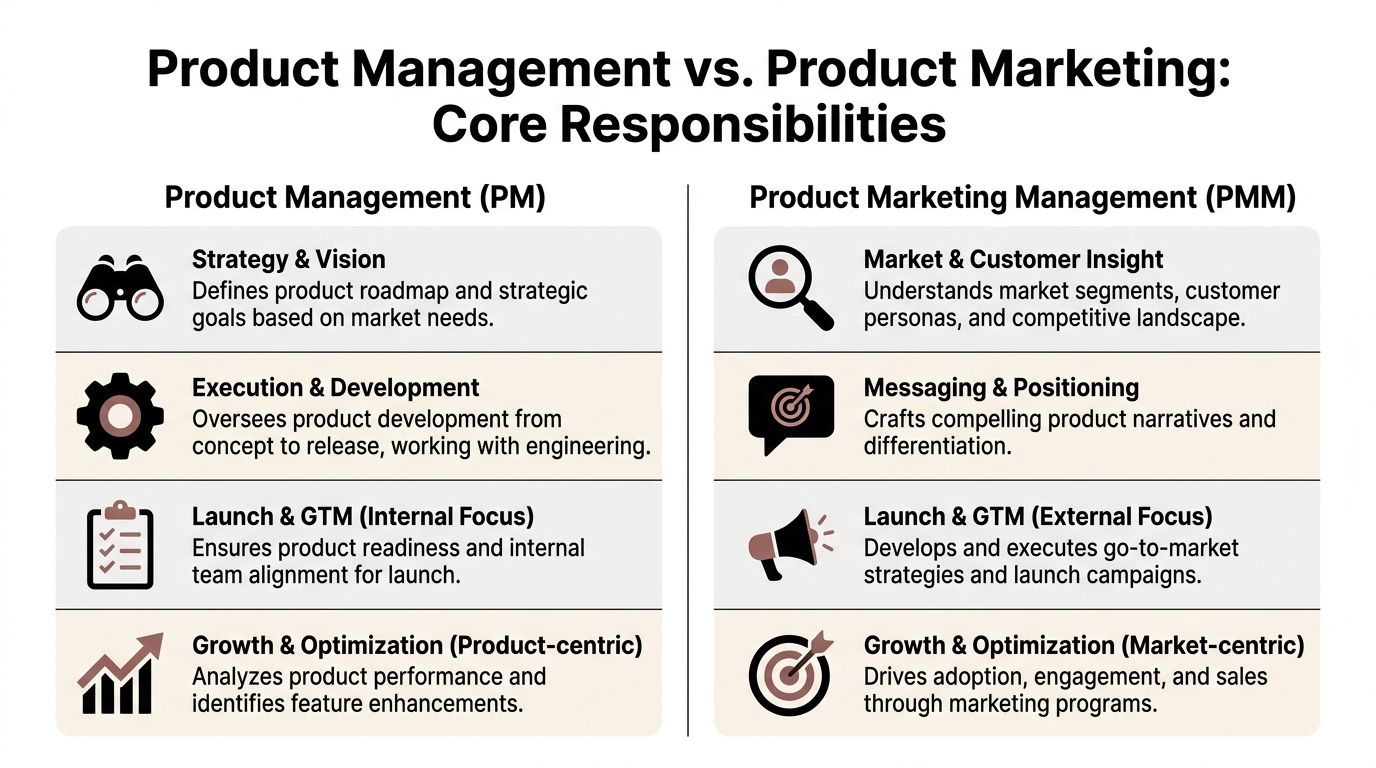
Lifecycle ownership
Here’s the cleanest model I use.
| Lifecycle stage | Product management owns | Product marketing owns | Shared decisions |
|---|---|---|---|
| Discovery | Problem selection, user pain, workflow diagnosis | Market segments, buyer context, competitive framing | Which audience matters first |
| Definition | Requirements, trade-offs, success criteria | Positioning hypothesis, launch narrative, packaging input | What outcome the launch should create |
| Development | Scope, sequencing, engineering alignment | Sales readiness plan, content angles, analyst/customer language | Timing and release risk |
| Go-to-market | Product readiness, in-app experience, instrumentation | Messaging, enablement, launch execution | Who gets targeted first and how success is measured |
| Post-launch | Adoption analysis, retention signals, iteration plan | Campaign performance, objection handling, message refinement | Whether the market story and product experience match |
That’s the high-level split. The practical split is artifact-based.
- The PM owns the user story.
- The PMM owns the market story.
- The PM owns backlog decisions.
- The PMM owns positioning decisions.
- They both own launch judgment.
Contentsquare’s guide captures the distinction well: PMs prioritize backlogs using customer data, while PMMs craft campaigns from top-performing content insights and contribute through user research like interviews and session replays in this comparison of product management vs product marketing.
Artifacts that separate strong teams from noisy teams
A lot of friction disappears once each function knows which document they’re expected to produce.
PM artifacts
- PRD or feature brief with problem, user flow, trade-offs, dependencies
- Roadmap narrative explaining why now, why this, what gets deferred
- Instrumentation spec so adoption can be measured after release
PMM artifacts
- Messaging doc with ICP, pain points, value prop, proof, objections
- Launch brief for sales, CS, support, and marketing channels
- Competitive battlecard showing alternatives and differentiation
Joint artifacts
- RACI for launch
- Single source of truth FAQ
- Post-launch readout
The fastest way to create duplicate work is to let PM write messaging in the PRD and PMM rewrite product logic in the launch brief.
Where teams usually blur the line
Pricing, packaging, and release timing often create the most tension. PMs usually have the strongest view on feature economics and product constraints. PMMs usually have the strongest view on willingness to pay, competitor framing, and sales friction.
That’s why a mature new product development process matters. It forces upstream decisions before a team reaches the noisy end of the lifecycle.
Role clarity also matters for PM career growth. If you want a practical breakdown of the PM side specifically, this guide to roles and responsibilities of a product manager is useful because it separates strategic ownership from project coordination.
The Collaboration Playbook Frameworks That Work
Few teams need another workshop on alignment. They need two operating documents and a recurring cadence.
A 2024 PMA State of Product Marketing report found that only 4% of PMMs say stakeholders fully understand their role, while 25% say stakeholders “don’t get it at all”, as summarized by Product School. When that’s the baseline, vague collaboration advice isn't enough.
Framework one, the launch RACI
Use a lightweight RACI for every meaningful release. One page is enough.
Responsible means doing the work.
Accountable means final call.
Consulted means input before decision.
Informed means updated after decision.
A practical version looks like this:
| Launch workstream | PM | PMM | Eng | Design | Sales | CS |
|---|---|---|---|---|---|---|
| Problem statement | A | C | I | C | C | C |
| Feature scope | A | C | R | C | I | I |
| Positioning | C | A | I | I | C | C |
| Pricing input | C | A | I | I | C | C |
| Sales enablement | I | A | I | I | R | C |
| In-app onboarding | A | C | R | R | I | C |
| Launch date recommendation | A | A | C | I | C | C |
| Post-launch readout | A | A | C | I | C | C |
Two rules matter.
- One accountable owner per row. Shared accountability sounds collaborative and creates hesitation.
- Decide before the sprint closes. If the PMM enters after code freeze, the team will recycle internal language into market language, and that rarely works.
Framework two, the GTM readiness checklist
Use this in the final stretch before launch. It keeps PM and PMM focused on different kinds of readiness.
Product readiness
- Instrumentation live: Events exist for activation, adoption, and failure points.
- Support prep done: Known issues, workarounds, and escalation paths are documented.
- Experience audited: Empty states, permissioning, and upgrade prompts make sense.
Market readiness
- ICP selected: One primary audience gets priority.
- Message tested: The headline explains value, not mechanics.
- Sales script ready: Reps know when to pitch, when not to pitch, and how to handle objections.
Shared readiness
- Success metric named: Everyone agrees what signal matters first.
- Customer list reviewed: Beta users, references, and risk accounts are identified.
- Feedback path assigned: PM owns product learning, PMM owns market learning, both review together.
A lot of PMs underinvest here because launch feels external. It isn't. GTM quality affects what gets learned next.
If you’re building your own operating rhythm, Aakash Gupta’s piece on cross-functional collaboration skills is worth reviewing because this is less about personality and more about repeatable habits.
The meeting cadence that works
Teams often benefit from fewer meetings, but better ones.
Weekly PM and PMM sync
Thirty minutes. Decisions only. No status recital.Two-week pre-launch review
Check messaging, demos, onboarding, objections, and launch risks.One-week post-launch readout
Review user behavior, sales call feedback, support tickets, and narrative gaps.
A short explainer can help your team align on launch mechanics:
Operating principle: PM and PMM should hear the same customer evidence, not separate summaries of it.
Measuring Success Shared and Separate KPIs
Bad PM and PMM relationships usually show up in metrics before they show up in org friction.
The mistake is treating metrics as function-specific. PM watches adoption. PMM watches conversion. Leadership watches revenue. That split creates local optimization. Strong teams use a small set of shared business metrics, then assign different levers to each function.
Shared metrics first
These are the metrics both functions should care about, even if they influence them differently:
- DAU and MAU
- Stickiness ratio
- Retention rate
- Churn rate
- Net Revenue Retention
- NPS and CSAT
- Feature adoption
- Conversion Rate and CPA
Contentsquare’s guide explains why these metrics bridge both functions, especially in SaaS where PMs shape product behavior and PMMs shape market uptake through positioning, launches, and content strategy.
A useful diagnostic model
The DAU/MAU ratio is one of the cleanest shared signals because it sits at the intersection of value, habit, and communication. A ratio of 0.2 or 20% or higher indicates healthy retention, and product teams use it to identify segments with weakening engagement, according to Quantum Metric.
When stickiness drops, don't assume it's a product problem or a marketing problem. Ask a sequence of questions.
Did activation break?
If new users never reach first value, PM likely has a workflow issue.Did the promise overreach?
If users sign up for one expectation and find another, PMM likely has a positioning problem.Did one segment fall faster than others?
If so, the issue may be in persona targeting, onboarding path, or feature relevance.
Shared KPI map
| Metric | PM influence | PMM influence |
|---|---|---|
| Stickiness | Improve recurring use cases, remove friction | Attract better-fit users with clearer messaging |
| Retention | Increase product value over time | Set expectations that match delivered value |
| NRR | Build expansion-worthy capabilities | Drive upsell, cross-sell, and packaging clarity |
| NPS | Improve experience quality | Sharpen value communication and customer education |
| Adoption rate | Launch usable features with clear onboarding | Explain why and when the feature matters |
If a feature has low adoption, the fix might be in onboarding, but it might also be in naming, packaging, and who the launch targeted.
The same logic applies to revenue-facing metrics. PM can improve NRR by making the product more valuable to the installed base. PMM can improve NRR by helping the right customers discover expansion use cases and by reducing confusion in the buying journey.
That’s why I push teams to review KPIs together, not in separate decks. If your org still blurs OKRs and operational metrics, this breakdown of OKR vs KPI helps clean up the language before you try to fix the behaviors.
The New Frontier The AI PM and AI PMM
AI products make product marketing and product management harder because the product behavior is less deterministic and the customer expectation risk is much higher.
A normal SaaS feature can be described as a workflow improvement. An AI feature often needs to be described as a capability with conditions. That changes both roles.

What changes in AI products
The PM has to work through model behavior, fallback states, confidence thresholds, latency trade-offs, and trust mechanisms. The PMM has to explain probabilistic value without making the product sound unreliable or magical.
That means both functions need tighter loops around three things:
- Expectation setting
- Feedback for retraining or prompt improvement
- Pricing and packaging
ProductPlan notes that Forrester’s 2024 and 2025 reporting projects pricing agility as critical, with 70% of tech firms missing revenue goals due to misaligned pricing, especially relevant for AI tools where PMM-led competitive intel supports value-based pricing in this product marketing for product managers guide.
The AI handoff teams often miss
For AI launches, PM should not hand off a feature list. PM should hand off a usage contract.
That usage contract should answer:
- What is the model good at right now
- Where does it fail or degrade
- What input quality does it need
- What user behavior improves output quality
- Which claims the company should never make
PMM then turns that into market-safe messaging. Not softer messaging. More precise messaging.
Field rule: In AI, overclaiming burns trust faster than underclaiming burns demand.
AI prompts PMs can use with PMMs
You don't need AI to replace judgment. You can use it to speed the first draft and sharpen the discussion.
Try prompts like these in ChatGPT, Claude, or similar tools:
Prompt for positioning
- “Act as a B2B SaaS product marketer. Rewrite this AI feature description for a buyer who cares about speed, compliance, and reliability. Avoid hype. Keep claims grounded in workflow outcomes.”
Prompt for objection handling
- “Generate a sales enablement sheet for this AI feature. Include likely objections from legal, procurement, and end users. Separate concerns about trust, data quality, and ROI.”
Prompt for onboarding clarity
- “Turn this technical capability into in-app guidance. Explain what the feature does, when to use it, and what results users should and should not expect.”
For teams evaluating workflow support, this roundup of AI tools for product managers is a helpful starting point because it spans research, writing, and prioritization use cases.
A practical operating model for AI PM and PMM
Use one shared review every two weeks with these inputs:
| Input | PM brings | PMM brings |
|---|---|---|
| Usage data | Feature behavior, activation, error patterns | Persona-level adoption signals |
| Market feedback | Support themes, workflow blockers | Sales objections, lost-deal language |
| Pricing feedback | Consumption patterns, value moments | Packaging tension, competitor framing |
| Trust signals | Failure modes, quality thresholds | Misinterpretation risk, claim clarity |
If you’re moving into this area, Aakash Gupta’s AI product management resources are one practical option among the current materials available for PMs trying to build skill in AI-specific product thinking.
Career Paths Salary Benchmarks and Job Transitions
A common hiring scenario looks like this. The PM has strong product judgment, can run discovery, and knows how to ship. The PMM can sharpen positioning, arm sales, and spot where the market is shifting. The candidate who gets promoted faster is often the one who can cover 70 percent of one role and 30 percent of the other without getting sloppy.
That mix matters even more in AI roles. Companies hiring AI Product Managers are not only screening for roadmap judgment or model familiarity. They also want evidence that the person can translate technical capability into buyer value, risk boundaries, adoption plans, and credible claims. That creates real career arbitrage for PMs who build PMM skills, and for PMMs who can prove product depth.
The useful career question is simple: which part of value creation do you want to own, and which adjacent skill set are you willing to practice until it shows up in your work?
How to choose your primary lane
Choose PM if your best work shows up in decisions that shape the product itself.
You are likely stronger in PM if you consistently do well at
- Trade-off decisions: Scope, sequencing, dependencies, and product judgment under constraints
- Workflow design: Breaking vague problems into user actions, system behavior, and measurable outcomes
- Execution across functions: Keeping engineering, design, data, and stakeholders aligned around one plan
Choose PMM if your strongest work shows up in how the product wins in the market.
You are likely stronger in PMM if you consistently do well at
- Narrative construction: Turning product complexity into language buyers, users, and sales teams can repeat
- Market pattern recognition: Seeing segment differences, buyer friction, and competitive openings early
- Commercial execution: Building positioning, launches, objection handling, and enablement that change pipeline quality
The strongest leaders usually develop both. PMs with GTM fluency are easier to trust in executive reviews because they connect roadmap choices to revenue consequences. PMMs with product depth become more strategic because they influence what gets built, not just how it is presented.
What hiring managers look for in transitions
When I assess PMs moving toward PMM, I do not care that they can explain a feature. I look for proof that they can define audience, urgency, differentiation, and sales risk. A good signal is a candidate who has written launch briefs, shaped packaging discussions, or changed roadmap language after hearing repeated objections from the field.
When I assess PMMs moving toward PM, I need more than strong messaging instincts. I look for prioritization logic, user problem decomposition, comfort with ambiguity, and evidence that they can make trade-offs without hiding behind stakeholder consensus.
Use this transition matrix to spot the missing proof points before you apply.
| If your background is | Add this to move toward PM | Add this to move toward PMM |
|---|---|---|
| PM | Discovery depth, analytics rigor, technical fluency | Positioning, pricing input, sales enablement |
| PMM | Product sense, roadmap logic, experimentation design | Stronger market research synthesis and launch ownership |
| Growth | Feature strategy, retention thinking | Narrative strategy and segment-specific messaging |
| Founder | Structured prioritization and process | Repeatable GTM systems and enablement discipline |
Salary benchmarks without bad precision
Compensation varies too much by market, company stage, and technical scope to quote a clean number here without introducing shaky data. In practice, pay moves fastest when the role sits close to revenue, owns visible cross-functional decisions, and covers a hard-to-hire capability.
That is why AI PM roles are pulling attention. A PM who can work with engineering on model constraints, define a usable workflow, and partner with PMM on trust and positioning is competing in a smaller talent pool. The same pattern applies to PMMs who can support AI launches with real product depth instead of surface-level messaging.
If you want a compensation bump, title alone is a weak strategy. Scope is the stronger lever. Own a launch category, pricing input, onboarding outcomes, or a product line with measurable revenue impact. Then the promotion case writes itself.
Culture and team design change the value of the role
A PM role with little strategic ownership turns into delivery management. A PMM role with no product influence turns into launch support. Both can be good training grounds for a period of time. Neither compounds well if you stay too long.
This is one of the easiest mistakes to make during a transition. Candidates focus on title and miss operating conditions. Ask who owns pricing input, who sees customer calls, who writes the launch brief, who decides packaging, and whether PM and PMM share goals or work in separate lanes until release week.
Good teams make cross-functional skill building normal. Weak teams force it to happen through politics.
A practical transition plan
The best move is usually not a cold title switch. It is building evidence in your current seat.
For PMs moving toward PMM:
- Write the positioning memo for one launch
- Join sales calls and document objection patterns
- Draft message guardrails for one AI feature, especially around trust and expected results
- Contribute to packaging or pricing discussions, even if you are not the final owner
For PMMs moving toward PM:
- Run a discovery sprint on one customer problem
- Write a prioritization memo with trade-offs and a recommended sequence
- Partner with design and engineering on workflow decisions, not just launch planning
- Own one post-launch analysis tied to activation, retention, or usage quality
For either path, AI is the best current proving ground. The work naturally forces PM and PMM skills together. You need product judgment, technical curiosity, customer empathy, market clarity, and disciplined claims. Candidates who can show that blend stand out quickly.
The highest-return transition is often becoming the person who closes PM and PMM gaps before anyone changes your title. That gives you operating proof, not career theater.
Actionable Templates for Immediate Impact
If you want better product marketing and product management collaboration this week, don't start with a reorg. Start with shared documents.
Template one, one-page launch brief
Copy this into Notion, Google Docs, or Confluence.
Feature or launch name
[Insert name]
Customer problem
What user pain are we solving?
What buyer pain does this connect to?
Primary audience
Who is the first segment this launch is for?
Who is explicitly not the first segment?
Value proposition
What outcome gets better?
Why now?
What changed in product
New workflow, feature, or capability in plain language.
Message guardrails
Claims we can make.
Claims we should avoid.
Success signal
What metric tells us this launch is working?
Top risks
Adoption risk, message risk, support risk, pricing risk.
Template two, weekly alignment snippet
This works in Slack or email.
PM update
- Shipped or shipping this week
- Key product risk
- New user learning
- Decision needed from PMM
PMM update
- Messaging or launch asset progress
- Sales or customer feedback theme
- Market risk
- Decision needed from PM
Shared asks
- One decision
- One blocker
- One customer conversation to review
Keep it short. If a team needs a long update, it usually needs a decision meeting instead.
Template three, customer interview synthesis
Use one interview for both roadmap learning and messaging refinement.
Customer context
Role, company type, current workflow
Problem language used by customer
Exact phrases worth reusing in messaging
Current workaround
What they do today instead
Moments of friction
Where time, trust, cost, or confusion appears
Value triggers
What makes them care enough to switch or adopt
Product implications
What PM should validate or prioritize
Message implications
What PMM should test in positioning or enablement
Open questions
What still needs follow-up
The point of these templates isn't documentation for its own sake. It's forcing decisions early enough that launch quality and product quality improve together.
If you want more practical frameworks like these, plus deeper guidance on PM career growth, GTM thinking, and AI product work, explore Aakash Gupta.
