Most PMs don’t lose credibility because they lack ideas. They lose it because their ideas enter the organization and come out late, diluted, buggy, or commercially irrelevant.
That gap is where careers stall.
I’ve hired and mentored enough PMs to know the pattern. The ones who rise fastest aren’t always the best strategists in the room. They’re the ones who can take ambiguity, align design and engineering, make trade-offs under pressure, and get a product into customers’ hands without creating chaos around them. They understand delivery of product as a leadership discipline, not an ops chore.
That matters more now because shipping is under more pressure than ever. In commerce, for example, the U.S. is projected to ship 24.6 billion packages in 2026, with 66.8 million packages delivered daily, according to SellersCommerce package delivery statistics. Different domain, same lesson. At scale, delivery is not a back-office detail. It is the business.
For PMs, that means one thing. If you want better scope, more influence, and the kind of reputation that leads to senior roles, become the person who makes delivery reliable.
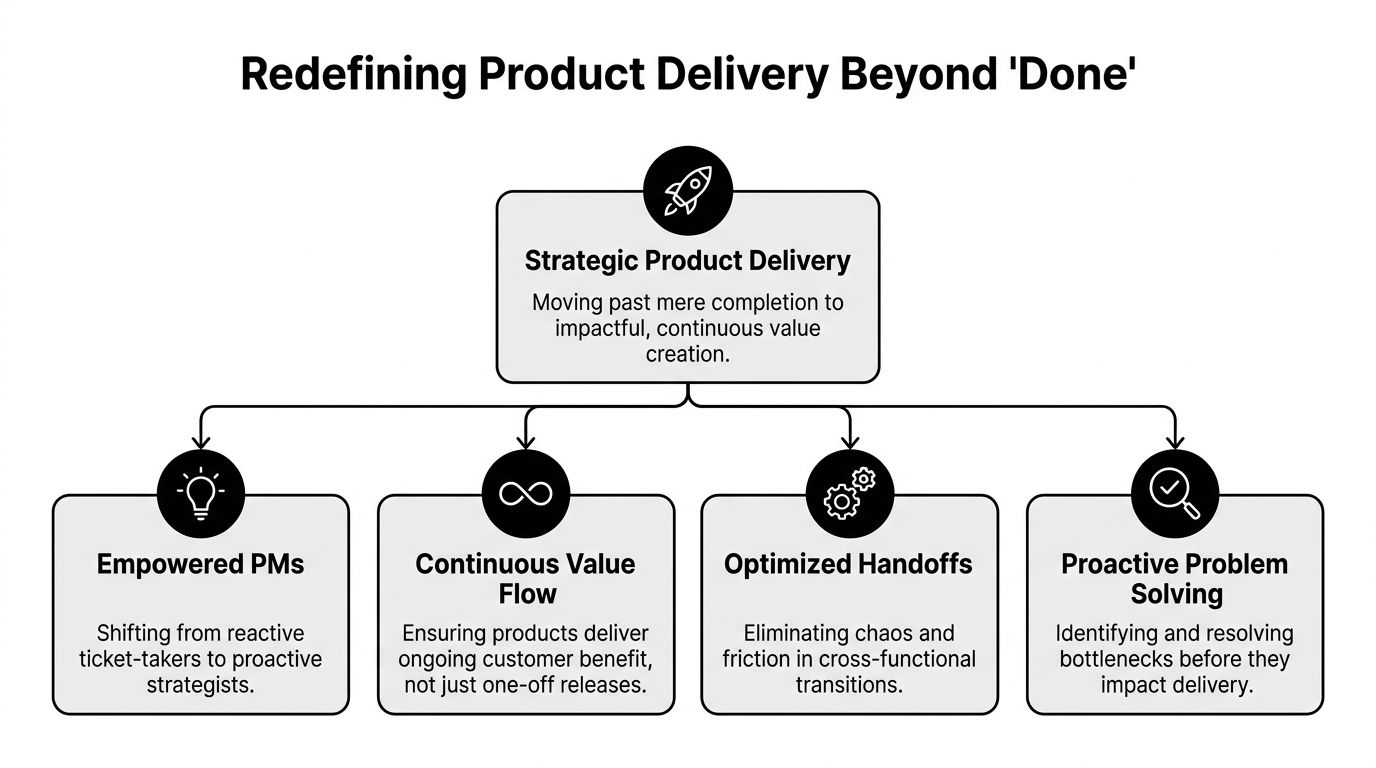
Redefining Product Delivery Beyond 'Done'
The average PM treats delivery as a sequence. Discovery, PRD, build, QA, launch, done.
Top PMs treat delivery as a value stream. A customer problem gets validated, translated, built, released, adopted, and measured. If any link breaks, the product wasn’t delivered. It was merely shipped.
That distinction sounds semantic until you’ve run teams at scale. A feature can hit production and still fail delivery because support wasn’t briefed, analytics weren’t instrumented, onboarding wasn’t updated, or the wrong customer segment got it first.
The mindset shift that changes everything
A weak PM asks, “Did engineering finish it?”
A strong PM asks:
- Was the problem valid
- Did we ship the right scope
- Did users receive the value
- Can the team repeat this cleanly next sprint
That’s why I don’t like the phrase “requirements owner.” It shrinks the role. In practice, the PM owns continuity across handoffs.
A Michelin-star kitchen and a fast-food line both produce food. The difference is control. In a great kitchen, every handoff has intent. Timing, sequencing, and quality checks are tight. In a feature factory, work gets thrown between functions and everyone hopes the final plate looks decent.
Most PM organizations say they want outcomes. Then they reward ticket throughput.
If you want a better operating model, start by grounding the team in outcomes rather than completion. A useful primer is Aakash Gupta’s piece on objectives versus outcomes. PMs who internalize that difference stop celebrating output too early.
Delivery is a revenue and retention problem
This isn’t abstract. Delivery reliability changes whether customers come back.
Failed deliveries cost businesses $17.2 per parcel in the U.S., and 70% of shoppers are unlikely to buy from a brand again after a single delivery failure. On top of that, 48% of U.S. customers will not make a repeat purchase from a company that delivers late, according to SmartRoutes delivery success rate data.
Those are commerce stats, but the principle carries straight into software. When your team ships late, breaks trust, or launches sloppily, customers don’t grade your internal complexity on a curve. They just leave.
Practical rule: Your job isn’t to get work to “Done.” Your job is to make value arrive intact.
What top 1% PMs do differently
They don’t vanish after the kickoff.
They stay active in the seams where delivery usually fails:
- Before build they force clarity on scope, dependencies, and what won’t ship.
- During build they resolve ambiguity quickly instead of letting engineers guess.
- Before launch they inspect analytics, support readiness, rollout logic, and failure paths.
- After launch they look for evidence of customer behavior change, not applause in Slack.
This is the ultimate career separator. Junior PMs manage artifacts. Senior PMs manage flow. Product leaders build systems that keep value moving even when the roadmap gets messy.
The Modern Delivery Lifecycle Stages and Handoffs
Most delivery breakdowns don’t happen inside a stage. They happen between stages.
A roadmap item looks healthy in planning. Then discovery ends without a crisp recommendation. Engineering gets a PRD with missing edge cases. QA gets a build without test notes. Marketing hears about launch two days before release. Everyone says they’re aligned. Nobody is.
That’s why I care less about your process label and more about your handoff quality.
Stage one: idea validation to scoped opportunity
Weak delivery often starts early in this stage. PMs fall in love with a solution before they’ve defined the problem tightly enough for the team to work on it.
The handoff from opportunity to scoped work should include:
- User pain clarity with the specific behavior or workflow that’s broken
- Business rationale tied to retention, growth, cost, or strategic positioning
- Target user definition so design and engineering know who this is for first
- Non-goals so the team doesn’t accidentally expand the brief
- Decision owner for trade-offs when discovery surfaces conflicting inputs
If this handoff is fuzzy, the build stage becomes a debate club.
Stage two: discovery to PRD
This handoff is where PMs often over-document the obvious and under-document the risky.
A strong PRD-to-engineering package has a few essential elements:
Problem statement
Short enough to remember. Specific enough to debate.User stories or job flows
Don’t just list features. Show the sequence the user moves through.Acceptance criteria
Not aspirational language. Testable conditions.Open questions
Teams move faster when uncertainty is visible.Constraints
Legal, data, platform, migration, pricing, partner dependencies, launch timing.Instrumentation plan
If you can’t observe adoption or failures, you haven’t finished planning delivery.
For a useful companion on operationalizing releases once scope is set, I’d point PMs to mastering release management for product development. It’s one of the few resources that treats release discipline as part of product quality rather than admin work.
Stage three: build loop and change control
Once engineering starts, many PMs either over-manage or disappear. Both are bad.
Your role during build is to keep decisions cheap and momentum high. That means:
- Answer questions fast
- Collapse ambiguity before it becomes rework
- Protect the team from drive-by scope additions
- Escalate dependency risks early
- Reconfirm what can slip without breaking the release
If a PM says “let’s just build and see,” someone else will pay for that vagueness later.
Stage four: ready for QA
The worst QA handoff is “it’s in staging, can you test it?”
The right handoff includes:
| Handoff item | Why it matters |
|---|---|
| Feature summary | QA needs to know what changed, not just where the code lives |
| Expected behaviors | Prevents testers from reverse-engineering intent |
| Known risk areas | Focuses attention where regressions are likely |
| Test accounts or data setup | Removes friction before validation starts |
| Release notes draft | Forces clarity on user-facing impact |
Stage five: launch and post-launch control
Launch is not a date. It’s a controlled exposure event.
Top-performing supply chains achieve over 95% on-time delivery, while global averages sit at 75-85%, according to Enveyo’s supply chain delivery benchmarks. That same source notes that optimizing click-to-ship to under 2 hours and improving EDD accuracy to over 90% builds trust. In software, the analog is obvious. The customer remembers predictability more than your internal heroics.
Your launch handoff should include:
- Rollout plan with staged release logic
- Monitoring owner for technical and product signals
- Support briefing with expected issues and response paths
- Rollback criteria defined before launch, not after a problem appears
- Success review date already on the calendar
If you want a clean mental model for where these transitions fit, this overview of product development lifecycle stages is a good reference.
The Delivery Metrics That Matter
If your team’s main delivery metric is story points completed, you’re not measuring delivery of product. You’re measuring how convincingly the team estimates work.
That’s why experienced PMs learn to read delivery metrics like a diagnostic panel. Good metrics don’t make you look busy. They tell you where flow is breaking.
DORA metrics tell you whether engineering can ship safely
The most useful baseline in technical delivery is the DORA set:
- Deployment Frequency
- Lead Time for Changes
- Change Failure Rate
- Time to Restore
These metrics matter because they expose trade-offs that PMs often miss.
A team with low deployment frequency may be bundling too much scope into every release. A team with long lead times may not have a coding problem at all. They may have a review bottleneck, environment instability, or handoff confusion upstream. A team with high change failure rate may need less roadmap pressure and more investment in quality practices.
In large companies, flow efficiency is often only 10-20%, meaning most elapsed time is lost to waiting and handoffs, according to Agile Seekers on flow efficiency and DORA metrics. That same source cites Dr. Nicole Forsgren’s Accelerate research showing elite performers achieve deployment lead times under 1 hour, versus over 6 months for low performers, with 60% fewer failures.
That should change how PMs argue for investment. Better CI/CD, tighter readiness criteria, and smaller batch sizes aren’t engineering luxuries. They’re delivery multipliers.
Flow metrics tell you where work is stuck
DORA gives you operational performance. Flow metrics tell you where the system drags.
Here’s the dashboard I’d want every PM to understand:
| Metric | What It Measures | Why a PM Cares |
|---|---|---|
| Cycle Time | Time from work start to completion | Shows whether scope is sized realistically |
| Lead Time | Time from request to production | Reveals total customer wait, not just build effort |
| Throughput | Work items completed in a period | Helps you see capacity patterns without fetishizing velocity |
| Flow Efficiency | Active work time relative to total elapsed time | Exposes waiting, approvals, and handoff waste |
| Change Failure Rate | Share of releases causing issues | Signals whether speed is degrading reliability |
| Time to Restore | How quickly service recovers after failure | Indicates resilience and incident readiness |
A PM who knows how to read these metrics stops asking shallow questions.
Instead of “Why is this late?” they ask:
- Where did the item wait the longest
- Did batch size increase before lead time worsened
- Are incidents clustered around certain feature types
- Did approval layers, not engineering effort, create the delay
What these metrics change in practice
They change prioritization.
If cycle time keeps expanding, stop feeding the team giant epics. If failure rate is climbing, don’t push for more launch volume until release quality improves. If time to restore is poor, make observability and runbooks part of delivery, not side work.
The best PMs use metrics to change system design, not to scold teams.
If you need a stronger grounding in which product metrics deserve executive attention, this collection on metrics for product managers is worth reviewing.
What not to do
Don’t compare teams blindly.
A platform team, a growth team, and an AI infrastructure team won’t produce the same metric profile. The point isn’t to force symmetry. The point is to identify friction and remove it.
Also, don’t weaponize metrics. The minute people think a dashboard is there to punish them, they’ll optimize appearances instead of delivery. PMs who grow into VP roles learn this fast. Metrics are for shared diagnosis. Not theater.
The AI Playbook for Accelerating Product Delivery
AI is no longer a side tool for PMs who like to experiment. It’s becoming part of the operating system for teams that ship fast.
That doesn’t mean replacing product judgment. It means removing low-impact work so the PM, designer, and engineer can spend more time on problem quality, trade-offs, and customer risk.

A 2025 Gartner report notes 68% of global PMs struggle with delivery delays due to unaddressed logistics. The same source points to a 25% rise in AI-driven delivery tools in the last year, including Vercel Edge Functions with adoption up 30%, as summarized in IndexBox’s analysis of underserved product delivery angles. The gap isn’t access to tools. It’s knowing where they fit into delivery of product.
Where AI helps
The best use cases are boring in a good way. They shorten the work between insight and action.
I’d use AI in five places first:
Interview synthesis
Feed transcripts into ChatGPT or Claude and ask for clustered pain points, repeated objections, and contradictions by segment.PRD drafting
Use AI to produce a first draft from rough notes, then edit for precision. Never publish raw output.Story and edge-case generation
Turn a one-page brief into user stories, failure states, and acceptance criteria candidates.Release comms
Draft support notes, internal launch briefs, changelog entries, and customer-facing explanations faster.QA preparation
Generate test scenario lists from the PRD and known risk areas before QA starts.
That last point matters more than PMs think. AI is good at expanding a human’s initial list into “what are we forgetting” territory.
Prompts worth stealing
Use prompts that force structure.
For discovery synthesis:
Review these user interview notes. Group pain points by workflow stage, rank them by repeated intensity, list direct evidence for each cluster, and identify where users disagree.
For PRD support:
Convert this product brief into a PRD draft with problem statement, target user, goals, non-goals, user flows, acceptance criteria, instrumentation plan, and open risks. Flag any ambiguity you can’t resolve.
For engineering handoff prep:
Generate user stories and edge cases for this feature. Include failure states, permissions issues, data sync risks, and mobile versus desktop differences.
For launch readiness:
Based on this spec, create a go-live checklist that includes analytics verification, support preparation, rollout guardrails, rollback triggers, and post-launch monitoring questions.
Tool stack that increases effectiveness
You don’t need a giant AI stack. You need a few tools with clear ownership.
A practical setup might look like this:
| Workflow | Useful tools |
|---|---|
| Research synthesis | ChatGPT, Claude, Notion AI |
| PRD drafting and editing | ChatGPT, Claude, Google Docs AI features |
| UI prototyping | Vercel v0, Figma AI |
| Engineering copilots | GitHub Copilot, Cursor |
| Meeting capture | Otter, Granola, Fireflies |
| Test case generation | ChatGPT plus your existing QA tooling |
If you’re building a broader operational approach rather than isolated experiments, Thomas Prommer’s guide to an AI adoption strategy for scalable impact is useful because it frames adoption as workflow design, not tool shopping.
A broader tool overview for PM workflows is available in this guide to AI tools for product managers in 2025.
Here’s a walkthrough worth watching if you’re trying to make AI part of your day-to-day execution rather than occasional novelty:
What doesn’t work
Three anti-patterns show up quickly.
First, PMs paste sensitive inputs into public tools without governance. Don’t do that.
Second, teams use AI to inflate documentation volume. More text is not better delivery. A shorter, sharper spec still wins.
Third, PMs let AI smooth over unresolved choices. If the strategy is fuzzy, AI will generate polished confusion.
AI should compress grunt work and expand thinking. It should not replace judgment.
The PMs getting ahead right now aren’t the ones saying “AI is changing everything.” They’re the ones using it to reduce cycle friction this week.
Career-Limiting Mistakes in Product Delivery
A PM ships a feature on time, the release notes go out, and leadership still loses confidence. I’ve seen that movie many times.
The reason is simple. Careers do not advance on shipping alone. They advance on reliable delivery under actual constraints. The PMs who get bigger scopes, better compensation, and GM-track opportunities are the ones who can move a team from idea to outcome without creating chaos on the way.
Some mistakes in product delivery are easy to recover from. The ones below are not.
The throw-it-over-the-wall PM
This PM is strong in kickoff meetings and weak in the messy middle.
They write the spec, get verbal alignment, and assume execution is now an engineering problem. Then complexity shows up. Edge cases were underspecified. Design intent breaks under technical constraints. Dependencies move. Launch risk increases. The PM reappears late and asks for a status update as if that is product leadership.
That pattern gets noticed fast.
Strong PMs stay close to decision points, especially when the plan meets reality. They do four things consistently:
- Clarify ambiguity before engineers make expensive assumptions
- Make trade-offs explicit when time, scope, and quality collide
- Cut or reshape scope before hidden complexity burns the sprint or quarter
- Own launch readiness across product, design, engineering, support, and go-to-market
Delivery of product is not complete at handoff. Handoff is where accountability starts.
The velocity worshipper
I’ve seen PMs manage story points with more intensity than customer outcomes. It never ends well.
Velocity is a local planning input. It is not evidence of good product delivery. Once a PM starts treating velocity as the scoreboard, the team learns the wrong lesson. Estimates get inflated, easy work gets favored, and uncomfortable questions about customer value, usability, and adoption get pushed aside.
The senior leaders you want to impress are not asking, “Did the team stay busy?” They are asking, “Did this release solve the problem without creating new operational drag?”
If your dashboard says the team is efficient while customers are confused, the dashboard is the problem.
The vague Definition of Done problem
This mistake erodes trust.
A feature looks finished in Jira, but support has no script, analytics is missing, onboarding copy is still rough, QA found edge-case failures, and nobody agreed on rollout criteria. The team calls it done because build work ended. The business experiences it as unfinished because customer-facing risk is still high.
Top PMs treat Definition of Done as a working contract, not a ritual artifact. They align it with the actual release surface. That usually includes:
- Functional quality is tested against agreed acceptance criteria
- Telemetry is live for the behavior you need to monitor
- User-facing copy is reviewed and final
- Operational readiness exists for support, sales, or success teams
- Rollout controls are defined if the release needs staged exposure
- Usability evidence exists, not just implementation evidence
This sounds basic. It is also where many promotion cases fall apart. Leaders trust PMs who close loops, not PMs who declare completion early.
The one-size-fits-all delivery model
Average PMs reuse the same delivery pattern across every product, team, and customer segment. Good PMs adapt. Great PMs adapt early.
A delivery model that works for a mature enterprise workflow can fail badly in SMB, self-serve, or zero-to-one bets. The trade-offs change. Setup friction matters more. Documentation weight matters less. Release cadence may need to be tighter. Cross-functional approval paths may need to be lighter. If you run every initiative through the same process, you create process debt and call it discipline.
Leadership notices this too. Scope growth usually follows pattern recognition. Can this PM adjust operating cadence to the risk, the team, and the customer? Or do they only know how to run one playbook?
The PM who confuses activity with ownership
Busy PMs are common. Trusted PMs are rarer.
Status meetings, ticket grooming, and polished docs can create the appearance of control while delivery quality keeps slipping. Ownership shows up somewhere else. It shows up in escalation quality, decision speed, trade-off clarity, and whether the team gets unstuck when pressure rises.
That is why product delivery is a career issue, not just an execution issue. At senior levels, your reputation is built on whether people believe you can deliver through ambiguity without dropping the customer, the team, or the business context.
If you want a sharp self-audit, review these deadly sins of PM and compare them against your working habits, not your intentions.
Your Actionable Product Delivery Toolkit
A PM gets promoted after a messy launch, not because the launch was clean, but because leadership saw who kept decisions moving, protected the customer experience, and recovered fast when reality broke the plan. That is how delivery changes careers. Strong delivery earns trust, larger scopes, and compensation growth long before title changes catch up.
The toolkit below is built for that standard.
Choose the delivery mode that fits the risk
Good PMs stop arguing methodology and start matching the operating model to the work.
| Situation | Better fit | Why |
|---|---|---|
| High uncertainty, fast learning loops | Kanban | Priorities shift often, and fixed sprint commitments create overhead instead of control |
| Cross-functional feature work with planned increments | Scrum | Useful when the team benefits from regular planning, demos, and visible near-term commitments |
| Larger bets with tight appetite and upfront shaping | Shape Up | Useful when leadership wants stronger scope control before engineers start building |
The trade-off is simple. More structure improves predictability, but it also slows learning. Less structure speeds learning, but it can hide drift if the PM is weak on prioritization and escalation.
Top PMs know the cost of picking the wrong mode. They do not run a zero-to-one experiment like a compliance program. They also do not run a platform migration like a loose discovery sprint.
Pre-handoff checklist
Engineering handoff is where weak product thinking gets exposed. If the team still has to guess at basics, delivery risk is already high.
Before kickoff, confirm these are settled:
- Problem is explicit
- Target user is named
- Success signal is defined
- Non-goals are written
- User flow is clear
- Acceptance criteria are testable
- Dependencies are identified
- Analytics plan exists
- Edge cases are listed
- Decision owner for trade-offs is known
If two or three items are fuzzy, expect churn. Expect rework. Expect engineers to make product calls by default because nobody else did.
Go-live readiness checklist
Shipping is not the finish line. The final mile decides whether a launch creates confidence or cleanup work.
Before release, verify:
- Rollout plan exists and one person owns it
- Monitoring is live for product and technical signals
- Support is briefed on likely questions and known issues
- Customer-facing copy is final
- Rollback criteria are agreed
- Post-launch review is scheduled
- Internal stakeholders know what is shipping
- Access, permissions, and migration paths are tested
- Analytics events are firing
- Success and failure signals are visible on day one
Experienced PMs treat launch readiness as a business review, not a shipment ceremony. If support, analytics, and rollback planning are weak, the team has not finished the job.
The operating assets worth keeping
PMs who rise faster build a repeatable system. They keep decision logs, kickoff templates, launch checklists, risk trackers, and post-launch review docs close at hand. That reduces setup time, shortens handoffs, and raises quality across every release.
If you want a strong starting point, use a product management template library and adapt it to your team’s delivery risk, release cadence, and reporting needs.
The reputation that matters is specific. Clear decisions. Clean handoffs. Honest scope cuts. Responsible launches. Reliable outcomes.
That reputation compounds release by release. So do the career benefits.
