You’re probably in one of two situations right now.
Either you’re building a roadmap and someone senior has asked, “What’s the business value?” Or you’re interviewing for a PM role, and you know the hiring manager doesn’t care that you shipped a feature. They care whether you can connect product decisions to company outcomes.
That’s why business value definition matters so much. It isn’t an academic term. It’s the filter executives use to decide which PMs they trust with bigger bets, bigger teams, and bigger scope.
A PM who talks about tickets, launches, and adoption sounds operational. A PM who can explain why a product decision improves revenue quality, lowers cost, strengthens retention, or builds a strategic moat sounds promotable.
The key shift is simple. Stop treating business value as a finance phrase. Treat it as your job.
Why Business Value is Your Most Important Metric
The most important moment in many PM careers isn’t a launch. It’s the meeting after the launch.
A roadmap review, QBR, or annual planning session usually comes down to one question: Why should the company invest here instead of somewhere else? If you can answer that clearly, you stop looking like a feature owner and start looking like a business leader.
PMI defines business value as the “net quantifiable benefit derived from a business endeavor that may be tangible, intangible, or both” in its PMBOK framework, which is a useful anchor because it forces PMs to think beyond output and into outcomes like customer loyalty and employee satisfaction (PMI definition via Wikipedia).
What senior leaders are actually listening for
When a CRO, CFO, or CEO asks about business value, they’re usually testing four things:
- Commercial judgment. Do you understand how the company makes money?
- Resource discipline. Do you understand trade-offs across engineering, design, GTM, and support?
- Strategic maturity. Can you connect your roadmap to company goals?
- Executive communication. Can you explain impact without hiding behind jargon?
That’s why PMs who learn P&L thinking advance faster. If that’s a weak spot, Aakash Gupta’s primer on P and L responsibility is worth reading because it sharpens the operating lens behind product decisions.
Practical rule: If you can’t explain why a feature matters to the business in two or three sentences, you’re not ready to ask for resources to build it.
What gets people promoted
At Google, Meta, Amazon, or OpenAI, nobody gets promoted for “working hard on important initiatives” unless they can show impact in business terms.
The PMs who move up fastest usually do three things well:
- Define value before delivery
- Measure value after launch
- Retell the story of that value in a way executives remember
That pattern matters even more in an efficiency-focused market. Teams are smaller. Prioritization is harsher. More work gets cut. The PM who survives and grows is usually the one who can defend why a project deserves investment.
The Four Pillars of Business Value
A PM asks for six engineers to build an AI copilot. The demo is strong. Stakeholders are interested. Then the CFO asks a simple question: how does this create business value in the next 12 months, and what does it improve after that?
That question breaks weak product thinking fast.
The useful model here is simple. Business value usually shows up in four forms: revenue, cost, customer outcomes, and strategic compounding effect. Strong product cases usually have one clear primary pillar and one secondary pillar. Weak cases try to claim all four and prove none.
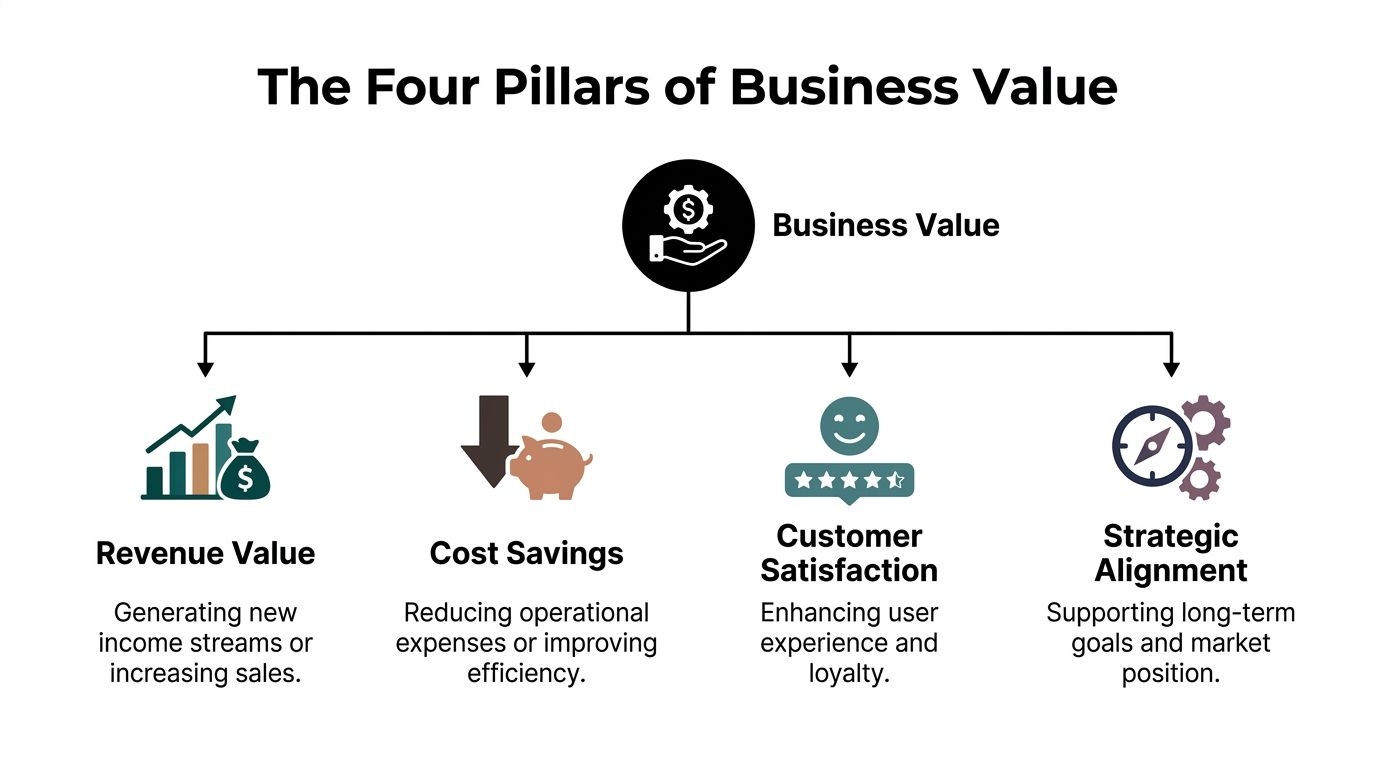
Revenue value
Revenue is the pillar everyone understands first, and that creates a common PM mistake. Teams overstate direct monetization because revenue sounds executive-friendly, even when the actual effect is retention, activation, or sales efficiency.
Revenue value comes from increasing cash in. New customer acquisition, conversion improvement, expansion revenue, attach rate, pricing power, and reduced churn all fit. At Google Ads, a feature that improves campaign performance can justify itself through advertiser retention and spend growth. At Meta, recommendation quality often matters because better relevance improves engagement, which improves monetization later.
Use this pillar when the path to money is credible, not just possible.
Cost value
Some of the highest-impact product work never appears in a keynote.
An Amazon PM who cuts infrastructure waste by 8 percent on a high-scale system may create more economic impact than a PM who launches a visible feature with weak adoption. The first PM often gets promoted faster if they can quantify the savings, show that the reduction persists, and explain what the company can fund with those dollars.
Cost value includes lower support volume, less manual ops work, fewer incidents, reduced cloud spend, shorter implementation time, and simpler internal workflows. This pillar matters a lot for AI products because inference costs, human review costs, and model evaluation costs can erase margin fast. If your AI feature raises engagement but triples serving cost, you did not create much value. You shifted it around.
For teams making resourcing decisions, a quick Benefit Cost Analysis can sharpen the trade-off.
Customer value
Start with a real user behavior change.
A new onboarding flow that gets more teams to first value in one day instead of five creates customer value before it creates revenue value. The business case gets stronger when you connect that improvement to activation, retention, expansion, or lower support burden.
Customer value covers usefulness, reliability, trust, speed, usability, and adoption. In practice, this is the pillar PMs need to defend with the most discipline because stakeholders hear “better experience” all day. Vague claims do not survive review. Specific changes do. Fewer setup errors. Faster task completion. Better weekly retention. Lower abandonment at a critical step.
If you need sharper language for framing what users care about, these examples of value proposition are a useful com…aakashg.com/examples-of-value-proposition/) are a useful complement.
Strategic value
This pillar separates feature shipping from company building.
A short-term spreadsheet often undervalues strategic work because the payoff arrives through future options: entering a new market, building proprietary data assets, improving distribution, creating a defensible workflow position, or making later launches faster and cheaper. FAANG companies make these bets constantly. Amazon invested in infrastructure capabilities long before every capability had a clean standalone ROI. Google has repeatedly funded platform work that looked indirect at first and became a multiplier for multiple product lines later.
AI makes this pillar even more important. An evaluation layer, human feedback loop, safety system, or enterprise admin control plane may not produce immediate revenue, but it can determine whether the business can scale the category responsibly. PMI describes business value broadly enough to include both tangible and intangible outcomes on its business value resources at PMI.org, which is the right framing for these bets. The promotion-relevant skill is not calling something “strategic.” It is explaining what future advantage the work creates, what risk it reduces, and when that advantage should show up.
How to classify an initiative fast
Use this lens during planning reviews:
| Initiative type | Primary pillar | Common mistake |
|---|---|---|
| New upsell capability | Revenue value | Ignoring retention impact |
| Internal tooling automation | Cost value | Underselling long-term platform advantage |
| Onboarding redesign | Customer value | Failing to connect to business outcomes |
| AI evaluation infrastructure | Strategic value | Getting rejected for weak near-term framing |
A final rule helps in real roadmap debates. Pick the primary pillar first. Then name the supporting pillar. If a proposal cannot do that cleanly, the case is probably still fuzzy.
Your Toolkit for Measuring Business Value
Once you know which pillar matters most, you need a tool that fits the decision. Many PMs go wrong here. They use one framework for every problem, then wonder why stakeholders push back.

Use the right tool for the right decision
Here’s the practical version.
| Framework | Best for | Good in | Weak when |
|---|---|---|---|
| ROI | Simple investment decisions | Mature products, executive reviews | Benefits are delayed or intangible |
| NPV | Long-term cash flow decisions | Platform bets, enterprise products, AI uncertainty | Inputs are too speculative |
| RICE | Fast backlog sorting | Startups, growth teams, experimentation | Team treats it as objective truth |
| CLV | Retention and expansion work | B2B SaaS, subscription businesses | Customer economics are unstable |
| OKRs | Alignment and tracking | Cross-functional execution | Used as a substitute for valuation |
ROI when the choice is straightforward
ROI is useful when the investment and expected benefit are both relatively understandable.
If you’re deciding whether to build an automation feature that reduces manual support work, ROI gives you a fast language for trade-offs. Executives like it because it’s easy to compare across projects.
The downside is obvious. ROI tends to flatten uncertainty. It also struggles with strategic work, platform investments, and product quality improvements that matter but don’t map cleanly to immediate financial return.
NPV when timing matters
NPV is better when value arrives over time and timing changes the decision.
That’s common in enterprise platforms, infrastructure bets, and AI features where the payoff may be real but delayed. A PM proposing model evaluation tooling, governance workflows, or reusable inference architecture often needs an NPV-style argument because the benefits accumulate across multiple future releases.
A lot of PMs avoid NPV because finance owns it. That’s a mistake. You don’t need to become a banker. You need to understand when future cash flows and uncertainty should shape prioritization.
RICE when speed matters more than precision
RICE is often the most useful early-stage PM tool because it forces explicit assumptions about reach, impact, confidence, and effort.
That makes it ideal for startup backlogs, growth teams, and feature discovery. It’s also easy to socialize in product reviews because people can challenge the assumptions instead of arguing in circles.
The trap is treating RICE as math instead of judgment. If a team inflates impact and confidence, the score becomes theater.
A scoring framework doesn’t make a weak idea strong. It only makes your assumptions visible.
CLV when retention is the value story
If you work on subscription software, fintech, marketplaces, or any business where repeat usage matters, CLV is one of the most powerful tools in your set.
A Salesforce-style B2B SaaS team might use CLV to justify onboarding improvements, admin workflows, or customer success integrations because the point isn’t immediate conversion. The point is preserving long-term account value.
That’s why PMs working on retention should know the surrounding economics cold. Churn, expansion, support burden, and product adoption all shape the value case.
OKRs when you need alignment, not valuation
OKRs are not a valuation model. They’re a coordination model.
Use them to align teams around the outcomes that matter. Don’t use them as proof that the underlying work is worth doing. “Increase activation” is useful as an objective. It is not, by itself, a business case.
A practical stack that works
A layered approach works best:
- Use RICE to narrow the backlog
- Use ROI or NPV for the bigger bets
- Use CLV for retention and lifecycle work
- Use OKRs to align execution after the decision
If you want a more formal finance lens for trade-off discussions, this walkthrough of Benefit Cost Analysis is a helpful companion, especially when you need to compare alternatives with different benefit types.
For day-to-day PM work, keep a small measurement library in one place. A dashboard in Looker or Tableau, a lightweight model in Sheets, and a common review doc in Notion usually work better than an elaborate internal tool nobody updates. A structured content library like Aakash Gupta’s PM resources on metrics for product managers can also help teams standardize how they talk about outcome measurement.
Calculating Value for an AI Feature A Step-by-Step Example
A lot of PMs sound confident on business value until the project involves AI. Then the assumptions get fuzzy, the metrics get messy, and the narrative falls apart.
That isn’t rare. A 2025 Gartner report notes that 68 percent of PMs struggle to link AI features to business outcomes, and only 22 percent use advanced models like NPV adjusted for AI uncertainty (Scrum.org summary citing Gartner).
Here’s a practical way to handle it.

Example of an AI Smart Summary feature
Assume you’re a PM at a project management SaaS company. You want to launch Smart Summary, an AI feature that summarizes long project threads, meeting notes, and task updates.
A weak PM pitch sounds like this: “Customers want AI, competitors have AI, and this would modernize the product.”
A strong PM pitch starts with a value chain.
Step 1 builds the customer value hypothesis
Start with the user problem.
Project managers, team leads, and executives waste time reading long updates. Smart Summary reduces that friction by helping them understand project status faster.
The customer value hypothesis is qualitative but concrete:
- For managers it reduces review time
- For contributors it lowers communication overhead
- For executives it improves visibility across projects
This is the point where many PMs stop. Don’t stop here.
Step 2 translates user benefit into business outcomes
Now connect the user win to business value.
Possible paths:
- Retention path. Teams that rely on summaries may use the product more and become harder to replace.
- Expansion path. AI features can support packaging upgrades or justify premium tiers.
- Cost path. Better summarization may reduce support tickets about project visibility or workflow confusion.
- Strategic path. The feature creates a foundation for future AI workflows such as task generation, risk flags, and executive reporting.
Write these as testable assumptions, not guaranteed facts.
“If Smart Summary becomes part of the weekly workflow for managers, we expect it to improve account stickiness and create a stronger case for premium packaging.”
Step 3 scores the opportunity with lightweight rigor
At this stage, use a simple RICE-style review.
- Reach asks how many users or accounts could reasonably use the feature
- Impact asks how important the change would be if it works
- Confidence asks how strong your evidence is
- Effort asks what engineering, design, evaluation, and compliance work it takes
You don’t need fake precision. A directional model is enough for comparison.
Step 4 pressure-tests the economics
For AI features, add a second pass beyond RICE.
Ask:
- Inference cost risk. Does usage get expensive at scale?
- Quality risk. What happens if summaries are wrong or incomplete?
- Trust risk. Will users rely on it in sensitive workflows?
- Follow-on option value. Does this capability enable future products?
A payback lens is helpful here. If you need a clean way to discuss how quickly an investment returns value, Aakash Gupta’s guide on what is the payback period is a useful reference.
Step 5 uses AI tools for thinking, not authority
ChatGPT, Claude, or Gemini can help you generate assumptions, edge cases, and metric trees. They shouldn’t become your evidence.
Try prompts like:
- “List five ways an AI summary feature could create customer value in B2B collaboration software.”
- “What are the likely failure modes for an AI-generated project summary?”
- “Create a metric tree connecting summary adoption to retention, support burden, and premium conversion.”
That workflow is repeatable. Start with user benefit. Map business paths. Score the opportunity. Pressure-test economics. Then communicate uncertainty transparently.
A Practical Framework for Value-Based Prioritization
Most backlogs fail for one reason. Teams compare ideas without a shared definition of value.
That’s why prioritization gets political. Sales wants one thing, engineering wants another, the CEO has a pet request, and product ends up mediating opinion instead of making decisions.

Build a weighted score that reflects how your company wins
You don’t need a fancy prioritization app. A spreadsheet is enough if the logic is clear.
I like a weighted model with six fields:
| Field | What it captures |
|---|---|
| Revenue value | New revenue, expansion, pricing leverage |
| Cost value | Efficiency, support reduction, platform savings |
| Customer value | Retention, usability, trust, satisfaction |
| Strategic value | Market position, capability building, learning |
| Confidence | Evidence quality and assumption strength |
| Effort | Delivery cost and organizational drag |
Score each item directionally, then discuss the reasons behind the score. The discussion matters more than the number.
Don’t let low-effort work dominate the roadmap
One of the most common PM mistakes is over-prioritizing work that’s easy to ship.
That creates a polished but weak roadmap. Teams complete lots of items and still don’t move the business. Senior leaders notice this quickly.
Good prioritization does two things at once:
- It protects capacity for compounding bets
- It prevents “strategic” work from becoming a hiding place for vague ideas
Current value versus potential value
Stronger PMs distinguish themselves here. They don’t just score what helps users today. They score what changes the company’s future position.
Product leaders who focus on bridging Current Value and Potential Value through retention-focused prioritization can raise competitor entry barriers by 30 to 50 percent and reduce churn below the 5 percent benchmark for SaaS (Product Talk business value glossary).
That matters because some roadmap items defend the core while others expand the frontier.
Use this lens:
- Current Value work keeps your existing users successful
- Potential Value work creates access to future revenue, new segments, or stronger moats
A healthy roadmap needs both.
A simple operating cadence
Run prioritization on a repeatable cadence, not as a one-time workshop.
- Collect candidate work from product, engineering, sales, support, and leadership.
- Attach a value hypothesis to each item before it enters planning.
- Score independently to expose disagreement early.
- Review the outliers where scores diverge the most.
- Decide by portfolio balance, not just top score.
The strongest PMs also maintain a “not now” list with reasons. That list becomes valuable in executive reviews because it shows discipline.
Here’s a useful video on framing and sequencing product decisions before you run your next planning cycle:
What works and what doesn’t
What works
- Visible assumptions so people debate evidence, not personalities
- A mixed portfolio of core improvements, growth bets, and strategic investments
- Explicit confidence levels so uncertain work doesn’t masquerade as certainty
- Post-launch review to improve future scoring
What doesn’t
- Single-metric prioritization where every idea gets forced into revenue
- Executive exception culture where scoring exists but never matters
- Gaming effort estimates to move pet projects up
- Treating prioritization frameworks as neutral truth
If your team needs more models to compare, Aakash Gupta’s overview of product prioritization frameworks is a solid reference point.
How to Communicate Business Value to Stakeholders
A PM can do the analysis correctly and still lose the room.
That usually happens because the message is generic. The same deck goes to the CEO, engineering manager, and head of sales. Nobody hears their language, so nobody feels ownership.
That’s expensive. A 2025 IDC analysis found that 55 percent of projects in major tech markets fail to prove ROI because of generic messaging that undervalues multifaceted value propositions such as agility and customer experience (Bain page citing the analysis).
Speak in the stakeholder’s decision language
Executives usually care about resource allocation, strategic fit, and downside risk.
Engineers care about user pain, technical clarity, delivery constraints, and whether the problem is worth solving.
Sales and marketing care about differentiation, customer pain, packaging, and what story they can credibly take to market.
So don’t reuse the same framing.
A simple message template for executives
Use this format in a roadmap review or QBR:
- Problem. What important business or customer issue exists?
- Why now. Why is this worth solving in this planning window?
- Value path. How does this create revenue, reduce cost, improve retention, or strengthen strategy?
- Risks. What could make the investment fail?
- Decision needed. What approval, trade-off, or resource shift do you want?
Example:
We’re seeing a visibility gap in complex accounts. Smart Summary addresses that by making project status easier to consume. The expected value path is deeper workflow adoption, stronger retention, and a better premium packaging story. The main risks are summary quality and inference cost. I’m asking for a staffed pilot rather than a full rollout.
How to talk to engineering without sounding financial
Engineers usually disengage when PMs jump straight to revenue language.
Use customer and system language first:
- Start with the user pain
- Clarify the success condition
- Acknowledge constraints openly
- Explain why this problem matters to the company
This is far more effective than saying, “Leadership wants this because it’s a big opportunity.”
How to arm sales and marketing
Sales needs a sharp angle, not a strategy lecture.
Give them:
- Who the feature is for
- What painful job it solves
- How it differs from alternatives
- What proof points exist already
If you can’t equip GTM with those basics, they’ll create their own story, and it may not match the product reality.
The PM’s job isn’t just to discover value. It’s to translate value so each function can act on it.
The promotion signal most PMs miss
Communication about business value creates visibility. Visibility creates trust. Trust creates scope.
If a VP can repeat your value story in a staff meeting without needing you in the room, you’re operating at a higher level.
Three Career-Limiting Traps to Avoid
Most PMs don’t struggle because they’ve never heard the term business value. They struggle because they use it badly.
The feature factory trap
This happens when a PM equates shipping with success.
The warning signs are easy to spot. Roadmaps are packed. Launches happen on time. Retrospectives celebrate delivery. But nobody can explain what changed for the business or the customer.
The counter move is simple. Tie every significant initiative to one outcome statement before development starts. If the team can’t describe the expected change, the work isn’t ready.
The tangible-only trap
Some PMs only count what fits neatly into a spreadsheet.
That sounds disciplined, but it often leads to bad strategy. Reliability, trust, workflow depth, ecosystem positioning, and future capability building all matter. If you ignore them because they’re harder to model, you’ll underinvest in the very things that make a product durable.
This shows up constantly in AI product work. Teams either greenlight flashy demos with weak trust foundations or reject foundational work because the near-term ROI is fuzzy.
Strong PMs don’t ignore intangibles. They name them clearly, connect them to future advantage, and track leading indicators around them.
The vanity metric trap
Vanity metrics are numbers that look good in slides but don’t prove value.
Examples include raw feature usage, signups with weak retention, model interactions without workflow impact, or executive excitement that never turns into customer behavior.
The fix is to ask one blunt question: What decision would this metric change?
If the answer is “none,” it’s probably vanity.
A better operating habit
Before any roadmap review, pressure-test your own story:
- Does this metric reflect customer behavior or just activity?
- Does this initiative have a credible value path?
- Am I ignoring a strategic benefit because it’s hard to quantify?
- Am I claiming impact that the evidence doesn’t support?
PMs who avoid these traps build a reputation that compounds. People trust their judgment. Their roadmaps get less scrutiny. Their recommendations carry more weight.
Your Action Plan for Driving Business Value
If you want to build this muscle quickly, don’t wait for the next planning cycle. Use the next two days.
In the next 48 hours
- Pick one roadmap item and write a one-page value hypothesis using the four pillars.
- Name the primary pillar so your story has a clear center of gravity.
- Choose one measurement tool that fits the decision instead of defaulting to your team’s usual framework.
- List the critical assumptions behind the value case, especially if the initiative involves AI.
- Rewrite the stakeholder narrative three ways, one each for executives, engineering, and GTM.
In the next two weeks
- Review recently shipped work and ask whether the original value claim held up.
- Create a lightweight scorecard in Sheets, Airtable, or Notion for new initiatives.
- Kill one weak idea that has lots of activity but no credible value path.
- Promote one underappreciated initiative that creates cost, customer, or strategic value but hasn’t been framed well.
In the next 90 days
- Make value language part of team habit by requiring every major proposal to include a business value definition, key assumptions, and measurement plan.
- Build a post-launch review ritual so the team learns which value hypotheses were right and which were fiction.
- Develop your promotion narrative around business outcomes, not feature output.
That’s the payoff. Business value isn’t just a planning concept. It’s the language that turns PM work into leadership signal.
If you want more practical PM frameworks like this, explore Aakash Gupta. His content focuses on product strategy, metrics, prioritization, and career growth for PMs who want to operate with more executive influence.
