A Lean Canvas is your one-page strategic plan for de-risking a new product or feature. In the time it takes to grab a coffee, you can map out your riskiest assumptions and create a concrete plan to validate them. As a Product Manager, your most expensive mistake is building something nobody wants. This tool is your first, and best, defense against that.
Forget dense, 100-page business plans. Whether you're at a seed-stage startup or a product leader at Google launching a new AI initiative, speed and validated learning are your currency. The Lean Canvas, adapted by Ash Maurya from the Business Model Canvas, is built for exactly that: forcing brutal honesty about an idea's viability before you write a single line of code.
The Lean Canvas Framework: An Actionable Start

Here's the framework. I've seen teams at every level, from aspiring PMs to VPs of Product, use this exact structure to bring clarity to chaos. The canvas is built on nine essential blocks. Each one represents a critical hypothesis about your product's chances of survival.
This structure deliberately forces you to start with the most critical elements: your customers and their problems. You can learn more about how to define your target audience to ensure this foundational part of your canvas is rock-solid.
The Lean Canvas isn't a document you create once and file away. It's a living hypothesis. As you talk to customers and run experiments, you will constantly revise it. The goal isn't a perfect canvas; the goal is a validated business model. This constant cycle of building, measuring, and learning is the heart of the lean methodology.
To help you jump right in, I’ve put together a quick reference guide. Use this as your cheat sheet.
Lean Canvas Quick Reference Guide
This table is your tactical map for every canvas you create. It frames the core question you need to answer for each of the nine boxes.
| Block | Core Question It Answers | PM Career Level Focus |
|---|---|---|
| Problem | What is the #1 problem my target customer needs solved? | Aspiring/Entry-Level PMs: Your primary job is to become an expert on this. |
| Customer Segments | Who are my ideal early adopters? | Mid-Career PMs: Your skill is in segmenting and prioritizing these groups. |
| Unique Value Proposition | Why are we different and worth buying? | Senior PMs: You own crafting and defending this core message. |
| Solution | What are the top three features that solve the problem? | All Levels: Define the minimum required, not the entire vision. |
| Channels | How will I reach my customers? | Mid-Career/Senior PMs: This is where you partner with marketing and sales. |
| Revenue Streams | How will we make money? | Senior PMs/Leadership: You must connect product value to business viability. |
| Cost Structure | What are the key costs in our business? | Senior PMs/Leadership: Understand the financial implications of your product decisions. |
| Key Metrics | How will we measure success? | All Levels: Define the one metric that matters for the current stage. |
| Unfair Advantage | What is our sustainable competitive moat? | Senior PMs/Leadership: This is your long-term strategic defensibility. |
With this map in hand, you’re ready to start filling in the blanks and turning your idea into a testable set of hypotheses. Let's dive into each block one by one.
Deconstructing the 9 Blocks of the Lean Canvas
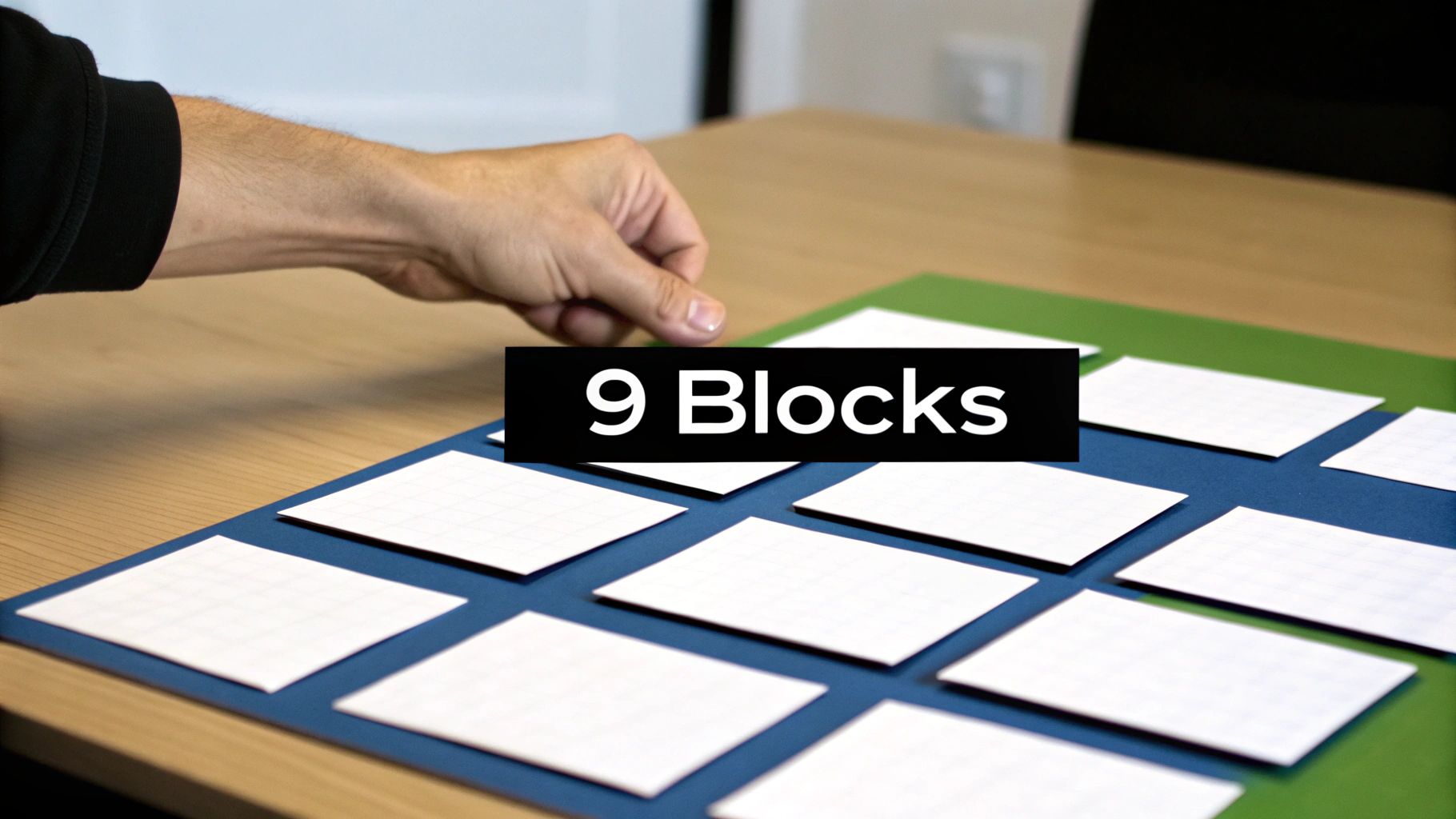
To master the Lean Canvas, stop thinking of it as a form to fill out. Each block is a hypothesis you must test in the real world. As a PM, your job is to systematically de-risk a product idea, and this is your mission control dashboard.
Let's walk through each block using a modern, relevant example: an AI-powered PM tool called "Clarity." This is the exact kind of product I see smart teams building today to solve their own problems.
Imagine Clarity is an AI assistant that automates competitive analysis, synthesizes user feedback, and drafts PRDs. Let's get its core assumptions on the canvas.
Problem and Customer Segments
These two blocks are non-negotiable. You always tackle them first. I've hired and mentored dozens of PMs, and the ones who succeed are obsessed with the problem space, not the solution space.
- Problem: Get brutally specific. "PMs are busy" is a useless insight. Dig deeper. For Clarity, the real problems are:
- Manually tracking competitor feature launches is a soul-crushing, low-leverage task that's never complete.
- Synthesizing 50 user interview transcripts into actionable insights is a major bottleneck slowing down the entire roadmap.
- Current "solutions" (spreadsheets, shared docs) are disconnected, creating administrative drag and killing momentum.
- Customer Segments: Define your early adopters. Who feels this pain most acutely? Be hyper-specific. For Clarity, our initial target isn't "all PMs." It’s "Mid-career PMs (L4/L5) at Series B to D B2B SaaS companies." This group is under immense pressure to show results, has budget authority, but lacks a dedicated research team.
Unique Value Proposition (UVP)
The UVP is the heart of your canvas—the single, compelling message explaining why you're different and worth buying. This isn't marketing fluff; it's the core promise of your product. A great UVP nails the "what, for whom, and why."
For Clarity, a strong UVP is:
Clarity is the AI product co-pilot that automates 80% of your discovery grunt work—from competitive tracking to user insight synthesis—so you can focus on high-impact strategy.
This is specific, highlights the benefit (time savings, strategic focus), and speaks directly to the target PM's pain. It's the hook that earns you the first five minutes of a customer's attention.
Solution
Only after you've nailed the Problem, Segment, and UVP should you touch this block. The classic rookie mistake is starting here, falling in love with features before validating the problem.
List the top 3-4 high-level capabilities that directly solve the problems you identified. For Clarity:
- Automated Competitor Intelligence: AI agent scrapes competitor updates and delivers weekly, summarized digests.
- AI Insight Synthesizer: Ingests user interview transcripts (from Gong, Chorus) and survey data to surface key themes and verbatim quotes.
- PRD First-Draft Generator: Creates a structured PRD outline based on insights and competitive gaps, integrated with Jira and Linear.
Channels and Revenue Streams
These blocks are your go-to-market hypotheses. How will you reach customers and make money?
- Channels: What are the most direct paths to your target segment? For Clarity:
- Sponsoring top-tier product newsletters (Lenny's Newsletter, Reforge).
- Targeted content marketing on LinkedIn, engaging with PM influencers.
- Direct, personalized outreach to Heads of Product at our target companies.
- Revenue Streams: How will you generate money? For Clarity, a tiered SaaS model is a fit:
- Pro Plan ($49/mo): For individual PMs.
- Team Plan ($199/mo for 5 seats): With collaboration features.
- Enterprise Plan (Custom): For larger orgs with SSO and advanced security.
Cost Structure and Key Metrics
Ground your idea in business reality. What will it cost, and how will you measure success?
- Cost Structure: What are the unavoidable operational costs? For Clarity:
- Salaries for top-tier engineering and product talent (avg. PM salary in SaaS is ~$150k-$220k).
- API costs for LLMs (OpenAI, Anthropic).
- Cloud infrastructure costs (AWS, GCP).
- Key Metrics: What's the one metric that matters right now? Early on, it’s rarely revenue. It’s about proving you're delivering value. For Clarity, a great key metric is "Weekly Active Users who generate at least one AI insight summary." This directly measures activation and core feature adoption.
Unfair Advantage
This is often the hardest block. An unfair advantage is something that cannot be easily copied or bought. "First-mover advantage" or "a passionate team" are not moats. In the AI world, a real moat is even tougher. For a deeper look, explore my guide on competitive analysis frameworks.
For Clarity, a real unfair advantage might be:
Proprietary dataset of 100,000+ anonymized PRDs used to fine-tune our generation model, resulting in outputs that are 50% more contextually relevant than generic LLMs like GPT-4.
That is specific, defensible, and tied to the product's value. It’s what makes your product defensible when a dozen competitors pop up.
How to Build Your First Lean Canvas Step by Step
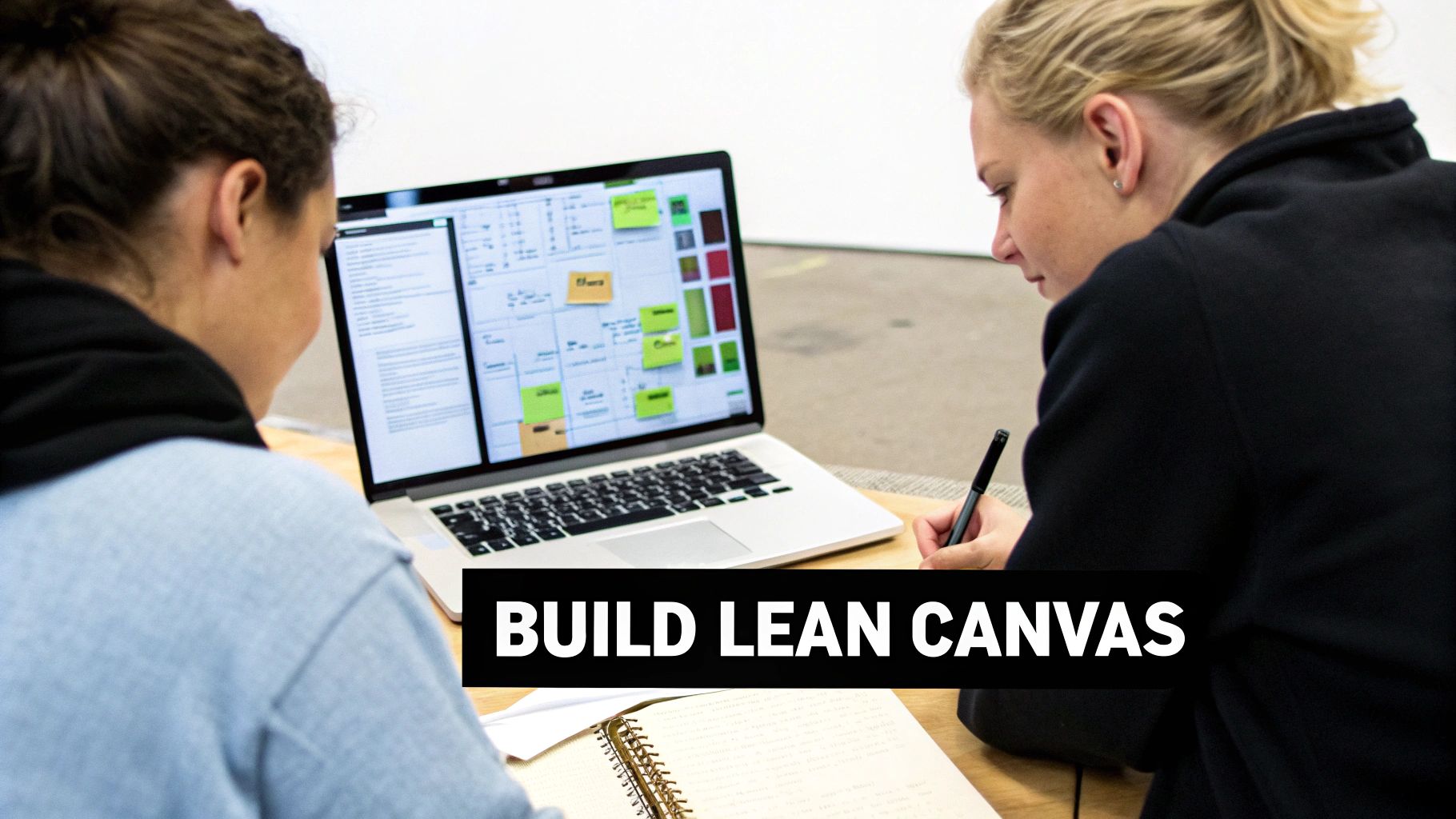
Moving from theory to execution is where top 1% of Product Managers differentiate themselves. A Lean Canvas isn't just a document; it’s the output of a strategic conversation. Without a clear workflow, it devolves into messy brainstorming.
As a PM leader, I've seen countless teams jump straight to the "Solution" box. This is the single biggest mistake. The right approach forces you to start with your highest-risk assumptions: your customers and their problems.
The Right Sequence for Filling the Canvas
Follow this battle-tested sequence to force a customer-centric mindset.
- Start with the Market (Right Side): Tackle Customer Segments and Problem together. They are inextricably linked.
- Define Your Promise: With a clear problem/customer, draft your Unique Value Proposition (UVP).
- Outline the Fix: Only now do you touch the Solution block. Brainstorm the minimum features to deliver the UVP.
- Map Your Go-to-Market: Define your Channels to reach your early adopters.
- Build the Business Case: Quantify the model with Revenue Streams and Cost Structure.
- Define and Defend: Wrap up with Key Metrics (how you’ll measure success) and your Unfair Advantage (your long-term moat).
Facilitating a Killer Lean Canvas Workshop
Your job as a PM is to lead a cross-functional team—engineering, design, marketing—through its creation. The best insights come from that mix of perspectives.
Here are pointed questions to ask your team for the critical first blocks:
For the Problem Block:
- What is the most painful, recurring task our target customer deals with?
- What workarounds or existing tools are they using? What do they hate about them? (e.g., "I spend 5 hours a week manually copy-pasting competitor updates into a spreadsheet.")
- What are the real-world consequences? Lost time, lost money, shipping the wrong feature?
For the Customer Segments Block:
- Who feels this pain most acutely? Can we describe them in one sentence?
- Where does this person work? Job title? Salary band? (e.g., "L5 PM at a B2B SaaS company, making ~$180k, under pressure to hit engagement metrics.")
- Who can we get on a call with this week to validate this? Check out my guide on how to conduct effective market research to get started.
A Lean Canvas is a snapshot of your current thinking. It's meant to be challenged. The goal of your first session isn't a perfect document; it's to surface the riskiest assumptions you need to test immediately.
Essential Tools for Collaboration
In today's hybrid world, digital whiteboarding tools are non-negotiable. Top product teams at Atlassian, Figma, and OpenAI depend on them.
- Miro: The industry standard. Its template library is excellent. Price: Free plan available; paid plans start around $8/user/month.
- Mural: Known for strong facilitation features like timers and voting systems. Price: Free plan available; paid plans start around $9.99/user/month.
- FigJam: From the makers of Figma, great for teams already in that ecosystem. Price: Free plan available; paid plans start around $3/user/month.
After your session, version your canvas (e.g., "AI Co-pilot Canvas v0.1 – Pre-Interviews"). As you gather data, create new versions. This creates a powerful visual history of your learning.
Seeing the Lean Canvas in the Wild: Tech Giants' Origin Stories
Frameworks are great, but the real learning comes from seeing them in action. Let's reverse-engineer the early days of two tech giants to see how a sharp focus on a few canvas blocks laid the groundwork for their dominance.
For a look at how these principles apply when a company is further along, check out our deep dive on Stripe and its journey to a modern product rocket.
Google: The Original Search Disruptor
Picture Larry Page and Sergey Brin at Stanford. Their first Lean Canvas would have been a masterclass in clarity on the Problem and Solution boxes.
-
Problem: Early web search (AltaVista, Lycos) was broken. It ranked pages by keyword density, making it easy to game. For academics and researchers, finding relevant, trustworthy information was impossible. The crisis wasn't a lack of information; it was a crisis of trust.
-
Customer Segments: Their first users were Stanford students and faculty. This hyper-specific group felt the pain of bad search results more than anyone.
-
Solution: The PageRank algorithm. It was a fundamentally different model, treating links as votes of confidence. This wasn't a minor improvement; it was a 10x better solution.
-
Unfair Advantage: PageRank was a complex, mathematically-driven algorithm that was incredibly difficult to copy. It created a powerful feedback loop: better results brought more users, which provided more data to improve the algorithm. That is a true, sustainable moat.
Facebook: The Social Connector
Facebook’s origin is the textbook case for nailing a tiny niche. Mark Zuckerberg wasn't trying to connect the planet; he was solving a specific problem for people he knew intimately.
The Lean Canvas forces you to ask, "For whom is this a must-have?" Facebook's initial success was about achieving an unprecedented level of problem-solution fit with a hyper-targeted audience.
-
Customer Segments: Harvard University students. It doesn't get more niche than that. This exclusivity created an environment of trust critical for sharing personal information.
-
Problem: There was no easy, trusted way for college students to see who was in their classes or social circles. Official university directories were clunky and impersonal. There was a glaring need for a digital "face book" that mirrored real campus life.
This methodical expansion—from Harvard to other Ivy Leagues, then to all colleges—is the Lean Canvas in action: validate your core assumptions with a small group of early adopters before scaling. You can find more examples of Lean principles in action over at Canva.com.
Lean Canvas vs Business Model Canvas: A PM’s Guide
Choosing the right framework is a critical decision. The Lean Canvas and the Business Model Canvas (BMC) are both powerful, but they’re built for different stages of a product's life. Picking the wrong one is like bringing a map of the subway to a hiking trip.
The Lean Canvas is for early-stage products, startups, or new features where your biggest risk is building something nobody wants. It’s designed for speed and learning when you’re hunting for problem-solution fit.
The Business Model Canvas is for established businesses where risks have moved from what to build to how to scale. The focus shifts to execution and optimization.
Key Differences in Focus
The Lean Canvas is pure lean startup methodology. It forces you to confront your core assumptions as fast as possible, swapping out the BMC’s operational boxes for ones focused on uncertainty.
Think about it: a PM at a seed-stage AI startup has a different job than a PM at Google launching a new feature for Maps. The startup PM is trying to prove a problem exists. The Google PM is navigating partnerships and a massive existing user base. They need different tools for different battles.
Once a company matures, its challenges evolve. This is where the Business Model Canvas shines. For giants like Google and Facebook, the game is no longer about finding a problem but about dominating a complex ecosystem.
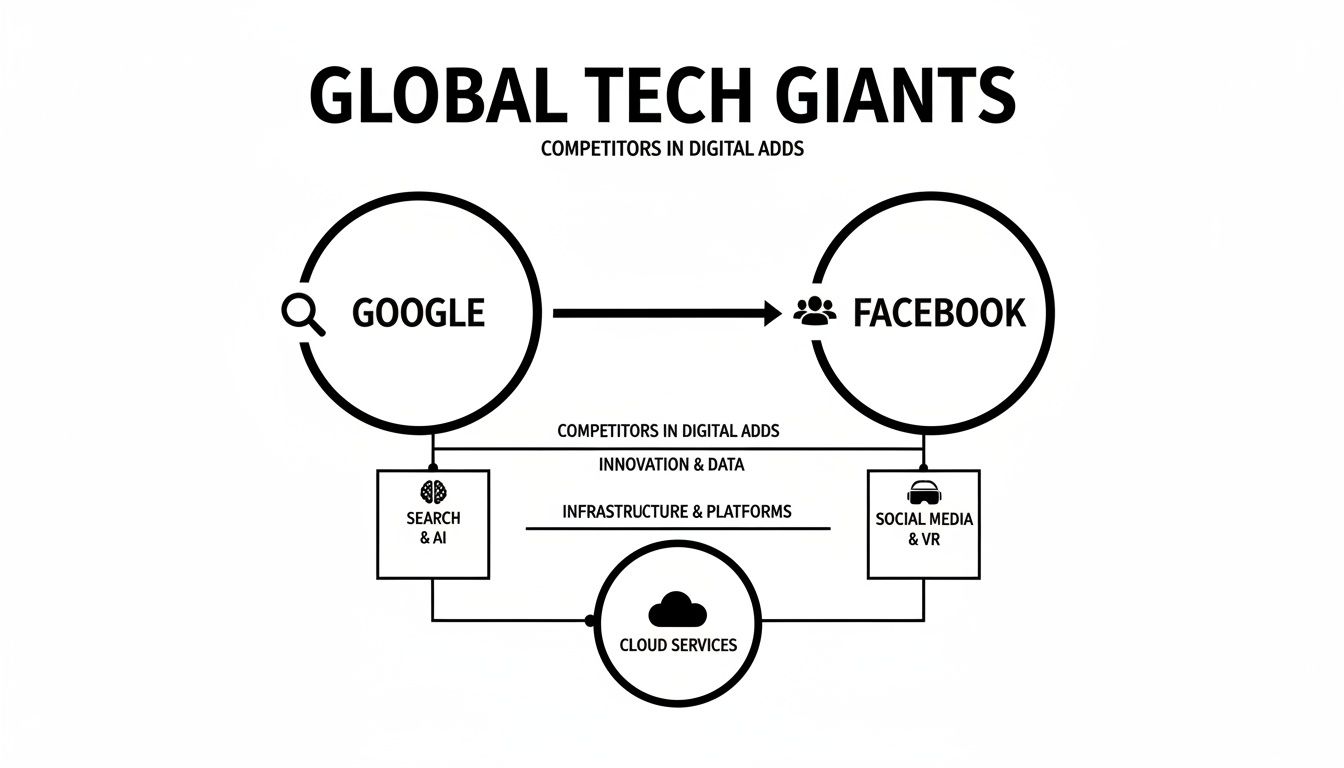
Their competition is now fought over vast, interconnected systems like AI platforms and cloud infrastructure—concerns that fit perfectly on a Business Model Canvas.
A Side-by-Side Block Comparison
The easiest way to feel the difference is to look at the four blocks that each canvas changes. These substitutions represent a fundamental shift from a problem-first mindset to an execution-first one. To zoom out and see how these tools fit into the bigger picture, explore other product strategy frameworks.
Here’s a direct comparison of what changed and why it matters.
Lean Canvas vs Business Model Canvas: A Product Manager's Guide
| Focus Area | Lean Canvas Block | Business Model Canvas Block | Best Used For |
|---|---|---|---|
| Problem vs. Execution | Problem | Key Activities | Use Problem for new ventures where you must validate a real customer pain. Use Key Activities for established businesses to map out core operational processes. |
| Solution vs. Resources | Solution | Key Resources | Use Solution to define the smallest possible thing (MVP) to solve a validated problem. Use Key Resources to list the assets (brand, patents, people) needed to operate at scale. |
| Metrics vs. Partners | Key Metrics | Key Partners | Use Key Metrics to track the numbers that prove customers care and you're learning. Use Key Partners for identifying suppliers and alliances needed to scale. |
| Competitive Edge | Unfair Advantage | Customer Relationships | Use Unfair Advantage to define your unique, hard-to-copy moat. Use Customer Relationships to map how you’ll get, keep, and grow customers in a known market. |
Ultimately, picking the right canvas comes down to being honest about your product's stage and its biggest risks. For PMs in the trenches of discovery, the Lean Canvas provides the brutal focus needed to find product-market fit.
Common Mistakes to Avoid With Your Lean Canvas
A completed Lean Canvas is a great first step, but it guarantees nothing. The real value comes from a canvas that's well-considered and continuously challenged. As a PM leader, I've seen more canvases become forgotten artifacts than dynamic strategic tools.
The difference almost always comes down to avoiding a few critical errors.
Treating the Canvas as a Static Document
This is the most frequent mistake. People treat the Lean Canvas like a business plan you write once and file away. This completely misses the point.
Your first canvas is nothing more than a collection of your riskiest guesses. Its entire value comes from its ability to evolve as you learn.
- The Mistake: You facilitate a great workshop, fill out all nine boxes, and save it as "Lean Canvas FINAL.pdf."
- The Fix: Treat it as a living document. Create a new version after every batch of customer interviews or experiment results. Label them
v0.1-Initial Assumptions, thenv0.2-Post-Interviews. This creates a powerful visual history of your learning journey.
Falling in Love With Your Solution
Engineers and product people are builders. It's tempting to jump straight to the "Solution" block. This is a fatal error that puts you on the fast track to building something nobody needs.
A Lean Canvas is a tool for problem discovery, not just solution validation. If you spend 80% of your time on the Problem and Customer Segment blocks, you've already sidestepped the most common startup killer.
Get obsessed with the problem first. The solution will follow.
Listing a Weak Unfair Advantage
"First-mover advantage" is not an unfair advantage; it's a head start. "A passionate team" is a prerequisite, not a moat. This box requires brutal honesty.
A true unfair advantage is something that cannot be easily copied or bought by a competitor with deep pockets.
- Examples of Weak Advantages: "Superior UX," "a great brand," "agile development."
- Examples of Strong Advantages: A proprietary dataset, a unique and defensible patent, powerful network effects, or exclusive access to a key distribution channel. For an AI PM, this could be a fine-tuned model based on unique, proprietary data that outperforms general models like GPT-4 for a specific task.
If you can't identify a real, defensible advantage, that’s a massive red flag. Acknowledging this painful truth early saves you from wasting years on an idea destined to be commoditized.
A Few Common Questions About the Lean Canvas
As with any good framework, the real questions pop up when you start using it. Let's tackle a few of the most common ones I hear from product managers.
How Often Should I Update My Lean Canvas?
In the early days of product discovery, you should revisit it constantly—weekly is a good rhythm, or after any significant customer conversation or experiment. The point is to capture learning as it happens.
Once you’ve validated your core assumptions and are moving toward execution, you can ease off to monthly or quarterly check-ins. The rule is simple: if you learn something that challenges a key assumption on your canvas, it's time for an update.
Can I Use a Lean Canvas for a New Feature?
Absolutely. It's a great way to bring strategic rigor to a new feature within a mature product, preventing you from just building things because you can.
Here’s how to adapt it for a feature:
- Customer Segment: This isn’t a broad market; it's a specific segment of your existing users.
- Problem: Get laser-focused on the exact pain point this feature solves for that user group.
- Channels: These are your existing product UI, email lists, and in-app messages.
What Is the Most Important Block on the Canvas?
Every block is connected, but seasoned PMs will almost always point to two: Problem and Customer Segments. These are the foundation.
If you can't nail down a burning, specific problem for a group of customers you can actually reach, it doesn't matter how brilliant your solution is. You're building a solution in search of a problem, and that's a recipe for failure.
Get the problem-customer relationship right first. The rest of the canvas will fall into place.
Ready to go deeper on product management? At Aakash Gupta, I share the frameworks and real-world advice you need to grow in your career. Explore my newsletter and podcast for insights from a PM leader who's been in the trenches.
