As a Product Manager, your career trajectory is defined by one thing: shipping products that solve real customer problems and drive business growth. The Voice of the Customer (VoC) is the most critical input for making that happen. Forget abstract theory; VoC is your tactical playbook for building a winning product and a top-tier PM career.
Let's get straight to it. VoC isn't a one-off survey or a pile of support tickets. It's your always-on listening engine—a systematic process for capturing, analyzing, and acting on customer expectations, preferences, and frustrations. It’s the difference between a PM at a struggling startup and a Group PM at Google.

Trying to build a product roadmap without a robust VoC program is like trying to navigate without a compass. You’re moving, but you're likely heading straight into a reef. Senior PMs at companies like Slack, Meta, or Miro don't guess; they use a sophisticated VoC system as their strategic compass to validate every major product bet. This isn't just a "nice-to-have." In today's market, it's a non-negotiable skill for career advancement. A typical Senior PM role at a FAANG company might list "deep customer empathy and experience with VoC programs" as a core requirement, with salaries ranging from $180,000 to $250,000+.
From Feedback Collection to Strategic Advantage
This is where many aspiring PMs get it wrong. They think VoC is just about collecting feedback. That’s entry-level. The work that gets you promoted—and where top PMs truly shine—is in the rigorous analysis, synthesis, and strategic application of those insights. It's about turning a messy, chaotic stream of raw customer input into a coherent, defensible product strategy.
A mature VoC program goes way beyond just reading survey responses. It:
- Identifies Unspoken Needs: It helps you see past explicit feature requests ("I need a faster horse") to uncover the deeper problems customers are trying to solve ("I need to get from A to B more quickly").
- De-risks Your Roadmap: It provides concrete evidence to either validate or challenge your strategic assumptions, drastically reducing the risk of wasting six months of engineering time on something nobody wants.
- Aligns the Organization: It creates a shared, empathetic understanding of the customer across engineering, marketing, sales, and leadership, pointing everyone toward the same North Star.
This customer-centric focus has transformed how modern tech companies operate. The global VoC market was recently valued at $2.7 billion, a clear signal that businesses are investing heavily in deep customer understanding.
The Core of Product Discovery
Ultimately, a strong VoC process is the bedrock of effective what is product discovery. It ensures you’re not just chasing shiny objects but are systematically identifying and prioritizing the most valuable problems to solve. This continuous loop of listening, learning, and acting is what separates market-leading products from the rest.
Building Your Customer Listening Engine
A powerful Voice of the Customer program isn’t built on a single source of truth. It's a sophisticated listening engine with sensors placed in all the right spots. As a Product Manager, your job is to architect this engine to capture the full symphony of customer needs, not just the loudest notes. This means moving beyond the annual generic survey and building a system that blends direct and indirect feedback channels. Each channel provides a unique signal; weaving them together creates a high-fidelity picture of the customer experience.
To build an effective listening engine, you must master the different methods and best practices for how to collect feedback from customers. Let's break down the essential channels you need to operationalize.
Direct Feedback Channels
Direct feedback is when you explicitly ask customers for their opinion. These methods are structured and intentional, giving you clean, targeted data on specific parts of your product.
- Customer Interviews: The gold standard for deep, qualitative insights. A single, well-run 30-minute conversation can reveal more about a user's core problems and motivations than a thousand survey responses. This is a non-negotiable skill for discovery. For Aspiring PMs: Your goal is to conduct at least one of these per week.
- Surveys (NPS, CSAT, CES): Your quantitative pulse checks. Net Promoter Score (NPS) measures loyalty, Customer Satisfaction (CSAT) gauges happiness with a specific interaction, and Customer Effort Score (CES) reveals how easy it was for a customer to get something done. For Mid-Career PMs: Your goal is to instrument these at key journey points (e.g., post-onboarding, post-support ticket).
- In-App Feedback Widgets: Tools like Hotjar or UserVoice let users give feedback in the moment. This is invaluable for capturing contextual reactions to a confusing workflow or a new UI, directly at the point of friction.
For PMs looking to sharpen their qualitative skills, our guide on how to conduct user interviews offers a tactical framework for asking the right questions.
Indirect Feedback Channels
Indirect feedback is what you learn by observing what customers do and say when they don't think you're listening. This data is often more candid and can expose unspoken needs customers wouldn't think to mention.
As a PM leader who has hired dozens of PMs, I find the greatest insights often come from what customers do, not just what they say. Indirect feedback is where you find the unfiltered truth.
This raw data takes more work to synthesize, but it's a goldmine for spotting emerging trends and hidden pain points.
- Support Ticket Analysis: Your customer support team is on the front lines. Mining support tickets from platforms like Zendesk or Intercom reveals recurring bugs, points of confusion, and the most urgent feature requests. HubSpot famously uses support chat logs to prioritize bug fixes and inform its roadmap.
- Social Media Listening: Monitoring brand mentions on platforms like X (formerly Twitter), Reddit, or industry forums gives you a real-time stream of public sentiment. This is where you'll hear the most passionate praise and the most scathing critiques.
- Product Analytics: Tools like Amplitude or Mixpanel show you exactly how people interact with your product. High drop-off rates on a specific screen or low adoption of a new feature are powerful, behavior-based signals that something is wrong.
A Holistic Approach
A world-class listening engine doesn’t just pick one or two of these channels. It integrates them.
For example, Airbnb uses post-stay surveys (direct feedback) to fine-tune its booking flow. Simultaneously, they're monitoring social media (indirect feedback) to catch emerging issues with their host policies before they escalate. By combining direct asks with indirect observation, you build a comprehensive system that captures both stated needs and unarticulated struggles. This holistic view is your unfair advantage in building products that consistently exceed expectations.
Right, so you’ve collected a mountain of customer feedback. Now what? The real mark of a senior PM isn't just gathering feedback, but knowing how to translate that raw, chaotic data into a coherent and defensible product strategy. Without a system, you're just drowning in opinions. This is the pivot point where you stop being a "feature factory"—blindly building what the loudest customer asks for—and become a strategic leader who unearths the real problems worth solving.
The goal is to build a repeatable process that turns a firehose of feedback into clear, actionable inputs for your roadmap.
Uncovering the 'Why' with Jobs-to-be-Done
One of the most powerful frameworks I've seen used at top companies is Jobs-to-be-Done (JTBD). It’s a profound shift in perspective. Instead of focusing on what customers say they want (e.g., "I need a faster horse"), JTBD forces you to dig deeper and understand the underlying "job" they are trying to accomplish (e.g., "I need to get from point A to point B more quickly").
A feature request is just one potential solution, but the "job" is the core, unchanging problem. When you focus on the job, you open up a much wider, more creative space for solutions. To master this, check out our complete guide on the Jobs-to-be-Done framework.
Mapping Problems to Solutions
Once you've defined the customer's core "jobs," you need a structured way to connect those problems to potential solutions. This is critical for preventing your team from jumping on the first idea that sounds good. Teresa Torres's Opportunity Solution Tree is a fantastic visual framework for this.
It’s a simple, elegant way to map things out:
- Desired Outcome: Start with a measurable business objective (e.g., "Increase user retention by 15% in Q3").
- Opportunities: These are the customer problems that, if solved, would help you hit that outcome (e.g., "Users are struggling to find relevant content when they first log in").
- Solutions: Brainstorm specific features or product changes to address those opportunities (e.g., "Build a 'Recommended for You' algorithm using our new ML model").
- Experiments: Define the small tests you'll run to validate if a solution actually works before committing to building the whole thing (e.g., "Run an A/B test with a simple version of the algorithm against the current homepage").
This structure ensures every feature your team works on has a clear line of sight back to a validated customer problem and a measurable business goal.
A great Product Manager doesn't just collect customer requests; they build a clear, logical bridge from a customer's pain point to a high-impact business outcome. Frameworks are the architecture for that bridge.
From Personas to True Empathy
Let's be honest: traditional personas can feel like flat, demographic-based caricatures that don't help you feel what the customer is feeling. To truly get inside the voice of the customer, you have to go deeper. This is where Empathy Maps come in. They are a brilliant tool for pushing your team to articulate what a customer is genuinely thinking, feeling, seeing, and doing.
An empathy map forces you to synthesize your interview notes and feedback into four powerful quadrants:
- Says: What are the direct quotes we've actually heard?
- Thinks: What might they be thinking but not saying out loud? What are their real motivations or worries?
- Does: What actions and behaviors have we physically observed?
- Feels: What emotions are they likely experiencing? (e.g., frustrated, confused, anxious, excited).
This exercise isn't academic; it forces you and your team to step directly into the customer's shoes. It’s this process that builds the genuine empathy required to design solutions that don’t just work, but truly resonate.
Making sense of qualitative data can feel overwhelming, but these frameworks provide the structure you need. They're not just about organizing notes; they're about building a shared understanding across your team. Each framework offers a different lens through which to view your customer's world.
VoC Synthesis Framework Comparison for Product Managers
| Framework | Primary Use Case | Key Benefit for PMs | When to Use |
|---|---|---|---|
| Jobs-to-be-Done (JTBD) | Identifying the core, underlying problem or motivation behind a customer's actions. | Shifts focus from features to outcomes, opening up more innovative solution spaces. | Early in the discovery phase to define the problem space and understand user motivation. |
| Opportunity Solution Tree | Visually mapping customer problems (opportunities) to potential solutions and experiments, all tied to a business outcome. | Ensures every feature is directly linked to a business goal and a validated user need. | During planning and discovery to prioritize opportunities and align the team on strategy. |
| Empathy Map | Developing a deep, shared understanding of the user's experience, including their thoughts, feelings, and actions. | Builds genuine empathy within the team, leading to more user-centric design decisions. | After user interviews or research sessions to synthesize qualitative data and build a customer profile. |
| Personas | Creating a fictional, representative character based on user research to guide product decisions. | Provides a quick, memorable reference point for who the team is building for. | When you need a simple, high-level archetype to align the team on the target user. |
Ultimately, these frameworks are tools in your PM toolkit. The key is to pick the right one for the job to transform raw feedback into a product strategy that not only works, but also creates products customers truly love.
The Modern VoC Tech Stack and AI Tools
Let's be blunt: manual feedback analysis is dead. If you’re a PM still wrangling hundreds of survey responses in a spreadsheet, you’re already behind. It doesn’t scale, and it won't get you promoted.
To get ahead, you need a modern tech stack. The goal isn’t to collect shiny new tools, but to build an integrated system that automates the grunt work. This frees you up to do what you were hired for: find the signal in the noise and build better products.
Foundational VoC Tooling
Before you even think about AI, you need a solid foundation for capturing feedback and understanding user behavior. These are the table stakes for any serious product team.
- Survey Platforms: Tools like Typeform or SurveyMonkey are your workhorses for structured feedback. Think NPS, CSAT, or targeted feature surveys. Their real power is in their simplicity and integrations, letting you fire off a survey right after a user completes a key action.
- Product Analytics: This is where you see what users do. Platforms like Amplitude or Mixpanel are the source of truth for behavior, showing you exactly where users drop off or which features they actually adopt. This data is critical for validating—or challenging—your qualitative insights.
- Dedicated VoC Platforms: Once you’re more mature, you might look at enterprise tools like Qualtrics or Medallia. They pull feedback from dozens of channels into a single dashboard. They're incredibly powerful but are a serious investment, usually best for organizations with a dedicated VoC program.
Think of it like this: your tools are the bridge that connects the raw, messy world of customer feedback to the clean, coherent world of product strategy.
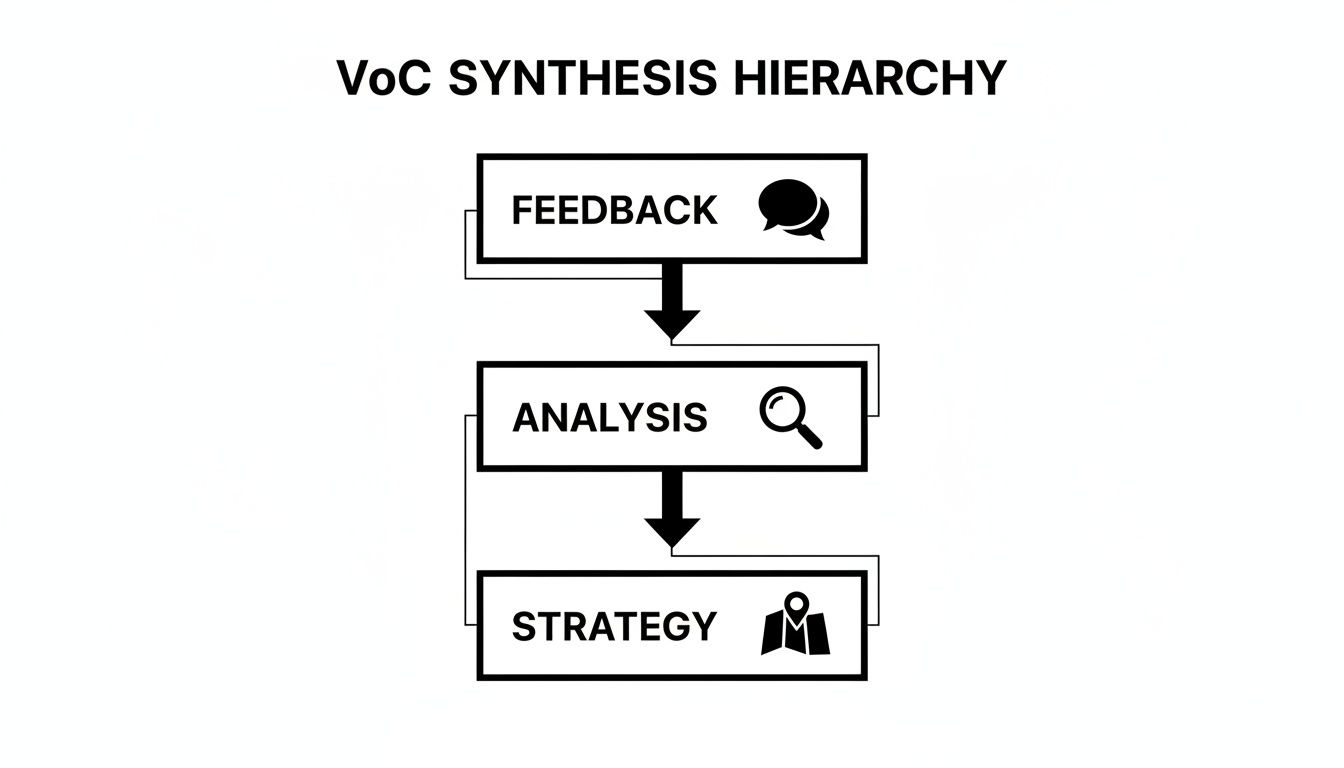
Without the right tech, that bridge collapses, and all that valuable feedback is left stranded.
The AI Revolution in VoC
The real game-changer for Product Managers is the recent explosion in AI. AI-powered tools can now analyze, summarize, and even prioritize feedback for you. This shift is turning VoC from a chore into a strategic advantage, particularly for AI PMs who are expected to leverage these technologies natively. The global VoC platform market was valued at $9.5 billion and is expected to more than double to $22.5 billion, driven largely by AI capabilities.
Here’s where AI makes a huge difference day-to-day:
Automated Transcription and Summarization: Tools like Dovetail or Otter.ai have become indispensable. They transcribe a 60-minute customer interview in minutes. Their AI features now go further, pulling out key themes, generating summaries, and highlighting powerful quotes. This is hours of work, done instantly.
Sentiment and Theme Analysis: AI can tear through thousands of open-ended survey responses, app store reviews, or support tickets and instantly tag recurring themes—like "login issues," "confusing UI," or "pricing questions"—giving you a quantitative pulse on qualitative feedback.
AI-Powered Synthesis: The newest tools use generative AI to do the synthesis for you. Imagine feeding an AI all your support tickets, user interviews, and survey data from the last quarter. You can use a prompt like this:
Prompt for ChatGPT/Claude: "Act as a Senior Product Manager. Analyze the following customer feedback data [paste data or link]. Identify the top 5 most critical customer pain points. For each pain point, provide 3 direct customer quotes as evidence, and suggest one potential product opportunity to explore."
Building a modern VoC stack is about choosing the right tool for the job. To help you navigate the options, check out our deep-dive on the top customer feedback analysis tools product teams are using right now. By layering these systems, you’ll transform your VoC program from a reactive feedback inbox into a proactive, automated insights engine that drives your roadmap.
Measuring VoC Impact and Closing the Loop
A Voice of the Customer program that doesn't lead to action is a listening hobby. Collecting feedback is only half the battle. Proving its value and, more importantly, showing customers you actually listened is what separates great product teams from the rest. This is where you connect your VoC work directly to business outcomes and build immense customer trust.
Without measuring, you're flying blind. You need clear, undeniable metrics to show how customer insights are improving the product and boosting the bottom line. This is how you justify your roadmap and get execs to sign off on your big bets.
Core VoC Metrics for Product Managers
You could track a million things, but a few core metrics provide a powerful, at-a-glance pulse on customer sentiment. Your job as a PM isn't just to track these numbers, but to dig into the "why" behind them.
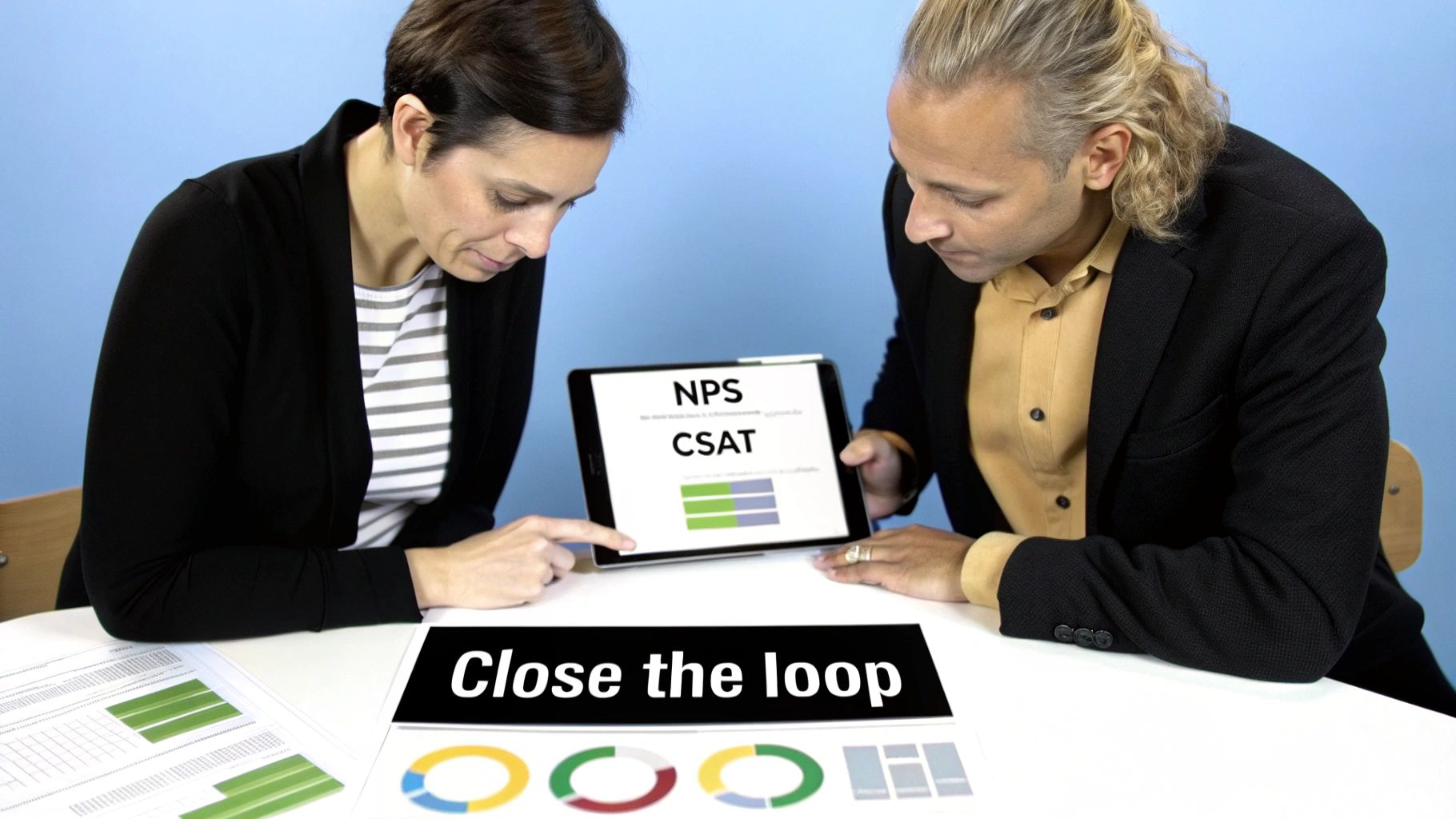
- Net Promoter Score (NPS): The classic loyalty metric: "How likely are you to recommend our product?" It segments users into Promoters, Passives, and Detractors, giving you a high-level snapshot of brand health.
- Customer Satisfaction (CSAT): Typically measured on a 1-5 scale, CSAT is your go-to for instant feedback right after a specific interaction, like using a new feature or getting help from support.
- Customer Effort Score (CES): This asks, "How easy was it to get your issue resolved?" A low effort score is a massive predictor of loyalty. Customers stick with products that are easy to use.
These metrics form the quantitative backbone of your VoC program. If you want to go deeper on a critical one, check out our guide on how to improve customer satisfaction scores.
Closing the Loop: The Ultimate Trust Builder
Measuring impact is critical, but the single most powerful thing you can do is close the loop. This means telling customers that their feedback led to a real change in the product. It’s shockingly rare, which makes it an incredible way to stand out.
When a customer sees their feedback turned into a feature, you haven't just solved a problem—you've created a loyal advocate for your brand. This transforms feedback from a transaction into a relationship.
Companies like Slack are masters of this. They don't just quietly ship a bug fix. They'll often highlight it in their release notes with a nod to the community, turning a simple update into a marketing moment that screams, "We listen." This creates a virtuous cycle: customers feel heard, so they give you more (and better) feedback.
Actionable Templates for Closing the Loop
You don’t need a fancy system to start. A simple, personal message has a huge impact. Here are a couple of templates you can adapt right now:
1. The In-App Notification:
- When to use it: For a widely requested feature that a ton of users will benefit from.
- Example Text: "You asked, we listened! You can now [describe the new feature]. Thanks for helping us build a better product."
2. The Personalized Email:
- When to use it: For specific, thoughtful feedback from a high-value customer or a group of users who helped you beta test.
- Example Text: "Hi [Customer Name], A few months ago, you mentioned how you wished you could [describe their feedback]. I'm excited to share that we just launched this feature, thanks in large part to your input. You can check it out here: [link]. We really appreciate you."
By systematically measuring the impact of your VoC program and consistently closing the loop, you turn customer feedback from a simple data point into your most powerful engine for growth and innovation.
Common VoC Program Pitfalls to Avoid
Even the most well-intentioned Voice of the Customer programs can go sideways. Many kick off with a flurry of activity but ultimately fizzle out, turning into a resource drain instead of a strategic asset. As a PM, knowing these common traps is your best defense against building a program that just creates noise.
Think of this as your pre-mortem. By anticipating these failures now, you can design a VoC system that’s resilient, impactful, and proves you’re a product leader who actually gets the customer.
Pitfall 1: Over-Indexing on a Single Channel
A classic mistake is getting hooked on one feedback source, like NPS surveys. While NPS is a decent high-level check on loyalty, it rarely tells you the why behind the score. A team that only listens to NPS might burn months trying to nudge a single number up without ever touching the real root of customer frustration.
A solid VoC program is like a balanced investment portfolio. You have to diversify your data sources to see the full picture.
- Countermeasure: Pair your quantitative data with qualitative insights. If your NPS score suddenly drops, don't just hit the panic button. Dig into support tickets from that same week, schedule interviews with detractors, and watch session replays in your analytics platform to see exactly where people are getting stuck.
Pitfall 2: Suffering from Analysis Paralysis
So you’ve gathered mountains of data—interview transcripts, survey results, analytics reports. Now what? The sheer volume can be completely overwhelming, leading straight to analysis paralysis. This is where you get so lost in the weeds of the data that you never actually make a decision.
The point of VoC isn't to find a perfect, statistically significant answer; it's to gather enough signal to make a confident, directionally correct bet.
The purpose of VoC isn't to eliminate risk; it's to reduce uncertainty. Great PMs are comfortable making decisions with imperfect information, using customer feedback as a guide, not a guarantee.
Countermeasure: Timebox your analysis and hunt for themes, not isolated data points. Use frameworks like an Opportunity Solution Tree to force a connection between a customer problem and a business outcome. That structure keeps you from endlessly exploring and pushes you toward insights you can actually use.
Pitfall 3: Falling for Confirmation Bias
Confirmation bias is that sneaky human tendency to look for and favor information that confirms what we already believe. In product management, this is incredibly dangerous. It’s conducting customer interviews where you accidentally lead the user to validate your pet feature idea. It’s cherry-picking the survey quotes that just happen to support your pre-written roadmap.
Countermeasure: Actively search for evidence that proves you wrong. When you’re planning the roadmap or in the middle of discovery, literally assign someone on your team to play "devil's advocate." Their only job is to argue against the popular opinion, using customer data to poke holes in the team's assumptions. This kind of structured dissent is a powerful antidote to groupthink, ensuring you’re building what customers need, not just what you want.
Frequently Asked Questions About VoC Programs
Rolling out a Voice of the Customer program always brings up a ton of questions. I've seen product leaders and their teams hit these same roadblocks time and time again. Let's cut through the noise with some clear, practical answers.
How Much Feedback Is Enough to Be Confident?
There's no magic number here. Honestly.
For qualitative feedback, like the insights you get from user interviews, you'll start hearing the same major themes pop up after just 5-7 conversations with customers in the same segment. The goal isn't to reach statistical significance like you would in a scientific paper. It's about spotting recurring patterns and pain points so you can reduce your uncertainty.
When you're looking at quantitative data from something like a survey, the volume you need really depends on the size of your user base. The key is to look for trends over time instead of getting hung up on a single data point. Think directional correctness, not absolute certainty.
How Do I Handle Contradictory Feedback?
First off, contradictory feedback isn't a problem—it's a signal. It's gold. It almost always means you're dealing with different customer segments who have completely different needs. When one group is raving about a feature and another absolutely despises it, the last thing you want to do is try to average their opinions.
Instead, that's your cue to dig deeper. Start segmenting that feedback by persona, plan size, or job-to-be-done. More often than not, you'll find that what's a deal-breaker for a brand new user is totally irrelevant to a power user who has been with you for years. This is exactly how you uncover opportunities for targeted improvements, rather than building a one-size-fits-none product.
What’s the First Step If I Have No VoC Program?
Start small. And scrappy. Please don't try to boil the ocean by launching five different feedback channels all at once. Pick one high-impact, low-effort method and get really good at it first.
The fastest way to start is to talk to your customer support team. They are a living, breathing repository of your customers' biggest frustrations and most-wanted features. A 30-minute weekly sync with support is the cheapest, highest-ROI VoC program you can possibly create.
Once you've got that rhythm down, you can layer in something simple like an in-app CSAT survey that pops up after a key user action. From there, you'll have the momentum to build toward more structured methods like regular user interviews.
Ready to build products that customers actually want? At Aakash Gupta, we provide the frameworks, insights, and career guidance to help you become a top-tier product leader. Learn more and subscribe to the world's largest PM newsletter.
