Product discovery is a systematic process for de-risking your product ideas. It’s the framework that separates elite PMs from the rest—the ones who consistently ship products that win versus those who just ship features. It's about rigorously answering one critical question before you write a single line of code: Are we building the right thing?
The goal is to deeply understand your customer's problem and validate that your proposed solution is desirable for them, viable for the business, and feasible for your team to build. Mastering this isn't just a skill; it's the core competency that defines a high-impact product management career.
Why Ignoring Product Discovery Tanks Careers and Companies
As a PM leader who has hired and managed teams at major tech companies, I’ve seen more projects and budgets evaporate due to unchecked assumptions than any other single cause. Teams, especially those under pressure, are tempted to skip right to building. This isn't just a tactical misstep; it's a strategic blunder that can tank your career, your team's morale, and even the company itself.
The problem is simple: building features is expensive, but building the wrong features is catastrophic. Without a proper discovery process, teams are just running on internal opinions, stakeholder guesses, and unverified beliefs about what customers want. That’s not product management—it’s a lottery.
The Financial Black Hole of Unused Features
The data on this is staggering. An estimated 80% of software features are rarely or never used after launch. This waste adds up to about $29.5 billion in R&D expenses globally each year. That's not just an inefficiency; it's a direct drain on resources that could have been invested in real innovation. You can discover more insights about this product development waste from Pendo.
This chart from CB Insights paints an even clearer picture of the risks.
Look at that top reason: "No Market Need" is the killer, cited by 38% of failed startups. This is the direct consequence of skipping product discovery. Teams build something they think is great, only to find out that nobody wanted it in the first place.
The Hidden Costs of Building Blind
Beyond the obvious financial loss, ignoring discovery kicks off a toxic cycle that can cripple a product organization. When you skip this crucial phase, you aren't just risking money; you're risking everything.
"The goal of product discovery is not to ship features. It is to build a shared understanding of the problem space, ensuring that when you do build, you're solving a real, validated need for a specific customer."
This cycle of failure shows up in a few painful ways:
- Wasted Engineering Cycles: Every hour your engineering team spends on an unvalidated feature is an hour they can't spend on something that actually drives growth. This is your most expensive and finite resource—don't squander it.
- Damaged Team Morale: Nothing kills motivation faster than seeing your hard work get completely ignored. Teams at even the best companies become disengaged when they feel like their effort doesn't matter.
- Eroded Credibility: As a PM, your reputation is built on delivering results. If you consistently ship features that fail to move the needle, you'll quickly lose credibility with leadership and your own team.
- Increased Career Risk: At the end of the day, PMs are judged on outcomes, not output. A portfolio of failed features becomes a huge liability in performance reviews and your next job search. I've seen promising PM careers stall out for this exact reason.
The Three Pillars of Modern Product Discovery
Let’s get one thing straight: product discovery isn't some vague "research phase." It’s a rigorous, systematic process for de-risking your product ideas.
Think of it like building a three-legged stool. If one leg is wobbly, the whole thing comes crashing down. In product, those three legs are Desirability, Viability, and Feasibility. This isn't just theory—it's the operating model for elite product teams at places like Google, Meta, and Netflix. They use it to build sustainable businesses, not just a random collection of features.
This framework is what separates hopeful guessing from confident decision-making. It forces you and your team to ask the toughest questions before you write a single line of code, saving millions in wasted engineering hours and months of lost time.
Ignoring these pillars means you're building on unchecked assumptions, and that's the fastest way to ship features nobody uses.
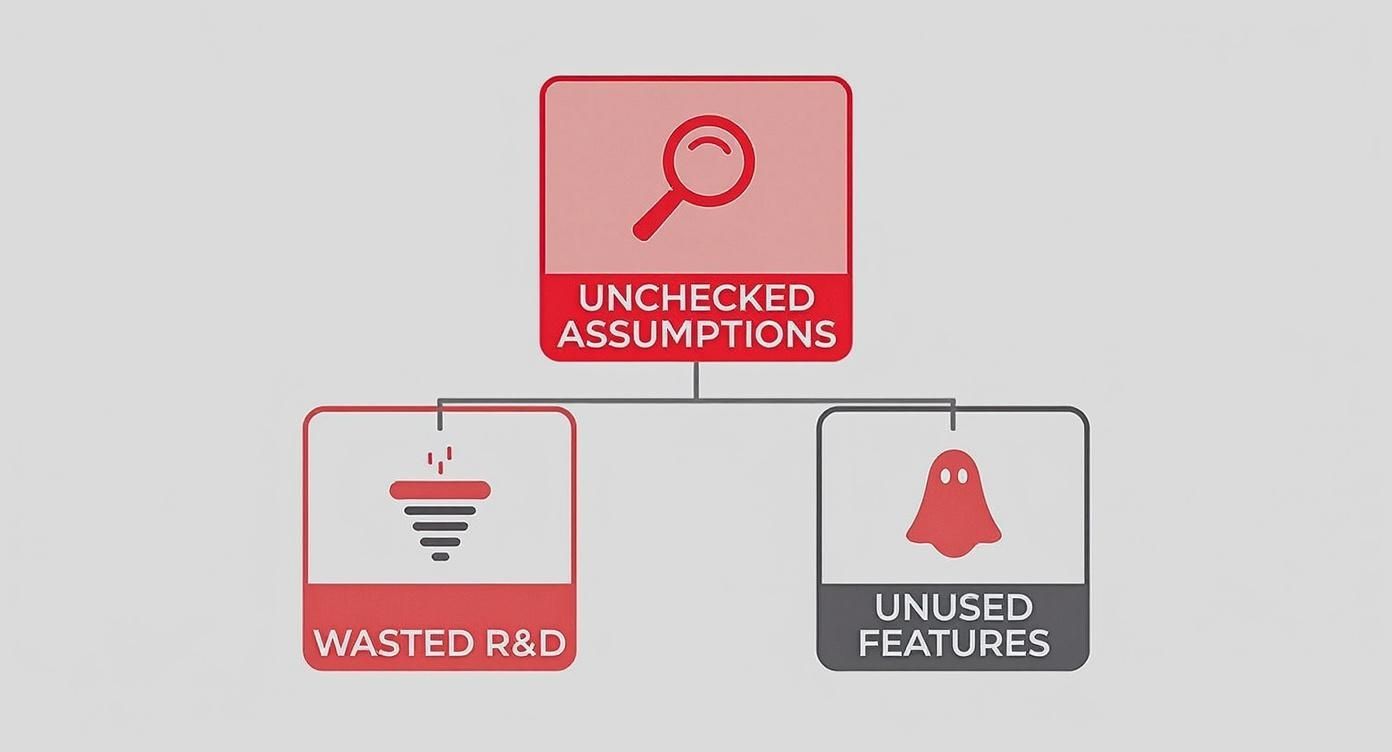
As you can see, failing to validate your core beliefs is the root cause of the most expensive problems in product development.
To help you systematically tackle risk, we can break down the discovery process into three core dimensions. Each pillar has its own central question and a distinct set of activities to find the answers.
The Three Pillars of Product Discovery Risk Mitigation
| Pillar | Core Question | Key Activities | Primary Owners |
|---|---|---|---|
| Desirability | Do they want it? | Customer interviews, surveys, prototype testing, user journey mapping. | Product, Design, Research |
| Viability | Should we build it? | Business model canvas, market sizing, pricing experiments, competitor analysis. | Product, Marketing, Finance, Legal |
| Feasibility | Can we build it? | Tech spikes, architecture reviews, resource planning, prototyping with engineers. | Product, Engineering, DevOps |
By addressing all three, you ensure you're not just building something cool, but something that customers will adopt, that makes business sense, and that your team can actually deliver and maintain.
Pillar 1: Desirability (Do They Want It?)
This is where it all begins. If nobody actually wants what you're building, the other two pillars are completely irrelevant. Desirability is all about uncovering a real, painful problem that a specific group of people is desperate to solve.
Your goal here is to become the world's leading expert on your customer's pain. That means ditching your assumptions and getting relentlessly curious.
Key Activities:
- Customer Interviews: Don't just ask for feature requests. Use techniques like the "Five Whys" to dig deep into the root motivations and frustrations behind a user's actions.
- Surveys & Questionnaires: Put numbers to the pain. How many people are affected? How often does this problem occur? How severe is it, really?
- Prototype Testing: Get something tangible in front of users fast. Use low-fidelity mockups in a tool like Figma to get gut reactions to potential solutions long before you commit to code.
A Real-World Example: Airbnb
Airbnb didn't start by building a massive, complex booking platform. They started with the most basic desirability test imaginable. Founders Brian Chesky and Joe Gebbia couldn't afford their rent in San Francisco, so they tossed an air mattress on their living room floor and built a dead-simple website to rent it out. When people actually paid money to sleep on their floor, they had their proof: a real desire existed for an alternative to overpriced hotels.
Pillar 2: Viability (Should We Build It?)
Okay, so people want it. But should we build it? Viability is the crucial link between solving a user's problem and creating a sustainable business model. A product can be intensely desirable but still sink a company if it costs more to run than it brings in.
This is where the product manager truly acts as the CEO of their product, constantly balancing customer delight with business realities. It's a tricky tightrope walk, and you have to get the balance right between moving fast and moving in the right direction. For a deeper look, check out this guide on balancing product discovery agility and effectiveness.
Key Activities:
- Business Model Canvas: Get it all on one page. Map out your value proposition, customer segments, revenue streams, and cost structure to see how all the pieces fit together.
- Market Sizing (TAM, SAM, SOM): Figure out the potential prize. Is the total addressable market big enough to justify the investment of time and money?
- Pricing Experiments: Don't just guess your price. Test different price points and models early on to understand what your target market is actually willing to pay.
A Real-World Example: Netflix
Netflix’s pivot from DVDs-by-mail to streaming was a monumental bet on viability. They saw the digital future, but the business case was a huge risk. They had to navigate incredibly complex content licensing deals, invest billions in new infrastructure, and completely overhaul their business model—all while their very profitable DVD business was still chugging along. Their success was born from rigorously modeling the financial viability of streaming years before it was a sure thing.
Pillar 3: Feasibility (Can We Build It?)
Last but not least, Feasibility grounds your grand vision in technical reality. This is where your engineering partners become your best friends. An idea can be brilliant, desirable, and viable, but if it can't be built with your current tech, skills, or budget, it's nothing more than a fantasy.
It's about asking the hard questions about what it will really take to bring this solution to life and keep it running smoothly.
Key Activities:
- Tech Spikes: These are short, time-boxed investigations led by engineers to answer a specific technical question. Can we integrate with that weird third-party API? Is this new database technology as fast as they claim?
- Architecture Reviews: Your tech lead or principal engineer needs to weigh in. How will this new feature fit into our existing system? Will it create a mountain of technical debt we'll pay for later?
- Resource Planning: Get real about the effort. Work with engineering leadership to estimate the work involved and ensure you have the right people with the right skills available to do the job.
A Real-World Example: Slack
When Slack was first being built, their core feasibility challenge was immense: create a real-time messaging experience that was lightning-fast and rock-solid reliable across dozens of different devices and platforms. They knew that instant, seamless communication was their non-negotiable value prop. So they invested heavily in their backend infrastructure from day one to ensure they could technically deliver on that promise at scale.
Implementing Continuous Discovery Habits
So, we've talked strategy. But a strategy is just a pretty slide deck until you put it into practice. The absolute best product teams I've ever hired or worked with don’t treat discovery as "Phase 1" of a project. They live and breathe it. Every single week.
This is the whole idea behind Continuous Discovery Habits, a framework that product discovery coach Teresa Torres really brought into the mainstream. It’s a total mindset shift—moving away from big, chunky, project-based research and into an ongoing, sustainable rhythm of learning.
The point is to build a constant feedback loop with your customers. This ensures your team is always, always working on the most valuable problems. We're not talking about massive, time-consuming research studies here. Think quick, small, iterative learning cycles that fuel your decisions week in and week out.
The Weekly Cadence of Customer Touchpoints
The heart of this whole thing is a simple but incredibly powerful habit: talk to at least one customer every single week.
This isn’t some formal, high-pressure usability test. It’s just a conversation. You’re trying to understand their world—their goals, what drives them crazy, and the clever workarounds they’ve invented to get by.
To make this happen, you need a system for getting people to talk to you. Don't overthink it.
- Automated Recruiting: Pop a simple, non-annoying banner in your app or a link in your email signature that says something like, "Got 20 minutes to help us improve? Schedule a time here." Use a tool like Calendly to make the scheduling painless.
- Customer Success Handoffs: Your Customer Success and Support teams are sitting on a goldmine. They talk to users all day. Set up an easy way for them to ask customers who share interesting feedback if they’d be open to a quick chat with the product team.
- Standing Panel: For B2B products, this is huge. Find a small group of engaged customers who agree to be part of a "customer advisory" group you can tap into regularly.
During these interviews, your job is to dig for true needs, not just collect a laundry list of feature requests. To get better at structuring these conversations, you can check out our in-depth guide on how to conduct user interviews. The real magic is in the questions you ask.
Sample Questions to Uncover Real Needs:
- "Tell me about the last time you tried to [accomplish a specific goal related to your product]."
- "What was the hardest part about that?"
- "How did you end up solving it?" (This question is pure gold for uncovering workarounds.)
- "If you had a magic wand and could change anything about that process, what would it be?"
Mapping Insights with the Opportunity Solution Tree
Just collecting insights isn’t enough. You need a way to organize them so you can draw a straight line from a customer need to the work your team is doing. This is where the Opportunity Solution Tree (OST) becomes your team's best friend.
An OST is a simple visual that connects a clear business outcome to the customer opportunities you’ve found, and then maps those to potential solutions and experiments. It makes sure every feature idea can be traced back to a real, validated customer problem.
Here’s what a typical Opportunity Solution Tree looks like.
This framework literally forces your team to stop and think about why they are building something, connecting the company's goals directly to the user problems you're trying to solve.
Structuring Your Opportunity Solution Tree:
- Desired Outcome (Top): Start with a specific, measurable business goal. For instance: "Increase new user activation rate by 15% in Q3."
- Opportunities (Branches): These are the customer needs, pains, and desires you heard in your interviews. They are problems, not solutions. Example: "I'm not sure where to start after signing up."
- Solutions (Sub-branches): Now you can brainstorm multiple ways to tackle an opportunity. Example: Create a guided onboarding tour, offer a checklist of setup tasks, or build in-app video tutorials.
- Experiments (Leaves): Design small, fast tests to see which solution actually works. Example: Test a prototype of the onboarding tour with 5 users to see if it improves their initial understanding.
Mini Case Study: A B2B SaaS Pivot
A B2B SaaS company I advised had a "reporting dashboard" that nobody was using. Engagement was flat. Through their new weekly interview habit, they discovered that customers weren't ignoring it because they didn't want data; they were ignoring it because the data wasn't useful for their specific role (Sales Ops).The real opportunity wasn't "build better charts." It was "help me quickly identify at-risk accounts for my weekly team meeting."
Using an OST, they mapped this opportunity to several solutions, including a pre-built "At-Risk Account" report template. They mocked up a simple prototype, tested it, and the feedback was fantastic. After shipping the new template, the company saw a 30% increase in their core activation metric—weekly report generation—within a single month. That’s the power of this process in a nutshell.
Your Essential Product Discovery Toolkit
A framework is only as good as its execution. Having a map is great, but you still need the right vehicle and gear to navigate the terrain. This section is your hands-on toolkit, filled with the specific tools and techniques used by PMs at top tech companies to turn discovery theory into validated product strategy.
Executing modern product discovery is a mix of qualitative insight, quantitative validation, and rapid iteration. The right tools don't just make you faster; they bake a certain rigor into your process, ensuring you're genuinely de-risking your bets and not just going through the motions.
Think of this as your workshop, stocked with everything from precision instruments for user research to powerful machinery for prototyping and prioritization.
User Research and Insight Generation
This is the bedrock. Get this wrong, and everything else you build is on shaky ground. The goal here is to dig past surface-level feedback and unearth the deep, often unspoken, needs of your users.
-
UserTesting & Sprig: These platforms are your go-to for getting qualitative feedback at scale, fast.
- Use Case: You've got a new onboarding flow prototyped in Figma. You need to know if new users "get" the core value proposition within the first 90 seconds. Instead of spending a week recruiting, you can launch a test and get video feedback from your exact target demographic in a matter of hours.
- Cost: Enterprise plans typically start in the $20,000-$30,000 annual range.
- Pro-Tip: Never just ask users if they "like" something. Give them a specific task to complete and watch where they get stuck. Their actions will always tell you more than their opinions.
-
Dovetail & Condens: Raw interview notes are a chaotic mess. These tools are purpose-built for creating a "research repository," letting you tag, analyze, and spot patterns across dozens of interviews.
- Use Case: After interviewing 15 customers, you can tag every mention of "reporting difficulties." Instantly, you can pull up common themes, grab powerful quotes, and quantify the pain point to share with stakeholders.
- Cost: Starts around $100/month for small teams.
- Pro-Tip: Set up a standardized tagging system before you start. This upfront discipline pays off massively as your repository grows, turning it into a searchable "single source of truth" for user insights. For more on gathering these initial insights, check out our guide on how to conduct market research.
Prototyping and Validation
An idea is just a thought until you make it tangible. Prototyping is the fastest way to turn an abstract concept into something you can put in front of users for real, visceral feedback.
A prototype is a question embodied. Its purpose isn't to be perfect; it's to get a specific answer about one of your assumptions as quickly and cheaply as possible.
- Figma & Proto.io: These are the industry standards for good reason. Figma is king for collaborative, high-fidelity UI design and basic click-through prototypes. Proto.io really shines when you need to simulate more complex interactions, transitions, and mobile gestures.
- Use Case: You have an idea for a new mobile feature. Within a day, your designer can whip up a realistic, clickable prototype in Figma. You can load it onto a phone and test the core workflow with actual users before a single line of code gets written.
- Cost: Figma has a generous free tier; paid plans start at $12/editor/month. Proto.io starts around $24/month.
- Pro-Tip: Focus your prototype on testing your single biggest assumption. If you're unsure about the checkout flow, don't waste time perfecting the "About Us" page.
Leveraging AI for Discovery Acceleration
Let's be real: AI assistants are becoming a PM's superpower. They can't do the critical thinking for you, but they can slash the time you spend on the manual, soul-crushing tasks that bog down discovery.
- ChatGPT & Claude: Treat these as your synthesis and brainstorming partner.
- Use Case 1 (Synthesizing Notes): Dump a raw interview transcript into the model.
- Prompt: "Act as a senior product manager. Review this user interview transcript and extract the top 3 user pain points, 2 key user goals, and 1 surprising insight. Present them in a bulleted list with supporting quotes."
- Use Case 2 (Generating Hypotheses): Once you've identified an opportunity, use it to frame experiments.
- Prompt: "Based on the user opportunity 'Users struggle to find relevant past projects,' generate 3 distinct solution hypotheses following the 'We believe that [building this feature] for [these users] will result in [this outcome]' format."
- Cost: The free tiers are incredibly powerful; paid plans are around $20/month.
- Pro-Tip: Always, always verify the AI's output. It’s a phenomenal tool for a first draft, but your context and critical judgment are essential to refine the insights and ensure they're actually accurate.
- Use Case 1 (Synthesizing Notes): Dump a raw interview transcript into the model.
Avoiding Common Product Discovery Pitfalls
Look, even with the best intentions and a slick toolkit, product discovery can go sideways—fast. As a product leader and hiring manager, I’ve seen way too many teams (and individual PMs) burn months chasing dead ends because they stumbled into the same predictable traps.
Getting good at discovery isn't just about knowing the frameworks. It's about spotting these pitfalls before they completely wreck your project.
These mistakes are what separate junior PMs who just ship features from senior leaders who actually drive business outcomes. Steering clear of them is non-negotiable for preventing wasted effort and protecting your own credibility.
Mistaking Opinions for Evidence
This is the big one. It's the single most dangerous trap you can fall into: treating stakeholder requests or your own bright ideas as if they're validated user needs. A senior executive might have a "great idea," but without proof from an actual customer, it's just a highly-paid opinion.
This is how you end up building what I call "the ghost feature"—a solution to a problem nobody really has. It looks fantastic on a roadmap slide but gets crickets after launch.
Anonymous Failure Story: A team I know spent six months and over $500,000 in engineering time building a complex analytics dashboard requested by their CEO. After it went live, the data was brutal: fewer than 2% of customers ever touched it. The team mistook a single, powerful opinion for a widespread customer need.
Your job as a PM is to be the voice of the customer in the room, backed by real data and conversations, not just to be an order-taker.
Solving Problems with No Market Value
A close cousin to the first pitfall is finding a real user problem that just isn't worth solving from a business standpoint. Sure, a specific workflow might be a little clunky for a few users, but is the pain sharp enough that they’d pay for a fix? Is the market big enough to justify your team's time and effort?
Product discovery has to connect user desire with business viability. Always. A solution that doesn't make money, save money, or advance your strategic position is just a hobby project, not a real product initiative.
The reality is harsh. Microsoft's own data suggests that a shocking 70% of features in software products are rarely or never used. Think about that. And fixing a feature that misses the mark costs three times more than it would have to just validate the idea upfront. You can learn more about the costly consequences of poor discovery if you want to really scare yourself.
Falling Victim to Confirmation Bias
We’re all human, and we’re wired to seek out information that confirms what we already believe. In product discovery, this is deadly. You go into interviews hoping your brilliant idea is correct, and you subconsciously start hearing only what you want to hear.
It’s subtle, but it shows up in how you ask questions. You end up asking leading questions like, "Wouldn't it be great if you could do X?" instead of open-ended ones like, "Tell me about the last time you tried to accomplish Y."
Here's a quick checklist to keep yourself honest:
- Assign a "Devil's Advocate": Have someone on your team whose job is to actively challenge the main hypothesis when you're reviewing research.
- Seek Disconfirming Evidence: Don't try to prove your assumptions right. Frame your experiments to try and prove them wrong. A failed experiment that saves you six months of engineering work is a massive win.
- Use the "Five Whys": When a user asks for something, don't stop there. Dig deeper. Ask "why" over and over to get to the root problem, not just the feature they think they want.
A Quick Reference Guide to Common Pitfalls
Navigating the discovery process can feel like walking through a minefield. To help you stay on track, I've put together a quick reference table. Think of it as your field guide to spotting trouble before it blows up in your face.
| Pitfall | Warning Sign | Corrective Action |
|---|---|---|
| Confirmation Bias | You're only hearing "yes." Interview notes are full of quotes that perfectly support your hypothesis. | Frame research questions to disprove your idea. Appoint a team member to play devil's advocate. |
| Opinion-Based Decisions | The justification for a feature is, "The CEO wants it." | Insist on validating the idea with real users. Present qualitative and quantitative data to stakeholders. |
| No Business Value | You've found a real user problem, but can't tie the solution to a clear business metric (revenue, cost, etc.). | Kill the idea or pivot. Every project must have a clear "why" that links to business goals. |
| Solving for Everyone | Your target user is described as "all of our customers." | Create specific user personas. Focus on solving a deep problem for a narrow segment first. |
| Analysis Paralysis | You've been "researching" for months with no clear decision or experiment being run. | Timebox your research. Define a specific, testable hypothesis and design the smallest possible experiment to test it. |
Keep this table handy. When you feel that something is off in your discovery process, a quick check against these common mistakes can often show you exactly where you're going wrong and how to get back on the right path.
Answering Your Product Discovery Questions
Even after you've got a handle on the frameworks and tools, making product discovery work in the real world is a different beast entirely. As a leader who's coached more PMs than I can count, I’ve seen exactly where theory smacks into the messy reality of deadlines, stakeholder pressure, and agile ceremonies.
Let's tackle the most common questions head-on. No theory, just direct, actionable advice.
How Do I Fit Discovery into Our Two-Week Agile Sprints?
This is it. The single most common point of friction I see teams run into.
The big mindset shift is to stop thinking of discovery as some "Phase Zero" that happens before development starts. It's not a one-and-done thing. Instead, you need to run two tracks in parallel, all the time.
This is what people mean when they talk about dual-track agile.
- Discovery Track: Think of this as your continuous learning engine. Every single week, this track is humming along with activities like user interviews, assumption testing, and knocking out rapid prototypes. The output here isn't code; it's validated learning and de-risked opportunities.
- Delivery Track: This is your traditional development sprint. The engineering team is focused on building and shipping features that have already been validated by the discovery track.
The whole point is for the discovery track to stay a few steps ahead, feeding a steady stream of well-understood, high-confidence work into the delivery pipeline. Don't try to cram a massive research project into a single sprint. That's a recipe for disaster. Instead, build small, consistent habits, like aiming for one customer interview and one prototype test every single week.
My Stakeholders Demand Features Now. How Do I Get Buy-in?
When you’re facing that intense pressure to "just build," trying to push for discovery can feel like career suicide. I get it. The secret is to reframe the entire conversation. You're not talking about delaying features; you're talking about reducing risk.
Stakeholders, especially the senior ones, think in terms of ROI and resource allocation. You have to speak their language.
Your pitch isn't: "We need more time for research." It's: "I want to make sure our engineers' very expensive time is spent building something that will actually move our business metrics, not features that customers will ignore."
Start small to build credibility. Pick one upcoming feature on the roadmap and propose a lightweight, time-boxed discovery effort—maybe just one week. Set a crystal-clear goal: "We will spend five days testing this concept with five users to validate our core assumption. This will ensure we don't spend the next three sprints building the wrong thing."
The first time you successfully invalidate a bad idea and save the company months of wasted engineering effort, you’ll earn the trust to make discovery a standard part of how you work.
How Can I Measure the ROI of Product Discovery?
Trying to measure the return on investment for an activity that prevents bad things from happening can feel a bit abstract, but it’s absolutely possible. You just need to focus on two areas: the positive impact on business outcomes and the reduction of waste.
Start tracking these metrics to build your case:
- Improved Business Outcomes: Compare the performance of features that went through a proper discovery process versus those that didn't. Look at hard numbers like feature adoption rates, user retention, and customer satisfaction scores (CSAT/NPS). A clear, measurable lift in these metrics is your most powerful evidence.
- Cost Avoidance: This is all about measuring the work you didn't have to do. Keep a "graveyard" of invalidated ideas. For every idea you kill during discovery, create a rough estimate of the engineering hours it would have taken to build. This represents direct, tangible cost savings. Killing just one resource-heavy feature can easily save a company hundreds of thousands of dollars.
To see a tangible example of the whole journey from an initial concept to a launched product, including that crucial early-stage planning, this guide to developing a social media app from idea to launch offers some really valuable insights.
How Do We Scale Discovery in a Large Organization?
Scaling discovery across a bunch of product teams in a big company comes with its own set of headaches. You'll run into issues with consistency, knowledge sharing, and just trying to maintain a customer focus as the organization gets bigger and more complex.
The key is to create enabling structures, not restrictive processes.
- Establish a Research Repository: Get a tool like Dovetail and create a central, searchable database for every user interview, survey result, and experiment finding. This is a game-changer. It stops teams from re-doing the same research and lets new PMs get up to speed on customer knowledge in days, not months.
- Develop Discovery Guilds or CoPs: Create a "Community of Practice" where PMs, designers, and researchers can get together to share best practices, review each other's research plans, and learn from wins and failures. It creates a support system and raises the bar for everyone.
- Standardize the 'How,' Not the 'What': Don't be the process police. Never mandate what every team must discover. Instead, provide standardized toolkits, interview templates, and frameworks like the Opportunity Solution Tree. This gives teams the autonomy they need while ensuring a baseline level of quality and consistency in their approach.
Scaling discovery isn't about adding more meetings or approval gates. It’s about building a culture of continuous learning and empowering individual teams with the tools and knowledge to make better decisions on their own.
At Aakash Gupta, we're dedicated to helping you master these skills and advance your product career. For more deep dives, frameworks, and expert advice from inside the world of product management, subscribe to the newsletter and podcast. Learn more about Aakash Gupta
