As a Product Manager, your single most critical job is to build products that customers will happily pay for. The secret isn't a magical product sense; it's a disciplined system for listening called Voice of the Customer (VoC).
VoC is the framework you build to systematically capture, analyze, and act on what your customers need, want, and expect. It's the engine that turns raw customer feedback—from support tickets, user interviews, and surveys—into a data-backed product roadmap that drives measurable business growth. Mastering this is what separates a junior PM who ships features from a senior leader who shapes strategy.
Instead of guessing what to build next, let's look at how a VoC-driven approach changes the game.
Product Development Before vs After VoC
This table breaks down the massive shift in mindset and execution that comes from adopting a VoC program. It's the difference between the old way of building on intuition and the modern, evidence-based approach used at companies like Google and Meta.
| Aspect | Traditional PM Approach (Without VoC) | Modern PM Approach (With VoC) |
|---|---|---|
| Source of Ideas | Internal brainstorming, executive opinions, competitor features | Direct customer feedback, support tickets, user interviews, surveys |
| Feature Prioritization | Based on "gut feel," perceived impact, or the loudest voice in the room | Data-driven, tied to specific customer problems and business metrics |
| Success Metrics | Feature shipped on time, usage metrics (sometimes without context) | Customer satisfaction (CSAT), Net Promoter Score (NPS), retention, task success rate |
| Risk Management | Launch and pray; fix issues after they become major complaints | Proactively identify and address potential issues during discovery |
| Product Roadmap | Rigid, long-term plan based on internal assumptions | Flexible, iterative, and directly informed by ongoing customer insights |
| Customer Relationship | Transactional; feedback is seen as a complaint to be handled | Collaborative; customers are treated as partners in product development |
The takeaway is clear: VoC transforms the PM role from a feature manager into a strategic leader who builds what the market truly values. For an aspiring PM, demonstrating this skill set can mean a starting salary of $120,000+. For a senior PM, it’s what justifies a compensation package well into the $250,000+ range.
What Is Voice of the Customer and Why It Matters Now
At its heart, VoC is a practice of listening—truly listening—to what your users are saying (and not saying) across every single place they interact with your company.
Consider it your ultimate unfair advantage. While your competitors are busy building features based on what their executives think customers want, you're building based on what your customers have explicitly told you they need. This isn't about collecting feedback just to have it; it's about creating a direct pipeline from customer pain points straight into your product roadmap.
For any Product Manager, this is critical. But for PMs working on AI products where user behaviors are still brand new, mastering VoC is non-negotiable. It’s the difference between shipping a feature that drives a 20% jump in user retention and one that’s met with complete silence.
The Strategic Shift from Guesswork to Growth
For years, the old way of building products ran on internal intuition. A senior leader would have a "great idea," and teams would burn months building it, only to find out it solved a problem nobody actually had. It was a slow, expensive, and incredibly risky way to operate.
A modern, VoC-driven approach completely flips that script. It all starts with systematic listening and deep empathy—foundational pillars of any solid product discovery process. Instead of guessing, you're gathering evidence. This fundamental change has a direct impact on the bottom line:
- Increased Revenue: When you build products based on real market needs captured through VoC, adoption rates are higher and customers are more willing to pay.
- Improved Retention: Customers who feel heard—and see their feedback turned into actual product improvements—stick around. Their loyalty deepens, and churn goes down.
- Stronger Market Share: Consistently delivering what people want builds a powerful brand reputation that pulls in new users and creates a moat against competitors.
As a PM leader who has hired dozens of product managers, I can tell you that a candidate’s ability to articulate how they use VoC to make decisions is a primary differentiator. It separates the feature shippers from the true product strategists who drive business results.
The market sees this shift happening, too. The Voice of the Customer market was valued at $2.7 billion in 2024 and is projected to explode to $8.6 billion by 2033. This growth isn't just a trend; it's a massive, industry-wide move toward customer-centric strategies. PMs are now using everything from simple surveys to advanced AI analytics to capture insights in real time. For a closer look at these numbers, check out the full report on VoC market growth from MarketIntelo.
Your Tactical Toolkit for Capturing VoC Data
Alright, let's move from theory to action. Capturing the Voice of the Customer isn't just about collecting feedback for the sake of it. It's about systematically grabbing the right data to answer your most pressing product questions.
Think of your VoC methods like a specialized set of tools. You wouldn't use a hammer to turn a screw, right? In the same way, the method you'd pick to gauge broad customer loyalty is totally different from the one you'd use to see if a new AI feature prototype is even a good idea.
Let's break down the toolkit by the goals you're actually trying to hit as a PM, complete with the best methods, example questions, and the modern tools to get it done.
For Deep Qualitative Insights
Sometimes you need to know why. Why are users dropping off here? Why isn't this feature getting adopted? This is where you have to go deep, and qualitative methods are your best friend. They give you the rich, narrative feedback that charts and numbers just can't.
- Goal: Validating a new feature idea or understanding a complex user workflow.
- Best VoC Method: User Interviews. There's still nothing that beats a one-on-one conversation for digging into pain points, motivations, and the messy reality of how people work. They let you ask "why?" five times and uncover needs your customers can't even articulate themselves. To really sharpen this skill, check out this in-depth guide on how to conduct effective user interviews.
- Example Question: "Walk me through the last time you tried to accomplish [user goal]. What was the most frustrating part of that whole process for you?"
- Recommended Tool: Calendly. It just kills the endless back-and-forth of scheduling, making it painless for users to book time with you.
Another incredibly powerful way to get qualitative insights is to just watch.
- Goal: Identifying usability issues and friction points in your current product.
- Best VoC Method: Session Replays. Think of these as a DVR for your product. You get to watch recordings of real user sessions, seeing exactly where people get stuck, rage-click, or just give up. It’s raw, unfiltered proof of where your UX is falling short.
- Example Insight: Seeing that 70% of users trying to export a report click on the wrong icon first. That's not a user problem; it's a design problem.
- Recommended Tool: FullStory or Hotjar. These platforms don't just record sessions; they also serve up heatmaps and analytics to help you spot widespread issues quickly.
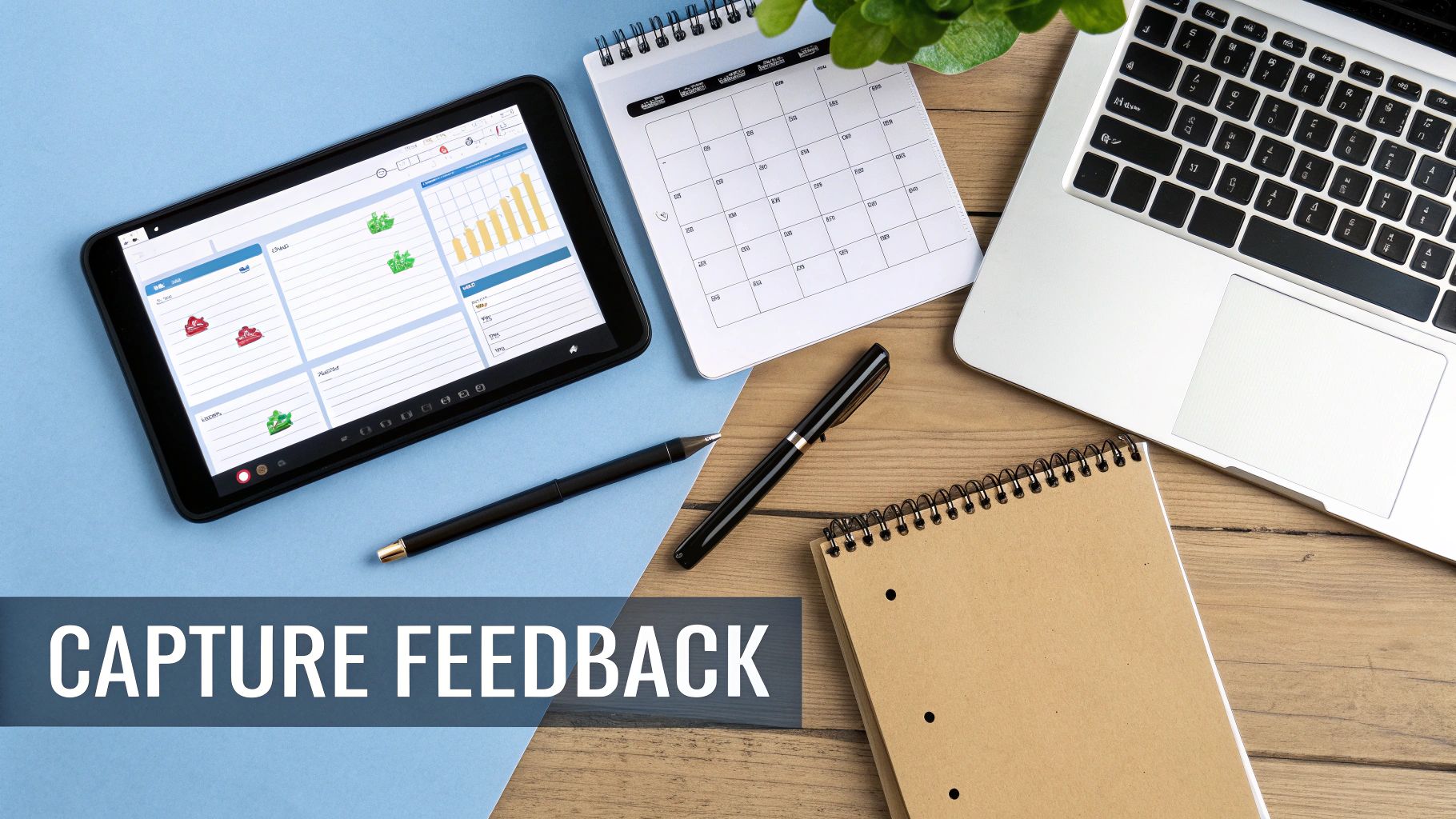
This kind of visual summary of user friction is gold for a PM. It makes it dead simple to see which parts of your product are causing the most pain.
For Broad Quantitative Measurement
While qualitative feedback gives you depth, quantitative data gives you scale. It’s how you understand how big a problem really is and track sentiment across your entire user base over time.
- Goal: Measuring overall customer loyalty and likelihood to recommend.
- Best VoC Method: Net Promoter Score (NPS) Surveys. It's a classic for a reason. This simple, one-question survey ("How likely are you to recommend us?") is a powerful benchmark for customer sentiment. But the real magic is in the follow-up question: "Why did you give that score?" That's where you get the context behind the number.
- Example Question: "On a scale of 0-10, how likely are you to recommend our product to a friend or colleague?"
- Recommended Tool: Typeform or SurveyMonkey. Both have great templates and analytics for running NPS campaigns without a lot of fuss.
For more immediate, in-the-moment feedback, another method is key.
- Goal: Understanding satisfaction with a specific interaction, like a support ticket resolution or a new feature launch.
- Best VoC Method: Customer Satisfaction (CSAT) Surveys. These are the short, in-app surveys that pop up right after you've done something. They ask users to rate their satisfaction with that specific experience, giving you super relevant feedback.
- Example Question: "How satisfied were you with your recent support experience?" (Rated on a 1-5 scale).
- Recommended Tool: Zendesk or Intercom. These platforms can trigger CSAT surveys automatically after a customer interaction, so you can set it and forget it.
VoC Data Collection Methods and Tools for PMs
To make it even easier, here's a quick reference table. Think of this as your cheat sheet for matching the right VoC method to your specific product goal. Bookmark this section to use on the job.
| PM Goal | Best VoC Method | Example Question to Ask | Recommended Tool |
|---|---|---|---|
| Validate a new feature idea | User Interviews | "If you had a magic wand to solve [problem], what would it do for you?" | Calendly, UserTesting |
| Measure overall customer loyalty | NPS Surveys | "On a scale of 0-10, how likely are you to recommend us to a friend?" | Typeform, Delighted |
| Identify usability friction points | Session Replays | (Observational) Where are users rage-clicking or abandoning tasks? | Hotjar, FullStory |
| Gauge satisfaction after an interaction | CSAT Surveys | "How satisfied were you with the resolution of your support ticket today?" | Zendesk, Intercom |
| Collect passive, ongoing feedback | Feedback Widgets | "Have feedback or an idea? Let us know!" | UserVoice, Canny |
| Understand public brand perception | Social Listening | (Observational) What are the recurring themes in Twitter mentions or Reddit threads about our product? | Brandwatch, Sprout Social |
This table isn't exhaustive, but it covers the core toolkit every product manager needs. The trick is knowing which tool to pull out of the bag for the job at hand.
As a product leader, I've seen teams get stuck in "analysis paralysis" because they try to use one method for every problem. The most effective PMs I've worked with are masters at matching the right VoC tool to the specific product question they need to answer. Your goal dictates your method.
By blending these qualitative and quantitative approaches, you start to build a complete picture. You get the deep, narrative "why" from interviews and the broad, statistical "what" from surveys. That balanced perspective is the foundation for making smart, customer-centric product decisions that actually drive growth and build a product people genuinely love.
Turning Raw Feedback into Product Gold with AI
Collecting customer feedback is just the starting line. The real work—and where the best product managers shine—is turning that mountain of interview notes, survey answers, and support tickets into a clear signal that actually guides your product strategy.
This is where modern analysis, supercharged by AI, comes into play. It’s what separates the PMs who are drowning in data from those who are extracting gold from it.
Gone are the days of spending weeks manually highlighting spreadsheet rows. Today, it’s all about using smart tools to do the heavy lifting, freeing you up to focus on the strategic “so what?” behind the feedback.
From Manual Spreadsheets to AI Synthesis
The old-school method was brutal. You’d export a CSV from a survey tool, then spend hours—or even days—reading every single open-ended response, trying to manually tag and group them into themes. It was a massive time sink, incredibly tedious, and riddled with personal bias.
As a PM, your time is your most precious resource. Spending it on manual data tagging is a huge opportunity cost.
Modern VoC analysis tools are built to fix this exact pain point. They use AI and natural language processing (NLP) to tear through massive amounts of unstructured text in minutes, not weeks.
- Theme Detection: AI can instantly scan thousands of reviews and pull out recurring topics. Think "login issues," "feature request for reporting," or "confusing UI." It finds the patterns you might miss.
- Sentiment Analysis: These tools don't just tell you what customers said, but how they said it. They assign a positive, negative, or neutral score, giving you a quick emotional pulse check on your user base.
- Effort Scoring: Some platforms can even infer customer effort from the language they use. Phrases like "I spent an hour trying to figure out…" or "it was impossible to find" get automatically flagged as high-effort experiences that need your attention, fast.
This shift is why the Voice of Customer (VoC) analytics market is projected to explode from $1,696 million in 2024 to $4,681.5 million by 2030. Companies that get this right grow revenues 4-8% faster than their rivals. It’s a clear competitive advantage.
Your Modern VoC Analysis Tech Stack
For any practicing PM, having the right tool is a game-changer.
When you're dealing with qualitative data from user interviews or usability tests, a tool like Dovetail is the industry standard. It acts as a central hub where you can dump transcripts, tag key quotes, and work with your team to build a shared map of user needs. If you’re curious, I’ve put together a full breakdown of the best customer feedback analysis tools out there for PMs.
Here’s a peek inside Dovetail. You can see how raw interview notes get tagged and organized into actionable themes like 'User Onboarding' or 'Pricing Concerns.'
This visual way of synthesizing information helps your team move from a messy pile of individual quotes to a high-level, evidence-backed story about your users' biggest pains and opportunities.
For massive amounts of quantitative and qualitative data—think NPS responses, app store reviews, and support tickets—enterprise platforms like Medallia or Qualtrics are the heavy hitters. They use AI to connect the dots across all your feedback channels, giving you dashboards that track key metrics and spot trends before they become fires.
Using AI Prompts for Quick-and-Dirty Synthesis
You don’t always need a fancy, dedicated platform to get the benefits of AI.
Large language models (LLMs) like OpenAI's ChatGPT or Anthropic's Claude are surprisingly powerful for summarizing unstructured VoC data. You can just copy-paste a few interview transcripts or a batch of survey responses, feed it a well-structured prompt, and get shockingly good insights in seconds.
Here’s a practical prompt you can copy, paste, and adapt right now:
AI Prompt for Summarizing User Interview Transcripts:
"Act as a senior product manager at a top-tier tech company like Google, synthesizing Voice of the Customer data for a quarterly product review. I am providing you with [number] transcripts from user interviews about [product/feature].
Your task is to analyze these transcripts and provide the following:
- Top 5 Customer Pain Points: List the 5 most frequently mentioned frustrations or problems. For each, include 2-3 direct quotes as evidence.
- Top 3 Feature Requests or 'Magic Wand' Ideas: Identify the 3 most common solutions or features customers wished for.
- Key User Goals: What are the primary jobs-to-be-done that users are trying to accomplish with our product?
- Sentiment Summary: Provide an overall sentiment analysis (positive, negative, mixed) and explain the reasoning, citing specific examples.
- Actionable Product Opportunities: Based on this feedback, suggest 3-4 potential product opportunities or areas for further discovery, framed as 'How Might We…' statements that a product team could immediately start brainstorming against."
A prompt like this turns a multi-hour synthesis slog into a five-minute task. It gives you a high-quality first pass, letting you quickly spot the patterns so you can jump straight to the deeper strategic thinking. This is a tactic used by top PMs at AI-first companies like OpenAI to accelerate their discovery cycles.
Embedding VoC into Your Product Roadmap and Strategy
Collecting Voice of the Customer data is only half the battle. The real magic happens when you translate those raw insights into actual roadmap items. This is where great product managers bridge the gap between customer empathy and business impact, turning a passive feedback report into the active driver of your product strategy.
Without a system to connect VoC to your roadmap, you risk creating an "insight graveyard"—a sad collection of interesting feedback that never actually influences what you build. The best PMs at places like Airbnb and Slack don't just listen; they build concrete mechanisms to weave customer needs directly into their planning and prioritization.
This whole process is about turning a firehose of raw data into a clear, actionable stream of insights that can fuel your roadmap.
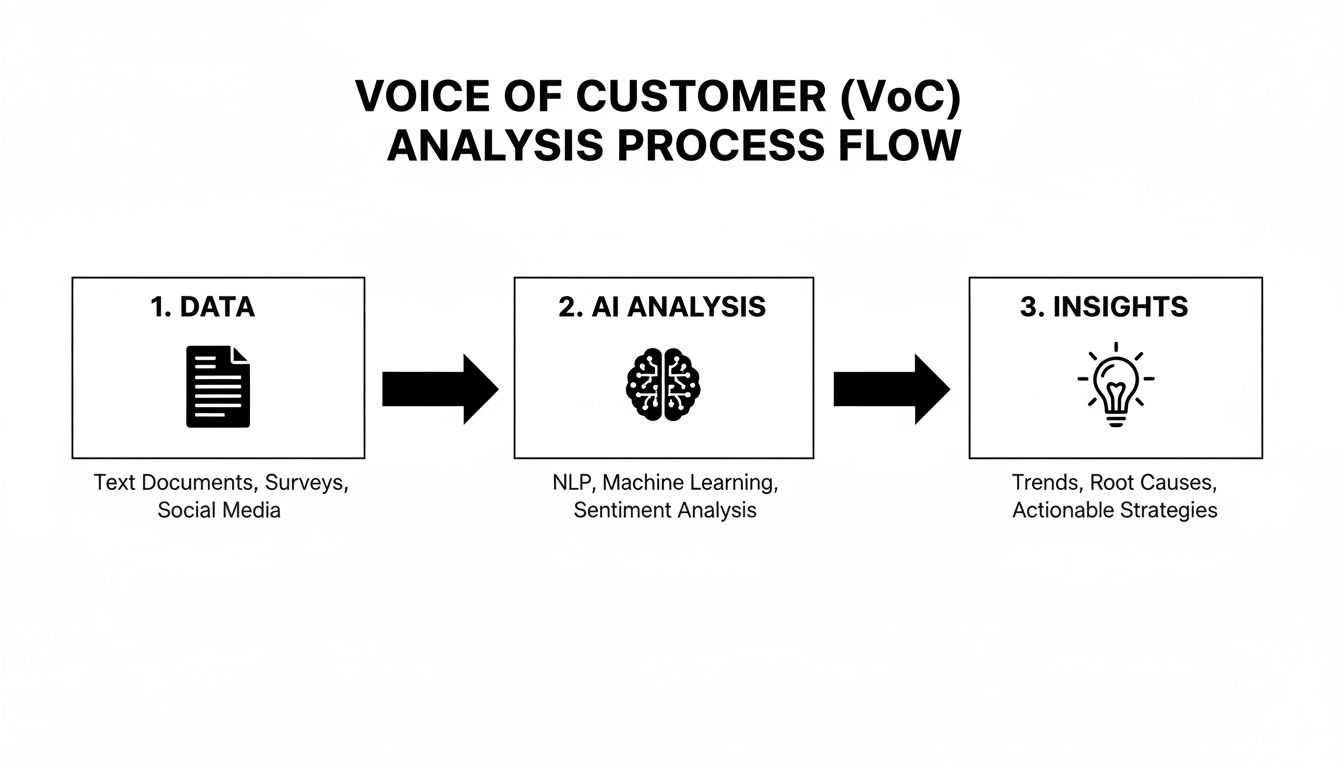
It’s a funnel, really. You start wide with lots of data points and narrow them down through analysis until you have pure, strategic gold.
From Feedback Themes to Roadmap Initiatives
First things first, you need to connect the dots. Stop looking at feedback as a bunch of disconnected data points. If you get ten support tickets about a confusing checkout page and five user interviews mention friction in the payment flow, you don’t have fifteen small problems. You have one big theme: "Payment Friction."
Once you’ve bundled individual complaints into these high-level themes, you can frame them as potential roadmap initiatives. For example, the "Payment Friction" theme can be elevated to an initiative titled "Streamline the Checkout Experience." See what happened there? You just turned a list of complaints into a strategic opportunity.
A Practical Framework for VoC-Driven Prioritization
Gut feelings don't get features built. You need a way to quantify the impact of solving these customer problems to justify spending precious engineering time. A simple but incredibly powerful way to do this is by creating a prioritization framework that scores initiatives based on your VoC data.
You can start with just two core metrics:
- Customer Impact Score (CIS): This measures the breadth of the problem. How many customers are actually running into this? Tally up the mentions across surveys, support tickets, and app store reviews to get a hard number.
- Pain Severity Score (PSS): This measures the depth of the problem. How badly does this hurt the users who experience it? A minor UI glitch gets a low score. A show-stopping bug that prevents users from completing a core task gets a high one.
Now for the simple math: multiply these two scores (CIS x PSS) to get a VoC-driven priority score. This little equation transforms a pile of subjective feedback into an objective metric you can use to rank your backlog and defend your roadmap decisions.
Aligning VoC with Company Objectives for Executive Buy-In
This is the final, crucial step. You have to connect your VoC-backed initiatives to the company's big-picture goals, often framed as Objectives and Key Results (OKRs). This is how you get budget, resources, and enthusiastic support from leadership.
Let's say a top-level company OKR is to "Increase New User Retention by 15%." You can map your VoC themes directly to that goal:
- Objective: Increase New User Retention by 15%
- VoC Theme: "Confusing Onboarding Process" (High CIS, High PSS)
- Roadmap Initiative: Redesign the First-Time User Experience
- Your Pitch: "Our VoC data shows that 40% of new users who churn in the first week mention being confused by our initial setup. By fixing this, we can directly impact our company's core retention OKR."
This approach makes your roadmap bulletproof. You're no longer just "fixing things customers complained about." You're a strategist, using customer intelligence to drive core business outcomes. Learning to build these kinds of data-backed roadmaps is a game-changer, and you can dive deeper into product roadmap best practices to really sharpen your skills.
The market is betting big on this, too. The VoC platform space was valued at $21.15 billion in 2024 and is projected to hit $62.59 billion by 2032. Companies are pouring money into these tools because they know that a VoC-driven experience leads to 6-14x higher customer value and 55% better retention. This isn't a "nice-to-have" anymore; it's a core driver of long-term success.
Common VoC Pitfalls (and How to Sidestep Them)
Even the most well-intentioned Voice of the Customer programs can go off the rails. I’ve seen teams sink a ton of money into VoC tools and processes, only to end up with a mountain of useless data and an engineering team wondering what they’re supposed to do with it all.
The line between a VoC program that fuels product strategy and one that just creates noise is surprisingly thin. It all comes down to avoiding a few common, predictable traps. Knowing what not to do is just as important as knowing what to do.
Let's walk through the classic mistakes that derail customer-centric efforts and, more importantly, the battle-tested ways to keep your program on track and delivering real value.
Pitfall 1: The NPS Trap
This is a big one. Teams get fixated on their Net Promoter Score as the single source of truth. They celebrate when the score inches up and hit the panic button when it dips, but they completely miss the rich, qualitative story hidden behind that number.
A score without context is just a vanity metric. It tells you what but not why.
The Solution: Obsess Over the "Why," Not the Score
Think of your NPS score as a high-level health check, not the final diagnosis. The real gold is in the open-ended follow-up question: "What's the main reason for your score?"
- Segment the Verbatim Feedback: Don't just average it out. Split the comments into your three core groups: Promoters (score 9-10), Passives (7-8), and Detractors (0-6).
- Analyze Themes Separately: Each group gives you a different kind of gift. Promoters tell you what your product’s "magic moments" are—the things you must protect at all costs. Detractors hand you a ready-made, prioritized list of your most painful user experiences.
This approach turns NPS from a simple grade into a continuous engine for strategic insights.
Pitfall 2: Listening Only to the Loudest Voices
Another classic blunder is selection bias. This happens when you disproportionately listen to the squeaky wheels—your most passionate power users or, on the flip side, your most infuriated customers.
Their feedback is absolutely valuable, but it’s not the whole story. It doesn’t represent your entire user base, especially the quiet majority who use your product, have opinions, but never shout them from the rooftops.
The Solution: Intentionally Diversify Your Listening Tour
To get the full picture, you have to proactively seek out feedback from different user segments. Don't just wait for it to land in your inbox.
- New Users: What are their first impressions? Where are they getting stuck in the first 15 minutes? Onboarding friction is a silent killer.
- Power Users: What advanced features are they clamoring for? How can you make their most common workflows 10x more efficient?
- Churned Users: Why did they leave? An exit survey or a quick interview can provide brutally honest—and incredibly valuable—feedback on your product's biggest weaknesses.
By deliberately segmenting your listening, you ensure your understanding of the customer isn’t skewed by a vocal minority. You start building a product for your whole market, not just a fraction of it.
Pitfall 3: Collecting Data Without a Plan
This might be the most dangerous pitfall of all: analysis paralysis. Teams get so good at collecting feedback that they end up with beautiful dashboards full of charts and metrics they never, ever act on.
This doesn't just waste time; it actively damages customer relationships. When users take the time to give you feedback and see nothing change, they eventually stop bothering. Why would they?
The Solution: Close the Feedback Loop. Always.
For every piece of feedback you gather, have a clear process for what happens next. And when you finally ship a feature or fix a bug based on that input, shout it from the rooftops. Make your customers feel like co-creators.
- Weave It Into Release Notes: Specifically call it out: "You asked, we listened! We've improved the export feature based on your feedback."
- Send Targeted Emails: Personally reach out to the customers who requested a specific feature and let them know it's live. They'll become your biggest advocates.
- Arm Your Support Team: Give them a heads-up on which customer-requested fixes are coming so they can share the good news on their next call.
Closing the loop is non-negotiable. It proves you’re actually listening and makes customers feel like partners in your product's journey.
Measuring the ROI of Your VoC Program
As a product manager, your ability to secure resources, justify headcount, and prove your team’s value always comes down to one thing: linking your work to business impact. A Voice of the Customer program is no different.
Executives don’t fund initiatives based on good feelings; they invest in programs that deliver a measurable return. This is where you have to move beyond fuzzy sentiment metrics and connect VoC directly to the bottom line.
To pull this off, you have to speak the language of the business. That means translating what customers are telling you into the financial and product outcomes that leadership actually cares about.
Connecting Sentiment to Product Metrics
The first step is drawing a straight line from your core VoC metrics to tangible product performance. While sentiment scores are useful leading indicators, they become incredibly powerful when you can show how they correlate with concrete business results.
Don't just report that NPS went up; explain what happened as a result.
- Net Promoter Score (NPS): Track how changes in your NPS line up with user retention rates. For instance, you might find that customers who are "Promoters" (score 9-10) have a 25% higher 90-day retention rate than "Detractors" (score 0-6).
- Customer Satisfaction (CSAT): Link CSAT scores from specific interactions (like completing a new feature’s onboarding) to feature adoption rates. A high CSAT score right after using a new tool is a strong predictor of long-term engagement with it.
- Customer Effort Score (CES): A low CES (meaning less effort) should directly correlate with higher conversion rates in key funnels. If you simplify the checkout process, you should see a measurable lift in completed purchases.
Building a Business Case for VoC Initiatives
Once you’ve established these correlations, you can build a powerful business case for investing in VoC-driven improvements. The key is to frame the opportunity in financial terms. If you really want to get good at this, learning how to calculate customer lifetime value is an essential skill for any PM.
Example Business Case: Forecasting ROI
Identify the Pain Point: "Our VoC data shows that 30% of new users abandon our onboarding flow at the 'connect your data source' step, citing confusion. This friction is our top-reported issue from Detractors."
Quantify the Impact: "This drop-off impacts 5,000 users per month. Our analysis shows that users who complete this step have a 40% higher Customer Lifetime Value (CLV) than those who don't."
Propose the Solution: "We propose a two-week sprint to redesign this step, based on direct feedback from user interviews."
Forecast the Return: "If we can reduce this drop-off by just half (from 30% to 15%), we will successfully onboard an additional 750 users per month. Based on our average CLV, this translates to an estimated $150,000 in new, retained revenue over the next year."
This framework transforms a customer complaint into a compelling, data-backed investment opportunity. It proves that listening to the Voice of the Customer isn’t just about making users happy—it’s about building a healthier, more profitable business.
Common Questions About VoC
Let's tackle some of the most common questions PMs have when they're first digging into Voice of the Customer work.
How Do I Start a VoC Program on a Limited Budget?
Starting a VoC program doesn't require a six-figure check. You can get surprisingly far with free and low-cost tools that pack a serious punch.
- Google Forms: Perfect for sending out simple customer satisfaction (CSAT) or quick feature-feedback surveys.
- Customer Calls: Just schedule 15-minute calls with five customers every month. The nuance and depth you get from a direct conversation are things you'll never find in a spreadsheet.
- Social Listening: Manually keep an eye on Reddit threads, X (formerly Twitter) mentions, and LinkedIn discussions. See what your users are saying when they think you're not listening.
The real key here is consistency, not fancy, expensive software.
What Is the Difference Between VoC and User Research?
This question comes up a lot. Here’s a simple way to think about it: VoC is the continuous pulse, while user research is the deep diagnosis.
A VoC program is your always-on system for capturing a steady stream of broad customer feedback—think NPS scores, support tickets, and App Store reviews. It’s designed to be constant.
User research, on the other hand, is usually a specific project with a clear start and end. It’s focused on answering deep, specific questions using methods like usability testing or in-depth interviews.
They work together beautifully. VoC tells you what the problems might be, and user research helps you understand why they're happening.
How Often Should We Collect Customer Feedback?
The right cadence really depends on the type of feedback you're after.
For transactional feedback, like a CSAT survey after a support ticket is closed, it needs to be immediate and automated. You want the feedback while the experience is still fresh.
For relationship-based feedback, like an NPS survey, it's better to collect it quarterly or semi-annually. This lets you track trends over time without burning out your customers with too many requests. And, of course, you should always be "passively" collecting feedback through channels like a feedback widget on your site or ongoing social media monitoring.
How Do You Handle Conflicting Feedback?
First off, conflicting feedback isn't a bad thing—it's a sign that you have a diverse user base. It's a feature, not a bug, of a healthy program. When you run into it, here’s how to sort it out:
- Segment Your Data: Where is the conflict coming from? Are your power users saying one thing and new users another? Are your enterprise customers at odds with your SMBs? Segmentation is your best friend here.
- Quantify the Conflict: Figure out how many users are in each camp. Don't let a small but very vocal minority drown out the needs of the silent majority.
- Align with Strategy: Step back and ask: Which piece of feedback best aligns with our product vision and company goals? Your strategic objectives are the ultimate tie-breaker when the data is pulling you in two different directions.
Ready to turn customer insights into your strategic advantage? At Aakash Gupta, we provide the frameworks and career guidance you need to become a top-tier product leader. Explore more at https://www.aakashg.com.
