Yes, you can take notes into an interview. For Product Managers, it’s often a positive signal when used strategically, and a 2025 LinkedIn poll of 1,200 PM recruiters found that 68% view discreet note references tied to research initiative positively, while 42% of PM job postings on Indeed specify “bring portfolio/notes for case discussions,” up from 28% in 2024.
That matters because PM interviews rarely test recall alone. They test whether you can listen, structure ambiguity, capture constraints, and respond without losing the thread. If you’re interviewing at a place like Meta or Google and get a case prompt with user segments, metrics, trade-offs, and execution risks, taking notes the right way doesn’t make you look weak. It makes you look like a PM.
The mistake is treating notes like a script. Interviewers want to see judgment in real time. They don’t want to watch you read prewritten answers to “Tell me about a time you disagreed with engineering” or “How would you improve Reels onboarding?” Notes should help you think clearly, not hide.
If you’ve been asking “can i take notes into an interview,” the better question is this: what kind of notes help me show PM-level thinking without breaking rapport? That’s the standard to optimize for.
The Short Answer Is Yes But Not How You Think
A strong PM candidate doesn’t use notes to remember canned stories. They use notes to manage complexity.
Consider the difference between two candidates in a product case round. One answers immediately, forgets half the constraints, and circles back awkwardly. The other says, “Let me capture the objective and constraints so I can structure this well,” writes for a few seconds, and then gives a clean response. At companies that value structured thinking, the second candidate usually feels more credible.
What interviewers actually react to
The outdated fear is that notes signal you’re unprepared. In PM interviews, that’s often backwards. If your notes contain company research, customer hypotheses, product observations, or a simple framework for organizing your answer, they show diligence and operating maturity.
The strongest support for that comes from MGMA’s summary of PM recruiter sentiment, which cites a 2025 LinkedIn poll of 1,200 PM recruiters where 68% viewed discreet note references positively when tied to research initiative. The same piece notes that 42% of PM job postings on Indeed specify “bring portfolio/notes for case discussions,” up from 28% in 2024.
Practical rule: Bring notes to support thinking, not to replace thinking.
That distinction is where many candidates fail. If you glance at a page to recall the retention issue you noticed in the signup funnel, that’s fine. If you read a polished STAR answer word for word, you’ve signaled dependency.
What works and what doesn’t
Here’s the split:
- Works well. A one-page brief with company facts, questions for the interviewer, your prepared examples, and space to structure live prompts.
- Usually hurts. A dense packet of prewritten answers you keep scanning while speaking.
- Works especially well in PM loops. Notes for case, estimation, system design, analytics, and product critique rounds.
- Needs a lighter touch. Behavioral and leadership conversations, where rapport and presence matter more.
At Google, Meta, Stripe, or OpenAI, no one is impressed that you can memorize every metric from your prep doc. They are impressed when you can absorb a prompt, isolate the decision, and communicate a framework calmly. Notes can help with that. Used badly, they make you look brittle.
A Framework for Deciding When to Take Notes
Use one rule: the more ambiguity and moving parts in the round, the more useful note-taking becomes.
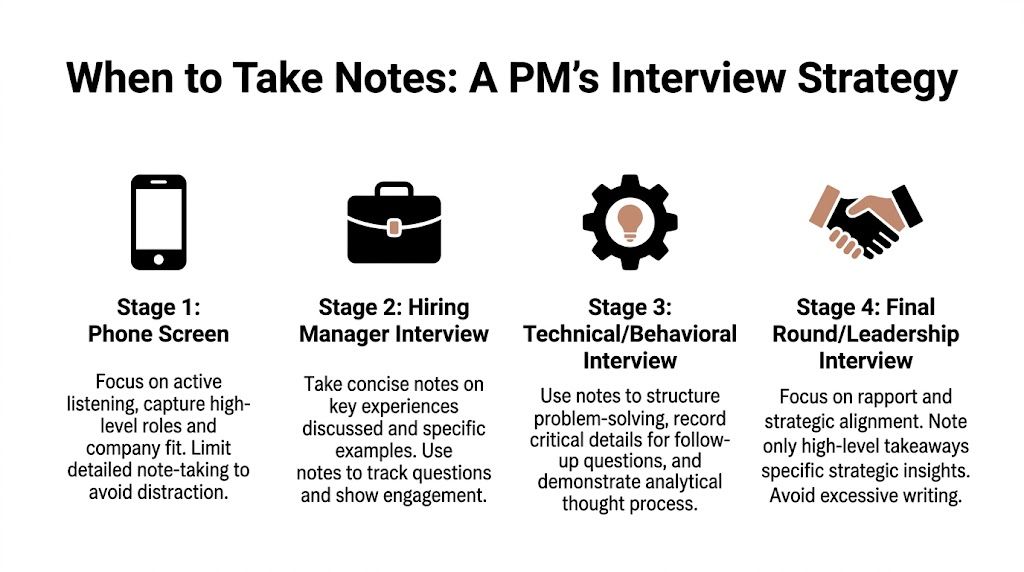
A good PM doesn’t make this decision emotionally. They make it based on the job the notes need to do. If you need a simple decision model, use the same logic behind clear trade-off thinking in this framework for making decisions.
Use this by interview type
| Interview type | Notes stance | Why |
|---|---|---|
| Phone screen with recruiter | Light notes | Capture role scope, team context, logistics, and anything you want to clarify later |
| Hiring manager round | Moderate notes | Useful for role expectations, team pain points, and follow-up questions |
| Behavioral interview | Minimal visible notes | You need presence, eye contact, and fluid storytelling |
| Product case or execution round | Strong yes | You need to track goals, assumptions, constraints, and recommendation logic |
| Analytics or metrics round | Strong yes | You’ll likely need to organize numbers, hypotheses, and trade-offs |
| Product design or system thinking round | Strong yes | Whiteboard-style structure matters more than polished recall |
| Leadership or final round | Selective notes | Focus on strategic alignment, not constant writing |
A simple go or no-go filter
Ask yourself three questions before the round starts:
Will I need to hold multiple constraints at once?
If yes, take notes.Is the interviewer judging structure as much as content?
If yes, take notes.Will visible note-taking weaken rapport?
If yes, reduce it and use short keywords only.
If the round looks like a PM work sample, notes help. If it looks like a trust-building conversation, use them sparingly.
That’s why a behavioral round at Meta needs a lighter hand, while a product sense or execution round at Google practically invites note-taking. In one setting, your interviewer wants signal on communication under pressure. In the other, they want to watch your thinking stack up in real time.
The PM Note-Taking Toolkit Paper Versus Digital
The tool matters less than the friction it creates.
If your note-taking method makes you slower, noisier, or less present, it’s the wrong tool for that interview. Most PM candidates overthink aesthetics and underthink execution.

If you’re comparing options, the broader field of these product management tools is useful context, but interviews need a narrower standard: low friction, low distraction, high clarity.
Paper wins more often than people expect
For in-person interviews, paper is usually the safest choice.
A slim notebook and pen look intentional. They don’t put a screen between you and the interviewer. They also make it obvious you’re not searching the web, checking Slack, or reading hidden prompts. If you’re interviewing on-site at Google or Meta, paper keeps the interaction clean.
Paper is also strong in remote interviews if you can keep it just below camera level. No typing noise. No shifting tabs. No “sorry, I was just pulling something up.”
Digital works when it disappears
Digital notes can work in remote loops, especially if you use a tablet with a stylus. That setup allows for silent sketching of funnels, metrics trees, or product flows. It’s better than typing if the keyboard noise is noticeable.
Laptops are the riskiest option. They create ambiguity. Even if you’re taking notes, the interviewer may wonder whether you’re reading from a prep document or multitasking.
Here’s the trade-off in plain terms:
- Paper notebook. Best for in-person rounds, strong for remote, highest trust signal.
- Tablet with stylus. Best digital option for remote case or design rounds.
- Laptop. Acceptable only if you explicitly say you’re using it for notes and keep your attention on the conversation.
- Phone. Don’t use it. Even if you mean well, it reads as disengaged.
A tool is good if the interviewer forgets it exists after the first minute.
If you want a default answer, use paper for on-site and either paper or tablet for remote. Don’t optimize for novelty. Optimize for fluency.
Executing Flawlessly With Proper Etiquette
The best note-taking is visible but not disruptive. You want the interviewer to register “organized” and move on.
Start by asking permission in a way that signals care for the question, not anxiety. Use one of these lines:
- For a multi-part case prompt: “This has a few moving parts. Mind if I jot down the goal and constraints so I can answer it cleanly?”
- For a behavioral question: “I’d like to note the specific framing so I answer the right part of your question.”
- For a remote interview: “I may glance down briefly to capture key points, just so I don’t miss anything important.”
Those phrases work because they frame note-taking as service to the conversation.
Small behaviors that change the impression
Most candidates don’t fail on the notebook. They fail on the body language around it.
Use this checklist:
- Keep your head up first. Listen fully before you start writing.
- Write in bursts. Capture keywords, then re-engage visually.
- Narrate briefly if needed. “I’m just noting the user segment and success metric.”
- Keep the page open and simple. Don’t shuffle papers.
- Never write while the interviewer is sharing something personal or evaluative. That’s a moment for direct attention.
A practical prep list like what to bring to an interview is useful because logistics affect execution more than people think. Pen dies. Notebook forgotten. Charger missing. Those details create avoidable stress.
You’ll find more tactical patterns in these product manager interview tips, but one habit matters most here: ask, jot, reconnect.
What not to say
Avoid lines that sound defensive.
Don’t say, “I have really bad memory, so I need notes.”
Don’t say, “I prepared a script for this.”
Don’t start typing without context.
“I want to make sure I answer the question you actually asked” is a strong PM sentence.
It signals precision. Interviewers trust precision.
The Strategic PM Note-Taking System
Most candidates write too much and think too little. Your notes need a structure.
The best model I’ve seen for interviews is Dots and Dashes with STAR margin annotations. Whiteboard Talent’s write-up on better interview notes says this approach can improve inter-rater reliability in hiring decisions by 40%, and that separating data capture from analysis helps reduce judgment biases like the halo effect that can decrease hiring accuracy by 25-35%.
That’s useful on the interviewer side. It’s also useful on the candidate side, because it forces cleaner listening.

How to set up the page
Split your page into three zones:
- Left margin for STAR
Write S, T, A, R vertically for behavioral rounds. - Main column for Dots
Use bullets for verbatim facts, prompts, constraints, and interviewer wording. - Right side for Dashes
Use dashes for your hypotheses, answer structure, follow-up questions, and risks.
If visual processing helps you, light color coding notes can make the page easier to scan. Keep it restrained. One color for constraints, another for metrics, and a third for risks is enough.
What to write in each PM interview type
For a behavioral round, capture:
- Situation. Team, product, user problem
- Task. Your role and decision
- Action. What you specifically drove
- Result. User or business outcome, plus what you learned
For a product case, capture:
- Objective
- User segment
- Success metric
- Constraints
- Trade-offs
- Recommendation
For an analytics round, write down the exact metric definitions the interviewer uses. PM candidates lose points when they answer a retention question with acquisition logic because they didn’t capture the framing precisely.
For a system or product design round, write the nouns first. Users, surfaces, constraints, signals, and failure modes. Then sequence the answer.
A sample page layout
Try this simple template:
- Top line: Company, interviewer, round type
- Prompt area: Exact question
- Assumptions box: Missing data, stated assumptions
- Structure box: Framework you’ll use
- Risks box: Trade-offs, edge cases, open questions
- Close box: Final recommendation
If you discuss user problems or feature prioritization, a quick refresher on user story note-taking helps because it pushes you to separate user need from implementation detail.
Don’t fill the page. Build a map.
That’s the PM move. Your notes should make your answer sharper, not longer.
Using Your Notes After The Interview
Good notes pay off after the call.
Most PM candidates treat interview notes as disposable. That’s a mistake. A better approach is to treat them like customer research notes. You’re collecting signals about team priorities, product challenges, decision style, and what each interviewer cared about.

In Product Talk’s guidance on research interview note-taking, structured handwritten notes are associated with 20-30% better retention and insight generation than typing, because handwriting supports deeper cognitive processing. That same principle transfers well to interviews. When you capture notes by hand, you often synthesize as you write rather than transcribe mindlessly.
A simple post-interview workflow
Within a short window after the interview:
- Clean the notes up. Rewrite any messy shorthand while the conversation is fresh.
- Tag themes. Product strategy, execution risk, org complexity, user empathy, metrics rigor.
- Mark follow-ups. Anything you want to ask in the next round or clarify with recruiting.
- Save one memorable detail. This becomes useful in a thank-you note.
Teresa Torres’s customer interview advice includes capturing key phrases, follow-ups, and organizing notes for faster synthesis. That mindset works well here too. You’re not archiving paper. You’re building an evidence trail.
Turn notes into better follow-up
A weak thank-you note says, “Great meeting you.”
A strong one references something specific from your notes: the onboarding challenge, the team’s experimentation culture, the complexity of balancing creator and consumer needs, or the leadership principle the interviewer emphasized. That shows attention and makes the conversation easier to remember on their side.
Use your notes to answer three questions after each round:
- What did this interviewer care about most?
- What concerns might they still have about me?
- What story or example should I sharpen before the next round?
The interview ends when the call ends. The evaluation doesn’t.
Candidates who synthesize their notes well enter the next round sounding more informed, more consistent, and less rattled.
Modern Considerations Accessibility and AI Scribes
For some candidates, notes aren’t optional. They’re an accessibility support.
If that’s your situation, be direct and calm with recruiting. A simple line works well: “I perform best when I can jot down prompts and structure my thoughts during interviews. I wanted to flag that in advance so it’s clear what I’m doing.” If you want broader perspective on neurodiversity in the hiring process, this piece on Autism and Job Interviews is a useful read.
Be extremely careful with AI note-taking
AI has changed PM work. It hasn’t changed interview trust.
Tools like Otter, meeting bots, AI transcription assistants, and automated note-takers may be normal in your day job, but using them in an interview without explicit permission is risky. Interview loops often include confidential product discussions, internal process details, and candidate evaluation norms. Recording or transcribing without enthusiastic consent can damage trust fast.
If you’re exploring how AI fits into PM workflows more broadly, this guide to AI tools for product managers is helpful. For interviews, though, the standard is stricter. Human notes are usually the safer choice.
The rule is simple. If you want to use any AI scribe, ask in advance, get clear approval, and be prepared for the answer to be no.
If you want sharper, more practical PM career advice from someone who’s operated at senior levels and coached thousands of product professionals, Aakash Gupta is one of the best resources on the internet. His writing, podcast, and training are especially strong if you’re preparing for high-bar PM interviews, leveling up your product judgment, or figuring out how AI changes the PM career path.
