The worst advice in product manager linkedin jobs is also the most common: update your profile, turn on Open to Work, and click Easy Apply until something sticks.
That advice fails because it treats LinkedIn like a job board. It isn't. LinkedIn is a distribution system. Recruiters search it. Hiring managers sanity-check candidates on it. Peers refer people through it. Your posts shape whether someone sees you as a serious PM or just another applicant with a polished headline.
I’ve hired PMs from startup to leadership level, and the pattern is consistent. The candidates who win on LinkedIn don’t behave like applicants. They behave like operators. They build a profile that converts, a network that opens doors, and a body of visible thinking that reduces risk for the hiring team.
If you want interviews, stop acting passive. Build a machine.
Beyond 'Easy Apply' The New Rules for Winning on LinkedIn
Easy Apply isn’t evil. It’s just overused, lazy, and rarely enough on its own.
The PM market is still large and worth competing in. The U.S. product manager market was projected to grow 10% from 2018 to 2028, creating about 33,700 new jobs, with LinkedIn hosting over 100,000 U.S. postings in 2025 according to Zippia’s product manager job trends. That’s the good news.
The bad news is simple. Large markets attract crowded candidate pools. If your strategy is identical to everyone else’s, you’ll get identical results.
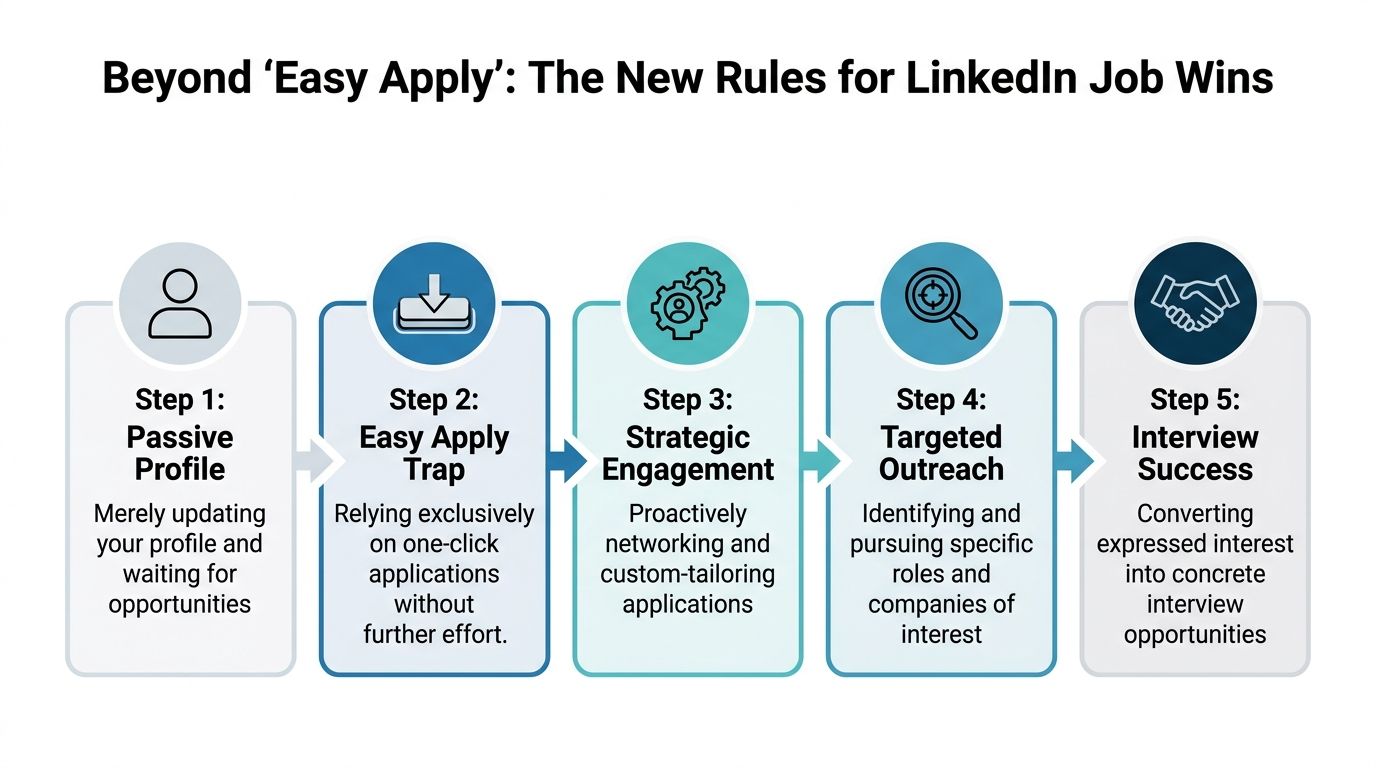
The LinkedIn flywheel that actually works
The right mental model is a LinkedIn flywheel.
Profile
Your profile needs to rank in recruiter search and make instant sense to humans.Proof
Your posts, comments, portfolio, and recommendations need to prove how you think.Proximity
You need warm paths to recruiters, hiring managers, and PMs at target companies.Precision
You apply selectively, tailor the pitch, and follow up with intent.Pipeline
You keep enough quality opportunities moving that one rejection doesn’t derail momentum.
Most candidates only do step four, and they do it poorly.
A weak LinkedIn strategy creates more applications. A strong one creates more conversations.
That difference matters. Recruiters don’t just hire the most qualified PM on paper. They advance the PM who looks easiest to trust. A complete profile, visible product thinking, and intelligent outreach all reduce uncertainty.
What passive candidates get wrong
Passive candidates usually make three mistakes:
- They optimize for completion, not conversion. A filled-out profile isn’t the same as a compelling one.
- They apply cold to roles they barely understand. That produces generic resumes and generic messages.
- They disappear between applications. No comments, no posts, no signals of product judgment.
If you need help thinking beyond job boards, Aakash Gupta has a practical system on getting job interviews without applying online using AI systems. The framing is right. Build advantage before you need it.
For the visibility layer, use a repeatable content approach. These strategies for impactful LinkedIn posts are useful because they force you to post with a purpose instead of publishing vague career updates.
Engineer Your Profile for Recruiter Inbound
Your LinkedIn profile is not your resume pasted into a social network. It is a landing page.
Recruiters make fast decisions. Hiring managers make even faster ones. If your profile doesn’t answer “What kind of PM is this person, what have they shipped, and why should I care?” within seconds, you’re wasting the highest intent traffic in your career search.
Top-performing PM profiles aim for an SSI over 70, include 8 to 12 core skills, and use the STAR method in experience sections. Profiles with quantified impact see 40% more recruiter engagement according to Redfish Tech’s LinkedIn guidance for product management professionals.
Fix the headline first
Most PM headlines are terrible. “Product Manager at X” says almost nothing. Your headline should do three jobs at once:
- identify your level
- identify your specialization
- hint at business impact
Use this formula:
[Target role] | [Domain or product area] | [Outcome or signature strength]
Examples:
- Senior Product Manager | B2B SaaS, Growth & Monetization | Built and scaled adoption-focused product bets
- AI Product Manager | LLM Experiences, Workflow Automation | Turns ambiguous AI ideas into shipped products
- Aspiring Product Manager | Customer insights, experimentation, analytics | Transitioning from ops to product
Don’t stuff keywords mindlessly. Write something a recruiter would search for and a hiring manager would respect.
Rewrite the About section like a PM
Your About section should read like a strong product brief, not a career autobiography.
Use this structure:
- Opening line with role identity and scope
- 2 to 4 bullets showing impact themes
- Keyword cluster for your target roles
- Closing line that makes networking easy
Example:
PM focused on growth, onboarding, and monetization across consumer and SaaS products. I work best at the intersection of user behavior, experimentation, and crisp execution.
Then follow with bullets such as:
- Led product work across roadmap, experimentation, and launch planning
- Partnered with design, engineering, data, and GTM teams
- Built strong habits around discovery, prioritization, and stakeholder alignment
Then add a natural keyword cluster:
Product Strategy, Product Roadmapping, Data Analytics, A/B Testing, Agile Methodologies, User Research
Use STAR in the experience section
Most PMs lose credibility by listing responsibilities instead of outcomes.
Weak:
- Responsible for roadmap planning
- Worked with engineers to launch features
- Managed stakeholders across functions
Strong:
- Identified onboarding drop-off, aligned design and engineering on a simplified flow, and launched changes that improved activation quality
- Prioritized and shipped a new workflow for enterprise users, partnering with sales and support to reduce friction in evaluation
- Built experimentation plans for pricing and packaging changes, translating ambiguous feedback into clear product decisions
You don’t need fake numbers to sound credible. Specific action is stronger than empty claims.
Practical rule: If a bullet could apply to any PM at any company, rewrite it.
Skills matter more than people admit
Curate 8 to 12 skills, not a random pile. Pick skills that map to the jobs you want.
For generalist PM roles:
- Product Strategy
- Product Roadmapping
- Agile Methodologies
- A/B Testing
- Data Analytics
For AI PM roles, add adjacent terms naturally in your profile copy and project descriptions. Think model evaluation, workflow design, prompt UX, AI safety tradeoffs, and experimentation. Don’t pretend to be an ML engineer if you’re not one. Good AI PMs translate capability into product value.
If you need help choosing the right terms, Aakash Gupta has a solid resource on product manager resume keywords that maps well to LinkedIn optimization too.
Profile optimization by career stage
| Profile Section | Aspiring PM / Career Switcher Focus | Senior PM / Leader Focus |
|---|---|---|
| Headline | Target role, adjacent strengths, domain interest | Scope, specialization, leadership signal |
| About | Transferable skills, customer insight, execution habits | Product philosophy, business ownership, team leadership |
| Experience | Projects, cross-functional wins, evidence of ownership | Portfolio outcomes, strategy decisions, org influence |
| Skills | Core PM skills, analytics, agile, research | Roadmapping, portfolio strategy, stakeholder leadership |
| Featured | Case study, side project, product teardown | Talks, product launches, strategic writing, team artifacts |
Add proof assets, not just claims
The Featured section is underused. Use it.
Strong options include:
- a product teardown
- a case study from a side project
- a launch write-up
- a cleaned-up PRD excerpt
- a short presentation on an experiment you ran
If you don’t have a clean way to package your work, this guide on how to create a digital portfolio is useful. PMs don’t need a designer portfolio. They need evidence of judgment.
The Proactive Job Search and Networking Machine
A good search process is boring, disciplined, and repeatable. That’s why it works.
Most candidates waste hours browsing the LinkedIn Jobs tab like it’s social media. Serious PM candidates build a target list, run saved searches, and contact the right humans before the posting gets stale.
Build a target company map
Start with companies, not jobs.
Create a simple tracker in Notion, Airtable, or Google Sheets with:
- Company name
- Role type such as core PM, growth PM, platform PM, AI PM
- Why it fits
- Hiring manager or product leader
- Recruiter
- PM peers on the team
- Application status
- Warm path available
This changes your search from reactive to deliberate. You stop chasing random openings and start building conviction around a shortlist.
Use LinkedIn company pages, founder posts, product launch announcements, and recent leadership changes to understand where product investment seems active. If a company is talking about platform expansion, new pricing, AI features, or enterprise motion, that usually creates PM work.
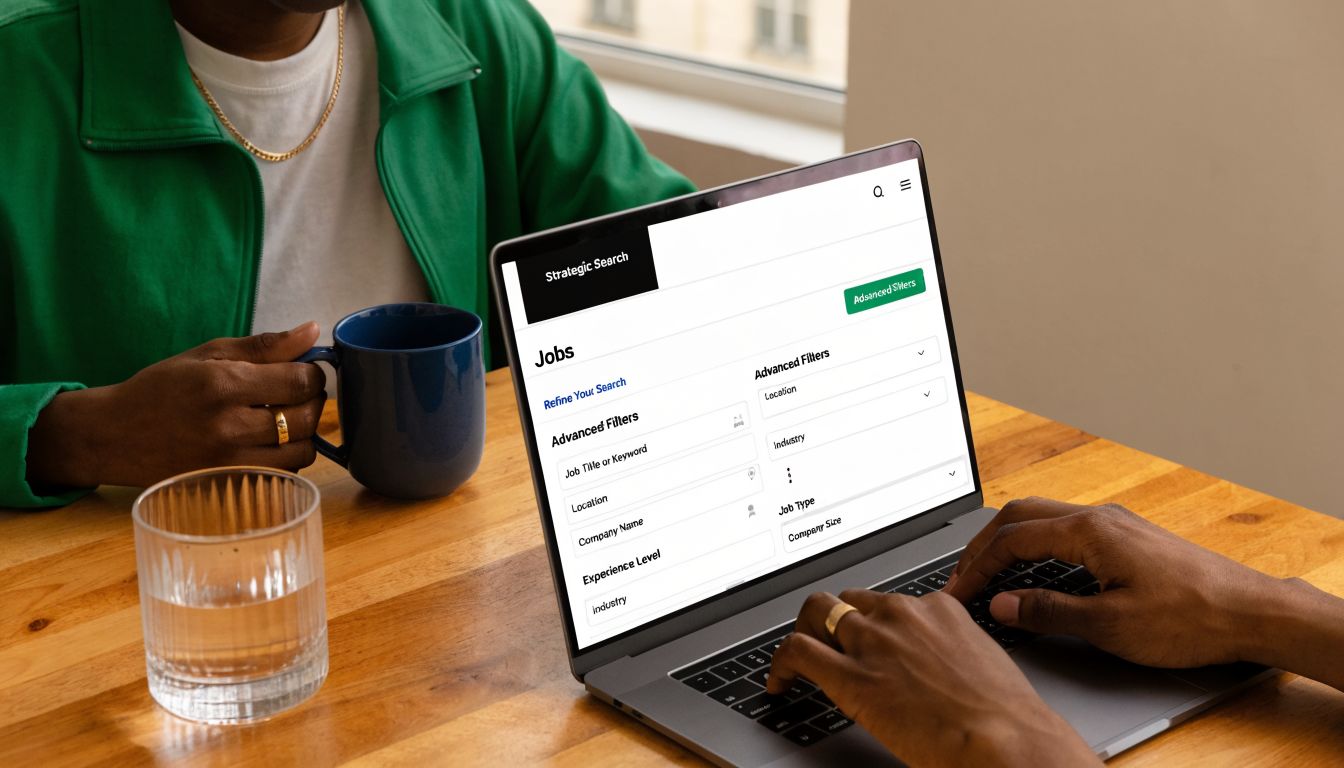
Search smarter on LinkedIn Jobs
Many individuals use one weak search phrase and call it a strategy.
Use combinations:
- “Product Manager” plus industry terms
- “Growth Product Manager”
- “AI Product Manager”
- “Platform Product Manager”
- “Product Lead”
Then filter aggressively:
- location
- remote or hybrid preference
- seniority level
- company size
- industry
Save multiple alerts. One for broad discovery, one for exact-fit roles, one for adjacent bets.
What matters is speed plus selectivity. Newer postings usually deserve faster attention. Old postings with no visible activity often deserve skepticism.
Run parallel outreach before and after you apply
For each role you want, contact three people:
- Hiring manager or product leader
- A peer PM
- Recruiter or talent partner
Each message should be different.
For a peer PM:
Hi Priya, I’ve been following your work on payments infrastructure at Stripe. I’m exploring PM roles in that space and would love to learn how your team thinks about roadmap tradeoffs and execution. Open to a brief chat if helpful.
For a hiring manager:
Hi Daniel, I’m interested in the PM role on your team because the product problem is clear and commercially important. My background is strongest in cross-functional execution and product discovery. I applied today and wanted to introduce myself directly.
For a recruiter:
Hi Maya, I applied for the PM opening on the growth team. My background aligns well with experimentation, onboarding, and analytics-heavy product work. Sharing my profile here in case it’s helpful for your review.
Short. Specific. Respectful. No begging.
The goal of outreach isn’t to ask for a job. It’s to make your name familiar before your application gets reviewed.
Use comments as a warm-up channel
Cold outreach works better when it isn’t fully cold.
Follow PM leaders, recruiters, and founders at your target companies. Comment thoughtfully on their posts for a week or two before sending a note. Don’t write “Great post.” Add a product observation, user angle, or tradeoff they didn’t mention.
That creates familiarity. When your message arrives, you’re not a random stranger.
A lot of PMs also underuse simple content. Post one useful thing each week:
- a teardown of a product flow
- your take on an AI feature launch
- a short lesson from an experiment
- a framework you use for prioritization
If you want a practical walkthrough on using LinkedIn for PM recruiting and outreach, this video is worth your time:
A weekly operating cadence
Don’t improvise every day. Run a cadence.
Monday
Review new alerts, save promising roles, update tracker.Tuesday
Tailor applications for the best-fit openings.Wednesday
Send outreach to peers, recruiters, and hiring managers.Thursday
Publish or comment on product content.Friday
Follow up, review response patterns, and refine messaging.
That system compounds. You’re no longer “searching for jobs.” You’re building a pipeline.
Converting Interest into Interviews
Once someone responds, speed and clarity matter.
This is the part where mediocre candidates fumble momentum. They reply slowly, send generic materials, or treat recruiter conversations like admin. Strong PM candidates use these moments to shape the narrative early.

Choose Easy Apply or direct application on purpose
Use Easy Apply when:
- the role is fresh
- your profile already matches the role closely
- you’ve also contacted someone at the company
- you can move fast and follow up
Use a direct company application when:
- the role is high priority
- the company has a structured hiring process
- the job description is specific enough to tailor your resume
- you want to attach a more customized case for fit
The mistake isn’t using Easy Apply. The mistake is using it alone.
Tailor your resume to match the role
Your LinkedIn profile gets attention. Your resume gets screened.
Mirror the language of the job description, but keep it honest. If the role emphasizes platform work, use platform language. If it emphasizes experimentation, lead with experimentation. If it’s an AI PM role, show product judgment around AI use cases, not just tool usage.
For roles that ask for a cover letter or a written intro, use a tight structure:
- why this company
- why this role
- why your background fits now
If you need help with the format, these product manager cover letter examples are a useful starting point.
Handle recruiter messages like a PM
Recruiter outreach is discovery. You’re qualifying the role as much as they’re qualifying you.
Reply quickly. Confirm interest. Offer a few times to speak. Then ask smart questions that reveal whether this is a real fit.
Good questions:
- What problem space would this PM own first?
- Is this role more weighted toward discovery, delivery, or stakeholder alignment?
- What does success look like in the first six months?
- Where is the team feeling the most pain today?
- Why is the role open?
Those questions do two things. They give you signal, and they show you think like an operator.
A first recruiter call isn’t a formality. It’s your chance to define yourself before the loop starts.
A strong recruiter response template
Use this structure:
- thank them for reaching out
- confirm the role
- show a reason for interest
- offer availability
- include one relevant fit point
Example:
Hi Sarah, thanks for reaching out about the Senior Product Manager opening. I’m interested because the role sits at the intersection of platform strategy and customer-facing execution, which matches the work I’ve been doing. Happy to connect. I’m available Wednesday afternoon or Thursday morning.
Short beats clever.
Don’t let the process go dark
After the screen:
- send a concise thank-you note
- restate one reason you’re excited
- reference one concrete part of the conversation
- clarify next steps if they were vague
Then keep your own tracker updated. Date of conversation, themes discussed, risks, enthusiasm level, follow-up date.
PMs who manage job searches like a product funnel get more interviews because they don’t drop context between touches.
From Interview Loop to Offer Negotiation
By the time interviews begin, LinkedIn stops being a job board and becomes an intelligence tool.
Use it that way. Most candidates don’t. They show up with generic prep, rehearse canned answers, and miss obvious context about the team, product direction, and interviewers.
Prep against people, not just questions
Look up each interviewer on LinkedIn.
Check:
- current role and scope
- prior companies
- what they post about
- whether they came from engineering, growth, design, or ops
- shared connections who can give context
This helps you calibrate examples. A former growth leader will care about experimentation and funnel reasoning. A platform PM leader may care more about systems thinking, internal users, and technical tradeoffs. A founder-turned-CPO will care whether you can operate with ambiguity.
You’re not trying to flatter people. You’re trying to speak their language.
Use insider conversations carefully
Current and former employees can help you understand:
- how the PM team is perceived
- where the org is strong or chaotic
- whether product owns strategy
- what execution friction looks like
Keep these conversations professional. Ask about operating style, decision-making, and product culture. Don’t ask for gossip.
Useful prompts:
- What kind of PM thrives here?
- Where do PMs get stuck?
- How does product work with engineering and go-to-market?
- What makes the interview loop different from other companies?
That context sharpens your stories. You’ll know whether to emphasize structure, adaptability, influence, or speed.
Negotiate with evidence and composure
Compensation negotiation is not chest-thumping. It’s positioning.
Use available salary information from LinkedIn Salary, Levels.fyi, and the company’s posted range when available. Then combine that with your own scope assessment:
- role level
- team size
- business criticality
- domain difficulty
- expected cross-functional load
One useful market anchor is that LinkedIn job data aggregated in the verified material indicates median PM pay can exceed $130,000. Treat that as a general market reference, not a reason to quote a rigid number in every conversation.
Your negotiation language should be calm and specific.
Examples:
- Based on the scope of the role and the market context I’m seeing, I’d like to discuss whether there’s flexibility on base compensation.
- I’m excited about the opportunity. I’d be more comfortable accepting if we can move closer to the top end of the range.
- The role appears to carry significant ownership, and I’d like the package to reflect that scope.
If you need a cleaner framework, Aakash Gupta has a practical guide on how to negotiate salary.
Don’t negotiate like you’re apologizing. Don’t negotiate like you’re threatening. State your case and let the company respond.
Don’t evaluate only on pay
PMs make bad career moves when they obsess over title and ignore operating conditions.
Ask yourself:
- Who is my manager, and can I learn from them?
- Does this team know what good product management looks like?
- Is the product strategy coherent?
- Will I own meaningful decisions?
- Does the company’s trajectory make this experience valuable?
A slightly lower title on a sharper team can beat a bigger title in a confused org.
Advanced Strategies for AI PMs and Industry Switchers
The biggest opportunities in product manager linkedin jobs now sit in two buckets most advice handles badly: AI PM roles and non-tech or regulated industry PM roles.
Generic tips hurt both groups. AI PM candidates often over-index on buzzwords. Industry switchers often undersell the domain knowledge that makes them hireable.

If you want AI PM roles, stop keyword stuffing
A lot of candidates slap “AI” into the headline and assume that’s enough. It isn’t.
Real AI PM positioning on LinkedIn should show:
- where you’ve used AI in a product workflow
- what user problem it solved
- what trust, quality, or accuracy issues mattered
- how you handled human-in-the-loop decisions
- where experimentation changed the roadmap
That can come from building with OpenAI APIs, evaluating copilots, improving support workflows, or running AI-assisted internal tooling. It does not require pretending you trained models.
What does help is visible thinking. Comment on launches from OpenAI, Google, Anthropic, or Microsoft with a product lens. Write about UX tradeoffs in AI copilots. Share how you’d evaluate an AI feature before scaling it.
LinkedIn’s newer AI-oriented features can support that if you use them well. Contributing thoughtful answers, engaging with skill-based content, and participating in AI-adjacent discussions can make your profile more discoverable. But don’t let the platform write your whole identity for you. Authenticity still beats automation.
For PMs specifically targeting this path, Aakash Gupta’s AI PM resources are relevant because they focus on role-specific skill development rather than generic AI hype.
If you’re switching from finance, healthcare, or other sectors, lean into domain depth
Bad PM advice does real damage. Career switchers often try to hide their prior industry experience because they think only pure tech backgrounds count.
Wrong.
In many product roles, especially in fintech, healthtech, enterprise software, operations-heavy businesses, or regulated environments, domain credibility is a major advantage. If you understand compliance workflows, claims processing, underwriting, procurement, revenue operations, or clinical operations, that knowledge can matter more than having worked at a trendy consumer app.
Your profile should make that obvious.
Bad positioning:
- Aspiring PM passionate about technology and innovation
Better positioning:
- Product-minded healthcare operator focused on workflow design, user pain points, and regulated systems
- Fintech product candidate with deep payments and risk operations experience
- Enterprise PM candidate with experience translating customer needs into scalable internal tools
How to bridge the credibility gap
If you’re an AI PM candidate or an industry switcher, you need public proof.
Use a mix of:
- Product teardown posts tied to your target sector
- Short case studies on problems you know well
- Featured artifacts such as PRDs, launch notes, or prototypes
- Comments on domain leaders’ posts that reveal depth, not enthusiasm alone
A finance candidate might post a teardown of a treasury workflow tool. A healthcare candidate might write about patient intake friction. An AI PM candidate might analyze how a copilot feature should balance speed with reviewability.
This kind of visible specificity does more than any “open to work” banner.
The contrarian move that usually works
Don’t try to look universal. Try to look useful.
Hiring teams don’t need another PM who claims to do everything. They need someone who can solve their problem. LinkedIn rewards clarity. So do recruiters.
If you’re targeting:
- AI PM, be the candidate who can connect model capability to user trust and business value.
- Fintech PM, be the candidate who understands risk, workflow, and operational precision.
- Healthtech PM, be the candidate who respects regulation, clinician time, and system complexity.
- Enterprise PM, be the candidate who can manage messy stakeholders and ugly constraints.
That is how you stand out without faking credentials.
The candidates who win product manager linkedin jobs in 2026 won’t be the loudest. They’ll be the clearest.
If you want sharper frameworks for PM hiring, interviewing, and career growth, explore Aakash Gupta. His site includes practical resources on job search strategy, PM skill building, and leadership development for both aspiring and experienced product managers.
