The CIRCLES framework is a seven-step method for answering product design interview questions. Lewis Lin created it, and he wrote Decode and Conquer. I interviewed Lewis on The Growth Podcast in March 2025 and asked him to walk me through it.
I’ve used it myself. It’s a really handy framework. I’d change two things, and I wrote them down in my 2023 product sense guide.
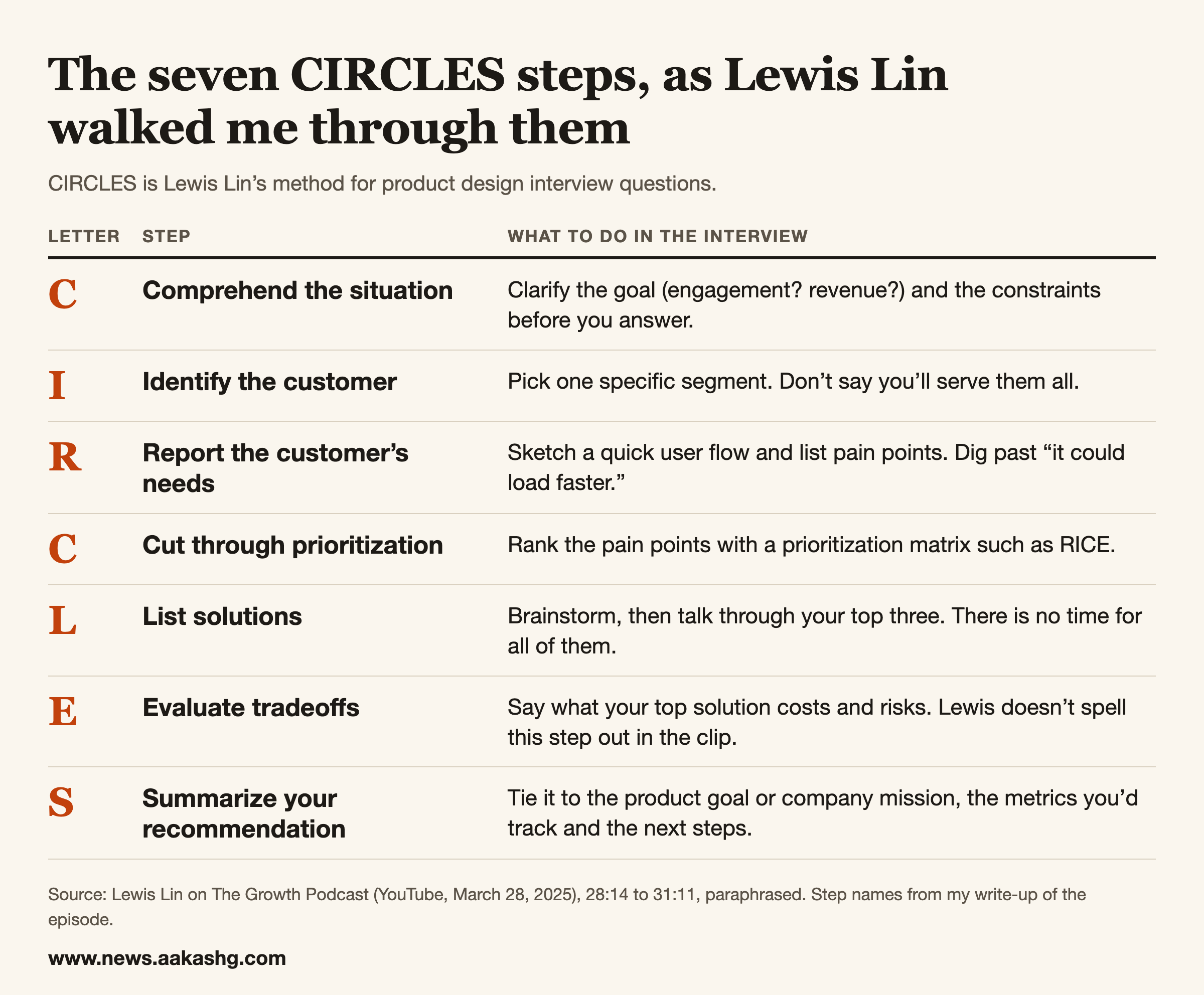
The seven steps
CIRCLES stands for Comprehend the situation, Identify the customer, Report the customer’s needs, Cut through prioritization, List solutions, Evaluate tradeoffs and Summarize your recommendation. My 2023 guide paraphrased the letters. These seven are Lewis’s. ProductPlan and Uxcel list the same seven. Here’s how Lewis explained each step in his walkthrough.
- Comprehend the situation. Clarify the question. Lewis says to find out two things: the goal and the constraints. We don’t want to improve a product just because we’re bored, so are we after engagement or revenue? His example from Amazon: an interviewer asks how you’d improve the shopping experience, you talk for 30 minutes about the website, and then he says he meant the smart speaker. Lewis calls that a bad gotcha. He still says clarifying the constraints is important. His other example is an exec who says “destroy Twitter”. Does that mean building a Twitter clone, or making Instagram more text-based? You need to ask.
- Identify the customer. Pick one specific segment and meet its needs in depth. The common mistake, Lewis says, is trying to focus on every segment you sell to. Don’t.
- Report the customer’s needs. Sketch a quick user flow and list the pain points along it.
- Cut through prioritization. Rank the pain points. Lewis suggests a prioritization matrix like Intercom’s RICE.
- List solutions. Brainstorm, then talk through your top three. There isn’t time for every idea. I cover brainstorming below.
- Evaluate tradeoffs. Lewis doesn’t spell this step out. He goes from your top three solutions straight to the summary. I cover it below.
- Summarize your recommendation. Say what’s best for the product goal or the company mission. Then give the key metrics you’d track and the next steps.
Step three is where candidates first struggle
Lewis says candidates have real trouble digging into pain points. Asked how to improve the Uber app, the typical candidate says the app is kind of perfect, or it could load faster, or prices could be cheaper. He says those pain points aren’t inspiring. They lead to solutions like lowering prices or speeding up the backend code.
On the show, this came up too. A PM who walks into a product case and says “lower the prices” has forgotten that there’s a pricing team out there whose entire job is figuring out the prices.
Lewis’s fix is what he calls the G method. G isn’t an acronym. It means get mad, “get angry like a bear.” You look for the moment the product made you angry.
| What the typical candidate says | The kind of moment Lewis wants |
|---|---|
| The Uber app is kind of perfect. | My driver canceled on me, and Uber didn’t take the initiative to set me up with a backup driver. |
| It could load faster. Prices could be cheaper. | Uber knows I have a family, so why didn’t it send a driver with a car seat? |
The right-hand column paraphrases Lewis’s own Uber example from the episode.
The car seat one got a longer discussion on the show. If you have kids you need two car seats, and you can’t use Uber. We show up in these cities and think, I guess we’re going to have to rent a car. That is a pain point nobody gets from “it could be cheaper.”
My show notes say to start with your own frustrations as a user. Think of the moment that made you grit your teeth, and what you wished the app had magically fixed for you. That emotional reaction is where the real insight comes from.
How to brainstorm for step five
Solutions are the other place candidates get stuck. Lewis says the ideas that come to mind first are usually things the competition recently did, and that doesn’t surprise or impress an interviewer. His fixes:
- Take a stimulus such as AR, drones or AI and ask how it would fix the problem. Buying clothes on Amazon is his example.
- Notice what the products you use have recently launched. Spotify added video podcasts, for one. Noticing launches like that teaches you what a big feature launch looks like.
I use a third one with my own teams, and I said so in the episode: what would the Airbnb solution to this problem be? The Uber solution? The Tinder solution? Maybe a Tinder-style swipe left, swipe right could solve some crunchy B2B SaaS issue. Or maybe not, but at least the third or fourth idea might get you somewhere.
What step six looks like
Lewis never names it in the walkthrough. Earlier in the episode, in the metrics questions, he talks about tradeoffs. That advice applies here too.
In what he calls a binary tradeoff question, the interviewer wants you to assess the tradeoffs and choose one option. Don’t say “why don’t we try a little bit of A and a little bit of B.” Real estate is finite, he says, so choose the one that’s best for the company. In a counter-signal tradeoff, one metric goes up while another goes down. His example is an Instagram PM who launches Reels at the top of the feed: Reels engagement rises and the Stories PM complains that Stories engagement fell. He says that situation paralyzes people.
Lewis said this about metrics questions. Applying it to step six is my read. For your top three solutions, say what each costs and what it puts at risk, then pick one and say why. In my CUPS-PDM edit, that job sits in two steps: Prioritize, where I look for the “bang for your buck solution that’s creative,” and Measurement & Risks.
Here’s my example for this page, using Lewis’s Uber prompt. Say two of your top fixes for the canceled ride are a backup driver assigned automatically and a penalty for drivers who cancel. Name what each one costs and risks. Pick the backup driver because it protects the rider’s time, and say which metric would tell you it works. Don’t present both as winners.
Where CIRCLES falls short
In my 2023 product sense guide, I listed two things I’d change.
- The labels are a stretch. The step names don’t use plain words, so the acronym is hard to remember under pressure. I still like the basic idea.
- It misses design. I think the nitty gritty of design choices is what separates a product manager from a product strategist, so I added a step for it.
There are two more problems now.
First, Lewis thinks candidates have it memorized. He said on the show that the bar for case interviews has risen a lot since 2013. Then he added, “I’d like to pat myself on the back and say, oh, maybe it’s because the CIRCLES method, everybody’s got that memorized into their brain, and I think that absolutely is part of it.” If your interviewer can name your framework from your first sentence, it doesn’t set you apart.
Second, it can sound rehearsed. In 2023 I wrote that I don’t recommend using a framework others can tell you’ve used. On AI roles, my 2026 AI product sense guide is blunter: you can’t CIRCLES your way through “how would you increase Claude Code WAU 10x?” My October 2025 AI product sense guide says it plainly: don’t use the same framework for every question. Build a structure for the specific prompt.
CIRCLES and the frameworks around it
| Framework | Steps | Fits |
|---|---|---|
| CIRCLES | Comprehend, Identify, Report, Cut, List, Evaluate, Summarize | A full product design question with time to cover every step. |
| AARM | Ask clarifying questions, Analyze the problem, Recommend a solution, Measure success | A shorter question. Another Lewis Lin framework, from my 2023 guide. |
| CUPS-PDM | Clarify, User, Problem, Solutions, Prioritize, Design, Measurement and risks | A 45-minute interview built around one case. My edit of CIRCLES. |
| CPSM | Clarify, Problem, Solution, Measurement | A quick question. My relabeling of AARM. |
What I use instead
CUPS-PDM is my seven-step edit of CIRCLES, with plain words for the steps and a design step added. It’s long, though. It’s great if you have a 45-minute interview focused on one case question.
In a quick interview, fall back to CPSM. It’s a subset of CUPS-PDM, which makes it easier to remember. AARM is the short Lewis Lin framework, but I find its names hard to remember, as with CIRCLES. That’s why I prefer CPSM.
The habit matters more. Ask for a minute to structure your answer around the case. It sounds like this:
Interviewer: <asks the question>
You: <asks clarifying questions>
You: Can I take a minute to structure my answer?
You: Here’s how I’d like to spend our time: <structure>. Does that fit what you want to cover?
Say you get Lewis’s own question: how would you improve the Uber app? Here is a structure I’d build for it. I wrote this outline for this page as a sketch:
- Agree on the goal and any constraint, such as the rider app only.
- Pick one rider and the moment that hurts most, such as a canceled ride.
- Brainstorm fixes for that moment and pick one.
- Show how the fix works in the app.
- Say which metric you’d watch and what could go wrong.
It uses steps from CUPS-PDM and skips the ones the prompt already covers. I worked a different example, “How would you build Uber for Kids?”, through the same idea in the 2023 product sense guide.
When CIRCLES is still worth knowing
Learn it. In 2023 I wrote that it’s so ingrained in PM culture that half your interviewers would expect it. That was an estimate I made then, without measuring anything. On the show I called it pretty much the dominant framework for answering product design questions. Use it as a checklist for a complete answer. Build what you say out loud around the question.
How I’d practice, in order
- Learn the seven steps from the card above until you can say them without it.
- Write three weak pain points and three G-method pain points for a product you use.
- Take a prompt and write a structure for it before you answer.
- Say the structure out loud to another person and ask which clarifying question you missed. You can read Decode and Conquer cover to cover, but until you say it out loud, in a room with someone pushing back, it won’t click. Lewis has never seen anyone win a karate tournament by reading a karate book.
- Repeat with different prompts. Lewis says people in his Slack group do 30 to 40 practice sessions, and some as many as 100, before they land an interview.
If you’re preparing for Google, see my Googleyness interview page and the Google product manager page. My product strategy interview guide covers list, matrix and CIRCLES-variant frameworks for strategy questions. The full conversation is in the Lewis Lin episode. For tough case questions from another author, see my episode with Gayle McDowell, who wrote Cracking the PM Interview. I write about PM interviews at www.news.aakashg.com.
CIRCLES framework FAQ
What does CIRCLES stand for?
CIRCLES stands for Comprehend the situation, Identify the customer, Report the customer’s needs, Cut through prioritization, List solutions, Evaluate tradeoffs and Summarize your recommendation.
Who created the CIRCLES framework?
Lewis Lin created it. He wrote Decode and Conquer, and I interviewed him about the framework on The Growth Podcast in March 2025.
What is the “Evaluate tradeoffs” step in CIRCLES?
It is the sixth step. Lewis doesn’t spell it out in his walkthrough, but he says elsewhere in the episode that when an interviewer asks for a tradeoff, you should assess the options and choose one instead of blending them. For CIRCLES, say what each of your top solutions costs and risks. Then pick one and explain why.
Is CIRCLES for product design or product sense questions?
Lewis presents it as the method for product design questions. Companies name the round differently. Gal Eshel, a former Google PM, says Google’s 2026 loop calls its product sense round product vision.
Should I use CIRCLES in a PM interview?
Learn it, then structure your answer for the question. In 2023 I recommended asking for a minute to structure your response, and I still do.
How is CUPS-PDM different from CIRCLES?
CUPS-PDM is my seven-step edit: Clarify, User, Problem, Solutions, Prioritize, Design, Measurement and risks. It uses plain words for the steps and adds a design step.
