Googleyness. It’s one of the hardest words in the job search to explain. Almost everyone wants a job at Google, and most are at a loss to say what Googleyness is. That’s why I had Gal Eshel on the podcast. Google’s own public interview-tips page never uses the word. It does cover ambiguity and collaboration, and it asks you to think about your leadership style.
For my paid Google PM guide in July 2026, I talked to 6 people: 1 candidate who had recently completed the Google process, 1 mid-process, 2 current hiring managers and 2 former hiring managers. Then I sat down with one of them. Gal was a PM at Google for six years and sat on the hiring committees that decided whether people were Googley enough. He now coaches at IGotAnOffer, which also publishes a Googleyness guide. I asked him to define the word on The Growth Podcast, and the full transcript is on this site.
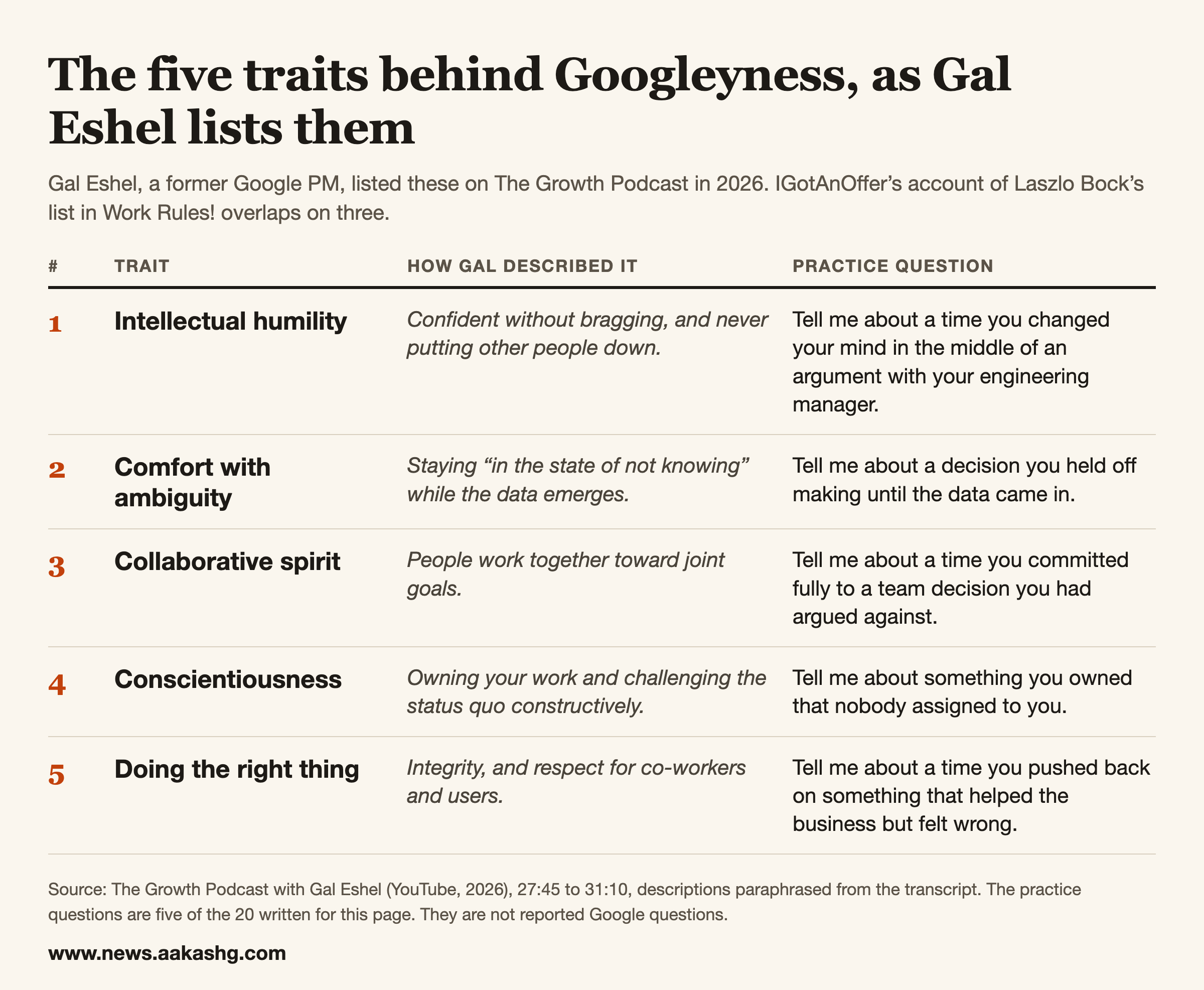
I’ve paired each of his five traits with practice questions. Then I cover what Google says in its own words and how to pick your stories. The questions are mine. A question gets a link only where Gal says the same thing at that minute.
What Googleyness means
Gal says the word has been around almost as long as Google. He puts the first official definition in 2015, in Laszlo Bock’s book Work Rules!, and ties his five traits to it. Bock was head of people operations at Google then.
IGotAnOffer’s Googleyness guide prints the passage from Bock’s 2015 book where he describes Googleyness:
“Attributes like enjoying fun (who doesn’t), a certain dose of intellectual humility (it’s hard to learn if you can’t admit that you might be wrong), a strong measure of conscientiousness (we want owners, not employees), comfort with ambiguity (we don’t know how our business will evolve …), and evidence that you’ve taken some courageous or interesting paths in your life.”
That is a different list from Gal’s, and the two overlap on three: humility, conscientiousness and ambiguity. Gal’s five are his working list. He says they’re just examples, and there are many traits. Honesty is one of them.
His proof that the word is real: he landed in London to work with a team he hardly knew. The moment he stepped into the room, everyone assumed the others had good intentions. I called that default trust in my guide. Gal says Googleyness is one of the things that makes it possible: Google picks Googley people, and they act in a Googley way.
Data and cross-functional work are covered in the other interviews. In this one, Gal assumes you did well on those. He wants to see who you are and whether he’d want to work with you.
The five traits, with 20 practice questions
I wrote the questions for this page. They are not reported Google questions. A question gets a link only where Gal says the same thing at that minute. Where two questions share a minute mark, Gal covers both ideas in one sentence.
1. Intellectual humility
Gal’s test is the one he applies to every behavioral answer: “I don’t want to hear how smart you are.” He doesn’t want to hear about the data you brought either. He wants to hear that you’re confident and know what you’re talking about, but you never brag and you never put down other people.
Gal’s example of the weaker answer reads like a win. The example is a hypothetical, and he says he never worked on Gmail. In story A, a PM wants the team to improve an AI auto-reply feature. The engineering manager wants to fix failed messages. The PM brings data, goes to the VP with the manager, wins, and user satisfaction rises 23%. In story B, the PM wants to build an inbox sorter in-house. The manager says borrowing modules from other teams would ship in the coming quarter, while building in-house would take three or four. The PM asks for a quick test, watches one engineer produce a decent result in two days, and says “I think actually he convinced me.” The feature gets little traction and users turn it off. Gal prefers B. He can’t promise every Googler would, but most of the ones he knows would. The numbers are his illustration.
Story B shows how you listen to people and put your ego aside. In my July 2026 guide I labeled A a victory narrative and B a Googleyness narrative.
- Tell me about a time you changed your mind in the middle of an argument with your engineering manager. (see Gal at 21:03)
- Tell me about a time someone on your team was right and you were wrong.
- Tell me about a time a colleague’s work fell short, and how you talked about it afterward. (see Gal at 28:40)
- Tell me about a launch that worked mostly because of other people’s ideas.
2. Comfort with ambiguity
Gal describes it as not jumping to the solution. You listen to other opinions, maybe run a quick proof of concept, and stay “in the state of not knowing” for a long while, waiting for the data to emerge. His line: you want the best solution, not necessarily the one you find first. Choose a story where the answer wasn’t clear and you waited for the data. For AI PM roles his test is simpler: can you accept ambiguity and change course if nothing works?
- Tell me about a decision you held off making until the data came in. (see Gal at 29:23)
- Tell me about a time you ran a proof of concept before committing the team. (see Gal at 29:07)
- Tell me about a time the quickest solution was available and you chose to wait for a better one. (see Gal at 29:40)
- Tell me about a time you changed course because nothing was working. (see Gal at 1:09:40)
3. Collaborative spirit
Gal says this one speaks for itself. People at Google work together toward joint goals, and he estimates that 99% of meetings there end in consensus instead of escalation. Tell the story of a disagreement you settled without escalating it, after walking in assuming good intentions.
- Tell me about a time you committed fully to a team decision you had argued against.
- Tell me about a disagreement with a peer on another team and how it ended.
- Tell me about a conflict you settled without escalating it. (see Gal at 27:02)
- Tell me about the last time you joined a team where you hardly knew anyone. (see Gal at 26:47)
4. Conscientiousness
For Gal, conscientiousness is taking ownership of your work and maintaining high ethical standards. It also means challenging the status quo constructively and being guided by your conscience. Look for a story about work you owned and a time you pushed back constructively.
- Tell me about something you owned that nobody assigned to you.
- Tell me about a time you challenged the way things were done and how you went about it. (see Gal at 30:24)
- Tell me about a time you held your team to an ethical standard when it would have been easier not to. (see Gal at 30:24)
- Tell me about a time your conscience and your deadline pulled in different directions. (see Gal at 30:32)
5. Doing the right thing
Gal says Googleyness is a lot about just being a good person. That means integrity, and respect for your co-workers and your users. Many times we know the right thing to do and have reasons not to do it, so we do the second best. His version of Googleyness is being willing to pay the price for doing the right thing. Name the price in your story: what you gave up or risked by doing it.
- Tell me about a time you pushed back on something that helped the business but felt wrong.
- Tell me about a time you said something hard to a co-worker and still kept their respect.
- Tell me about a time doing the right thing cost you something. (see Gal at 31:30)
- Tell me about a decision where what users needed and what your team wanted pulled apart.
One more question comes from candidates I coached. In the Google section of my safety and ethics guide, they said the Googleyness round is where safety surfaced, and the behavioral prompt was framed as “Tell me about a time you spoke up about something that wasn’t right.”
What Google says in its own words
Two Google pages cover this. Neither uses the word Googleyness. I searched both on October 15, 2026.
Google’s PM interview prep pack does use the word. IGotAnOffer’s guide quotes it: Google says Googleyness is about finding employees who “dream of the next moonshot idea, thrive in ambiguity, value feedback, effectively challenge the status quo, and do the right thing.”
Google’s how-we-hire page says the process typically takes roughly 6 to 8 weeks. Every candidate for a role is assessed against the same clear rubrics. The questions are open-ended and role-related, with no brainteasers. Before interviews you may be asked to take the Google Hiring Assessment, which Google says measures workstyle skills. AI tools are not permitted during interviews.
Google’s interview-tips page covers the behavioral side. It says many questions will sound like “Tell me about a time when.” It gives a formula for data: “Accomplished [X], as measured by [Y], by doing [Z].” Its STAR method spells the A as Activity: Situation, Task, Activity, Result.
The same page lists what to think about before you walk in. It reads a lot like Gal’s traits:
- Ambiguity: “How do you deal with ambiguous situations and problems?”
- Collaboration: “Google has a collaborative culture,” then “How would you address a conflict with someone you work with?”
- Influence: “What strategies might you use to influence teammates?”
- Collaboration again: “What examples do you have of a time when you drove collaboration?”
- Leadership: a section titled “Think about your leadership style.”
Google frames these as things to think about. Have a story ready for each anyway.
Where Googleyness shows up in the loop
There is no single answer, so ask your recruiter what each interview is called.
In my January 2025 Google PM guide, the 15 to 30 minute recruiter screen looked for two things: Googleyness and role-specific experience. In my May 2026 safety and ethics guide, the candidates I coached described a Googleyness round, and that’s where safety questions came up.
Gal’s list for 2026 is different. He says Google sends five interview types to every candidate: product vision (what used to be product sense), product analysis, strategic insights, execute with judgment and problem space understanding. None is called Googleyness. He also says the labels and the content can differ, because Googlers can ask whatever they want. A strategic insights interview can be really short and then become a really long Googleyness interview. One candidate’s hiring manager interview was billed as product vision and problem space understanding, with a lot of behavioral questions on top. So expect behavioral questions anywhere in the loop, and show who you are in how you tell every story.
My full Google PM guide goes round by round.
Pick the story, then choose the theme
The easy trap is to treat the behavioral round like a knowledge test and dump a wall of facts at the interviewer. Gal says candidates often assume the interviewer already knows everything and will connect the dots. As I said to Gal in the episode: if you just give people facts or data, they’re going to write the story themselves.
Gal has three rules for stories.
First, you don’t have to pick a Googley story. The interviewer asks for a time you did something. Don’t go looking for a time you were intellectually humble.
Second, the facts are fixed and the meaning is not. He borrows plot and theme from screenwriting. His example: 18 bags of groceries and a broken elevator. Told as a story about the lifting and the teenager he recruited to help, it shows someone good at hard work and project management. Told as a story about an 83-year-old widower neighbor, and about offering help politely so the neighbor didn’t feel unable to do it himself, it shows someone empathetic. The facts are identical. Which theme you choose tells the interviewer which values matter to you.
Third, prepare eight, ten or twelve stories in advance. His claim is that ten good stories from your career would probably cover 95% of behavioral questions, because each story answers many questions. Then take a question bank and practice telling each story with the theme that fits the question.
My guide to behavioral interviews covers the STAR method.
Mistakes to avoid
Gal calls overfitting the most common pitfall. You bend a story to fit what you think Googleyness is, and you stop being honest. His rule: “Do not invent a story, because it shows.” If the story is about ambiguity, don’t exaggerate how ambiguous it was.
The second is restating your resume. In the episode, Gal scored my rebuilt “tell me about yourself” answer eight, maybe even nine out of ten. The gap to ten was one thing, in his words: “I need to hear and feel why you really love doing what you do.” A resume can’t show that. At the end of the episode I said it this way: don’t make your behavioral answers too long, and don’t just restate your resume. Tell the story that helps people see your passion and why you fit the role. My tell me about yourself guide walks through that rebuild.
The third is glossing over the parts of your career you’re not proud of. In his prep advice, Gal says that if you worked at a company you’re not proud of, one that used dark UX patterns for example, you should decide honestly how you’ll talk about it. You probably shouldn’t sound proud of it in this interview.
How to answer “Why Google”
Gal’s Google-specific advice starts with a writing exercise. Write down what is really important to you as a product manager, then honestly ask yourself, “do you really believe in what Google believes?” He wants you to know how Googley you really are and where your gaps are, even if the honest answer is that you’d feel better at a more competitive place.
For the answer itself, I use the structure from my 2024 “Why this company” post. After “tell me about yourself,” it’s the number 2 most frequently asked question in PM and tech interviews. I’ve heard it at every job I got at least once along the process: Why Affirm? Why thredUP? Why Epic Games? In a survey of 100 PM hiring managers that I ran in June and July 2024, 41 chose “interest in the company” as one of their top 3 reasons for hiring someone. A good answer has to be all three of these at once:
- Personal: something only you can say.
- Flip your weaknesses into strengths, with your positioning in mind.
- Show your PM craft. The answer shouldn’t fit any other role.
Go for about 2 minutes, with strong energy and a fast pace.
Googleyness for AI PM roles
In the same episode, Gal says two traits matter most for AI PM roles. Comfort with ambiguity is the number one signal, and intellectual humility is second. He describes it as working with an unpredictable collaborator. You need to be humble because that collaborator is really smart, really fast and can do things you will never be able to do.
If you have no AI experience, his advice is don’t pretend. The interviewer sees you trying to hide something. Say it in the first three minutes, then say what you’re doing about it. My AI PM interview guide covers that loop.
Jaclyn Konzelmann, a Director of AI PM at Google, lists six traits she looks for in an AI PM in her episode. One of them is clarity in chaos: being able to “hold competing tensions in your mind without having to solve them all at once.” It lines up with Gal’s comfort with ambiguity.
How I’d prepare, in order
- Read Google’s how-we-hire and interview-tips pages. They’re short.
- Write your eight to twelve stories. Use real ones and don’t change the facts.
- For each story, write the theme you’d choose and one sentence on what it says about you.
- Match a story to each of Google’s five prompts above and to the 20 practice questions on this page.
- Do Gal’s writing exercise: write down what matters to you, then check it against what Google believes.
- Say your answers out loud to a person who pushes back. A real interview isn’t a script. Your interviewer will challenge you, interrupt you and dig deeper, as I wrote after my episode with Gayle McDowell, author of Cracking the PM Interview. Lewis Lin says he has never seen anyone win a karate tournament by reading a karate book, and I covered his mock interview advice in his episode.
For the full loop, read my Google PM interview guide or the Google product manager page. If you’re earlier in your career, see the Google APM program page. I write about PM interviews at www.news.aakashg.com.
Googleyness FAQ
What is Googleyness?
Googleyness is Google’s term for how you behave with colleagues. Gal Eshel, a former Google PM, lists five traits: intellectual humility, comfort with ambiguity, collaborative spirit, conscientiousness and doing the right thing. IGotAnOffer’s account of Laszlo Bock’s list in Work Rules! overlaps on three of them.
What are examples of Googleyness interview questions?
Google’s interview-tips page tells you to think about prompts such as “How do you deal with ambiguous situations and problems?” and “What strategies might you use to influence teammates?” This page adds 20 practice questions, four per trait, such as “Tell me about a decision you held off making until the data came in.” I wrote those for this page, and they are not reported Google questions.
Is Googleyness a separate interview round?
It depends on who you ask. In my January 2025 guide it was assessed in the recruiter screen, and candidates I coached described a Googleyness round. Gal’s list of the five 2026 interview types has no round by that name, and the two Google pages I searched don’t use the word. Ask your recruiter what each interview covers.
How many stories should I prepare for the Googleyness interview?
Gal Eshel recommends eight to twelve real stories. He says about ten good stories would cover roughly 95% of behavioral questions, so practice telling each story with the theme that fits the question you get.
Can I use AI during a Google interview?
No. Google’s how-we-hire page says AI tools are not permitted during interviews. Its interview-tips page says the same about Google Search and AI, and asks for your own thoughts.
How long does the Google interview process take?
Google says it typically takes roughly 6 to 8 weeks and varies by role and team. Your recruiter explains your specific timeline.
