To break into Product Management or climb to a senior role at a place like Google or Meta, you need to master one core skill: defining exactly who you are building for. A weak customer profiles definition leads to features nobody uses, burned-out engineering teams, and a stalled career.
The best PMs I've hired and worked with don't use fuzzy personas. They build data-driven, actionable customer profiles. This isn't an academic exercise; it's a strategic weapon. This guide will give you the exact framework to build and leverage customer profiles to drive product strategy, secure roadmap buy-in, and accelerate your career.
Let's start with the framework you can apply today.
Your Framework for Actionable Customer Profiles
Forget abstract theory. An actionable customer profile is a tactical tool that answers the most critical question in product: “Who are we building this for?” It's the framework that separates top-tier PMs at companies like Netflix and Spotify from the rest. It's how you make decisions with conviction and get your roadmap approved.
As a PM leader who has hired dozens of Product Managers, a candidate's ability to articulate a data-backed customer profile is a key differentiator. It shows they can move beyond guesswork and lead with strategy. A robust customer profile is the single source of truth that aligns product, engineering, and marketing, ensuring every team member is solving a real, validated user problem.
The 4 Core Components of a Modern Profile (The A.C.T.I.O.N. Framework)
For a customer profile to be more than a document that gathers dust, it must be structured for immediate action. I call this the A.C.T.I.O.N. framework—it’s the intelligence file on your user.
- A – Analytics & Behavior: What does the data show they actually do? This is your quantitative foundation. (e.g., "Logs in 3x/week, uses Feature X for an average of 12 minutes, but has a 75% drop-off rate at the payment screen.")
- C – Context & Pains: What specific roadblocks, anxieties, and frustrations are they dealing with? (e.g., "Spends 2 hours manually reconciling data between our app and their accounting software every Friday.")
- T – Task (Jobs-to-be-Done): What is the real progress the user is trying to make by "hiring" your product? This is deeper than surface-level tasks. (e.g., JTBD: "Give my boss an accurate, real-time view of our team's performance so I look competent and prepared.")
- I – Ideal Outcomes: What does a "win" look like for the user, both tangibly and emotionally? (e.g., "Reduce reporting time from 2 hours to 10 minutes," "Feel confident and in control during weekly leadership meetings.")
- O – Obstacles & Objections: What prevents them from succeeding or adopting your solution? This could be pricing, complexity, or lack of trust. (e.g., "Worries the subscription is too expensive for the value," "Fears data migration will be a nightmare.")
- N – Next-Best Solution: What are they using now? This could be a direct competitor, a spreadsheet, or even a pen and paper. (e.g., "Currently uses a messy combination of Google Sheets and manual email updates.")
Mastering these components gives you an incredibly powerful tool. It’s the hard evidence you bring to a leadership meeting to get your roadmap approved. It's the guide your UX team uses to build intuitive flows. For more on this, my detailed guide on how to create a framework for making decisions will help you turn this customer knowledge into real business impact.
Profile vs. Persona vs. Segment: A Critical Distinction for PMs
In product meetings, you'll hear "profile," "persona," and "segment" used interchangeably. This is a rookie mistake that can send your strategy spinning. For a PM aiming for a senior role, understanding this hierarchy is non-negotiable.
Think of it as zooming in on your customer, moving from a 30,000-foot view to a microscopic one.
Segments: The Broad Market Buckets
At the highest level are customer segments. These are giant, generalized buckets based on shared, high-level attributes.
A fintech app like Robinhood might segment its market into:
- "Millennial Investors" (Demographic)
- "High-Net-Worth Retirees" (Value-based)
- "Active Day Traders" (Behavioral)
Segments are crucial for market sizing and high-level strategy (e.g., "Our total addressable market for 'Millennial Investors' is $50B"). But they are too vague to inform what specific feature to build next quarter.
Personas: Adding an Empathetic Story
Zooming in, we get to user personas. A persona takes a segment and gives it a human face, a name, and a backstory. It’s an archetypal character built to create empathy.
A persona is a narrative tool. For the "Millennial Investor" segment, you might create "Alex, the Cautious Investor"—a 28-year-old software engineer terrified of losing his savings but wants to start building wealth.
Personas are fantastic for aligning teams and getting stakeholders to connect with user motivations. You can find excellent persona examples and templates that show their power. However, they are still aggregated and fictional.
Customer Profiles: The Data-Driven Dossier
This brings us to the most granular and powerful level: the customer profile. While a persona is a story, a customer profile is a data-driven dossier on a real group of users who fit that archetype. It swaps the narrative for verifiable facts.
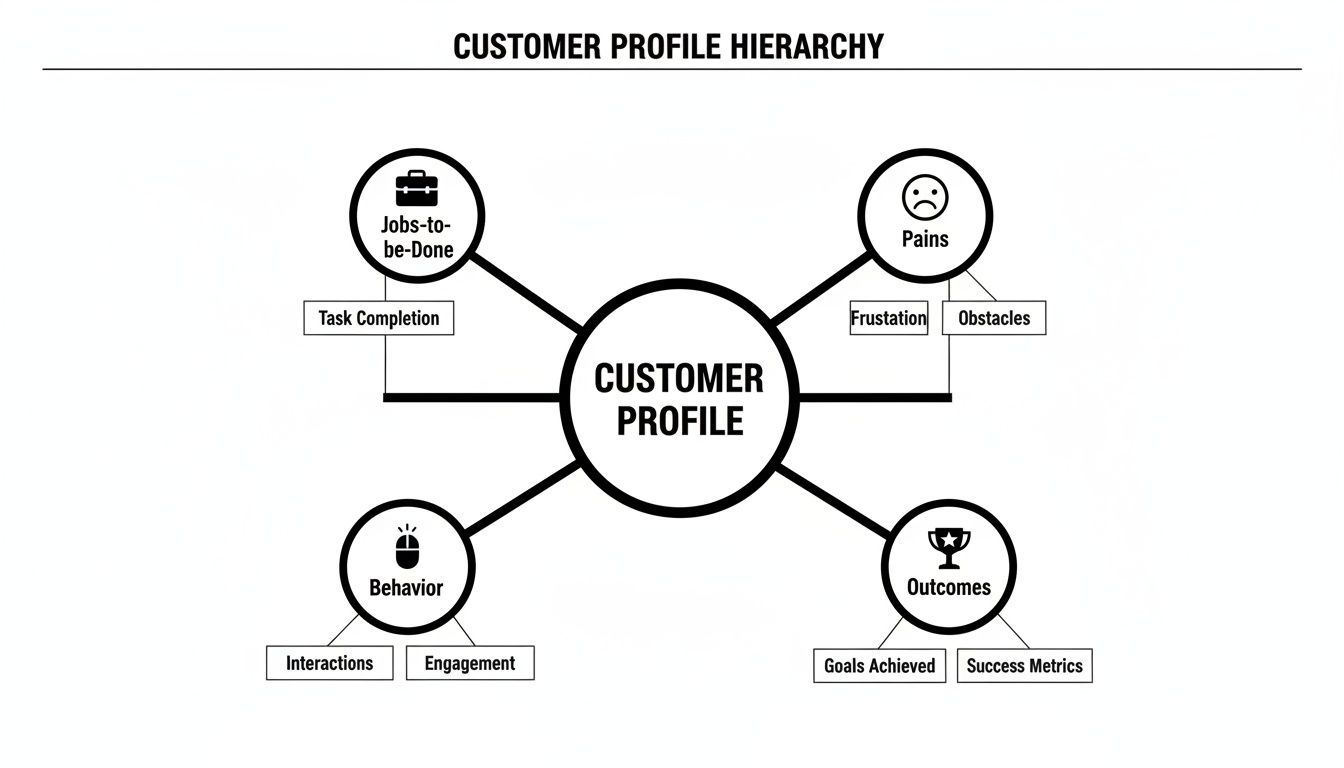
The diagram below breaks down the core components of a truly useful customer profile. It’s all about their Jobs-to-be-Done, pains, behaviors, and what they hope to achieve.
A customer profile for "Alex" would include concrete data points from actual users who fit that mold:
- Real transaction history: They consistently make small (<$200) trades in low-risk ETFs and have never touched options.
- App usage data (from Amplitude/Mixpanel): They log in 5x a week but spend 90% of their time on the portfolio overview and market news screens.
- Support tickets (from Zendesk/Intercom): They’ve submitted two tickets in the last month asking for clearer explanations of investment fees and another about tax implications.
This isn't a story; it's evidence.
Profiles vs Personas vs Segments at a Glance
This table breaks down the three concepts for quick reference in your next strategy session.
| Concept | Core Focus | Key Components | Primary PM Use Case | Good For… |
|---|---|---|---|---|
| Segments | Who is in our market? (Broad) | Demographics (age, location), Firmographics (company size), high-level behavior. | Market Sizing, high-level business strategy, broad marketing campaigns. | Aspiring PMs: Understanding market landscape. |
| Personas | Why do they behave this way? (Narrative) | Fictional name, photo, backstory, goals, motivations, frustrations. | Building empathy, aligning teams, communicating user needs to stakeholders. | Entry-level PMs: Storytelling and team alignment. |
| Customer Profiles | What are they actually doing? (Data) | Jobs-to-be-Done (JTBD), pains, behaviors, desired outcomes, real usage data. | Driving specific feature development, validating hypotheses, roadmap prioritization. | Mid-Career & Senior PMs: Making high-stakes product bets. |
Segments tell you who to target, personas help you feel their pain, but data-rich customer profiles give you the hard evidence to build the right product and win roadmap debates. They are your source of truth.
How to Build Your First Customer Profile from Scratch: A 3-Step Process
Theory is useless without execution. This three-step process is how you turn raw data into a strategic asset. Think of it as data triangulation—pulling from multiple sources to create a complete, evidence-based picture.
Step 1: Gather Quantitative Data (The "What")
Start with the numbers. This is objective truth about user behavior.
- Your Go-To Tools:
- Product Analytics: Amplitude, Mixpanel, Google Analytics. Dig into feature adoption, session duration, and key funnel drop-offs.
- CRM: Salesforce, HubSpot. Look at purchase history, contract value, and firmographics (company size, industry).
- Billing Systems: Stripe, Chargebee. Analyze spending habits, popular subscription tiers, and Lifetime Value (LTV).
- What to Look For:
- Who are your most engaged users? (e.g., top 10% by session length)
- What features do your highest LTV customers use most?
- Where do users drop off most frequently?
This data forms the skeleton of your profile. It's undeniable proof of what's happening.
Step 2: Collect Qualitative Insights (The "Why")
Now, add the human story. This is where you uncover the motivations and frustrations behind the numbers.
- Your Go-To Methods:
- User Interviews: The highest ROI activity for any PM. Aim for 5-8 interviews per profile. Ask open-ended questions about their workflow, pains, and goals.
- Support Ticket Analysis: Your Zendesk/Intercom is a goldmine. Look for recurring themes of confusion, frustration, and feature requests.
- Sales & CS Call Recordings (Gong/Chorus): Listen to how prospects describe their problems and how current customers talk about value.
- Surveys & Feedback Forms: Use NPS/CSAT for a baseline, but always include open-ended questions like, "What's one thing we could do to make this product indispensable for you?"
In my experience, one afternoon spent synthesizing five interview transcripts provides more actionable roadmap ideas than a month of internal brainstorming.
Step 3: Synthesize and Structure Your Profile
You have the data. Now, connect the dots between the quantitative "what" and the qualitative "why." Don't start with a blank page; use an ideal customer profile template to provide structure.
Fill it out using the A.C.T.I.O.N. framework. As you plug in your insights, clear themes will emerge. If you need a refresher on the first steps of this process, my guide on how to define your target audience will ensure your work is focused from the start.
This finished profile becomes your team’s guiding star, the document you pull up to settle debates and justify your roadmap.
From Document to Daily Driver: Putting Your Profile to Work
Here’s the reality: most teams build a profile, present it once, and then it dies in a forgotten Confluence page. This is a massive waste. Top PMs use their profiles every single day. It's their strategic compass.
Driving Product Discovery and Prioritization
Your customer profile is a prioritization machine. In a roadmap meeting, when the debate starts between a shiny new feature and fixing a nagging bug, you don’t defer to the loudest voice. You turn to the profile.
- Example in Action: Your profile for "Startup Sam" makes it clear his biggest pain is manual data entry, costing him 5 hours a week. A feature for a Zapier integration that automates this workflow jumps to P0, ahead of a minor UI refresh that's just a "nice-to-have." This removes emotion and politics from roadmap planning.
Powering Growth and Personalization
Customer profiles are the engine behind any modern growth strategy. Companies that excel at personalization—built on solid profiles—generate 40% more revenue from those efforts than average players.
Here’s how top-tier PMs use profiles to fuel growth:
- Personalized Onboarding: Instead of a generic tour, they tailor the first-run experience. A "Power User" profile might get a walkthrough of advanced APIs, while a "Newbie" profile gets a step-by-step guide to the core workflow.
- High-Impact A/B Tests: Stop testing random button colors. Form sharp hypotheses. Example: "We believe adding a security badge to checkout will increase conversion for our 'Security-Conscious Sarah' profile by 15% because her top pain point is data privacy."
- Targeted Messaging: Craft in-app messages and release notes that speak directly to a profile's known pains and goals. This is how you achieve >50% open rates on product update emails.
As a hiring manager, I often ask candidates: "Walk me through how you used a customer profile to make a tough trade-off decision." I want to hear how they used real user data to kill a popular feature idea or prioritize a less glamorous but more impactful one. This separates strategic PMs from feature factory project managers.
To gather the qualitative data needed for this level of impact, our guide on understanding the Voice of the Customer is a must-read.
The AI Revolution in Advanced Customer Profiling
If you're still relying on manually built, static customer profiles, you are already falling behind. The most effective PMs, especially those targeting AI Product Manager roles, are using AI to build dynamic, predictive models of their users.
This is the new frontier of what a customer profiles definition even means. AI platforms can analyze massive, disparate datasets—product analytics, support tickets, CRM data, and even call transcripts—to identify hidden "micro-segments" with unique behaviors that were previously invisible.
From Reactive to Predictive Product Management
Instead of waiting for a quarterly report to see churn is up, an AI model can flag an "at-risk" profile based on subtle behavioral shifts.
- Real-world example: A SaaS company I advised used an AI tool to discover that users who stopped using their "reporting" feature for two consecutive weeks were 90% more likely to churn the following month. This isn't just data; it's a window to intervene with a targeted email or in-app guide before they cancel.
This is the critical shift from analyzing what happened last quarter to forecasting what users will need next month. It’s an essential skill for any PM aiming for leadership in an AI-first company like OpenAI or Google. Our updated AI tools for Product Managers guide details the tools to build this capability.
A recent BCG survey of CxOs found that 87% are increasing investment in AI for customer insights, driven by the fact that 56% of customers now expect hyper-personalized offers.
The AI-Powered PM: Prompts and Prominence
As an AI PM, your job isn't just to consume these insights, but to generate them.
Actionable AI Prompt for Profile Synthesis:
"Analyze these [20 user interview transcripts] and [100 Zendesk tickets]. Identify the top 5 recurring pain points and the primary Job-to-be-Done for a user segment described as 'small business owners with 5-10 employees.' Synthesize these into a customer profile, including direct quotes for each pain point."
This is how modern PMs turn raw data into strategic assets in hours, not weeks. Your role becomes that of the "human-in-the-loop," ensuring AI-driven personalization is helpful, not creepy, and always respects user trust. AI tells you the what; you provide the strategic why.
This approach unlocks a fundamentally different way to understand people, generating powerful AI driven marketing insights that give you predictive clues about your customers' next moves.
Common Pitfalls and How to Avoid Them (The PM Leader's Checklist)
I've seen too many PMs fall into the same traps, creating profiles that are either useless or actively misleading. Here are the most common mistakes and how to avoid them.
The "Vanity Profile" Trap:
- The Mistake: A beautifully designed document with stock photos and vague descriptors ("Tech-savvy millennial") that looks great in a presentation but is useless for making a single trade-off decision.
- The Fix: Every point in your profile must be backed by a specific data point or a direct user quote. If it's not actionable, cut it.
The "Too Many Profiles" Trap:
- The Mistake: Slicing your user base into a dozen granular profiles, leading to analysis paralysis and a diluted product that tries to please everyone and excites no one.
- The Fix: Focus on the vital few. Start with 1-3 core profiles that represent the 80% of your user base driving your key business metrics (e.g., revenue or engagement). Master these before you expand.
The "Static Artifact" Trap:
- The Mistake: Creating a profile and never updating it. A profile from a year ago is a historical document, not a strategic guide for the future.
- The Fix: Schedule a quarterly audit. Put it on the calendar. Check your profiles against new analytics data, support ticket trends, and fresh user interviews. This ensures your customer profiles definition remains a living, strategic tool.
A stark reality check: while 84% of businesses believe they excel at personalization, only 54% of their customers agree. This disconnect stems from profiles built on internal assumptions rather than real, multi-source data. Don't fall into that trap.
Frequently Asked Questions
I get these questions constantly from PMs I mentor. Here are the straight answers.
How Many Customer Profiles Should A Product Have?
Start with one to three. Any more and you risk analysis paralysis. These should represent the core 80% of your active, high-value users. For a SaaS business, this might be one profile for the "End User" and another for the "Economic Buyer." You can add niche profiles later as your strategy matures.
How Often Should I Update My Customer Profiles?
Treat them as living documents. Schedule a quarterly audit to review them against new data. Plan a major refresh annually or whenever there's a significant market shift, a new competitor emerges, or you pivot your product strategy. In fast-moving sectors like AI, a bi-annual deep dive is wise.
Can I Create Profiles For A Product With No Users?
Yes, but you must label them as "provisional profiles." Build them using market research, competitor analysis (what do their unhappy customers complain about on G2 or Reddit?), and interviews with your target audience. The crucial step is to create a plan to validate or completely overhaul these profiles with real user data as soon as you launch. This prevents early assumptions from hardening into false dogma.
Ready to accelerate your career? Join thousands of PMs who get smarter every week with Aakash Gupta's newsletter and podcast. Get expert insights on product growth, strategy, and leadership delivered straight to your inbox. Subscribe and learn more at AakashG.com.

One reply on “The PM’s Actionable Guide to Customer Profiles: A Framework for Product-Led Growth”
[…] you're weak on segmentation, spend time learning how strong PMs think about customer profiles. Most broken canvases fail here […]