Most product teams already have one AI tab open all day. The harder question isn't whether to use AI. It's whether you're using the right model for the job in front of you.
If you're a PM, the difference shows up fast. One request is a roadmap draft for next quarter. The next is a messy spreadsheet of user feedback. Then engineering asks whether the API spec you wrote will create edge-case failures in auth, rate limiting, or payload design. A general-purpose assistant can help with all of that. A more technical model can outperform it on the work that causes products to fail.
That’s why deepseek ai vs chatgpt matters. This isn't a consumer app comparison. It's a workflow decision for product managers who need faster analysis, sharper technical reviews, and fewer bad assumptions. If you're evaluating your broader stack, this roundup of the best AI tools for mobile app building is a useful companion because it shows where model choice fits inside a larger PM toolchain.
The AI Showdown on Every Product Manager's Desk
ChatGPT usually enters the team first. It's familiar, polished, and easy to adopt across product, design, support, and go-to-market. DeepSeek enters differently. It shows up when engineering starts comparing model outputs on code, reasoning, and structured problem-solving.
That split matters because PM work isn't one thing. Some tasks reward breadth and communication quality. Others punish even small reasoning errors. If you're writing release notes, a launch brief, or interview questions for user research, the smoothest generalist often wins. If you're validating SQL logic, pressure-testing technical assumptions, or modeling trade-offs in a spec, specialist performance matters more.
The practical mistake I see teams make is standardizing too early. They pick one model for everything, then force every workflow through it. That creates hidden costs. PMs over-trust outputs that sound confident. Engineers stop using the shared tool because it can't keep up with technical depth. Leadership thinks "AI adoption" is done when the true question should be which tasks belong on which model.
Practical rule: Choose AI the same way you choose PM frameworks. Match the tool to the decision, not the other way around.
In most organizations, deepseek ai vs chatgpt isn't a winner-take-all decision. It's a portfolio choice. ChatGPT often works better as the broad assistant across planning, synthesis, and stakeholder communication. DeepSeek becomes more compelling when the task is structured, technical, auditable, or cost-sensitive.
Understanding the Contenders and Their Philosophies
A PM choosing between DeepSeek and ChatGPT is really choosing between two product philosophies.
ChatGPT is built as a broad workbench. The product is designed for fast adoption across functions, polished outputs, and workflows that move between drafting, summarizing, editing, and collaboration. In practice, that matters when product work is messy and cross-functional. If a PM needs to turn a research transcript into a one-pager for leadership, rewrite a vague requirement into user stories, and then polish launch messaging for sales enablement, ChatGPT usually fits the flow better.
That design choice shows up in how teams use it. Product, design, support, and go-to-market can all get value quickly without much prompt discipline. The model is forgiving. It handles ambiguity well, and it tends to produce cleaner first drafts for communication-heavy work.
DeepSeek comes from a different place. It appeals to teams that care more about reasoning discipline, technical depth, deployment flexibility, and cost control than broad consumer-style usability. If you want a quick orientation before adoption, this vetted AI tool Deepseek overview is a practical starting point.
For product managers, that difference is concrete. DeepSeek is more attractive when the task looks closer to analysis than authorship. I would use it to pressure-test API edge cases, validate logic in a spec, sanity-check SQL or calculation paths, or work through structured trade-offs with engineering. It is less compelling if the job is to produce stakeholder-friendly writing with minimal editing.
The open model posture also changes the decision. Teams that need more control over deployment, customization, or model behavior will often give DeepSeek a harder look. That matters in regulated environments, internal tooling, and AI-native products where the model is part of the product experience rather than just a writing assistant. PMs working through those decisions should treat model selection as part of product strategy, not just procurement. This guide to artificial intelligence product management is useful for that reason.
Here is the practical read: ChatGPT is usually the better default for broad PM throughput. DeepSeek is often the better choice for technical PM work where correctness, transparency, and operating cost carry more weight than polish.
Neither philosophy is universally better. The right choice depends on where your team loses time today. If the bottleneck is communication and synthesis, ChatGPT usually wins. If the bottleneck is reasoning-heavy validation before engineering commits to a path, DeepSeek deserves serious consideration.
Core Capability Comparison for Product Roadmaps
Roadmap work breaks in two places. First, a PM gets the logic wrong. Second, the PM gets the story wrong. DeepSeek is stronger at the first problem. ChatGPT is stronger at the second.
That split matters more than general model rankings because product teams use AI at different points in the roadmap cycle. One model is better for pressure-testing assumptions before commitment. The other is better for turning messy inputs into something leadership, design, and engineering can act on.
| Roadmap capability | DeepSeek AI | ChatGPT | Better choice for PMs |
|---|---|---|---|
| Prioritization math | Strong on structured reasoning, scoring logic, and trade-off analysis | Good for framing, weaker when the logic chain gets dense | DeepSeek |
| Spec and edge-case review | Better at finding logic gaps, dependency issues, and technical inconsistencies | Better at explaining the issues in plainer language | DeepSeek |
| Executive roadmap narrative | Functional, but usually more mechanical | Stronger at clarity, tone, and summarizing trade-offs for stakeholders | ChatGPT |
| Customer insight synthesis | Useful if the inputs are already structured | Better at clustering themes and writing readable summaries | ChatGPT |
| Multistep technical planning | More reliable for API flows, states, constraints, and validation | Better for high-level explanation than rigorous checking | DeepSeek |
| Broad team adoption | Often takes more setup and tighter use-case definition | Usually easier to roll out across PM, design, and GTM workflows | ChatGPT |
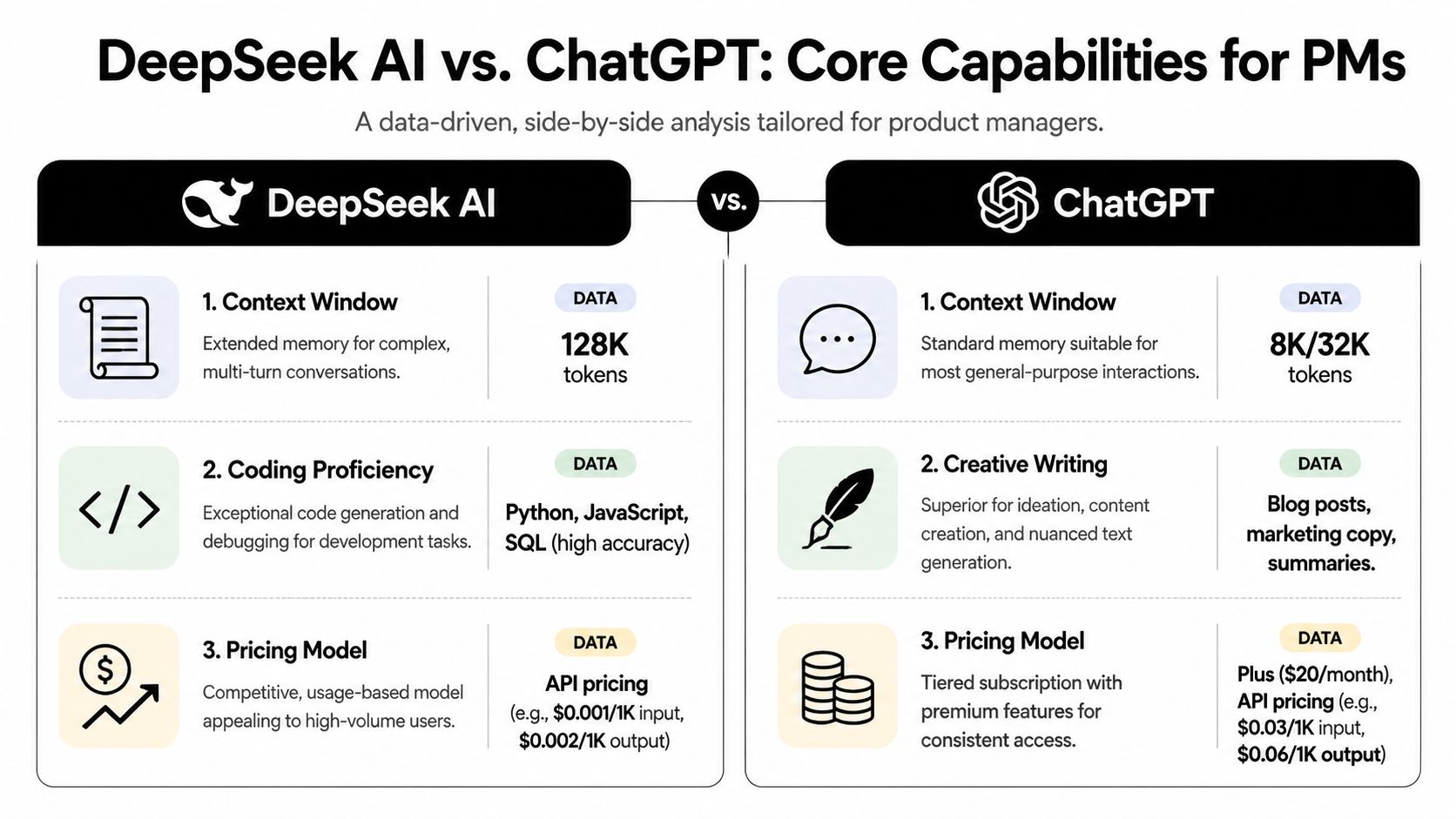
Where DeepSeek wins for roadmap decisions
DeepSeek is the better tool when the roadmap question has a right answer, or at least a tighter answer set.
I use it for effort models, dependency checks, API contract reviews, instrumentation plans, and "what breaks if we ship this in phases?" conversations. It handles structured prompts well, especially when the model has to keep track of rules, constraints, or mutually exclusive states over several turns.
An arXiv benchmark comparison of DeepSeek and ChatGPT found DeepSeek performed better on a broad set of reasoning-heavy questions, including mathematics and commerce-oriented tasks. For a PM, that maps to work like validating a pricing model, checking whether an experiment design isolates the right variable, or testing whether a success metric can be gamed.
Use DeepSeek for roadmap inputs such as:
- scoring frameworks with weighted criteria
- assumptions behind revenue or adoption forecasts
- technical risks hidden inside a feature breakdown
- state diagrams, user flows, and failure-mode reviews
- validation of AI feature specs before engineering sizing
If the roadmap item is likely to create rework because the underlying logic is shaky, DeepSeek usually gives the better first pass.
Where ChatGPT wins for roadmap communication
Roadmaps do not fail only on analysis. They fail in review meetings.
ChatGPT is better for the parts of PM work that need synthesis and persuasion. It turns scattered discovery notes into a coherent recommendation faster. It also does a better job producing stakeholder-ready writing that needs less cleanup before it goes into a deck, PRD, release brief, or leadership memo.
That matters in common PM scenarios:
- writing the narrative for why Q3 priorities changed
- summarizing a research readout for executives
- drafting a roadmap update for sales and customer success
- turning workshop notes into a clear decision memo
- reframing technical trade-offs in language non-engineers can follow
I would not use ChatGPT alone to validate the logic behind a complex roadmap call. I would use it to make the call understandable.
The decision framework I would give a product team
For roadmap planning, the cleanest operating model is task-based, not tool-loyal.
| PM scenario | Recommended tool | Why |
|---|---|---|
| Build a prioritization scorecard | DeepSeek | Better at keeping the scoring logic consistent across criteria |
| Review a feature spec with engineering constraints | DeepSeek | Better for edge cases, dependencies, and implementation logic |
| Turn roadmap notes into an exec-ready narrative | ChatGPT | Better writing quality and clearer synthesis |
| Summarize 100+ pieces of user feedback into themes | ChatGPT | Better at clustering signals into readable insights |
| Validate an AI feature workflow before estimation | DeepSeek | Better for multistep reasoning and constrained scenarios |
| Prepare a quarterly roadmap memo for broad distribution | ChatGPT | Better for tone, structure, and stakeholder readability |
For teams building a repeatable stack, this guide to AI tools product managers should know in 2025 is useful because model choice gets easier when each tool has a clear job inside the product workflow.
One more practical point. If your roadmap touches regulated workflows, contract review, or policy-heavy product decisions, keep adjacent specialist tools in mind too. General-purpose models help with synthesis, but domain-specific products can be a better fit for legal review and compliance-sensitive work. This overview of AI tools for legal professionals is a good example of where a focused tool outperforms a general assistant.
My recommendation for PMs
Use DeepSeek to test whether the roadmap is structurally sound. Use ChatGPT to make the roadmap legible, persuasive, and easy to execute.
If I had to choose one model for a technical PM working on APIs, AI features, infrastructure, or platform bets, I would choose DeepSeek first.
If I had to choose one model for a growth PM, platform PM with heavy cross-functional communication needs, or a product leader writing constantly for broad audiences, I would choose ChatGPT first.
For many teams, the best answer is both. DeepSeek checks the reasoning. ChatGPT improves the communication.
Real-World PM Use Cases and Actionable Prompts
Monday morning, the sprint is under-defined, customer feedback is piling up, and engineering wants sharper requirements by noon. For PMs, the DeepSeek versus ChatGPT decision becomes practical under these circumstances. The right model depends on the job in front of you, not on abstract benchmark debates.
I have found a simple pattern that holds up across teams. Use DeepSeek to pressure-test logic, edge cases, and technical assumptions. Use ChatGPT to turn rough analysis into something cross-functional partners can read and act on quickly.
Generating user stories from a vague feature idea
Start with a common PM input: "Users want a faster way to reorder past purchases in our mobile app."
Use ChatGPT when the immediate need is a workable first draft for product, design, and engineering. It usually gives broader coverage across personas, cleaner acceptance criteria, and stronger phrasing for a PRD draft.
Base prompt for ChatGPT
Act as a senior product manager. Turn this feature idea into user stories, acceptance criteria, and likely edge cases for a mobile commerce app: "Users need a faster way to reorder past purchases." Separate MVP from future enhancements.
Power-user prompt for ChatGPT
You are helping me prepare a product requirements draft. For the feature idea "reorder past purchases," generate:
- primary user jobs-to-be-done
- user stories by persona
- acceptance criteria
- UX risks
- analytics events to track success
- open questions for design, engineering, and legal
Keep the language crisp enough to paste into a PRD.
Use DeepSeek when the risk sits in operational detail. It is better at pulling apart state transitions, dependencies, exception handling, and production failure paths.
Base prompt for DeepSeek
Break down the feature "reorder past purchases" into system states, user flows, edge cases, and technical constraints. Identify assumptions that could fail in production.
Power-user prompt for DeepSeek
Analyze a mobile commerce reorder feature as a systems problem. Map entities, dependencies, possible failure modes, and validation rules. Include cases involving unavailable inventory, changed pricing, expired payment methods, region restrictions, and partial reorder logic. End with a checklist a PM can use in spec review.
For backlog shaping, the best sequence is ChatGPT first, DeepSeek second if the feature touches payments, catalog complexity, permissions, or regional rules.
Performing competitive analysis from competitor websites
Competitive analysis is another place where the winner changes based on the output you need.
ChatGPT is better for the version that ends up in a leadership deck. It synthesizes themes, sharpens positioning, and produces a narrative that helps with roadmap discussions. DeepSeek is better for the version you use to make a decision. It is more likely to separate observed facts from inferred assumptions and expose weak logic in your own conclusions.
Try this with either model.
Base prompt
Compare these competitors based on homepage messaging, pricing structure, onboarding flow, and target customer. Identify where our product can differentiate.
Power-user version for DeepSeek
Build a competitor matrix from these websites. Infer target segment, value proposition, product architecture clues, and likely monetization logic. Flag assumptions separately from observed facts. Then recommend three product bets with the strongest strategic rationale.
Power-user version for ChatGPT
Analyze these competitors and summarize the findings for an executive audience. I need a one-page narrative with market themes, whitespace opportunities, and positioning language for our next roadmap review.
A practical rule helps here. If the deliverable is a strategic memo, start with ChatGPT. If the deliverable is a product bet that will consume engineering capacity, run the same inputs through DeepSeek before you commit.
Drafting a technical spec for a new API endpoint
This is one of the clearest DeepSeek wins for PMs.
If you are defining an endpoint for event ingestion, partner integration, admin tooling, or an AI feature with structured inputs and outputs, DeepSeek is usually better at identifying missing validation rules, authentication assumptions, malformed payload scenarios, and throughput concerns.
Base prompt for DeepSeek
Review this draft API endpoint spec for missing constraints, ambiguous behavior, and edge cases. Suggest a cleaner version with request schema, response schema, error handling, and rate-limit considerations.
Power-user prompt for DeepSeek
Act as a staff engineer reviewing a PM-authored API spec. Challenge the design for idempotency, backward compatibility, auth failure handling, malformed input, observability, pagination, rate limits, and versioning. Return a redlined critique, then provide a revised spec.
Then hand the output to ChatGPT.
Refinement prompt for ChatGPT
Rewrite this technical spec for a mixed audience of engineering, support, and product operations. Keep technical accuracy but improve readability, section order, and clarity.
This workflow mirrors how strong PM teams already operate. One pass for technical scrutiny. One pass for clarity and adoption. If you are building repeatable review loops, this guide to AI agents for PMs is useful because spec validation is shifting from one-off prompts to staged agent workflows with defined checks.
Here’s a useful video overview before building your own workflow:
Analyzing raw user feedback for sentiment and themes
This use case is closer, and the right pick depends on whether you are preparing a readout or building a taxonomy.
Use ChatGPT if you need to summarize support tickets, call notes, app reviews, or interview transcripts into a narrative for roadmap prioritization. It produces better prose, cleaner summaries, and stronger stakeholder-facing language.
Use DeepSeek if your team needs tighter categorization. It is better for separating usability issues from feature gaps, identifying overlap across themes, and challenging whether the taxonomy itself makes sense.
Prompt to start with
Analyze this raw user feedback. Group issues into themes, identify likely root causes, separate feature requests from usability issues, and suggest which items belong in discovery versus delivery.
In practice, I would not trust either model blindly on this task. Spot-check the underlying comments, especially when the output will influence quarterly prioritization. Both tools can over-cluster vague complaints or miss severity hidden in a small but high-value customer segment.
When Explainability is a Requirement
For PM teams in healthcare, finance, or legal tech, explainability changes the tool choice. A Frontiers article on explainability and transparency highlights why auditability and transparency matter when AI contributes to decisions that affect users, policy enforcement, or regulated workflows.
That makes DeepSeek more attractive in situations where teams need to review how outputs were produced or justify model behavior to internal stakeholders. ChatGPT can still help with drafting, summarization, and early exploration, but it is harder to defend as the primary engine behind decisions that may need formal review.
If you are building adjacent workflows in compliance-heavy domains, these examples of AI tools for legal professionals are a useful reference because they show how quickly the bar rises once audit trails, defensibility, and domain-specific reasoning enter the product scope.
A simple operating rule works well:
- Low-stakes PM task: summarizing notes, drafting copy, brainstorming. ChatGPT is a good fit.
- High-stakes product decision: regulated workflow, customer risk, audit trail, policy-sensitive output. DeepSeek deserves closer evaluation.
Decoding the Pricing Models and Business Impact
The budget decision usually shows up after the pilot goes well. A PM has one model producing decent specs, another summarizing interviews faster, and leadership asks the harder question. Which option lowers cost per shipped decision?

Where DeepSeek changes the economics
DeepSeek tends to win when product teams care about model cost, deployment flexibility, and technical control. I would put it at the top of the list for internal PM tooling, AI-assisted backlog triage, large-scale feedback classification, and workflows where engineering wants tighter control over how the model is used.
That matters because PM costs do not stop at the subscription line. If the team is processing thousands of support tickets, generating first-pass user stories from discovery notes, or validating PRDs against technical constraints, per-task efficiency starts to matter. DeepSeek usually makes a stronger case in those high-volume, repeatable workflows.
The trade-off is operational overhead. Teams often need more involvement from engineering, platform, or IT to set things up well and keep quality consistent.
Where ChatGPT earns the higher spend
ChatGPT usually wins on adoption speed. Product, design, research, support, and go-to-market teams can start using it quickly with less process design upfront.
That changes the business case. If your main goal is to help PMs write cleaner briefs, summarize calls, draft roadmap updates, and pressure-test feature messaging this quarter, ChatGPT often gets value into the org faster. The direct cost may be higher, but the rollout is simpler and the training burden is lower.
I have seen this play out repeatedly. The cheaper model on paper loses if PMs avoid it, prompts break across teams, or every output needs extra review.
The business case PMs should bring to leadership
Treat this like any other product pricing decision. Evaluate whether costs scale predictably, whether usage expands value or just inflates spend, and which team absorbs the support burden. This guide to SaaS pricing model design and trade-offs is a useful reference because the same logic applies here.
A practical framing works well in budget reviews:
- Choose ChatGPT for broad PM adoption, fast rollout, and general-purpose work such as roadmap drafts, meeting synthesis, stakeholder updates, and early concept exploration.
- Choose DeepSeek for high-volume technical workflows, tighter cost control, and products where deployment flexibility affects margin or feasibility.
- Run both if your PM org has two clear lanes. ChatGPT for daily productivity. DeepSeek for structured, repeatable workflows tied to product operations or AI feature development.
The wrong purchase is usually not the more expensive model. It is the model that looks efficient in procurement and creates friction in execution.
Implementation and Migration for Product Teams
A model decision becomes real when you integrate it into planning, documentation, and delivery. Many PM teams often underestimate the work at this stage.

The adoption checklist
If you're standardizing on one model or adding a second, use a short decision checklist before rollout:
- Workflow fit: List the top five PM tasks your team runs weekly. Don't evaluate the model in the abstract.
- Prompt portability: Check whether your current prompts, templates, and automations transfer cleanly.
- Review burden: Estimate who will verify outputs, especially on specs, analytics logic, and customer-facing language.
- Security and compliance: Involve legal, security, and engineering early if the model will touch sensitive workflows.
- Training overhead: Plan how PMs, designers, and engineers will learn when to use each model.
Most migrations fail because teams skip step one. They compare demos instead of comparing recurring workflows.
The hidden TCO problem
A comparison of leading AI models from SGU makes an important point. While DeepSeek's training cost is low, there is little analysis of enterprise total cost of ownership, including infrastructure, support, and security audits.
That matters a lot. Self-hosting or customizing an open model can look cheaper at the model layer while creating operational burden elsewhere. Managed APIs can look expensive on paper while saving engineering time, support effort, and procurement complexity.
How to evaluate switching costs
If your team already relies on ChatGPT and is considering DeepSeek, don't ask whether DeepSeek is better. Ask whether the improvement shows up in the workflows that matter enough to justify migration.
Use this switching test:
- Identify the critical jobs. Spec review, user feedback analysis, research synthesis, PRD drafting, or internal copilots.
- Run parallel trials. Use the same prompts and same inputs on both models.
- Score output quality. Accuracy, edit effort, review time, and stakeholder usefulness.
- Count operational work. API changes, security review, retraining, and governance updates.
- Decide by function. You may keep ChatGPT for general PM work and introduce DeepSeek only for technical review.
Migration is easiest when you treat it as workflow segmentation, not a platform replacement project.
The Final Verdict A PM's Decision Framework
Monday morning. The roadmap review starts in 20 minutes, engineering wants sharper acceptance criteria, and GTM needs a customer-facing summary by noon. In that moment, the right answer to deepseek ai vs chatgpt is not a philosophical preference. It is a workflow choice.
For PMs, the best model depends on the job to be done.
Choose DeepSeek when the PM task is technical and failure is expensive
DeepSeek fits product work that benefits from tighter reasoning and more challenge to assumptions. I would use it for API product planning, edge-case discovery, technical spec review, evaluation design for AI features, and pressure-testing user stories before they reach engineering.
Use DeepSeek when these conditions are true:
- Your PMs spend significant time with engineers on system behavior, constraints, and implementation trade-offs
- The task requires step-by-step reasoning, not just a polished answer
- You want the model to surface flaws, gaps, or contradictions in a draft spec
- Your team is willing to trade some convenience for more control and lower model-layer cost
In practice, this is the model I would put on spec validation, technical risk review, and backlog refinement for complex products.
Choose ChatGPT when speed, clarity, and cross-functional output matter more
ChatGPT is the better default for broad PM work. It handles fast synthesis, executive communication, writing quality, and context switching well. That makes it a stronger fit for roadmap narratives, stakeholder updates, launch messaging, customer interview summaries, and first-pass PRDs that need to be read by design, sales, support, and leadership.
Use ChatGPT when these conditions are true:
- You need one tool the whole product org can adopt quickly
- The output needs to be polished enough to share with stakeholders with light editing
- The work spans research, writing, brainstorming, and communication in the same session
- You care more about team speed than model customization
If I had to choose one default assistant for a generalist PM team, ChatGPT is usually the safer starting point.
Use both if your workflow moves from analysis to communication
The strongest PM setup is often a two-model flow. Use DeepSeek to stress-test the substance. Use ChatGPT to package the conclusion so other teams can act on it.
| PM task | Better choice |
|---|---|
| Reviewing a technical spec for edge cases and logic gaps | DeepSeek |
| Turning messy customer feedback into clear themes and recommendations | ChatGPT |
| Writing user stories for a technically complex feature | DeepSeek first, ChatGPT second |
| Drafting a roadmap memo for executives | ChatGPT |
| Validating an AI feature definition, eval criteria, and failure states | DeepSeek |
| Preparing release notes, FAQs, or internal launch comms | ChatGPT |
A simple rule works well in product teams:
- If the task is about correctness, constraints, or implementation risk, start with DeepSeek.
- If the task is about alignment, readability, or stakeholder buy-in, start with ChatGPT.
- If the task will shape product decisions and engineering execution, run both and compare edit effort.
Teams that want to make this repeatable should document model choice the same way they document prioritization rules. A lightweight set of decision-making frameworks for product teams helps keep model selection tied to task type, risk, and review cost instead of personal preference.
The PM advantage comes from matching the tool to the stage of work. DeepSeek is stronger for technical scrutiny. ChatGPT is stronger for communication and range. The best decision is rarely one model for everything. It is a clear operating rule for when each one earns its place.
