The meeting usually starts the same way. Engineering wants the model that gives the team the most headroom. Finance wants predictable cost. Legal wants fewer surprises. The CEO wants a fast answer to a deceptively simple question: should we build on OpenAI or Anthropic?
That question sounds technical. It isn’t. In practice, openai vs anthropic is a strategic bet on product direction, hiring profile, compliance posture, and how much migration pain your team is willing to absorb later.
I’ve seen teams treat provider choice like a model benchmark exercise and regret it within a quarter. The better frame is simpler. Pick the vendor whose strengths match your product’s hardest problem, and whose weaknesses won’t become your roadmap’s hidden tax.
The Strategic Choice Facing Every Product Manager
A PM usually gets pulled into this decision after the prototype works. The chatbot demo looks good, early users are impressed, and someone says, “Great, now which provider should we standardize on?”
That’s the wrong moment to start thinking narrowly.
Your provider choice affects the behavior your users experience every day. It also affects what your team can ship without custom infrastructure, how your AI costs behave as usage scales, and how your company gets perceived by candidates, customers, and regulators. If you want a useful lens for making the call, start with the same discipline you’d use for product strategy fundamentals. Anchor on the user problem, the business model, and the constraints that won’t disappear in six months.
Here’s the practical framing I use in leadership reviews:
| Decision area | OpenAI tends to fit best | Anthropic tends to fit best |
|---|---|---|
| Consumer product velocity | Broad ecosystem, multimodal workflows, integrated tools | Possible, but not usually the first pick |
| Enterprise document-heavy workflows | Viable, especially with broader orchestration needs | Strong fit for long-context reasoning and careful outputs |
| Cost control for simple high-volume tasks | Often easier to justify | Better when caching and long-context work dominate |
| Talent attraction | Appeals to builders who want the biggest platform | Appeals to teams optimizing for careful reasoning and enterprise rigor |
| Brand signal | Fast-moving, platform-oriented, consumer aware | Safety-conscious, reliability-oriented, enterprise serious |
The expensive mistake isn’t choosing the weaker model. It’s choosing the provider whose roadmap pulls your team in the wrong direction.
A PM’s job here isn’t to declare a universal winner. It’s to make a decision that still looks smart after launch, after procurement, and after the first ugly incident review.
Two Philosophies Shaping the AI Landscape
The cleanest way to understand openai vs anthropic is to stop thinking about model names for a minute and look at company behavior.
OpenAI built scale by winning mindshare first. Anthropic built trust by leaning into enterprise needs first. Those choices show up everywhere: release cadence, product packaging, API ergonomics, support expectations, and how each company talks about safety.
By mid-2025, OpenAI held 36.5% business adoption versus Anthropic’s 12.1%, while Anthropic showed enterprise momentum with projected penetration of 22% by 2026 according to ElectroIQ’s OpenAI vs Anthropic market statistics. That split tells PMs something important. OpenAI won breadth. Anthropic built a narrower but increasingly serious wedge.
OpenAI sells possibility
OpenAI’s strategy feels familiar to anyone who has worked on consumer platforms. Get usage. Expand the ecosystem. Turn distribution into an advantage that compounds.
That approach matters because provider scale creates second-order benefits:
- Hiring gets easier when more engineers already know the tooling.
- Internal evangelism gets easier when executives have used the product themselves.
- Experimentation gets easier when one vendor can cover multiple modalities and workflows.
This is why OpenAI often becomes the default recommendation inside companies that want to move fast. The vendor has enough breadth that teams can start with one use case and keep expanding without resetting the stack.
Anthropic sells confidence
Anthropic’s posture is different. It tends to resonate more with teams building internal copilots, document analysis flows, legal review tools, finance workflows, and other products where “mostly good” isn’t enough.
The company’s appeal is not just model quality. It’s the philosophy behind it. Teams often read Anthropic as a signal that the company is taking reliability and controlled behavior seriously. That matters in enterprise sales conversations, especially when buyers want to know who thought about edge cases before the procurement call.
A lot of product leaders miss this point. Vendor choice is also market signaling.
What your choice communicates: OpenAI signals ambition, ecosystem leverage, and product breadth. Anthropic signals caution, rigor, and enterprise seriousness.
Why this changes roadmap planning
A provider’s philosophy becomes your roadmap constraint faster than often anticipated.
If you choose OpenAI, you’re usually leaning into breadth. That often works well when product strategy depends on embeddings, multimodal features, agent frameworks, and broad developer familiarity. If you choose Anthropic, you’re usually prioritizing quality in document-heavy reasoning, safer interaction patterns, and enterprise confidence.
For PMs, the primary question is not “Which company is better?” It’s “Which company’s operating model best matches the kind of product and organization we’re trying to build?”
That’s also why strong AI PMs increasingly study vendor philosophy the same way they study platform shifts, API roadmaps, and team design. The best ones don’t just compare outputs. They read the strategic signals. If you want a good example of that mindset applied to product leadership, the conversation on AI product leadership with Rachel Wolan on Claude Code and Cursor is worth your time.
The Core Model Showdown for Product Use Cases
A PM usually feels this decision when the prototype works, leadership wants a launch date, and engineering asks a harder question: which failure mode are we willing to own in production?
That framing produces better decisions than a generic intelligence ranking. Many technical comparisons stall at “which model is smarter.” Product teams need a narrower test. What breaks your product faster: weaker reasoning on core tasks, or more platform complexity around the model?
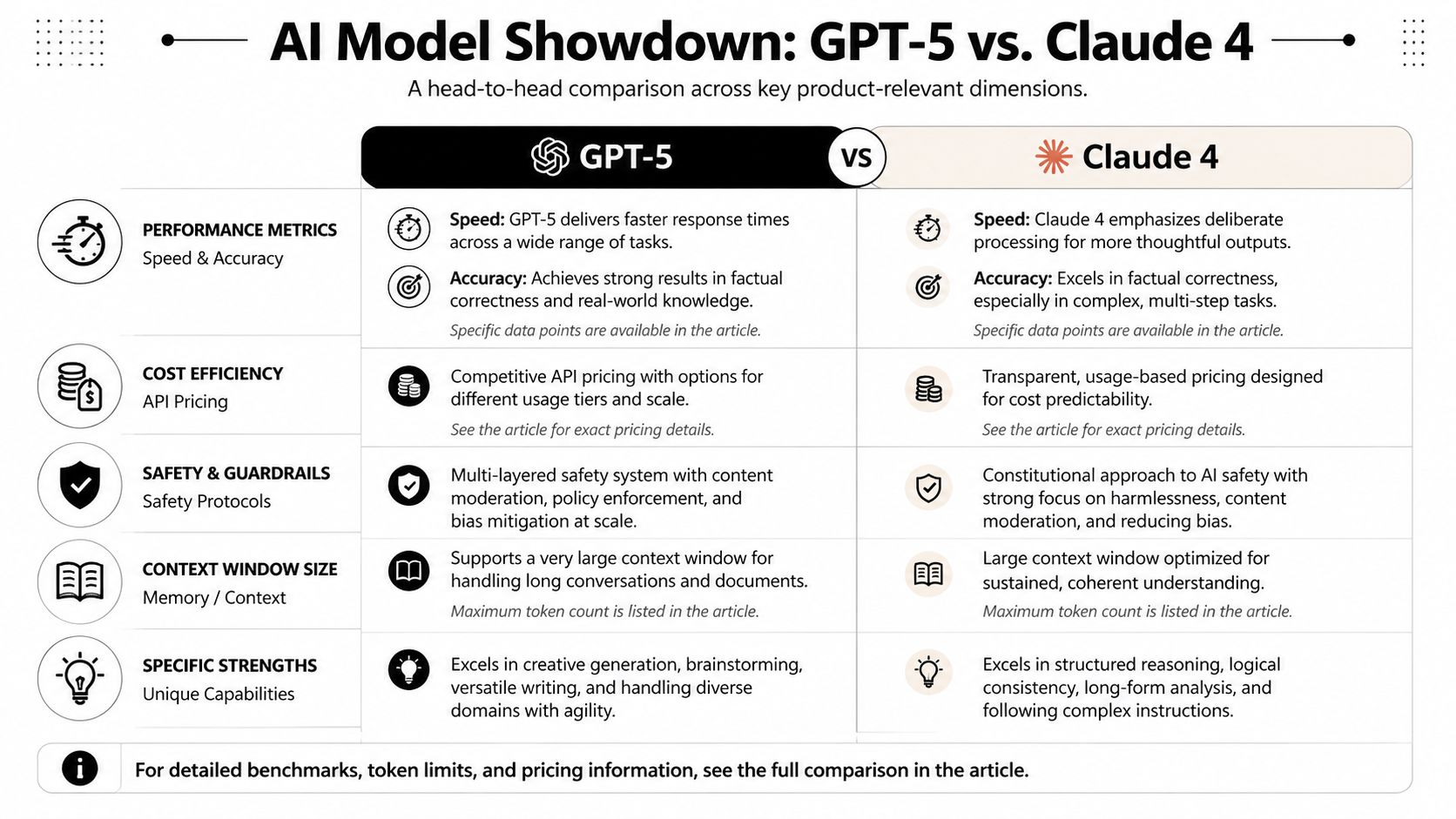
If the expensive mistake is bad code output, shallow synthesis, or dropped context across long documents, Anthropic deserves serious consideration. If the expensive mistake is stitching together multiple vendors for embeddings, multimodal inputs, generation, and agents, OpenAI usually starts with an advantage.
Where Anthropic wins
Anthropic tends to be the better fit for products that live or die on careful reasoning over messy inputs. I’ve seen this matter most in document-heavy workflows where users do not forgive hallucinated summaries, missed clauses, or brittle instruction-following.
IS4’s comparison of the OpenAI and Anthropic APIs found stronger benchmark performance from Claude on coding and reasoning tasks, and highlighted Anthropic’s large context window. For PMs, that matters because long context is not just a model spec. It affects product architecture. A stronger long-context model can reduce chunking logic, retrieval tuning, and prompt workarounds your team would otherwise maintain for months.
That changes hiring and execution. If your roadmap depends on heavy RAG tuning to compensate for weak document handling, you need people who can build and maintain that layer. If the base model handles more of the task cleanly, the team can stay smaller and focused on product behavior instead of model compensation work.
Anthropic is often the stronger starting point for:
- Internal developer copilots that need reliable code suggestions
- Research and analytics products that synthesize long source material
- Contract, compliance, and policy review where missing a detail creates real risk
- High-trust enterprise assistants where conservative behavior helps sales and procurement
Best fit for Claude: reasoning-heavy workflows where context retention, instruction quality, and output restraint matter more than platform breadth.
Where OpenAI wins
OpenAI usually wins when the product is more than a text box. Teams building consumer features, growth loops, or broad assistant experiences often need one provider that covers more ground with fewer vendor decisions.
That matters in practice. Search features need embeddings. Visual workflows need multimodal support. Agent experiences need tool use and orchestration patterns that engineering can ship without building half the stack themselves. In those cases, OpenAI’s advantage is not only model quality. It is lower coordination cost across adjacent capabilities.
That choice has second-order effects PMs often underestimate. OpenAI is easier to staff for because more engineers, designers, and prompt builders have already worked with its ecosystem. It also sends a market signal. Choosing OpenAI often communicates speed, experimentation, and product ambition. That can help with recruiting in fast-moving product orgs and with investor narratives around platform expansion.
OpenAI is often the better starting point for:
- Search and recommendation features that depend on embeddings
- Visual analysis or image-based workflows
- Consumer assistants that span multiple modalities
- Multi-tool product experiences where one ecosystem reduces integration drag
A PM-oriented model comparison
| Product need | Better starting point | Why it matters |
|---|---|---|
| Code generation inside product workflows | Anthropic | Better reasoning can reduce review overhead and user-facing mistakes |
| Summarizing large document sets | Anthropic | Long context can lower retrieval and chunking complexity |
| Search and recommendation features | OpenAI | Embeddings and related platform support simplify implementation |
| Visual prototyping or image-based UX workflows | OpenAI | Multimodal coverage supports broader feature design |
| Integrated multi-tool agents | OpenAI | One vendor can reduce orchestration and vendor-management overhead |
| High-trust enterprise assistants | Anthropic | More conservative behavior can help with enterprise acceptance |
What actually fails in production
Single-prompt demos are poor buying criteria. They hide repetition risk, edge-case behavior, and the amount of system glue your team will carry after launch.
Use a three-part scorecard:
Task fidelity
Evaluate the exact workflow users pay for. Do not substitute a benchmark or a polished internal demo.System overhead
Measure how much retrieval, fallback logic, guardrails, and prompt maintenance engineering must own.Organizational fit
Assess what this choice does to hiring, compliance reviews, sales confidence, and future migration cost.
That third point affects careers. A PM who chooses the better demo but creates a year of integration debt will not get credit for model taste. A PM who chooses the provider that fits the product, team, and company posture usually will.
If your team is still sorting through model families, pricing tiers, and practical fit by use case, a curated roundup like SubmitMySaas's top GPT models can help clarify where different OpenAI options fit before you commit to one model line.
I’d summarize the trade-off this way. OpenAI often wins the platform argument. Anthropic often wins the workflow-quality argument for reasoning-heavy products. If you want another example of this platform-versus-specialist pattern, the same tension shows up in this comparison of DeepSeek AI vs ChatGPT for product teams evaluating provider trade-offs.
Comparing API, Developer Experience, and Pricing Models
A lot of provider decisions get made in a sprint review and show up later in hiring plans, cloud bills, and customer promises.
I’ve seen teams choose OpenAI because the first demo shipped faster, then spend months standardizing prompts, fallback logic, and governance after the product gained traction. I’ve also seen teams choose Anthropic for higher-trust workflows, then discover they needed more surrounding platform work than expected for broader product ambitions. The model choice rarely stays contained to the model layer.
Where OpenAI tends to reduce execution risk
OpenAI usually fits teams that want one provider to cover more product surface area with fewer architectural debates. If the roadmap includes assistants, multimodal features, tool use, and rapid iteration across several workflows, the platform breadth matters. Engineering can standardize faster, product can test more ideas in parallel, and recruiting gets easier because more candidates have already worked with the stack.
That hiring point is not minor. A provider with wider market familiarity shortens onboarding and lowers the odds that one staff engineer becomes the only person who understands the production setup.
OpenAI also tends to be easier to explain internally when leadership wants an AI platform story, not a point solution story. That matters in budget reviews and in enterprise sales. Buyers often read provider choice as a signal about how ambitious, mainstream, or experimental your product strategy is.
Where Anthropic can produce a better cost profile
Anthropic tends to look better when the product repeatedly sends large instructions, long documents, or stable context that benefits from caching. In those cases, list price is only part of the story. Prompt reuse, context handling, and the amount of application code needed to keep outputs reliable can matter more than a headline per-token number.
This is the mistake I see PMs make most often. They compare raw model pricing before they compare request shape.
If your workflow is repetitive and context-heavy, Anthropic can be cheaper in practice. If your workflow is lightweight, high volume, and spread across many product surfaces, OpenAI often wins on total delivery cost because the surrounding platform can save engineering time.
Use a pricing lens that matches the business
Ask finance and engineering to price the full operating model, not just inference.
Simple, high-volume requests
OpenAI often fits better if the product runs many short interactions and benefits from a broader native ecosystem.Repeated long prompts or document-heavy flows
Anthropic often has the stronger cost structure if prompt caching and long-context consistency are central to the workflow.Heavy orchestration needs
OpenAI can lower total build cost if your team would otherwise stitch together multiple services for tools, multimodal inputs, and agent-style behavior.Enterprise procurement and brand posture
OpenAI is often the easier platform narrative for broad capability. Anthropic is often the cleaner narrative for careful reasoning and controlled deployments.
The second-order effect is what PMs should care about. Provider choice shapes who you hire, how much vendor-specific glue your team maintains, and what customers infer about your company’s judgment. Those are product strategy decisions, not just API decisions.
Questions to bring into this week’s planning review
- Which workflows depend on embeddings, vision, or multi-step tool execution?
- Which workflows reuse large prompts, system instructions, or long documents often enough for caching to matter?
- Where will latency affect activation, retention, or conversion?
- What happens in the product when the model refuses, drifts, or returns an answer with the wrong level of confidence?
- Which pricing model matches our own packaging and margins?
Teams that handle this well usually map model cost to product economics early. The same discipline shows up in strong SaaS monetization work. For a useful framework, review pricing models for SaaS products and apply it to your AI cost structure before usage patterns harden into tech debt.
Real-World Use Cases in B2B and B2C Products
The easiest way to make the openai vs anthropic choice concrete is to test it against two product briefs.
One is a B2B platform selling into risk-sensitive teams. The other is a B2C app trying to maximize engagement, breadth, and experimentation speed. Both can use either provider. One provider usually fits better.
B2B platform for legal, finance, or internal knowledge work
Say you’re building a contract intelligence product. Users upload long agreements, supporting docs, policy exceptions, and previous negotiation notes. They don’t want a clever answer. They want a careful one.
Anthropic has become especially compelling for this category. By early 2026, Anthropic’s annualized revenue run-rate rose past OpenAI’s, driven by more than 1,000 customers spending over $1 million annually each, and its enterprise traction was tied in part to document-heavy reliability, including a retrieval accuracy improvement from 18% to 76% according to Trending Topics coverage of Anthropic overtaking OpenAI in revenue run-rate.
That aligns with what product teams in regulated industries care about:
- Long document handling without excessive chunking
- More careful instruction following for review workflows
- Enterprise credibility in finance, legal, academic, and government-adjacent contexts
- Predictable behavior that legal and compliance teams can live with
In these instances, Claude frequently excels. A PM building for legal ops, procurement review, or audit support usually benefits more from strong reasoning over dense materials than from broad multimodal features.
B2C app for engagement and growth loops
Now flip the use case. You’re leading product for a language app, a coaching app, a creator tool, or a consumer learning product. You need broad interaction styles, varied prompts, maybe image analysis, maybe generated content, maybe personalization layers tied to search or recommendations.
OpenAI is often the better fit here because product breadth matters more than narrow excellence on one reasoning task. The platform can support more experimentation across user-facing surfaces, especially when the roadmap includes multimodal features and integrated agents.
A PM in this environment usually cares about:
- Faster experimentation across many feature ideas
- Shared vendor tooling across product squads
- Embeddings for personalization and retrieval
- Lower friction moving from one AI use case to five
Here’s a useful discussion starter for teams mapping those trade-offs into product design:
The second-order effect most teams miss
The difference isn’t just model behavior. It’s team shape.
If you choose OpenAI, you often attract builders who want platform breadth and product experimentation. If you choose Anthropic, you often attract teams that care a great deal about system behavior, enterprise workflows, and careful deployment. Neither signal is necessarily better. But it does influence who joins, who thrives, and what your engineering culture optimizes for.
Vendor choice becomes hiring strategy faster than most PMs expect.
That’s why the best product leaders don’t separate technical fit from organizational fit. In B2B, Anthropic can strengthen a trust narrative. In B2C, OpenAI can strengthen a speed and possibility narrative. Your users may not read the architecture diagram, but your market will feel the consequences.
Evaluating Safety, Alignment, and Strategic Risk
A lot of product teams reduce safety to one question: “Which model is less likely to say something bad?” That’s too narrow.
PMs need a broader risk model that includes refusal behavior, regulatory perception, market access, and supplier stability. Safety isn’t only about the output. It’s also about whether your vendor’s strategic posture creates downstream constraints for your company.
Behavioral safety versus business safety
Anthropic’s approach often appeals to PMs who want stronger guardrails and more conservative behavior. That can be useful. It can also create friction if your product needs more flexible outputs or if users frequently run into refusals that feel overprotective.
OpenAI can feel more pragmatic in product settings where breadth and adaptability matter. That’s attractive for growth teams. It can also force PMs to do more product-level governance work because a flexible system still needs clear boundaries.
If your team is debating where guardrails should live, it’s worth reading a broader guide to responsible uncensored AI. Not because every product should be uncensored, but because PMs need a more mature vocabulary than “safe” versus “unsafe.”
Political and supply chain risk are real
The simplistic view says Anthropic is the safer choice because it is more cautious. That’s incomplete.
The 2026 Pentagon fallout exposed a different category of risk. As described in this analysis of the Anthropic and OpenAI defense split, Anthropic’s systems were halted by executive order while OpenAI secured a major deal, and OpenAI’s flexibility positioned it to capture more of the $1.8B U.S. defense AI spend. For PMs in regulated sectors, that’s not just political gossip. It’s a reminder that vendor policy posture can affect market access and long-term reliability.
A better risk checklist for PMs
Use these questions with legal, security, and GTM leaders:
Output risk
Which provider’s default behavior is closer to our acceptable failure mode?Customer trust risk
Will our buyers view the vendor as credible for our category?Policy risk
Could the vendor’s public positions create barriers in our key markets?Dependency risk
If the provider changes access, positioning, or roadmap, how hard is migration?Talent risk
Does this choice help us recruit the kind of builders we need?
One hard truth: a vendor can be safer at the model layer and riskier at the market-access layer.
If you work in healthcare, cybersecurity, government-adjacent software, or any category where procurement risk matters, this broader framing is mandatory. It’s the same kind of thinking product leaders should already apply to AI cybersecurity threats, vendor concentration, and compliance architecture.
The AI Provider Decision Matrix for Product Teams
PMs don’t need another abstract debate. They need a decision tool they can take into planning, procurement, and roadmap review.
This matrix is the one I’d use with engineering, design, finance, and leadership in the room. It doesn’t assume one provider wins. It forces the team to make trade-offs explicit.
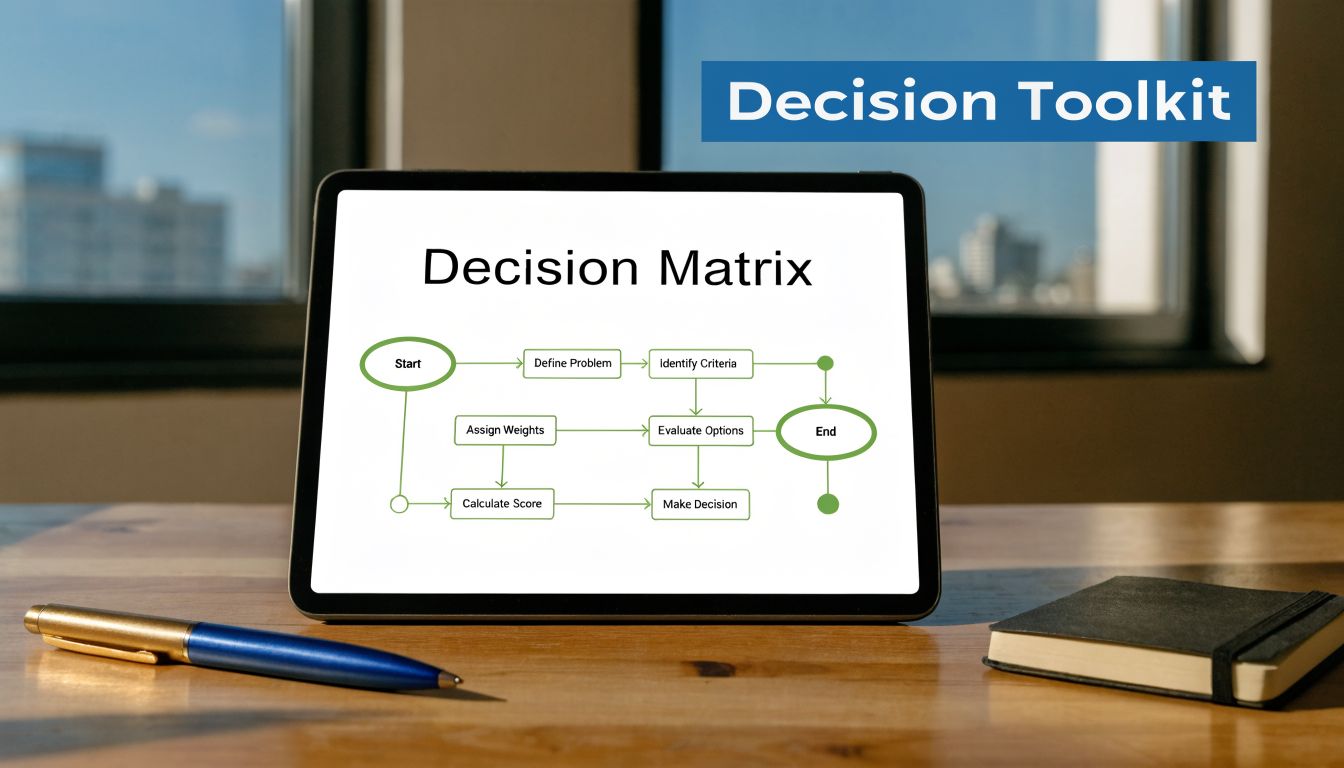
Start with the product’s hardest job
Don’t begin with the vendor. Begin with the feature that must work.
If the critical workflow is document reasoning, policy interpretation, code help, or long-context synthesis, Anthropic deserves strong consideration. If the critical workflow depends on multimodality, embeddings, broad experimentation, or integrated agent tooling, OpenAI usually starts ahead.
Write the answer in one sentence: “Our product lives or dies by ______.” If the room can’t agree on that sentence, you’re not ready to choose a provider.
Score the organization, not just the model
At this point, PMs usually sharpen the decision.
Team capability
Can your engineers absorb a more complex stack if it buys better task performance? Or do you need one broad platform now?Launch urgency
If speed matters most, the easier platform often wins. Perfection rarely survives quarter-end deadlines.Cost shape
Is your usage simple and high volume, or dense and repetitive with large prompts? That changes what “cheap” means.Compliance posture
Will your buyers or internal stakeholders reward conservative behavior, or will they punish excessive refusals?
Use a simple recommendation framework
| If this is true | Lean OpenAI | Lean Anthropic |
|---|---|---|
| We need one ecosystem across many AI feature types | Yes | |
| We need stronger document-heavy reasoning | Yes | |
| We care most about consumer product experimentation | Yes | |
| We sell into regulated enterprise teams | Yes | |
| We need embeddings and multimodal breadth | Yes | |
| We expect large prompt reuse and context-heavy workloads | Yes |
Decide your level of commitment
This is the part senior PMs handle better than junior PMs. Provider choice is not binary. Commitment level is the key lever.
Pick one of these three paths:
Primary vendor strategy
Use one provider for most workflows. Good for focus and operational simplicity.Split-by-use-case strategy
Use OpenAI for consumer or multimodal features, Anthropic for high-trust reasoning workflows. Good when product lines differ.Abstraction-layer strategy
Build enough separation so the app can swap providers over time. Good for resilience, but more expensive up front.
The cleanest architecture isn’t always the best product decision. Sometimes a little duplication is cheaper than a year of lock-in.
The career lens matters too
This decision affects your career, not just your roadmap.
A PM who chooses well can explain the trade-offs in business terms, gain credibility with engineering, and show leadership that they can manage second-order effects. A PM who chooses badly and frames it only as a benchmark win often inherits migration work, budget stress, and stakeholder distrust.
Before you finalize the recommendation, answer these five questions in writing:
- What user outcome are we optimizing for?
- What vendor weakness are we accepting knowingly?
- What would make us revisit this choice?
- How hard would migration be in twelve months?
- What does this decision signal about our company to customers and candidates?
If you can answer those clearly, you’re ready.
The short version is this. OpenAI is usually the stronger default for breadth, multimodality, and fast-moving product experimentation. Anthropic is usually the stronger default for enterprise reasoning, document-heavy workflows, and trust-sensitive deployments. The best PMs don’t ask which is best in general. They ask which one fits the business they are trying to build.
If you want more practical product thinking like this, follow Aakash Gupta for sharp, experience-backed guidance on product strategy, AI PM skills, growth, and career progression.
