As a PM leader who has hired and mentored dozens of Product Managers at companies like Google and early-stage startups, I can tell you that pricing is the single most powerful lever you can pull to drive growth. Get it right, and you create a self-sustaining engine for revenue. Get it wrong, and even the most brilliant technology will stall on the launchpad.
This isn't an academic exercise. This is a tactical playbook. If you're an aspiring PM, mastering this skill will get you hired. If you're a practicing PM, it will get you promoted. Let's get into the frameworks and real-world examples you can apply immediately.
Choosing Your First SaaS Pricing Model: A PM's 90-Day Action Plan
Whether you're a new PM in your first 90 days or a senior leader re-evaluating your strategy, getting pricing right is a career-defining skill. Don't get lost in abstract theory. We're going to make a decision based on your product's value, your customer segments, and your business goals.
We’ll focus on the five models that truly dominate the SaaS landscape:
- Per-User Pricing: The classic model. You charge for each person using the software (e.g., Salesforce, Asana).
- Tiered Pricing: The "Good, Better, Best" approach. You bundle features into distinct packages (e.g., HubSpot, Monday.com).
- Usage-Based Pricing: Customers pay for what they consume, like API calls or data storage (e.g., Twilio, Snowflake).
- Value-Based Pricing: The price is aligned with the tangible ROI the customer gets. This is the holy grail for enterprise SaaS.
- Freemium: Offer a free, limited version to drive massive user acquisition and product-led growth (e.g., Slack, Dropbox).
The Old Guard vs. The New Wave in Pricing
For years, per-user pricing was the default for B2B SaaS. It's simple, revenue is predictable, and it still accounted for over 35% of models as recently as a few years ago. When I was starting out, this was the unquestioned standard.
But the market has evolved. The most significant trend I've seen in the last five years is the seismic shift towards consumption-based and hybrid models. Why? Because market leaders like Snowflake and Twilio proved that aligning your price directly with the value a customer receives is a superior growth strategy. It reduces friction for adoption and scales revenue as your customer succeeds. You can find more data on this industry shift over at Cloudnuro.ai.
The team at ProfitWell put together a great visual that shows which value metrics are most popular.
This chart makes it crystal clear: while "per user" is still a heavyweight, "per feature" (Tiered) and pure "tiered" models are right there with it. This data validates that you must select a value metric—the unit you charge for—that directly reflects how your customer gets value from your product.
As a Product Manager, your job isn't to just set a price; it's to design a system that captures a fair portion of the value you create. Your pricing model is a direct reflection of your product strategy and your understanding of the customer. A VP of Product can spot a junior PM's thinking versus a senior PM's by how well their pricing model aligns with the core product value.
This isn't a decision you make in a vacuum. It’s the foundation of your entire go-to-market motion. A smart pricing model can make your sales process dramatically simpler and drive adoption faster, directly fueling your company’s growth. For a deeper look into this, check out our guide on how pricing connects to broader product growth strategies.
Now, let's move from strategy to tactics. Below is a quick-select guide to get your bearings, and then we’ll dive into a playbook for putting each model into action.
Quick-Select Guide to SaaS Pricing Models
Deciding on a pricing model can feel overwhelming. Use this table as your initial decision-making framework. It's the same kind of cheat sheet I've used with my teams to quickly narrow down options.
| Pricing Model | Best For | Key Benefit | Primary Risk | Real Company Example |
|---|---|---|---|---|
| Per-User | Collaboration tools, CRMs, project management software where each user gets distinct value. | Simplicity & Predictability: Easy for customers to understand and for you to forecast revenue. | Value Disconnect: Can become expensive for large teams, leading to seat-sharing and churn. | Figma: $12/editor/month. Value is tied to individual creation and collaboration. |
| Tiered | Products with a broad feature set that can be segmented for different customer needs (SMBs vs. Enterprise). | Clear Upsell Path: Naturally guides customers from a lower-priced plan to a more expensive one as they grow. | Feature Paralysis: Customers might get confused by too many options or feel they're paying for features they don't use. | HubSpot: Tiers for Marketing, Sales, etc., targeting different company sizes. |
| Usage-Based | Infrastructure (AWS), API products (Twilio), or platforms where consumption is the core value metric. | Perfect Value Alignment: Customers only pay for what they use, lowering the barrier to entry and scaling with their success. | Revenue Unpredictability: Can lead to fluctuating monthly revenue and make it hard for customers to budget. | Twilio: Charges per SMS message sent or per minute of voice call. |
| Freemium | Products with network effects or a very broad potential user base where user acquisition is paramount. | Massive Top-of-Funnel: Excellent for rapid user acquisition and creating a product-led growth engine. | High Support Costs: A large base of free users can strain resources without generating direct revenue. Conversion rates are low. | Slack: Free tier with message history limits drives upgrades to paid plans for retention. |
| Value-Based | Specialized B2B software that delivers clear, quantifiable financial returns (e.g., saving a company $1M/year). | Maximum Revenue Capture: Directly ties your price to the immense value you create, allowing for premium pricing. | Difficult to Implement: Requires deep customer understanding and a complex, consultative sales process to prove value. | Chargebee: Pricing is based on the revenue managed through their platform. |
Think of this table as your initial filter. Once you’ve identified one or two models that seem like a good fit, you'll be ready to dig into the implementation specifics, which we’ll cover in the following sections.
Alright, let's talk about the brass tacks. Moving from a high-level pricing strategy to actually building out your pricing page is where great Product Managers separate themselves from the good ones. This is a skill that directly impacts your career trajectory and compensation. PMs who master pricing can command higher salaries, often in the $180k-$250k+ range, because they demonstrate a clear link between their work and revenue growth.
Choosing a model is just step one. Structuring it for growth? That's the real game. This is my practical playbook for the core SaaS pricing models you'll actually use in your career.
We'll break down the mechanics, the customer psychology behind them, and the metrics you need to be watching like a hawk. For each one, I want you to put on your PM leader hat and ask: How do I build this? Who is this really for? And what data tells me if it's actually working?
This decision tree is a great starting point for mapping your product's value to the right model.
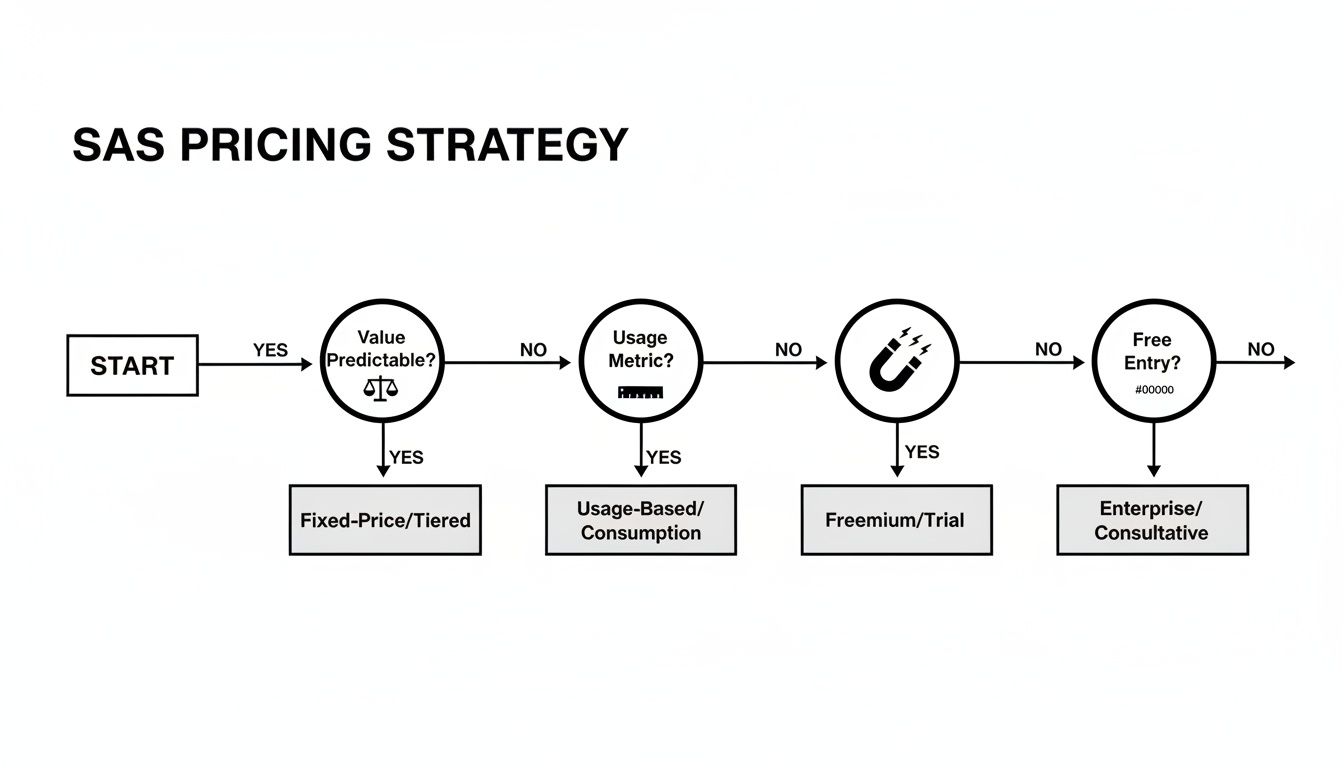
It forces you to answer the tough questions right away. Is your value predictable? Is there a clear metric for usage? The answers will guide you to a model that fits the reality of your business, not just a theoretical ideal.
Per-User Pricing
This is the bread and butter of SaaS, especially for any tool built around collaboration. Think of your company’s CRM (Salesforce) or a project management tool like Asana—their value increases with every person who has access.
The structure couldn't be simpler: you charge a flat fee for each user, every month. A classic example is $15/user/month. Its biggest advantage is predictability. Your finance team can forecast revenue, and your customer's finance team can budget for it. Everyone loves that.
The danger, though, is when seats don't equal value. If a company has 100 employees but only 20 are true power users, per-user pricing can feel bloated and expensive. This often leads to password sharing, which is a direct hit to your bottom line.
PM Action Plan:
- Ideal Customer: Teams where individual access is critical for getting work done (e.g., Slack, Figma).
- Key Metric to Track: Seat Utilization Rate. If you see accounts with low login rates (<50% of purchased seats active in 30 days), that's a huge red flag. It’s a sign your pricing is out of sync with the value customers are getting and a leading indicator of churn.
Tiered Pricing
Tiered pricing, what we all know as 'Good, Better, Best,' is all about creating obvious upgrade paths for your customers. You bundle features into packages designed for different customer types—think a "Startup" tier, a "Business" tier, and an "Enterprise" one. HubSpot has absolutely mastered this, building tiers that map perfectly to a company's growth from a 2-person startup to a 2,000-person corporation.
The psychology at play here is incredibly effective. You anchor people with a lower-priced option but make the benefits of the next tier up crystal clear. It's a fundamental part of many winning product-led growth strategies.
Your job as the PM is to define the strategic feature gates. What features are absolutely essential for every user (e.g., core creation tools)? And which ones solve a more complex problem that justifies a higher price point (e.g., advanced analytics, SSO, compliance features)? A rookie mistake is gating a dozen minor features, which just creates friction instead of a real incentive to upgrade.
Usage-Based Pricing
This model has been a massive shift in SaaS, tying what a customer pays directly to how much they use your product. Think API calls for Twilio, data processed by Snowflake, or for an AI PM, the number of tokens processed by an LLM.
This approach massively lowers the barrier to entry. A tiny startup can start using an incredibly powerful platform with almost no upfront cost, and their bill grows as their own business scales. When your success is directly aligned with your customers' success, it becomes a powerful engine for retention.
The biggest challenge? Revenue predictability. Your monthly recurring revenue (MRR) can swing up and down, which makes financial planning a lot trickier. And for the customer, getting an unexpectedly high bill can be a major source of frustration and churn. Successful companies mitigate this with reserved capacity discounts and clear cost calculators.
PM Action Plan:
- Ideal Customer: Companies that are tech-savvy and use infrastructure or API-first products. Increasingly common for AI SaaS products.
- Key Metric to Track: Net Revenue Retention (NRR). If your NRR is above 120% (the benchmark for top-tier SaaS), it's proof that your existing customers are spending more over time. That's the ultimate validation that your usage metric is the right one.
Freemium
Let's be clear: freemium is an acquisition strategy disguised as a pricing model. You offer a version of your product that's free forever, but with specific limits. The goal is to convert a tiny fraction (typically 2-5%) of that massive user base into paying customers. It's how companies like Dropbox and Slack grew to dominate their markets.
It's an incredibly effective way to build a huge top-of-funnel, but it's not actually "free." Supporting millions of free users creates a significant operational and financial drag. As you explore different core SaaS pricing models, checking out real-world pricing structures can give you great ideas on how others have made this work.
The single most critical decision for the PM is defining what the free experience includes. It has to be valuable enough to get people hooked and using it daily, but limited enough that there's a powerful, nagging reason to upgrade. This could be a cap on storage (Dropbox), collaborators (Miro), or feature access (most of the market). If your free plan is too good, you’ll have a great product with terrible conversion rates.
Mastering Value-Based Pricing Strategy
Most SaaS pricing models fixate on the wrong thing—your costs, your features, your number of seats. They're all inward-looking.
Value-based pricing completely flips the script. It starts with one powerful question: What is the real, measurable, economic impact your product has on your customer's business? This approach gets you out of the business of counting seats and into the business of delivering outcomes.
This isn't just a feel-good theory; it's how market leaders price. A ProfitWell analysis of over 5,000 SaaS companies found that those using value-based pricing grew significantly faster. It’s a fundamental shift in monetization.
Identifying Your Value Metric
At the heart of any value-based strategy is your value metric. This is the single unit of customer success that your pricing revolves around. It’s the "per what" that defines your model.
Think of it this way:
- A marketing automation platform (HubSpot) could charge per marketing contact.
- An e-commerce platform (Shopify) could charge a percentage of revenue processed.
- A customer support tool (Intercom) could charge per active contact.
The magic happens when this number goes up. The customer’s business improves, and your revenue scales right alongside them. It creates a true partnership where your success is perfectly aligned with theirs.
For a senior Product Manager, mastering value-based pricing is non-negotiable. It proves you have a deep, strategic grasp of your customer's business and can tie your product's features directly to their bottom line—a skill that screams "leadership potential" and is a key differentiator for Principal PM and Director-level roles.
A Framework for Implementing Value-Based Pricing
You can't just guess what your customers value and slap a price on it. Shifting to this model demands a structured, data-driven process. You have to prove it.
Here’s a step-by-step framework I use with my teams:
- Hypothesize Potential Value Metrics: Brainstorm all the ways your product creates value. Is it time saved? Revenue gained? Costs slashed? Risk avoided? For an AI product, is it "tasks automated" or "insights generated"? Get it all on a whiteboard.
- Quantify the Impact with Customer Data: Now for the hard part. Get your hands dirty in the data. Use SQL or a BI tool to isolate your highest LTV customers. What do their usage patterns have in common? Does high usage of Feature X correlate strongly with low churn?
- Conduct Customer Interviews and Surveys: Data tells you the "what," but you need to talk to customers to get the "why." Get your best customers on a call and ask them point-blank: "If our tool disappeared tomorrow, what would be the biggest impact on your business?" Use quantitative methods like conjoint analysis or the Van Westendorp Price Sensitivity Meter to zero in on their willingness to pay for specific outcomes.
- Analyze and Select the Strongest Metric: The perfect value metric needs to check three boxes: it's easy for the customer to understand, it's directly tied to the value they get, and it scales up as their business grows.
A Real-World Example: Chargebee
Chargebee, the subscription management platform, is a masterclass in value-based pricing. They could have easily charged per user or created feature tiers like everyone else. They didn't.
Instead, their pricing scales with the amount of revenue their customers manage through the platform.
This is a brilliant move. A tiny startup pays next to nothing to get started. But as that startup explodes into a unicorn processing millions in revenue, their Chargebee bill grows with them. The value is undeniable, the alignment is perfect, and Chargebee's growth is directly hitched to their customers' success. A key part of nailing this is understanding the lifetime value of those accounts, which you can learn more about in our guide on how to calculate customer lifetime value.
Using AI to Uncover Value Drivers
As an AI-focused PM, you can supercharge this discovery process. Instead of spending weeks manually sifting through data, you can deploy AI to find the hidden signals of value. This is a skill that will set you apart in today's job market.
Actionable AI Prompt for Value Discovery:
Take this prompt to a tool like GPT-4 or Claude and feed it your anonymized usage data:
"Act as a Principal Product Manager at a B2B SaaS company. Analyze this dataset of customer usage for our top 15% highest LTV accounts and our bottom 50% lowest LTV accounts. The data includes feature usage frequency, session duration, and user roles. Identify the top 3 usage patterns and feature adoption sequences that are unique to the high-LTV cohort. Based on these differentiators, propose three potential value metrics we could use for a value-based pricing model, and rank them by how well they correlate with high LTV."
This prompt forces the AI to look past the obvious metrics and uncover the specific behaviors that signal a customer is getting massive value. It gives you a data-backed starting point for a pricing strategy that truly works.
Building Your Pricing And Packaging Framework
Picking a pricing model is just the first domino. An amazing model—whether it's tiered, usage-based, or something else—is useless without smart packaging. This is where the real strategy kicks in.
Your next move is to bundle your features into packages that are so compelling, they not only get customers in the door but also create a natural path for them to spend more with you over time. This is where you connect your pricing theory to actual revenue.
Think of it like building a staircase. Each step up has to feel like a logical, valuable, and even exciting next move for your customers as they grow. If the steps are too far apart, too steep, or lead nowhere, they’ll get frustrated and find another staircase.

Applying The Good-Better-Best Framework
The 'Good-Better-Best' model is a classic for a simple reason—it just works. It makes the choice easy for your customer and gives your business a clear path to upsell revenue. The trick is to align your features with specific customer types and what they're willing to pay.
Good Tier (Starter): This is your welcome mat. It needs the absolute core features that solve one primary pain point and deliver value right away. This is for a small business or a single team just getting started. Example: Asana's "Basic" plan offers unlimited projects and tasks.
Better Tier (Pro/Business): This should be your superstar—the plan you want most people to pick. It includes everything from the 'Good' tier, but adds features that unlock efficiency, teamwork, and the ability to scale. This is for the business that's hitting its stride. Example: Asana's "Premium" adds timelines, dashboards, and admin controls.
Best Tier (Enterprise): This is your premium, all-in offering. It has all the features of the lower tiers, plus advanced tools (e.g., security, compliance, advanced analytics), top-tier security (SSO, audit logs), and white-glove support. This package is built to solve complex problems for large, mature organizations. Example: Asana's "Business" tier adds portfolio management and custom integrations.
You can't do this in a vacuum. You have to know who you're selling to. Our guide on customer segmentation techniques is a great place to start building out the personas that will anchor each of these tiers.
Conducting A Feature Value Analysis
Figuring out which features belong in which package is arguably the hardest part of pricing. It's so easy to get this wrong. A feature value analysis is how you stop guessing and start making decisions with data.
Your goal is to sort every feature you have into one of three buckets:
- Core Features: These are the table stakes. They're non-negotiable and fundamental to your product’s entire value proposition. These belong in every single plan, including your 'Good' tier.
- Differentiating Features: These are your upgrade drivers. They solve more sophisticated problems and are the main reason a customer will move from 'Good' to 'Better' or 'Better' to 'Best'. They form the backbone of your higher-priced tiers.
- Add-on Features: These are powerful, specialized features that only a fraction of your customer base will need (e.g., a "premium support" package, or an "advanced AI" module). By offering them as optional add-ons, you avoid bloating your main packages and open up a brand new, high-margin revenue stream.
A critical PM skill is recognizing that not all features are created equal. Some acquire customers, some retain them, and others drive expansion revenue. Your packaging must reflect this strategic difference. This understanding is what separates tactical feature-shippers from strategic product leaders.
The Power Of The Decoy Tier
Here’s a tactic you see top PMs use all the time: the strategic 'decoy' tier. It’s a plan that you intentionally design to make another plan—usually your 'Better' tier—look like an absolute no-brainer.
Let's say your 'Good' plan is $50/month and your 'Better' plan is $150/month. You could introduce a 'Plus' plan at $135/month that offers only a tiny bit more value than the 'Good' plan. All of a sudden, that $150 'Better' plan, with its massive jump in features, seems like an incredible deal. It leverages psychological pricing principles to steer customers toward your preferred option.
Checklist For Launching New Pricing
Changing your pricing is a high-stakes project. It’s not just updating a number on a webpage. I’ve seen this go wrong more times than I can count because teams didn’t plan meticulously. Use this checklist to make sure your rollout is smooth.
Launch Checklist:
- Internal Alignment: Get everyone in Sales, Marketing, and Customer Support in a room. Make sure they not only understand the new tiers but can also confidently explain the why behind them. Role-play the common objections.
- Customer Communication Plan: Draft clear, empathetic messages for your existing customers. Explain why you're making the change and what new value they're getting. Don't hide from it.
- Migration Strategy: This is a big one. How will you handle existing customers? Will you grandfather them into their old price, give them a transition window, or move them immediately? (Hint: A grandfather clause with a time limit often strikes the best balance).
- Analytics & Tooling Setup: Before you launch, make sure your analytics tools (like Mixpanel or Amplitude) are ready to track everything. You need to see tier adoption, upsell rates, and churn by package from day one.
- Update All Assets: Go through everything. Your website, your marketing collateral, your sales decks, your support docs—they all need to be updated to reflect the new reality.
When you treat your packaging with the same rigor you give your product roadmap, you turn your pricing from a static number into a powerful engine for growth.
Testing And Iterating Your Pricing Strategy
One of the biggest mistakes I see Product Managers make is treating their pricing page as a finished product. They launch it and breathe a sigh of relief. But the best PMs at places like Meta and Google know that launch day is just the beginning.
Your pricing isn't some static artifact you build once. It’s a living part of your product that demands constant, data-driven attention. Making the shift from a "set it and forget it" mindset to one of continuous testing is what separates the companies that lead their market from those that just exist in it.
This means you have to start treating pricing like a science. You'll be designing controlled experiments, figuring out what customers will pay without ever asking them directly, and tracking performance with the same obsession you apply to your core features.

Designing Your Pricing Experiments
Guesswork has absolutely no place in a decision as critical as pricing. We have to lean on proven methods to figure out what customers are actually willing to pay and how they perceive the value you're offering.
There are two powerful techniques you should have in your PM toolkit:
- Van Westendorp's Price Sensitivity Meter: This is a survey method that's brilliant for finding an acceptable price range. You ask four specific questions: At what price would this be too expensive to consider? At what price would it be so inexpensive you'd question the quality? At what price is it starting to get expensive, but you'd still consider it? And at what price is it a bargain? The output isn't a single magic number; it's a data-backed range to anchor your thinking.
- Conjoint Analysis: This one is more advanced, but incredibly powerful for packaging. It forces users to make trade-offs, just like they do in the real world. Instead of asking about price or features in a vacuum, you show them different bundles (e.g., Plan A with Feature X for $50 vs. Plan B with Features X & Y for $75) and ask them to pick their favorite. This process reveals what they truly value, not just what they say they value.
A/B Testing Your Pricing Page
Once your survey data gives you a solid hypothesis, it's time to test it in the wild. A/B testing your pricing page is the most direct way to measure how changes to your packaging and price points affect your conversion rates.
But here’s a word of caution from experience: A/B testing live prices is risky. Showing different prices to different people can backfire spectacularly, leading to customer confusion and hurting your brand's credibility.
A safer, but still effective, approach is to A/B test the presentation of your pricing. For a deeper dive, you should check out our comprehensive guide on A/B testing best practices.
You can experiment with things like:
- Highlighting one of your tiers as "Most Popular."
- Changing the order of the pricing tiers (e.g., showing 'Best' first).
- Rewriting feature descriptions to focus on the benefits, not just the functions.
- Testing an "Annual vs. Monthly" toggle to drive commitment.
These "softer" tests can drive huge wins in sign-ups and upsells without the risk of a full-blown price test.
Building Your Pricing Analytics Dashboard
To really turn pricing into a science, you need the right instruments. Your goal should be to build a dedicated pricing dashboard in a tool like Amplitude or Mixpanel. This isn't just some one-off report; it's your command center for the health of your entire monetization strategy.
As a PM leader, if I don't see a dedicated pricing dashboard, I assume the team is flying blind. You can't optimize what you don't measure, and pricing is too important to be left to guesswork. This is a deliverable I expect from my PMs within their first quarter of owning pricing.
This dashboard has to go way beyond just tracking revenue. You need a complete picture of customer behavior. The market moves fast, and you need this level of vigilance to keep up. Time series analysis shows that the pace of price changes has sped up dramatically. Where companies once adjusted prices over several years, leaders now do it every 9-12 months. Between mid-2024 and mid-2025, for instance, most SaaS firms raised prices, with the average hike being 12%. You can dig into how data reveals these SaaS pricing trends on GetMonetizely.com.
Your dashboard should give you an at-a-glance view of the most critical metrics, letting you spot trends, measure the impact of your experiments, and make proactive changes before you fall behind.
Key Metrics for SaaS Pricing Model Success
To truly get a handle on your pricing performance, you need to track a specific set of metrics. These KPIs are the vital signs of your business model, telling you not just how much money you're making, but how healthy your customer base is and how sustainable your growth is.
Here's a breakdown of the essentials that every PM should have on their pricing dashboard.
| Metric (Abbreviation) | What It Measures | Why It's Critical for Pricing | Ideal Benchmark |
|---|---|---|---|
| Average Revenue Per User (ARPU) | The average revenue generated from each active user or account over a specific period (usually monthly or annually). | Shows the direct monetary value of an average user. Essential for understanding the impact of price changes and for segmentation. | Varies by industry. Aim for steady growth. |
| Customer Lifetime Value (LTV) | The total revenue a business can expect from a single customer account throughout their entire relationship with the company. | LTV tells you the long-term value of acquiring a customer, which justifies your marketing and sales spend. Must be > CAC. | Aim for LTV to be at least 3x your CAC. |
| Customer Acquisition Cost (CAC) | The total cost of sales and marketing efforts needed to acquire a single new customer. | If your CAC is higher than your LTV, your business model is unsustainable. Pricing directly impacts how quickly you can recoup CAC. | Should be recovered within 12 months. |
| Customer Churn Rate | The percentage of customers who cancel their subscriptions over a given period. Also measured as Revenue Churn. | High churn is a clear sign of a pricing/value mismatch. It's one of the most destructive forces for a SaaS business. | Aim for < 5% annually for enterprise; < 5% monthly for SMB. |
Tracking these metrics isn't a passive activity. You need to be actively analyzing them, looking for the story they tell about your pricing. A dip in ARPU after a new tier launch, or a spike in churn after a price increase, are signals that require immediate investigation and action.
Frequently Asked Questions About SaaS Pricing
As a Product Manager, you're going to get hit with tough pricing questions. A lot. I've seen these trip up everyone from new PMs to seasoned leaders in interviews and board meetings.
So, here are the real-world questions you'll face on the job, with the direct, no-fluff answers I’ve learned over the years.
How Often Should A SaaS Company Change Its Pricing?
The old "set it and forget it" pricing strategy is dead. If you're doing that, you're leaving money on the table and falling behind the market.
Leading SaaS companies are now reviewing their pricing strategy at least annually, with actual adjustments happening every 9-12 months. That's a huge shift from the old days of a multi-year cycle.
Now, an "adjustment" doesn't always mean a straight price hike. It could be a smarter repackaging of your tiers, finding a better value metric, or rolling out a new add-on. The point is to treat pricing like a living, breathing part of your product that needs constant attention and optimization.
My advice? Schedule a recurring "Pricing & Packaging Review" with your key partners (Sales, Marketing, Finance) at least twice a year. And be ready to call an emergency meeting if you see any of these triggers:
- You're about to launch a major new product or feature (especially an AI-powered one).
- The competitive landscape shifts (a new player like OpenAI enters, or a rival changes their pricing).
- Your Ideal Customer Profile (ICP) or target market starts to change.
What Is The Best Way To Grandfather Customers When Changing Prices?
This is one of the most delicate decisions you'll ever make. You're walking a tightrope between hitting revenue targets and maintaining customer trust. Get this wrong, and you can trigger a wave of churn that will seriously damage your brand.
You basically have three plays you can run:
- The "Forever" Grandfather: Your existing customers lock in their current price for life. This generates incredible goodwill and loyalty, but it's a costly move. You're consciously leaving a ton of potential revenue on the table.
- The Timed Grandfather: Customers hang on to their old price for a fixed window, usually 6 or 12 months. This is often the best compromise. It gives your loyal customers a heads-up and time to adjust, but still gets your entire user base onto the new model eventually.
- The Forced Migration: All customers get moved to the new pricing on their next renewal date. This is the fastest path to maximizing revenue, but it also carries the highest risk of furious customers and painful churn.
Which path you take really depends on the strength of your customer relationships and how big the price jump is. But no matter what, transparent and proactive communication is completely non-negotiable. You have to clearly explain the why behind the change and hammer home the new value they're getting.
How Can I Use AI To Improve My SaaS Pricing Strategy?
AI has gone from a "nice-to-have" in pricing to an essential part of the modern PM's toolkit. It lets you move way faster and spot insights that were basically invisible before. If you're an aspiring AI PM, this is a core competency.
AI supercharges pricing by transforming messy, qualitative data into quantitative, actionable insights. It helps you find the 'why' behind customer value at a scale and speed that manual analysis simply can't match.
Here are three practical ways to start using AI today:
Find Your True Value Metric: Dump all your raw customer data—usage logs, support tickets, even sales call transcripts from Gong—into a large language model (LLM) like GPT-4 or Claude. Ask it to find the behavioral patterns that are unique to your highest-LTV customers. This is how you discover the real-world actions that actually correlate with retention and expansion.
Automate Competitive Intelligence: Manually scraping competitor pricing pages is a soul-crushing, endless task. You can set up AI agents to do this for you. Have them regularly check the pricing pages of your key competitors, and then use an LLM to summarize their packaging, flag recent changes, and even analyze the language they use to sell their value.
Run Smarter Pricing Research: AI-powered tools can run sophisticated conjoint analysis that would have taken a specialized agency months to complete. These platforms simulate thousands of customer choices to find the perfect mix of features and price points, giving you a rock-solid, data-driven foundation for your next packaging decision.
Here's a specific prompt you can adapt and use right now:
"Act as a Director of Product for an AI SaaS company. Analyze this dataset of customer usage for our top 20% highest LTV accounts. Identify the top 3 usage patterns that are unique to this cohort compared to the bottom 80%. Based on these differentiators, propose three potential value metrics we could use for a new pricing model, such as 'AI-generated reports,' 'automated workflows completed,' or 'data points analyzed.' Evaluate each proposed metric on a scale of 1-10 for 'scalability with customer growth' and 'ease of customer understanding.'"
As you continue your journey in product management, remember that mastering concepts like SaaS pricing models is crucial for career growth. At Aakash Gupta, we provide the resources, insights, and expert guidance to help you excel. Dive deeper into our content and community at https://www.aakashg.com to accelerate your PM career.
