A PM I hired once asked why her X account wasn’t growing. Her posts were smart, but her profile looked anonymous and her content read like meeting notes. We fixed the packaging, tightened the message, and treated the account like a product with a clear user, funnel, and growth loop.
Build Your Foundation Your PM Profile is a Product
If you’re serious about twitter how to increase followers, stop thinking like a creator first and start thinking like a product manager. Your profile is not a résumé. It’s a conversion surface.
Your target users are obvious. Recruiters. Hiring managers. Product leaders at companies like Google, Meta, Stripe, Figma, and OpenAI. Other PMs who might share your work. Founders looking for someone who can think clearly about product, growth, and AI.
Your profile has one job. Turn a profile visit into a follow in a few seconds.
Start with the highest leverage element
Accounts with professional face photos receive 47% more followers than accounts using logos or illustrations, and profile optimization alone can improve conversion by 200-400%, which means the same traffic can generate 3-5x more followers when the profile is optimized, according to Tweet Archivist’s Twitter follower growth analysis.
That means this is not a design tweak. It’s a funnel fix.

Use a clean headshot. Good lighting. Neutral background. Your face should be easy to recognize at thumbnail size. If you’re building a personal brand and still using a company logo, you’re making growth harder for no reason.
Practical rule: If your profile photo looks like it belongs on Slack, it’s probably good enough for X. If it looks like a cropped wedding photo, replace it.
Write a bio that positions you, not your employer
Most PM bios are weak because they describe a title instead of a point of view.
Bad bio:
- Product Manager at fintech startup
- Interested in AI, growth, and startups
That tells me nothing.
Better bio:
- PM building AI products
- Write about product strategy, growth loops, and PM careers
- Former B2B SaaS, current obsession: AI workflows
The best bio has three parts:
- What you do
- What you talk about
- Why you’re worth following
If you’re an aspiring PM, don’t pretend you already have a Staff PM background. Position around your learning edge. “Breaking into PM through teardown threads and AI product analysis” is better than vague ambition.
Build a banner that signals your niche
Your banner should make your niche obvious without forcing people to decode it.
If you focus on AI PM work, say that visually. Use a clean banner with a simple line like:
- AI Product Manager
- Product strategy, user research, growth
- Writing weekly about what top teams get right
If you focus on B2B SaaS, PLG, fintech, consumer apps, or internal tools, make that clear. X rewards fast pattern recognition. So do humans.
Pin one tweet that acts like your killer feature
Your pinned tweet should answer one question: why should I follow you?
Good pinned tweet formats for PMs:
- A high-signal intro thread with your background, what you write about, and who it helps
- Your strongest teardown of a product from Notion, Uber, Duolingo, Linear, or ChatGPT
- A practical PM career framework, like how to prep for product sense interviews or how to break into AI PM
Keep it concrete. Show taste. Show thinking. Show usefulness.
If you want a stronger model for turning visibility into a real Twitter follower increase, study frameworks that treat profile optimization as conversion design rather than vanity branding.
Treat your profile like a landing page
Audit your profile with this checklist:
| Element | What good looks like | What to avoid |
|---|---|---|
| Profile photo | Clear professional face photo | Logo, group photo, blurry selfie |
| Name | Real name plus light positioning if needed | Keyword stuffing |
| Bio | Specific expertise and content promise | Generic “thoughts are my own” filler |
| Banner | Signals niche and credibility | Random abstract graphic |
| Pinned tweet | Best proof of value | Old joke, stale company announcement |
The same profile discipline matters on other platforms too. If you want a sharper benchmark for how PMs should package themselves online, study this guide to LinkedIn jobs product manager profile optimization. The principle is identical. Attention is earned by clarity.
Develop Your PM Content Engine
Great profiles convert. Great content compounds.
Most advice on twitter how to increase followers is lazy. “Post consistently.” “Write threads.” “Be authentic.” That’s not strategy. That’s wallpaper.
You need content pillars that map to PM credibility. Not generic motivation. Not recycled startup quotes. Your feed should make people think, “This person actually understands products, users, and where the market is going.”
Use four content pillars
I like four pillars for PMs because they create range without making your account chaotic.
Product teardowns
This is the fastest way to demonstrate structured thinking.
Pick a product people already know. Airbnb search flow. Figma onboarding. Notion AI prompts. ChatGPT memory UX. Break down:
- the user problem
- the tradeoff the team likely made
- what you’d improve
- what the product decision says about strategy
A good teardown doesn’t summarize the interface. It explains why the product behaves that way.
Career frameworks
This is your authority layer.
Write posts like:
- How I’d prepare for a PM interview at a company building AI features
- The difference between a roadmap PM and a growth PM
- What junior PMs misunderstand about stakeholder management
- How to write a product spec that engineering wants to read
This content gets saved, shared, and sent in DMs because it helps people make career decisions.
Industry analysis
If you want strong people in tech to follow you, have opinions on where the market is moving.
That doesn’t mean hot takes for attention. It means informed analysis on things like:
- AI copilots becoming standard product surface area
- why search is being redefined by conversational UX
- how B2B software is shifting from dashboards to agents
- where product teams overuse AI and where they still underuse it
The best PMs on X don’t just react to launches from OpenAI, Google, Anthropic, or Meta. They interpret what those launches mean.
Building in public
This one creates trust.
Talk about a live product problem you’re working through. Share how you prioritize experiments. Show your framework for user interviews. Explain how you test onboarding copy in a side project.
Don’t overshare confidential company material. Do share your thinking.
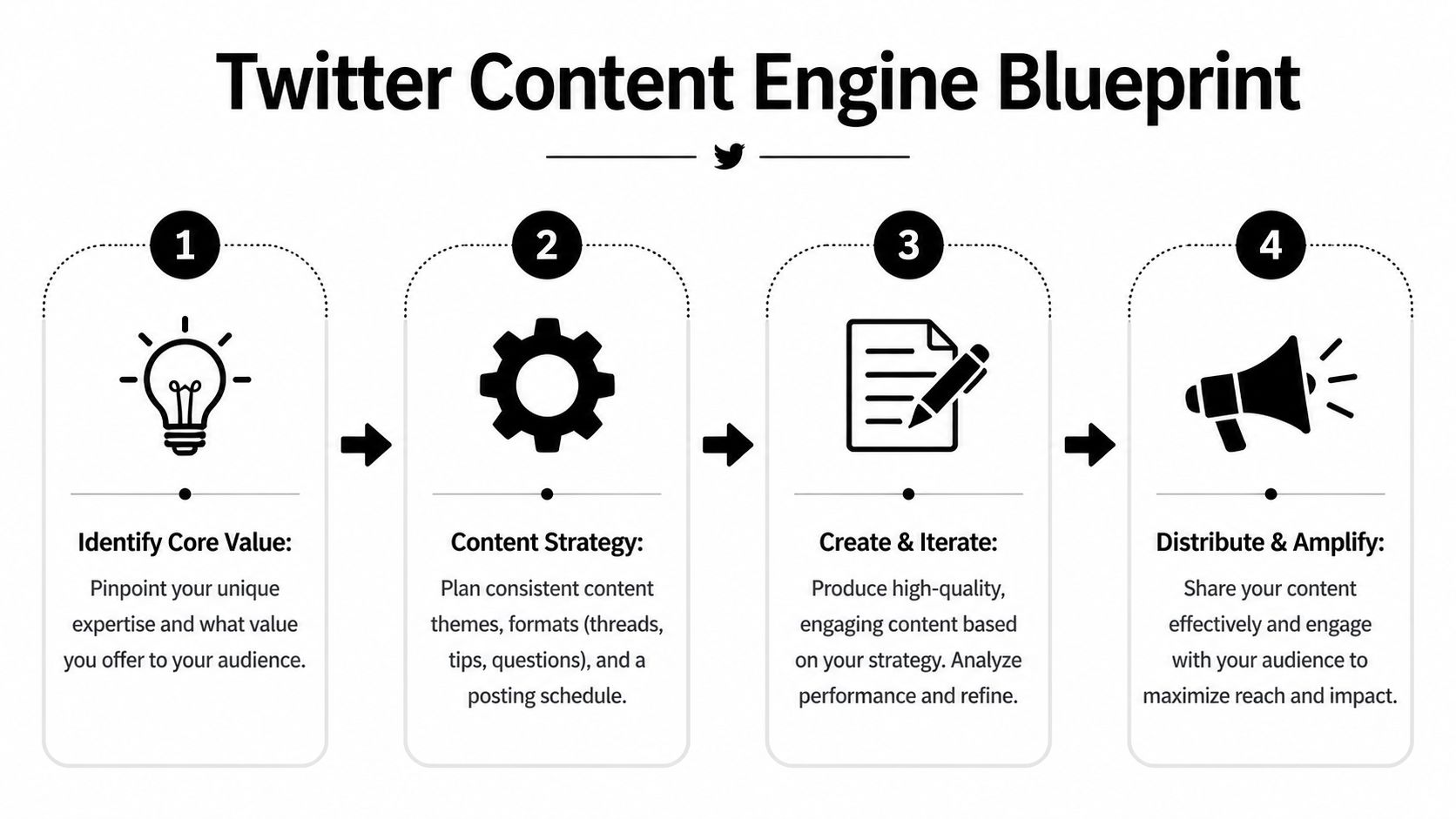
Format matters more than most PMs admit
Most PMs write smart posts that nobody reads because they package them badly.
Visual content significantly outperforms text-only posts on X. Video is six times more likely to be retweeted, tweets with hashtags are 33% more likely to be retweeted, and putting a URL in the middle of a tweet makes it 26% more likely to be retweeted, according to Tweetfull’s Twitter growth tactics breakdown.
That gives you a very clear operating system:
- use screenshots
- use simple visuals
- test short video explainers
- add relevant hashtags without turning the post into spam
- if you include a link, don’t dump it at the end
A practical content mix for PMs
Here’s a content mix that works without making your feed repetitive:
- Monday analysis post: Break down a launch from Stripe, Duolingo, Meta, or OpenAI.
- Tuesday short lesson: One PM framework in plain English.
- Wednesday visual thread: Use screenshots, a simple chart, or a workflow diagram.
- Thursday opinion post: A clear stance on product, AI, org design, or career growth.
- Friday build-in-public note: A lesson from your own work, project, or experiment.
That rhythm gives people a reason to follow beyond one lucky post.
Your audience doesn’t need more content. They need a reliable source of signal.
Use AI to speed ideation, not replace judgment
Use ChatGPT, Claude, or Gemini for prompts like:
- Give me 20 product teardown angles on ChatGPT, Notion, and Linear from a PM lens
- Turn this product meeting note into 5 tweet hooks
- Rewrite this thread with a sharper first tweet and stronger narrative arc
- Generate counterarguments to my take on AI copilots in SaaS
But don’t publish raw AI copy. Everyone can smell it. The best use of AI is pattern expansion, hook generation, structure testing, and editing.
If you’re making good content and still not growing, review the common failure modes in this breakdown of the 5 mistakes of creators who aren’t growing. Most PMs don’t have an idea problem. They have a positioning and packaging problem.
Systematize Your Cadence A Workflow for Busy PMs
You’re a PM. Your calendar is already full of roadmap reviews, 1:1s, sprint ceremonies, customer calls, and Slack noise. If your X strategy depends on inspiration, it will collapse by Wednesday.
A better approach is simple. Run your account like a lightweight content operation with fixed inputs, fixed outputs, and minimal decision fatigue.
Use a weekly pipeline, not a daily scramble
I recommend a small Kanban board in Notion with five columns:
- Ideas
- Drafting
- Ready
- Scheduled
- Repurpose
That’s enough. You don’t need a creator OS. You need a system you’ll use.
Every time you see a sharp product launch, a bad onboarding flow, an interesting AI interaction pattern, or a great interview question, drop it into Ideas. Don’t trust your memory. PMs who rely on memory for content are running an unreliable backlog.
The workflow that fits a real PM schedule
This cadence works because it respects time constraints.
| Day | Focus (Time Commitment) | Activity | Tools |
|---|---|---|---|
| Monday | Idea batching (1 hour) | Capture observations from product work, industry news, and saved posts. Select themes for the week. | Notion, X bookmarks, Readwise |
| Tuesday | Light drafting (30 minutes) | Write two short posts from Monday’s ideas. Queue one reply target list. | Notion, ChatGPT |
| Wednesday | Deep writing (2 hours) | Draft one high-impact thread or teardown with screenshots or visuals. | Notion, Canva, Figma |
| Thursday | Scheduling (30 minutes) | Schedule core posts and prep follow-up replies. | Buffer, Hypefury |
| Friday | Engagement review (30 minutes) | Respond to comments, note what resonated, move strong posts to repurpose column. | X Analytics, Notion |
This isn’t glamorous. That’s why it works.
Build once, repurpose repeatedly
A single product insight can become:
- one thread
- three short posts
- five replies
- one visual carousel
- one poll or question
If you wrote a teardown on Duolingo’s streak mechanics, spin that into:
- a thread on habit loops
- a single post on retention tradeoffs
- a reply on gamification
- a visual breakdown of trigger, action, reward
That’s how creators stay visible without tweeting nonsense all day.
Pick tools that reduce friction
I’d keep the stack tight:
- Notion for idea pipeline and editorial backlog
- Buffer or Hypefury for scheduling
- Canva for simple visuals
- Figma if you already use it and move faster there
- ChatGPT or Claude for hooks, rewrites, and idea expansion
Don’t over-automate your voice. Schedule posts, yes. Auto-reply gimmicks and generic AI content usually make PM accounts feel synthetic.
Consistency wins because it lowers variance. You stop disappearing for two weeks every time work gets busy.
Protect quality with one rule
Never schedule a post that doesn’t pass this filter: would a strong PM at a company I respect find this useful, interesting, or worth sharing?
If the answer is no, cut it.
A lot of PMs confuse activity with reputation building. Posting more low-signal content doesn’t create authority. It dilutes it.
Engineer Your Growth Loops Smart Engagement and Networking
Posting is only half the job. If you treat X like a publishing platform and ignore the network layer, you’ll grow slower than you should.
The strongest PM accounts use engagement as distribution, relationship building, and career advantage. Not random commenting. Targeted visibility.
Build a dream network list
Create private X Lists for people you want to know.
I’d build at least three:
- Hiring and operator list: Directors, Heads of Product, VPs, founders
- PM peer list: smart ICs and managers posting useful work
- AI product list: PMs, researchers, builders, and technical creators
With this approach, real network growth begins. You stop reacting to random feed noise and start engaging where it matters.
For example, if you want to move into AI PM, your daily attention should include product leaders talking about model UX, retrieval, evals, trust, and workflow design. If you want B2B SaaS roles, focus on operators discussing onboarding, retention, PLG, pricing, and enterprise complexity.
Write replies that earn profile visits
“Great point” is invisible.
A strong reply does one of three things:
- adds a useful example
- sharpens the argument
- respectfully disagrees with better reasoning
Examples:
- On a post about AI assistants, add a note about where copilots fail in onboarding because users don’t trust automation without context.
- On a product launch thread, point out the likely metric the team optimized for.
- On a hiring post, share the exact artifact you’d bring to the interview loop.
That kind of reply does two jobs. It helps the original conversation and advertises your thinking.
If you want better examples for crafting interaction that doesn’t feel cheap, review DailyShorts' engagement tactics. The useful part isn’t “engage more.” It’s learning how to create responses people want to continue.
Collaboration is the underused growth loop
Most PMs ignore collaboration because they think it’s for lifestyle creators and podcasters. Wrong. It’s one of the most effective ways to grow a relevant audience.
For authentic follower growth, PMs can partner with niche tech micro-influencers. Those partnerships yield 60% higher engagement rates than macro-influencer collaborations, and a 2025 Buffer study cited by Tweetfull’s collaboration analysis found they drove a 25% follower increase in three months for B2B creators.
That matters because PM career growth depends on trust and relevance, not celebrity adjacency.
What collaboration actually looks like for PMs
Try:
- a co-hosted Space on breaking into AI PM
- a joint thread with a PM recruiter on what candidates get wrong
- a teardown exchange with another product operator
- a shared discussion with a PM podcaster on product sense versus execution skill
- a mutual promo around a useful framework, template, or event
Don’t chase giant accounts. Partner with credible niche people whose audience overlaps with yours.
A PM with a thoughtful following in SaaS pricing, AI UX, or consumer retention is more valuable to you than a broad business account with weak alignment.
Here’s a useful video if you want to think more deliberately about network-driven growth on X:
A simple networking operating model
Use this weekly rhythm:
- Monday: check your lists and leave a few high-value replies
- Tuesday: DM one person after a public interaction if there’s a real reason
- Wednesday: quote-tweet one smart idea and add your own analysis
- Thursday: ask one peer for a lightweight collaboration
- Friday: review who noticed you, replied, followed, or continued the conversation
That’s enough to create momentum.
If you already get warm intros through referrals, apply the same logic here. This guide on whether you should invest in referrals as a channel is useful because X networking works the same way. Relationships convert better when there’s context, trust, and repeated value.
The best X growth loop for PMs is simple. Useful post, smart reply, profile visit, follow, DM, opportunity.
Measure What Matters From Vanity Metrics to Career Impact
Follower count is a commonly monitored metric because it’s visible. Serious PMs track the funnel.
If your goal is career acceleration, the only version of twitter how to increase followers that matters is the one that creates opportunities. Recruiter outreach. Interview requests. Podcast invitations. Product community relationships. Credibility with people you want in your corner.
The PM career funnel
Track your X presence like this:
| Stage | What it means | What to ask |
|---|---|---|
| Impressions | Your ideas were seen | Which topics and formats travel furthest |
| Profile visits | People were curious enough to check you out | Which posts create intent, not just reach |
| Follows | Your profile converted interest | Is your packaging aligned with your content |
| Engagement | People care enough to respond or share | Are you producing signal |
| Opportunities | DMs, intros, interviews, collaborations | Is the audience quality improving |
Follower growth on X varies by account size. New accounts in the 0-1,000 follower range can grow 10-30% monthly, while the global average is 2-5%, and profile visits are the key conversion step because each visit is a chance for a follow, according to EvergreenFeed’s breakdown of Twitter growth metrics.
That should immediately change what you look at every week.
Profile visits matter more than most PMs realize
Impressions are top-of-funnel. Nice to have. Profile visits show intent.
If one post gets broad reach but no profile visits, it may be entertaining but weak for brand building. If another gets fewer impressions but drives a lot of profile visits, that post is doing real career work.
That’s why I care more about:
- posts that attract the right people
- replies that get clicked
- threads that create DMs
- ideas that lead to second-order opportunities
A viral meme might inflate your graph. A sharp AI product teardown might get you noticed by the exact hiring manager you want.
Review metrics monthly, not emotionally
Open X Analytics on a fixed schedule. Monthly is enough for most PMs.
Review:
- top posts by profile visits
- top posts by engagement
- mentions from relevant people
- follower growth against your starting base
- DMs or external opportunities tied to content themes
Then answer:
- Which topic brought the best people?
- Which post type made strong operators engage?
- What should I stop posting?
That’s PM behavior. Instrument, inspect, iterate.
If a post attracts the wrong audience, growth can still be a problem.
Connect on-platform signal to off-platform outcomes
This is the true test.
Maybe your thread on AI product tradeoffs leads to a coffee chat with a senior PM. Maybe a recruiter messages you after a teardown. Maybe a founder invites you to advise on onboarding because your posts consistently show judgment.
That is success.
If you need help sharpening your measurement instincts, this guide on metrics for product managers is worth reading because the same mistake shows up everywhere. Teams track what’s easy to see instead of what drives outcomes.
Organic vs Paid Growth A PMs Decision Framework
Most PMs should grow organically.
That’s my view, and I’m not hedging. If you’re building a career brand, trust matters more than speed. Organic growth forces you to earn relevance through ideas, judgment, and interaction. Paid growth can amplify, but it can’t create substance.
When organic is the right choice
Organic is the default if:
- you’re still refining your niche
- your profile and content aren’t sharp yet
- you want trust with recruiters, PM peers, and operators
- you’re building authority around PM, AI, growth, or product strategy
For almost everyone, that’s the right starting point. Write strong posts. Build lists. Reply well. Collaborate with credible niche people. Improve the funnel before you buy distribution.
When paid can make sense
Paid promotion is useful only when there’s a specific outcome.
Good use cases:
- promoting a strong thread to a relevant tech audience
- amplifying a side project launch
- driving the right people to a portfolio, newsletter, or event
- testing whether a message resonates with a tightly defined audience
Bad use cases:
- buying followers
- boosting weak content
- paying for vanity instead of intent
- promoting yourself before your positioning is clear
Treat it like any other growth experiment. Hypothesis, audience, creative, spend, outcome.
A simple decision checklist
Use paid only if you can answer yes to most of these:
- Is the profile already conversion-ready?
- Is the post strong enough to deserve more reach?
- Do you know exactly who should see it?
- Is there a concrete career or business goal attached?
- Will you measure outcome beyond follower count?
If not, stay organic.
A lot of PMs rush to distribution because it feels faster. Usually it just exposes weak positioning to more people. The same logic shows up in product growth work. Channels don’t rescue bad fundamentals. They amplify whatever is already there. This framework is the same one you’d use in broader product growth strategies.
Organic builds signal. Paid should only accelerate signal that already exists.
If you want sharper PM thinking, better career strategy, and practical frameworks that help you stand out, follow Aakash Gupta. His writing, podcast, and resources are some of the most useful anywhere for product managers who want to grow faster and operate at a higher level.
