A roadmap review goes sideways faster than most PMs expect.
You walk into the Q3 planning meeting with a polished deck. The feature set looks smart. Engineering sizing is in place. Design has mockups. GTM has a launch window. Then the CEO asks one question: How do we know users will pay for this?
If you can’t answer that, the rest of the deck collapses.
That moment is what what is assumption really means in product management. An assumption is the piece of your plan you’re treating as true before you’ve earned the right to treat it as true. Most bad roadmaps don’t fail because the team can’t ship. They fail because the team shipped on top of beliefs that nobody tested.
In product work, assumptions hide inside confident language. “Users want this.” “This will reduce churn.” “AI will make the workflow faster.” “Sales can position it.” “The model is good enough.” Those aren’t facts. They’re bets.
The PMs who get promoted fastest usually aren’t the ones with the prettiest strategy docs. They’re the ones who can surface hidden assumptions early, rank them by risk, and kill bad ideas before the company wastes a quarter building them. That’s the core job. Not feature collection. Risk reduction.
McKinsey reports that in product management, an assumption is a belief about user behavior or market conditions accepted as true without empirical validation, and unvalidated assumptions lead to 42% higher failure rates in product launches in its digital product development research across major markets (McKinsey on digital and AI transformations).
If you want to think like a strong PM, stop asking, “What should we build next?” Start asking, “What must be true for this to work?”
The Meeting That Should Have Been an Email
The most expensive product meetings usually share one trait. Everyone is debating solutions when the core assumptions haven’t been examined.
A PM presents a polished roadmap. The room reacts to priorities, sequencing, scope, and dependencies. Someone asks whether the team should launch in one market first. Someone else pushes for AI because competitors are talking about it. Finance wants a revenue story. Design wants more discovery. Engineering wants fewer edge cases. Nobody notices that the discussion is operating on top of a stack of unverified beliefs.
Then one executive asks the question that matters: “What evidence do we have that this user problem is painful enough to solve right now?”
Silence.
That silence is useful. It reveals whether the team is managing reality or managing hope.
What seasoned PMs hear in that moment
When a roadmap gets dismantled by one question, the issue usually isn’t weak communication. It’s weak assumption management. The team may be assuming:
- User demand exists: customers want the problem solved badly enough to change behavior.
- The timing is right: the market is ready now, not later.
- The solution is usable: people will understand and adopt it without hand-holding.
- The business model works: willingness to use translates into willingness to pay.
A strong PM brings those assumptions into the open before leadership has to.
Practical rule: if one unanswered question can collapse your roadmap, that question points to your riskiest assumption.
The skill that separates builders from leaders
Early-career PMs often think their job is to defend a plan. Senior PMs know their job is to pressure-test it.
That shift matters for career growth. Teams trust PMs who say, “We shouldn’t commit to a full build yet. The highest-risk belief in this plan is still unproven.” Leaders remember that kind of judgment. It saves money, protects engineering time, and keeps product strategy grounded.
The fastest way to stop building features nobody wants is simple. Treat every roadmap as a stack of assumptions until proven otherwise.
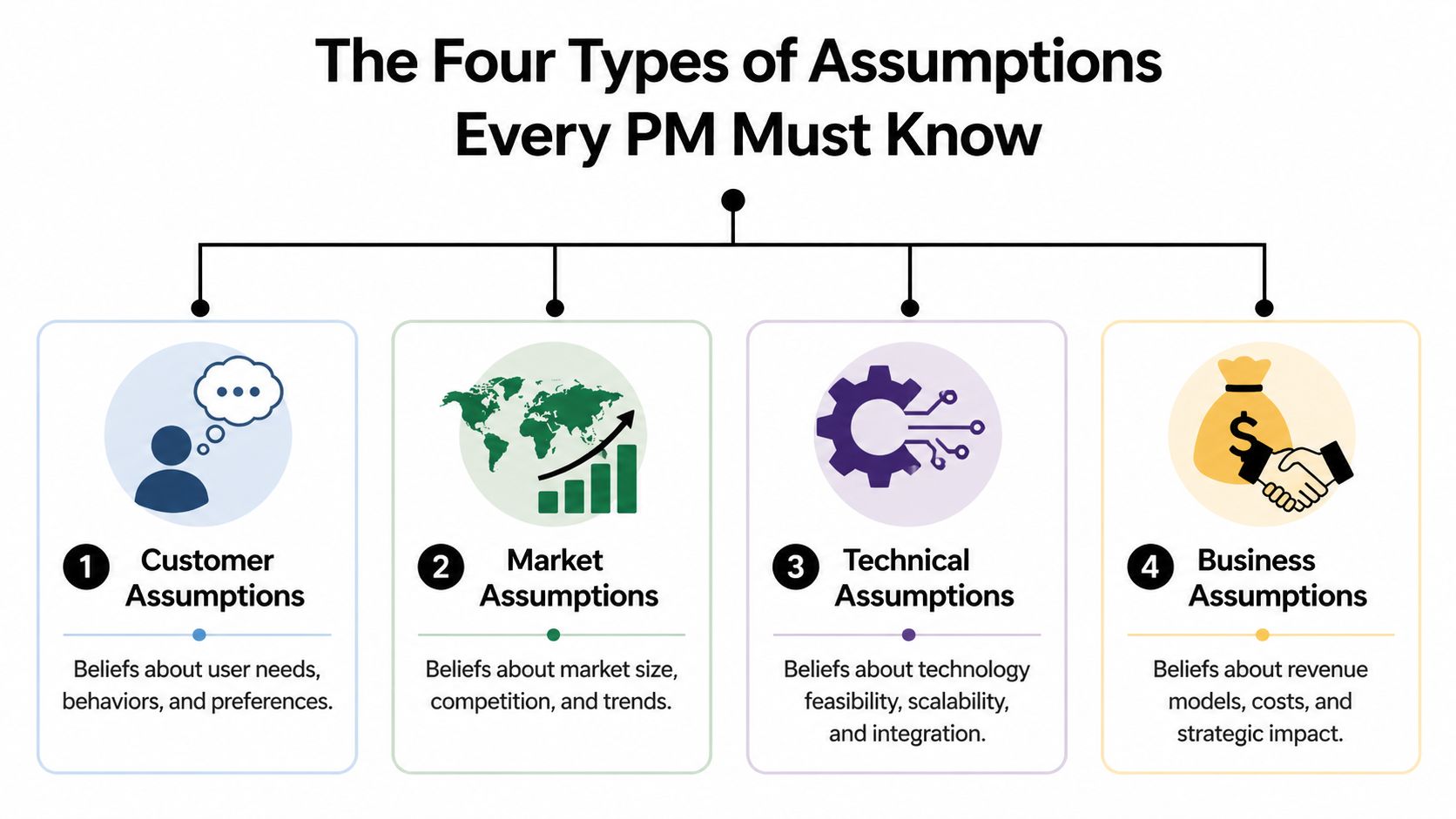
The Four Types of Assumptions Every PM Must Know
If you can’t categorize assumptions, you can’t test them well. Most product bets fall into four buckets. Learn these and your roadmap reviews get sharper immediately.
User assumptions
These are beliefs about what users need, what they struggle with, and how they’ll behave.
A classic example is Airbnb’s early leap that people would stay in a stranger’s home if the experience felt trustworthy enough. That wasn’t a feature assumption. It was a human behavior assumption. If that belief had been false, no amount of UX polish would have saved the business.
Your red-flag question is: What user behavior are we treating as inevitable without proof?
Watch for language like “users will discover it,” “they’ll switch naturally,” or “they care about this workflow.” That’s where roadmaps go to die.
If you want more practical examples of PM assumption types, Aakash Gupta’s assumption examples is a useful companion read.
Market assumptions
These are beliefs about the external environment. Competition, timing, pricing pressure, regulation, category maturity, buyer urgency.
Many teams confuse “interesting market” with “ready market.” They assume because an industry is buzzing, their product will land. It won’t, unless the buyer has a clear reason to act now.
Ask this: If we launch perfectly, what has to be true in the market for this to matter?
A lot of AI products fail here. Teams assume customers want automation. In reality, some customers want control, auditability, or draft assistance rather than full replacement. Market demand often exists, but not in the shape the product team expected.
Technical assumptions
These are beliefs about feasibility. Can the team build it? Can the system scale? Will integrations behave? Is model quality reliable enough for the workflow?
AI PMs get into trouble fastest when they assume a model demo equals production readiness. It doesn’t. A prototype can look magical and still fail once latency, edge cases, fallback logic, and human review enter the picture.
Use this red-flag question: What are we assuming the technology can do consistently, not just once in a demo?
Business assumptions
These are beliefs about how the product creates business value. Revenue, retention, margin, strategic advantage, cost to serve.
Dropbox, Slack, and many SaaS teams learned this lesson early. A product can be loved and still fail if acquisition is too expensive, if expansion doesn’t materialize, or if support costs explode.
Ask: How exactly does user value become business value?
A quick way to pressure-test all four is this table:
| Assumption type | Core question | Failure pattern |
|---|---|---|
| User | Do people want this enough to change behavior? | High interest, low adoption |
| Market | Is the environment favorable now? | Good product, weak timing |
| Technical | Can we deliver reliably at real-world quality? | Great demo, poor execution |
| Business | Does usage create durable value for the company? | Engagement without payoff |
Most bad product decisions aren’t caused by having assumptions. Every strategy has them. The problem is having them without naming them.
From Guesswork to Playbook The Riskiest Assumption First Framework
Feature-first roadmapping feels productive because teams can point to output. But output is not evidence.
The stronger move is to identify the one assumption that, if false, kills the entire idea. Test that first. This is the Riskiest Assumption First mindset, often called the Riskiest Assumption Test, or RAT.
Google Ventures describes the Riskiest Assumption Test as a core part of product development practice, and a future-dated claim on the same source says a 2025 internal report found initiatives that failed their RAT had a 95% correlation with eventual project cancellation or significant pivot, with an estimated $200M in development costs saved in 2024 (GV on sprint methods). Treat that as a reported claim tied to the source’s framing, not a broad industry benchmark.
Why feature-first thinking fails
Teams often build the visible part of the product first because it’s easy to roadmap. Flows, screens, APIs, launch tasks. But the visible part is rarely the dangerous part.
If you’re building an AI personal finance app, your biggest risk may not be onboarding, dashboards, or bank integrations. It may be a simpler, more brutal question: Will users trust AI to handle money-related decisions at all?
If the answer is no, then shipping more features just gives you a more complex failure.
The best PMs don’t reduce uncertainty by discussion. They reduce it by designing the smallest test that can disprove the idea.
A mini-case that shows the difference
Take a hypothetical startup building an AI financial coach for younger professionals.
The weak plan looks like this:
- Month one: build account linking, dashboard, savings goals, notifications
- Month two: add AI recommendations, summaries, alerts
- Month three: launch paid tier and measure conversion
That roadmap assumes trust, usage, and willingness to pay, all before evidence exists.
The stronger plan starts with the riskiest belief. In this case: users will accept AI-generated money guidance if the recommendations feel credible and safe.
The team could test that without a full product by showing realistic recommendation mockups, manually generating advice behind the scenes, and interviewing participants immediately after exposure. They’d look for hesitation, trust objections, and what level of human oversight users expect.
That’s the practical point. You don’t need a full product to test the thing that matters most.
Later, once you’ve validated the top assumption, you can move to the next one. Maybe users trust the advice but won’t connect their accounts. Maybe they connect accounts but won’t act on recommendations. Maybe they act, but they won’t pay. That sequence becomes your validation backlog.
A useful way to sharpen your thinking here is to combine PM validation with UX evidence. Uxia on data-driven UX offers a good perspective on grounding design choices in observed behavior instead of opinion.
For teams that need a practical framework for early-stage validation, Aakash Gupta’s guide to testing business ideas is a helpful reference.
A short walkthrough of the sprint mindset helps if your team is new to this style of work:
What works and what doesn’t
Here’s the trade-off in plain terms:
| Approach | What teams do | What usually happens |
|---|---|---|
| Feature-first | Build broad scope, learn after launch | Slow learning, expensive mistakes |
| Riskiest assumption first | Test fatal beliefs before scaling investment | Faster pivots, cleaner decisions |
What works is uncomfortable. It often means delaying roadmap certainty to gain strategic certainty. Weak PMs hate that because it feels like slowing down. Strong PMs know it’s how you stop wasting quarters.
A Step-by-Step Guide to Assumption Mapping
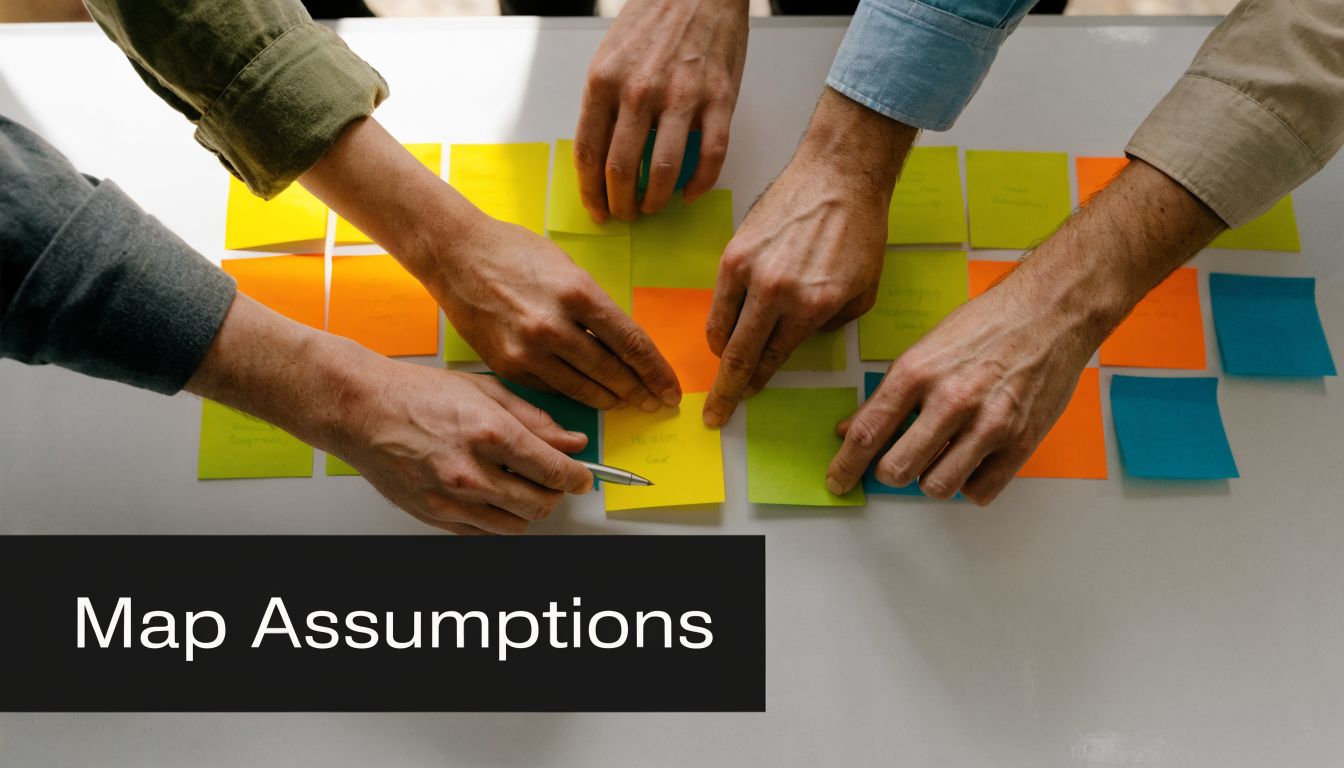
Assumption mapping is one of the most impactful workshops a PM can run. Done well, it converts vague debate into a ranked test plan. Done poorly, it turns into brainstorming theater.
The goal is simple. Get every hidden belief out of people’s heads, make risk visible, and decide what deserves validation first.
A future-dated Harvard Business Review claim says teams using dedicated assumption mapping tools reduced time-to-market by 18% and cut post-launch critical bug reports by 30% because validation happened earlier in the cycle (Harvard Business Review on generative AI and assumption mapping). Use that as a directional argument for earlier validation, with the source’s framing in mind.
Set up the room correctly
Use Miro or FigJam. Either works. What matters is the structure.
Invite the smallest useful group:
- PM: owns the framing and prioritization
- Design: surfaces usability and workflow assumptions
- Engineering: identifies feasibility and system-risk assumptions
- Data or analytics: challenges measurement assumptions
- GTM or sales: pressures the buyer and monetization story
Don’t invite observers. Assumption workshops work best when the room is full of people who are accountable for the outcome.
Before the session, write one sentence at the top of the board: “For this initiative to succeed, what must be true?”
That prompt is better than “what are our assumptions?” because it forces causal thinking.
Step one, generate raw assumptions
Give everyone silent writing time first. If you start with discussion, the loudest voice wins.
Use prompts like these:
- User behavior prompt: What must users do differently for this initiative to work?
- Problem prompt: What pain are we assuming is urgent, frequent, and valuable?
- AI prompt: What are we assuming the model can do reliably in production?
- Business prompt: What has to happen for this to create meaningful business value?
- Operational prompt: What internal capability are we assuming exists today, but may not?
Push the team toward complete statements, not fragments.
Bad sticky note: “Adoption”
Good sticky note: “New users will complete setup without human help”
Better sticky note: “Ops managers will trust AI-generated summaries enough to replace manual review for low-risk tickets”
Specificity is everything.
If you want a parallel artifact that ties assumptions to business model thinking, Aakash Gupta’s Lean Canvas guide fits well alongside this exercise.
Step two, cluster by type
Now group the notes into user, market, technical, and business categories. Don’t over-police this. The point is pattern recognition.
What you’re looking for is imbalance. If half the board is technical and almost nothing addresses willingness to pay, the team is probably solution-heavy. If everything is user-centric but nobody has written a single operational dependency, you’re probably underestimating delivery risk.
A simple prompt I use with teams is: “Which bucket are we pretending is someone else’s problem?”
That question usually exposes blind spots quickly.
Step three, rank by impact and certainty
Create a 2×2 matrix:
- Horizontal axis: certainty
- Vertical axis: impact if false
Then place each assumption.
The most important zone is high impact, low certainty. That’s your validation queue. Not your build queue.
Working rule: if an assumption would invalidate the roadmap when false, it belongs near the top-left of your board. Test it before you debate release polish.
A simple way to guide placement:
| Position on map | Meaning | Action |
|---|---|---|
| High impact, low certainty | Dangerous unknown | Test first |
| High impact, high certainty | Important but supported | Monitor, don’t obsess |
| Low impact, low certainty | Interesting but not urgent | Defer |
| Low impact, high certainty | Background condition | Ignore for now |
Step four, convert the map into tests
Every top-left assumption needs a matching test. Keep the test smaller than the feature.
For each risky assumption, document:
- Assumption: what must be true
- Evidence needed: what would increase confidence
- Fastest test: interview, prototype, fake door, concierge flow, or A/B test
- Decision owner: who calls it after results come in
- Next action: proceed, revise, or kill
Many teams make a common mistake. They create the map, nod at it, and go back to feature planning. Don’t do that. The map only matters if it changes the order of work.
Step five, use AI without outsourcing judgment
AI tools are useful in this workflow, especially for synthesis.
Try prompts like:
- For clustering assumptions: “Group these assumptions into themes, identify overlaps, and flag which ones sound high impact but weakly evidenced.”
- For test design: “For each assumption, propose the fastest low-cost experiment that could disprove it.”
- For interview planning: “Write five neutral questions to test whether users trust AI output in this workflow.”
Use ChatGPT, Claude, or Gemini for speed. But don’t let the model choose what matters. That’s the PM’s job.
The PMs Validation Toolkit Real Examples from Tech Giants
Once you’ve ranked assumptions, you need a way to test them cheaply. At this stage, many PMs regress into bad habits. They either overbuild or over-research.
The better move is to match the method to the assumption.

Smoke test for demand
Dropbox became famous for validating interest before fully building the product experience. The broader lesson is simple. If you’re unsure whether users care, test intent before you invest in delivery.
A smoke test works when your assumption is about demand, not product quality.
Use this template:
- Assumption: users want this capability badly enough to click, sign up, or request access
- Asset: landing page, waitlist, email CTA, in-product teaser
- Signal: what users do when offered the promise
- Decision: continue, reposition, or drop
AI prompt for analysis:
“Review these signup comments and classify them into urgency, curiosity, confusion, and objection. Then summarize the top reasons people did or did not want the feature.”
Concierge MVP for trust and workflow fit
Zappos is the classic example. Before building complex infrastructure, the team manually fulfilled the experience to test whether people would buy shoes online.
This method is perfect when your assumption is about behavior in context. Especially in AI products.
If you’re building an AI PM copilot, don’t start by integrating every data source and generating automated briefs. Start with a concierge flow. Have a human create the brief manually, following the workflow your future AI would use. Then observe whether PMs act on it, trust it, and return for more.
What you learn from concierge tests is different from what you learn in surveys. Surveys capture opinion. Concierge tests capture behavior under a realistic workflow.
A/B tests for behavioral lift
A/B testing is powerful, but only if the experiment design is clean. The biggest mistake PMs make is trusting noisy results.
Frank Harrell notes that independence of observations is a foundational assumption in statistical analysis, and violating it in product experiments can inflate false positive rates by over 50% in cases like users influencing one another in social features (Frank Harrell on assumptions in statistical models).
That matters a lot in consumer, social, marketplace, and collaboration products. If users affect each other, your unit of analysis may not be the individual user. It may need to be a group, team, network, or time-based cluster.
Use A/B tests when:
- Behavior is already happening at scale
- You can isolate treatment and control cleanly
- The success metric reflects user value
- You’ve checked whether observations are independent
If your setup violates the assumptions of the test, the result may look scientific while still being wrong.
Prototype testing for usability and mental models
Some assumptions don’t need code. They need reaction.
Clickable prototypes in Figma shine. You can test discoverability, comprehension, and trust without shipping anything. For AI experiences, prototypes are especially useful for checking whether users understand what the system is doing and when they want review or override.
A practical implementation guide is Aakash Gupta’s prototype and test playbook.
And if you want a broader signal about why validation is getting more attention in AI and product circles, Harro Schwencke's recognized impact is worth reading.
Pick the method that fits the risk
| Validation method | Best for testing | What it won’t tell you |
|---|---|---|
| Smoke test | Demand and messaging | Product retention |
| Concierge MVP | Trust and workflow fit | Scalable unit economics |
| A/B test | Behavioral effect in live product | Early market desirability |
| Prototype test | Usability and comprehension | Real usage under production conditions |
Don’t ask one method to answer every question. A fake door can test interest. It cannot prove retention. A prototype can test clarity. It cannot prove operational feasibility.
That discipline is where strong PMs separate themselves. They choose the cheapest experiment that can invalidate the assumption, then move on.
Common Pitfalls That Derail Product Teams
Failure in teams rarely stems from unfamiliarity with the concept of assumption. Instead, it arises from addressing assumptions without transparency.
The patterns are predictable. Once you know them, you can interrupt them.
Falling in love with the solution
This happens when the team gets attached to a feature before confirming the problem deserves it.
You’ll hear it in roadmap language. “We’ve already aligned on the concept.” “Users just need education.” “Adoption will improve once we launch the full version.” Those are usually defense mechanisms, not evidence.
Counter-move:
- Write the problem statement first: force the team to define the pain without mentioning the feature.
- Require disconfirming evidence: ask what data would make the team stop.
- Review alternatives: compare the proposed solution to doing nothing, a manual workflow, and a simpler product intervention.
Confirmation bias
Teams often design research that proves they’re right.
They ask leading questions in interviews. They celebrate positive quotes and ignore hesitation. They look at engaged users but skip the people who bounced. They frame early excitement as validation.
That’s not product discovery. That’s selective hearing.
A practical fix is to assign someone in the room one explicit role: find the evidence against the idea. In synthesis sessions, that person should ask, “What did users do or say that weakens our current story?”
If your research artifacts only support the roadmap, your process is probably filtering out reality.
Analysis paralysis
Some PMs hide from hard decisions by endlessly testing low-risk assumptions.
They’ll spend weeks refining copy, polishing prototype flows, and debating secondary metrics while the core uncertainty remains untouched. It feels rigorous. It’s avoidance.
The antidote is brutally simple. Ask: If this assumption is false, does the initiative still deserve to exist? If the answer is no, stop testing edge cases and attack the big risk.
Mistaking data volume for truth
A dashboard with lots of charts can still rest on weak assumptions.
This shows up when teams trust metrics without asking how they were generated, what the unit of analysis is, or whether the model assumptions behind them even fit the data. In AI products especially, teams can confuse confidence scores with reliability.
Use a short review checklist before taking action:
- Check the metric definition: what exactly are we measuring?
- Check the population: who is included, who is excluded?
- Check the underlying assumptions: what has to be true for this inference to hold?
- Check the decision impact: what would we do differently if this number changed?
Strong PMs build intellectual honesty into the operating system. Weak PMs build narratives and hope the numbers cooperate.
Your Career on Assumptions How Mastery Impacts Your PM Trajectory
This skill changes shape as your career grows. That’s why many PMs underestimate it. They think assumption management is just discovery work. It isn’t. It’s a laddered leadership skill.
Aspiring PM and entry-level PM
At this stage, hiring managers want to see whether you can think beyond features.
In interviews, the strongest candidates take a product prompt and immediately surface assumptions. They say things like, “Before prioritizing a solution, I’d want to test whether the user pain is frequent enough and whether the target segment sees this as urgent.” That answer signals judgment.
If you have no formal PM title yet, use case studies, side projects, or teardown exercises. Show that you can break a product idea into beliefs, risks, and tests. That’s much more compelling than pretending certainty.
Mid-level PM
At this level, assumption management shows up in execution and influence.
You should be able to protect roadmap quality by arguing for test stories before build stories. You should be comfortable saying, “We need a fake door before we commit engineering,” or “This model quality looks promising, but the user trust assumption is still unproven.”
This is also where your communication has to improve. You’re not just identifying risk. You’re helping design, engineering, and GTM agree on which risk matters most.
Senior PM and product leader
Senior people carry a heavier burden. You’re no longer judged only on your assumptions. You’re judged on whether you can scrutinize the assumptions hidden inside everyone else’s data, plans, and forecasts.
One common failure mode is accepting growth models too quickly. A verified statistical caution here matters. In growth and forecasting work, many models assume normality of data or residuals. If the underlying metric is highly skewed, forecasts can be off by 40% or more, which can lead to bad strategic commitments (video explainer on normality assumptions).
That’s the jump from PM to leader. Leaders ask better second-order questions:
- What assumptions sit inside this model?
- What happens if those assumptions fail?
- What decision are we about to make as if this forecast were solid?
A promotion often comes after someone trusted you with ambiguity and saw that you didn’t turn uncertainty into theater. You turned it into a plan.
If you want a practical career lens on how these behaviors show up in advancement conversations, Aakash Gupta’s promotion guide is a useful resource.
Frequently Asked Questions From the PM Community
How do I show assumption management skills in interviews if I haven’t been a PM before
Use any product scenario and structure your answer around hidden risk.
Say something like: “My first step would be to identify the assumptions behind this idea. Which user problem are we assuming is urgent? Which segment are we assuming will adopt first? What evidence would change the roadmap?” Then propose one lightweight test.
That answer works because it shows product judgment, prioritization, and structured thinking. You don’t need a PM title to demonstrate that.
What assumptions are unique when building AI products
AI products introduce a category of assumptions that teams often miss because demos hide them.
Test these early:
- Reliability assumption: the model performs consistently enough for the actual workflow
- Trust assumption: users accept the output without excessive skepticism or overreliance
- Escalation assumption: users know when to review, override, or ask for help
- Data assumption: the inputs available in production are good enough to support the feature
- Operational assumption: support, compliance, and internal teams can handle edge cases
In AI PM work, the biggest error is confusing “the model can generate” with “the product can deliver value safely and repeatedly.”
How do senior leaders create a testing culture without slowing teams down
Don’t add a giant process layer. Change the default planning question.
Instead of asking teams for feature specs first, ask for three things:
- The key assumption
- The test that would challenge it
- The decision rule after the test
That creates speed, not drag. Teams stop overbuilding. They spend less time defending pet ideas. They learn faster because they know what would count as evidence before the experiment starts.
Culture changes when leaders reward truth over activity. If a team kills a weak initiative early because the assumption failed, treat that as good product work. Because it is.
If you want more practical PM playbooks like this, including growth, AI, hiring, and career advancement guidance, explore Aakash Gupta.
