As a Product Manager, your first job isn't to build features—it's to define who you're building for with extreme precision. You need to move from a vague description like "millennials who invest" to a sharp, actionable hypothesis like, "Aspiring investors, aged 25-35, earning $70k-$120k, who are intimidated by traditional brokerage platforms and need a low-friction, mobile-first way to start building a portfolio."
This initial hypothesis is the strategic foundation for your entire roadmap. It's the filter you'll use for every product decision, ensuring you're solving a real, painful problem for a specific group of people, not building a generic solution for a blurry, undefined market. This guide provides the step-by-step framework I've used to lead teams at companies like Google and Affirm to define audiences that drive product success.
Step 1: Formulate a Data-Informed Hypothesis (Before You Talk to a Single User)
As a hiring manager for PM roles, I've seen countless roadmaps derailed by the phrase, "our user is everyone." That's a direct path to building a product that excites no one. Your first task is to escape this trap by formulating a concrete starting hypothesis, even if it's not perfect yet.
The most effective framework for this is Jobs-to-be-Done (JTBD). Instead of asking, "Who is our user?" you must ask, "What 'job' are they hiring our product to do?" This reframes the user from a static demographic into a person with a specific motivation and a desired outcome.
Consider Robinhood. Their target wasn't just an age group. Their initial JTBD was to empower a new generation of investors to "hire" their app to overcome the high fees and overwhelming complexity of traditional brokerages. That laser focus on the "job" defined their entire early product strategy.
Your Initial Audience Hypothesis Framework (A PM's Starting Template)
Before diving into research, structure your initial assumptions. This template forces clarity and gives you something tangible to validate or disprove. For a new PM, this is a non-negotiable first step.
| Component | Guiding Question | Example: An AI-Powered Project Management Tool |
|---|---|---|
| User Segment | Who is the specific professional persona feeling this pain most acutely? | "Mid-career marketing managers (L4/L5) at B2B SaaS companies with 200-1000 employees." |
| The 'Job' (Problem) | What is the core, recurring task they are trying to accomplish? | "They need to prove the ROI of their content marketing to VPs of Marketing and Sales." |
| Desired Outcome | What does success look like for them in their career context? | "Generate a clear, one-page report that connects specific content assets to closed-won deals, securing budget for the next quarter." |
With this hypothesis, you have a filter. When an engineer suggests a new feature, you can ask, "Does this help an L5 marketing manager at a SaaS company prove content ROI to their VP?" If the answer is no, it's an easy "not now."
To sharpen your initial hypothesis, analyze where these potential users live online. Understanding their digital behavior reveals unstated needs. Knowing how to improve social media engagement by listening to conversations in relevant subreddits or LinkedIn groups can uncover powerful clues before you even schedule your first interview.
Step 2: Build Your Qualitative Research Engine
Analytics tell you what users are doing. User interviews tell you why.
Mastering qualitative research is a core competency for any PM aiming for a senior role. A tool like Mixpanel can show a 70% drop-off in your signup funnel, but it will never explain the user's frustration or confusion that caused it. That's your job. You must build a repeatable system—a qualitative research engine—for talking to actual users. This isn't about occasional chats; it's a consistent process to uncover pain points, workflows, and the real-world context your product must fit into.
The Modern PM's Interview Tech Stack
Your time is your most valuable asset. Automate the logistics so you can focus on insights. A clunky, manual process kills momentum. Here is the exact stack I recommend to the PMs I mentor:
- Recruitment: UserInterviews.com and Respondent.io are industry standards for finding high-quality participants. You can filter by job title, industry, and company size to match your hypothesis precisely. Budget for this: A standard B2B interview incentive is $100-$150 for a 60-minute session via a gift card. This is a non-negotiable cost of doing business.
- Scheduling: Stop the email ping-pong. Use Calendly. Participants pick a slot, and it syncs to your calendar. It's a solved problem.
- Recording & Transcription: If you're taking notes manually, you are not actively listening. Use an AI tool like Otter.ai or Fathom to record and transcribe the call live. This frees you to focus entirely on the user's story and ask better follow-up questions.
This system allows you to go from a research question to five interview transcripts ready for synthesis in 48-72 hours, not weeks.
How to Uncover Million-Dollar Insights
The secret to a game-changing interview is asking open-ended, non-leading questions that get people talking about their current reality. Never ask, "Would you use a feature that did X?" You're just inviting them to be polite.
The most powerful insights don't come from users telling you what features to build. They come from you deeply understanding their existing problems and workflows, then connecting those dots to a potential solution.
At a previous B2B SaaS company, our analytics showed a new reporting feature had abysmal engagement. Instead of guessing why, we interviewed five marketing managers who fit our primary persona.
We didn't mention our feature. We started with one prompt: "Walk me through the process of building your last monthly report for leadership. Open up your screen and show me."
A massive workflow gap immediately became clear. They were all manually exporting data from HubSpot, Google Analytics, and Salesforce into a monstrous spreadsheet—a process that took 4-6 hours per week. Our feature didn't solve this core data consolidation problem.
The quantitative data told us the feature was failing. The qualitative interviews told us why and pointed us toward a $100 million ARR opportunity in solving the real, painful workflow. This is how you find insights that turn a "nice-to-have" product into a "must-have" tool. This process is a foundational element of how to conduct market research effectively.
Step 3: Validate at Scale with Quantitative Data
Your user interviews have given you powerful, story-driven hypotheses. Now, you must validate them at scale with quantitative data.
While qualitative interviews provide the rich, contextual "why," analytics and surveys deliver the statistical "what." This is how you transform compelling anecdotes from five users into a bankable market segment that convinces your VP of Product and Head of Engineering to staff your project.

This step is about layering hard proof onto your qualitative findings, giving you a defensible, 360-degree view of your target audience.
From Anecdote to Analysis
Your first move is to translate interview insights into measurable queries. If your interviews suggest your ideal users are marketing managers at mid-sized tech companies, you need to see if your product data supports this.
Product analytics platforms like Mixpanel or Amplitude are essential PM tools. They let you move beyond vanity metrics and into granular user behavior.
Ask specific, data-driven questions:
- Behavioral Cohorts: What distinguishes users who retain after 30 days from those who churn? Do they come from a specific industry (e.g., SaaS vs. e-commerce)? Do they adopt Feature X within their first 24 hours?
- Feature Adoption by Segment: Is our new AI reporting feature being adopted by senior users (as we hypothesized), or is it surprisingly popular with junior analysts?
- Conversion Funnels by Persona: Is the conversion rate from free trial to paid significantly higher for users from companies with <500 employees?
The patterns that emerge will either confirm your interview-based personas or challenge them. Either outcome is a win, as it moves you closer to the truth. This process is fundamental for any PM aspiring to lead data-driven product teams.
Validating with Surveys and Market Data
Product analytics shows what users do inside your product. Surveys fill in the demographic and psychographic gaps. Use Typeform or Google Forms to deploy a short survey to your user base.
Keep it concise. Ask for their job title, company size, and the primary "job" they hire your product for. The goal is to collect enough data to see if the traits from your interviews hold true across a statistically significant sample.
As a product leader, your ability to blend qualitative stories with hard numbers is your superpower. Presenting a user persona backed by interview quotes and a chart showing 75% of your power users fit that profile is how you build conviction and align your organization.
Finally, look beyond your user base. Public data can be a goldmine. If you're building a D2C product for Gen Z, analyzing Instagram's demographic data can validate your audience assumptions at zero cost. If your interviews point to one demographic but your social following is completely different, you’ve uncovered a critical disconnect you must investigate.
Step 4: Synthesize Raw Data into Actionable User Personas
Data sitting in a spreadsheet is useless. Your next job is to synthesize your research into a strategic tool that your entire team—from engineering to marketing—can rally behind: user personas.
These aren't fluffy profiles with stock photos. A great persona is a strategic artifact that grounds every design debate, feature prioritization meeting, and marketing decision in real user needs. You are transforming abstract data points into a relatable human story that drives action.
The Anatomy of a High-Impact Persona
To create personas that drive product strategy, go deeper than surface-level demographics. You must capture the why—the motivations, frustrations, and context.
A powerful persona template includes:
- Goals & Motivations: What is this person trying to achieve in their career? (e.g., "Get promoted to Senior PM in 18 months.") What is the ultimate business outcome they drive?
- Frustrations & Pain Points: What specific obstacles get in their way? What part of their current workflow is inefficient or infuriating? Use direct quotes from your interviews here.
- Key Tasks & Scenarios (JTBD): What are the 1-3 critical "jobs" they would hire your product to do? Frame these as user stories (e.g., "As a marketing manager, I want to automatically generate a report connecting content to pipeline, so I can prove my team's ROI.")
- Tech Stack & Communication Channels: What other tools are open on their desktop all day (e.g., Slack, Jira, Figma)? How do they prefer to receive information—email, Slack, in-app notifications?
This flow chart illustrates the synthesis process:
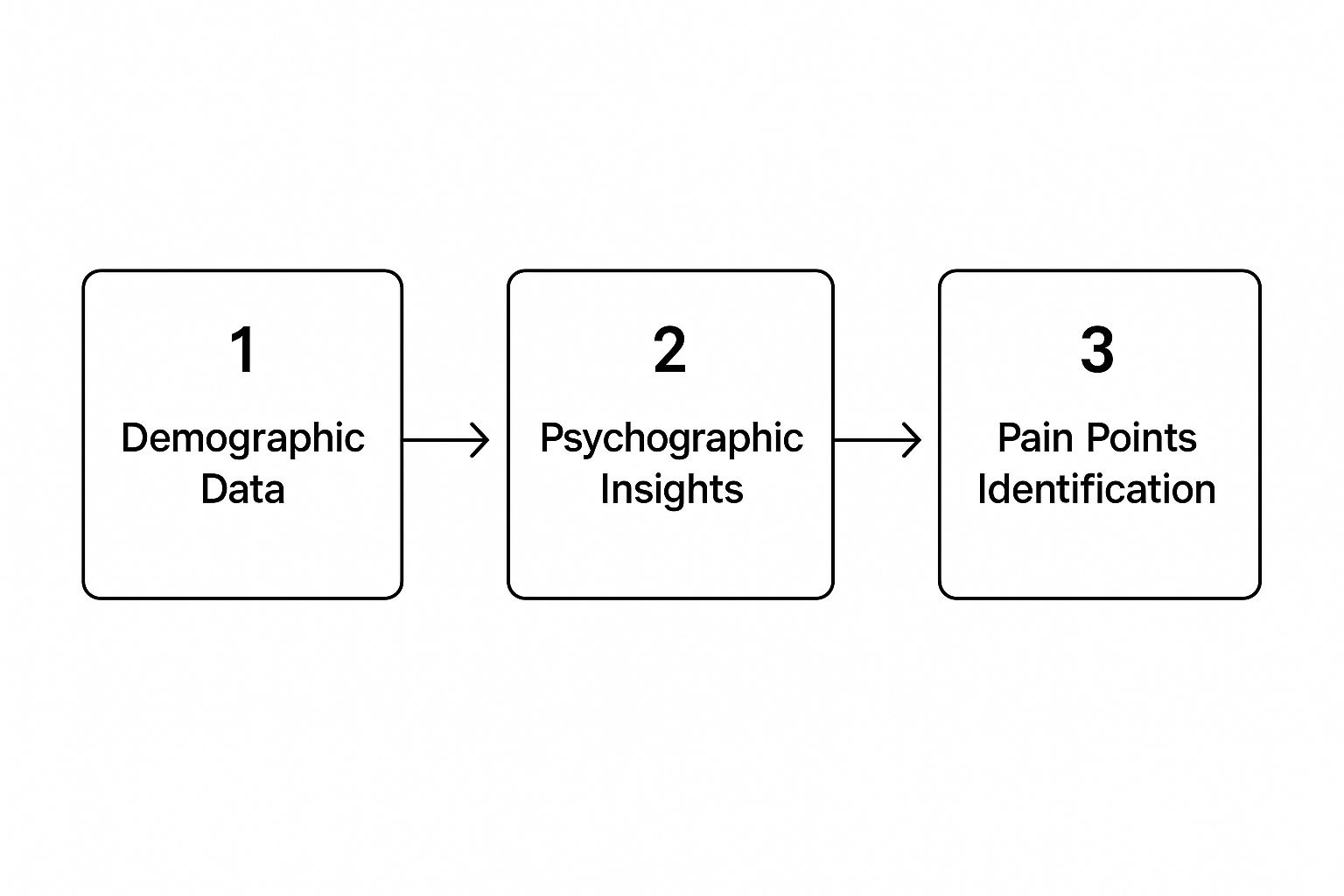
You start with foundational demographic data, enrich it with psychographic insights from interviews, and then distill it all into the core pain points your product is uniquely positioned to solve.
The Persona Spectrum: Your Defense Against Scope Creep
A common mistake PMs make is failing to define who they are not building for. The persona spectrum is a framework that forces this clarity and is your best defense against scope creep.
- Primary Persona: This is your bullseye. The protagonist of your product's story. 80% of your design and development effort should be laser-focused on making this person wildly successful.
- Secondary Persona: This user also gets significant value, but their specific needs are deprioritized if they conflict with the primary persona's goals.
- Anti-Persona: This is the user you are explicitly not building for. Defining them empowers the team to confidently say "no" to irrelevant feature requests and avoid accommodating edge cases that distract from the core mission.
For example, when building an advanced analytics tool, the Primary Persona might be a "Data-Savvy Senior Product Manager." The Anti-Persona could be a "Non-Technical Marketing Intern." This prevents the team from wasting cycles simplifying the UI to a point where it loses its power for the primary user.
For a deeper dive, I recommend this practical guide on creating buyer personas. It’s also critical to understand where your personas live online. Knowing that TikTok is a Gen Z stronghold where users spend nearly 10 minutes per visit is a key insight when defining a persona's digital habits. For more on this, our guide on using personas for product growth is a valuable resource.
Step 5: Keep Your Audience Definition Dynamic (It's Not a One-Time Project)
Defining your target audience isn’t a one-and-done task. The biggest mistake I see PMs make is treating their personas like museum artifacts—perfectly crafted but never revisited.
Markets shift. New competitors like OpenAI emerge and change user expectations overnight. Your audience definition must be a living document, not a static report.

Great product organizations build continuous feedback loops into their operating rhythm. This is less about a massive quarterly overhaul and more about constant, incremental validation.
Building a Continuous Feedback Loop: A PM's Workflow
Your goal is to capture fresh, real-time insights without launching a major research project. Here are tactical ways to do this:
- In-App Microsurveys: Use tools like Hotjar or Sprig to ask a single, context-aware question. Prompt Example: After a user successfully uses a new feature, trigger a survey asking, "What 'job' did you use this feature to do today?"
- Monitor NPS & CSAT Scores: A dip in your Net Promoter Score is a signal. Read every verbatim comment from Detractors. Those quotes are raw, unfiltered feedback about where your product is failing to meet their needs.
- Power User Panel: Identify your top 10% most engaged users in Mixpanel. Invite them to a private Slack channel or a quarterly 30-minute feedback session. They are your canaries in the coal mine for shifting needs.
Think of your audience definition like managing a stock portfolio: you need periodic reviews, strategic rebalancing, and data-driven adjustments to stay ahead of market dynamics.
Staying Ahead of Market and Technology Shifts
Direct user feedback tells you what's happening now. To see what's coming next, you must scan the market.
For example, the rise of generative AI forced countless SaaS companies to re-evaluate their personas. A "Content Marketer" persona from 2021 is now an "AI-Augmented Content Marketer" in 2024, with completely different workflows and expectations. Companies that didn't adapt their product to this new reality are already falling behind.
Remember that users operate in a multi-channel world, juggling an average of 6.8 different social media platforms monthly. Relying only on in-product data is insufficient. To get the full picture, explore this social media demographics report and layer those external trends onto your internal user data. A living audience definition keeps your product relevant and defensible.
Common Questions About Defining Your Audience
https://www.youtube.com/embed/qWbUEf8fjzg
Even with a strong process, defining a target audience always surfaces tough questions. I get these from PMs I mentor at all levels, from Associates to VPs. Here are the most common ones.
How Many User Personas Are Too Many?
Your job as a PM is to create focus. For most products, two to three primary personas is the sweet spot. This is enough to represent your critical user segments without paralyzing the team with conflicting needs.
If you have five or more personas, it's a red flag. It likely means you've either defined your market too broadly or you're creating "new" personas for minor variations in behavior rather than distinct Jobs-to-be-Done.
The fix? Consolidate. Go back to the core "job" that unites different segments. A persona is a tool for ruthless prioritization. Too many makes it useless.
What if My Qualitative and Quantitative Data Conflict?
This is a good problem to have. It signals you've uncovered a non-obvious insight your competitors have likely missed. Do not discard one data source for the other.
This conflict almost always reveals a gap between what users say they do (interviews) and what they actually do (analytics). For instance, users might claim in a survey they want more advanced features. But when you check your Mixpanel data, you see 95% of them never navigate beyond the main dashboard.
This is where your next hypothesis comes from: "Our users aspire to use advanced features, but they are intimidated by our current UI complexity." Now you have a specific, testable problem to solve through usability testing or a new onboarding flow. This is where product breakthroughs happen.
How Do I Define an Audience for a Brand New Product (0 to 1)?
For a "zero-to-one" product, you have no existing user data. Your process must be built on hypotheses and aggressive market research.
Start by defining the problem with extreme clarity. Then, form a sharp hypothesis about who feels this pain most acutely—this is your "proto-persona."
With your proto-persona, your next step is conducting problem discovery interviews. The goal is not to pitch your solution. It's to validate that the problem is real, painful, and frequent enough that they would pay to solve it. Supplement this with deep competitor analysis: who are they targeting, and more importantly, where are the gaps in their strategy? Your initial audience definition will be a well-researched assumption. Your job is to then relentlessly test and refine it as you build your MVP and onboard your first real users.
Ready to level up your product management skills? At Aakash Gupta, we provide actionable insights and frameworks to help you excel in your career, from breaking into the industry to reaching senior leadership. Explore our resources today and join a community of top-tier product managers.
