To handle scope creep, you must relentlessly define project boundaries, implement a formal change control process, and communicate trade-offs with data. The core skill is shifting the conversation from "Can we add this?" to "Okay, what gets de-prioritized to add this?" This single change transforms you from an order-taker into the strategic guardian of the product vision, a key differentiator for PMs at companies like Google and Meta.
As a PM leader who has hired and mentored hundreds of PMs, I can tell you that mastering this is a non-negotiable skill for career advancement. Your ability to protect your team's focus directly impacts your ability to ship high-impact products on time, which is how you get promoted.
Your Action Plan for Managing Scope Creep
Scope creep is the silent killer of product roadmaps. I’ve seen it completely derail launches at scrappy startups and, yes, even at FAANG companies. It seeps in through casual Slack messages, those infamous "quick syncs," and seemingly harmless feature ideas lobbed over by influential stakeholders.
Without a system to manage it, these "small asks" pile up. It’s a death-by-a-thousand-cuts scenario that burns out your engineering team and pushes deadlines into the next quarter. A PM who can't control scope will struggle to advance past an entry-level salary, which in a high-cost market like San Francisco or New York, hovers around $120k-$140k. Senior PMs, earning upwards of $220k+, are expected to manage this flawlessly.

This guide isn’t a theoretical exercise. It's a battle-tested playbook for shutting down scope creep before it tanks your product's success. Your first and best line of defense is a disciplined, consistent process for holding every single request up against the original, agreed-upon scope.
The Foundation of Control: Your PRD
Your power to control scope is directly proportional to the clarity of your initial Product Requirements Document (PRD). Vague or incomplete requirements are a welcome mat for scope creep. Before a single line of code gets written, you need ironclad alignment.
This foundation is built on non-negotiable pillars within your PRD:
- Crystal-Clear Success Metrics: What specific business outcome (e.g., "Increase user activation by 15% in Q3") or user problem are we solving? Every new request must be measured against this North Star metric.
- Documented Deliverables (In-Scope/Out-of-Scope): Write down, in explicit detail, what's in scope. Critically, create an "Out of Scope" section. For example: "In Scope: User login via email. Out of Scope: Social logins (Google, Facebook), 'Forgot Password' email customization." This is your primary defense.
- Stakeholder Sign-Off: All key stakeholders (Engineering Lead, Design Lead, Marketing, etc.) must formally agree to the PRD. This isn’t a formality; it creates shared accountability and gives you a rock-solid document to reference later.
Having this solid base is everything. If you're looking for a deep dive into creating this critical documentation, reviewing a guide on how to write product requirements will give you the detailed structure you need to start strong and kill ambiguity from day one.
The Scope Creep Litmus Test: A Quick Assessment Framework
When a new request lands on your desk, you need to triage it fast. This "Scope Creep Litmus Test" is a series of questions you should ask yourself—and the requester—before the idea ever gets near your engineering team. This isn't about reflexively saying "no." It's about forcing a strategic conversation about value and trade-offs.
| Assessment Question | Low-Risk Signal (Potential Value Add) | High-Risk Signal (Likely Scope Creep) |
|---|---|---|
| Alignment: Does this directly support the primary OKR for this project? | "Yes, it unblocks a key user journey we defined in the PRD." | "It's a cool idea that came up in a different meeting." |
| Customer Impact: Is this based on new, significant customer data? | "Our top 5 beta users all requested this exact functionality." | "The CEO's cousin mentioned they'd like to see this." |
| Effort vs. Value: What's the rough T-shirt size (S, M, L, XL) of the effort? | "It's a small UI tweak that engineering estimates at a few hours." | "This would require a new database schema and several API changes." |
| Dependency: Can the project launch successfully without this? | "No, a recent API change from a partner broke our MVP." | "Yes, the product works perfectly fine without it." |
| Timing: Is there a compelling reason this must be done now? | "A major competitor just launched this feature yesterday." | "It would just be nice to have for the launch." |
This initial evaluation is your first and most effective filter. It separates legitimate, high-value adjustments from the distracting, low-impact additions that bleed your resources dry.
The core principle is simple: every "yes" to a new feature is an implicit "no" to something else—whether it's another feature, hitting your launch date, or paying down tech debt. Your job is to make that trade-off explicit.
By using a simple test like this, you immediately establish yourself as a disciplined leader who protects the team's focus and the product's strategic integrity.
Spotting Scope Creep Before It Derails Your Project
Scope creep almost never walks through the front door. It sneaks in disguised as a casual Slack message or a "quick question" at the end of a meeting. As a PM, your job is to develop an ear for its subtle language. If you can catch it early, you can stop a seemingly innocent request from turning into weeks of unplanned work.
And make no mistake, getting this wrong is costly. Scope creep is a top reason projects go over budget and miss deadlines. A startling 52% of all projects globally fall victim to it. When left unchecked, it can single-handedly tank a project, making this a non-negotiable skill for any product manager, especially in the fast-paced world of AI products where "small" additions can have massive model-retraining implications.
The Tell-Tale Language of Creep
There are a handful of phrases that should set off alarm bells the moment you hear them. They almost always sound collaborative and harmless—that's what makes them so insidious. I've heard these hundreds of times, and they get my Spidey-sense tingling every single time.
Listen for these verbal cues in meetings, emails, and chat:
- "While you're in there…": An engineer is fixing a bug in the checkout flow, and a stakeholder casually asks if they can "just" add a new discount code field. The phrase implies the work is basically free because the "hood is already open." It never is.
- "The CEO just saw a cool feature on…": This is the dreaded "shiny object" request. At OpenAI, we'd hear similar things related to new research papers. It's often disconnected from your validated roadmap and customer research.
- "Can we just add one more small thing?": The word "just" is a poison pill for product timelines. It's designed to minimize the perceived effort of the ask. In product development, there's no such thing as "just"; every change has a cost.
- "It shouldn't be too hard, right?": This is a sneaky way to pre-negotiate the effort without ever talking to the people who will actually do the work. It dismisses the potential complexity out of hand.
These phrases usually come from a good place, but they represent undefined, un-prioritized work. Your role isn't to be a gatekeeper who just says no, but a clarifier who brings structure to the chaos.
AI Prompt to Analyze Requests
To quickly analyze the strategic fit of an inbound request, use this prompt with your AI assistant (like ChatGPT or Claude) after feeding it your PRD:
**Prompt:** "Act as a Senior Product Manager at Google. My team's current project is defined by the attached PRD. We've just received the following feature request: [Insert stakeholder's request here]. Analyze this request against our project's primary OKR and stated 'Out of Scope' items. Provide a bulleted list of clarifying questions I should ask the stakeholder to determine if this is valuable scope change or scope creep, and draft a polite 'Acknowledge, Question, Redirect' response."
This prompt arms you with a structured, professional response in seconds, allowing you to handle these interruptions without losing momentum.
A Triage Framework for Prioritizing New Requests
Once you spot the warning signs of scope creep, your next move is everything. Without a system, you'll end up debating every single request, burning precious time and political capital. The best PMs don't just react; they have a triage framework ready to go.
The goal here isn’t to build a bureaucratic wall that frustrates everyone. It’s about creating a transparent, predictable process. This simple shift changes the conversation from a subjective, "Can we squeeze this in?" to an objective, "What's the trade-off if we do this?" This is how you manage scope creep with confidence.
First, every new idea needs to pass a basic sniff test. This decision tree is the first line of defense.
This quick flow forces one critical, immediate question: is this request truly aligned with what we all agreed to, or is it something new? If it's a deviation, the process needs to pause for a formal evaluation. This simple step is what stops a "small ask" from quietly slipping into the engineering workflow.
Formalize the Ask with a Change Request Process
Casual requests are the Trojan horse of scope creep. To fight this, you need to introduce just enough healthy friction to force real clarity.
The second a stakeholder makes a request that is clearly out of scope, your response should be automatic: "That's an interesting idea. Could you pop that into a change request ticket in Jira so we can evaluate it properly?"
This one sentence accomplishes three critical things:
- It tests their commitment. If they aren't willing to spend five minutes outlining the business case, the idea probably wasn't worth derailing a sprint for.
- It creates a paper trail. You now have an official, documented record of the request.
- It funnels the request into your system. The idea moves from a random, untraceable message into a formal workflow that you control.
You can build this right into the tools you already use. In Jira or Asana, create a specific issue type called "Change Request" with required fields like "Problem Statement," "Business Justification (link to OKR)," and "Success Metrics."
Quantify Impact with Prioritization Frameworks
Once an idea is formally logged, you need a consistent way to stack it up against your existing priorities. This is where objective frameworks become your best friend, because they strip emotion and opinion out of the equation.
For ad-hoc requests, I've found two frameworks particularly effective:
- RICE Scoring: Scores ideas based on Reach, Impact, Confidence, and Effort. It’s perfect for a quick, apples-to-apples comparison. That "cool idea from the CEO" might have huge hypothetical impact, but low confidence and high effort often reveal it shouldn't jump the queue.
- Cost of Delay: This framework, famously used at Meta, forces you to quantify the value lost for every week you don't ship something. When a sales leader pushes for a feature to close one deal, you can reframe the debate: "What's the weekly Cost of Delay for this feature versus the core roadmap item we'd have to push out to make room for it?"
Using these tools shifts the burden of proof. It's no longer your opinion versus theirs; it's a data-informed conversation about real-world trade-offs. For detailed steps, our full guide to product prioritization frameworks is an essential read.
The most powerful weapon against scope creep is a simple question: "If we agree this new request is the #1 priority, what on our current list is now #2?" This immediately forces stakeholders to see the roadmap as a zero-sum game, not an infinite buffet.
Size the Work and Document the Decision
Before any final call, you must loop in your engineering lead. A stakeholder's "small ask" could be hiding a mountain of technical debt or require major architectural changes. Get a quick, informal "T-shirt size" estimate (Small, Medium, Large) to ground the conversation in reality.
Finally, whatever you decide—yes, no, or not now—document it publicly. Go back to that Jira ticket and clearly state the outcome and the why.
- Example Rejection: "After RICE scoring, this request (score: 2.5) didn't prioritize above our current P1 initiatives (scores ranging from 8-10). We're moving this to the Q4 backlog for future consideration."
- Example Approval: "Approved. The Cost of Delay was calculated at $50k/week. We are de-prioritizing Story #XYZ to free up capacity. This will impact the release date by an estimated 5 days."
This transparency is how you build trust. It shows a rigorous, fair process is in place, turning contentious arguments into routine, operational decisions.
Mastering Stakeholder Communication and Saying No
Let's be honest. The hardest part of handling scope creep isn't Jira tickets or prioritization frameworks. It’s the human element. The real challenge is looking a senior executive or top sales lead in the eye and saying “no”—or, more strategically, “not now.”
Mastering this skill is what separates good PMs from great ones. It’s not about being a rigid gatekeeper. It’s about being the strategic guardian of the product’s vision. Your job is to make sure every engineering cycle is spent on work that drives measurable business outcomes.
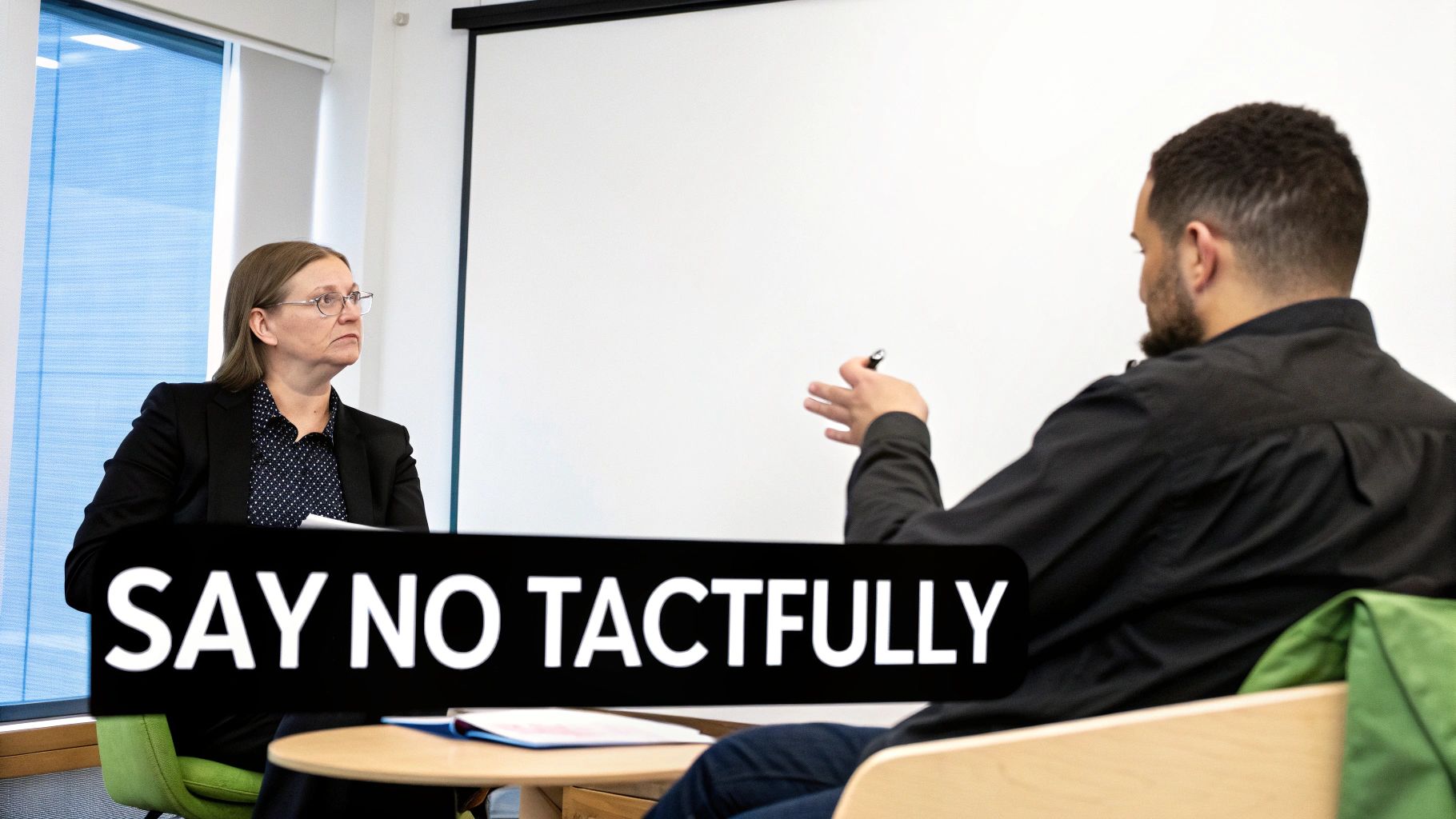
This isn't about picking fights. It’s about reframing the conversation from a yes/no into a collaborative discussion about trade-offs and shared goals. The secret is to align your "no" with the very same objectives the stakeholder already cares about.
Battle-Tested Scripts for Pushing Back
Having go-to responses in your back pocket is a game-changer. It pulls the emotional, in-the-moment pressure out of the equation.
Scenario 1: The Executive "Drive-By"
Your CEO hits you up on Slack: "Just saw a competitor launched an AI chatbot. We need that. When can we get it?"
A flat "no" is career suicide. A blind "yes" derails your entire quarter.
- Your Script: "That's a powerful idea, and I agree we need a strong play in AI. To do this right, it would require significant engineering resources. Right now, our team is fully focused on the checkout redesign, which is tied to our primary company OKR of increasing conversion by 15%. Can I add the chatbot idea to the Q3 backlog for validation and sizing? That way, we can make an informed decision on prioritizing it against our Q3 revenue goals."
Why It Works: You validate their idea so they feel heard. Then, you immediately connect your current work to a top-level company goal they absolutely care about. Finally, you redirect their request back into your established process without making them feel dismissed.
Scenario 2: The Sales-Led Feature Request
A sales leader insists a new, niche feature is critical to closing a massive enterprise deal. There’s immediate revenue on the line.
- Your Script: "I appreciate you bringing this to us; closing that deal is a huge priority. This feature isn't on our current roadmap, so building it now would mean pulling the team off the performance improvements project, which is set to reduce customer churn by 10% across our entire user base. Can we explore a workaround for this specific customer for now? Or, if this feature is a must-have, can we discuss the trade-off of delaying the churn project with the leadership team?"
Why It Works: You’re not just saying no; you’re framing the decision as a strategic choice between short-term revenue and long-term retention. By quantifying the trade-off, you elevate the conversation and force a business-level decision. This is a core skill for any PM trying to figure out how to influence without authority.
The "Yes, and…" Method
Sometimes, a hard "no" isn't the right move. The "Yes, and…" technique, borrowed from improv comedy, is an incredibly effective way to protect your scope while still coming across as a collaborative partner.
- Stakeholder: "We need to add social sharing buttons to every article."
- You: "Yes, and that's a great way to increase our content's reach. To get that into the current sprint, we'll need to push the bug fix for the slow-loading images to the next cycle. Given that page speed is a major focus this quarter, are we comfortable with that trade-off?"
This simple shift in language completely changes the dynamic. You are no longer the person saying no; you are the person presenting a clear choice with clear consequences.
Communicating effectively about your team's capacity is vital. This sometimes means using strategies for confidently declining meeting requests that can pull you and your team away from critical work. Protecting your team’s time is just as important as protecting the product scope itself.
Real-World Case Studies: The High Cost of Unchecked Scope
Theory and frameworks are great, but nothing drives the lesson home like seeing scope creep derail projects at world-class companies. When you're trying to convince a stakeholder that a "small ask" has real consequences, these stories become your most powerful tool.
Even the most innovative, well-funded organizations are vulnerable.
These aren't hypothetical scenarios. They are high-profile examples of how unchecked scope can introduce massive risk, delay launches, and burn through capital. They prove that no amount of talent or money can compensate for a lack of discipline in scope management.
Tesla Model 3: The Peril of Perpetual Optimization
Tesla's ambition with the Model 3 was monumental: bring a mass-market electric vehicle to the world. But the road to production was famously difficult, a period Elon Musk called "production hell." While many factors were at play, a subtle form of scope creep was a huge contributor.
Instead of locking down a design and mastering the manufacturing process for that specific build, Tesla continuously introduced changes on the fly. New features and ongoing "improvements" were fed into an already revolutionary and highly automated production line.
Each change, no matter how small, created a ripple effect. It meant re-tooling machinery, updating software calibrations, and changing quality checks, injecting chaos into what should have been a streamlined process.
The lesson for PMs is crystal clear: constant "improvements" during an active development cycle are never free. They introduce complexity and instability, turning a predictable sprint into a frantic scramble. This is a classic example of how unchecked scope directly creates technical debt. You can dive deeper into how to manage technical debt in our dedicated guide.
Amazon Prime Air: When Vision Outpaces Execution
Amazon's Prime Air drone delivery service is another fascinating case study in scope expansion. The initial vision was bold and clear, but as the project moved forward, the requirements began to balloon.
Teams reportedly kept adding to the list: greater payload capacity, longer flight range, and more advanced autonomous navigation. These weren't just simple feature adds; they were fundamental engineering challenges that pushed the project timeline out again and again.
Every new capability added layers of complexity, from new hardware needs to navigating a maze of regulatory hurdles. The result? A project that faced years of delays as the ever-expanding scope outpaced the team's ability to deliver a viable product.
These stories show how unmanaged scope can hamstring even the most visible, well-funded initiatives. It's why product managers absolutely must learn to push back constructively.
These aren't small startups we're talking about. Both companies had billions in market cap and world-class talent, yet scope creep still hammered their delivery timelines. In the software world, it's even more stark—one study found that unchecked scope creep can drive costs up to four times the initial budget. Exploring the broader impact of poor management and other common mistakes that can lead to startup failure provides a stark reminder of why this discipline is so critical.
Frequently Asked Questions About Scope Creep
As a PM, you'll start to hear the same questions about scope creep over and over. Getting your answers dialed in doesn't just make you look on top of your game—it’s a chance to teach your stakeholders how disciplined product development actually works.
Here are the most common questions I've fielded from my teams and execs over the years.
What Is the Difference Between Scope Creep and a Valid Scope Change?
This distinction is everything. It's the line between controlled adaptation and chaos.
A valid scope change is a conscious, formal adjustment. It comes through a proper channel (e.g., a Jira Change Request ticket), gets vetted for its impact on the timeline and budget, and is signed off on by key stakeholders. Most importantly, it always forces a trade-off discussion. We're choosing to add this, which means we're consciously choosing not to do that—or we're all agreeing to push the deadline.
Scope creep is the slow, silent killer. It's the accumulation of small, unvetted additions that sneak past the formal process—all those "while you're in there" or "can you just quickly add…" requests. Individually, they seem harmless, but together, they derail the project without anyone ever having that crucial trade-off conversation.
How Do I Prevent Scope Creep in an Agile Environment?
This is a classic one. Many people mistakenly think Agile's flexibility is an open invitation for chaos within a sprint. It's not. Agile is about adapting priorities between sprints.
The key to taming scope creep in an Agile world is to fiercely protect the sprint goal.
Once your team has committed to a set of deliverables for a sprint, that commitment needs to be sacred.
Any new requests that pop up mid-sprint don't get squeezed in. They go straight to the product backlog. This way, they can be properly groomed, sized, and prioritized against everything else during the next sprint planning. You maintain the team's focus while still letting the product evolve in a structured way.
How Do I Push Back When My Manager Is Causing Scope Creep?
This is easily one of the most delicate situations a PM can face. Pushing back on your own boss requires a careful mix of respect and hard data. Never make it about your opinion versus theirs. Frame the conversation around the business objectives you both share.
Ditch the flat "No, we can't do that." Shift to a collaborative, data-driven approach.
- Try this script: "I love that idea, and I can definitely see how it would add value. To build it the right way, the engineers estimate it'll add three weeks to our current timeline. That would unfortunately push our launch past the big Q3 marketing window. My recommendation is we slate this for our fast-follow release to make sure we nail our primary launch goal. Does that sound like the right priority call to you?"
This approach positions you as a strategic partner who's thinking about the bigger picture and downstream consequences, not just a project manager trying to protect a schedule.
What Are the Best Tools for Tracking Scope Changes?
The best tools are the ones your team is already living in every day. You don't need new software; you need more rigor in your existing setup.
-
Jira: Create a specific "Change Request" issue type. Customize the workflow to require mandatory fields like "Business Justification," "Impact Assessment," and "Stakeholder Approval" before an engineer can pick it up.
-
Asana: Set up a dedicated board for incoming requests. Use custom fields for RICE scores or T-shirt size estimates. This makes it easy to quickly sort and prioritize new ideas against the existing backlog.
-
Confluence or Notion: These are perfect for maintaining a central, transparent Change Log. This document becomes your single source of truth, recording every approved and rejected scope change along with the why behind each decision.
At Aakash Gupta, we believe that mastering skills like managing scope is what separates good Product Managers from the top 1% of leaders. For more actionable frameworks and career-advancing insights delivered weekly, check out the newsletter at https://www.aakashg.com.
