When your customer satisfaction scores are tanking, you don't have a quarter to fix it. As a Product Manager, this is a code-red signal that directly impacts retention, revenue, and—let's be honest—your career trajectory. This isn't about a six-month strategic overhaul. It's about a swift, diagnostic framework to find the friction, prioritize the biggest wins, and get high-impact fixes into your very next sprint.
Your 48-Hour Framework for Immediate Improvement
High CSAT, CES, and NPS scores aren't just vanity metrics for a dashboard; they are the vital signs of a healthy, user-centric product. Top-tier PMs at companies like Google and Meta treat these scores as leading indicators of future revenue. The good news? You can start making a meaningful difference in the next 48 hours with this actionable framework.

The core principle is simple but non-negotiable for any PM I'd hire: diagnose before you prescribe. Too many PMs jump straight to feature ideas without truly understanding the root cause of user frustration. Your first job is to become a tactical expert on what’s currently driving your users crazy.
Step 1: Conduct a Rapid Satisfaction Audit (Today)
Your first move is a quick, laser-focused audit of the qualitative data you already have. You're hunting for patterns—recurring themes that point to specific, fixable pain points. Don't try to boil the ocean. Aspiring PMs often get lost here. A senior PM focuses their energy on these three goldmines:
- Support Tickets: Jump into your CRM (like Zendesk or Intercom) and filter for tickets tagged with "bug," "complaint," or "feature request." What are the most common issues people have reported in the last 30-60 days?
- App Store Reviews: Go straight to your 1, 2, and 3-star reviews. What specific usability nightmares, crashes, or missing features are people screaming about over and over again?
- Session Recordings: Fire up a tool like FullStory or Hotjar and watch 10-15 recordings of users who churned or failed to complete a key action. You'll see exactly where they rage-clicked or just gave up and left.
This audit isn't about opinions; it's about evidence. It gives you the raw material you need to build a compelling, data-backed case for what to fix right now.
I've mentored dozens of PMs, and here's a hard truth: a well-documented summary of 20 support tickets all describing the exact same bug is infinitely more powerful in a planning meeting than a single executive’s gut feeling about what feature to build next.
It's also worth remembering that satisfaction is tied to the entire user experience. Small details matter immensely. Even basic things like strategic cleanliness to boost customer satisfaction scores can have a surprisingly large impact on perception and loyalty.
Step 2: Prioritize with an Impact/Effort Matrix (Tomorrow)
Once you have a list of friction points, you need to prioritize. My go-to tool for this is a simple Impact vs. Effort Matrix. Don't overcomplicate it.
Just plot each issue on a four-quadrant grid. The Y-axis is "Customer Impact" (High/Low), and the X-axis is "Engineering Effort" (Low/High).
Your prime targets are sitting in the High-Impact, Low-Effort quadrant. These are your quick wins. They’re the low-hanging fruit that can deliver a noticeable bump to your satisfaction scores in a single sprint.
And you need to move fast. Market data shows that 73% of consumers will jump ship to a competitor after just a few bad experiences. Even worse, more than half of your unhappy customers won't even complain—they'll just leave, silently chipping away at your revenue. This is the business reality of customer satisfaction.
Translating CSAT, CES, and NPS Into Actionable Product Strategy
Every aspiring PM knows you can't improve what you don't measure. But when it comes to customer satisfaction, just measuring isn't enough. Your primary instruments are the "big three": CSAT, CES, and NPS. Understanding them is table stakes; translating them into product strategy is what separates top-tier PMs from the rest. A Senior PM making $220k+ has mastered this.
These aren't just numbers for a dashboard. They are direct signals from your users, telling you exactly where your product shines and where it's causing real pain. Mastering how to decode and act on these signals is a fundamental career skill.
Decoding the Big Three Metrics
You'll primarily rely on three key quantitative methods to get a pulse on customer happiness. First is the Customer Satisfaction Score (CSAT), which is usually calculated as the percentage of customers rating their satisfaction a 4 or 5 on a 5-point scale. Then you have the Customer Effort Score (CES) to measure ease of use, and the Net Promoter Score (NPS) to gauge overall loyalty.
For a deeper look at these metrics, check out this great breakdown of customer satisfaction metrics on Omniconvert.com.
Think of them this way:
-
CSAT (Customer Satisfaction Score): This is your real-time, transactional pulse check. Use it right after specific, high-value interactions. Did a user just finish your onboarding flow? Hit them with a CSAT survey. Did they just get help from your support team? Perfect time to measure their immediate satisfaction. A low score here points to a very precise moment of friction.
-
CES (Customer Effort Score): CES answers one simple question: "How hard was it for the user to get their job done?" A high effort score is a massive red flag and a huge leading indicator of churn. Companies like Amazon obsess over this, engineering features like one-click ordering specifically to drive CES down. If users find your product difficult, they just won't stick around.
-
NPS (Net Promoter Score): This is your long-term relationship metric. It measures overall loyalty by asking how likely a user is to recommend your product. But the real gold isn't the score itself—it's the qualitative feedback from your Promoters and Detractors.
Your NPS comments are a pre-packaged backlog of your most impactful feature ideas and critical bug fixes. Detractors will tell you exactly what's broken, while Promoters will tell you what your 'magic moments' are so you can double down on them. This is free, high-quality user research.
From Scores to Strategy
Once the data starts rolling in, the real work begins. Your goal is to move beyond simply reporting scores and start driving actual product decisions. This almost always involves digging into feedback based on user groups. For aspiring PMs, learning this skill is critical for advancing to a mid-career role.
For a deeper dive on how to slice your data effectively, check out our guide on advanced customer segmentation techniques.
A great place to start is by segmenting your NPS feedback. We've put together a quick guide for Product Managers on how to turn this feedback into a concrete plan.
Actionable Strategies for Each Customer Segment
This table breaks down how PMs can approach each NPS segment—Detractors, Passives, and Promoters—to drive meaningful product improvements. You can apply this framework immediately.
| Segment (NPS) | Primary Goal | Actionable PM Strategy | Example Tactic |
|---|---|---|---|
| Detractors (0-6) | Triage & Retain | Address critical issues to prevent churn. Prioritize their feedback for bug fixes and major usability gaps. | Create an "Urgent Fixes" epic in Jira populated directly from Detractor feedback themes. |
| Passives (7-8) | Convert & Engage | Identify what's holding them back from being true fans. Their feedback often reveals "good enough" features that need a little push to become great. | A/B test a new feature idea that directly addresses a common theme from Passive comments, like simplifying a multi-step workflow. |
| Promoters (9-10) | Amplify & Empower | Understand what makes them love your product and double down on it. Use their insights to inform your core value proposition and marketing. | Launch a beta program for a new power-user feature and invite only your top Promoters to provide early feedback. |
This methodical approach—segmenting feedback and assigning clear goals—is how you turn abstract scores into a concrete, customer-centric action plan. It transforms raw data into a powerful tool for building a product that people genuinely love.
Using AI to Decode Customer Feedback at Scale
Manually sifting through thousands of app reviews, survey responses, and support tickets is a guaranteed way to miss the forest for the trees. The best PMs I know at places like Meta and Google just don't do it. Instead, they use AI as a force multiplier, giving them an almost unfair advantage in understanding their customers at scale. This is a non-negotiable skill for PMs in the 2024 job market.
Think of it this way: your key customer satisfaction metrics are all connected. You measure transactional satisfaction (CSAT) and how much effort something took (CES), and that granular data ultimately rolls up to influence overall brand loyalty (NPS).
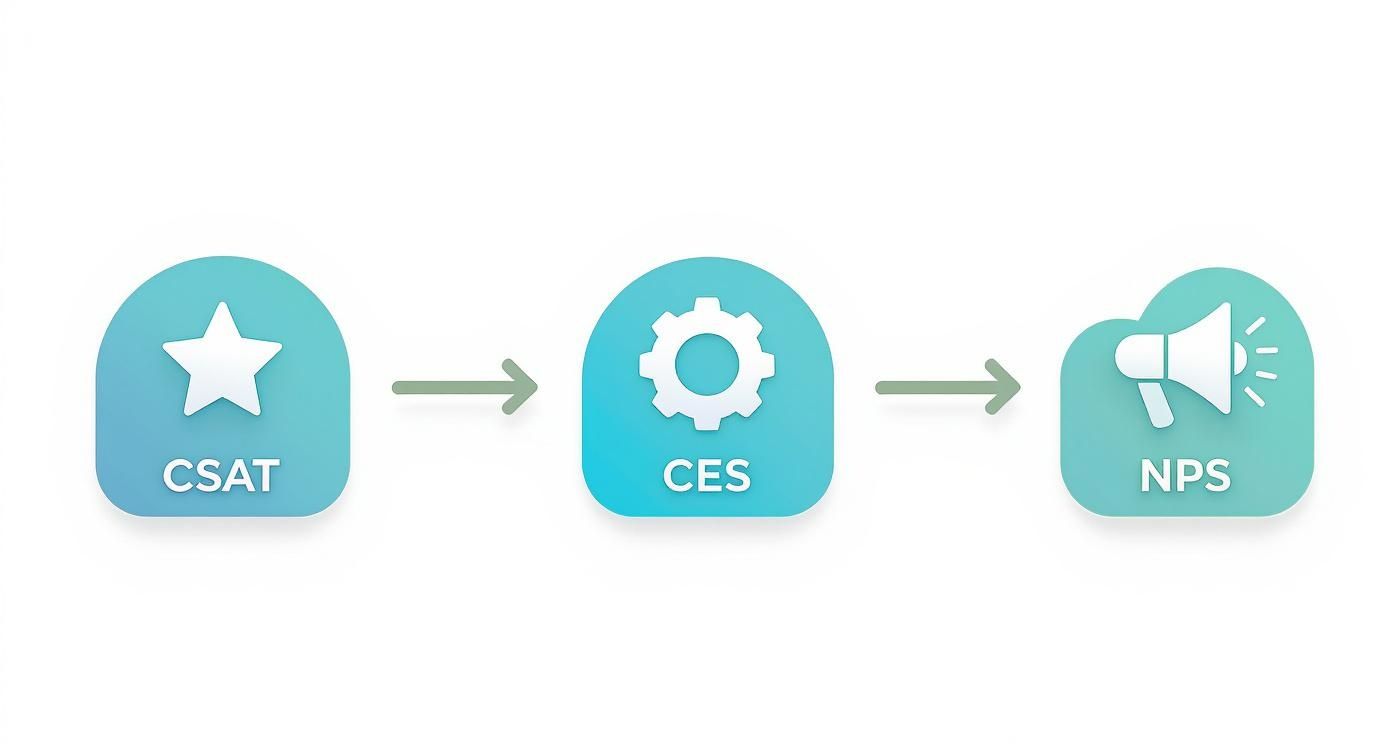
This shift to AI-powered analysis isn't just a trend; it’s a fundamental change in how we manage products. Top organizations predict that by 2025, 90% believe AI and automation will resolve 80% of customer issues without human intervention. That’s a massive move toward tech-enabled solutions that directly boost customer satisfaction and a skill you need to highlight on your resume.
AI Prompts for Instant Feedback Analysis
You don't need a data science team to get started. You can use LLMs like ChatGPT or Claude for powerful analysis right now. The secret is giving the AI a clear role, context, and a structured output format.
Here's a prompt I’ve actually used to quickly synthesize user feedback. You can copy and paste this into ChatGPT-4 today.
AI Prompt for Feedback Synthesis:
"Act as a Senior Product Manager at a B2B SaaS company specializing in project management software. You are an expert at synthesizing qualitative user data into actionable product insights.
I'm about to give you 100 pieces of raw user feedback from recent NPS surveys and Zendesk support tickets.
Your task is to:
- Identify the top 5 recurring themes or pain points. Name each theme (e.g., 'Integration Failures', 'UI Clutter', 'Slow Performance').
- Categorize each piece of feedback under one of those 5 themes.
- Assign a sentiment score (Positive, Neutral, or Negative) to each piece of feedback.
- For each theme, write a 2-sentence summary that clearly articulates the core customer problem and its likely business impact (e.g., "Users are frustrated by frequent API timeouts with our Jira integration, leading to broken workflows and likely churn risk for technical teams.").
- Present the final output in a markdown table with columns for: 'Feedback Snippet', 'Identified Theme', 'Sentiment', and 'Problem Summary'."
This kind of structured prompt turns a mountain of unstructured text into a prioritized list of problems you can solve. It gives you a clear path forward to improve your customer satisfaction scores.
Automating Your Feedback Loop
Once you've done this manually, the next step for a senior PM is automation. With tools like Zapier or Make, you can build a workflow that fires off every time new feedback lands.
Here’s a simple but incredibly effective workflow you can set up this week:
- Trigger: A new response is submitted in Typeform (for NPS) or a new ticket gets a specific tag in Zendesk.
- Action: The feedback text is automatically sent to the OpenAI API with a prompt just like the one above.
- Action: The categorized output (theme, sentiment, summary) is then pushed into a dedicated product team Slack channel and added as a new row in a Google Sheet for long-term trend analysis.
This creates a real-time "Voice of the Customer" feed, putting customer sentiment at the center of your team's daily conversations. If you're just starting out, there are plenty of great customer feedback analysis tools that can help you build this system.
Building a Customer-Centric Product Roadmap
High customer satisfaction scores don't happen by accident. They're the direct result of a product strategy that treats customer happiness as a core, non-negotiable feature. Your roadmap is where you turn feedback into shippable improvements. For mid-career PMs, influencing the roadmap is a key step toward a leadership role.
This means moving beyond tracking metrics. You must actively embed the voice of the customer into your planning process, making it a fundamental part of your development lifecycle.
Create a Voice of the Customer (VoC) Document
First, you need a single source of truth for all customer feedback. This is your Voice of the Customer (VoC) document. Think of it as a living synthesis of insights. It's not a data dump; it's a curated summary that tells a clear story about what your users need.
Your VoC document should pull from all over:
- Surveys: Key takeaways from the open-ended feedback in your NPS, CSAT, and CES surveys.
- Interviews: Direct quotes and recurring themes from one-on-one customer calls.
- Support Channels: Top ticket categories and friction points your support team is flagging.
- Reviews: Common complaints and praises you’re seeing on app stores and third-party sites like G2 or Capterra.
By centralizing these insights, you arm yourself with the qualitative evidence needed to champion customer-focused projects.
Championing Satisfaction in Roadmap Meetings
Now for the real challenge: convincing stakeholders. In roadmap meetings, you're competing against shiny new features that promise big revenue. This is where you connect customer happiness directly to business outcomes.
Don't just say, "Users are frustrated with the checkout flow."
Instead, frame it with data: "Our CSAT scores for checkout drop 30% right after the shipping entry step. FullStory recordings show a 15% abandonment rate at this exact point, representing a potential $50k in lost monthly revenue. Fixing this usability issue is our biggest lever to reduce churn this quarter."
When you can argue that fixing a 'small' usability bug has a bigger financial upside than building a 'big' new feature, you're doing your job as a PM. You're not just the voice of the customer; you're the voice of customer-driven revenue.
This approach changes the conversation from subjective opinions to a data-driven business case. You're making it clear that improving satisfaction isn't just about making people happy—it’s about protecting and growing the bottom line. This is just as critical as getting your initial user journey right. For a deeper dive on that, you can review these essential customer onboarding best practices.
Avoiding Common Customer Experience Pitfalls
It’s the question that keeps product leaders up at night: Why did our customer satisfaction scores suddenly hit a wall? You ship some great features, and then… flatline. The metrics stop moving up. This isn't usually a catastrophic failure. It's a death-by-a-thousand-cuts experience for your users.
I call this phenomenon "satisfaction debt." It’s the slow pile-up of minor annoyances, confusing UX choices, and inconsistent experiences. Each seems trivial, but together they silently chip away at user trust and drag your CSAT scores down. Learning to spot these warning signs is a crucial skill for senior PMs.
The Internal Experience Is the External Experience
One of the biggest blind spots for PMs is forgetting that what happens inside your company inevitably shows up on the outside. Your internal environment—your tools, your culture, your team's morale—directly shapes the customer's experience.
-
Weak Employee Experience: I've seen it firsthand. When support agents have to jump between five different systems just to process a simple refund, that delay and frustration get passed straight to the customer. You end up with longer wait times and agents who can't give a straight answer. Empowered teams just deliver better service.
-
Poor Technology Implementation: Rushing a new feature out the door without properly training your customer-facing teams is a recipe for chaos. If your own team doesn't understand how a new feature is supposed to work, how can they possibly help a customer who's struggling with it?
This isn't just a hunch; the data backs it up. The Forrester Global Customer Experience Index Rankings for 2025 flagged a worrying trend where 21% of brands actually saw their CX scores decline. A key reason? The direct link between a poor employee experience and clunky technology, which ultimately torpedoes the customer experience.
Maintaining Your Momentum
How do you avoid this slide into mediocrity? It takes a conscious, ongoing effort to keep the customer at the center of everything your team does.
Maintaining high satisfaction scores is about building a system, not just completing a project. You need to create durable feedback loops that constantly feed insights back into your development cycle.
To keep your scores climbing, you have to build customer-centric habits into your team's DNA. Here’s a checklist you can implement:
-
Celebrate Customer-Centric Wins: When a developer pushes a bug fix that came directly from a customer support ticket, post it in your team's main Slack channel. Mention it in the sprint retro. This reinforces the exact behavior you want to encourage.
-
Benchmark Against Competitors: Don't just read their blogs. Sign up for their free trials. Click through their onboarding flow. Contact their support with a question. Getting a feel for their experience is the fastest way to spot gaps and opportunities in your own. This is the kind of competitive analysis that hiring managers look for.
A huge part of preventing satisfaction debt is making sure your product is actually enjoyable to use in the first place. For a deeper dive, check out these ideas on building products users will actually love with good UX design and retention strategies. A positive core experience is your single best defense against the slow erosion of customer trust.
Your Top Questions, Answered
As you start putting all this into practice, some common questions pop up. Let's tackle the ones I hear most often from PMs at all levels. Getting these right separates PMs who successfully build customer-loved products from those who just can't seem to move the needle.
How Often Should We Measure CSAT and NPS?
It’s all about cadence and context. Your measurement frequency must match the feedback you're after.
-
Transactional CSAT: Measure this immediately after a key moment: support ticket closed, user finishes onboarding, or right after a purchase. You want to capture the feeling about that specific interaction while it's fresh.
-
Relational NPS: This is your big-picture loyalty metric. Send this out on a consistent, recurring schedule—usually quarterly or semi-annually. This is frequent enough to spot trends without spamming users.
The magic isn’t in a specific number of days, but in consistency. Tracking scores over time is how you'll prove your product changes are working and spot troubling dips before they become a five-alarm fire.
What's The Biggest Mistake PMs Make with CSAT?
Hands down, the single biggest mistake is obsessing over the score while ignoring the qualitative feedback behind it. Chasing a number is a fool's errand. An NPS of 35 is just a data point; the real gold is buried in the comments.
A PM who reads every single piece of Detractor feedback to understand the why is infinitely more valuable than one who just reports the top-line score in a meeting. The 'why' is where your next high-impact project is hiding.
Your job is to dig into the story the data is telling you. Interview your Promoters—find out exactly what they love so you can do more of it. And your Detractors? They're literally handing you a prioritized list of your product's most painful problems, for free. Don't let that gift go to waste.
How Do I Get Leadership Buy-In for Satisfaction Projects?
You reframe the conversation around a different kind of revenue: retained revenue.
You have to connect customer satisfaction directly to the hard business outcomes your leadership team loses sleep over, like churn and retention. Use data to make your case. Point to industry data showing that 73% of customers will jump ship to a competitor after just a few bad experiences.
Build a business case that contrasts the sky-high cost of acquiring a new customer with the much lower cost of keeping an existing one happy. Go a step further and calculate the Customer Lifetime Value (CLV) of your Promoters versus your Detractors. The difference is usually staggering.
When you can walk into a room and frame your pitch as, "This project will reduce churn by X% and increase our average CLV by Y," it's no longer a fuzzy "nice-to-have." It becomes a smart financial decision they can't afford to ignore.
At Aakash Gupta, my focus is on giving you the frameworks and career insights to tackle challenges just like this one. To go deeper on product strategy and leadership, check out my newsletter and other resources at https://www.aakashg.com.
