As a Product Manager, your ability to set the right price for a new product is one of the most critical, high-stakes decisions you'll make. Get it right, and you fuel growth for years. Get it wrong, and you can cripple an otherwise brilliant product before it ever has a chance.
This isn't about finding a magical number. It's about executing a defensible process that aligns with your company's core objectives. Leadership, Sales, and Marketing are all looking to you for a number and a compelling story behind it. This guide provides the tactical frameworks and real-world examples you need to build that story, get stakeholder buy-in, and launch with confidence.
Step 1: Define Your Core Objective (The First 15 Minutes of Any Pricing Discussion)
Before you touch a spreadsheet or analyze a single competitor, you must answer one question: Are we playing for market share or for profit?
Every single pricing decision flows from this. As an experienced PM leader who has hired and mentored dozens of PMs, I can tell you this is where junior PMs stumble. They dive into models without first anchoring to the strategic goal. Your job is to force this clarity.
This single decision immediately cuts your options in half and provides the "why" behind your strategy.
-
Market Penetration (Playing for Share): The goal is rapid user acquisition. You price aggressively—often at a loss initially—to build a user base, create network effects, and establish a foothold in a crowded market. This is the classic playbook for PLG (Product-Led Growth) companies. Think of how Slack used a dominant freemium model to become the default collaboration tool for millions, making it nearly impossible for competitors to gain traction.
- Career Context: Championing a penetration strategy shows leadership you understand scale and long-term defensibility. Aspiring PMs should study the unit economics of companies like Slack or Miro to understand this play.
-
Profit Maximization (Playing for Profit): The goal is to extract maximum revenue from early adopters who perceive immense value and are willing to pay a premium. The go-to tactic here is price skimming: launch high, then methodically lower the price over time to capture new segments. Apple is the undisputed master of this, launching new iPhones at a premium before introducing lower-cost models later in the cycle.
- Career Context: Executing a successful skimming strategy demonstrates your ability to tie product value directly to revenue, a skill highly valued in senior PM roles.
Your Decision Framework
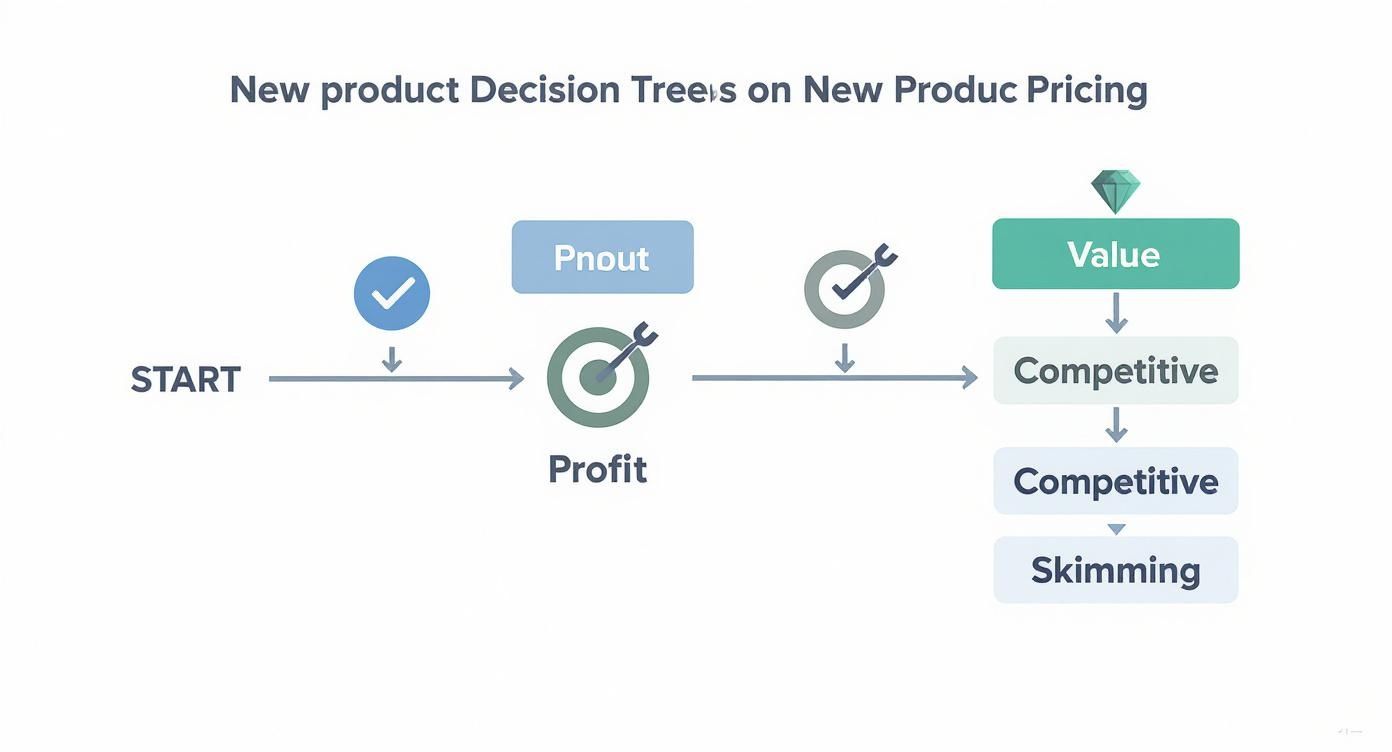
Use this flowchart to visually map your objective to a primary strategy. This isn't just a diagram; it's your first slide in your stakeholder presentation. It immediately shows that your pricing strategy for new products is deliberate and rooted in a clear business objective.
Actionable Quick-Selector Table
This table is your tactical cheat sheet. It connects your objective directly to the strategy and the KPIs you'll be held accountable for.
| Strategy | Primary Goal | Best For… | Key Metric to Track | PM Career Level Focus |
|---|---|---|---|---|
| Penetration | Rapid market share capture | Entering competitive markets; products with network effects. | Daily Active Users (DAU), Market Share %, CAC Payback Period. | Entry to Mid-Level (Growth Focus) |
| Skimming | Maximize early revenue | Innovative products with a strong, defensible moat. | Average Revenue Per User (ARPU), Gross Margin, Conversion Rates at each price point. | Mid-Level to Senior (P&L Ownership) |
| Value-Based | Align price with customer ROI | B2B SaaS delivering clear, quantifiable ROI. | Customer Lifetime Value (LTV), Net Revenue Retention (NRR), Churn Rate. | Mid-Level to Senior (Strategic Focus) |
| Cost-Plus | Ensure profitability per unit | Physical goods or commoditized services where costs are primary. | Gross Margin, Contribution Margin. | (Generally not recommended for software PMs) |
| Competitive | Position against rivals | Mature markets with established price anchors. | Price relative to key competitors, Win/Loss Rate against competition. | Entry to Mid-Level (Market Awareness) |
Step 2: Use Data to Define Your Market Position
Great PMs don't guess; they use data to build a defensible position. Launching without market data is malpractice. Your pricing must be anchored in the reality of your market, not internal spreadsheets or gut feelings.
Analyze Competitor Price History
Your competitors have spent years and millions of dollars educating the market. Use their history as a free lesson in what the market will tolerate.
- Steady Price Increases (e.g., Salesforce): This signals a healthy market with inelastic demand. Customers are locked in and see the value, giving you room to enter with a premium offering if your value proposition is strong.
- Frequent Discounts & Promotions (e.g., legacy software): This is a red flag for a commoditized market. Competitors are fighting on price. To win here, you need a radical cost advantage or a breakthrough feature set that justifies a higher price.
Leverage Adjacent Product Trends
No direct competitors? No excuse. Analyze pricing for complementary products or tools that solve a similar job-to-be-done for your target audience.
Real-World Example: When we were pricing a new AI-powered code completion tool, we didn't just look at other code assistants. We analyzed the pricing of CI/CD pipeline tools, cloud hosting platforms (like Vercel), and premium IDEs. Why? Because they all compete for the same developer team budget. This helped us understand our customers' overall willingness to pay for productivity gains. This is a core component of how to conduct market research effectively.
As a PM, your job is to become an expert on your market's perceived value. Analyzing historical pricing data isn't just about finding a number—it's about understanding the psychology of your buyer and the economic forces that shape their decisions.
Tools for Tactical Data Collection
Manual tracking is for amateurs. Top-tier PMs automate this to gain a strategic edge. Platforms like Prisync for e-commerce or Dataweave for broader market intelligence provide real-time competitor price tracking and historical analysis. These tools are no longer a luxury; they are a requirement for anyone serious about pricing. An investment of a few hundred dollars a month can save you from a multi-million dollar pricing mistake.
A dashboard like this moves you from being reactive to proactive, allowing you to anticipate market shifts instead of just responding to them.
Step 3: Select and Justify Your Pricing Model
You have your objective and your data. Now it's time to choose your model. This is where you demonstrate strategic thinking. The best PMs don't just pick a model; they articulate why it's the right choice over all other options.
Value-Based Pricing
This is the gold standard for most modern B2B SaaS. You anchor your price to the perceived or, ideally, the quantified value your product delivers.
How to Implement: If your new CRM feature saves a sales team 10 hours per rep per month, and the average fully-loaded cost of a rep is $75/hour, that's $750 in value per rep per month. Pricing your feature at $50/rep/month becomes an easy "yes." Your job is to build the ROI calculator and embed it in your sales and marketing collateral. HubSpot is a master of this, aligning their pricing tiers with tangible outcomes like lead generation and contact management scale.
Competitive Pricing
Here, you set your price relative to your rivals. This is common in mature markets where price expectations are already set (e.g., project management tools like Asana, Monday.com, Trello).
How to Implement: This is a positioning play. You can price slightly higher to signal premium quality, at parity to compete on features, or slightly lower to be the value leader. Warning: This is a dangerous model if you don't have a clear differentiator. It can easily lead to a price war and commoditization, a battle you likely can't win against incumbents.
Price Skimming
For truly innovative products with a strong competitive moat, price skimming is a powerful way to maximize revenue from day one. This is a classic pricing strategy for new products in hardware and deep tech.
How to Implement: Launch high to capture the innovators and early adopters. Use the high margins from this first cohort to fund further R&D and scale marketing. Then, over 6-18 months, strategically lower the price or introduce new, lower-cost versions to attract the early majority. Apple's iPhone launch strategy is the canonical example. This only works if your initial product has a significant, defensible advantage.
Penetration Pricing
The polar opposite of skimming. Here, you intentionally underprice (or offer a free version) to rapidly acquire market share and build network effects.
How to Implement: This is the heart of the PLG playbook. Slack's generous freemium tier allowed it to infiltrate millions of organizations, making it the de facto standard before competitors could react. The strategy is to acquire users first and monetize later through premium feature upsells. This model only works if your Customer Acquisition Cost (CAC) is near zero for free users and you have a crystal-clear conversion path to a paid plan.
Freemium and Tiered Pricing
A staple of SaaS, tiered pricing allows you to serve multiple customer segments with a single product. The key is to align each tier's features and limitations (the "value metric," e.g., number of seats, API calls, contacts) with a specific customer persona's needs.
How to Implement: A typical structure includes:
- Free Tier: For acquisition and product-led growth.
- Pro/Team Tier: For your core SME customer base, priced to be the main revenue driver.
- Enterprise Tier: Custom pricing for large organizations with needs like SSO, advanced security, and dedicated support.
Success hinges on understanding what features trigger an upgrade. A key metric to master here is the LTV/CAC ratio. For a deep dive, see our guide on how to calculate customer lifetime value. To stay on the cutting edge, explore new approaches like strategically pricing offers using AI.
Step 4: Get Stakeholder Buy-In (The Hardest Part)
A brilliant pricing strategy for new products is useless if you can't get Sales, Marketing, Finance, and Leadership to support it. As a PM, your job isn't just to find the price; it's to build the internal consensus required to launch successfully.
Build a Bulletproof Pricing Document
This is your single source of truth. It's not a slide deck; it's a defensible artifact that proves your recommendation is based on rigorous analysis.
Mandatory Sections:
- Executive Summary: Proposed price, core strategy (e.g., "Market Penetration via Tiered Freemium"), and expected business impact (e.g., "Achieve 10,000 MAUs in Q1").
- Market & Competitor Analysis: One-page summary of competitor pricing, positioning, and market trends.
- Customer Segments & Value Proposition: Define your ICPs and quantify the value your product delivers to each.
- Proposed Pricing Model & Rationale: Detail the chosen model, price points, and—most importantly—why you rejected other models.
- Financial Projections: Partner with Finance to model revenue, LTV, CAC, and gross margin. This shows you're thinking like a business owner, not just a feature builder.
Speak the Language of Your Stakeholders
Translate your strategy into the metrics each department cares about. A classic mistake junior PMs make is presenting a one-size-fits-all pitch.
A classic mistake PMs make is assuming everyone sees pricing through a product lens. Sales cares about commission, Marketing cares about lead volume, and Finance cares about margin. Your job is to connect your price to their success.
How to Talk to Sales
- Their Goal: Hitting quota and maximizing commission.
- Your Language: Focus on Average Contract Value (ACV) and deal velocity. Frame your price as, "This price point allows you to close deals 20% faster while maintaining a strong ACV, helping you blow past your quota."
How to Talk to Marketing
- Their Goal: Generating qualified leads and driving conversions.
- Your Language: Tie the price to lead generation and conversion rates. If using a freemium model, say: "This will be our single biggest lead magnet, projected to generate 5,000 PQLs per month."
How to Talk to Finance
- Their Goal: Profitability and predictable revenue.
- Your Language: Speak in terms of contribution margin, LTV to CAC ratio, and revenue forecasting. Show them the unit economics and how your model ensures long-term financial health.
How to Talk to Leadership
- Their Goal: Achieving strategic business objectives (market share, profitability).
- Your Language: Connect your pricing directly back to the high-level business goals they defined in Step 1. Frame it as, "Our penetration pricing strategy is the most direct path to achieving our board-mandated goal of capturing 15% market share within 24 months." Our guide on how to present to executives provides more frameworks for these critical conversations.
Step 5: Implement and Test Your Pricing Strategy
Your launch price is Version 1.0. The best PMs at companies like Netflix and OpenAI treat pricing with the same agile, iterative mindset they apply to product features. You must build a system for continuous optimization.
Run Agile Pricing Experiments
You need structured tests that provide clean, actionable data.
- A/B Testing on Pricing Pages: The gold standard for conversion optimization. Test price points, feature bundling, and value proposition copy. Show 50% of traffic a $29/mo plan and 50% a $35/mo plan to measure the direct impact on sign-ups.
- Van Westendorp Price Sensitivity Meter: A survey-based method perfect for beta users. It asks four key questions to identify an acceptable price range by mapping what customers consider "too cheap," "a bargain," "getting expensive," and "too expensive."
To help you select the right method, use this table:
Pricing Experimentation Methods
| Method | Best For | Complexity | Key Question Answered |
|---|---|---|---|
| A/B Testing | Optimizing a specific price point or package for conversion. | Medium | "Does Price A or Price B lead to more sign-ups?" |
| Van Westendorp Survey | Finding the acceptable price range in the pre-launch or early stages. | Low | "What price range do customers perceive as valuable but not too expensive?" |
| Conjoint Analysis | Understanding which features customers value most in a package. | High | "How much are customers willing to pay for Feature X vs. Feature Y?" |
| Monadic Testing | Gauging purchase intent for a single, complete pricing offer. | Low | "At this specific price with these features, how likely are you to buy?" |
For more ideas, explore some winning pricing strategies for sellers to see how tactical execution can make or break a launch.
Use AI for Quicker Insights
Leverage AI to accelerate your process. Use tools like ChatGPT to draft survey questions and analyze qualitative feedback.
Actionable AI Prompt:Act as a senior product manager at a B2B SaaS company. My new product is an AI-powered tool that automates financial reporting for small businesses. Generate a set of survey questions based on the Van Westendorp Price Sensitivity Meter methodology. Ensure the questions are clear, concise, and targeted at a non-technical audience of business owners.
This prompt gives you a methodologically sound starting point in seconds, freeing you to focus on analysis rather than survey design.
Build Your Pricing Iteration Roadmap
Your initial tests are just the beginning. The next step is to analyze results and plan future optimizations, just as you would for a product roadmap.
Cohort analysis is your most powerful tool here. By tracking groups of users who signed up at different price points, you can measure the long-term impact on LTV and churn. You might find that a higher price point had a slightly lower conversion rate but resulted in a 30% higher LTV because it attracted more committed customers. This is the kind of insight that gets you promoted.
Common Pricing Mistakes That Sink New Products
Learning from the failures of others is a hallmark of a senior PM. I've seen these same mistakes made repeatedly by otherwise talented product managers. Avoid them at all costs.
The Cost-Plus Pricing Trap for Software
This is the most common mistake for PMs transitioning from physical goods. You calculate your development and operational costs, add a profit margin, and set a price. This is fundamentally broken for software. Your customers do not care about your server costs. They care about the value you deliver. Pricing based on your costs instead of their value is a recipe for leaving millions on the table.
Anchoring Your Product as "Cheap"
Setting your launch price too low out of fear is a catastrophic, often irreversible error. It permanently anchors your product's perceived value in the bargain bin. Once the market perceives you as "the cheap option," it is nearly impossible to reposition as a premium, high-value solution later. Every future price increase will be met with intense customer backlash.
Misaligning Price and Value Metrics
Charging for the wrong thing is a subtle but deadly mistake. Your pricing metric (what you bill for—per user, per GB, per project) must be perfectly aligned with the primary value your customers derive from your product. If you charge per user, but the value comes from the volume of data processed, you have a critical mismatch. This misalignment creates friction and ensures your revenue does not scale as your customers' success grows.
New Product Pricing Strategy FAQ
Here are the most common questions I get from the PMs I mentor.
How Often Should We Revisit Our Pricing?
Pricing is not a "set it and forget it" task. For most SaaS products, conduct a formal pricing review at least annually. However, you should constantly monitor metrics and be prepared to act on key triggers:
- Major Product Updates: Shipping a significant new feature that delivers new value requires a price review.
- Market Shifts: A new competitor enters or an existing one changes its pricing.
- Poor Performance Metrics: A declining LTV/CAC ratio or a spike in churn are urgent signals that your pricing may be wrong.
What Is The Best Pricing Model For A New SaaS Product?
There is no single "best" model, but the most robust starting point for a new B2B SaaS product is value-based tiered pricing. This allows you to serve multiple segments, from startups to enterprises. Adding a freemium tier is a powerful PLG tactic, but only if your marginal costs are near-zero and you have a clear, compelling upgrade path.
How Do I Price A Product With No Direct Competitors?
This is a high-risk, high-reward scenario. Without market benchmarks, your focus must be 100% on the customer and the value you create. Do not default to a cost-plus model. Lean heavily on research methods like the Van Westendorp Price Sensitivity survey and in-depth customer interviews to quantify their perceived value. This data-driven approach is your only defense against pure guesswork.
Mastering pricing is a career accelerator for any Product Manager. For more frameworks and strategies used by top PMs at companies like Google and Meta, explore the resources at Aakash Gupta. Dive deeper into how you can lead your product to success at https://www.aakashg.com.
