Forget the 'CEO of the product' cliché. As a PM leader who has hired and mentored hundreds, from Associates at Google to VPs at high-growth startups, I’ve seen what separates the top 1% from the rest. It's not about having all the answers; it’s about mastering a core set of responsibilities and executing with precision.
This guide deconstructs the essential roles and responsibilities of a product manager, providing actionable frameworks you can use within 24 hours. We move beyond abstract theory to the concrete systems that drive career-defining products at companies like OpenAI and Meta. You'll get tactical advice you can apply immediately, whether you're trying to land your first PM role (average US salary: $110,000) or scaling a product organization as a Director of Product (average US salary: $195,000+).
This listicle isn't just a high-level overview. We will dive deep into the 10 non-negotiable functions of modern product management, outlining not just the what but the how. Expect to learn about:
- Translating Vision into Action: How to create and communicate a strategy that aligns engineering, design, and marketing using a one-page vision doc.
- Ruthless Prioritization: Applying frameworks like RICE to make high-stakes decisions with incomplete data.
- Influencing Without Authority: Using a "Triad" leadership model to lead cross-functional teams and manage stakeholder expectations.
- AI-Powered Product Management: Leveraging AI to accelerate discovery, data analysis, and technical scoping.
Each section is a practical, standalone guide to a core PM function, equipping you with the tools needed to excel in this demanding but rewarding career.
1. Defining and Communicating Product Vision and Strategy
At the core of all product management roles and responsibilities lies the ability to define and evangelize a compelling product vision. This isn't just a mission statement; it's the product's North Star. The vision articulates the future state you are trying to create, why it matters, and who it matters to. A powerful vision, like Airbnb’s "create a world where anyone can belong anywhere," serves as a guiding light that aligns every team, from engineering to marketing, and provides the context to make difficult trade-off decisions. Without it, a team is just a feature factory.
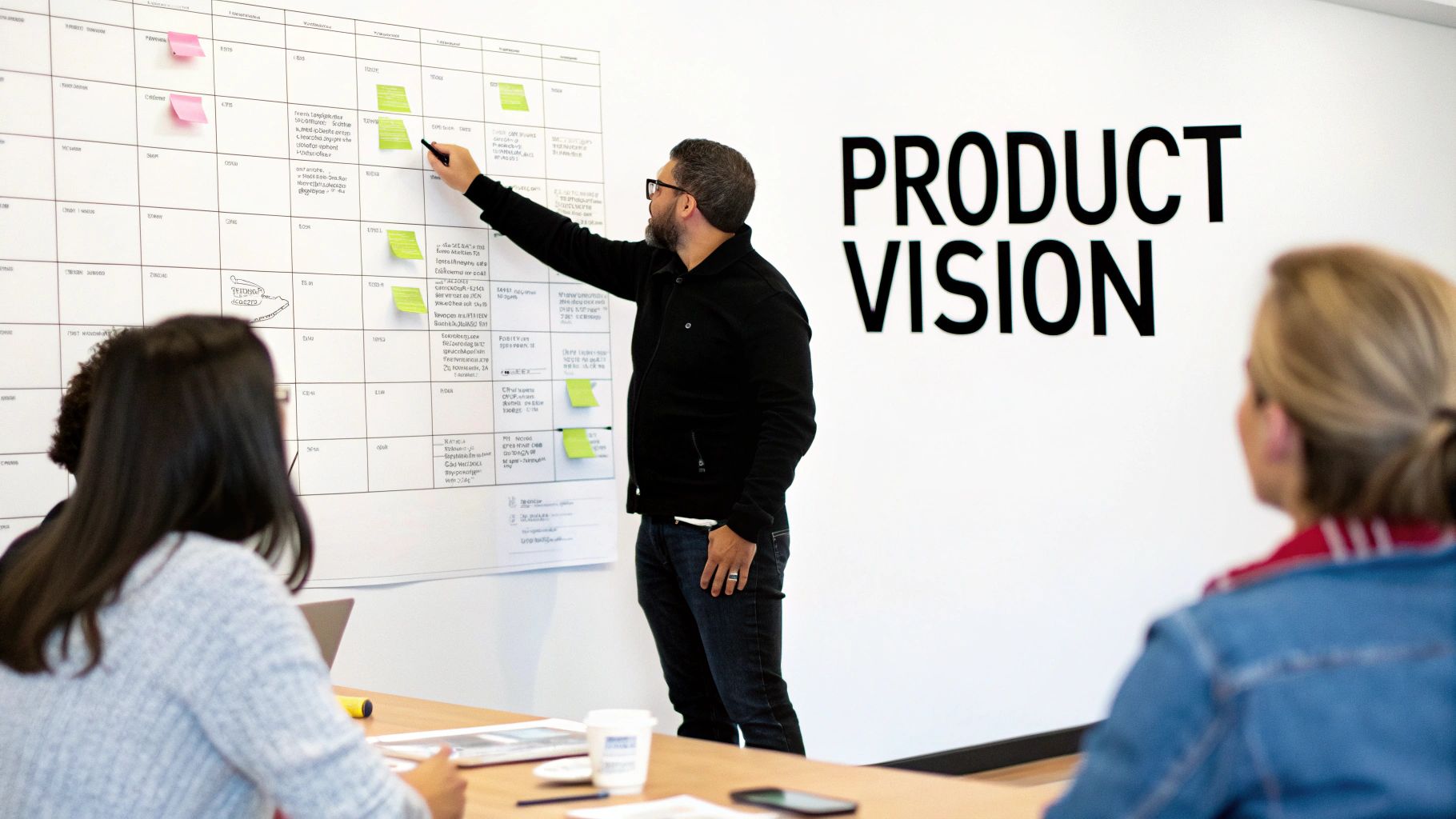
From this vision, a product strategy is born. The strategy is the high-level plan that outlines how you will achieve the vision, connecting it to measurable business objectives. It details the target market, key differentiators, and the sequence of major initiatives required to win.
Actionable Framework: The One-Page Vision Document
To make this a practical and repeatable process, follow these steps:
- Draft a One-Page Vision Document: Condense your vision into a single, memorable page using these headers:
- Target Audience: Who are we building for? Be specific (e.g., "Early-stage B2B SaaS founders," not "small businesses").
- Problem: What core, painful problem are we solving for them?
- Core Value Proposition: How do we uniquely solve that problem?
- Differentiators: What makes our solution 10x better than alternatives (including inertia)?
- Communicate Through Storytelling: Don’t just present bullet points. Craft a narrative around a user’s journey, showing how their life is improved by your product. People remember stories, not data points.
- Validate and Revisit Quarterly: A vision is not static. Set a recurring meeting every quarter to review market trends, user feedback, and competitive shifts. Ask: "Is our vision still relevant and ambitious?"
- Connect Vision to Daily Work: Explicitly link every new feature or initiative back to the vision during sprint planning. Constantly reinforce the "why" to maintain motivation and focus.
2. User Research and Discovery
One of the most critical roles and responsibilities of a product manager is to become the undisputed expert on the customer. This is achieved through rigorous and continuous user research. This process involves deeply understanding user needs, pain points, and behaviors through a mix of qualitative (interviews) and quantitative (product analytics) methods. Effective discovery, a core tenet of what is product discovery, ensures you are solving real problems, dramatically reducing the risk of building something nobody wants.

This responsibility is not about asking users what they want; it’s about uncovering the underlying jobs they are trying to get done. Spotify’s deep research revealed users wanted curated experiences for moments like "focusing at work," leading directly to their wildly successful personalized playlists.
Actionable Framework: The Continuous Discovery Cadence
To integrate this into your workflow, follow these steps:
- Establish a Continuous Discovery Cadence: Adopt a model like Teresa Torres' "Continuous Discovery Habits." Block 2-3 hours on your calendar every single week for customer conversations. Involve your design and engineering leads.
- Triangulate Your Data: Never rely on a single source. Combine qualitative insights from interviews (using tools like Dovetail) with quantitative data from product analytics (like Amplitude) and market surveys.
- Leverage AI for Synthesis: Accelerate your research by using AI. After an interview, upload the transcript to a tool like ChatGPT-4 and use this prompt:
Act as a senior product manager. Analyze this user interview transcript and identify the top 3 user pain points, user goals, and any direct feature requests or suggestions. Present the output in a markdown table. - Focus on Problems, Not Solutions: During interviews, resist pitching ideas. Instead, focus on past behaviors. Ask "Tell me about the last time you…" to uncover real-world context and unmet needs.
3. Prioritization and Roadmap Planning
A core function in the roles and responsibilities of a product manager is navigating the constant influx of ideas and requests. Prioritization is the strategic process of deciding what to build, when, and most importantly, what not to build. It transforms an endless backlog into a focused plan that maximizes value. This leads directly to the creation of a product roadmap, a high-level visual summary that aligns all stakeholders on the future direction. For a deeper dive, explore various product prioritization frameworks and strategies.
Effective prioritization is what separates high-performing teams from feature factories. It ensures engineering resources are invested in initiatives that directly support the product vision. Stripe’s early decision to ruthlessly prioritize its complex payment processing infrastructure over consumer features allowed it to build an incredibly robust platform—a direct result of strategic prioritization.
Actionable Framework: The RICE Prioritization System
To build a robust and transparent prioritization process, follow these steps:
- Adopt a Prioritization Framework: Use a consistent method like RICE (Reach, Impact, Confidence, Effort) to score initiatives objectively in a shared spreadsheet.
- Reach: How many users will this affect in a given period? (e.g., 500 customers/month)
- Impact: How much will this move the needle on our key metric? (Score 3 for massive, 2 for high, 1 for medium, 0.5 for low)
- Confidence: How sure are we about our estimates? (Score 100% for high, 80% for medium, 50% for low)
- Effort: How many "person-months" will this take? (e.g., 2 engineers x 1 month = 2)
- RICE Score = (Reach x Impact x Confidence) / Effort
- Communicate the "Why" and the "Why Not": When you share your roadmap, spend as much time explaining what is not being worked on and why. This proactively manages stakeholder expectations.
- Balance Your Portfolio: A great roadmap isn't just new features. Ensure it includes a mix of strategic bets (growth), quick wins (customer delight), and tech debt (platform health).
- Build in Buffer Capacity: Allocate roughly 20% of your team's capacity for inevitable urgent bugs or small high-priority requests. This prevents your strategic roadmap from being constantly derailed.
4. Cross-Functional Collaboration and Stakeholder Management
Product management is a role of influence, not authority. A critical responsibility is orchestrating diverse teams—engineering, design, marketing, sales—toward a common goal. Effective collaboration means transforming a group of specialists into a cohesive product team. It’s ensuring that engineering insights on feasibility, design perspectives on user experience, and marketing's understanding of market positioning all inform key decisions. For a deeper dive, see these guides on developing critical cross-functional collaboration skills.
Stripe’s renowned platform quality is a direct result of its deep, trust-based collaboration between product and engineering, where both are equally responsible for the customer outcome. Without this skill, even the best strategy will fail.
Actionable Framework: The Product Triad and Communication Plan
To build strong partnerships, integrate these practices:
- Establish a "Triad" Leadership Model: Form a core leadership group with yourself (product), a design lead, and an engineering lead. Make all major product decisions collectively within this triad, presenting a united front. This prevents silos.
- Create a Stakeholder Communication Plan: Map all key stakeholders by influence and interest. Define a clear, proactive communication cadence for each in a simple spreadsheet:
- Stakeholder: VP of Sales
- Influence/Interest: High/High
- Communication Method: Bi-weekly 15-min sync
- Purpose: Share roadmap updates, gather customer feedback from the sales team.
- Lead Through Shared Objectives: When conflicts arise, re-center the conversation on the shared goal or the user problem. Frame disagreements as a collective challenge, not a battle between functions.
- Invest in Relationships Proactively: Schedule regular, informal 1-on-1s to understand stakeholder goals and pressures. This builds social capital that becomes invaluable during high-stakes negotiations.
5. Data Analysis, Monitoring and Optimization
Elite product management is fundamentally data-informed. This responsibility involves defining success in measurable terms, tracking product health, and using quantitative insights to drive continuous improvement. A PM who masters data can move conversations from "I think" to "the data shows." This is about transforming raw data into a clear story about user behavior, product performance, and business impact. Learn more about data-driven decision-making for product teams.
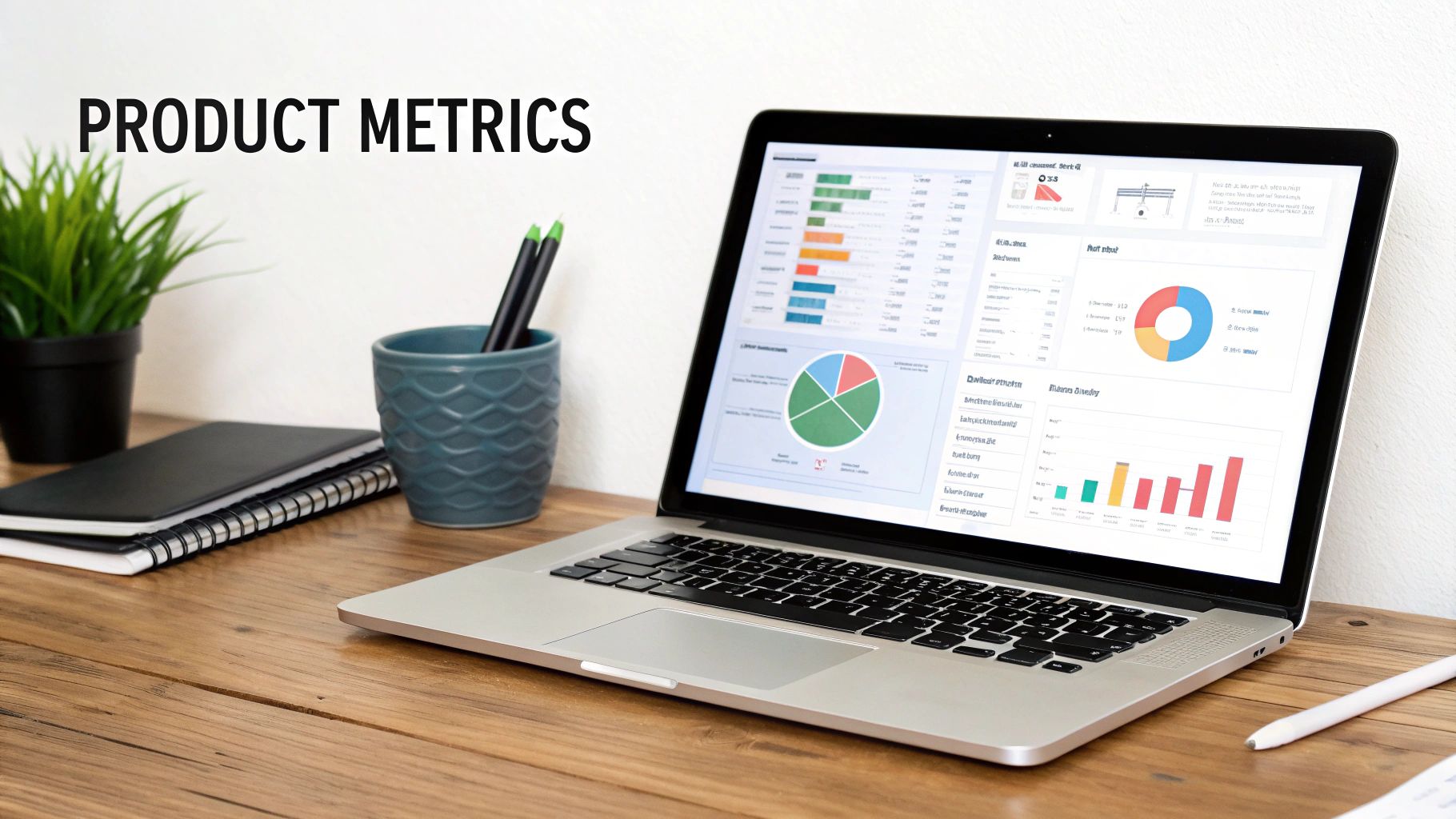
This process starts with selecting the right Key Performance Indicators (KPIs). For instance, Netflix's obsessive focus on viewing hours and retention rates directly shapes its massive investment in content. Duolingo's "streak" metric became a core behavioral driver, hardwired into the product to foster daily engagement.
Actionable Framework: The Metrics Hierarchy & Experimentation Loop
To build a robust data practice, follow these steps:
- Establish a Metrics Hierarchy:
- North Star Metric: The single metric that best captures the core value your product delivers (e.g., "Weekly Active Users" for a social app).
- Driver Metrics: 3-5 key metrics that directly influence your North Star (e.g., New User Sign-ups, Day 1 Retention, Message Send Rate).
- Implement a Product Analytics Stack: Use advanced product analytics tools like Amplitude or Mixpanel to enable deep funnel analysis, cohort tracking, and user segmentation without requiring constant engineering support.
- Create a Centralized Dashboard: Build a performance dashboard in a tool like Looker or Tableau that is visible to everyone. Schedule a recurring meeting to review trends and discuss insights.
- Run Hypothesis-Driven Experiments: Don't just make changes; test them. Formulate a clear hypothesis (e.g., "Changing the CTA button color from blue to green will increase sign-ups by 5% because it has higher contrast"). Use A/B testing frameworks to validate or invalidate your assumptions.
6. Feature Definition and Technical Fluency
A critical role for a PM is guiding the technical development process. This is more than writing user stories; it's making informed trade-offs on scope, timeline, and technical debt. A PM must possess sufficient technical fluency to engage in meaningful dialogue with engineers, grasp the implications of system design choices, and build credibility. For a PM working on an AI product at a company like OpenAI, understanding concepts like model training, inference latency, and API design is non-negotiable.
While PMs are not expected to code, they must understand the "how" well enough to influence the "what" and "when." This technical literacy prevents the PM from becoming a mere conveyor of requirements and transforms them into a true strategic partner to their tech lead.
Actionable Framework: The Technical Scoping System
To build and leverage technical fluency, integrate these practices:
- Invest in Continuous Technical Education: You don't need a CS degree, but you must be proactive. Enroll in a course like "AI For Everyone" by Andrew Ng ($49 on Coursera) or Reforge's 'Technical Acumen for Product Managers' (approx. $1,995).
- Create a System Architecture "Cheat Sheet": Work with your tech lead to map out your product's architecture on a single page. Understand the key services, data flows, and dependencies.
- Dedicate Roadmap Capacity for Tech Debt: Formally allocate 20% of each development cycle to address technical debt. This is essential for long-term product health.
- Use AI for Technical Exploration: Leverage AI tools to draft technical specs or understand complex concepts. Use a prompt like:
I am a Product Manager building a feature that allows users to upload a video and receive a text transcript. Explain the key technical components required (e.g., file storage, transcoding, speech-to-text API). List the pros and cons of using a third-party API like AssemblyAI vs. building it in-house.
7. Customer Feedback Loop and Iteration
One of the most critical roles and responsibilities of a product manager is to build a system grounded in real user needs. This is achieved by establishing a continuous customer feedback loop. This isn’t just collecting feature requests; it’s a disciplined process for gathering data, synthesizing insights, and channeling those learnings directly into the development cycle. A robust feedback loop ensures the team is solving actual problems.
This responsibility transforms a product team from a feature factory into a learning engine. Slack’s early success was driven by its obsessive focus on user feedback, rapidly iterating on core features based on how its initial customers were actually using the tool.
Actionable Framework: The Centralized Feedback System
To build an effective and scalable feedback loop, follow these steps:
- Create a Centralized Feedback Repository: Use a tool like Productboard ($20/mo) or a structured Airtable base to aggregate feedback from all channels: customer support tickets (Zendesk), sales calls (Gong), NPS surveys, and social media. This allows for pattern recognition.
- Distinguish "What" from "Why": When a user requests a feature (the "what"), your job is to dig deeper to understand the underlying problem (the "why"). This focus on core needs often reveals more elegant solutions.
- Conduct Post-Launch Reviews: After shipping a feature, schedule a formal review. Compare expected outcomes (your hypothesis) with actual results (analytics). Document what you learned to inform future decisions.
- Use Feature Flags for Controlled Rollouts: Use a tool like LaunchDarkly to release new features to small, specific user segments before a full launch. This allows you to gather real-world feedback with minimal risk.
8. Go-to-Market Strategy and Product Launch
Building a great product is only half the battle. One of the most critical roles and responsibilities of a product manager is to own the go-to-market (GTM) strategy and orchestrate a flawless launch. This strategy is the comprehensive plan for how the product will reach and win over the target audience, encompassing positioning, messaging, pricing, and distribution channels. A powerful GTM ensures that the value you’ve built is clearly communicated.
A well-executed launch creates crucial early momentum. Consider Slack's legendary freemium GTM, which turned the product itself into the primary marketing engine, driving viral, bottom-up adoption. The PM is the cross-functional leader who ensures that product, marketing, sales, and support are perfectly synchronized.
Actionable Framework: The Launch T-Minus Checklist
To build a robust GTM strategy, follow this checklist:
- T-8 Weeks: Develop GTM Canvas: Use a one-page GTM canvas to define key elements: target customer segments, value proposition, key messaging pillars, pricing, and distribution channels.
- T-6 Weeks: Create Cross-Functional Launch Plan: Document every launch activity, owner, and deadline in a shared tool like Asana. This "run of show" should cover pre-launch, launch day, and post-launch activities.
- T-4 Weeks: Arm Your Teams:
- External: Prepare a press kit with approved messaging, screenshots, and company information.
- Internal: Create a comprehensive FAQ document that anticipates questions from sales, support, and marketing to ensure consistent communication.
- T-2 Weeks: Define and Track Launch KPIs: Establish clear success metrics before launch (e.g., achieve 500 new user sign-ups in week 1, 15% adoption of the new feature). Monitor these metrics closely post-launch.
9. Competitive Analysis and Market Intelligence
A product manager's responsibilities extend beyond their own product; they must be the foremost expert on the market. This involves systematically gathering and analyzing information about competitors, market trends, and adjacent industry shifts. This intelligence is not about reactively copying features; it’s about proactively understanding the ecosystem to inform product strategy.
Effective market intelligence prevents building in a vacuum. Zoom recognized that while Skype was dominant, its UX was clunky for business meetings. By understanding this weakness, Zoom focused on simplicity and performance, creating a significant market opening. A modern PM at Meta must be intimately aware of TikTok's algorithm and Snapchat's AR advancements to inform the Instagram roadmap.
Actionable Framework: The Competitive Intelligence System
To integrate this responsibility into your workflow, follow these steps:
- Establish a Competitive Tracking System: Use a tool like Crayon or a simple Notion database to track key competitors. Regularly update their pricing changes, feature releases (use their RSS feed), marketing campaigns, and even job postings (which signal future strategy).
- Analyze User Sentiment on Competitors: Don't just look at what competitors build; analyze how their customers feel. Scour G2, Capterra, Reddit, and social media to find pain points and opportunities.
- Differentiate Between Threat Types: Categorize competitors as direct (solving the same problem for the same audience), indirect (solving the same problem for a different audience), or potential (could enter your market).
- Share Insights, Not Mandates: Disseminate findings in a digestible format, like a monthly "Market Pulse" newsletter or a dedicated Slack channel. Frame the information as context, not a directive to copy.
10. Leading and Developing Product Teams
As PMs advance to senior roles (e.g., Group PM, Director), their focus shifts from direct product ownership to multiplying their impact through others. Building and leading high-performing product teams is a critical responsibility that defines an organization's long-term success. This involves cultivating a culture of innovation, providing mentorship, and creating an environment where PMs can do their best work.
Satya Nadella’s cultural transformation at Microsoft is a prime example, where he shifted the focus to a growth mindset, empowering leaders to foster learning and customer obsession. This function is essential for scaling innovation and ensuring the entire product portfolio aligns with the company's strategic goals.
Actionable Framework: The Team Development System
To build and lead an effective product team, focus on these practices:
- Treat Hiring as a Product: Define clear competencies and create structured interview loops. A sample job posting from a top tech company for a Senior PM role might list:
- 5+ years of product management experience with a track record of shipping successful B2B SaaS products.
- Experience working on AI/ML-powered products is a strong plus.
- Deep technical understanding of API design and platform ecosystems.
- Implement a Structured Onboarding Program: Develop a 30-60-90 day plan that transfers your team's mental models, introduces them to key stakeholders, and provides deep dives into the product, market, and user base.
- Establish a Rhythm of Feedback: Adopt a framework like Kim Scott's Radical Candor. Schedule weekly one-on-ones focused on coaching and career development, not just status updates.
- Define Career Progression: Clearly document the career ladder for your PMs. Set explicit expectations for what "great" looks like at each level (Associate PM, PM, Senior PM) to empower them to own their progression.
Product Manager Roles & Responsibilities: 10-Point Comparison
| Activity | Implementation Complexity 🔄 | Resource Requirements ⚡ | Expected Outcomes ⭐📊 | Ideal Use Cases 💡 | Key Advantages ⭐ |
|---|---|---|---|---|---|
| Defining and Communicating Product Vision and Strategy | High — cross‑org alignment, market research 🔄 | Medium — leadership time and research budget ⚡ | Clear strategic direction; better decision speed ⭐📊 | New product lines, strategy resets 💡 | Unifies teams; secures buy‑in and resources ⭐ |
| User Research and Discovery | Medium — method mix and synthesis 🔄 | High — participant recruitment, tools, researcher time ⚡ | Validated needs; reduced product risk ⭐📊 | Early‑stage discovery, feature validation 💡 | Evidence‑based decisions; stronger user empathy ⭐ |
| Prioritization and Roadmap Planning | Medium — frameworks + stakeholder negotiation 🔄 | Low–Medium — PM time and cross‑functional input ⚡ | Focused execution; predictable delivery ⭐📊 | Backlog management; aligning stakeholders 💡 | Maximizes impact; clarifies trade‑offs ⭐ |
| Cross‑Functional Collaboration and Stakeholder Management | High — relationship building and facilitation 🔄 | Medium — meeting cadence, facilitation effort ⚡ | Aligned teams; fewer handoff issues ⭐📊 | Matrixed orgs, complex multi‑team projects 💡 | Diverse expertise; reduced rework ⭐ |
| Data Analysis, Monitoring and Optimization | High — instrumentation and analytics pipelines 🔄 | High — engineering, analytics tools, analysts ⚡ | Measurable gains; evidence‑driven growth ⭐📊 | Growth optimization, scale‑stage products 💡 | Decisions backed by data; continuous improvement ⭐ |
| Feature Definition and Technical Fluency | Medium — scoping, feasibility and trade‑offs 🔄 | Medium — engineering collaboration and learning time ⚡ | Realistic timelines; maintainable architecture ⭐📊 | Technical products, complex integrations 💡 | Stronger engineering trust; fewer surprises ⭐ |
| Customer Feedback Loop and Iteration | Medium — feedback channels and synthesis process 🔄 | Low–Medium — support channels, analytics, PM time ⚡ | Faster issue detection; iterative refinements ⭐📊 | Post‑launch tuning, PMF testing 💡 | Responsive evolution; increased user loyalty ⭐ |
| Go‑to‑Market Strategy and Product Launch | Medium — cross‑functional GTM planning 🔄 | High — marketing, sales enablement, launch spend ⚡ | Faster adoption; revenue acceleration ⭐📊 | New launches, market entry, re‑positioning 💡 | Maximizes uptake; aligns commercial teams ⭐ |
| Competitive Analysis and Market Intelligence | Low–Medium — continuous monitoring and synthesis 🔄 | Low — research tools and analyst time ⚡ | Informed positioning; opportunity spotting ⭐📊 | Market shifts, strategic positioning decisions 💡 | Early threat detection; tactical differentiation ⭐ |
| Leading and Developing Product Teams | High — hiring, coaching, culture development 🔄 | High — recruiting, onboarding, training investment ⚡ | Scaled capability; higher retention ⭐📊 | Scaling organizations; leadership roles 💡 | Multiplies impact; sustainable organizational growth ⭐ |
Integrating These Roles into Your Daily Workflow
We've deconstructed the ten core pillars that define the modern PM. The roles and responsibilities of a product manager are a dynamic blend of art and science, requiring strategic foresight, deep user empathy, technical fluency, and exceptional communication.
The most common pitfall is viewing these responsibilities as a checklist. In reality, they are an interconnected, iterative cycle. A powerful GTM strategy is built on rigorous user research. A well-prioritized roadmap is meaningless without strong cross-functional collaboration. Mastering this role isn't about mastering ten separate domains; it's about becoming a master integrator who drives product success and business impact.
From Theory to Daily Practice: Your Action Plan
The difference between a good PM and a great one—the kind leading teams at OpenAI or scaling the next unicorn—lies in deliberate practice and systemization. Knowing you should do competitive analysis is different from building a repeatable system to gather and disseminate market intelligence. It's time to translate knowledge into career-advancing habits.
Your First 30-Day Challenge:
- Week 1: Deepen User Empathy. Block five hours on your calendar this week for user engagement. This could be three 45-minute user interviews, analyzing session recordings in FullStory, or reviewing support tickets. Your goal is to generate and share one surprising user insight with your engineering and design leads by Friday.
- Week 2: Formalize Your Prioritization. Take your current backlog and apply a formal prioritization framework like RICE. Document your scoring and rationale for the top three initiatives. Share this with a key stakeholder for feedback, explicitly explaining why you chose this method.
- Week 3: Enhance Stakeholder Communication. Identify your most critical stakeholder not on your immediate team. Schedule a 30-minute sync to proactively share your team's progress and upcoming priorities. Ask them, "What information would be most helpful for me to share with you regularly?" This builds immense trust.
- Week 4: Leverage AI for Strategy. Pick one feature your team is building. Use an AI tool with this prompt:
Act as a senior product strategist. For a feature that [describe feature], write a one-page document connecting it back to a product vision of [state your vision] and the company’s strategic goal of [state your goal]. Quantify the expected impact using these key metrics: [list metrics].This sharpens your strategic thinking.
This structured approach transforms the abstract list of roles and responsibilities of a product manager into a concrete development plan. The goal isn't perfection overnight; it's to be demonstrably more effective every quarter. This relentless focus on operational excellence is what truly defines a top-tier product leader.
For PMs committed to mastering these skills, the newsletter by Aakash Gupta is an invaluable resource. He breaks down complex product challenges into actionable guides that directly map to the roles we've covered, helping you accelerate your career growth.
